
The last time I approached that Old Dark House – the titular edifice of a 1932 Hollywood thriller directed by the queer English filmmaker James Whale and founded on a novel by the English social critic J. B. Priestley—my eyes were not focussed on any particular visual detail. I was remarking generally on the house as a concretization of Priestley’s views on the condition of Britain after the so-called Great War, as the film and its source, Priestley’s Benighted (1927), are often understood: Interwar Britain as an empire haunted by its past and a kingdom lacking a vision as unifying as the largely unchallenged rule of its alleged heyday.

Not that British moviegoers, let alone US American audiences, would have considered this perspective, partially obscured by the retitling of the property, as being essential to the experience of the fun house-ghost train atmosphere the film conjures. Sure, the house, with its shadowy corridors, massive oaken doors and branching staircases, is as ill-lit as any old Gothic-fictional castle; but the unenlightened ones at the heart of this picture are its denizens, the backward, dim-witted and intractable Femms in whose midst we, along with a small group of unfortunate travelers, find ourselves.
Nominally presided over by Sir Roderick Femm, a recumbent shut-in of a redundant patriarch, the household is run by a cantankerous zealot, Rebecca Femm, who, as the dark angel of the house, has mastery as well over her eccentric but meek brother Horace, a skeleton in search of a closet in which he would much rather hide from his brother Saul. The latter is a pyromaniac who, like Jane Eyre’s Bertha Mason, is kept under lock and key in the attic, where he is meant to be looked after by Morgan, a deaf-mute brute of a servant who runs amok when inebriated.
The idiosyncrasies of this delightful family group notwithstanding, their gloomy abode, cut off as it is from the world by water, in sublime isolation, has been read as “a metaphor … for England,” despite the fact that the scene is set in what one of Priestley’s English characters refers to as “wildest Wales.” Just as otherness is made manifest in the rocks and sliding mud, the forbidding terrain of the mythical Wild West of Britain, benightedness is a figure of speech rendered figurative and representational in The Old Dark House.
The rules of the old Welsh homestead are certainly bewildering to the motley group of English intruders – Mr. and Mrs. Waverton, a bickering but loving couple; their friend, Mr. Penderel, a disillusioned dreamer; Sir William Porterhouse, a working-class Northerner who worked himself up in the world; and his companion, Gladys, a London chorus girl on her uppers—seeking shelter from a storm and finding themselves greeted with arms decidedly more folded than open.
“No beds!” Rebecca Femm repeatedly snarls at the strangers as she flits about with a flickering candle in her hand: “I’ve none of this electric light.” Considering that the house is home to a firebug, this rejection of modern conveniences proves hazardous to the past that is meant to be kept alive as a secret.
Darksome as the house may be, it is the play with unstable light that lends the proceedings an air we might with some justice call gothic. Metaphorically inclined, I was reminded of a study dimly recalled from my New York undergraduate days: The Mirror and the Lamp: Romantic Theory and the Critical Tradition (1953) by M.H. Abrams, who, incidentally, died at 102, which is Sir Roderick’s age in The Old Dark House.
Setting up his argument, Abrams explains that the
title of the book identifies two common and antithetic metaphors of mind, one comparing the mind to a reflector of external objects, the other to a radiant projector which makes a contribution to the objects it perceives. The first of these was characteristic of much of the thinking from Plato to the eighteenth century; the second typifies the prevailing romantic conception of the poetic mind.
Abrams “attempted the experiment of taking these and various other metaphors no less seriously when they occur in criticism than when they occur in poetry; for in both provinces the recourse to metaphor, although directed to different ends, is perhaps equally functional.”
Read in this light, the modally gothic nature of The Old Dark House can be appreciated as the attempt of its writer, J. B. Priestley, an author who did not habitually dwell in the demesne of the neo-Gothic or dark Romantic, to redefine, reimagine and realign the boundaries of romance and realism. James Whale, a director of motion pictures as diverse as Journey’s End, Frankenstein and Show Boat, visually expands on this.
The feat deftly accomplished by the adaptation, which—with the major exception of its soft Hollywood ending—renders its source with remarkable fidelity, is not only the translation of metaphoric benightedness. The Old Dark House playfully subverts the mirror and lamp binaries, traditional views predicated on the simplistic notion of mirrors as accurate reflections and lamps as furnishings in the reliable service of shedding light on matter.
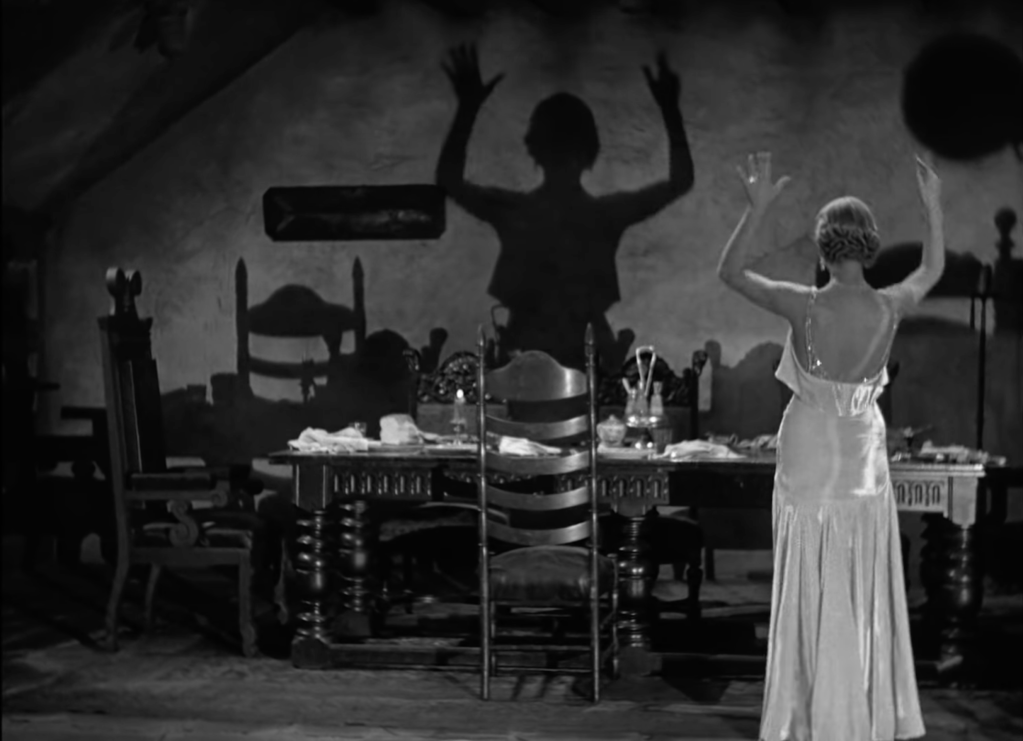
I previously referred to as the plot as a “Phantasmagoria” staged by the intruding English. Uneasy as she may be about the spending a night in the presence of Morgan, Mrs. Waverton, briefly left to her own devices, takes a childlike delight in performing shadow puppetry for her own amusement.
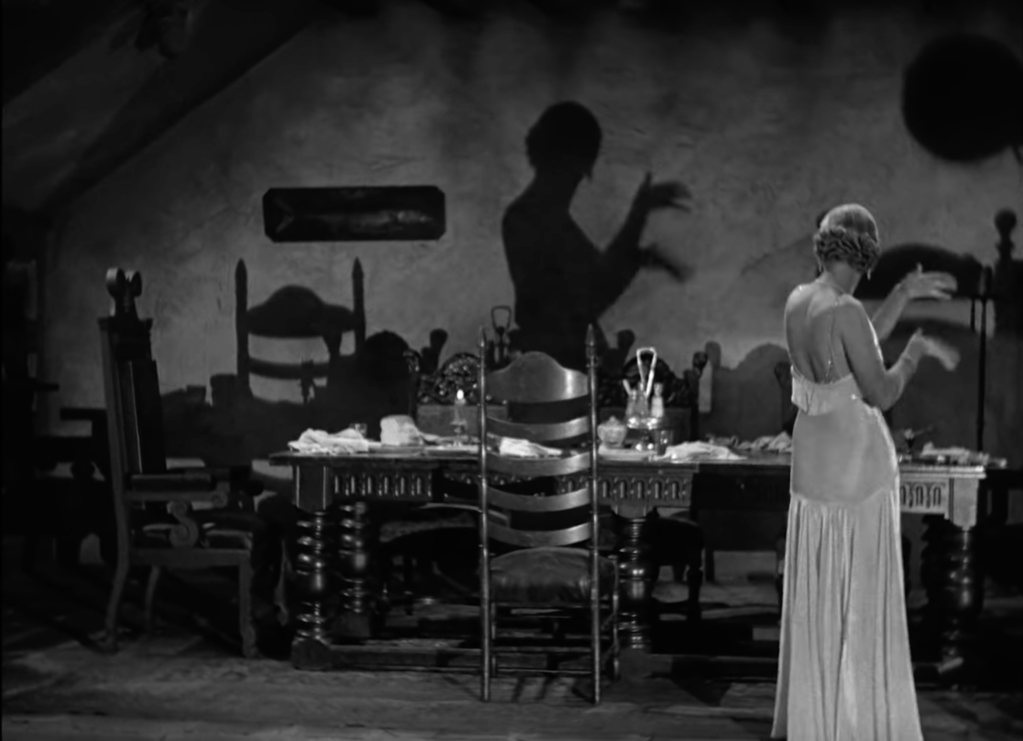
The slightest source of light provides an opportunity to indulge in the flights of fancy, hackneyed though the illusions may be (fighting dogs, a bird taking wing). It is Hollywood reflecting on its infancy; but it also struck me as a queer filmmaker’s contestation of the perception that the realm of shadows—or whatever we relegate to it—is a negation of light.
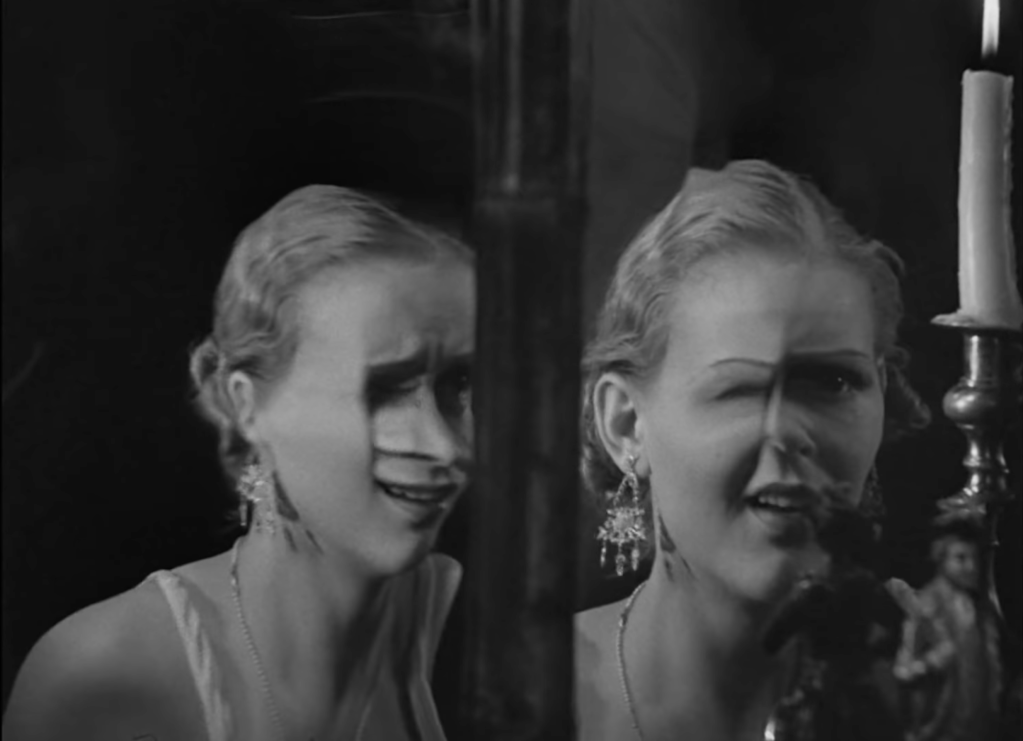
Meanwhile, the reflection that Mrs. Waverton eyes in the mirror—distorted and multiple—is a grotesque perversion of her youthful beauty; but the image is true all the same. It is as accurate as a foregone conclusion, a dead cert. Beauty will not last, Rebecca Femm insists gleefully. The opposite of a photograph that captures a moment instantly converted into pastness, Mrs. Waverton’s fleeting unlikeness foreshadows her future.
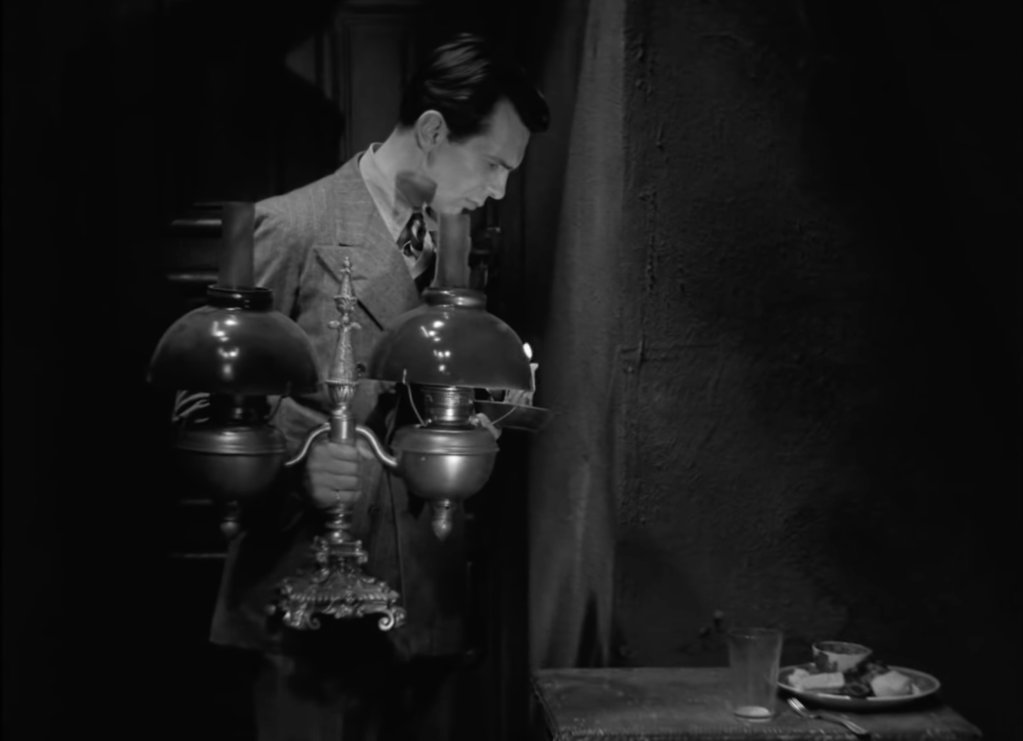
The one portable lamp of any use in the house—the fetching of which from upstairs Horace Femm dreads—certainly fails to illuminate.
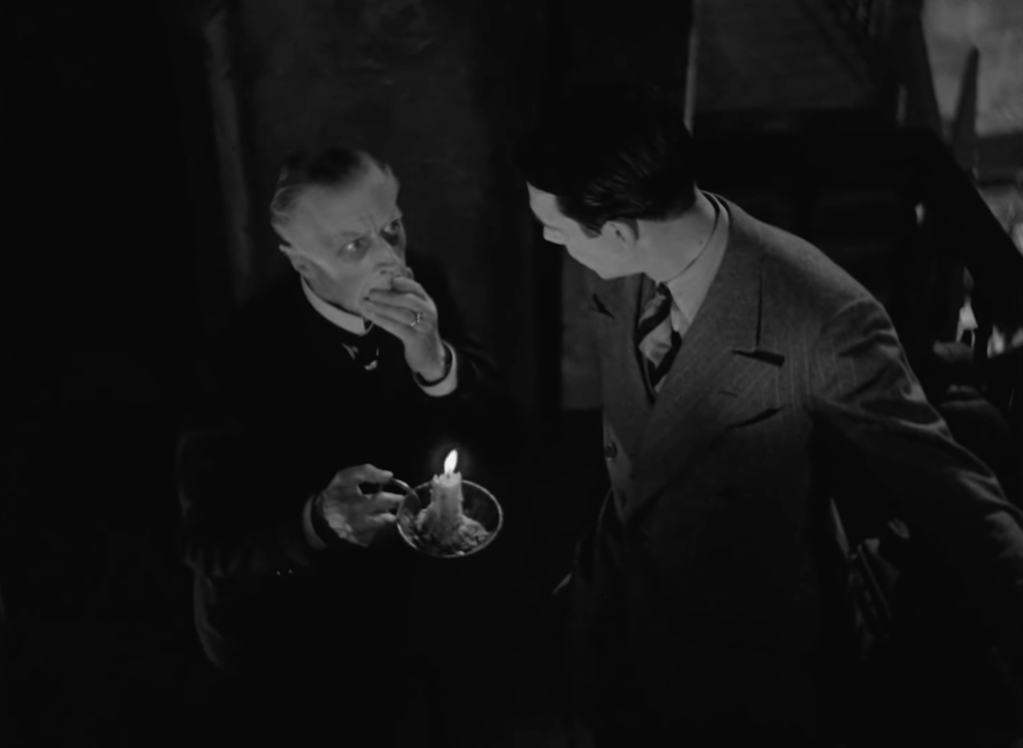
Reimagined as a tool against benightedness, it succeeds all the same when it is hurled at the drunk Morgan, whom it knocks unconscious.

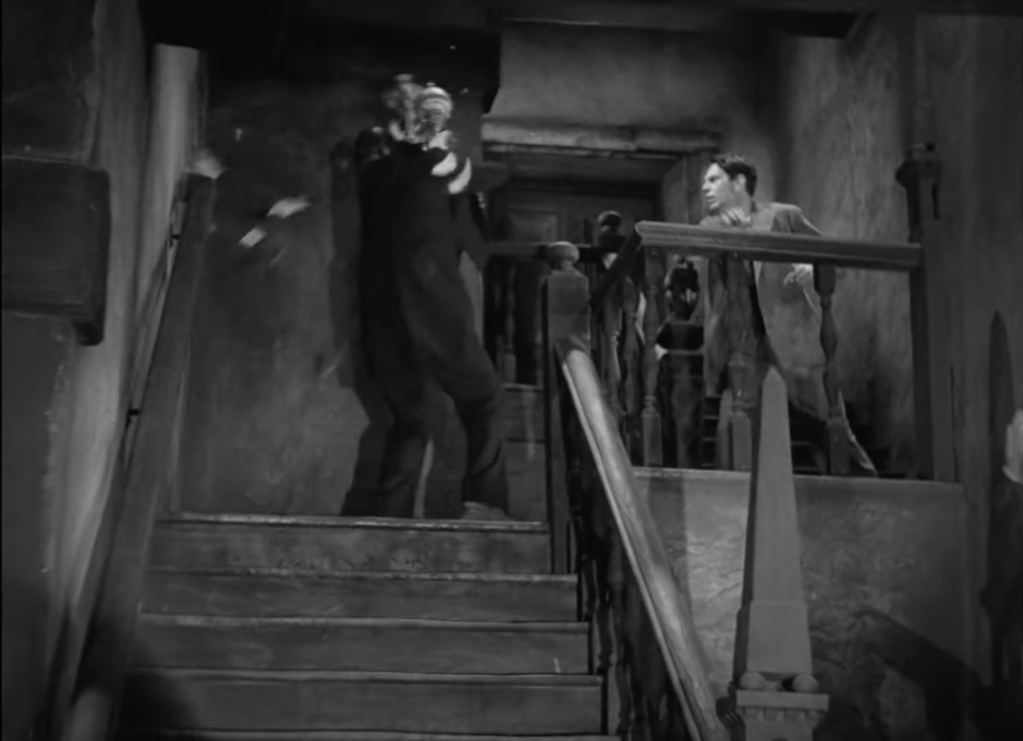
Still, the light is extinguished in the process. And as night draws on, light becomes a weapon in the hands of Saul Femm, who expounds on the qualities of fire and sets the curtains alight.
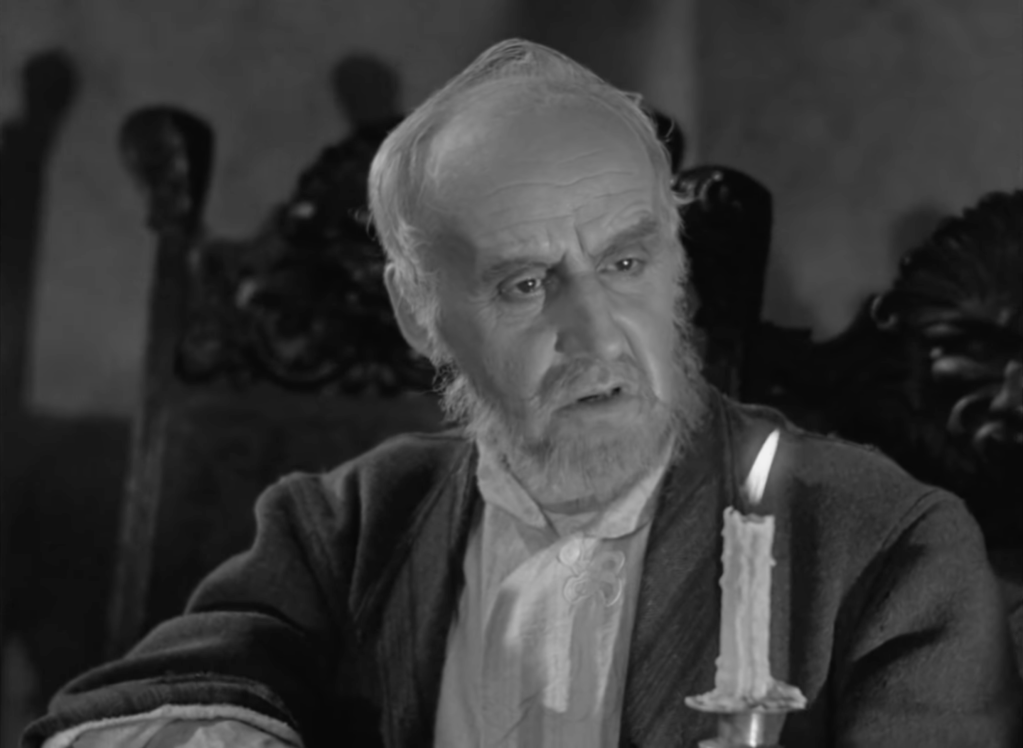
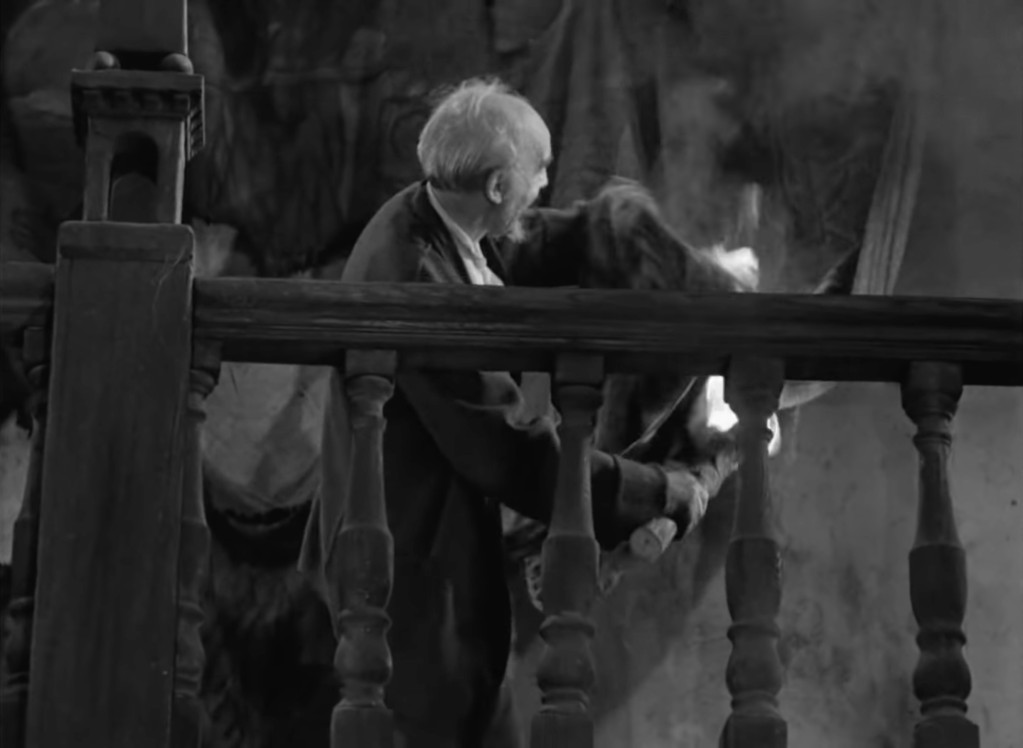
The Old Dark House is a place where a mirror image can mirror the mind of a religious fanatic and the smashing of a lamp may provide momentary relief from the terror of benightedness.
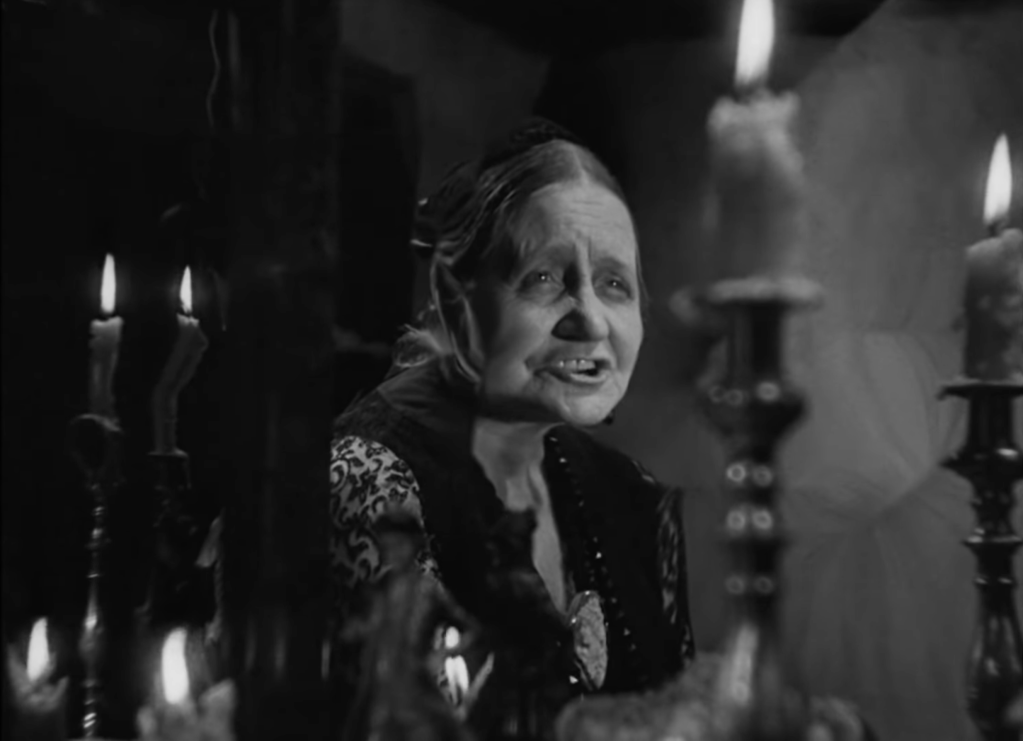
Rather than being regarded as “antithetic metaphors of mind,” mirror and lamp as household objects are significantly othered to turn conventional thinking about reflection and radiance, image and imagination, or copy and source on its head.

What the film invites is a questioning—and a queering—of boundaries, binaries and beliefs in its quest for liberation from ossified modes of seeing the world and reflecting on life.
Discover more from Harry Heuser
Subscribe to get the latest posts sent to your email.
 Harry Heuser
Thank you for forwarding.
<
div>
Sent from my iPhone
<
div dir=”ltr”>
<
blockquote type=”cite”>
LikeLike