
“Keeping up with the out-of-date” am I? Well, sometimes the motto I chose for this journal hits home like a slap in the face. Not a knock-out punch, mind. Just the kind of cuff that crimsons the cheek all the more because it is unnervingly public. Now, I am not slap-happy. If I keep going way back for more and go on reflecting at length on the ostensibly passé that others could care less about it is because, to my mind, time is not of the essence. That lingering tingle is, and I sting easily.
Whether or not we engage with it, there is no out-of-date as long as our memory serves. Or, rather, it dictates, like a fingerpost redirecting us into the remotest regions of our mental landscape. When it comes to our past, it matters little how long ago an experience dates back or however long in the tooth we are getting. The past can still get at us, provided we are fortunate enough—if indeed we feel quite so appreciative—to have faculties that keep us from letting bygones be … well, you know the rest.
And never mind the adage that time has curative properties. Healing all wounds and all that. If elephants do not forget, as another saying goes, imagine the capacity for recalling emotions among those, including myself, whose hide is less thick than that of a pachyderm. “I feel, therefore it is”—or something like that.
Before I get too caught up in the exercise of putting truisms to a test that your patience is unlikely to stand, let me tell it to you as straight as a queer person can bend it. A while ago, I received an invitation to my fortieth high school reunion. I had never been invited previously, presumably because, despite my web presence and my fairly uncommon name, the organizers of the event had been unable to locate me these past few decades.
To rectify the matter, I took the initiative of contacting the reunion committee and had my name added to the list of invitees once I had gotten hold of their email address through a fellow graduate who, out of the proverbial azure, contacted me to inquire whether I would attend. Would I? The 2024 reunion has been and gone. I did not go.
Now, why did I ask to be invited when I had no intention of showing up? The answer is far simpler than this cumbersome setup: I wanted to be placed on the list to let everyone on it know why I chose to be absent. My response to a reminder about the planned get-together was uncharacteristically terse: “Enjoy your reunion. Not everyone can be expected to wax nostalgic about what I experienced as a stiflingly heteronormative, phobic environment.”
As I was told in a smattering of subsequent exchanges, the snub sparked discussions between some attendees, particularly among parents who came face to face with their lack of awareness after being obliged to face the fact of having queer children.
As gratifying as it may be to make one’s presence felt in absentia, might I have done more and better by showing up? How do you represent yourself at a reunion of former classmates whose memories of you are the product of impressions and conjectures based on decades-old personas that, of necessity, bear little resemblance to your hybrid, multiple and transforming self?
Taking these open questions into the gallery, my exhibition Retroactive Selfies invites belated conversations about the visibility of queer lives and their acts of self-representation by presenting—publicly, for the first time—photographs of and by myself dating from mid to late 1980s.
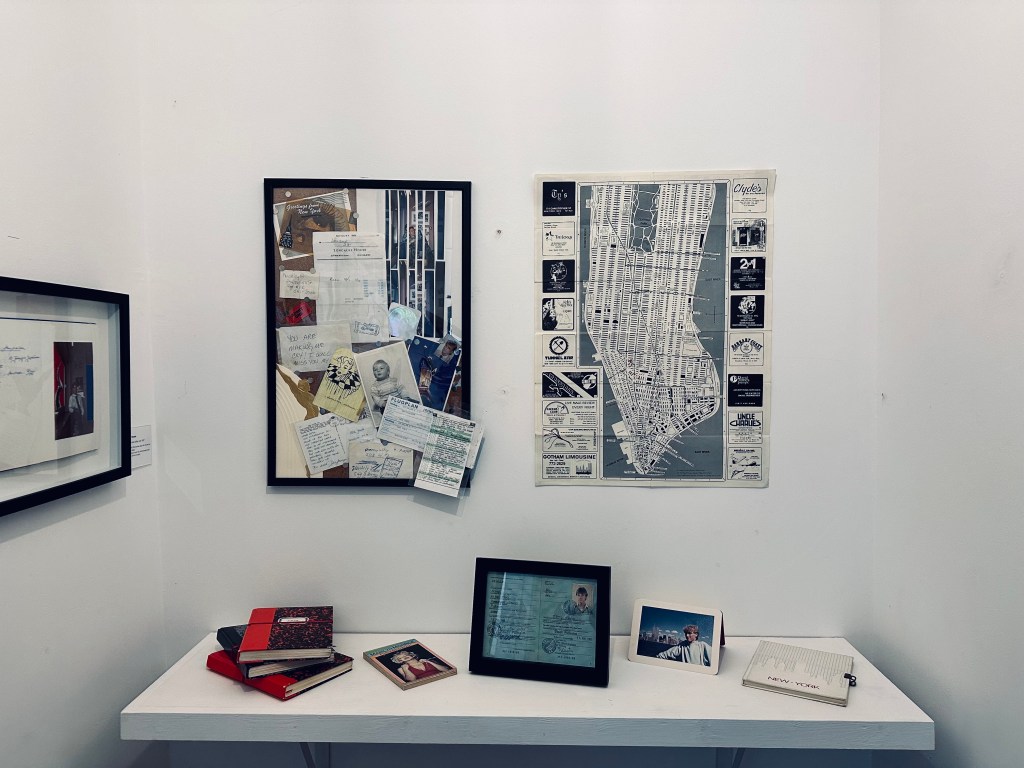
On show until 23 November 2024 at the excitingly diverse contemporary art venue Gallery Gwyn, Aberaeron, in mid-Wales, Retroactive Selfies—shown as part of the group exhibition Inter_Change—is a visual narrative of identity in an era before social media. The display is suitably accommodated in a closet space of the gallery. It comprises the seventeen-minute slide show “The Return of/to the Boy in the Avocado Bathtub,” which is screened alongside a selection of personal items including diaries, a passport, as well as ephemera—postcards and handwritten notes pinned to a cork board—that document my tumultuous first visit to New York City in 1985.
The scraps of paper, which survived all these years after being shipped from Germany to New York and from New York to Wales, form a cryptic collage of identity as a material an alternative to conventional self-portraiture not unlike the kind of off-camera portraits I have been exhibiting in Asphalt Expressionism, a show devoted to photographs of New York City sidewalks that I navigated—my nod to autobiographer Alfred Kazin—as a walker in that city.
Rummaging through the tangible remains of my past, I recovered a gay map of Manhattan dating from the mid-1980s. It shows a vanished culture, a network of safe spaces where queer contemporaries held congress and of businesses in the service of a community under threat by AIDS, indifference and homophobia. It is a map of which I did not have the courage to make much use at the time, even though places are marked on it for me, by whose hand I do not recall.
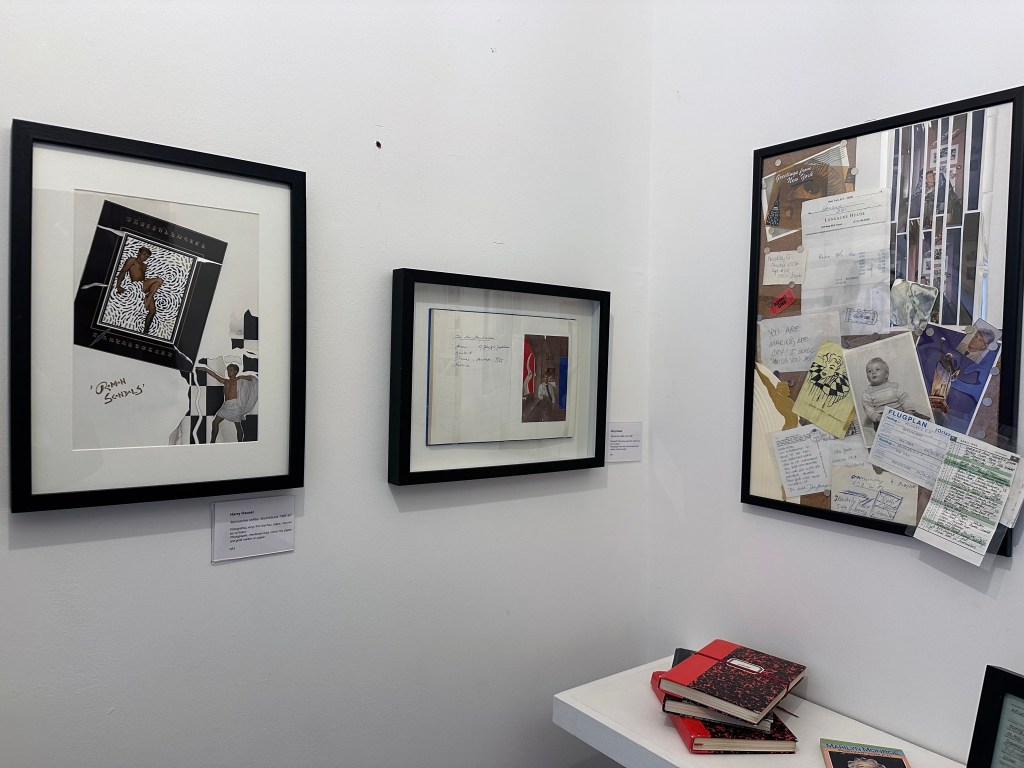
Five of those “Retroactive Selfies” are framed and mounted to show that they originated as analogue photographs, some of which I modified at the time by drawing on or collaging them, while others were pasted into albums to form compositions that contextualize them or create alternative narratives for and of myself.
By opening my albums and diaries to exhibit these personal photographs publicly in a gallery and on instagram, I aim to encourage others to spill their drawers and guts about the past through which they lived while thousands were silenced by AIDS and the politics that contributed to the delay of its cure and prevention. As I put it in the concluding slide of “Retrospective Selfies: The Return of/to the Boy in the Avocado Bathtub,”
It took years for this old Boy to step out of the Avocado Bathtub that still haunts my memories.
Meanwhile, thousands of queer pioneers lost their lives in the fight for my right to make just that one step.
Performing my coming out in “Retrospective Selfies,” I meditate on photographs unseen and identities as yet unknown.
Discover more from Harry Heuser
Subscribe to get the latest posts sent to your email.
 Harry Heuser