
I commenced this journal back in 2005. It was intended as a continuation of, and promotional vehicle for, my doctoral study “Etherized Victorians: Drama, Narrative, and the American Radio Play, 1929–1954.” Its title, broadcastellan, was meant to declare me to be keeper of a vast Luftschloss—a neglected alcazar of the air, immaterially composed of numberless radio recordings I determined to play back.
As of this post, broadcastellan is nearing its twentieth anniversary. While I do not take this as an opportunity, let alone an excuse, to reissue older posts, I nonetheless wonder: When history seems to be repeating itself, perhaps I may be justified to do the same, if only to demonstrate that not every “been there” necessarily translates into a feeling of “done that,” and that not all twice-told tales are a rehash—not, at least, when you approach them from a perspective that has profoundly, even fundamentally, changed along with the context, your life experience and your attitude toward the world.
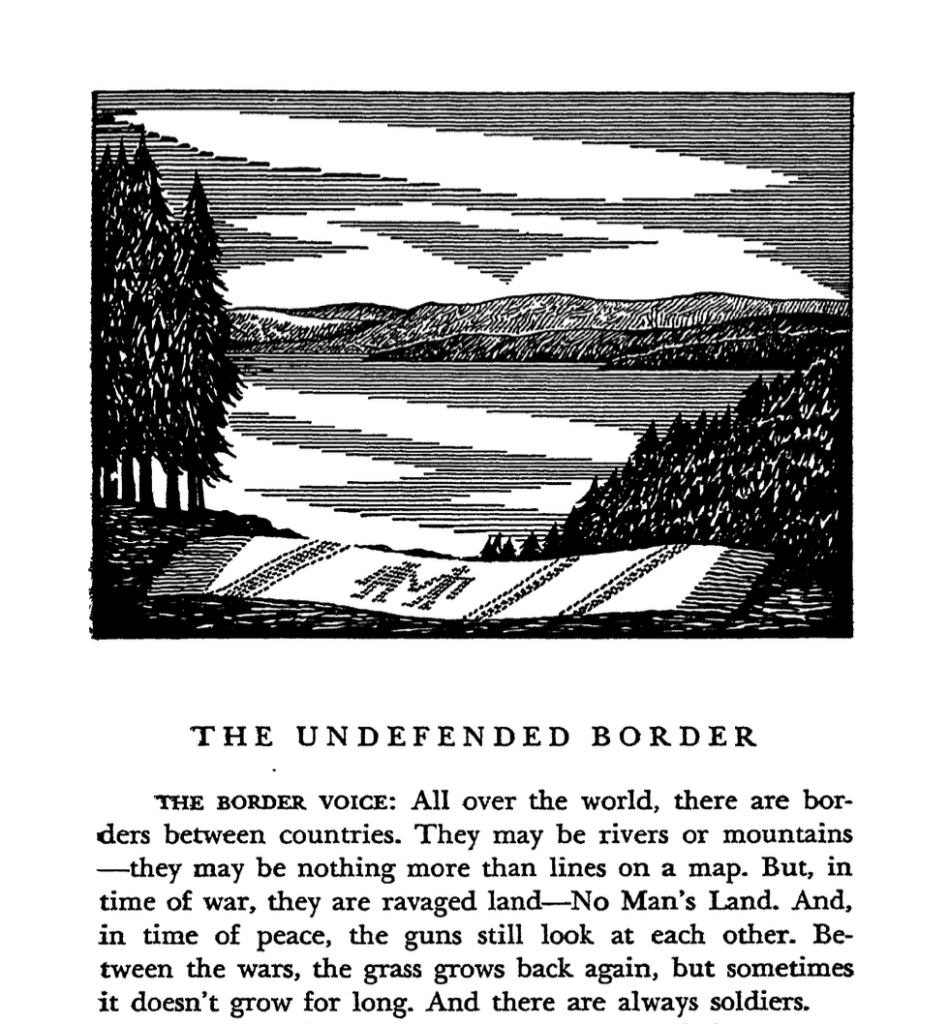
I devoted one early entry to “The Undefended Border” (1940), a play by Pulitzer Prize-winning poet Stephen Vincent Benét (1898–1943). Revisiting it now, in the age of the MAGA tariff wars and annexation threats, I cannot but think of the loose cannon that is recklessly flouting, or at any rate tarnishing, the legacy of the rusty “lone cannon” commemorated in Benét’s play.
Written especially for radio, “The Undefended Border” was produced in the United States as part of the DuPont-sponsored Cavalcade of America program. It was broadcast nationally over NBC stations on 18 December 1940, about a year before the US, responding to the attack on Pearl Harbor, entered the Second World War, an escalating global conflict that had been changing borders and violating the sovereignty of nations in Europe since 1939.
Reflective of the neutrality the United States was maintaining until that fateful day in December 1941, “The Undefended Border” carried a message of peace and unity among the Americas. Announcing “The Undefended Border” as one of the noteworthy plays of the week, Movie and Radio Guide magazine pointed out as “significant” that “this piece about the good neighbors of North America” would be “specially broadcast by short wave to South America.”
As I wrote back in 2005, Benét’s play
celebrates the peace between the United States and Canada. Both countries were at war in 1812; but there existed friendships between those living along the border. Benét tells of such a friendship and how it encouraged an American citizen to go on mission to Washington to urge the Acting Secretary of State, Richard Rush, and the representative of the British crown, Sir Charles Bagot, to create a border that would foster rather than endanger friendly relations between the neighboring countries.
The Rush-Bagot Agreement was signed in April 1817. A syndicated article, published at or around the time of the broadcast and attributed to Frank Monaghan, the “historical consultant” for the Cavalcade program, stated that the agreement
was later extended to include all the frontier between two great and powerful nations. It has several times been questioned, but each time re-affirmed. And today, because the people of two important countries believe that there can be no misunderstanding of the basic things, there are no armaments along the three thousand miles of water and land that separate the United States from the Dominion of Canada. That is one of the great achievements of men of good will in the Western World.
With its message of “good will,” “The Undefended Border” contrasts sharply with Benét’s decidedly more strident and stirringly propagandist wartime scripts for radio, including the aforementioned propaganda series Dear Adolf or plays such as “They Burned the Books” and “Your Army.”
Writing about the US-Canadian border, Benét seemed determined not to take sides, neither between the two nations nor between US citizens divided on the issue of their country’s commitment to allies engaged in the conflict abroad. After all, “The Undefended Border” was written just a few weeks after the formation of the isolationism-advocating America First Committee in September 1940, and it carefully straddled the battle line that, for the United States, had as yet no frontlines.
The play avoids overt references to the war waging in Europe, to acts of German aggression that provided reason enough for the US to secure alliances with neighboring countries, and it steered clear of the debate surrounding military aid for Britain.
“The Undefended Border” was ideally suited to the objectives of the Cavalcade series’ sponsor, considering that DuPont was determined not to draw attention to its history as a manufacturer of gunpowder and to reports about the company’s profiteering during the First World War.
In a letter to the Cavalcade’s producer Homer Fickett, dated 23 October 1940, thus less than two months before the scheduled broadcast, Benét remained vague about his script, while all the same trying to sound reassuring as to its aims:
I can’t give you a detailed outline right now as I happen to be one of those writers who don’t work from outlines. But my feeling about the story is that it ought to be as human a story as possible the story of something which is exciting because it doesn’t exist (a border without fortifications) told in human [terms]. Maybe a family on each side of the border—maybe one family—I don’t know. But to realize the extraordinariness of something taken for granted—the continual passage back and forth between Canada and America—the likeness on the two sides of the undefended border.
Creating a mixture of essay, poetry, imaginary journalism and historical drama, Benét eventually delivered what he had promised. In the play, as broadcast, listeners were reminded that “from New Brunswick to Puget Sound there runs a border between two great nations of proud people, individual people, people with their own customs and beliefs and ways.”
The boundary in question, as “The Undefended Border” reminded its listeners, had
not one fort, not one ship of battle, not one hidden or usable gun. There is a lone cannon. And they point it out to tourists as a memory of the past. The cannon is rusted now and covered with moss. The little boys on both sides of the border climb over it and are not afraid. And there are the voices of people talking across the border […].
The “everyday speech” of folks living along the border—contrived by the playwright as it is—anecdotally but vividly captures how intertwined the experience of Canadians and US Americans had become, notwithstanding their nations’ distinct histories and characters.
In an article titled “A Decade of Radio Drama” and published in College English in January 1947, Glenn Christensen commended Benét for “constantly” exhibiting “his mastery of everyday speech; it rings so true that one reads pages”—an academic privileging of the printed word over the speech delivered via radio, as intended—without being aware of the speech itself.”
“Naturally, the theme is good neighborship,” Benét pointed out in his letter, even though the finished script does not make any mention of “neighbors,” whereas the word “cannon” appears about two dozen times, often in a choric staccato—”Cannon. Cannon. Cannon. Cannon. Cannon. Cannon. Cannon! Cannon!”—spoken words resembling the shots never fired on the Cavalcade program during those prewar years.
However “vague” his ideas were, or however vaguely they were expressed in his letter, Benét assured Fickett that his play would not “be overloaded with propaganda.” That said, the playwright added, “our relations with Canada are a matter of extreme importance,” and “anything we can do to help understanding between the two countries” struck him as “well worth doing.”
Benét vowed to “keep strictly away from a ‘big brother’ attitude.” To that end, the Canadian actor Raymond Massey was chosen as the narrator, “the voice of the border.” Massey, who, earlier in 1940, had starred in the title role of Abe Lincoln in Illinois, a film based on a play by Robert E. Sherwood, was in a position to negotiate the border instead of confirming its existence:
I was born under the Maple Leaf. I was born under the Stars and Stripes. I’m people who are used to space and wide skies—to an old and dear tradition and the wind that blows over a new world. The Douglas fir and the redwood, the trillium and the number one hard wheat—all these are in the veins of my people. The gray stones of Quebec are part of them and the old French speech—the rolling Dakota plains and the warm, wheat-growing summers—the springs of the Mississippi and the shining bay of Vancouver and the rocky shield of the Laurentians, the necklace around the North Pole. Where there is space and freedom, love of law and love of justice, you will find my people.
“[F]reedom, love of law and love of justice”? How hollow these words ring now as US history—along with the histories of the Americas, and indeed the world—is being hastily rewritten, ignorantly and arrogantly, or else erased, by the decree of a self-styled king with a thirst for vengeance and a hunger, if not for territory, so at least for lasting fame or infamy—a distinction about which MaGAvellian minds are not particular—at any cost.
More than a decade after the play was broadcast, at which point radio drama in the US went into steep decline, the passage from “The Undefended Border” referring to the rusted “lone cannon” and the “voices of people talking across the border” was still quoted in the 1951 high school textbook Living in Our America: History for Young Citizens. It was meant, so the editors, to serve the point that US Americans were
not likely to look on the Canadians as complete strangers. And they do not particularly think about us as foreigners. The fact that the people of these two nations have become acquainted and have peacefully ironed out their difficulties is encouraging. It gives us hope that efforts along the same lines will accomplish the same good results with all our neighbors. When we are able to point to real neighborliness here in the Western Hemisphere, we can then feel that we are setting an example the rest of the world should try to follow.
No such interpretation, aimed at high schoolers, would be endorsed by the current administration. In a revisionist tale told by an idiot full of unsound fury—and of himself—the “undefended border” signifies nothing more than an ambition that, like any ideal and aspiration, can be dismissed and silenced, like so many alternative voices, in a coordinated attack on the “great house of freedom”—the “house that shall not fall!”—as it is celebrated, albeit naively, by Benét’s play.
In an age in which the US seems determined to erase whatever “memory of the past” it deems inconvenient, in which Canada is considered and hubristically referred to by 47th US president as a potential 51st State, and in which international tourists, especially those arriving via Canada and Mexico, risk being deported like hostile aliens, it is difficult not to look back at “The Undefended Border” and its “lone cannon” as a cultural relic representative of a now severely compromised alliance, or at least as a manifestation of diplomacy that has been abandoned with a vengeance.
“Can the spirit of Benét’s play endure? Or will it be the doing of today’s anxious politicians to tear down our freedoms by putting up new fences?” Those were the questions I asked nearly twenty years ago. In response, a fellow blogger from Canada commented that he found the post “particularly appropriate,” as, on 15 December 2005, the “US House of Representatives voted to ‘consider erecting physical barriers along the American border with Canada.’”
“Apparently,” the Canadian blogger pointed out,
the amendment was moved by a California Republican as a means of “assuring” their constituents that new measures to strengthen security along the Mexican border weren’t a special penalty for one frontier over another.
The Trump administration has merely amplified—and given legitimacy to, in so far as it is at all concerned with the niceties of law and the function of the judiciary—the calls for an “America First” agenda that regards the ideal-turned-reality of an undefended border as indefensible, and that looks as anything beyond US borders as hostile yet conquerable territory.
Posting this not long after Canadian Prime Minister Mark Carney reiterated at his first official visit to the White House that Canada was not up for grabs, I am mindful of the words uttered by the “Border Voice” toward the conclusion of Benét’s play: “We’ve had folks who tried to sow dissension […], but they never raised a crop and they never will.”
These days, when the prime sower of dissension raises tariffs and threat levels, along with eyebrows and voices of dissent the world over, to “realize the extraordinariness of something taken for granted,” as Benét put it in his letter to Fickett, means to defend the fragile state of the undefended—the freedom of the unbounded and the limitless potentialities of “good will” that are now, along with plain common sense, in the firing line of a loose cannon.
Discover more from Harry Heuser
Subscribe to get the latest posts sent to your email.
 Harry Heuser