
Over the past few months, enervated by minor illnesses and the lingering nuisance of ingrown eyelashes that make reading for pleasure less than pleasurable, I have been busying myself performing the mentally undemanding task of cataloguing my digital collection of detective and mystery magazines, most of which, for the reason aforementioned, still await my perusal.
Not one to embrace chaos or relish disorder, I derive comfort from such indexing. The virtue of record-keeping is not simply its own reward, however. After all, owing to a dogged determination that some may prefer to label “anal retentiveness” or look upon as signs of life “somewhere on the spectrum,” I now have a fairly comprehensive overview of twentieth-century British and US American crime fiction, especially by writers active during the so-called golden age of murder mysteries between the two world wars, authors whose rules-governed puzzles resonate with us once more in a period of heightened global uncertainties and the attendant anxieties to which they gives rise.
I was just completing, for the time being, my currently 139-page-long single-spaced crimino-bibliography, replete with cross-references and annotations, when I happened on an item that brought home again how elusive and downright illusory any attempts are to escape, via fictional chronicles of crimes long solved, from the actual and ongoing illegalities of today, not least the enforced lawlessness in the rewilded West of the by now all but nominal United States.
It is impossible, and indeed reckless, not to take notice of reports about the fascistoid malefactions of MAGA—the megalomaniacal threats against allies and enemies alike, the acts of violence and intimidation perpetrated by governmentally sanctioned masked marauders, and the continued obfuscation, normalization and pardoning of felonies past and present.
Not that a catering to escapism or nostalgia was ever the objective of this journal, which, concerned though it is with the popular culture of yesteryear, is predicated on the recyclability of the ostensibly passé and its regenerative potential to matter differently in the shifting contexts of history and the story of my own queer existence in particular.
As a responsive but at times wilfully irresponsible reader—someone to whom “reading” and “reading into” can seem indistinguishable—I have long been intrigued by the relationships between and interdependence of text and context, the ways in which time-stamped cultural products such as erstwhile page-turners, forgotten motion pictures and neglected radio plays may regain currency or acquire unforeseen meanings when they are experienced decades after they were first created.
The phrase “first created” is by no means redundant, as fictions are always created anew in the act of their reception. They become invested with our own stories, informed or reformed in conformance with our personal perspectives, and invented (as in “discovered,” the roots of the Latin origins of “invention” being invenire, or “coming upon”) within the inventory—to use another word derived from invenire—of our particular frames of reference as we bring them into being each time we commit to engaging with them.
Granted, my preamble is getting rather cumbersomely abstract. It may well strike you as overblown given the coincidence—a reference in name only—that set this runaway train of thought precariously in motion.
As I said, it all started with my one-track minded determination to keep track of my collection old, albeit not always classic, crime fictions. One of the last items I committed to my catalogue of crimes bares a red flag of a title that not only compelled me to retrieve it straight away but also motivated me to continue the broadcastellan journal, of which, for quite some time now, I have been pretty much forced to lose sight.
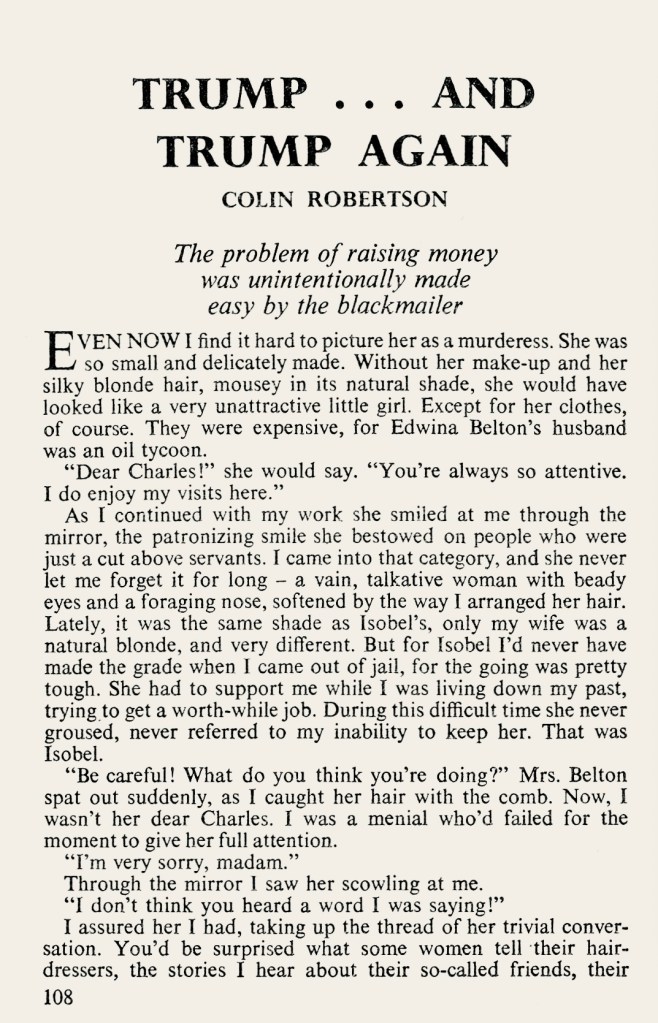
The story in question is “Trump … and Trump Again.” It was written by the prolific, once popular but now little-known British crime writer Colin Robertson (1906-1980), several of whose short fictions were published in Edgar Wallace Mystery Magazine, in which “Trump … and Trump Again” appeared in May 1965.
Iniquitous ubiquity! The double reference to a certain twice-elected and twice indicted Janus head of state—a two-faced double-dealer with the temper of terrible twos—sure had me looking twice. The attention-getting header resembling my cries of exasperation whenever the attention-seeking imperialist menace elbows himself—sometimes literally—into the limelight also prompted me to read Robertson’s obscure but ominously titled work of fiction.
The plot of “Trump … and Trump Again”—the gist of the story, I mean, not of the machinations or future resting place of a con man—concerns a financially desperate hairdresser who is duped by a customer he is fool enough to prejudge as a dumb blonde into committing a burglary in her home only to be blackmailed into assisting her in disposing the body of her husband, the oil tycoon she just smothered to death with a pillow.
“So you fell for it beautifully, Charles!” the mariticidal blonde sneers at the stylist she chose to fashion into her unwitting accomplice. But her triumph is short-lived. Charles manages to extricate himself with the aid of the second “Trump” in the title, “trump” meaning, in this context, a “valuable resource that may be used, especially as a surprise, in order to gain an advantage.” In each instance, the “trump” is a piece of information, the first being the deliberately divulged combination to a safe, the second a carelessly discarded letter.
“Trump … and Trump Again” is a tale economically told (by my count, in just under 3400 words). And even though the pay-off is not as neat an ending as its writer tries to make it out to be, Robertson makes it easy for us to root for Charles, the first-person narrator, a man with a criminal record who determines to reoffend by stealing from the rich—taking only what he “needed”—because he is guided by moral principles and the love for his wife, Isobel:
But for Isobel I’d never have made the grade when I came out of jail, for the going was pretty tough. She had to support me while I was living down my past, trying to get a worth-while job. During this difficult time she never groused, never referred to my inability to keep her. That was Isobel.
Now, though, Isobel requires spinal surgery and prohibitively expensive care, making it necessary for Charles to grow a spine of his own:
Three hundred pounds would have paid for everything, including a daily help to look after the two youngsters, while she was away. But how was I to find that much money? I hadn’t got it, and I could see no way of raising it.
A burglar turned accessory-after-the-fact, Charles ultimately resorts to forgery, the very crime that landed him in jail years earlier but that now sets him free. It is the faked suicide note Charles pens in the dead man’s handwriting that gainsays the lies of the murderous spouse.
What I appreciate even more than the ironically twisted logic of Robertson’s O. Henry-fied noir is the distinction it makes between self-serving crimes and illegal acts that are selfless and therefore justifiable.
Justifiable crimes that beget justice. Looking beyond the plot of the hairdresser’s murderous client toward the hair-raising reality of today, I am reminded of the necessary acts of selfless resistance to the tyranny of the law that are being committed in the streets of US cities, by neighbors for neighbors, in defiance of an increasingly authoritarian government, headed by a criminal egoist with a soufflé of a coif to the creation of which no self-respecting stylist would lay claim—a regime that criminalizes civil rights, weaponizes the justice system and undermines the fundamental separation of powers to enable and uphold autocratic rule.
If a “trump” is a “valuable resource that may be used, especially as a surprise, in order to gain an advantage,” it needs to be employed now—in the USA, in Europe, and around the world. We have seen what befalls us when we are duped out of our rights because we “fell … beautifully” for the lies told by those who get away with murder by declaring themselves to be above the law.
Trump … and never again.
Discover more from Harry Heuser
Subscribe to get the latest posts sent to your email.
 Harry Heuser