
“By the magic of the radio.” Suitably charming if by then well-worn, the phrase served as the opening of a public address by the thirty-first president of the United States, Herbert Hoover. Broadcast from the White House on this day, 12 February, in 1931, and occasioned by the birthday of Abraham Lincoln, the message conveyed in the speech that followed was decidedly less magical than the purported medium of enchantment by way of which it was delivered.
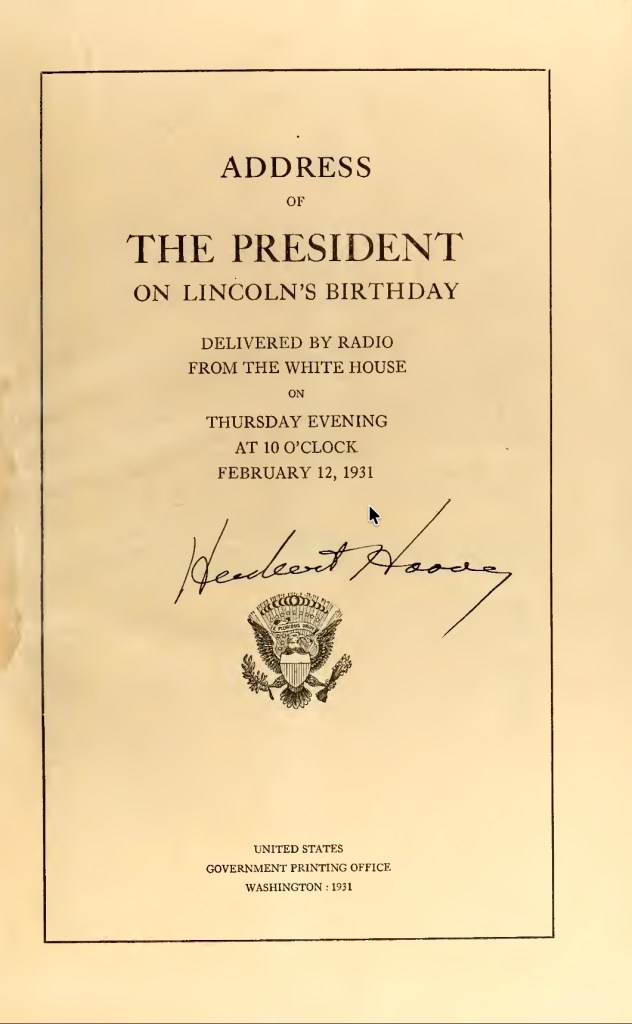
In lieu of a recording, the script published by US Government Printing Office serves as a reminder of Hoover’s inability to respond with understanding to the needs—and the mood—of the multitudes who tuned in to hear his words. And while its initial reception is now difficult to gauge, the broadcast no doubt contributed to Hoover’s defeat the following year, on 8 November, when Franklin D. Roosevelt won the popular and electoral vote, carrying forty-two states.
FDR came to be known as “the radio president.” His predecessor, however, had already made ample use of the medium, especially after the establishment of national chains—NBC in 1926 and CBS in 1927—significantly increased the possibility of reaching millions of US Americans instantly and simultaneously in their homes.
Just days after Hoover’s radio address on Lincoln’s Birthday in 1931, for instance, his administration launched a “drive against illiteracy in the United States” in cooperation with the Columbia Broadcasting System.
There was little evidence of Hoover’s ability to read the room, however, as his voice passed through the four walls in which so-called members of the far from homogenous public sat alone or in intimate circles to learn about his response to the economic crisis that had left so many of them floundering.
In the 1920s, when the potential reach of national broadcasts was considerably smaller, Hoover had grasped the difference between personal communications and public speaking—a distinction that he, as an elected official addressing the nation at large would struggle to make.
Granted, the former mining engineer had considered the matter mainly from a techno-logistical perspective when he declared the “use of the radio telephone for communication between single individuals” to be a “perfectly hopeless notion.” Cluttering up the airwaves for one-to-one chats would result in “frantic chaos, with no communication of any kind possible.” Instead, Hoover argued in a speech broadcast on 27 February 1922, wireless telephony needed to be used for the “spread of certain predetermined matter of public interest from central stations.”
As Secretary of Commerce under Harding and Coolidge, Hoover had been instrumental in attempts to regulate the fabled ether via the Radio Act of 1927. His approach was instrumental as well in the failure to prevent the commercialization of the airwaves that Hoover himself had initially dreaded.
In 1922, when broadcasting was in its infancy, Hoover had attended the First National Radio Conference, where, as radio historian Susan Smulyan points out, he expressed misgivings about “allow[ing] so great a possibility for service, for news, for entertainment, for education, and for vital commercial purposes, to be drowned in advertising chatter.”
According to Smulyan, Hoover maintained that the “radio industry should resolve the controversy regarding advertising […] without government interference,” a hands-off approach that not only prevented him from “acting aggressively to contain the growth of broadcast advertising” but that also delayed the implementation of a federal radio policy whose passage Hoover would veto in 1933. The refusal to intervene, on a federal level, would mean a great deal of interference on the air.
As regards his own brand of “chatter,” Hoover was not equal to the practical “magic” of the wireless, despite his growing acquaintance with the medium. According to Robert West, Director of the Radio Arts Guild of America and author of The Rape of Radio (1941), Hoover “faced the microphone ninety-five times during his four years of incumbency.” He also had to face the fact that the microphone was proving somewhat of an encumbrance.
“The microphone betrayed deliberate effort,” West argued, and the “timbre” of Hoover’s voice was “a trifle heavy,” an assessment to which extant recordings attest. A comparative study of campaign broadcasts carried out by CBS production manager John Carlile and published in the New York Times on 6 November 1932, referred to Hoover’s halting monotone as “the voice of a man who does not like to talk.” Meanwhile, FDR’s voice was deemed to be “well-trained instrument capable of reflecting his moods and the color of his thoughts,” albeit disclosing a “personality a little too pleasant.”
Aware of his shortcomings as an orator, Hoover was “said to have called afternoon rehearsal sessions before appearing on the air.” And yet, even “elaborate preparations” did not prevent a “fumbling and uncertain delivery” that “used to give his admirers the jitters.” Hoover, West concluded, “seems to have been wrapped at birth in a cobweb of awkwardness.”
“Awkwardness” is just one way to describe the 1931 presidential broadcast on Lincoln’s Birthday. Tone-deaf is another. The speech demonstrates how little Hoover had learned about the intimacy of a medium that FDR would put to such excellent propagandistic use in his genial fireside chats. To be sure, Hoover’s comparative disconnect as a radio personality was not merely a matter of persona. It was a matter of policy.
Hoover had made his radio debut a decade earlier, on 15 January 1921, when, as the Director the American Relief Administration, he gave a speech on “European Relief” from the exclusive Duquesne Club, a private, male-only meeting place for the business elite in downtown Pittsburgh, Pennsylvania.
In the aftermath of the Great War, the American Relief Administration reportedly delivered more than four million tons of relief supplies to European countries. When millions of US citizens would have benefitted from similar support following the Stock Market crash of 1929, Hoover seized the birthday of the Great Emancipator as an opportunity to preach self-reliance instead.
“It is appropriate that I should speak from this room in the White House where Lincoln strived and accomplished his great service to our country.” Like other less than confidence-inspiring Republican presidents before and after him, Hoover conjured—or, rather, hijacked—the spirit of Lincoln to deflect from his own avoidance to measures that would tackle the effects of the Depression on the lives of his fellow citizens.
An “invisible presence dominates these halls,” Hoover declared, making Lincoln sound like Lamont Cranston (alias The Shadow), “ever recalling that infinite patience and that indomitable will which fought and won the fight for those firmer foundations and greater strength to government by the people.”
It seems that Hoover was hoping Lincoln’s “presence” would rub off on him, like patina: “Here are the very chairs in which he meditated upon his problems,” Hoover set the scene for the radio listeners. Without access to visuals, they would simply have to take his word for it—or so Hoover indubitably hoped.
Concluding the brief tour, Hoover pointed to a plaque embedded on the fireplace in Lincoln’s bedroom, which reads: “In this room Abraham Lincoln signed the Emancipation Proclamation of January 1, 1863, whereby 4,000,000 slaves were given their freedom and slavery forever prohibited in these United States.”
Hoover reflected that “[i]f Lincoln were living, he would find that this race of liberated slaves” had “by its own endeavors progressed to an amazingly high level of self-reliance and well-being,” suggesting that, after their emancipation, no federal support for that “race” was required or warranted.
The use of the possessive determinator “its” is telling. Clearly, Hoover did not conceive of “this race” as being part of the listening audience. He talked about African Americans abstractly and collectively rather than imagining himself to be talking to any of them. The actuality of inequality is brushed aside in favor of a sweeping progress narrative:
To Lincoln it would have been incredible that within a lifetime the millions of children of these slaves would be graduating from the public schools and colleges, that the race could have builded itself homes and accumulated itself a wealth in lands and savings; that it should have carried on with success every calling and profession in our country.
Hoover went so far as to assert that “many of the issues” of Lincoln’s day were “dead and gone.” Claiming that Lincoln’s “tradition has dominated [the Republican party’] to this day,” he intimated that the “temporary” economic challenges and resultant inequities of the present did not call for federal interventions.
Here, Hoover’s argument sounds familiar to us not because it aims to evoke Lincoln but because it foreshadows the calamitous reign of Number 47:
In Lincoln’s day the dominant problem in our form of government turned upon the issue of States rights. Though less pregnant with disaster, the dominant problem today in our form of government turns in large degree upon the issue of the relationship of Federal, State, and local government responsibilities. We are faced with unceasing agitation that the Federal Government shall assume new financial burdens, that it shall undertake increased burdens in regulation […].
That the “responsibilities” of the federal government are dismissed selectively by different Republican administrations is apparent in Hoover’s rejection of calls to “undertake increased burdens in regulation of abuses and in the prosecution of crime,” a “burden” the second Trump administration is only too eager to shoulder in order to exert unprecedented interference in matters of law enforcement in states run by elected officials whose views are not aligned with his agenda.
“Our concept of Federal, State, and local responsibilities,” Hoover tentatively allowed, “is possible of no unchangeable definitions” and “must shift with the moving forces in the Nation.” Nonetheless, he added, the “time has come when we must have more national consideration and decision of the part which each shall assume in these responsibilities.”
The time had come, apparently, for the federal government to do nothing. The Depression was nothing but a “critical test” of resilience. “The true growth of the Nation,” Hoover insisted, “is the growth of character in its citizens. The spread of government destroys initiative and thus destroys character.”
To avoid the “enervation of will and destruction of character,” Hoover advocated for efforts to “strengthen in the Nation a sense and an organization of self-help and cooperation to solve as many problems as possible outside of government” in order “to avoid the opiates of government charity and the stifling of our national spirit of mutual self-help.”
Victory over this depression and over our other difficulties will be won by the resolution of our people to fight their own battles in their own communities, by stimulating their ingenuity to solve their own problems, by taking new courage to be masters of their own destiny in the struggle of life. This is not the easy way, but it is the American way. And it was Lincoln’s way.
While Herbert Hoover eventually changed his tune, federal assistance came too late, both for his country and for his chances at a second term. It was FDR whose federal programs—among them the Works Progress Administration, the Federal Emergency Relief Administration, and the National Recovery Administration—pulled the United States out of the Great Depression.
Also signed into Law by FDR was the Communications Act of 1934, effective federal regulations of the medium having been vetoed by Hoover. It was designed to “make available, so far as possible, to all the people of the United States, without discrimination on the basis of race, color, religion, national origin, or sex, a rapid, efficient, Nationwide, and world-wide wire and radio communication service with adequate facilities at reasonable charges.”
Hoover call for self-reliance was profoundly misjudged. Yet as damaging as the socio-economic inaction of his administration proved to be, they are wholesome compared to the wrecking-ball policies of Number 47, an autocratic RINO whose disdain for federal programs and hostility toward the federal workforce is as unprecedented as it is pernicious—to say nothing of his social media ramblings or public speaking.
Mind you, it is challenging to make the claim that federal aid programs are the “opiates of government charity” resonate with folks who lacked shoes to string and belts with which to tighten their budget. These days, at least, they receive more concrete guidance: put fewer dolls on your shopping list. And while you’re at it, use fewer pencils!
Discover more from Harry Heuser
Subscribe to get the latest posts sent to your email.
 Harry Heuser