
When it comes to second-hand knowledge, I can get a tad—permit the portmanteau—malcontentious. You know, not just dissatisfied but downright disputatious. It frustrates me not to be able to get straight to the source and having to rely instead on a privileged intermediary.
Owing to that frustration, I tend to quote extensively from the primary sources that I discuss so as to enable my readers, whoever they may be, to enter into a conversation with me on whatever matter I happen to advance for discussion. I am not content to alert others, by way of a footnote, to materials to which they may not have immediate access or which they cannot be bothered to dig up when prompted. Inquisitive as I am, I do not expect anyone to take my word for an elusive “it.”
Mind you, the “it” in question is not, say, the US-Israel war on Iran currently underway—a fact-based rationale for which has yet to be cogently articulated—but the special brand of make-believe known, by some, as Hörspiel—plays for the ear that came into being with the advent of broadcasting in the early 1920s. It is that sort of ephemera to which I have devoted this journal, a blog whose title, broadcastellan, is another portmanteau I invented to cast myself as a keeper of the castles in the air that rose and crumbled in the early to mid-twentieth century, some exceptions notwithstanding.
Unlike silent films, almost none of the broadcasts of those pioneer days of wireless storytelling have survived, either as recordings or as scripts. Hardly any have appeared in print, despite the fact that virtually all of them were scripted. As a result, I am obliged to be told about them in contemporary reviews, which likewise are in short supply.
Fact is, we do not today enjoy the same kind of access to early US radio plays than we do to motion pictures of the 1920s. Too little has been preserved, mainly because, despite the existence of sound recording equipment, sound-only broadcasting was not thought of as anything but ephemeral, accountability, commercially understood, only just coming into being as a rationale for keeping records.
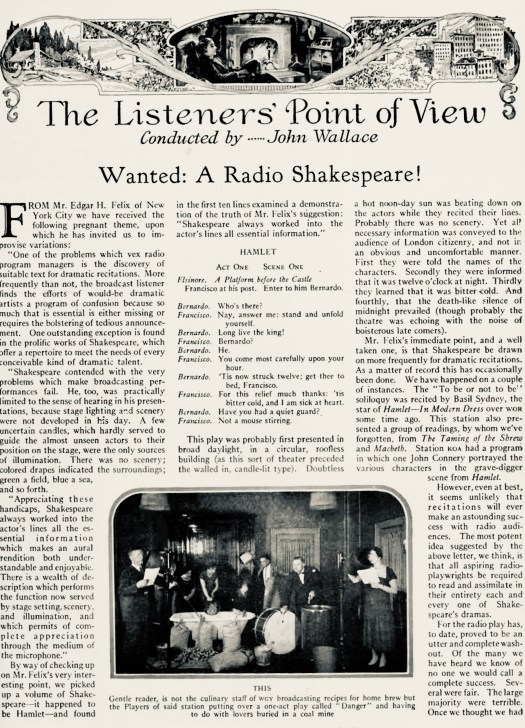
This gap—a lacuna not quite matata—leaves me, if not speechless, so at least without confidence adequately to respond to “Wanted: A Radio Shakespeare,” one such early second-hand account of radio listening. The article was published in the March 1926 issue of Radio Broadcasting as part of a tauntingly titled column “The Listener’s Point of View,” as represented by John Wallace, a critic whose remarks on the first radio play published in the United States I previously mentioned here.
Having referenced the article in Immaterial Culture, I did not return to it until now—”now” being the one-hundredth anniversary of Wallace’s remarks on, and recommendations for, the advancement of the radio play in the United States.
“Wanted: A Radio Shakespeare” is worthwhile picking up anew, considering that the attitudes toward the sound-only medium voiced by Wallace would remain valid for at least another decade, by which time, in the summer of 1936, the Columbia Workshop signaled that experimentation was, at last, however tentatively, being given a modicum of attention in US broadcasting.
Despite its limitations, or perhaps due to them, Wallace’s article makes for fascinating reading, not least because so few accounts are available to us of listening experiences that were, well, experienced by the writer purporting to be the voice of the listener.
In his March 1926 column, Wallace responded to the following comment made by Edgar H. Felix, a radio listener and Radio Broadcasting reader from New York City, who, according to the passage quoted by Wallace, declared:
One of the problems which vex radio program managers is the discovery of suitable text for dramatic recitations. More frequently than not, the broadcast listener finds the efforts of would-be dramatic artists a program of confusion because so much that is essential is either missing or requires the bolstering of tedious announcement. One outstanding exception is found in the prolific works of Shakespeare, which offer a repertoire to meet the needs of every conceivable kind of dramatic talent.
Shakespeare contended with the very problems which make broadcasting performances fail. He, too, was practically limited to the sense of hearing in his presentations, because stage lighting and scenery were not developed in his day.
A few uncertain candles, which hardly served to guide the almost unseen actors to their position on the stage, were the only sources of illumination. There was no scenery; colored drapes indicated the surroundings; green a field, blue a sea, and so forth.
Appreciating these handicaps, Shakespeare always worked into the actor’s lines all the essential information which makes an aural rendition both understandable and enjoyable. There is a wealth of description which performs the function now served by stage setting, scenery, and illumination, and which permits of complete appreciation through the medium of the microphone.
Wallace then quotes from Act 1, Scene 1 of Hamlet to demonstrate just how Shakespearean plays convey crucial context through dialogue rather than action or scenery, of which there was, in terms of staging, practically nothing in Elizabethan England.
Radio plays, which likewise could not rely on stagecraft, had, according to Wallace,
proved to be an utter and complete wash-out. Of the many we have heard we know of no one we would call a complete success. Several were fair. The large majority were terrible. Once we thought we had a good one: it had held us breathless, spell-bound, and so forth, for fully ten minutes—but just then a shooting occurred and we spent the rest of the play trying to figure out who in thunder had been killed.
In “fairness to the radio Thespians,” Wallace added, “theirs is a more difficult task than that of their brethren on the visible boards” since the “stage actor is assisted by props, costume, action, gesture, and makeup.” Provided that those “accessories are of high standard,” Wallace argued, the “cerebral and vocal deficiencies” of the stage actor “may be partly overlooked, or at least not seem quite so glaring.”
By contrast, “ability” of the “radio actor” to
put over his part is exclusively dependent upon his ability correctly to understand and interpret his lines and upon his natural vocal endowment. We advance this point, not because we think it to be an obscure one, in the ferreting out of which we have exhibited great acumen, but because, obvious as it is, it does not seem to have occurred to radio play producers. Their radio players are made up, for the most part, of second rate hams who would in no wise add to the glory of a third-rate stock company.
At this point, Wallace’s reasoning demonstrates just how little radio plays—often erroneously, or at least problematically, referred to as “radio drama”—was truly understood as an independent form of storytelling. “As a matter of fact,” Wallace contended,
nothing short of an all-star cast culled from the headliners of the legitimate stage would be able to put across a flawless radio play, so difficult is the chore. Such a cast we may not expect; but at least we may ask the station directors to come a little closer to it. High school dramatics may be endured while we are waiting for little Oswald to go up for his diploma, but they are likely to be tuned-out when they come via radio.
Never mind amateurs like little Oswald. Do stage actors make good radio players? Is aural play an ancillary—a deficient, even—form of stage drama? Looked upon, instead of listened to, as stage drama suited to the airwaves, the radio play is almost inevitably second-rate, an assumption that left Wallace
encouraged to state dogmatically that we have never heard a radio play worth two bent pins and war tax. For we don’t recall having ever been completely absorbed in, or carried away by one. We have never experienced any difficulty in getting “back to earth” after listening to a radio play; to us at least, every radio play has remained just a “radio play” from start to finish. The reason for their unsuccess has been stated so often it has become banal: “Radio is an entirely new medium and requires an entirely new and distinct type of play.” Yet, in spite of the frequent reiteration little has been done about it.
There it is, the crux and the paradox: radio is an “entirely new medium.” And yet, it was continually being judged in terms of standards, traditions and techniques that need not apply to it, by plays not written with the sound-only medium in mind.
Emphasizing orality at the expense of aurality, Wallace dismissed sounds such as “clanging bells, galloping hoofs, and wailing wind effects. Little gain can come from such-like trickery,” he opined.
In the final analysis it’s the words, words, words that count. Just as the radio actor has to have a better command of his voice and inflection than the legitimate actor, so the radio playwright has to have a better command of the President’s English. With neither scenery nor action to fill in his gaps of thought he is up against a problem even harder than Shakespeare had to face.
“So it would seem,” Wallace sarcastically concluded, “that the radio playwright who would do his job in the best possible manner will need to possess slightly more ability than Shakespeare. Here’s hoping such a man comes to light!”
The misogyny of the statement aside—the first radio play published in the United States a few months earlier having been written by a woman—Wallace’s argument sums up the lack of vision for the development of an art form whose main asset was just that—a lack of vision.
Meanwhile, to quote the famously impractical stage directions in The Winter’s Tale, my mind’s eye envisions Wallace’s departure from the podium in Shakespearean terms: “Exit, pursued by a bear.”
Not that Wallace deserted his podium at that stage. He went on to comment on the efforts of novelist and playwright Cosmo Hamilton’s attempts to write—and read—a novel especially “composed” for radio. In December 1925, Hamilton predicted that, in the “future,” writers would have “to adapt their stories for people to hear, not to read.” History proved him wrong, as most of the scripts read or performed on the radio were adapted from stage, print and screen.
Nonetheless, Hamilton advanced the “novel idea”—meaning, his idea for a new novel”—that was not a “condensation of an already written full-length novel, but of one written newly for the radio, which must take no longer than fifteen minutes to read.”
Apparently, the notion left Wallace speechless, as he referred his readers to the wit of Franklin P. Adams, whose column “The Conning Tower” he could not “refrain from quoting,’ if indeed he did quote, as I have not been able to verify the existence of the quoted passage:
Mr. Cosmo Hamilton, having said that the radio would put the spoken drama out of business, advances a parasang and predicts that the radio will make unnecessary the written novel. Novels, Mr. Hamilton forecasts, will be broadcast. And a jolly idea, too. Perhaps in a day or two we shall revise, for radio audiences, some novel or other. It would have been a glorious thing to do in the old days. There is a scene in Ivanhoe, for example, that goes something like this:
“My grandsire drew a good bow at Hastings.”
“The foul fiend on thy grandsire and all his generation! In the clout! In the clout! A Hubert forever!”
The radio audience would listen in on this:
“Hello, folks! This is Walt Scott, from WEAF, broadcasting. Well, here we are in Sherwood Forest. The boys are having a contest in archery. There they are, folks, all lined up. Now, let’s see. Well, Sir Reginald steps up and starts boasting.
“‘My grandpa was a curly wolf at this game,’ he says. ‘He won a cup at Hastings Field.’
“‘So’s your old man!” cried they all.
“And now, folks, while they’re shooting, Miss Elsie O’Brien, who takes the part of Rebecca in the novel, will sing, ‘I’ve an Eye for Ivanhoe! If you like this little lady, folks, send a postal to her in care of the Waverley Length Radio Corporation, Newark, New Jersey. The Waverley Length Radio Corporation, Newark, New Jersey.”
Now, that does sound more like radio. And it also sums up what Wallace does not state explicitly: that radio in the United States was primarily conceived as an advertising medium. This effectively curtailed experimentation; it made experimental writers wary of engaging with the medium and caused “play” for radio to be defined as “drama” so as to allow for acts and curtains in front of which to display whatever products were meant to be hawked that day.
There was something rotten in the state of make-believe, all right. What was wanted in US broadcasting anno 1926—and for the three decades thereafter, before television proved it could place products so much more effectively before the eyes of the public—was not a “Radio Shakespeare.” It was a voice that could represent the “Listener’s Point of View” in the face of commercial interests that did not have the interests of the listener in mind. It was a voice seldom heard—or heeded—in US broadcasting, a lack of representation that ultimately resulted in the near extinction of the radio play in the United States even as a bastardized, bowdlerized and thoroughly commercialized “orphan child of accepted literature,” as Max Wylie, Director of Script and Continuity at CBS called it in 1939.
Then again, even Wylie argued that the “structure of good radio plays is the structure of good plays.” He claimed to “know of no single exception which violates this characteristic.” How could he have known of an exception, product and spokesperson that he was of a system invested in turning aural playfulness into the three-act tragedy of a form forced to rehearse its own demise?
To be sure, there are worse tragedies imaginable, even in the history of broadcasting. Then again, I was talking make-believe anno 1926, largely inaccessible though it now is, rather than the rotten realities of 2026 as televised from real-life theaters of war, media coverage of which has met with the ire of the US Federal Communications Commission chair, who issued the none-too-veiled threat, hollow though it rings, that broadcast licences could be revoked if network affiliates do not act in what the administration wilfully misrepresents as being “the public interest.”
Discover more from Harry Heuser
Subscribe to get the latest posts sent to your email.
 Harry Heuser