
“Who he?” I thought. Or make that “hooey!” The “he” in question is Walter Prichard Eaton (1878–1957), a theater critic and academic of whose voice I first took note when flicking through the digitized pages of Vanity Fair’s April issue. April 1926, mind. The “hooey!” is Eaton’s, or rather, it is my response to his sweeping dismissal of motion pictures in an article titled “The Strangling of Our Theatre,” the first in a series of reports from the cultural battlefield that Vanity Fair billed as a “Symposium” on the “Future of the Theatre in America.”
In a succession of articles, prognostications on the fortunes of the theater in the United States were made by Pulitzer Prize-winning playwright Sydney Howard (May issue), theater mogul Lee Shubert (June), independent theater manager Brock Pemberton (July), Ralph Block, production manager of the Famous Players-Lasky Film Corporation (August), and John Emerson, President of the Actor’s Equity Association (September). Eaton’s response to them in the October 1926 issue of Vanity Fair drew the curtain on the “Symposium.”
Now that “Motion Picture Producers” were beginning to exert “direct control of the drama,” as the editors of Vanity Fairput it, a number of questions, however leading, arose:
Will this result in the production of only such plays as will make good motion pictures, in other words, cheap, obvious and sensational plays?
Will the intelligent minorities who are sponsoring non-commercial playhouses succeed where the commercial houses have failed?
Is our stage to lend itself still more to the standards of Moronia, or will a new theatre of the Intelligent Minority arise, overthrow the theatre of commerce and release the latent dramatic talent of America?
Now, “Symposium” literally means “drinking together.” Perhaps the water-cooler was contaminated to begin with, given this set-up, but the intemperance of Eaton’s verbiage has no convivial air about it.
What follows, which may well be “hooey” to you—or “flap-doodle,” to borrow the term used by Eaton that started me off on this tangent—is an attempt at having a word on having words: words as thought, words as theatrics, and words as troll.
Theatrics Eaton’s ways of putting things certainly are. The melodramatic title of his article—“The Strangling of Our Theatre”—already signals a determination to go full throttle, polemically speaking. And while it leaves readers in curiosity-promoting darkness about the alleged asphyxiator, the identity of the purported victim, to whom Eaton lays claim on behalf of his compatriots, is not in doubt. Come to think of it, though, “Our Theatre” looks decidedly Old World.
I gather the British spelling was adopted, as it often is by writers and editors in the United States, to connote drama of distinction—serious, uncompromising and sufficiently independent to resist commercial pressures. And yet, the deference to the ways of the former colonizer complicates such a narrow view of a centuries-spanning performing arts tradition that accommodates entertainments including the pantomime, the Eidophusikon and Mr. Punch’s long-condoned assaults on Judy. So much for the independence of “Our Theatre.”
Rather than illustrating a “Strangling,” Eaton makes a case for the drowning of standards upheld by the theater and a diluting of values in an “overwhelming wave” of
motor cars, motion pictures, radios, jazz dances, and above all the uprush into the forefront of American life of the great, submerged mass of the workers, fat wages in their pockets, a sense of independence in their hearts, a new love for the luxuries of life in their souls.
As a result, Eaton reasons, the
oldtime theatre found itself confronted with an unprecedented situation, because a large proportion of its former patrons, who had known no other place to go, now had plenty of other places, and places where they could feel more at home, and find entertainment really much closer to their mental capacities, find an art that was created for them, indeed.
In other words, as Eaton seems eager to rephrase for an opportunity to stack up the brickbats at his disposal, the “vast army of morons or child-adults” defecting from the theater was now, “in this democracy of ours, given […] their own art, their own playhouses, their independent aesthetic life.” Exit, pursued by a baited bear.
Not that Eaton expresses himself concerned about “their” vacant heads. His sympathies lie with the playhouses they vacated. After all, according to Eaton’s logic, their main reason for being, or having been, was to keep the playhouses open for the benefit of those patrons whose “mental capacities” were up to the standards that “places” such as motion pictures were now lowering.
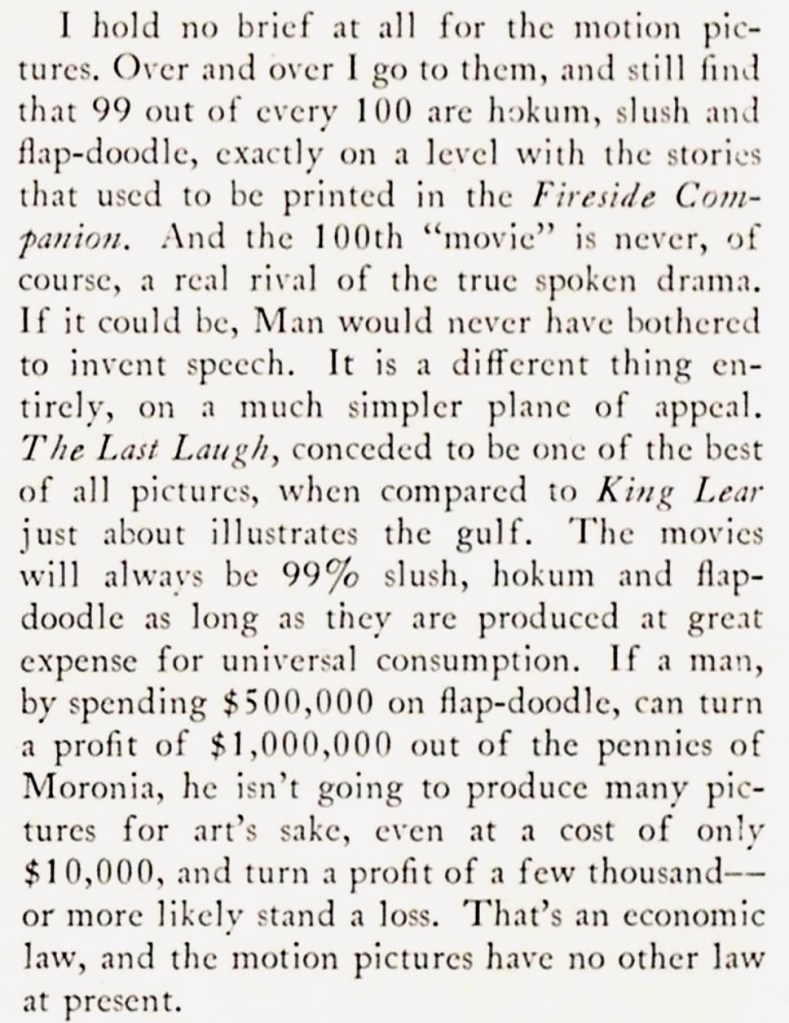
“I hold no brief at all for the motion pictures,” Eaton scoffed, despite a generous sampling that, if his words are to be believed, betrays a streak of masochism:
Over and over I go to them, and still find that 99 out of every 100 are hokum, slush and flap-doodle, exactly on a level with the stories that used to be printed in the Fireside Companion [a popular nineteenth-century periodical geared toward children]. And the 100th “movie” is never, of course, a real rival of the true spoken drama.
The movies to which Eaton referred were, of course, not yet talking. The synchronized sound revolution would get underway a year later, in 1927, when The Jazz Singer Toot-Toot-Tootsie’d the silents “Goo’ Bye.” Whether the closer alignment to “spoken drama” improved matters artistically is debatable; but that is not a speculation into which Eaton’s argument enters.
Since they were not “spoken drama,” Eaton reasons, the motion picture of his day could be no “rival” of the “true” drama performed live on the stage. “If it could be,” he sneers, “Man would never have bothered to invent speech.”
Despite his claim that a “movie” was a “different thing entirely” from stage drama, Eaton insists on comparing the two art forms, the former invariably falling short. Taking his professed disdain to the extreme, Eaton makes mention of The Last Laugh (1924), “conceded to be one of the best of all pictures”; but he does so only because Murnau’s wordless drama “just about illustrates the gulf” between screen and stage when “compared to King Lear.”
Movies, so Eaton, are constructed “on a much simpler plane of appeal” than are stage plays. What made them “simpler,” he reasoned, was that they spoke the language of the masses, whereas the theater kept alive the “mighty music of our English speech.”
There is no engagement with the artistry of silent film or with the qualities that, aside from their comparative wordlessness, make them “different.”
The movies will always be 99% slush, hokum and flap-doodle as long as they are produced at great expense for universal consumption. If a man, by spending $500,000 on flap-doodle, can turn a profit of $1,000,000 out of the pennies of Moronia, he isn’t going to produce many pictures for art’s sake […].
A somewhat more substantive and nuanced comparison between screenwriting and stage plays appeared, a few years later, in Eaton’s study The Drama in English (1930), in which Eaton argued, albeit in passing, that the “technique” of Shakespeare’s Antony and Cleopatra was “decidedly like that of the average silent ‘movie’—rapid flashes to propel the story, even ‘cut back’ scenes.” And while the argument Eaton advances with a vengeance in “The Strangling of Our Theatre,” is repeated in his critical history The Theatre Guild: The First Thirty Years (1929), the tone of the latter is less strident:
[L]ay the blame as you like on movies and motors and radios and what-not rival distractions, what has alienated many thousands of theatregoers from their ancient playhouses through the land has been loss of confidence in the value of the stage entertainment sent to them by the shopkeepers of Broadway. Lacking the creative energy and resources to rebuild for themselves local playhouses to take the place of the old local stock companies, which the shopkeepers had destroyed, these people have long been without a theatre worthy of the name.
Close, but no “flap-doodle.”
“Flap-doodle,” then, is troll—a baited line with which to ensnare readers who, the publisher of Vanity Fair hoped, would be awaiting responses from other members of the so-called “Symposium” with bated breath. Not that any of the authorities whose arguments were presented subsequently in the series actually responded to Eaton’s words, let alone quoted any of them. The “Symposium” on the “Future of the Theatre in America” is a mere contrivance. Nobody is confabulating with anyone.
For a moment it seemed conceivable to me that, as if persuaded by the arguments he sums up and comments on in the in the October 1926 issue of Vanity Fair, Eaton, or his journalistic persona, was becoming less dogmatic with respect to the performing arts, when, in an article perfunctorily titled “The Theatre and the Motion Pictures,” he acknowledged The Last Laugh to be a “splendid picture.” However, the views of the man Vanity Fair announced as a “reformed”—meaning former—“dramatic critic,” showed little sign of reforming. In fact, the repertoire of derogatory terms for motion pictures—such as “slush, hokum and flap-doodle”—was being broadened to allow for “smut.”
How different the Yankee flap-doodle of his posturing is from the welcoming extended to readers of Penguin Persons and Peppermints (1922), a collection of Eaton’s essays. In his introduction, the author explains that it
is the peculiar flavor of the essay that it reveals an author through his chat about himself, his friends, his memoirs and fancies, in something of the direct manner of a conversation or a letter; and he himself feels, in writing, a delightful sense of intimacy with his future readers.
If I like cats and snowstorms, and you like cats and snowstorms, we are likely to come together on that mutual ground, and clasp shadow hands across the page. But if you do not like cats and snowstorms, why then you will not like me, and we needn’t bore each other, need we?
Not that writers are the sum of—or only as good as—their subjects. What Eaton passes off as “delightful sense of intimacy” with “future readers”—that, is with ideal readers the writer has in mind—can be experienced as estrangement, a disconnect not just between writers and readers but between writers and whatever writerly personae they choose or agree, for a price, to don. How intimate can you get with someone who dismisses one of your passions as “flap-doodle”?
From a publisher’s perspective, a lack of “mutual ground” between reader and writer is neither a viable option; nor is it an obstacle. In the effort of bringing together an audience whose interests are as diverse as “cats and snowstorms,” the meeting place of minds must be remade as a sparring ring of sorts in which writers trade fighting words and punchlines such as “slush, hokum and flap-doodle” that, by whipping readers into a frenzy about any subject imaginable, are calculated to knock out the competition in the publishing game.
How, to misappropriate Yeats, can we know the thinker from the thought? Not, surely, by assuming that speakers are their speech.
When we speak of someone having a say or of a cause needing a “voice,” what we really mean is a “point of view” or stance—an attitude and the agency to bring it across. In short, we are more concerned with subject matter than with any particular manner of speaking.
It is the differentiation between content and style that seems to make it possible for us to unpack meaning by getting past the wrapper of language. That, in the process, we end up confusing “voice” with “view” suggests just how dubious the distinction is. After all, when we take issue with someone’s attitude, as I do with Eaton’s combative language, what irks us more than the message is the messenger’s tone of voice.
Regarding—or disregarding—style as external leaves us prone to the peril of slipping on the proverbial banana peel. How can we know what hit us if we neglect the “how” that got us there? The bruise we may end up with is the least of our problems. Skin is a vital organ. And so, however labored my analogy, is style.
“Having words” involves the challenge of weighing them up, of pondering their aptness in a specific context, interrogating their intended uses, and imagining the impression they may have on an audience that, to my thinking, should be discouraged from losing sight of the materials with which arguments are being constructed. Making style visible means letting readers in on the rules-governed game that is language by drawing attention to the player.
As a graduate student pursuing a PhD in English, I went so far as to make lexical gamesomeness my middle name, fancifully signing my term papers “Harry ‘Illudo Chartis’ Heuser.” A Latin phrase borrowed from Thomas Carlyle, it simply means “I play on paper.” And perform I did, even if my academic readers, whose task it was to assess my knowledge of a given subject matter, did not always feel inclined to play along.
No doubt, writing in a second language plays a part in this self-conscious foregrounding of a fishing for words and the display I make of the catch. And even though my playful approach to language precedes my experience of learning English, encountering words at a remove from their cultural contexts—their connotations dawning on me belatedly—has made me more aware of the substance of style.
Granted, my more heavy-handed metaphors may fall flat with a thud; but it does not follow that I deliberately choose pieces of vocabulary based on my sense of their heft alone. Rather, I am responsive to the character of words and their quality as sounds, to their ability to resonate and their capacity to conjure associations.
To my ear, “flap-doodle,” unlike “slush” or “smut,” is a breezy word. As an exclamation not unlike “poppycock,” I rather prefer it, a noun though it is, to the similarly dismissive but woefully overused “ridiculous!” In his provoking and, as it turns out, deliberately misleadingly titled short story “Women Are So Silly” (1924), Eaton reduces the Dickensian “Bah humbug!” to an emphatic “Bah!” with the economic rigor he attributes to pragmatic women who have as much time for sentimentality as they do for polysyllabic vocables on that tiresome subject.
Its sound, in adherence to Alexander Pope’s dictum, seems indeed an echo to its sense. Slap-happily, it lands on your noodle with the lightness of a soufflé. That it tickles you does not make it any less of a nuisance.
A loose glove of a certain elasticity comes to mind, grazing the face of a mildly impertinent addressee in a gesture meaning “fiddle-de-dee.” At first sight, it just did not strike me as the kind of padded mitten fir that is for Firpo and Dempsey or ready to wear for the sophisticuffs in which Eaton engages in the “Strangling of Our Theatre.” Is his tongue in his cheek as he refuses to turn the other?
I wondered whether I was just not familiar enough with the word and its history to judge how it might have been intended by Eaton or received by his readers.
“Flapdoodle,” I was surprised to discover, is still in the English dictionary, even though it has long fallen out of favor. Eaton—or perhaps an uncredited magazine editor—hyphenated the word, as if to suggest novelty. Words like “teen-ager” or “e-mail” lost their hyphens only gradually as resistance to them wore down in the face of their ubiquity.
In fact, “flapdoodle” was no novelty in 1926. For instance, Eaton’s fellow theater critic George Jean Nathan had a particular fondness for it, judging by its occurrence in his writings. Does it come with the territory of sizing up theatrical also-rans?
As may be expected, there is “flapdoodle” in James Joyce’s Ulysses (1922). What word in the English language ain’t? You will find it in Sinclair Lewis’s Babbitt (1922), Conan Doyle’s Tales from the Camp (1922), and, should you look for it there, in John Masefield’s Sard Harker (1924). George Bernard Shaw availed himself of “flapdoodle” to dismiss Schiller’s The Maid of Orleans in his Table-Talk (1925) with his biographer Archibald Henderson, having already made use of it in his plays How He Lied to Her Husband (1904) before resorting to it anon in Too True to Be Good (1931) and Village Wooing (1933).
Could it be that the hyphenation of “flap-doodle” in “The Strangling of Our Theatre” indicates a half-heartedness or a degree of scepticism as to its felicity on Eaton’s part? As far as I could tell after a modicum of research, the word does not appear elsewhere in his writing. That the word is unhyphenated in Eaton’s subsequent article “The Theatre and the Motion Pictures” may betoken an academic’s growing acceptance of the word, unless it suggests confounding arbitrariness or hints at the possibility of my making altogether too much about next to nothing.
At any rate, Eaton’s use of “flap-doodle” made more of an impression on me than did Mark Twain’s, whose Huckleberry Finn (1884) contains a chapter “All Full of Tears and Flapdoodle”—a sly nod to Macbeth’s “sound and fury.” About a quarter of a century earlier, Thomas Hughes made use of it in Tom Brown at Oxford (1861), a follow-up to his popular novel Tom Brown’s School Days (1857). The sequel was serialized in Macmillan’s from November 1859 to July 1861, “flap-doodle” appearing—and indeed being defined—in the March 1861 installment: “Flap-doodle, they call it, what fools are fed on.”
The following year, the word pops up in Charles Kingsley’s Water-Babies (1862), also published in Macmillan’s, where it likewise refers to as a source of intellectual malnourishment, against which Kingsley cautioned in a Lecture at Wellington College on 25 June 1863:
All of you here, I suppose, depend for your success in life on your own exertions. None of you are born (luckily for you) with a silver spoon in your mouths, to eat flapdoodle at other people’s expense, and live in luxury and idleness.
As Kingsley acknowledges in The Water-Babies, the flowering of “flap-doodle,” whether hyphenated or not, was indebted to the seeds sown by Frederick Marryat in Peter Simple (1834):
“It’s my opinion, Peter, that the gentleman has eaten no small quantity of flapdoodle in his lifetime.”
“What’s that, O’Brien?” replied I; “I never heard of it.”
“Why, Peter,” rejoined he, “it’s the stuff they feed fools on.”
There we have it, the original meaning of the word, a meaning that distinguishes it from the stuff-and-nonsense for which there so many other expressions at our disposal. Flap-doodle is balderdash that is ladled out and dished up to be consumed by those who are not discerning enough to notice its toxic effect or are reckless enough to welcome the intoxication.
To a writer like Eaton, a lover of wordplay who was not adverse to planting new ones when the variety of the garden seemed wanting—never mind that his “Penguinity” never quite caught on—and to gathering strange ones like “flap-doodle” as food for thought, ignorance about the rules of language and indifference to rhetoric were intolerable. In one of his essays, Eaton was compelled to resort to exclamation marks after reading a few magazine short stories by a publisher who appeared to put “Business before Grammar,” as “not one” of those stories “concerned itself with people who could speak correct English”:
So this is fiction for “the average man,” and on this spiritual fare his cravings for literature are fed! So this is the sort of thing which doubles the circulation of a popular magazine in twenty months! Such melancholy reflections crossed our mind, coupled with the thought that with no speech at all in the movies, and such speech as this in his magazines, the “average man” will either have to read his Bible every day or soon forget that there was once such a thing as the beautiful English language.
“Flap-doodle” by any other name would smell as foul. But at least “flap-doodle” has literary pedigree—and it pointed the finger squarely at the dispenser.
These days, with much of the business of editing and pleasure of writing given over to Artificial Intelligence, the finger hovers aimlessly. I reckon that many of us have given up pointing altogether. Style is no longer a signature to which we can ascribe any significance. It is losing its substance, along with so much of the solidity that discourse once meant among people facing other even when they cannot see eye to eye.
What seems to have been eating Eaton was not so much the “flap-doodle” of popular culture than the culture of flap-doodling in which standards eroded along with the platforms for their bearers. Flap-doodling was not just spoiling the food for fools, it was ruining it for everyone else.
In light of such blighting, Eaton eventually began to explore the potentialities of the medium in which the spoken word was the chief means of communicating ideas, a medium whose distinct qualities had washed over him, back in 1926, in that “overwhelming wave” of “motor cars, motion pictures, radios, jazz dances.”
As an Associate Professor in Playwriting at Yale, Eaton would team up with Constance Welch, a colleague in the Drama Department, to edit Yale Radio Plays: The Listener’s Theatre (1940)—a volume I picked up decades ago for use in my dissertation Etherized Victorians without looking into the credentials of Eaton as its co-editor:
Words, words, words, said Hamlet scornfully. But had he been speaking of radio plays, there would have been no scorn. Words well chosen, pared down in number to the essentials, vivid, sharp, provocative, are after all the primary weapons of the radio dramatist. He does not appeal to the audience directly, like the stage dramatist, but solely through symbols, i.e. words, and causes the audience to set the stage and view the action in their own imaginations.
To do this successfully calls for a definite kind of literary artistry, allied with printed literature in its emphasis on word selection, but allied with play writing in its tightness and economy of construction and its emphasis on the rhythms of speech, not print.
As we “clasp shadow hands across the page” at last, glad that I am to have established the “mutual ground” that Eaton refers to in Penguin Persons and Peppermints, I realize that the “mutual ground”—despite my views on motion pictures—is our enthusiasm for language and our attention to matters of style. It took a mild irritant like “flap-doodle” and its seeming incongruousness to send me on this ramble on words as thoughts, theatrics, and troll.
If an occasional “flapdoodle” slips into my prose from now on, you have “The Strangling of Our Theatre” to thank or blame for it.
Discover more from Harry Heuser
Subscribe to get the latest posts sent to your email.
 Harry Heuser