Of “historical value”: Hitler’s “Best” Straight Talk and Other Continuity Types

As soon as I decided to make radio plays written in the United States in the 1930s, ‘40s and early ‘50s the subject of my doctoral study, I set out to scour New York City University libraries for scripts published during that period. My degree is in English, and I was keen not to approach broadcasting as a purely historical subject. The play texts and my readings of them were to be central to my engagement with the narrative-drama hybridity that is peculiar to radio storytelling. Whenever possible, I tried to match script with recording—but, to justify my study as a literary subject, I was determined to examine as many print sources as possible. One text that promised to provide a valuable sample of 1930s broadcast writing was Radio Continuity Types, a 1938 anthology compiled and edited by Sherman Paxton Lawton.

Back in the late 1990s, when I started my research, I was too focused, too narrow-minded to consider anything that seemed to lie outside the scope of my study as I had defined it for myself, somewhat prematurely. Instead, I copied what I deemed useful and dutifully returned the books I had borrowed, many of which were on interlibrary loan and therefore not in my hands for long. It was only recently that I added Radio Continuity Types to my personal library of radio related volumes—and I was curious to find out what I had overlooked during my initial review of this book . . .

Radio Continuity Types is divided into five main sections: Dramatic Continuities, Talk Continuities, Hybrid Continuities, Novelties and Specialties, and Variety Shows. Clearly, the first section was then most interesting to me. It mainly contains scripts for daytime serials, many of which I had never heard of, let alone listened to: Roses and Drums, Dangerous Paradise, Today’s Children. There are chapters from Ultra-Violet, a thriller serial by Fran Striker, samples of children’s adventures like Jack Armstrong and Bobby Benson, as well as an early script from Gosden and Correll’s Amos ‘n’ Andy taken from the period when the program’s format was what Lawton labels “revolving plot drama.”

Aside from a melodrama written for The Wonder Show and starring Orson Welles, I got little use out of Lawton’s book, mainly because I concentrated on complete 30-minute or hour-long plays rather than on serials I could only consider as fragments. Besides, I was not eager to perpetuate the notion of radio entertainment as being juvenile or strictly commercial.

Anyway. Looking at the book now, I am struck by Lawton’s choices. Never mind the weather report on page 346 or Madam Sylvia’s salad recipe. How about the editor’s selection of “Occasional speeches”? Historically significant among them are Franklin D. Roosevelt’s first inaugural, a “Welcoming” of Roosevelt by Getulio Vargas, President of Brazil, as well as Prince Edward VIII’s announcement of his abdication.

No less significant but rather more curious are Lawton’s “Straight Talk” selections of fascist propaganda by Benito Mussolini, Joseph Goebbels and Adolf Hitler: “Long live the National Socialist German Reich!” and “Now and forever—Germany! Sieg Heil!” Surely, such lines draw attention to themselves in a volume promising readers “some of the most successful work that has been done in broadcasting.” What, besides calling Goebbels’s “Proclamation on Entry into Austria” and Hitler’s “I Return” speech (both dated 12 March 1938) “straight” and “occasional,” had the editor to say about his selections? And what might these selections tell us about the editor who made them?

In a book on broadcasting published in the US in 1938, neutrality may not be altogether unexpected, as US network radio itself was “neutral”; but Lawton—who headed the department of “Radio and Visual Education” at Stephens College in Columbia, Missouri—seems to have gone beyond mere representations of “types.” Introducing a translation of Hitler’s speech, which comments on the reluctance of “international truth-seekers” to regard the new “Pan-Germany” as a choice of its people, Lawton argued it to represent “some of the best work of a man who has proved the power of radio in the formation of public opinion.” There are no further comments either on technique or intention. No explanation of what is “best” and how it was “proved” to be so. No examination of “power,” “public,” and “opinion.” It is this refusal to contextualize that renders the editor’s stamp of approval suspect.

The “continuity” Lawton was concerned with was of the “type” written for broadcasting—not the “continuity” of democracy or the free world. When he spoke of “historical value,” the editor did so as a “justification for a classification” of the kind of “continuity types” he compiled (among them “straight argumentative talks” by Senator Huey Long and Father Coughlin). And when, in his introduction, he speculated about radio in 1951 (“when broadcasting [would] be twice as old” as it was then), he did not consider what consequences the “best” and “most efficient” of “straight talk” might have on the “types” that were still “in common use” back in 1938.

Given its definition of “historical value,” it hardly surprises that Lawton’s anthology was not in “common use” for long. There was no second edition.

Ascent to the Gods: The Odyssey of Norman Corwin (1910-2011)

Obituaries often begin like this: The world (the art world, the theater world, the world of miniature golf, or what have you) has lost one of its leading, brightest, most prominent so-and-so’s. But that won’t do. Not if the so-and-so is Norman Corwin. The formula would not be worthy of him, for one. Stylistically alone, it would be un-Corwinian; it would be Hummertsian. Nor would it fit the occasion of commemorating his life’s work since the formula cannot contain it. The application would lead instead to inaccurate, misleading statements such as this one: The world of radio drama lost one of its greatest writers.

True, Norman Corwin, who died on 18 October 2011 at the age of 101, was a leading light in that dark theater of the mind. But he was also a journalist, a teacher, a screenwriter, a director, a producer, and, what has yet to get into the heads of those who assemble the anthologies of American Literature, a poet. He inhabited and enriched many worlds—and yet, for the past sixty years or so, Corwin has not been known the world over. You might say that we, most or millions of us, lost Norman Corwin decades ago because we, or some somebodies we permitted to act in our stead—though not on our behalf—decided that the world Corwin helped create and never forgot should be written off, abandoned, and depopulated of its talent like the ghost of a mine whose ore is no longer deemed worth our digging . . .

In the United States, the world of radio drama is such a lost world—and those, like cretaceous me, who keep on living in this world even if we can no longer live by it, might as well be dwelling on some dark star in a parallel universe. Unlike today’s listeners, radio writers did not have that choice back in the late 1940s, unless they were content, as Corwin put it in retrospect, to be “apolitical except for strong support of home and motherhood,” “inoffensive to the world in all its parts (although in radio practice, exceptions are often made in the case of minority-opinion groups which cannot possibly reply)” and prepared to “keep within the pale of clichés of character and situation so traditional there is a mellow patina on them.”

“I believe that artistic radio, whether commercial or otherwise, will not develop without a willing and interested leadership on the part of those who control programming, budget and time,” Corwin exclaimed in 1947. “That is all.”

That was all. One year later, Corwin felt compelled to remind those in control that he was still there, waiting and willing to take on another creative assignment—another Twenty-Six by Corwin, perhaps, another One World Flight. “I Can Be Had,” he announced; but those in “control” would not have him back.

“The artists are around, and there is nothing occult about the process of dialing their telephone numbers and talking it over.” Apparently, no one bothered to touch that dial. After years of restraint, commercial radio was eager to get richer even it that meant becoming culturally less enriching. It was a short-lived strategy of cashing in before television would take over and pretty much close the theater of the mind for good. Never again would a single play written for the ear reach and move an audience of sixty million in no more than two performances—as Corwin’s “On a Note of Triumph” did in 1945.

Forced to exit network radio because executives no longer commissioned verse plays, dramatic documentaries or travelogues in sound—three genres that are quintessentially Corwinian—Norman Corwin began travelling between worlds, the worlds of film, journalism, and the academia. Television, at least initially, was too small, too restrictive a realm to attract, let alone accommodate an imagination as vast as his. To Corwin, the audiovisual upstart was but a “poor bastard among the arts, having the benefit of neither the full scope and mobility of cinema, the immediacy of the legitimate theatre, nor the powerful suggestibility of radio’s unillustrated spoken word.”

The American theater of the mind may have been shut up, but Corwin’s mind stayed open. For over sixty years, he kept on journeying, searching and yearning. That’s the spirit that sustains you until you’re 101. Lucky are those who encountered him along the way. I prize the words of encouragement he wrote to me when, a few years ago, I dusted off my obscure dissertation on the American play to share my chapter on Corwin with the very man. I think of those words whenever I feel that, not being quite as eager as he to venture elsewhere, I lost my way; that I am lost to most of the image-minded world, untravelled, unraveling, yet all the while revelling in the “unillustrated spoken word.” I got the words, all right; Corwin had the wisdom as well.

I shall leave this entry in my otherwise image-filled journal “unillustrated.” I imagine Mr. Corwin appreciates the gesture . . .

(For those ready to catch up or on, the entire run of Twenty-Six by Corwin is currently being rebroadcast by John and Larry Gassman of Same Time, Same Station.)

History Stinks (and Your Granny Didn’t Smell So Good Either)

I’ve long tried—and, you might say, failed and pretty much given up on—filling a gap in the construction of our cultural histories, most of which are entirely too preoccupied with images and their interpretation. Western culture may privilege vision over any other sense—but if you think that the past will unfold before your eyes simply by looking at graphics, photos or printed records, you’ve been led by the ear you aren’t using. It’s no use being so eye-minded as to forget all about lowbrow radio programming, for instance. After all, sound-only broadcasting had a greater influence on most folks living in the middle of the 20th-century than the press or motion pictures—certainly a greater influence than most scholars are prepared to acknowledge. Radio comforted and counseled, intimated and importuned. It brought the world home and played on our minds like no competing medium could.

Crooning, cajoling, and commanding attention, whatever talent stood at the microphone became part of a soundtrack to the everyday of millions of dial-twisters who took in or were taken in by the big bands and banter, by sermons, sportscasts, and soap operas. Radio sold products as well as ideas and ideologies. It excelled in telling stories, be they fictive, factual or false; and, if you let it, it keeps on telling them or telling you about them . . .

While I have long suspected the picture to be incomplete if we insist on looking at the past as a sequence of images, I never seriously considered that, aside from sound, there is a story, too, in the way we smelled. And yet, in my old hometown of Cologne, Germany, alone—the burg that gave us the word for all our attempts at olfactory cover-up—the romantic poet Samuel Taylor Coleridge once ‘counted two and seventy stenches.’

There would have been no soap—and no soap operas—if we didn’t have trepidations about not being quite fresh, anxieties that were over-ripe for commercial exploitation. In the US, tuners-in of the 1930s, ‘40s and ‘50s were constantly being alerted to the dangers of B-O, reminded to ‘Lux’ their ‘dainties,’ and told to gargle before putting their kissers to the test. Lest they could endure facing guilt by omission, listeners lathered up with products like White King toilet soap, the box tops of which they collected and sent in to broadcasters as ocular proof of their hygienic diligence, for which cumulative evidence they were duly awarded various prizes (or premiums).

For all the restrictions faced by press and broadcasting, advertising some sixty, seventy years ago, was certainly more in your (presumably unwashed) face than it is now. It sounds as if listeners-in back then were in far greater need of Lysol and Listerine. Could it be that our forebears required more frequent scrubbing because they were more likely to labor manually without having access to as much running water, cold and hot, than our more sedentary selves take for granted today? If so, did they really need to be reminded of their particular emanations?

Advertisers did not rest until the natural acquired the whiff of the common. The airwaves, though they were not permitted to be polluted by sounds suggesting most of the bodily functions to which we give vent in private, certainly were awash with voices alerting us of the social consequences of reeking to high heaven.

However fleeting, sound has not been an instant bygone ever since we succeeded in preserving it some 135 years ago. Granted, such records do not tell us the whole story of how people talked and what they had to say; but whatever we bottle as fragrance is even more likely to throw us off the scent in our quest for the real, something that complicates our efforts whenever we feel inclined to stick our nose into the past.

The irony that I am using a print ad to illustrate my point has not eluded me. It is an ad, no less, from a magazine catering to the radio listeners, consumers who were often told, as they waited for the advent of long-promised television, that only sight could complete the picture. It is a myth in which even radio broadcasters were complicit.

Sure, the picture of the past is always incomplete; it is as much a composite as it is a construct. Still, I prefer to keep augmenting my impressions of those yesterdays by lending an ear to the ticking of our clocks. If we keep on looking, and look on only, we might well be missing what is right under our noses …

“The lady of the house speaking”: A Bucket for Myra Hess

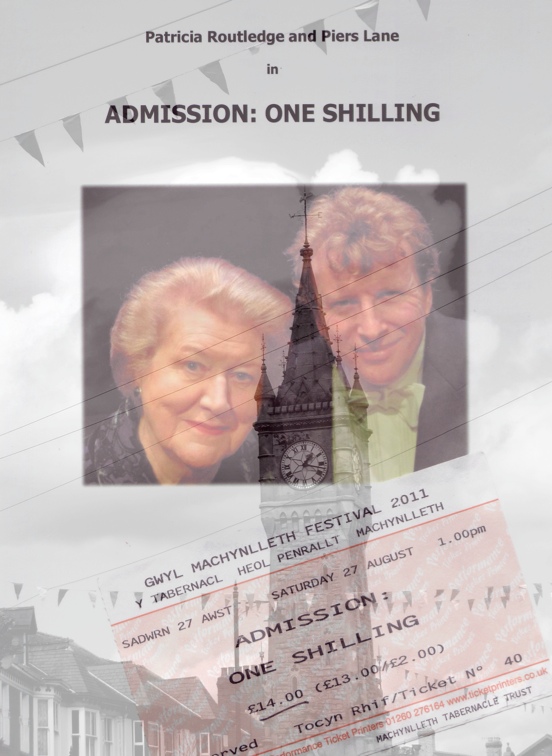
Eve Arden is Our Miss Brooks. Joan Collins is Alexis. Estelle Getty, Sophia. Whatever else these ladies did in their long stage, screen and television careers, they have become identified with a single, signature role they had the good fortune to create in midlife. Grabbing their second chances at a second skin, they experienced a regenerative ecdysis. The character or caricature that emerges in the process obscures the body of work thus transformed. Another such anew-comer coming readily to mind is Patricia Routledge, who, for better or worse, makes us forget that she has ever done anything else before or since she took on the role of Hyacinth Bucket in Keeping Up Appearances back in 1990. Would she forever keep up the charade, or might she yet have the power to make this our image of her disappear? Could she spring to new lives by kicking that Bucket? Those questions were on my mind when we drove up to the ancient market town of Machynlleth, here in mid-Wales, where Ms. Routledge was scheduled to make an appearance in a one-woman show.

Well, it was bucketing down that afternoon, which, had I been metaphorically minded at that spirit-dampening moment, I might have taken as an omen. Not that the rain had the force to keep the crowd, chiefly composed of folks scrambling to make the final check marks on their bucket list, from gathering in the old Tabernacle. Here, the stage was set for Admission: One Shilling. Not much of a stage, mind; there was barely “room for a pony.” Piano, I mean. But little more than that piano was required to transport those assembled to 1940s London, where, for the price of the titular coin, wartime audiences were briefly relieved from the terror of the Blitz by the strains of classical music . . .

The music, back then, was played by British concert pianist Myra Hess who, though much in demand in the United States, put her career on hold to boost the morale of her assailed country(wo)men. Hess did so at the National Gallery, a repository of culture that, at the outbreak of war, had taken on a funereal aspect when its paintings were removed from the walls and carted to Wales to be hidden in caves for the benefit of generations unborn and uncertain.

Meanwhile, those living or on leave in London at the time were confronted with a shrine that held none of the riches worth fighting for but that instead bespoke loss and devastation. From October 1939 to April 1946, Hess filled this ominous placeholder with music; much of it, like her own name, was German—a reminder that the Nazi regime and the likes of Rudolf Hess had no claim to the culture they did not hesitate to extinguish if it could not be made to serve fascist aims.

Taking her seat on the stage, the formidable, elegantly accoutred Ms. Routledge seemed well suited to impersonate Dame Myra as a woman looking back at her career in later life. It mattered little that Routledge did not herself play the piano while she reminisced about the concerts she had given. Selections from these performances were played by accompanist Piers Lane, who filled in the musical blanks whenever Routledge paused in her speech.

Writing that speech posed somewhat of a challenge, considering that Hess never published a diary. According to her great nephew, who created this tribute, the script is based on press releases and radio interviews. Indeed, the entire affair comes across as a piece made for radio, if it weren’t for those occasional darts shot at no one in particular from Ms. Routledge’s eyes, frowns that remind you of irritable Ms. Bucket’s priceless double-takes.

Perhaps, it does take a little more—and a little less—to pull off this impression. On the air, we could hear Dame Myra Hess at the piano. If the performance were more carefully rehearsed, or edited, we would not have before our mind’s eye the script from which Routledge reads throughout. We would not require the distractions of a screen onto which photographs of the wartime concerts are projected. We would not be as distanced from the life that yet unfolds in Hess’s own sparse words.

Never mind that Admission: One Shilling has about as much edge as a Laura Ashley throw pillow. What got me is that I felt as if I were attending one of Ms. Bucket’s ill-conceived candlelight suppers, whose decorous make-believe remains ultimately unconvincing. I found myself hoping for something undignified—a pratfall, even—as if I had come to see this woman but not come to see her succeed. Such, I guess, is the lasting legacy, the curse of Hyacinth Bucket that, as I exited, I was wondering what Sheridan might have done with the money . . .

Better the DeMille You Know

“Take Back UR Power Now,” the letters on the marquee read. I am standing in front of the Music Box Theater on Hollywood Boulevard. Whose power? I wonder. Who took it? Who lost it? And just who is telling me—or anyone else reading—to seize it? Take it from me, perhaps? Do I have it? Did I ever have it? Am I supposed to have it? If so, to do what with? Storm the box office? Take to the stage? Tear down the building and plant a tree? A windmill? Hold it. Is this one of those tiresomely postmodern Barbara Krugerisms? As my friend Clifton once put it, “I could look [it] up . . . but it’s more fun to speculate.”

The imperative “Now” intrigues me. It strikes me as incongruous, anachronistic. And, yes, antagonistic. It does not seem to denote the “Now” of 2011, my “Now” on this bright, sunny afternoon spent in one of the most frivolous locales in the western hemisphere. The look of the venue, the somewhat run-down surroundings, the slogan and its lettering transport me back to the early, bleak, violent, recession-shaken 1990s. Why am I thinking race relations? Could this not just as well be some hackneyed Tea Party catchphrase? Or else, a sign of things to come . . .

The time is ripe for warping. I’ve just been to Grauman’s Chinese, placing my palms into the imprints left by stars long gone out. I’ve been taking in all those names on the Walk of Fame, and it felt like treading on gravestones. And I arrived here, at the Music Box, transported by a longing, by the kind of nostalgia I am so wary of.

I did not expect to be reminded of the 1990s, to be taken aback instead of simply being taken back, if that were ever achieved ‘simply.’ Sure, I was prepared to be late. Seventy-five years late, to be exact. If it were in my power, I would be standing here, back in line with hundreds of other enthusiasts, to take a gander at Marlene Dietrich, Myrna Loy, Ruby Keeler, or Claudette Colbert. Not on the screen, mind, but live and in person. The Music Box, after all, was once the venue for the Lux Radio Theater, a Monday afternoon extravaganza hosted by showman-director Cecil B. DeMille. Merle Oberon, Marion Davies, Joan Crawford. Back in the summer of 1936, they were all here. I am in awe.

That is why I have come to this spot—on a Monday afternoon, no less, as I would later realize. I was dreaming. Now I feel tired out, and a little bit stupid, having caught myself chasing after ghosts. It is as if I had been hoping to get hold of the breeze stirred up by some wispy number long since mothballed. The spirit of the place does not “send me,” as swooning teenagers used to call it (the state of swooning, I mean). If anything, it sends me back to where I started this reverie. It takes me back into the ether, the mythical non-space I can fill, at will, with the voices of Marlene Dietrich, Myrna Loy, Ruby Keeler . . . as they were performing for millions of listeners, broadcasting live from the Music Box stage. It takes me back.

Wait. When was it again that I discovered these recordings for myself? The early 1990s. Well, what do you know! I guess, looking at that marquee, I have been forced to catch up with myself, and I find that self wanting, historically lost to the world. Years spent circling in representations of a past not alive to my being. Is it time to take back whatever I squandered? Is there still time? Do I have the energy to matter, the power to mean? I wonder . . .

The Touchables

The folks who proved that they had made their mark in Hollywood by leaving it in the cement slabs in front of Grauman’s Chinese Theatre had one thing in common. Besides having the stature of a movie star or Tinseltown personality, I mean. They could all stand up, bend down, and exert whatever pressure is required to produce those imprints. Even Charlie McCarthy, apparently. I always thought that it might please the supposed untouchables to be commemorated in a medium that is not as telltale about our inescapable senescence as a photograph or moving image. Many of us can stand up far longer than we can stand looking in the mirror.

Then again, the moving hands of time are readable in our footprints. Shirley Temple’s tiny imprint reminds us that, on 14 March 1935, she was at the height of a career that diminished as she increased in size. Still, the prints are meant to bespeak immortality. We don’t get to see the tracks of Christopher Reeve’s wheelchair, for instance. Nor is Zsa Zsa likely to be given the honor now to join those ladies in cement. These prints are all solid, no matter how much the concrete crumbles. The stars have bodies—and they are able and sound . . .

There is something reassuring in that solidity—if it weren’t for those cracks, and the puzzled looks I come across in the crowd gathered here to take pictures, mainly of themselves in front of a Hollywood landmark. Who was Rudy “My Time Is Your Time” Vallee, anyway? Norma Talmadge, who’s she? What were the Ritz Brothers all about? And who was that Sid fellow for whom they left those cryptic messages?

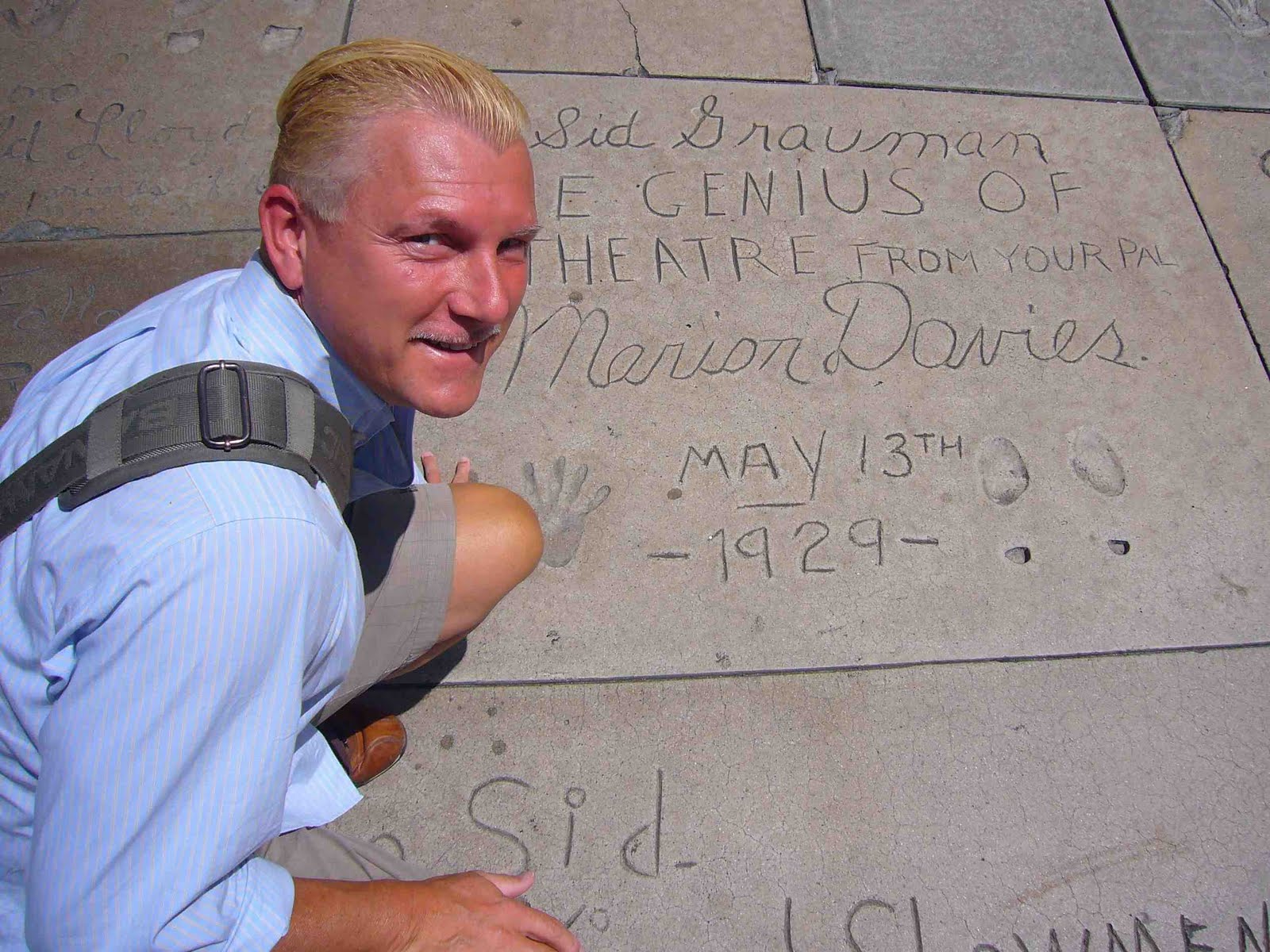
I got the space to myself as I have my picture taken with Marion Davies’s dainty indentations (dated 1929), my palm covering the hollow. No one is likely to pull a Lucy now; the Duke is still standing. Most walk right past—no, over—Ezio Pinza, whose block of concrete has become a mere steppingstone. Not a soul stoops to Monty Woolley. He’s the actor to whom my dog owes his name (I’m telling no one). I, too, I am out of touch.

There is one imprint, though, that keeps impressing after nearly sixty years. You can tell from the grime in the handprints of Marilyn Monroe just how many visitors have bowed down to approximate her posture, crouching over to show that they still look up to her. Screen partner Jane Russell’s palms are eloquently untainted by comparison. Marilyn—and we call her by her first name in recognition of her vulnerability—would be dead within ten years after being immortalized at Grauman’s. Our reaching out to her now is a belated, selfish gesture. You can’t expect rectitude from a crowd bent on lowering themselves for a photo opportunity. Remaining upright here means to be indifferent.

“Wipe your mucky paws,” I want to cry out. Yet these cultural touchstones are unlike other memorials to the untouchables. Here, we touch what we deem worth preserving. We bestow genuine stature with our own hands. We grasp at the chance to grease the Hollywood machine with our grubby palms, to fashion destinies with our filthy fingers. Since greatness does not rub off, most of us leave little more than a smudge. There is humanity in the residue of perspiration.

The Couple in Grandmother’s Bed

I have said nothing yet about my trip to Germany.  It was not any old sightseeing tour, mind; nor was it a carefully mapped out homecoming, which makes it all the more difficult to capture in a few indifferent words.  The thing is, I had not been to my native country in over two decades; and, during that time, not going back to what folks presume to be my home evolved into a programmatic, defining rejection of the notion that home equals country of origin.  I vowed never to return, except in a pine box. 

Ella and I

That I did go back at last, in the similarly confining encasement that is the cabin of a budget airline craft, required a great deal of preliminary introspection—and a leap over the shadow to which I had tried to relegate my past.

The department at the university where I teach was taking students to Berlin for its annual outing.  Previously, I had been on the departmental trip to Budapest; and while that adventure was an adulterated delight, owing to transportation problems in the form of a broken bus and a missed flight, I thought that it would be petty to stick to my principles and stay put while my partner, as head of the School, was joining our students and colleagues for a week in the town known for Cabaret, communism, and Currywurst.  Besides, Berlin is too far from my native Rhineland to be thought of as “home” or trigger unwanted back-where-I-come-from reminiscences.  So, to Berlin I agreed to go . . .

Now, a few days before we were scheduled to depart for the German capital—which hadn’t been capital at the time I left former West Germany for the East Coast of the United States—I received one of those infrequent e-missives from the fatherland that are reserved mainly for anniversaries, holidays, and assorted disasters.  My sister’s message read that my grandmother had contracted a virus while hospitalized for a fracture—her first hospitalization in well over half a century—and that, unless I acted posthaste, I might never see her alive again.

Unlike the mater of my father (both deceased), my maternal grandmother had kept in touch with me during my years abroad.  She had learned, decided—or perhaps never thought twice—to accept me, which, given her youth in fascist Germany, is a triumph of spirit over doctrine.  For years, she had been sending her regards to my same-sex partners, companions my other grandmother thought best accommodated behind barbed wire, if they were to be granted living space at all.

So, a few days before I was scheduled to depart for Berlin, I booked a flight to Düsseldorf to see Oma.  I suffered a great deal of anxiety going by myself, going to see relatives I had abandoned years ago and walking down streets I had known during what, not in retrospect only, was an unhappy youth.

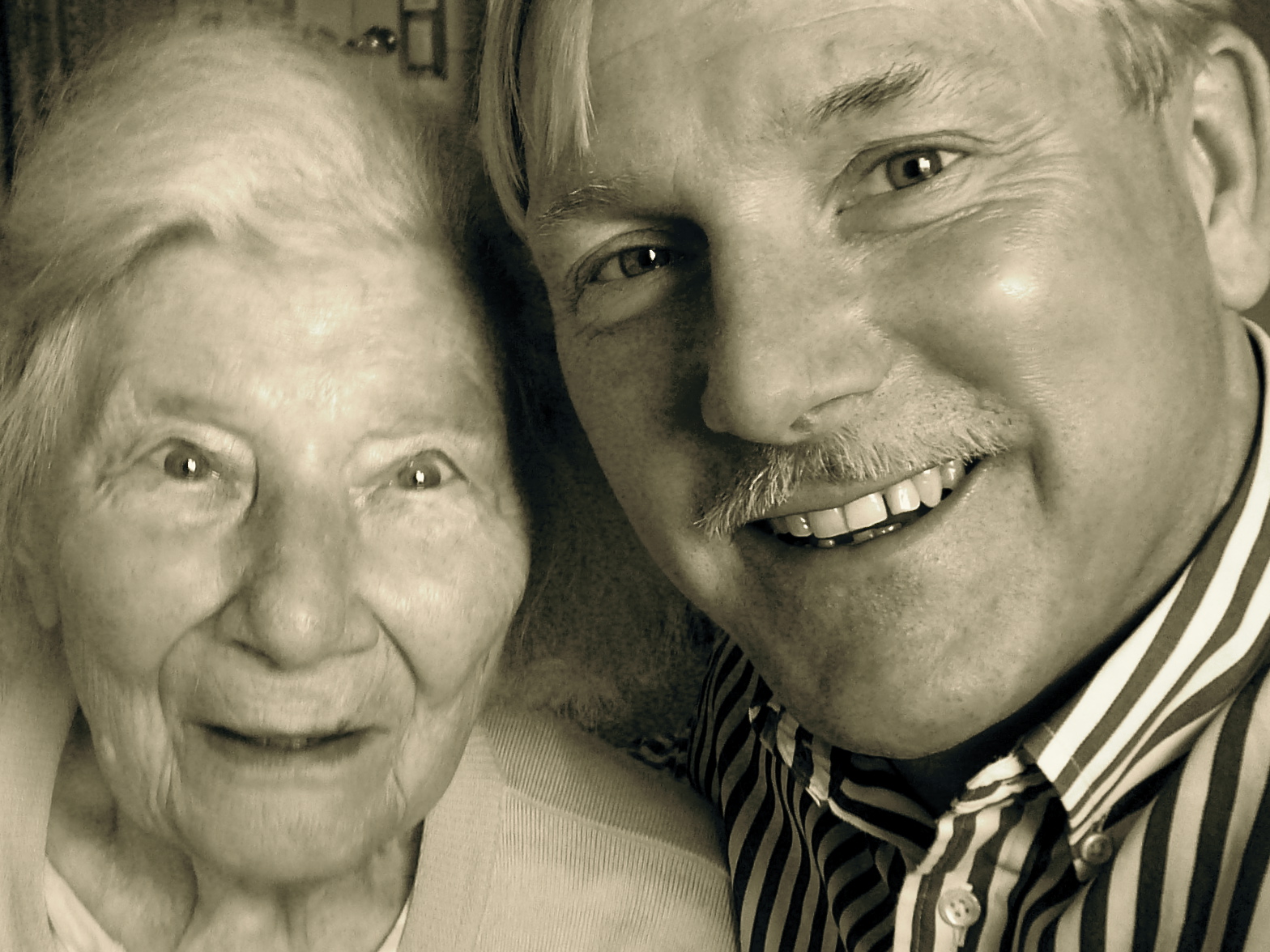
Luckily, I had friends on whom I could count: a cousin came to collect me from the rather remote airport and old friends offered quarters and shoulders should my visit prove overwhelming . . . or my arrival too late.  Such comforts notwithstanding, it was disconcerting to visit Ella at the hospital, especially since it involved having to wear a protective mask that obscured my face so that she did not recognize me.  I had not announced my visit lest she might think that, if even the prodigal grandson was coming to see her, her condition must truly be touch-and-go.  It was sobering to be greeted like a stranger, but also deserved, I thought—until at last there was a look of recognition in her eyes and a warm smile radiating from her lips.

Not having booked a hotel room, I stayed in grandmother’s apartment that night.  There I was, sleeping in the bed of a woman who might not see another morning and who, as it turned out, would never sleep in it again, though live she did.

We all have our security blankets, I suppose.  Mine is made out of immaterial stuff, a fabric as gossamer and yet as tangible as the air on a sultry summer’s evening as I had known it well to the west of Wales.  Lying there, alone in Ella’s bed, I surrounded myself with voices at once strange and familiar; voices of a safe, distant past—a past that was none of mine.

On a night rendered restless by thoughts of loss and futility—a life in danger and a life wasted in the refusal to be faced—I belatedly tuned in The Couple Next Door, a late-1950s serialized radio sitcom.  Written by and starring Peg Lynch, whom I had once seen performing one of her husband-and-wife sketches during an old-time radio convention, The Couple controlled the crowds with which my thoughts were teeming.  It comforted like no cotton coverlet could, warmed like no drop of Scotch.  Though not soundly, I did sleep that night, wrapped up as I was in a cocoon of sound . . . a quilt to muffle the guilt I felt for not returning sooner and for being defined instead by a quarter century of negation . . .

“Who Are [These] People?”: The Mediations of A. L. Alexander

“What do you think of a husband who has given a woman eight children and lived with [her] for twenty-four years and in front of his children denies that he is married to her?” No one hearing the question—an estimated twelve million US Americans—could have been particularly interested in a considered response by anyone else, given that radio listeners were invited to articulate it for themselves. It was the scenario that thrilled, the common, raw and purportedly true story that was 1438C, one of three cases put before A. L. Alexander and his Mediation Board on this day, 28 June, in 1943.

As told in the words—and the accents—of ordinary if not ordinarily quite so communicative contemporaries in situations of personal crises, it turned anyone listening into a father confessor, a judge of manners, morals and mental states.

Placing the unexceptional and non-exemplary on a national rostrum, the Mediation Board, like the tabloid talk shows that dominated the daytime schedules of American television networks during the 1990s, was a readily available and gratefully ingested nostrum, a dose of quack medicine designed to comfort the listener rather than cure the speaker . . .

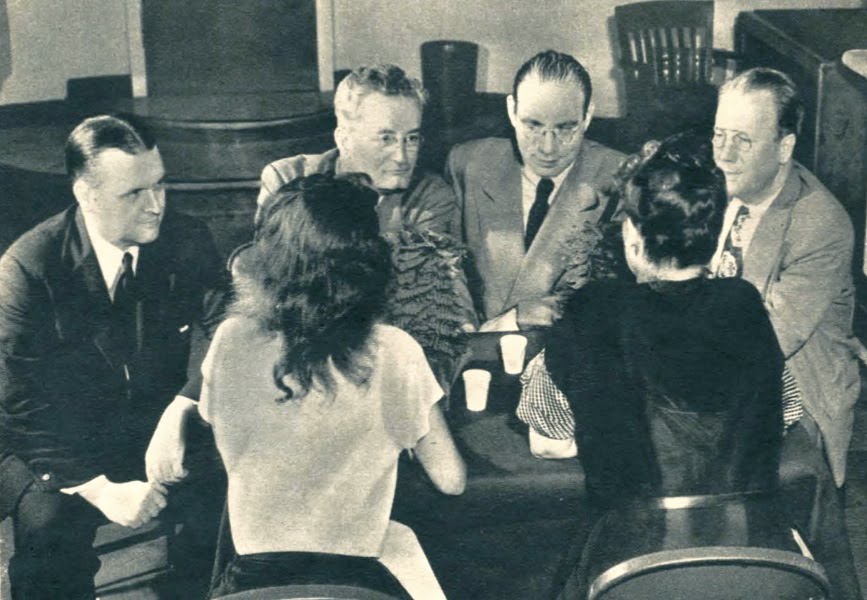
According to an article in the October 1945 issue of Tune In, “most” of the folks who wrote in to appear on the program—without receiving any compensation other than a few kind or cautionary words—were “working-class Americans who have never heard of psychoanalysts, or [would] find the cost of a divorce prohibitive,” and—the occasional “prankster” who would “invent some complex and chaotic problem” aside—turned to Alexander (pictured above, second from the right) and his rival John J. Anthony “with an intensity and devotion” that turned the host into an “almost god-like” figure.

Case 1438C was the story of forty-year-old woman who, at the age fifteen, left her parental home, where, according to her, she had been shown “no affection whatsoever,” to live with the man, then also a teenager, who eventually fathered her eight children.

Having been presented with a wedding band, she assumed herself to be legally married; but, by the time their first child was born, she came to realize that this was not the case, an illegitimacy that did not stop her from bearing him seven more. “I want my husband to marry me,” the woman now demanded, and that despite her suspicion that her partner was also a bigamist.

Unable to confront this accusation, her agitated “husband,” who had agreed to join her on the program, nearly stormed out of the WOR, New York studio from which A. L. Alexander’s Mediation Board emanated and broadcast nationally over the Mutual network. “There’s no such a thing as love,” he exclaimed, suggesting that the couple’s care for their offspring—among them “three lovely sons in the service”—was not reason enough to keep them together and legalize their relationship after nearly a quarter of a century.

To this, the Mediation Board members—priest William C. Kernan, executive director of the Institute of American Democracy, rabbi James G. Heller, and Paul Dawson Eddy, member of the Council for Religious Education and president of Adelphi College—had very little to say. Their words of warning or compassion merely sanctioned the dramatic she says/he says showdown, giving it an air of respectability and creating a sense that the program was living up to FCC standards.

Apart from its culturally diverse and reputable panel, Alexander’s Mediation Board responded to detractors by suggesting that its relevance and service in the public interest lay in the presentation of domestic problems “arising out of restless wartime conditions” in the alleviation it strove to assist, presumably as part of the war effort, however questionable it might have been to penetrate the home front in order to air its sundry grievances, thereby demonstrating it to be less than sound and far from self-disciplined.

Alexander had not always been able to defend his cashing in on the mental anguish and the at times morbid curiosity of his fellow Americans. Some six and a half years earlier, in December 1936, he was forced to shut down his popular Good Will Court, which, according to the 3-9 January 1937 issue of Radio Guide, had commanded network radio’s “fifth largest listening audience” until the New York Supreme Court ruled in favor of those who argued, as Alexander put it, that “the consideration of legal problems on the radio was ‘unethical.’”

By turning legal matters into spiritual and psychological concerns, Alexander managed to return to the airwaves and riding them, on the strength of the flotsam and jetsam with which his program was awash, for another decade.

After all, as Tune In pointed out, staying on the Board “proved to be one of radio’s most lucrative businesses,” especially considering Alexander’s credentials, or lack thereof, as a former “prize debater in public school” who had no “training in psychiatric social work.”

Having studied for the ministry and served three years at a Cincinnati theological seminary, he “became infatuated with the vast potentiality of listeners that radio could provide, took several routine announcing jobs before the idea for his program crystalized in his mind.”

During his involuntary and prolonged hiatus, Alexander explored the similarly vast financial “potentiality” of publishing by compiling Poems That Touch the Heart (1941), a volume of human interest poems that became a tie-in for his latest radio venture when selections were read at the conclusion the weekly Mediation Board meetings.

Heard on the 28 June 1943 broadcast, for instance, was “Who Are My People?” by Rosa Zagnoni Marinoni (not identified by name), a poem that emphasized comforting commonality while mitigating against what, in the unscripted words of the quarrelling couples, might come across as dead common.

In search of “my people,” the speaker senses “no kinship” toward fellow worshippers and feels estranged from the native old world, only to find the question “Who are my people?” answered by an encounter with one of the plebs:

Last night in the rain I met an old man
Who spoke a language I do not speak,
Which marked him as one who does not know my God.
With apologetic smile he offered me
The shelter of his patched umbrella.
I met his eyes. . . . And then I knew. . . .

Few folks now know A. L. Alexander; but the man who made a nation’s tattered nerve and moral fiber his umbrella—and who so shrewdly stitched the profane to the sacred cover he provided for it—still has his name on that volume of the poetry that served to promote his program. In print to this day, Poems That Touch the Heart still credits Alexander, however meaningless the reference may now be, with being the “Creator and Conductor” of the Good Will Court, the “original” Mediation Board, and The Court of Human Relations.

Patching, joining, and thriftily recycling for the ostensible public good—it was all part of the A. L. Alexander technique.

Murder on the Cathedral Radio: Rudy Vallee and the WPA

”Whatever your own political views in the matter may be. . . .”

Diplomatic, cautious and propitiatory, those are hardly words you would expect to hear coming from the close-miked mouth of crooner Rudy Vallee, one of the 1930s most popular—and insipid—radio personalities. After all, Vallee was not emceeing America’s Town Meeting of the Air; his chief ambassadorial function was to promote middlebrow culture and represent the makers of a certain leavening agent. Yet that is just the preamble with which the old Vagabond Lover segued into the dramatic portion of the Fleischmann’s Yeast Hour, which, on this day, 25 June, in 1936 presented what sounded very much like an endorsement of one of the Roosevelt administration’s latest projects, notwithstanding Vallee’s assurance that the views of the program’s producers and sponsors—in contrast to the debates from the Democratic Convention broadcast elsewhere that evening—were “strictly neutral.”

The calculatedly catholic Fleischmann’s Yeast Hour took variety to the extreme that evening, featuring vaudeville song-and-dance duo Alan Cross and Henry Dunn, “Gags and Gals” cartoonist Jefferson Machamer (who would have liked to talk “sex” but was told that the subject was “never mentioned” on the air), comedian Bert Lahr (whom Vallee’s writers sent to the dentist), swing vocalist Midge Williams (referred to as a “small bundle of dark dynamite”) . . . and T. S. Eliot’s Murder in the Cathedral. Natch . . .

Murder had come to Broadway some three months earlier, in March 1936. As stated by contemporary critics Ernest Sutherland Bates and Alan Williams in their book American Hurly-Burly (1937), Eliot’s play “as offered by the WPA was finer than anything produced during the season at any price.”

Yet rather than merely extracting scenes from the celebrated drama, Vallee’s program offered a dramatization of a “true story” that had “happened only a little while ago,” namely the behind-the-scenes story of how the Broadway production was cast.

As Vallee’s writers have it, an aging stage actor enters the offices of the WPA, declaring: “I’m looking for a job.” He claims to have been in the acting profession for thirty-three years; but lately he has only been pounding the pavement in hopes of treading the boards again. He is referred to the Federal Theatre Project, where, by the kind of miracle that smacks of Victorian melodrama, he is greeted by producer-manager George Vivian, an old friend of his from his days in London’s West End.

Soon, the actor is given the chance, however slight, of auditioning for Broadway director Edward T. Goodman, who is still trying to cast the role of the Archbishop. As many listeners tuning in to the Fleischmann’s Yeast Hour would have known, the old actor got the part—and, as Bates and Williams summed it up,

gave a magnificent performance in the role of Becket.  When Murder closed he re-appeared with another splendid characterization in Class of ’29, but at the end of the season he was promptly reclaimed by the commercial theater.

That actor—playing himself in the broadcast version of his story—was Harry Irvine, who, aside from Murder and Class of ‘29, went on to appear on Broadway in several dramas by Maxwell Anderson, including Joan of Lorraine starring Ingrid Bergman and Anne of the Thousand Days starring Rex Harrison.

Vallee commented that “the sequel” to this story was “yet to be written,” by which he was not referring to any attempts to follow up Murder with Resurrection. “The name of Harry Irvine appears again,” Vallee predicted. “He is very much in demand now. You’ll see him in pictures before long. Hollywood is taking care of that.”

Irvine responded to these not entirely fulfilled prophesies and commented on his good fortunes by reciting one of his speeches from Eliot’s play:

We do not know very much of the future
Except that from generation to generation
The same things happen again and again.
Men learn little from others’ experience.
But in the life of one man, never
The same time returns. Sever
The cord, shed the scale. Only
The fool, fixed in his folly, may think
He can turn the wheel on which he turns.

As much as he was in the center of the Fleischmann’s Yeast Hour playlet telling his story, Irvine was little more than a cog in the wheel, an example of the “true story” extolling the wonders of the “relief project” that gave “the actor out of work” a “helping hand.”

“In the larger cities all over the country these past few months,” Vallee reminded his audience,

dark theaters have been opening, idle actors have been finding work.  Reason: The Federal Theatre Project, a branch of the Works Progress Administration in Washington.

So why, radio having benefitted most from the Depression and the closing of popular playhouses, did an ersatz revue like Vallee’s program now celebrate the policies through which actors returned to newly reopened stages? Well, considering that the Fleischmann’s Yeast Hour was an East Coast production—whereas Lux Radio Theater had just left New York for Hollywood and abandoned its Broadway format—it stood only to gain from the renewed activity along the Great White Way.

Given that the performers who appeared on variety programs of that period were deemed somebodies largely owing to the name they had made for themselves in other media, Fleischmann’s, far from being neutral, depended on its theatrical ties—and stage actors like Harry Irvine—to fill its weekly roster of acts.

Listening to slickly commercial variety programs such as the Fleischmann’s Yeast Hour, I realize that escapism is not so much a matter of production as it is a manner of consumption, a way of tuning out rather than tuning in. No form of entertainment, however trifling or shallow, can entirely escape the role an alert listener may assign to it—the role of telling us about the time in which it was created.

“The terror of the unforeseen”; or, Missing The Plot

While not entirely lacking in fancy or imagination, I generally avoid speculating about roads not taken, avoid taking in prospects retrospectively by asking “What if . . . ?” What if I had never gone to America? What if I had not left again some fifteen years later? What if what I had left had not been a country whose majority had just re-elected George W. Bush? While I would not go so far or sink so low as to substitute that “What if” with a nonchalant “So what,” I much rather ask “What now?” or justify whatever decision I made with a defiant “So there!”

I suppose dismissing the value of such speculations by arguing that any alternate of myself would not be myself at all is a way to avoid accusing myself of not always having chosen the best or most sensible path. Perhaps, a little foresight might have worked wonders greater than could ever be performed by getting myself worked up wondering, in hindsight, what I might have been; but to compound the failure to see the future with the failure of facing up to the past as is strikes me as perversely self-destructive . . .

Now, this is not about me sighing for what might have been. Since I don’t ask “What if,” such regrets rarely present themselves—itself ample justification for not indulging in morosely remorseful constructions of alternate biographies. This is about the alternate history I took with me on that trip back in early November 2004, when I left America for a new life in a part of the old world I had never seen let alone set foot on. The book in my hand luggage was Philip Roth’s The Plot Against America—which, I thought, was just the volume for the occasion, just right for the moment of leaving behind what had been home to me and what, owing to the hysterical war-on-terror politics in the shaping of which I had no right to take part, had felt increasingly less like the freest, the friendliest, much less the only place to be.

In The Plot Against America, Roth considers what might have happened if Charles A. Lindbergh had defeated Franklin D. Roosevelt in 1941 to become President, largely on the strength of a persuasive if false—and unfulfillable—promise of “an independent destiny for America.”

Roth conceives of an alternate 22 June 1941, five months after Lindbergh’s inauguration, while yet adhering to the historical fact that it was the day on which the Treaty of Non-Aggression between Germany and the Soviet Union was broken when the former nation embarked upon Operation Barbarossa in an attempt to conquer the latter.

On that 22 June in AR (Anno Roth) 1941, Lindbergh, as President, addresses his countrymen and women by expressing himself “grateful” that Hitler was waging a war against “Soviet Bolshevism,” a war that “would otherwise have had to be fought by American troops.” Listening with dread to that address over the radio are the central characters of Roth’s nightmarish revision, a Jewish family from New Jersey who are terrorized by the thought that the pursuit of an ostensibly “independent destiny for America” means the alignment with a regime engaged in the Holocaust, that putting America first means putting an end to their civil liberties, which means “destroying everything that America stands for.”

“The terror of the unforeseen,” Roth writes, “is what the science of history hides, turning a disaster into an epic.” Good histories, including alternate ones, may yet provoke terror by not swaddling in the paper logic of hindsight causalities what, however palpable, is yet uncertain and unascertainable as events unfold, and by reminding us not to mistake the unforeseen with the unforeseeable.

I remember opening The Plot sitting at a New York airport named after another American president and finding myself distracted by a German family visibly disquieted by the book’s cover art. There, staring at them was a swastika, the symbol of the terror that could have been foreseen. I was so self-conscious of this act of provocation that I was unable to read on; and once I had arrived in Wales, I was too absorbed in my own altered state—the detachment from what I had known and been—to have much use for any engagement with any alternate past one.

This week, for no particular reason, I picked up the book anew, and I read it as a commentary on two historical pasts—1941 and a 2004 (mis)informed by 11 September 2001—that somehow seems too comfortably remote, the anxieties that had given rise to its creation and my purchase of it being past as well. I can now amuse myself by pointing out that the day I read the abovementioned passage in Roth’s book coincided not only with the anniversary of that imaginary radio address but also with the birthday of Lindbergh’s spouse Anne; I can appreciate references to popular radio programs (“You should be on Information Please”) and personalities like Walter Winchell that render The Plot verisimilitudinous, conveniently to extract them for the sake of yet another cursory entry into this essentially escapist journal whose raison d’être was the sense of homelessness and estrangement I felt when I arrived in Britain on the eve of Guy Fawkes, that celebrated plot against King and Parliament.

What if I had not mislaid—and not even missed—The Plot all these years? What if I had avoided the impulse of discontinuity, of creating for myself a virtual space and time capsule of extra-historic hence fictitious isolation and had made more of an effort instead to participate in the real debates that are shaping my future? By refusing to ask myself “What if . . .?” as I belatedly re-enter The Plot I seem to be defusing Roth’s argument, fully aware that, by doing so, I may well expose myself to—rather than becoming exempt from—that certain “terror” of not foreseeing.