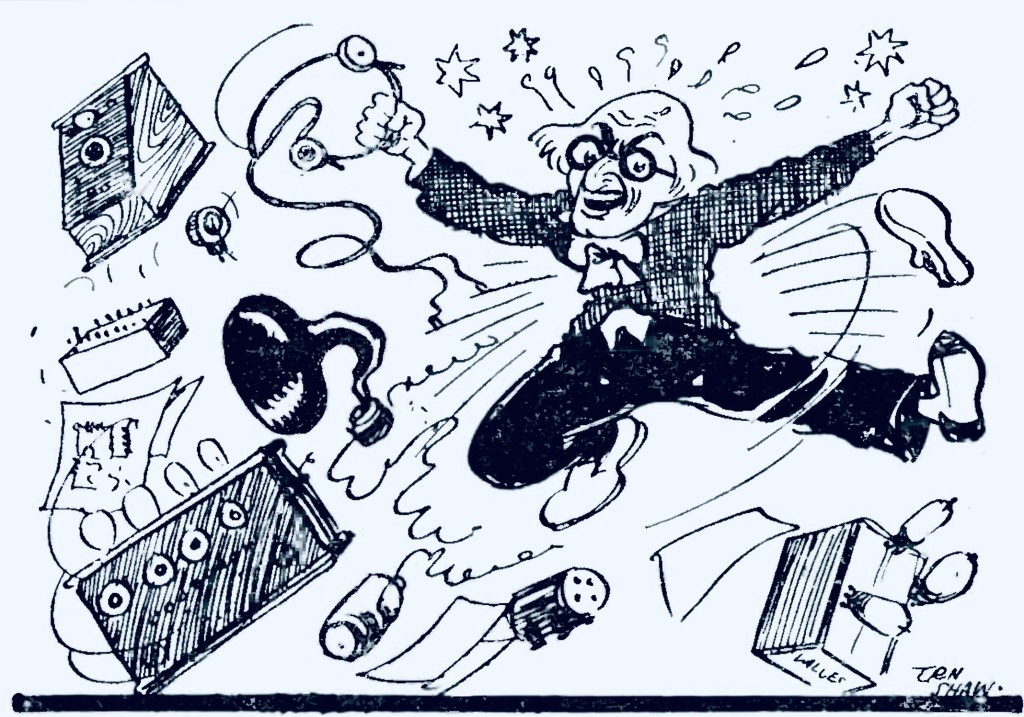
Illustration by Ern Shaw (Modern Wireless, Nov. 1924)
“Many plays have been broadcast, but none of them seems to me to have the pep that is needed to get not merely across the footlights but across the ether.” Complaints such as this one are all too familiar to me; in fact, they were launched so frequently against radio culture that, years ago, they prompted me to contest them.
To misappropriate the famous question posed by the feminist critic Linda Nochlin, I asked “Why Are There No Great Radio Writers?” The objective was not to find examples to the contrary—those queer, quirky and quicksilver exceptions that can serve to prove the rule—but to query the question itself as (mis)leading and to expose the biases underlying it.
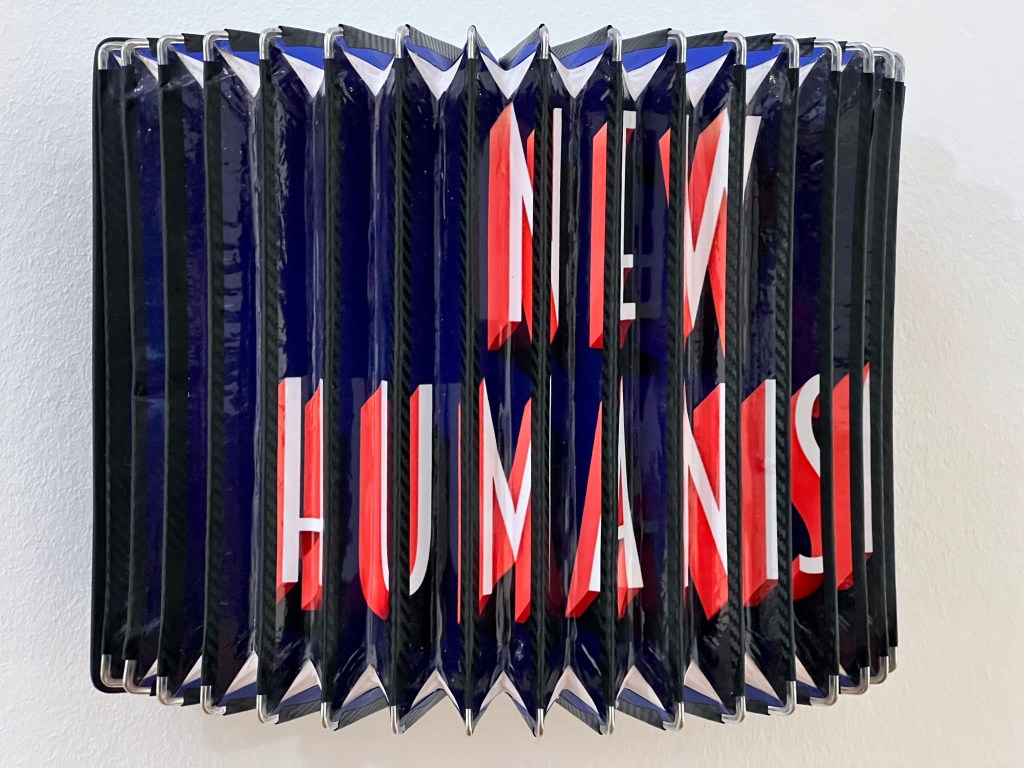
Pável Aguilar, Acordeones Anticoloniales (2022), “New Humanism”; installation view, Museum Ludwig; photograph by Harry Heuser
Get out much? Going places? Ready to take the part of “tourist”? Loaded with loathsome connotations, “tourist” has become a tainted word associated with a lack of regard for the cultures and customs of people who are forced to host the multitudes heading south for a few rays of sunshine and a dip in the sea, or whatever the local attractions the attractiveness of which the locals are promptly deprived by strangers that temporarily lay claim to them.
I am a “visitor,” not a “tourist.” That is a distinction I have always insisted on making when the latter label is affixed to me by New Yorkers, native or otherwise, who assume that my non-native tongue will stop wagging eventually to lick stamps set aside for picture postcards showing sights in the absence of which, once my “vagabond shoes” are back where they presumably belong, I am destined to suffer those “little town blues.”
To my mind, “visitor” better represents the close relationship that I—made in Germany, remade in/by NYC and based in Wales, as my Instagram profile proclaims—have with certain places, including Manhattan, whose sounds I recorded during my first visit in 1985 so that I might envelop myself in the metropolitan air by playing them back in the smalltown confines of my parents’ house.
Not that returning to places we once called home always feel like a homecoming, as my visit to that house in December 2022, after an absence of thirty-four years, persuasively drove home.
It was on that trip to the motherland that I went back as well, albeit not for the first time, to Museum Ludwig, the opening of which in 1986 I had greeted as a sign that Cologne had finally moved out of the shadow of the cathedral that towers over the cityscape like a two-fingered salute.
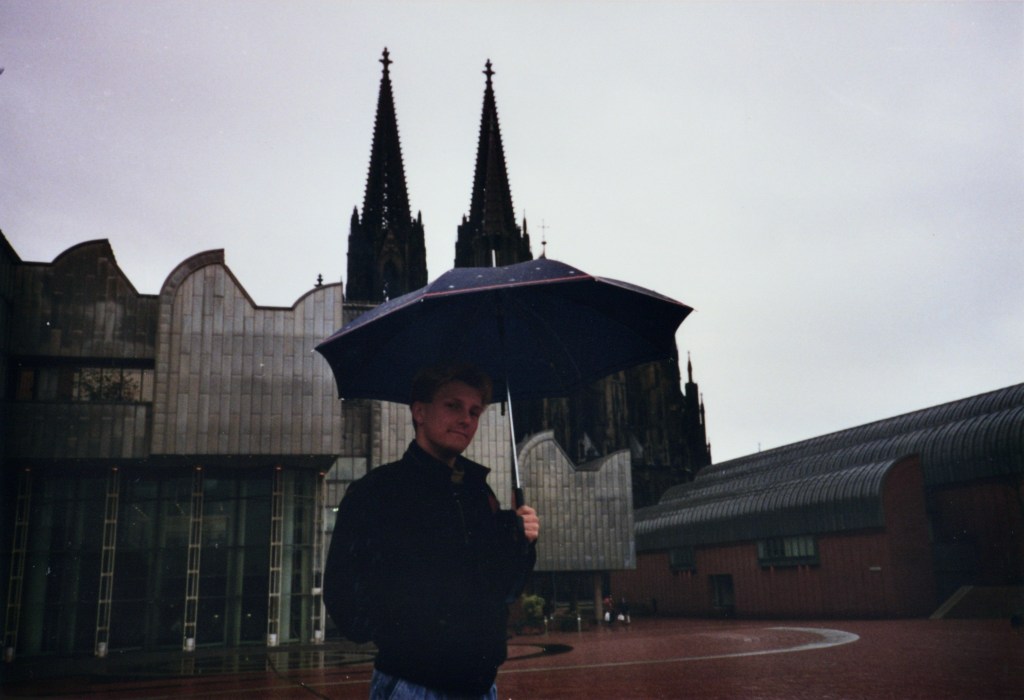
In front of Wallraf-Richartz Museum and Museum Ludwig, with Cologne Cathedral in the background, 20 Nov. 1988
Coming back, I was relieved to find that, during my absence, Museum Ludwig had not stood still and was still committed to engaging with the here and now, as its exhibition series Hier und Jetzt promises to do. Especially reassuring to me was the series’ 2022/23 iteration Anti-colonial Interventions (8 Oct. 2022 – 5 Feb. 2023). “Identity and Otherness” had long been a thematic strand of my art history teaching, whose attention to the marginalized derives from a personal history of dislocation, estrangement, and longing.
“Keeping up with the out-of-date” am I? Well, sometimes the motto I chose for this journal hits home like a slap in the face. Not a knock-out punch, mind. Just the kind of cuff that crimsons the cheek all the more because it is unnervingly public. Now, I am not slap-happy. If I keep going way back for more and go on reflecting at length on the ostensibly passé that others could care less about it is because, to my mind, time is not of the essence. That lingering tingle is, and I sting easily.
Whether or not we engage with it, there is no out-of-date as long as our memory serves. Or, rather, it dictates, like a fingerpost redirecting us into the remotest regions of our mental landscape. When it comes to our past, it matters little how long ago an experience dates back or however long in the tooth we are getting. The past can still get at us, provided we are fortunate enough—if indeed we feel quite so appreciative—to have faculties that keep us from letting bygones be … well, you know the rest.
Scoop up a tidbit, seemingly at random, however half-baked or nutritiously dubious. Ask what made you stick your fork—or spork or chopstick—in it. Reflect on why that morsel suits your palate, if indeed it does, at that particular moment in time. Present your thoughts on a platter meant for sharing. Hope for company, but don’t count on it. That, in a coconut shell has been my approach to writing for the web since I commenced this journal back in the blogging heyday of 2005. Eight hundred and forty-seven entries on, I am still at it, even though my diet, constitution and taste for potluck have changed considerably.
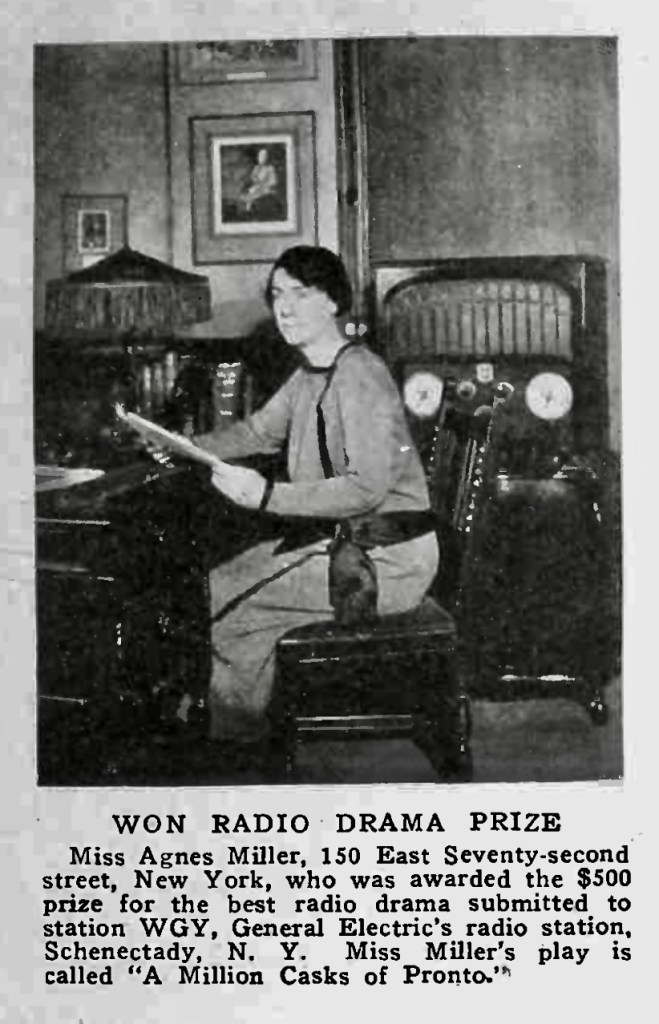
Not that I know exactly what those “Million Casks of Pronto” alluded to in the title of this blog entry contain; but more about that in as “pronto” as I can manage, especially since, as Wordsworth might have put it, these are lines composed a few minutes from Bronglais Hospital, where I went—and went under—for an endoscopy today. Gallstones be damned, I am in a reflective mood, and those “Casks,” which were tossed onto the airwaves back in 1924, have been on my mind for quite some time now.
Cover of the theater program for the Theatre Royal Haymarket production of Farm Hall (2024)
No horses—wild, domesticated or strictly metaphorical—would have dragged this fool (meaning, yours truly) to see Only Fools and Horses, a musical adaptation of a 1980s Britcom that made hay of nostalgia at the Theatre Royal Haymarket, where it enjoyed a record run before the stable doors closed, at last, in April 2023. How relieved was I then, returning to London after an eighteen-month-long hiatus, to find that what I assumed to be legitimate drama or, at any rate, a show beyond the dog-and-pony variety had returned to a venerable venue where, over the years, I had taken in plays as varied as William Wycherley’s The Country Wife (1675), Edward Albee’s The Goat, or Who Is Sylvia? (2000), and James Goldman’s The Lion in Winter (1966).
Granted, none of those theatrical evenings—certainly not the heavy-handed 2015 revival of the delightfully immaterial Harvey—were more memorably dramatic than The Rivals, during the 23 December 2010 performance of which I witnessed a member of the cast gallantly jumping off the stage to assist a fellow theatregoer suffering a stroke.
Nothing approaching such drama, scripted or otherwise, materializes in the course of the ninety minutes or so that historian Katherine Moar sets aside for the development of her episodic “snapshot,” as she calls it, of Farm Hall, the titular setting of a play about what happened in the summer of 1945 when a group of German nuclear scientists—members of the Uranium Club—were being kept under surveillance at a house in Cambridgeshire, only to learn, listening to news broadcast by BBC radio, that the United States had dropped the atomic bomb on Hiroshima.
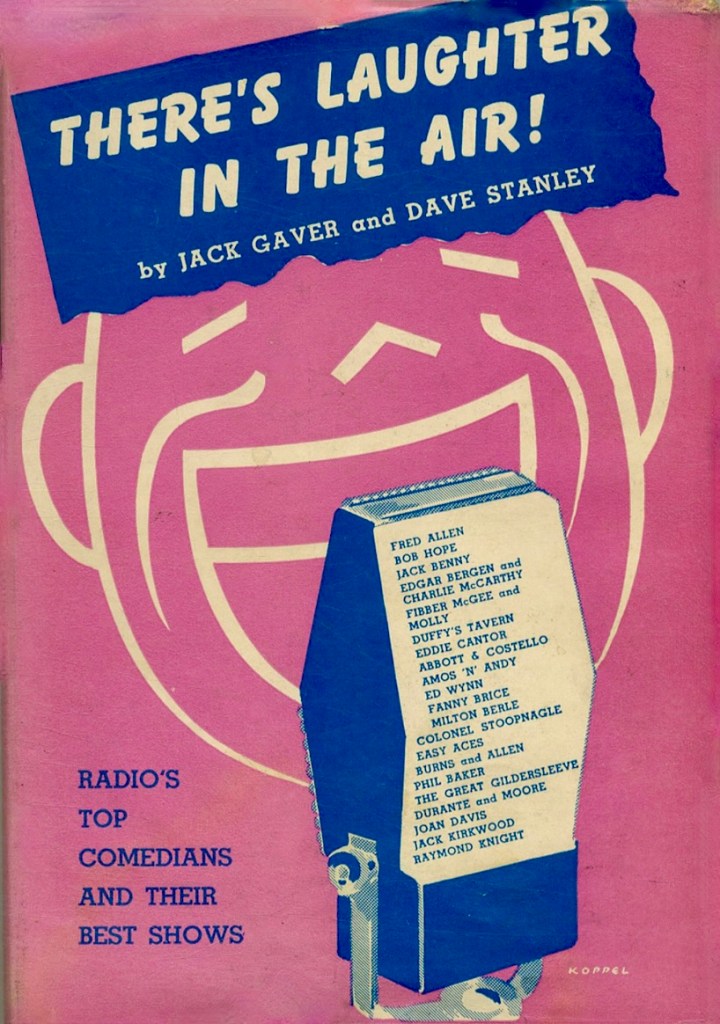
Granted, this 1945 book has little to do with the current debate about statespersonship and laughter
You might say that laughter has gotten us into this mess. Well, I am saying it, and I, though hypergelastically inclined (meaning laughter-prone) in my youth, am not laughing much at and about this present moment in time. By “mess”—an understatement, surely—I mean the state of global politics, and the state of our political discourse in particular.
Could laughter—supposedly the best medicine—also get us out of this mess? Might it be a symptom of our ailment as well as its cure? Not, I venture, if we carry on trying to laugh it all off. In the act of trivializing matters in hopes of dematerializing danger by declaring it risible, we run the risk of nixing democracy—a system predicated on the willingness to listen—altogether, throwing it away with a hearty tossing back of our heads in a communal display of hilarity. A ditch, after all, is not called a ha-ha for nothing.
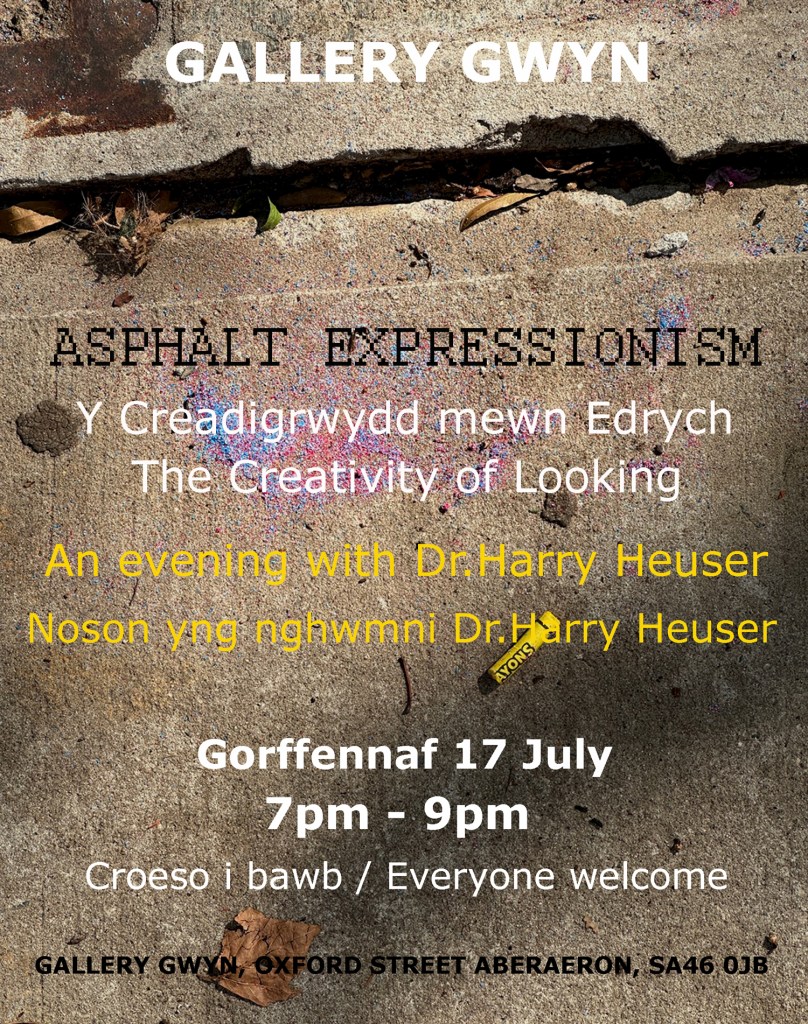
I have been asked, at some point during the run of my exhibition at Gallery Gwyn, to give a talk. I requested that the event be announced as ‘an evening with.’ Asphalt Expressionism was intended to be inclusive and interactive, and the scheduled get-together, likewise, should promote exchange. A conversazione, perhaps, but not a lecture.
Given that the smartphone is my primary means of creating the images huddled under the fanciful umbrella of Asphalt Expressionism—a series of digital photographs of New York City sidewalks—reference to the ubiquitous technology strikes me as an effective way of connecting with those who, phone no doubt in hand, might be joining me that evening.
With Claudia Williams at one of her exhibition openings following the publication of An Intimate Acquaintance
I had not long arrived in sweltering New York City for a month-long stay in my old neighbourhood on the Upper East Side when I learned that, across the pond, in my second adopted home in Wales, the painter Claudia Williams had died at the age of 90. I first met Williams in 2005. She was conducting research on a series of drawings and paintings commemorating the flooding of a rural Welsh community to create a reservoir designed to benefit industrial England. With my husband and frequent collaborator Robert Meyrick, who had known Williams for years and staged a major exhibition on her in 2000, I co-authored An Intimate Acquaintance, a monograph on the painter in 2013.
A decade later, an article by me on Williams’ paintings was published online by ArtUK on 28 May 2024; and just days before her death on 17 June 2024, I had been interviewed on her work by the National Library of Wales. So, when given the opportunity to write a 1000-word obituary for the London Times, I felt sufficiently rehearsed to sketch an outline of her life and career, as I had done previously on the occasion of her artist-husband Gwilym Prichard’s death in 2015.
Lunch in the yard with Gwilym Prichard and Claudia Williams
All the same, I was concerned that it might be challenging to write another “original” essay, as stipulated by the Times, on an artist about whom I had already said so much and whose accomplishments I was meant to sum up without waxing philosophical or sharing personal reminiscences. In an obituary, salient facts are called for, in chronological order, as is a writer’s ability to determine on and highlight the essentials.
So I omitted recalling the enjoyment Williams derived from watching my Jack Russell terrier begging for food on his hind legs, a sight that inspired her painting Tea with Montague, or the “Mon Dieu” emanating from our bathroom when Williams and her husband, both in their seventies, intrepidly and jointly stepped into the whirlpool bathtub – slight episodes that, for me, capture Williams’ joie de vivre and her enthusiasm for the everyday.
Clipping of a newspaper article on An Intimate Acquaintance featuring my dog Montague as painted by Claudia Williams
In preparation for the monograph, Williams had entrusted me with her teenage diaries and other autobiographical writings, which meant there was plenty of material left on which to draw. Rather than commenting authoritatively on her contributions to British culture, I wanted to let Williams speak as much as possible in her own voice, just as her paintings speak to us, even though we might not always realize how much Williams spoke through them about herself.
What follows is the tribute I submitted to the Times.
From where I’m standing: My Asphalt Expressionism project continues with a new exhibition
“I have resigned,” I keep on insisting whenever folks, however well-meaning, fallaciously refer to my retreat from academia as “retirement.” After all, I am not quite of retirement age; nor am I eligible for a state pension. My only recourse being a chance to set the record straight, it is incumbent on me to counter the tiresomely predicable visions that “retirement” conjures and dispel the mirage of a slow fade or a ride into an illusory sunset.
Sunset indeed! I just dodged a deluge. Such are the hazards of a life abroad: one day you are wet behind the ears, the next—and it sinks in only belatedly just how much later “next” is—you are trudging through a torrent of foul weather (let’s not call it the gutter just yet) you doubt will ever end up under the proverbial bridge. If my figures of speech were not quite so waterlogged already, the expression “sea change” might be dredged up to capture the mood at this point of departure.
Taking the radio play to the library has long been an ambition of mine, given that dramatic and literary works written for the medium of sound broadcasting occupy comparatively little space on the bookshelves. Taking the first of its kind to a national library—the National Library of Wales, no less—is a chance of a lifetime amounting to poetic justice. Allow me to shed a modicum of light on that, and on my benightedness besides.
So that meaningful conclusions may be drawn from my peculiar challenge of commemorating one hundred years of radio dramatics in just a few minutes, it strikes me as essential that the centenary first be quartered, a fate I hope to escape on 22 February 2024, the date set for the event.