Let George Say It

I penned my first autobiography at the age of sixteen. With the bombast befitting an insecure teenager eager for validation, I called it a “memoir.” It was a short, handwritten volume I passed around to fellow students, a performance designed at once to justify, expose, and invent myself. Like so many pieces of juvenilia, those “memoirs” were destroyed in an act of reinvention, or, not to be fanciful, embarrassment. I fear that many of the instances I recorded, however embellished, edited or carefully selected my memories, may be far more difficult to recreate, faded as my recollections have during all those intervening years that have made me a stranger to my former selves. I seem to have made forgetting a virtue by looking at it as the ability to move on and start over as if from scratch.

Perhaps, one reason for my dwelling in and on the presumably out-of-date in a journal reflective of my readings, viewings, and listening experiences is that it allows me to discover myself in a researchable past other than that which is chronologically and biologically my own: movies, radio programs, books that precede my past and inform my present. To research my story, I must rely on a memory I dare not trust. When it comes to my early life, I have little to go on, other than flashes of dreamlike recollections.

One of the problems involving the autobiographical act is to arrive at a narrative frame that fits the picture without distorting, let alone creating, it. It is difficult to determine where an autobiography ought to end, considering that, as its writer, one is still in engaged in the creation of memories. One is alive and, apparently, compelled to prove it. A future event might call for an entirely new arrangement of facts—a life-changing event may lie ahead, rendering negligible much that seems important at present.

Not quite as problematic, but troublesome nonetheless, is the beginning. Does one begin with one’s family, with one’s ancestors, with a description of the birthplace that, presumably, shaped our early life? Should an autobiography start with an explanation, an apology for the hubris of taking oneself serious enough to warrant such a performance, or an acknowledgement of whomever we construe as our audience? Dear reader, is this my life? Should, as in James Joyce’s Portrait of the Artist, the voice reflect the age, mind and intellect of the subject, the self turned object, in various stages of existence?

One man who knew how to begin was the aforementioned Emlyn Williams, born on this day, 26 November, in 1905; he grew up in a remote town in Wales, his parents hardly proficient in English, to become a well-known actor and playwright (a production of whose Night Must Fall I briefly discussed here), personae or roles that no doubt influenced his performance and may well have created the impetus to for it. He could count on an audience, a public that presumed and demanded to know him.

Williams’s lyrical introduction to George: An Early Autobiography (1961) is one that compels me both to read on and revisit the idea of writing my own life. Aware of the task at hand, of the challenges of starting, of devising a beginning reflective of one’s own start in life and the impossibilities of doing so ab ovo, it is disarmingly reflective:

The world was waiting. Waiting for me, to whisper my incantations. “I am George Emlyn Williams and . . .” I was lying with my head on my fist on morning grass, dry of dew and warm with the first heat of the year. All was still, even the stalks clutched in my hot fingers. I had come up into the fields to gather shaking-grass, a week with a hundred beads tremulous to the touch, which my mother would inter in two vases where it would frugally desiccate and gather dust forever. Spring smells and earth feelings crept into my seven-year-old boy; nine-tenths innocent, one-tenth conscient, it responded. I rolled one cheek up till it closed an eye, and squinted down at the sunlit village. A dog lay asleep in the road. Mrs. Jones South Africa was hanging washing, and quavering a hymn. Cassie hung on their gate and called for Ifor. “Time to go to the well!” The bleat of a sheep. A bird called, careless, mindless. Eighteen inches from my eye, a tawny baby frog was about to leap. It waited.

Everything waited: the hymn had ceased, the bird was dumb and suspended. “I was born November the 26th 1905 and the world was completed at midnight on Saturday July the 10th 4004—our Bible stated the year at the top of page one, the rest I felt free to add—“and has been going ever since, through Genesis Revelation the six wives of Henry the Eighth the Guillotine and the Diamond Jubilee right until this minute 10 AM. Sunday April the 14th 1912, when the world has stopped. The sun will not set tonight, or ever again, and I am the only one who knows.”

No sound: the spool of time has run down, the century is nipped in the bud. I shall never grow up, or old, but shall lie on the grass forever, a mummy of a boy with nestling in the middle of it a nameless warmth like the slow heat inside straw. This is the eternal morning.

The frog jumped. Cassie called again. I scrambled up, brushed my best knickerbockers, pulled the black stockings up inside them, raced down and hopped between my water buckets into the wooden square which kept them well apart so as not to splash. The sun did set, and by the time it rose next morning the Titanic had been sunk. If the world had stopped, they would not have drowned; I thought about it for a day.

The century, un-nipped, has crept forward, and the knickerbockers are no more. They encased one brother till he burst out of them, then another till they fell exhausted away from him, turned into floor rags and at last were decently burned. But I am still here, not yet decently burned or a floor rag or even exhausted, George Emlyn Williams, born November the 26th, 1905.

Autobiographies are performances, to be sure; but the audience, however large, also includes the one in the scrutinizing self in the mirror. Staring at it, it gives me no hints as to how, or whether, to write one. Regardless of all the personal reflections I have offered in this journal, I no longer have the confidence, or the illusions, of a sixteen year old who presumes that his life matters; nor is mine the life of a man like Emlyn Williams, who did.
Blind Justice; or, ‘1000 for Verdicts’

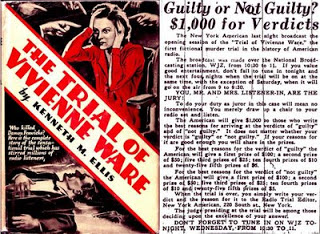
“It does not matter whether your verdict is ‘guilty’ or ‘not guilty.’ If your reasons for it are good enough you will share in the prizes.” With this peculiar invitation, millions of US Americans were lured to their radios, tuned in to WJZ, for a trial in which they, the listening public, were called upon to act as jurors. As previously mentioned here, it all began on this day, 25 November, in 1930.

The judge in the case was none other than New York Senator Robert F. Wagner, lending gravitas to a spectacle that was, in more sense than one, a trial broadcast. Would listeners find fictional society beauty Vivienne Ware guilty of the murder of millionaire architect Damon Fenwicke, a crime for which she could be sentenced to the electric chair? And would they leap out of their armchairs to boost not only their own circulation but that of their local paper by rereading what they just heard on the air?

“It is no part of your duty to decide whether or not she shall die,” Senator Wagner insisted. That, he told the listeners,

is the function of the Court and the Law.  But you must remember that in endeavoring to secure a conviction of this young and beautiful defendant the District Attorney is but pursuing the business to which you, the people of this State, have set him.  You will consider carefully all the evidence as it is presented for you from the witness stand.

Whether or not their voices could kill, those tuning in nevertheless derived their thrills from the importance of the interactive role granted to them. Tune in, have your say, all for a chance to win a substantial amount of dough—what’s not to love!

Leave it to a Hearst paper to conceive of a reality show like The Trial of Vivienne Ware—a trial that sold papers and bought the jury. Those who caught up with the daily broadcasts from the courtroom and read transcripts and analyses in their daily Hearst paper were rewarded for being informed enough to arrive at the verdict they were invited to mail in. No attendance, no deliberations with fellow jurors required. All that was needed, aside from a radio set and a few cents for daily tabloids, was curiosity, rhetoric, and greed.

You might say it was just fiction, this fictitious call for justice; but the Hearst press, known to have started a war with mere words, was doing its utmost to make the trial seem as real as the joined media of radio and the press could make it, all with the aim of a very real boost in sales through a cleverly manipulative marketing campaign.

More than a radio serial, The Trial of Vivienne Ware is one of the most elaborate and dubious media events ever staged. All that remains of it now are a number of newspaper articles and a book touted as “an innovation in both the radio and publishing worlds”—the “first radio novel.”

To be sure, Kenneth M. Ellis’s “novel”—a combination of faux news reportage and courtroom dialogue—has none of the thrills of the original experience. Its failure to excite and convince convincingly argues the power of the media to create a sense of reality through the realities we glean from sensation.

Once More Round the Horne

I just got back from Brighton, England, the popular seaside resort that is pretty much the gayest town in all of Britain. So, to speak in the cheek-lodged tongue of Polari, I was bound to have a “fantabulosa” time. And how “fantabulosa” was it for an old “omi-palone” like me to have Round the Horne playing just round the corner at Brighton’s Theatre Royal. Considering that Round the Horne is a British radio series whose last original episode aired back in 1968, I could hardly believe my “ogles” when I read that it was on while I was visiting. I was thrilled to get my “lills” on a pair of tickets to “aunt nell” some of the wittiest comedy act never seen by millions.

Round the Horne: Unseen and Uncut is an ingeniously—if deceptively—simple production. It merely presents two of the sixty-six 45-minute broadcasts from this much-loved and well-remembered BBC program (1965-68), separated by an intermission that only the most humorless of stick-in-the-muds would take as an opportunity to make a hasty retreat. The scripts are taken directly from the original series. You would not want to tinker with lines composed by Barry Took (Laugh In) and his writing partner Marty Feldman. You certainly would not have to.

The second act (or half, rather) builds on the first, allowing viewers to pick up the rhythm of the show, pick up on the slight but clever variations, and pick their favorite among the recurring characters in a line-up including Fiona and Charles, an aging pair of actors who reprise their preposterously Cowardesque silver screen dialogues (“I know you know I know”) in that posh and most unnatural anti-vernacular of BBC English; folk singer Rambling Syd Rumpo with yet another rendition of his Jabberwockian tunes; and, of course, Julian and his friend Sandy in all their Polari-riddled glory that was enjoyed by millions but understood and shared by only a few whose nature made them appreciate the subversiveness and desperation of such artifice. After all, homosexuality was still illegal at the time.

Of course, the production is not at all simple. The performers are called upon to impersonate well-known radio (and television) personalities, including Kenneth Horne (played by Jonathan Rigby), Kenneth Williams (Robin Sebastian), and Betty Marsden (Sally Grace). Standing behind a row of microphones, without any other props of scenery to speak of, the six cast members (not including the singers and orchestra members) have to sound the part and deliver their borrowed lines with an enthusiasm that is thoroughly rehearsed without sounding disingenuous. Along with the harmonizing quartet known as Not the Fraser Hayes Four, the seen voices of this stage show are fully deserving of a hearty cheer of “fantabulosa!”

However convincingly the experience of attending a live radio broadcast (or a recording session thereof) in a studio is being recreated, though, one aspect of such productions has been overlooked or obscured. Hidden from view were the indispensable sound effects artists whose presence would have completed the picture. I would have settled for an extra pressing a number of buttons while seated among the musicians who were in full view at all times. Instead, the recorded yet well-timed effects (from footsteps to horses hoofs) came from a loudspeaker, its makers or purveyors unseen and, a mention in the playbill aside, unacknowledged.

The production might also have benefited from a few glances behind the scene, with actors walking on, preparing for their roles or having a chat before each broadcast. No dirt, just an element of realism. Since Took’s widow serves as “script consultant” for this touring show, some insightful biographical notes might have been worked into this simulation. Kenneth Williams’s life, in particular, is worth exploring in a stage drama. According to the playbill, the “action takes place” at the “BBC Paris Recording Studios in Lower Regent Street, London”; but what there is of action hardly speaks as loudly as the words. This is “theater of the mind”; and once it is taken out of the wooden O of your cranium, you begin to wonder whether what you see is really what you get as you make an effort to wipe your “oglefakes.”

That said, I was glad for this chance to catch up with Round the Horne—and at such an opportune moment to boot. It so happens that, this Friday, 28 November, BBC Radio 7 is rebroadcasting the 7 March 1965 debut of the program, with subsequent episodes to follow sequentially in the weeks and months to come. My “aunt nells” are ready for it . . .

Bright Eyes and Black

Well-behaved children, however rare an over-protected species nowadays, are about as fascinating as so many slices of white bread. It isn’t until you have got something on them that they become even remotely interesting. What jam is to Wonder Bread is dirt to supposedly wonderful well-breads. If they’re simply wonderful, they are plain dull. You’re better off tossing sardines to a trained seal. Animals that do as they are told are invariably more engaging than docile offspring. I suspect that our enthusiastic response to the tricks performed by fair Lassie is really owing to our culture of laissez-faire; it is gratifying that we still can get pets to do what we dare not demand from our young. Obviously, I don’t have any kids to brag about, deserving or otherwise—which is why I get such a kick out of wicked children. Their mischief is one of those pleasures I refuse to feel guilty about.

Last night, I watched Shirley Temple in Bright Eyes (1934). Shirley is cute ‘n all, but it is Jane Withers who steals the show demanding a machine gun for Christmas, decapitating a doll, or playing train wreck, all the while manipulating her parents into doing exactly what she wants. Now, there’s a future executive.

These days, it takes nerves to get a Shirley Temple DVD past the checkout of your local supermarket. You are liable to incur the suspicion of fellow customers who might feel compelled to warn their parenting friends and neighbors about you. I buried my copies of Bright Eyes, Baby Take a Bow, and Rebecca of Sunnybrook Farm under a few bottles of Chardonnay; better to be thought of as an alcoholic!

Whether we are facing another depression or not, Miss Temple would not have a career today; at least, she would not be surrounded by a bunch of aviators singing “On the Good Ship Lollipop” while rubbing her tummy and licking all sorts of oversized candy. Jane Withers, too, would have a tough time with her “Bad Seed” routine. The Children of the Damned are very nearly outlawed, what with all the gun-toting prepubescents we come across in the news. It is no longer acceptable to fantasize about wayward kids (or fantasize about kids, period); our culture has become altogether too infantile, permissive, and litigious for that kind of amusement.

On this day, 19 November, in 1948, syndicated radio and television critic John Crosby already wondered “Whatever Happened to the Bad Boy?” He argued Henry Aldrich to be a poor substitute for Huck Finn or Penrod, the latter now being all but forgotten. Crosby might have responded more favorably to Bart Simpson; but even Bart has long been overshadowed by his childlike father. We don’t have a problem laughing at the juvenile, provided the little rascals come to us in the shape of a Will Ferrell. To that kind of let’s pretend our youth-obsessed society can readily relate.

What Crosby rejected was the kind of naughty child that was too dumb to know any better. For juveniles like Henry Aldrich he could

see no hope whatsoever of future brilliance. Week after week, they get into one jam after another, always by accident, never by design. The trouble they see is a censored, respectable, passive trouble. They’re the victims. In Huck’s day somebody else was the victim.

Never mind the kind of pampered brats we see today and dread. Show me a black-eyed smart aleck who sets out to shatter our sentiments of childhood as a period of innocence, sweetness, and pastel-colored light. Just make it fiction.

Soaps to Dial For: My Nights with That Noble Woman

I’ve been having sleepless nights recently, what with this cold and all the rest I am getting throughout the day. It is a testament to my restraint that you still don’t know the half of it. Since I’m not one to crochet or get crotchety, I generally substitute sound sleep for a generous if gentle dose of sound. There’s nothing like canned melodrama to fill the dark hours with images just mute enough not to clash with your pajamas. No thrillers like Inner Sanctum or Suspense, if you please. Too jarring by far! No Fred Allen or Vic and Sade to induce chuckles when it’s snores I’m after. No plays I’d be itching to follow, no tunes I’d be eager to hum. So, I kept my ears peeled for some pop-cultural flotsam that could send me adrift, and presto. The other sleepless night, I finally turned to the kind of fare I rarely try, particularly not when I am in fine fettle. My fettle being decidedly not fit to be in, I contrived to make a late night date with Mary Noble, Backstage Wife.

Backstage Wife belongs to that genre known as “soap opera,” defined by James Thurber as a

kind of sandwich, whose recipe is simple enough, although it took years to compound. Between thick slices of advertising, spread twelve minutes of dialogue, add predicament, villainy, and female suffering in equal measure, throw in a dash of nobility, sprinkle with tears, season with organ music, cover with a rich announcer sauce, and serve five times a week.

If you serve that platter past midnight, rather than at lunchtime, the sandwich appears to become more spicy than soggy. After all, what Thurber left out of that list of ingredients is the listener’s imagination, which tends to get saucier once you hit the sheets.

Fodder for radio satirists Bob and Ray’s “Mary Backstage, Noble Wife,” the “story of Mary Noble and what it means to be the wife of a famous star” was on the air for a quarter of a century. A small but sizeable helping of that run is readily available online, namely a storyline involving the scheming Claudia Vincent, a woman who fires shots at man to gain the confidence of another. That the other man is Mary Noble’s husband, Larry, makes Claudia Vincent’s obvious maneuverings all the more delicious.

Not that my taste buds can be trusted in times likes these, but the last thing I wanted was my mouth to start watering. Now my nights are spent wondering about Mary, Larry, Claudia and Rupert, knowing that I shall never hear the end of it, for want of extant chapters. Of course, serial dramas are not about endings. They, like all melodramas, are about the protracted middle, the main courses and the side dishes, about the precariousness of the status quo and all our attempts to stay as we are or get what is presumably owed us. For all its sensational scenes and rhetorical bombast, melodrama is truest to life, far more real, to be sure, than tragedy and comedy. In those aged and unadulterated models of drama, all endings are final; in melodrama, there is plenty of room for doubt, for turns and returns, for the “what ifs” that, I should have known, are keeping me asking for seconds and up for hours.

The current season of Desperate Housewives being so listless you cannot even claim it to have mustered energy enough to jump the shark, I am only too grateful for a bit of cheddar and ham as only those horrid Hummerts could slice it. Now pardon me while I dim the lights. It’s time for my sandwich.

Mikes in the Sticks: A Visit with Radio’s Real Folks

“You will want to know what are my qualifications,” Ring Lardner introduced himself to the readers of his new radio column in the New Yorker back in June 1932. “Well,” the renowned humorist-turned-broadcast critic remarked, “for the last two months I have been a faithful listen-inner, leaving the thing run day and night [ . . .].” Lardner was hospitalized at the time, but he sure knew how to make the most of his misfortune by twisting the dial long enough to squeeze a few bucks out of it, and that at a time when, like today, there were hardly any competitors on the scene but, unlike today, there were millions eager to listen to and read about the radio, its programs and personalities.
Believe me, there is nothing like a sickbed to turn you on to radio and into an avid listener, especially when all you want to do is close your eyes and have stories told to you. No other qualifications are needed to become a critic of the medium. No wirelessons required, if I may be Walter Winchell about it.

Sometimes, though, listening does not seem to be an option. Hundreds of the programs available to Lardner back then are no longer extant; earlier programs are still more difficult to uncover. This is particularly frustrating when you have heard of a show without ever getting a chance to hear it. One such forgotten program is Real Folks, the first dramatic series to air on NBC’s Blue network. It premiered on 6 August 1928 and ran for the relatively short period of three years.

Years ago, I came across a brief description of the series in Radio Writing (1931), a contemporary book on broadcast drama penned by radio dramatist Peter Dixon, who recommended Real Folks for being “excellent characterization and an example of the attractiveness of simple, homely humor.” As a radio critic, you do not want to take anyone’s word for the “it” of listening. Was I ever going to hear for myself?

Recovering from a seemingly interminable cold, I am fortunate in having much time to go in search of lost voices. You might say that I excite easily, but today I was thrilled to meet those Real Folks for the first time. On this day, 17 November, in 1940, writer George Frame Brown was joined by members of the original cast to bring back the series for a special broadcast. By then, the pioneering drama had been off the air for nearly a decade.

After a short and not altogether factual introduction by announcer Graham McNamee, the Real Folks sketch heard on Behind the Mike opens with a train whistle, a sound that, like no other, is capable of transporting you swiftly into town and country—and to any Whistle Stop along the tracks. Thompkins Corner was one of those places. Its mayor was Matt Thompkins, who was also the owner of the town’s general store. He was played by the man who knew him best: George Frame Brown.

Apart from its writer, the cast of Real Folks included Irene Hubbard, Ed Whitney, and Elsie Mae Gordon (pictured), all of whom were reunited for the Behind the Mike broadcast which, in its sentiment and politics, returned 1940s listeners straight back to the Depression, with a story involving lost jewelry, a stolen banana, and a destitute yokel. The sketch concludes with the sounds of the whip-poor-will and the Capraesque words of the Mayor who, having faced and avoided the end of his career, pensively remarks:

I guess there’s a lot of folks way up in politics tonight that wishes they was back living beside the country road listening to a whip-poor-will.

Perhaps, that rarely seen yet distinctive sounding bird was a metaphor for the radio, the preferred medium of the not-so-way up who enjoyed to find themselves represented by “home folks” like Vic and Sade, Lum and Abner of Pine Ridge, and Real Folks like those in Thompkins Corner; and it was voice talents like Elsie Mae Gordon who made it all sound authentic.

During the original run of Real Folks, Theatre Magazine‘s Howard Rockey pointed out Elsie Mae Gordon as a “veteran trouper” who came to radio “from the concert and vaudeville stages.” A sought-after player in those early days of radio drama, Gordon took on as many as

six to eight separate roles in the course of a single broadcast. To each of these “doubles” she imparts a distinct individuality, so natural that it is difficult to believe oneself listening to a “one-girl show.” In some sketches her lines are from her own pen, so that the complete interpretation is of her own devising. Miss Gordon’s differing voices are familiar to all who tune in on Real Folks, the Kukus, Detective Story thrillers and other weekly features.

Some of that versatility is also apparent in the Behind the Mike broadcast, the gender-bent casting being disclosed at the conclusion of the sketch. At the time of her reunion with her Real Folks co-stars, Gordon was still active in radio, notably in the distinguished anthology Columbia Workshop.

Her portrayal as Matt Thompkins’s wife, however, would have fallen out of earshot had it not been for the producers of Behind the Mike, who, as early as 1940, promoted the medium by featuring voices we would otherwise only read about. Indeed, Behind the Mike brought back Gordon a few weeks later to talk about her role as a voice coach.

Without voices like Gordon’s, and without all the real folks who make them heard on the web, I would have very little to go on about in this journal … except, perhaps, that my own voice has all but vanished as a result of the cold that has me listening, somewhat enviously, to the speech sounds of a bygone era.

Nostalgia and the Common Cold

If you were to ask me right now “what’s shaking,” I’d have to say “my laptop.” The lap in which it sits is an uneasy resting place right now. I am being seized by violent coughing fits, the kind that sets off such explosions in your skull, it shatters your equilibrium. Ever since that Halloween party—the first and probably last I condescended to attend—I have been suffering from the kind of cold that may be known as “common,” but that, to our relief, remains a disruptive exception to our everyday. Apart from all the pretty much useless over-the-counter medication I swallow, inhale or wrap my tongue around, I resort to any number of treats I know to be soothing in times like these. A return to Allen’s Alley, a helping of Chanograms, any combination of folds in the weathered phizog of Margaret Rutherford—whatever it takes.

I tend to return to established remedies, the kind of stuff I know to comfort and cheer me. In a way, I am warding off two sicknesses, all the while being in danger of contracting one. For whenever I am as miserable as I am these far from good old days, I am in danger of getting nostalgic.

Despite my appreciation of and frequent exposure to films, books and radio programs predating the 1960s, I am wary of this feeling. More than a sensation, nostalgia is a disease—a dis-ease—I am anxious not to catch; nor do I believe that am I generally prone to it. In a review of a friend’s book of short stories I once referred to nostalgia as the “fruitful reverie of a past whose text is a history of longing.” Now, even I don’t quite know what that means anymore, however smart it sounded at the time. The rotten apple in it is “fruitful”; although, in defense of the prose I have never managed to outgrow, I hasten to add that the sentence began with “If,” signalling that I merely offer for debate rather than wholeheartedly endorse the sentiment expressed. I vowed, years ago, never to write anything in which I do not believe. It is a proven prophylactic against much, though hardly all, pointless drivel.

True, nostalgia can and does bear fruit; but unless that fruit is intoxicatingly fermented it might be downright unfit to eat. It sure can give you an ache. Indeed, it is an ache. Literally, it is the ache to go home or the ache produced by the awareness of not being able to get there. It is a longing to belong, to return not simply to a place we once knew and loved, but to reach or build such a place from whatever scraps in the book of memory we can assemble with the paste that prevents us all from becoming unglued.

However rewarding such an imaginary retreat, it is a sense of the futility that makes the journey painful—the very moment along the way in which “what if” and “if only” turn to a bitter “as if!” An iffy a performance, in short. After all, how can you expect to find an effective home remedy for homesickness?

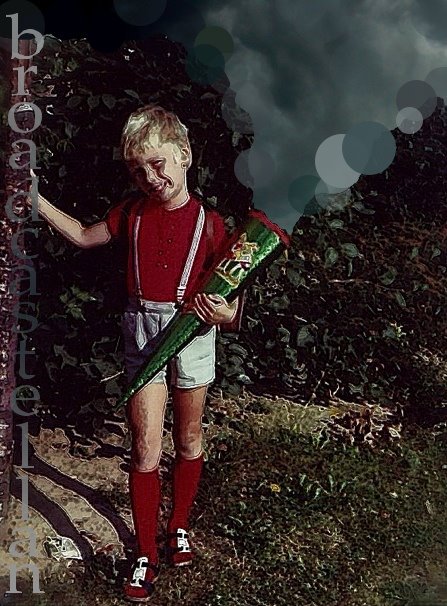
I wonder whether I tend to get childlike when ill because I (pictured above, with the horn of plenty that German children are handed upon entering school) was more ill than well as a child. As if anxious to stand out in a crowd of sick kids, I went out of my way to get scarlet fever twice. Not that “childlike” is used here to connote “innocent” or “carefree.” In my early days, I was subject to many more fears, doubts and ailments than the adult into which I somehow evolved—which is why I keep relying on those tried remedies, knowing them to have worked once and finding them working still.

Could it be that I love the movies, books, and radio plays of the past—a past predating mine by far—because I am stricken with the present, rather than just being presently sick? Good gosh, this might be a worse case of nostalgia than I thought.

Consider the Poppies

Once more, I turn to some humble sort of verse to express my thoughts on Armistice Day. As it turns out, it is the same thought for the same occasion. Hailing from the land of the old aggressor, I was unfamiliar with the British custom of sporting paper poppies in honor of the fallen. That Germans do not observe the day with such a display of red is both obvious and telling. What is being recalled are past victories and triumphs, not the vanity, the ruin and the death that are the now of war, the wars that are now.

Consider the Poppies

Symbols they are, I know,
those poppies pinned on lapels,
on shirts and on sweaters and coats.
A sea of them, all over Britain.

Scarlet flowers that shout down
the labels of whatever fashion,
to bloom for a day or so.

Simple it is, you know,
pinning those poppies to dispel
the sweat, and the lump in your throats.
I see it all. I am in Britain.

Go get yours, yet note also:
the poppy, so well out of season,
returns before long, to scorn
like the wars you ignore
in the very moment of commemoration.

“Von Ribbentrop’s Watch”: Thoughts on Kristallnacht

Perhaps I should call her. We have not talked in over a year. Could I have telephoned tonight, though? Not simply to exchange a few kind words, mind. From her, I would like to learn about the past that shaped our world; and who would not seize the opportunity to grasp that past firsthand? That said, I have never quizzed my German grandmother about life in the Third Reich, never attempted anything amounting to probing inquiry. I am more distressed by my failure to ask than by any responses I might get. Not that any number of answers could make me stop wondering.

Another watch, another (lost) wartime story

Tonight marks the 70th anniversary of Kristallnacht, and I am more keenly aware than usual that the past is not done with, that many of those who threw stones into shop windows or looked on as Jews were hauled off to the concentration camps are still among us. Their ideologies, their hypocrisies, and their indifference are alive as well.

My grandparents were not among those who resisted the Reich and its reign of terror. “Of course, we knew they were being shipped to the camps,” my paternal grandmother once told me. Frank about knowing, she was open rather than open-minded. Third Reich propaganda remained at work throughout her life, even some forty, fifty years after the defeat of the Nazi regime. Once she heard I was schwul (German for gay), she ceased to acknowledge me; not as much as a reply to my Christmas cards. My maternal grandmother, now in her nineties, continued to correspond, though, sending greetings and wishes to me and mine. Is she more open? Or is she, like so many of us, merely permitting her personal feelings for her own kind to gainsay thoughts that would otherwise dominate her mind?

My maternal grandmother worked for one of the leading Nazi families and remained loyal to them decades after the war, introducing me to the heirs when I was a child. My memories are vague. I remember being told about the guilt that made outcasts of the obviously well-to-do family for which grandmother worked as a seamstress. There was a boy, roughly my age, with whom I played while grandmother worked. As much as I would like to fill in the blanks, I cannot bring myself to ask about the past, about grandmother’s connection to the Von Ribbentrops.

On this Remembrance Sunday, as Britain commemorates the 90th anniversary of the 1918 armistice and those killed in war, I drift in and out of consciousness, sick with the commonest of colds. Swirling in the thick of my head are thoughts that just the right word cannot put into any conclusive or satisfying order. I continue to question myself rather than demanding answers from those who might help me to resolve matters.

Instead of proving that actions speak louder than words, Kristallnacht demonstrated that actions are louder than the silence of unvoiced dissent. A stone, in this respect, is like a resounding “no” to the potentialities of change latent in the troubled mind. Words can set nothing aright if they merely create the illusion of control, if they obscure the chaos within us rather than dispel it. I let my words bespeak confusion rather than answer conclusively, thus falsely. I let them run riot rather than underwrite what amounts to the hollow triumph of paper solutions.

A quandary is at the heart of “Von Ribbentrop’s Watch,” a radio play by Laurence Marks and Maurice Gran, which premiered 8 November 2008 on BBC Radio 4. It is the story of a Jewish shop owner in contemporary Britain who learns that the less-than-reliable watch he inherited from his father once belonged to Nazi Germany’s Foreign Minister Joachim Von Ribbentrop. What to do? Keep the watch and ignore the Swastikas to which a watchmaker alerted him? Sell it to collectors of Nazi memorabilia in order to keep alive his own struggling business? Would that be retribution or profiteering?

The fascinating premise is undermined by the language in which the conflict is couched. It seems that the playwrights are rather too enamored of their at times desperate wordplay, too eager to elicit awkward chuckles from assorted squabbles at a Passover table when restraint might have served them better. Perhaps, the broadcast date for this dreadful piece of imitation Goldbergs was as unfortunate a choice as the playwrights’ mockery—a Jewish defense of Nazi crimes, the sounds of broken glass after a family quarrel, followed by an otherworldly visit from Von Ribbentrop—as it gave me reason to believe that “Von Ribbentrop’s Watch” was meant to coincide with and somehow commemorate the horrors of Kristallnacht. Armistice Day, by comparison, is given a solemn treatment on BBC Radio 3, with an adaptation of All Quiet on the Western Front.

At least, the titular chronometer of “Von Ribbentrop’s Watch” seems to suggest that even belated justice is preferable to terminal ignorance; time catches up with timepiece in question, however exasperating and offensive the ninety minutes that it takes us to hear about it. Not that the conclusion is rewarding: in its tacky irony, the play insists that the Jews end up confessing their guilt by association.

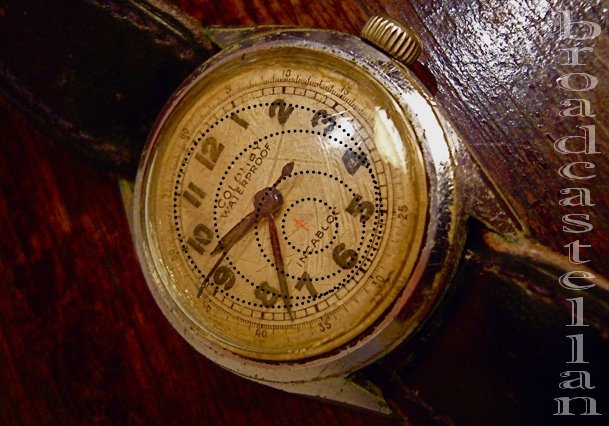
In response to this appalling piece of misjudged comedy, which is supposedly based on a true story, I retrieved the watch shown above. Like so many stories of so many objects around me, the story of this watch cannot be recovered, the one who could have helped to pieced it together having died many years ago. It was given to my partner, whose father brought it back from the Second World War. My camera failed to capture it, but the face bears the Cross of Lorraine, the symbol of the Resistance.

What we need to resist, always, is the convenient answer, the conclusive remark, the word to extinguish the doubt that is the life of thought, the hope for change; and the doubt we should all permit ourselves to voice on this day is whether the past is truly over or whether we are still victims of the same prejudices, susceptible to the same talk, capable of the same actions. Those are the questions we cannot expect anyone to answer on our behalf.

Not Every Tome, Dick, and Harry; or, How to Approach Claudette Colbert

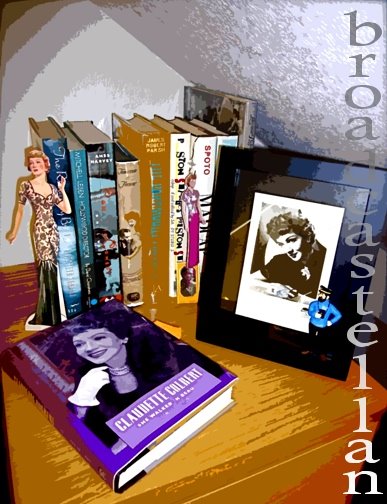
It had been two decades since last a biographer was given the chance to shed light on the life of a woman whose name was written in the bright lights of Broadway and whose radiant presence lit up the silver screen. Considering that the radiant one is my favorite actress, I was eager to clap eyes on Claudette Colbert: She Walked in Beauty (University Press of Mississippi, 2008), a promisingly scholarly tome by Bernard F. Dick. Not that the title inspires clapping, Byronic, bastardized, and bromidic that it is. It sure gave me the first clue, though: whatever it was that Colbert walked in—beauty, grace, wit—was being thoroughly trampled in a clumsy and inept performance that brings out the lambastard in me.

As I advised students attending my seminar in Effective Academic Writing yesterday, a gaffe can be so distracting as to drown out an argument in guffaws and undermine a reader’s trust in a professional writer. Dick’s editors left us with ample occasions to titter and groan. I put down the book often enough just to get some fresh air; but I had not gotten past page two when I was confronted with “the Prince of Whales.” That’s a fine kettle of mammals, I thought.

Not that the royalty thus referred to has anything to do with Colbert; Edward VII, along with Oscar Wilde and Theodore Roosevelt, is merely listed as one of the admirers of Lily Langtry after whom Colbert may have been named. Cumbersomely piled up, trivia like this slows the plodding, meandering account of how She Walked down to a crawl. However thorough a detective, Dick is unable to fashion the evidence he compiled into any cohesive—let alone compelling—narrative. Instead, he rehearses the biographer’s role of examining data:

Without school records, it is impossible to verify whether Claudette was still at Washington Irving in February 1919 [ . . .]. Although she told Rex Reed that she appeared in Grammar in December 1918, she could have graduated at the end of the fall term, in January 1919. Initially, Washington Irving, which opened its doors in February 1913, did not observe the traditional September-June school year.Then, too, there was the matter of Claudette’s missing at least four months of school, and possibly more, in 1916, which would also have affected her graduation date.

The “matter” in question was an accident that very nearly crippled his subject. It is commendable that Dick resists being melodramatic; but his idea of bringing an event like Colbert’s immigration to life for us is to check the records revealing that, “for the end of November, the temperature was a comfortable 45 degrees.” It is difficult to warm to such storytelling.

Fortunate for those who have not burned the book to beat the chill, She Walked gathers momentum once Colbert makes the move from stage to screen. Having watched virtually all of her films, Dick can fill in many of the blanks people are likely to draw when they try to remember any of the films in which Colbert starred before or after It Happened One Night. Most of these movies are not classics; and Dick does not pretend that they are. He nonetheless succeeds in offering a thorough overview of a career that might have been brighter had Colbert not been such a shrewd businesswoman. One of the highest paid actresses, she generally chose projects based on their financial worth to her rather than on their artistic value to us.

Demonstrating that her film career declined in the late 1940s, Dick is faced with an anticlimax that cannot be countered by references to stage performances to which we no longer have access. So, he holds back with the gossip some might have expected from him: was Colbert a lesbian or what? Once again, her biographer lays out the facts with admirable restraint. There is no evidence, besides her childless marriages, the fact that she did not so much as share a house with her first husband, that she had female live-in companions, and that she enjoyed being around gay people. No evidence, in short.

Dick confuses our desire to speculate about an artist’s gender orientation with untoward curiosity. Does it matter whether Colbert (whom Dick refers to as Claudette throughout, while according last names to her male co-stars) ever derived sexual pleasure from the company of another woman? Are those who, like me, are not born heterosexuals, inappropriately trying to appropriate another luminary by pushing her into the dark corner of our longings?

I have often wondered just what attracts me to Colbert, to whose Academy Award-winning performance I was introduced by my grandmother. Even as the pre-adolescent I was then, I sensed that I was gay. It would take nearly two decades more to make me feel cheerful about it. During that time, I rejected most of the gay icons to come out of Hollywood. In the dignified, understated performances of Claudette Colbert I seemed to detect something understood. Her sexuality was not threatening to a boy troubled by the realization that he could not get aroused at the sight of feminine beauty. To me, Colbert was a woman who charmed when others seemed to chide.

When I speculate about Colbert’s intimate life, I do so not with the intention of outing her, but in the hope of learning something about myself. She Walked is designed to put such speculations to rest. Yet no matter how many facts we can gather about others, even those close to us, we never stop wondering about them and our love for them. Once we have people all figured out, they tend to be more dead to us than alive. Such is the effect of setting a queer record straight.

Writing a speech about Colbert in college, I concentrated on her career, of which my fellow students knew little and for which they could not have cared less. That I mentioned the mystique in which her sexuality was shrouded did not seem to have bothered either Colbert or her secretary/companion much. Weeks after sending the only copy of my speech to Colbert’s home in Barbados, I received the autographed image shown here. While I would have liked to engage in conjecture, it was mainly to come out to my own audience, an autobiographical act I ultimately rejected as self-indulgent. A biographer’s predilections and prejudices must not get in the way of the project.

This, I felt, was precisely what kept She Walked from taking flight. Never mind the fanciful title with which Dick tries to evoke the romance he never found or instilled in his subject. Approaching biography with the mind of a bureaucrat, the scholar falls short of meeting the creative challenge at which he balked in duty.

As a failed opportunity to revive interest in someone who, to my great relief, is alive and well in films like the aforementioned Midnight and The Palm Beach Story, She Walked may well put an end to future studies. Yet even if an open-minded publisher can prevent this from being the last word on Colbert, Dick’s eulogy stands out as an act of unpardonable bumbling. Just how graceless a performance it is can be demonstrated by these two consecutive paragraphs, which I have mercifully abridged:

The end came on 30 July. Claudette, barely breathing, said, “I want to go home,” pointing upwards. O’Hagan stayed with her until the end [. . .]

Claudette was fortunate to have a friend in Helen O’Hagan, a celebrity in her own right. Widely known as the voice of Saks, she numbered the leading designers among her circle. In 2000, she hosted a retirement party for Bill Blass at the Waldorf, where she presented a slide show of his career, followed by a luncheon consisting of his favorite foods: meat loaf and oat meal cookies.

Not even if such culinary treats had been served at Colbert’s wake do I want to hear about them, especially not in the wake of the deathbed scene. If “The end came on 20 July” brought a tear to my eye, “oat meal cookies” made me choke—an unpleasant sensation that even the imminent conclusion of book could not alleviate. “A film actor’s life is a palimpsest,” Dick remarks in his Preface; She Walked in Beauty qualifies as an effacement I would like to see overwritten.