You’ve Got Mail, Herr Hitler

As of this writing, various episodes of The Shadow have been extracted some four-hundred thousand times from that vast, virtual repository of culture known, no, not as YouTube, but as the Internet Archive. This seems encouraging. At least, the most famous of all radio thrillers is still being remembered or rediscovered today, in part due, no doubt, to the misguided efforts of bringing Lamont Cranston back to the screen that cannot contain or render him. It is rather disheartening, though, that what is being so widely regarded as classic radio, perhaps even representational of American culture, is not the kind of non-matter likely to induce anyone to consider the aural arts as . . . art.

Sure, The Shadow has provided material for quite a few cultural studies, including this journal, and no history of popular entertainment in the United States ought to be called comprehensive, let alone complete, without at least a mention of this conceptually inspired if at times dramatically insipid neo-gothic phenomenon. Still, an injustice is done to a generation that had more on its mind and in its ears than vicarious thrills.

Few who rummage for old-time radio in the Archive appear to have been sufficiently intrigued by an item curiously labeled Dear Adolf. I, for one, was excited to find it there, having read the published scripts and discussed them in my dissertation without having come across those recordings. I argued against reading in lieu of listening; but, in the case of Dear Adolf, it would have been a mistake not to make a compromise and consider what I deem ersatz for ear play.

The series, after all, was written by the aforementioned Stephen Vincent Benét, a once highly regarded American poet who has long fallen out of fashion. While it did not do much damage to the name of Edna St. Vincent Millay, the writing of radio propaganda may have discredited Benét, along with his insistence on telling stories or retelling history, rather than being lyrical, experimental, or elitist.

Dear Adolf is unjustly neglected by those who enjoy such ready access to recordings from radio’s so-called golden age. The six-part program, tossed into the hole left by shows on summer hiatus back in 1942, was commissioned by the Council of Democracy and designed to turn detached listeners into active contributors to the war effort. As the title suggests, Dear Adolf was a proposed as a series of open letters to the enemy, written, we are to imagine with the help of seasoned performers from stage, screen, and radio, by ordinary Americans seizing a rare opportunity to communicate their fears, their hatred, and their defiance to the German dictator.

On this day, 12 July, in 1942, it was Helen Hayes’s task to portray an American “Housewife and Mother.” Well known to millions of listeners, the previously featured Hayes was one of the few theater actresses to embrace radio early on, if mainly, by her own admission, to be able to devote more time to her family and her rose garden.

The war suggested more urgent reasons for stepping behind the microphone, and the airwaves became a passage through which playwrights, poets, and performing artists could exit their ivory retreats and present themselves to the broader public for a cause worth the tempering of high art with an appeal to the lowest common denominator—the need for a clear image of what America stood for and was up against during a war whose objectives, it seems surprising today, were not appreciated or understood by a great many of its citizens. Their support—their money—was needed to provide the funds for a war of uncertain duration and, initially at least, less certain success.

Without becoming an outright fascist tool in a democratic society, radio needed to function as a unifier. In doing so, it had to address and engage a populace rather than assuming it to be homogenous. As I pointed out in my study, “Letter from a Housewife and Mother” is particularly interesting in this respect. Playing the part of a homemaker and part-time First Aid instructor, Hayes is meant to be—and her character insists on being—representative of free women everywhere. Rarely questioned, much less contested, in network radio, her white voice is being countered by that of a black woman, who protests:

Free women? What of me?
What of my millions and my ancient wrong?
What of my people, bowed in darkness still?

Despite her awareness that the enemy would further drive her people back to the “old slavery of whip and chains,” the speaker expresses her disillusionment with American democracy:

And yet, even today, we find no place
Even in war, for much that we could do
And would do for—our country.

However manipulative in its attempt to calm such unrest, the play is remarkable for its acknowledgment of such dissatisfaction with the status quo among those who felt themselves to be disenfranchised. It is a rare moment in American radio drama, far removed from the popular exploits of Amos ‘n’ Andy, which depended for its success on the general acceptance of conditions it refused to problematize.

Minds not clouded by crowd-pleasing commercial fare like The Shadow might appreciate Dear Adolf as an experiment in leveling with the marginalized rather than assuming or declaring their differences leveled. While in the business of pleasing everybody, radio did not always reduce difference to the aural stereotypes of regional and ethnic accents.

As Jane Airs; or, Going KUKU

My copy of Jane Woodfin’s novel Of Mikes and Men

“Jane Woodfin has worked for a West Coast radio station, in practically every known capacity, for more than twenty years—a period which almost spans the life of modern radio.” That is pretty much all I know about the wit that penned Of Mikes and Men, a narrative promising the “humorous inside story of early radio, when announcers doubled as soundmen and microphones went dead once a program.” I should not be quite so petty or perplexed—but the broadcast historian in me still doesn’t know quite what he’s reading.

At least, “humorous” is an entirely appropriate tag for Woodfin’s tale, that, tall or not, was published in 1951, when radio was still the source of mystery, romance, and adventure, but only in a programming sense. Otherwise, it was a big business, a well-oiled if somewhat past its prime machinery that bore little resemblance to the “anything goes”—or “nothing quite works”—broadcasting of the 1920s recalled by Woodfin.

Of Mikes and Men, which I picked up at a bookstore in Dryden, New York (aforementioned), opens like a prequel to Remember WENN. You know, the nostalgic sitcom set in a broadcasting studio, which aired on AMC during the mid-to late 1990s. Woodfin’s narrator, presumably the author, relates how she, penniless and none too skilled, got a job at a radio station in Portland, Oregon just after Wall Street laid that infamous “Egg.” Perusing the want ads, the young woman applied for the only position offered to female job searchers—that of “continuity writer” at station KUKU.

Not that she had any idea what a “continuity writer” was. She beat out a number of applicants and, being paid partly in cash, partly in the goods the station’s sponsors tried to peddle, was expected to deliver not only advertising copy and chatter (the so-called “continuity”) but also her own cooking program. That Jane, as her friend and neighbor points out, would be lost without a can opener, was something she kept to herself, until the audience, trying to follow her recipes, found out as much while gazing at the indigestible mess sticking to their pots and pans.

This is all rather jolly and preferable to leafing through I Hid It under the Sheets, the at times exasperatingly ungrammatical and disorganized reminiscences of journalist, sports writer, and radio listener Gerald Eskanezi, which I mentioned previously. At least, Woodfin knew how to turn a phrase and tell a story. So, why am I not just sitting back and enjoying that story?

For one, I am wondering just whose story it is. I mean, is it based on actual experiences? Is there anything between the covers that might tell me something factual about what it was like working in broadcasting before radio reached what is generally referred to as its “golden age”? Or is it a calculated, well timed antidote to the run-of-the-mill radio of the post-war years with whose Hucksterism Americans became so thoroughly disenchanted?

Playing it sly, Woodfin dedicates her book to those who presumable worked with her by stating:

To my dear friends and co-workers in early radio who will attempt in vain to find themselves in the pages of this book.  You aren’t here. I couldn’t put you in because you are normal.  But you may recognize some of the screwballs we both knew.

Station KUKU? I assumed Woodfin’s book to be an account of an early radio comedy of the same name. It was created by Raymond Knight, one of whose later Cuckoo programs you may find in the Internet Archive. According to the aforementioned Messrs. Gaver and Stanley, Knight began broadcasting on 1 January 1930 and distinguished himself by being one of the first radio satirists to poke fun at the medium. Groucho Marx reputedly thought him to be “the best comedian on the air.”

Turns out, Of Mikes and Men does not concern Mr. Knight, who broadcast from the East Coast. Nor have I come across any names that I recognize as referring to an actual radio pioneer. Still, leafing through Woodfin’s book, wondering whether Jane ever aired, I feel not unlike the earliest reader’s of Jane Eyre, who assumed the novel to be a biographical account of a governess in love with her master.

That Woodfin loved the radio, and knew it well, I do not doubt. I was just hoping for a bit of dirt I could trace to some of the real men and women behind those carbon mikes; but then I remembered my Aunt Ilse, the baby crier, bit my captious tongue, and let Woodfin keep hers firmly lodged in her unblushing cheek. Besides, those distinctions between fact and fiction, well nigh incomprehensible to today’s reality-TV audiences, went out of fashion in the days of the Spanish-American War . . .

“[A]iring the secret despair of a great many million people”: On Being Too Late to Be John Crosby

Assuming the role of an old-time radio columnist is like being coy in a funeral parlor. I mean, you can go on dropping those long-forgotten names like so many mended handkerchiefs—but you shouldn’t expect anyone to take the hint and pick them up along with the rest of you. So, you pick yourself up instead, make an orderly pile of those disregarded squares, and wait for the next sneeze. If the cold shoulder you’ve gotten from leaning against that wall of silence is any indication, there’s a good one coming on. I envy John Crosby, who had a radio column at that just the right moment in the history of the medium, when the multitudes were still tuning in but were getting increasingly cross with the old Crosley—the giveaway programs, the soaps, and whatever dross wafted across. The late 1940s, in short. Crosby, whose Out of the Blue I snatched up when last I was at the Strand, “greatly enjoy[ed] those things of which [he] most heartily disapprove[d].” Luckily, there was not much on the dial to fill him with boundless admiration, a reaction less tolerable than a rash, since it had the nasty side effect of striking him “dumb.” As he observed in his Afterword “most critics,” including himself, are “incoherent” in their “admiration but afflicted with a formidable coherence when [they] disapprove.”

So, what did Mr. Crosby disapprove of, aside from the novels of Taylor Caldwell, which he bought and displayed to remind himself what not to read? Mr. District Attorney, for instance, which he found “vastly more irritating” than most of the crime dramas so prominent on the programming schedule of the national networks during the years between VJ-Day and the Korean War. He went so far as to opine that Mr. DA was the “most reprehensible piece of trash ever dramatized.” Even the voice of the lead was so obnoxious to him that he felt obliged to string together a few adjectives the aptness of which you may test by sampling here what Crosby was sounding off about):

A few of [those adjectives] are pompous, complacent, sonorous, humorless, dogmatic, unconvincing and—I don’t know how this one got in here—superfluous. Mr. DA, to put it more succinctly, sounds like a bad Shakespearean actor in an empty auditorium.

I know that sound, having made it often enough. Sure, a scolding tongue wags faster than one tied in a lover’s knot. And the pen, the keyboard, or whatever implement you use to churn the bile, is really giving your hands a workout when it is propelled by or pounded with utter contempt. I learned that when I wrote my first play—the only one I did not tire of before its completion. It concerns a pair of sisters who delight in being mean; but at least their targets still numbered among the living (until, that is, one of them hung himself in despair). I thoroughly enjoyed feeding them lines that I might not have had the chance or the nerve to administer otherwise. I have mellowed since then, although some remarks I made about Kevin Spacey incited one reader to accuse me of sounding like a “bitter old queen.” I may be a “queen,” I’d even admit to being “old.” But “bitter”?

Besides, what is the point of spitting in the face of old Mr. Keen (whom I loathe as much as Crosby despised Mr. District Attorney) when he is best left in the welcome peace that ensued after the cancellation of the incomprehensibly long-running mystery series named after him? I am the Tracer of a lost culture, or one to which too few have found back; and, so as not to get lost in the miasma of stale air shrouding the tomb of John’s Other Wife or some such dearly departed, it is best to open up about what I am truly keen on. That doesn’t mean I don’t envy Mr. Crosby . . .

. . . under the Sheets: Catching Bill Stern at It

A recent addition to my library is I Hid It under the Sheets (2005), a personal account of New York Times reporter and sportswriter Gerald Eskenazi’s “Growing Up with Radio.” Charming and humorous, it is a rather undisciplined account of broadcasting in the pre-television era, likely to frustrate anyone fishing for facts. However impatient with chatty narratives, I do not number among such readers. I enjoy a good yarn, a point of view, an attitude. There is so little radio writing out there, which makes books like I Hid It a treat. After all, listening to recordings of old broadcasts can seem like a retreat, an act of isolating oneself from the world in the very process of connecting to it, however belatedly. You receive while being shut up, alone in your imaginings; any bookworm knows that feeling—but radioworms are exposing themselves to the spoken word, with voices entering their heads.
So, when you come across a fellow listener, you get anxious to exchange notes, no matter how different they are from yours or how removed the listener is culturally or historically. As a child, Eskenazi was passionate about radio; he went so far as to urinate on some kids who did not share his enthusiasm about certain superheroes or tune in to the same serials. Perhaps, I am safer at some remove.

My main reservation about reminiscences like I Hid It is that, instead of promoting radio drama, they insist on declaring it dead, accessible mainly through the filter of their reflections. Sure, Eskenazi listened to, say, Bill Stern back in the late 1940s; but, rather than having to rely on his or anyone else’s memory and recollections, we now enjoy access to thousands of recordings, most of whom are ignored in favor of such secondhand-me-downs.

It is only in the concluding chapter that Eskenazi acknowledges the existence of certain “sound bites and written dialogue of the old shows” on the Internet. Yet, the decision to “listen again” and to compare those cherished memories with extant recordings he declares to be a “dangerous turn,” one that he took only as he “came to the end of writing this book.”

Still, I let Eskenazi tell me about a past that I made my present. Of his tuning in, say, to Bill Stern and his colorful stories from the world of sports and the great outdoors, all of whom he believed to be truthful. Eskenazi vividly recalls Stern’s sensational account of an Alaskan trapper, a widower whose wife had died in childbirth. In search of milk for the infant, the trapper leaves his cottage, which was guarded by his dog. Returning after a long and arduous journey through the snow . . .

Wait, I thought, this is sounding very familiar. Some years ago, I was told just such a story while visiting a village in Snowdonia, not far to the north of me. And here is how George Borrow, in his 1854 travelogue Wild Wales, retold the legend of that place:

Beth Gelert is situated in a valley surrounded by huge hills [. . .]. The valley is said by some to derive its name of Beddgelert, which signifies the grave of Celert, from being the burial-place of Celert, a British saint of the sixth century [. . .] , but the popular and most universally received tradition is that it has its name from being the resting-place of a faithful dog [. . .]. Though the legend is known to most people, I shall take the liberty of relating it.

Llywelyn during his contests with the English had encamped with a few followers in the valley, and one day departed with his men on an expedition, leaving his infant son in a cradle in his tent, under the care of his hound Gelert [ . . .]. Whilst he was absent a wolf from the neighbouring mountains, in quest of prey, found its way into the tent, and was about to devour the child, when the watchful dog interfered, and after a desperate conflict, in which the tent was torn down, succeeded in destroying the monster. Llywelyn returning at evening found the tent on the ground, and the dog, covered with blood, sitting beside it. Imagining that the blood with which Gelert was besmeared was that of his own son devoured by the animal to whose care he had confided him, Llywelyn in a paroxysm of natural indignation forthwith transfixed the faithful creature with his spear. Scarcely, however, had he done so when his ears were startled by the cry of a child from beneath the fallen tent, and hastily removing the canvas he found the child in its cradle, quite uninjured, and the body of an enormous wolf, frightfully torn and mangled, lying near. His breast was now filled with conflicting emotions, joy for the preservation of his son, and grief for the fate of his dog, to whom he forthwith hastened. The poor animal was not quite dead, but presently expired, in the act of licking his master’s hand. Llywelyn mourned over him as over a brother, buried him with funeral honours in the valley, and erected a tomb over him as over a hero. From that time the valley was called Beth Gelert.

Neither Stern nor Eskenazi make mention of the Welsh origins of the tale. “Bill Stern had made the whole thing up,” Eskenazi remarked, only to share his disillusionment when, as a youngster, he heard the same story at school, where it was told to him as an “Indian” (is that, American Indian?) legend. Radio provided “avenues for education that were unsurpassed, if suspect,” Eskenazi concluded. Ain’t that a fact! Stern seems to have had no knowledge of Wales. As I overheard in this broadcast, he even refers to Ivor Novello as an “Englishman.”

Abiding Faith; or, Where’s the Caterer?

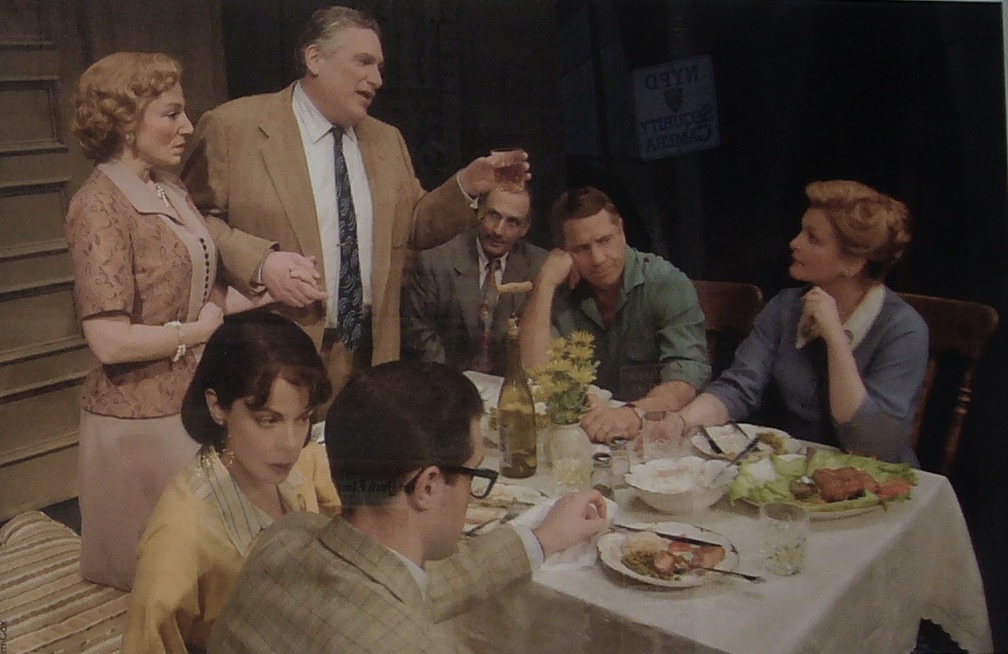
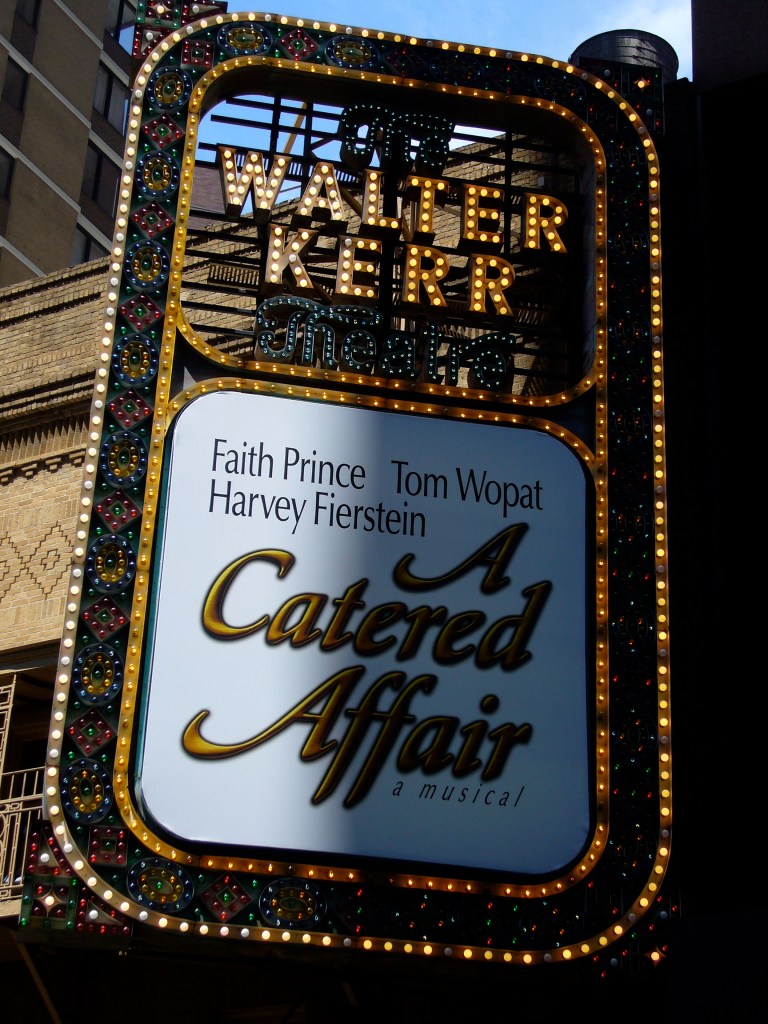
There was a sheet of paper pinned to each seat at the aforementioned Walter Kerr Theatre, asking patrons whether or not they had liked the current production and whether they would recommend the show. Now, I did not hand in my questionnaire. Who am I to caution theatergoers about a musical with such a wonderfully gifted group of players: Harvey Fierstein, who also wrote the libretto, Tom Wopat, whom I had previously seen, defenses way down, in Annie Get Your Gun, and the glorious Faith Prince (last featured here on the cover of the playbill for Bells Are Ringing)? Obviously, enough people had come to the Walter Kerr on that Tuesday evening in early June to relegate me, chancing it by getting a last-minute ticket at TKTS, to a seat way in the back.

Now, this might be all right when the stage is filled with a line of chorus girls making their way down a giant staircase, a set boasting an enormous showboat or an oil painting coming to life (as in the revival of Sunday in the Park with George I would see a few weeks later); but A Catered Affair is not that kind of a razzle-dazzler. It is a modest, earnest musical play; it examines characters rather than providing an opportunity for a series of show tunes. Modesty is its quiet strength, but, sitting in the back row, it still feels an awful lot like weakness.

I regret to report, however belatedly, that I did not warm to A Catered Affair, and not because its thin story felt somewhat warmed up. Sure, it is based on a 1955 television play by Paddy Chayefsky, himself not exactly a hot property these days; but then, most of today’s Broadway offerings are recycled.

A promotional close-up supplied by the theater to passers-by with a view no audience member would enjoy

No, it wasn’t that. I was simply too far removed from the hearth—even further than Uncle Winston, the sidekick Fierstein insisted on turning what, back in the 1950s, could only be an outsider. I appreciated him being there, as a reminder that homosexuals where always in the picture, even when they were kept well outside the frame of the camera. Unfortunately, Winston’s moment in the limelight is “Coney Island,” a dreadfully cliché-laden number in which he advises us to keep our eyes open as we ride the rollercoaster of life.

I had been told about the old stove, and that Ms. Prince actually prepared scrambled eggs during the scene. And that is a recommendation? Well, hand me a frying pan and start selling tickets! It rather reminded me of Gertrude Berg, who insisted on realism, and real eggs, even though The Goldbergs was a radio program. Yes, eggs were being prepared on the stage of the Walter Kerr that night, but, unable to smell the, that did nothing to whet my appetite. An intimate play deserves an intimate theater, especially a play that depends on character far more than on plot, of which there is little, and that anticlimactic.

Indeed, A Catered Affair would have made a fine radio musical, if something like that were ever to be reintroduced into American culture. This is not to say that it is cheap or second-rate. It just means that it does not require visuals for its staging of a family in crisis, a particular brand of problem play you might call Miller Light, even though Rheingold or Schlitz were more likely to be found in the family icebox.

The Walter Kerr was once a radio studio; back in the late 1930s, the playbill informed me, Alexander Woollcott broadcast from here. I would have enjoyed closing my eyes and listening to Ms. Prince, who wowed me many years ago as Adelaide and who keeps delighting me whenever I play selections from the Guys and Dolls cast album. Having kept my eyes peeled on a faraway stage with little to see (not even the event promised in the title), I did not recall a single tune upon exiting the theater shortly before 9 PM, after 90 minutes of intermission-free drabness.

Broadway does Family Tuesdays now, for the discerning “family,” however defined, that can afford to spend money on the less-than-spectacular.

"But some people ain’t me!": Arthur Laurents and "The Face" Behind Gypsy

Gypsy again? I guess that is what many theatergoers thought when, only five years after the previous revival, the show opened on Broadway for the fifth time since its debut back in 1959. I have seen three of those revivals and, not inclined to wield my thumb, shan’t ponder publicly whether or not this might be the definitive production. It better not be, since I hardly mind seeing the play interpreted a few other ways, if only to get a chance to catch the old routines with “new orchestrations.” Still, be it stagecraft, performance, or my own very gradual process of maturity, I have not seen the dramatic finale of Gypsy staged any more movingly than in the current production. To be sure, I am opening to Arthur Laurents’s book differently now that I have completed my doctoral study on American radio drama since seeing the 2003 revival starring Bernadette Peters. I am reading between—not into—Laurents’s celebrated lines to find the former radio playwright’s “Face.”

“May we entertain you?” Laurents’s career in radio began in 1939, when the Columbia Workshop produced his first original play, “Now Playing Tomorrow” (30 January 1939), a fantasy concerning the doubtful advantages of gazing into the future. With such a high-profile debut to his credit, the young writer had little difficulties selling scripts to various network programs, including Hollywood Playhouse (1937-40), The Adventures of the Thin Man (1941-50), and This Is Your FBI (1945-53). “Commercial pulp, all of it,” he commented sixty years later; yet unlike fellow playwright Arthur Miller (one of whose wartime radio dramas I discuss here), Laurents was not dismissive of, let alone bitter about, his radio days. He had actively pursued such a career, attending an evening class in radio writing at NYU. Laurents did not feel that he was “faced with the art vs. commerce dilemma”; besides, he was “too flattered” being “wanted, too thrilled at being paid for being happy.”

“Extra! Extra! Hey, look at the headline! / Historical news is being made!” Contributing to the war effort by writing plays for a number of dramatic propaganda series kept the draftee from facing combat overseas and secured him an income of up to $350 per script. The Army arranged for him to work on programs like Armed Service Force Presents (1943-1944), Assignment Home (1944-46), and the Peabody Award-winning documentary drama The Man Behind the Gun (1942-44).

Toward the end of the war, Laurents had found his voice as a radio playwright—a voice strong and convincing enough not to be muffled by spineless industry executives. Drawing on personal experiences, he managed to explore themes similar to those he tackled on Broadway, where he made his entrance with Home of the Brave (1945), a play dealing with anti-Semitism in the Army. While Washington looked closely at his scripts after he had been accused of communist affiliations, Laurents not only managed to get a controversial play about black soldiers on the air, it (“The Knife”) even earned him a citation.

Like Gypsy and West Side Story, Laurents’s radio plays are personal records; their author arrived at a code that made it possible for him to share his own story, the story of an outsider. There is a bit of Louise in many of them. “The Face,” a Writers’ War Board “best script of the month” for April 1945, is no exception. “Do you love a man for his face?” the play asks of us, exploring the experience of a disfigured soldier dreading his reintegration into post-war society, a society, he knows to place great importance on appearances.

“Small world, isn’t it?” Like many of Laurents’s early works for stage and screen, from Home of the Brave to his screenplay for Hitchcock’s Rope (1948), “The Face,” as I put it in Etherized Victorians, is a play of masked figures and figurative unmasking. Dreading the prejudices of post-war America, the disfigured Harold Ingalls and his fellow patients must learn to be strangers “joining forces”:

GOLDSTEIN.  When you get plastered . . . who do you go with?
INGALLS.  There used to be a fellow—but he was discharged last week.
GOLDSTEIN.  Was he—like us?
INGALLS.  Yeah.  So now I go alone.
GOLDSTEIN.  If—if I can get a pass . . . can—I go with you?
INGALLS.  Sure! You know it makes it good, when there are two of you.

“Together, wherever we go!” Rather than confronting his biological family, the mother and brother he’ll never quite “get away from,” Ingalls is eager to escape with his double, his secret sharer:

INGALLS.  You’re more of a brother than he is.
GOLDSTEIN.  Now that’s a real compliment.
INGALLS.  Oh you know what I mean.
GOLDSTEIN. Sure.
INGALLS.  Well, I’ll get my mother over with quick and then we’ll beat it into town and really tie one on.  You and me.
GOLDSTEIN.  Right!
INGALLS.  That’s the best way.
(Biz: Fade in MOTHER’s footsteps approaching slowly.)
INGALLS.  You and me.  That’s the— (He cuts as he hears the footsteps.  They are still off but coming closer, closer.)

Those footsteps are the sound of reality encroaching on oblivion and denial, of a past that Ingalls has to reconcile with his present. To move on, Ingalls needs the strength to let go of both by forging new relationships from or in spite of his state of effacement. “If Mama Was Married,” what might have happened to stripper-novelist Gypsy Rose Lee and her sister, June Havoc, who teamed up with a big name in radio? One stuck in infantilizing routines, the other in the rear of a cow costume, each fashioned a career out of a pipe dream of vicarious living.

When Ingalls is discharged, the Army psychiatrist reminds him that “every single day, people get slapped because of ignorance. They get slapped for religion, for color, for how they talk or what they look like.” She encourages him to “stand up to them and tell them they’re wrong!” The play ends with the wish that “this will be the beginning, the beginning of a world where the only thing that does matter is each man himself for what he is himself.”

“But I / At least gotta try [. . .].” While it may never be “Rose’s Turn,” the resilient Arthur Laurents—whose next project will be a revival of West Side Story—has long had a “wonderful dream” worth living, a vision of that “place for us, somewhere,” the voicing and realization of which is well worth the agony of uncovering the not always handsome face behind our masks . . .

Going Ithaca; or, A Hardy Welcome

Traveling through Upstate New York on a weekend in summer without having called ahead for reservations is like entering a lottery with money you owe to a loan shark with particularly keen nostrils. It is a heck of a gamble. While not the Vegas type and averse to mixed metaphors, I prefer vacationing without a safety net; but to the one driving and hoping for a bedpost instead of yet another signpost pointing to some rural spot barely traceable on the map it can be rather a pain in the hard-pressed posterior.

“There’s no room to be had in Ithaca,” we were warned one stormy evening by the proprietor of a second-hand bookstore in Dryden, a little town in the Finger Lakes District. That was Saturday, 21 June, which happened to fall on the second day of this year’s Ithaca Festival, the weekend Ithacans set aside to celebrate themselves and, by so doing, apparently draw considerable crowds to augment their population so as to justify every overpriced motel bed in town.

We had experienced difficulties with accommodations (make that impossibilities) on the previous night up in Saratoga Springs, where even the bedbugs were lining up for the tiniest of places to flop due to some rock concert of which we, who would much rather listen to a piano being tuned by Florence Foster Jenkins, were altogether, though not, as it turned out, altogether blissfully unaware.

Well, there was a room to be had in Ithaca. And not just a room, but a view, as well. That view, at some remove from the rather fancifully named Meadow Court Inn, was up in the balcony of the old State Theatre. We were being treated, free of charge, to a screening of a silent movie shot on location in Ithaca, which, as Aaron Pichel informed us in his extensive notes on the film we were about to see, was a center of motion picture production during the early days of narrative filmmaking.

Directed by the brothers Leopold and Theodore Wharton, The Lottery Man (1916) features a young Oliver Hardy (shown above) in the role of Maggie Murphy, a cheerful maid who ditches a chance at riches for the fellow servant she loves.

The audience at the old State Theatre was largely local. We could tell by their cheers. They recognized buildings and streets (pointed out to us in the program) and expressed themselves appreciative of this off-Hollywood production in the mounting of which several long since departed townspeople had been actively involved both behind and in front of the camera.

Based on a Broadway stage success of the same title and starring two of the original cast members of the 1909-10 production, The Lottery Man is a clever little farce that tells the story of an impecunious but resourceful college student who offers himself as prize to any woman daring or desperate enough to purchase a dollar ticket, only to realize that he has fallen in love and is jeopardizing a chance at matrimonial happiness by attempting such a money-raising stunt.

Among the luckless and disgruntled ticket holders shown in a climactic crowd scene were quite a few poorly disguised males, which brought to mind the recent policy changes in the State of New York owing to which the state of matrimony no longer demands that an Oliver in search of a husband either pose as Olivia or propose to one instead.

The little known and seldom shown Lottery Man, which, as of this writing, has yet to receive five votes on the Internet Movie Database, was ably accompanied that night by the jovial Philip Carli (pictured), one of a rare but according to him far from threatened breed of entertainers. The fact that we number among our friends a silent movie composer/accompanist who wrote a radio play-turned-television drama about Laurel and Hardy added further significance to this unexpected outing at the end of a long drive along the Mohawk and down Cayuga Lake.

Sure, the moviegoing experience might have been enhanced by the presence of a projector (the film was screened digitally); but I, for one, was glad to have been part of this special event at a night on which we could have hoped for nothing more than a roof over our chowderheads.

The House of [Broken] Glass

Fleischmanns is a small town. There’s a sign on the road just before you get to it that says POPULATED AREA. Fleischmanns is populated with five hundred people, no more, no less. To a stranger it looks like any other little village in the Catskill Mountains. To a native it’s a special place and every town he doesn’t live in is a nice place to visit but he wouldn’t want to live there—he wants to live in Fleischmanns.

This is how the aforementioned actress-playwright Gertrude Berg begins her reminiscences about the town in which her father opened a summer resort more than a century ago in a spot once known as Griffins Corners. That, incidentally, is also the name of the local pub where we had lunch on our stopover at that once thriving, affluent community. Fleischmanns. Who ever heard of a place that sounds like a time slot reserved for the sponsor of Rudy Vallee! When I read the name, I thought for a moment that Mrs. Berg, who knew all about commercial radio, had made it up; but when I discovered it on a map of the Hudson Valley shortly before our 1,300-mile trip through upstate New York a few weeks ago, I was determined to pay a visit.

Now, I am not prone to bouts of nostalgia, the state of pining for what never has been anything else but an intense longing to the indulgence in which entire industries are devoted. I much rather aspire to something that is, delve in what has been, or simply make up whatever suits me without getting all melancholy about it. Still, if there is any place in the Catskills that could make me melancholy, it would have to be the town of Fleischmanns.

I don’t quite know what I expected after I read the lengthy, detailed description in Berg’s charming Molly and Me; I only knew that I really wanted to go. After all, Berg’s serial The House of Glass owes much to the town and the hotel run by Berg’s father. The House of Glass (a single instalment of which, dating from 13 November 1935 and featuring famed contralto Madame Schumann-Heink, has been shared on the to me invaluable Internet Archives) was “Fleischmanns all over again—through a ribbon microphone” Berg remarks in her biography:

Barney Glass was my father. The hotel was full of guests, all of whom I had known. I used what I could remember of their stories, and where there were unhappy endings I added happy ones. The radio hotel always solved its problem with a laugh, and as far as reality was concerned all I had to do was change the names of the guests and I had my story line.

Fleischmanns has a museum devoted to memory. It was closed on the day we passed through. The library has a copy of Molly and Me. I took it from the shelf, flicked through it until I got to the chapter on the town, and left it on a little table, as if to remind anyone stopping by of those better days. I know that the Borscht Belt went bust some decades ago; but I sensed that we caught Fleischmanns with its pants down. Not the kind of clowning around that makes you laugh; more like a sad, half-forgotten soul stuck in a retirement home with a suitcase of ill-fitting clothes and a yellowed scrapbook filled with mementoes of a past few active minds could be stirred into recalling . . .

As Their Own Words: The "Colorless Green Ideas" of Sleep Furiously

How strange, I thought, sitting in the darkened auditorium of our local art house movie theater. Here I am, watching a film capturing the world around me—my immediate environs, the people who are now, in terms of proximity, though not, generally, of propinquity, my neighbors. Looking on once again brought home just how removed I am from the lives and experiences of the people shown on the screen, insisting instead on reliving my recent trip to New York, city and state.

That one of them is a friend, and that the film’s director is her son, only added to the sensation of not being truly part of the networks of people among whom I now happen to reside, that I seem to be less part of the land than our terrier, Montague, leaping in the fields.

The film was Gideon Koppel’s Sleep Furiously (2007), one of the official selections screening at this year’s Edinburgh Film Festival. You might call it a documentary; but it really is more precisely a document, meaning that no documentarian vision is imposed on what we are being shown. While the images of rural life in Wales are reminiscent of Humphrey Jennings’s aforementioned Silent Village, Sleep Furiously does not extract a message from what it examines, other than articulating an apparent respect for the life depicted. It captures what some argue to be endangered; it preserves what some fear to be fading. Beyond that, however, the film does not so much as construct a syntactic unit from the words it permits us to overhear.

The seeming randomness of Sleep Furiously (whose title is derived from Noam Chomsky’s famous grammatical yet nonsensical sentence) invites us to study each moment, each figure in the landscape as so many nouns and verbs. It is an encyclopedia of a place, not a social commentary.

The camera is mostly static. It is the people, the landscape and the living things in it that are in motion; and it is this movement within the frame that compels us to keep watching: a library van creeping up and down narrow countryside lanes, people busy at their day’s work, farm animals giving birth, raindrops gliding along a washing line. We are encouraged to look at snapshots, rather than judge or ponder the judgment of a curator who, by comparing and setting aside, is out to assign a definite space to each artifact with the intention of fixing a meaning beyond that each shot may either have intrinsically or hold for us, the individual spectators. Instead, the people we meet speak for themselves without posing or being imposed upon.

Freed from the burden of being representative types, mere manifestations of a director’s position of manifesto, the individuals we meet come alive; and however insignificant they might be to the world at large, their words and image become memorable. It is the lens and the microphone that communicate and let communicate, that extend the hidden community in which they dwell.

For once, I got to see the life in the cottages and farms all around me, disconnected as I remain from most of them and they from me. And, next time I see our friend, Pippi Koppel, I can tell her: hey, I never knew that about you—that you put a dead owl into your freezer and mailed it off to a taxidermist; that you renewed your library copy of Glorious Cakes; that you introduce children to the art of pottery; or that you place stones upon your husband’s grave . . .

I sensed that, beneath the syntax those who look on or judge without bothering to look construct out of our lives, we are all word made flesh. Most of us aspire to being nouns, to being somebodies, while others are adjectives, enriching or changing the lives of those on whom they depend for their own meaning.

The lucky ones are verbs: those who make, who mean, who matter without being mere complements of someone else’s sentence. Unless we are prepared to remain a question answerable to others—Happy? Misfit? Either … or?—we had better work at being and creating. Try! Continue! Change! That, not simply syntactically speaking, is imperative!

“Jumping Niagara Falls”; or, She’s Pushy, for a Corpse

Among the fifty-eight movies I added to our video library while shopping in New York City is the 1948 film adaptation of Lucille Fletcher’s radio play Sorry, Wrong Number. Fletcher penned the adaptation as well, despite her previous remarks about the merits of her original script. “I wrote ‘Sorry, Wrong Number,’” she was quoted in a 1948 anthology of Plays from Radio, “because I wanted to write a show that was ‘pure medium,’ something that could be performed only on the air.” And yet, “Sorry” has been reworked for stage and television and turned into both film and novel. If the original play is “pure medium,” Anatole Litvak’s melodrama is a Sorry adulteration. Just how much of a narrative muddle it is becomes clear when the screenplay was returned to the airwaves as a presentation by the Lux Radio Theater on 9 January 1950.

The thrill of the original lies in what Matthew Solomon refers to as its “narrative isochrony,” that is, the congruence of elapsed airtime and the clock ticking away the last minutes in the life of the central character. Instead, Sorry is marred by too many flashbacks and too much background story for what is essentially our witnessing of the inevitable death of someone we cannot wait to shut up.

Fletcher invites us to rethink Mrs. Stevenson’s role of a victim and permits us to enjoy tuning in to the well-scheduled execution of a perfect monster. In her screenplay, however, the playwright attempted to elicit feelings for a woman we’d much rather strangle, to make us waver between sympathy and condemnation. Mrs. Stevenson now has a first name and presumably a heart, however weak.

Alfred Hitchcock might have agreed with this revision, considering that the audience experiences suspense more keenly if the character is sympathetic. Fletcher also adds a moment of doubt as to Mrs. Stevenson’s fate by suggesting that her executioner might also become her rescuer.

At the same time, though, the film, unlike the radio play, compromises its point of view, letting the camera glide through Mrs. Stevenson’s room and giving us eyes to see the world beyond instead of keeping us close to the invalid who is being given a pair of wobbly legs just strong enough to make us wonder about her condition and chances of survival. Film insists on showing, even if the most compelling sight is the emotional state as written in the face of a person reduced to being all ears.

At any rate, Mrs. Stevenson died, eventually and unsurprisingly. Or did she? While on our trip upstate, recalled in the current entries into this journal, I was reminded of “Jumping Niagara Falls,” the unlikely sequel to Fletcher’s rather conclusive thriller. In it, Mrs. Stevenson is out for revenge—from the grave as her husband Elbert goes off to the Falls with a woman young enough to be his granddaughter. What’s left of Mrs. Stevenson is nothing more than what we get when we first encounter her—a voice, which insists on making itself heard on the telephone, the radio, and (or perhaps solely in) the mind of the man who masterminded her murder.

That voice, in the 1999 sequel (by Brian Smith and George Zarr) is Claire Bloom’s. To me, though, as to anyone loving radio, the voice of Mrs. Stevenson belongs to none other than the aforementioned “First Lady of Suspense.” Equipped with Moorehead’s larynx, Fletcher’s celebrated harridan might have us all over in a barrel.