
They [Got] What They Wanted: or, We Postpone This Wedding

Starting next week, I shall once again take in a few shows on and off Broadway. In the meantime, I do what millions of small-townspeople used to do during the 1930s, ‘40s, and early ‘50s—I listen to theater. Since the 1920, such makeshift-believe had been coming straight from the New York stage, whether as on-air promotion or educational features. Aside from installing an announcer in the wings to translate the goings-on and comings-in, it took the producers of broadcast theatricals some time to figure out what could work for an audience unable to follow the action with their own eyes. When that was accomplished, in came the censors to determine what could come to their ears. The censors were in the business of anticipating what could possibly offend a small minority of self-righteous and sententious tuners-in who would wield their mighty pen to complain, causing radio stations to dread having risked their license for the sake of the arts.

Few established playwrights attempted to re-write for radio. One who dared was Kenyon Nicholson, whose Barker, starring Walter Huston and Claudette Colbert delighted Broadway audiences back in 1927 (and radio audiences nearly a decade later). On this day, 19 May, in 1946, the Theatre Guild on the Air presented his version of Sidney Howard’s They Knew What They Wanted, with John Garfield as Joe, Leo Carillo as Tony, and June Havoc (pictured) as Amy.

Now, I have never seen a stage production of the Pulitzer Prize-winning They Knew; nor have I read it. Like most tuning in that evening, I would not have known about the tinkering that went on so that the story involving a doomed mail-order May-December romance could be delivered into American living rooms—were it not for Nicholson’s own account of what it entailed to get They Knew past the censors.

Nicholson got to share his experience adapting They Knew, one of his “favorite plays,” in a foreword to his script, which was published in an anthology of plays produced by the Theatre Guild on the Air. According to the inexperienced adapter, his “enthusiasm for the job lessened somewhat” as soon as he began to undertake the revision:

“Radio is understandably squeamish when it comes to matters of illicit love, cuckolded husbands, illegitimate babies, and such; and, as these taboo subjects are the very core of Mr. Howard’s plot, I realized what a ticklish job I had undertaken.”

After all, Messrs. Chase and Landry remind us, as the result of a single listener complaint about this adaptation of Eugene O’Neill’s Beyond the Horizon, which retained expressions like “hell” and “for god’s sake,” several NBC Blue affiliates were cited by the FCC and ordered to defend their decision to air such an offensive program. Nicholson was nonetheless determined “that there could be no compromise. Distortion of motivation as a concession to Mr. and Mrs. Grundy of the listening public would be a desecration of Mr. Howard’s fine play.”

It was with “fear and trembling” that Nicholson submitted his script. Recalling its reception, he expressed himself “surprised to find the only alteration suggested by the Censor was that Joe seduce Amy before her marriage to old Tony.”

The “only alteration”? Is not the “before” in the remark of the pregnant Amy—”I must have been crazy, that night before the wedding”—precisely the kind of “compromise” and “[d]istortion” the playwright determined not to accept? Nicholson dismisses this change altogether too nonchalantly as a “brave effort to whitewash the guilty pair!” Rather, it is the playwright’s whitewashing of his own guilt in this half-hearted confession about his none too “brave” deed.

The censors sure knew what they did not want those to hear who never knew what they did not get.

Cowcatchers and Hitchhikers: The Technique of Radio Writing

This one’s been around and seen hard times. A tattered dust jacket bespeaks much work and long neglect. And now that I got my hands on it, I expect it to be in my service for years to come. To be sure, Luther Weaver’s Technique of Radio Writing (1948) is no eye candy. It does not strive be shown off in talks around the coffee table.

After all, its subject matter is the business of broadcasting, of producing commercially viable scripts that, once flung out of the voice box and into the proverbial ether, come to the ears of the multitude who are to be coddled and cajoled all the way to the store.  The Technique of Radio Writing is very much concerned with commerce. It does not wax philosophical about the potentialities of radio; instead, it provides information about the industry, its workings, opportunities and limitations.

According to Weaver, it is pointless to lament the fixed slots that make it easy for the networks to sell time for advertising. “Time, or the lack of it, is a great nuisance to new writers in radio,” he acknowledges; but writers who protest such limitations “might just as logically protest against the sonnet’s requirement of 14 lines.”

Weaver urges writers to

remember the value of Anglo-Saxon words, staunch and sturdy: they can be depended upon to make your meaning clear in the way a Grant Wood painting makes a corn shock stand out ion a rolling Iowa farm. Words of Anglo-Saxon origin are usually short, crisp, direct, easy to say, easy to listen to, easy to understand. You’ll find them valuable in your work.

Making things plain, Weaver does not shy away from the vocabulary of the trade, but explains the at times colorful jargon. A “cowcatcher,” for instance, is a

commercial announcement “coming on first,” that is, preceding the opening of the program itself.  Note that it is on a different product or service from the product or service that appears in the commercials inside the program itself, but it is made or offered by the same sponsor.  Frequently it is known as an “allied “ product.  Similarly, a hitchhiker is a closing announcement, one that comes in after the regular program is finished. Both [. . .] are within the program time of the sponsor.  They vary in length, but common practice usually holds them to less than 1 minute.

A “block” of sales patter could “easily run to 3 minutes or more,” considering that the various advertisements—even in the age of sponsorship in which a single product became associated with a particular show—followed “in direct sequence: closing commercial, hitchhiker, station-break announcement, cowcatcher, opening commercial of the next program.”

In the years after the Second World War, commercialization was a hotly debated and much deplored fact of American living. As Weaver reminds us, future President Eisenhower referred to commercials as a “language that clinks sweetly in our ears”; to “hear commercials on the radio,” he argued, “means America.” Citizens, on the other hand, were voicing their objections.

While the networks tried to “knit the hitchhiker into the show itself by recurring theme music,” “[s]ome stations,” responding to complaints, decided to “bar both cowcatchers and hitchhikers on shows under their own control.”

By today’s standards, broadcasters of the mid-1940s still showed moderation when rendering their ostensible service to the public. According to Weaver, the National Association of Broadcasters (NAB) recommended that an hour-long program not exceed six minutes of commercial copy. The recommendation was followed by CBS, which stated the “length of copy regulations on the rate card of its company-owned stations” as being six minutes per hour after 6 PM, with nine minutes of commercials for each morning and afternoon hour.

Nowadays, it seems, the cow has run away with the boys and gals in the business of catching our attention while milking the tired medium of television for all it might once have been worth. Is it any wonder that so many of us are taking a hike and hitch alternative rides?

"I’ve been around, it’s been well advertised": Among the Radio Stars of Today

Wanting to put a face to a name—that is a widely exploited weakness common to radio listeners. Studio broadcasts, picture magazines, and touring shows supplied what those tuning in were led to think of as being in need of supplementation. There is thrill and satisfaction in getting the picture, in finding out whether it matches the one a voice imaged forth. Another one of my recent additions to my library of books on so-called old-time radio is such a supplement to our mental portrait galleries, a catalogue of all those radio personalities with whom Americans were so intimately acquainted in the 1930s and ‘40s.

Robert Eichberg’s Radio Stars of Today (1937), on which I first laid my greedy hands while researching my dissertation at Hunter College in New York City, is rich in photographs of those luminaries now dim who used to brighten the days of millions during the years of the Depression and the Second World War: The Easy Aces, Fred Allen, Amos ‘n’ Andy, Jack Benny, Major Bowes, Bob Burns, Burns and Allen, Eddie Cantor, Bing Crosby, Jessica Dragonette, Nelson Eddy, Helen Hayes, Guy Lombardo, Lily Pons, Dick Powell, Kate Smith, Rudy Vallee, and Irene Wicker are among the household names Eichberg dropped and placed into captions.
Passing the likenesses of Walter Damrosch, Lowell Thomas, and Robert “Believe It or Not” Ripley, my wandering eye was arrested by the sight of Virginia Verrill (pictured, left, next to her mother, erstwhile Vaudeville actress Aimee McLean). The name did not sound any chimes. “Vee,” as Eichberg informs us, “made her debut at the age of three, singing with [orchestra leader] Paul Whiteman,” who was a “friend of her mother’s.” By the age of thirteen, she was heard on local broadcasts and, a year later, was “doubling for Barbara Stanwyck.”

What readers back then could not have known, even an altered hairline did little to secure her leading lady status in Hollywood. Her film career, begun at the age of sixteen, did not take off; producers noted that Verrill “screened too much like Myrna Loy.” They noted, too, that she could “double” for those in need of a dubbing. It is hardly a path conducive to fame.

Loy’s looks and Hollywood’s trompe l’oreille may have stood in her way to stardom on the screen; but the largely invisible Verrill nonetheless made a name for herself on radio, to which her inclusion in Radio Stars attests. Verrill was heard on 1930s programs like Socony Sketchbook, Wonder Show and Log Cabin Jamboree. Just today, two of her Socony performances were brought to our ears courtesy of the Old Time Radio Researchers Group and their latest contribution to the Internet Archive.

Airing on 14 June 1935, the very first Socony Sketchbook broadcast features teenaged Verrill’s rendition of “Reckless.” Songwriter-composer Johnny Green did not hesitate to give Verrill the credit due to her:

Hollywood made that tune famous through the picture of the same name starring William Powell and Jean Harlow. Virginia Verrill did her part to make it famous, too, for it was her singing voice you really heard in the film.

“Gee, Johnny, you shouldn’t have mentioned that,” Verrill adds coyly before performing her number. Yet, as those in radio knew, it pays to be “well advertised” (to quote a line from the song). Nor does it dull the Milky Way when one star washes the hand of another. A week later, on the 21 June 1935 broadcast, Verrill got the chance to return the favor by reminding listeners that her latest song—”How Can I Hold You Close Enough?”—was “written by the pianist-composer Johnny Green.” I might as well give them both a hand before I return to flicking the pages of Radio Stars, especially since Green passed away on this day, 15 May, in 1989.

Notes on a “Note”: Milton Allen Kaplan’s Radio and Poetry

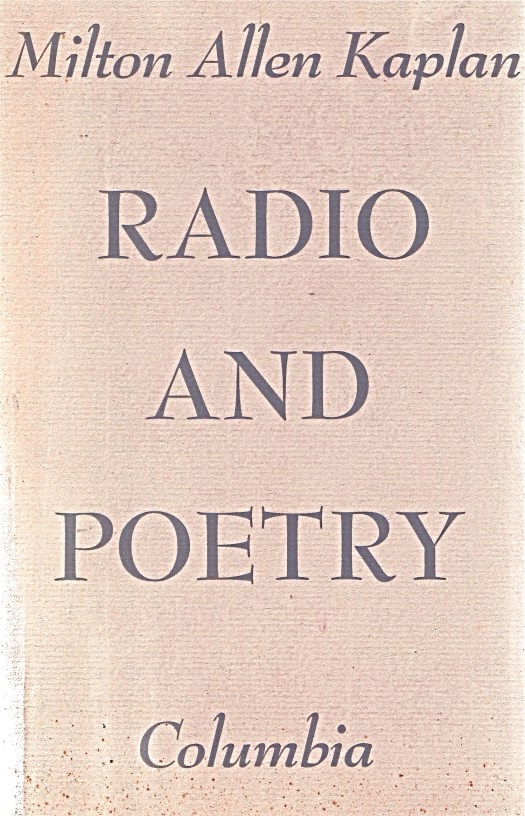
“If radio literature is worth study and analysis, it must be filed, classified, and catalogued accurately. The variety of programs would necessitate an intricate library system in order to permit a student to find such categories as poetry, music, historical drama, documentaries, readings, adaptations, and discussions.” Thus remarked Milton Allen Kaplan in his 1949 study Radio and Poetry, one of the most recent additions to my library of books on American broadcasting. To this day, such catalogues remain inaccurate and incomplete, at best, even at the Library of Congress or the broadcasting museums in New York and Chicago. Radio verse plays, in particular, are an immaterial thing—a nothing—of the past; they are almost entirely forgotten or ignored, especially in the teaching of literature and drama.

Literary critics seem to assume that, since radio was chiefly an advertising tool, the spoken yet scripted words that aired had only the most tentative connection to the arts. The study of what presumably were mornings with Stella Dallas, afternoons with The Lone Ranger and evenings with Jack Benny should be left to cultural historians whose trade it is to dig into the trash heap of Western civilization.

When Radio and Poetry was published, network radio was pretty much dead as a medium for verse. Even the most distinguished practitioners, Norman Corwin and Archibald MacLeish, found the networks less than accommodating. Corwin, of course, had come under suspicion by the House un-American Activities Committee and, in 1949, left CBS to write and produce plays for UN Radio instead. Only a few short years earlier, his works had been heard by tens of millions and were deemed vital to the war effort.

As Kaplan points out, Corwin was “the first poet brought up with radio,” as opposed to being among the “notable poets who turned to radio.” While not recruited, he was often importuned to write occasional verse, to speak to and for the nation, to erect aural monuments in commemoration of the momentous.

On this day, 13 May, in 1945, Corwin’s “On a Note of Triumph” was once again produced; the aforementioned play had originally been heard on V-E Day (8 May), which it was expected to celebrate. “Coming as it did at a climactic moment in our history,” Kaplan remarks, the play “won nationwide attention, and was rebroadcast, published, and transcribed.”

Corwin did not altogether embrace his role as a national chorus in the theater of war; and the “Note” he struck was hardly a positive one. Instead, it is cautiously optimistic, daring to consider the future rather than seeing victory as a happy ending to a drama staged with a cast of millions. The “Note” was also one of Corwin’s last major plays; the “triumph” of peace gave way to the whispers of anti-Communist hysteria and further war cries in Korea, the conflict that would not trigger any poetic responses on US radio. “So they’ve given up,” the play opens. “. . . on radio,” Corwin might as well have added after V-J Day.

Norman Corwin, who recently turned 98 (and whose 97th I commemorated here), is hardly unheard of today. His V-E Day broadcast was subject of the Academy Award-winning documentary A Note of Triumph: The Golden Age of Norman Corwin (2005). Still, his name is not frequently uttered among those whom Kaplan sought to engage, the literary scholar and educators whom he encouraged to consider radio plays as aural art.

Indeed, Kaplan’s study, long out of print, is just about as triumphant as the medium upon whose life it depended. Radio verse being a dying art back then, Radio and Poetry was doomed to be buried alongside it. The author’s enthusiasm seems to have fallen on deaf ears.

“Today,” he concluded in a passage sounding very yesterday,

we have many aspects of poetry on the air—the advertising jingle, the popular song, the cadenced prose of the announcer, the verse play, the radio opera.  Tomorrow, as our audiences comes to demand more and more of the medium and as that medium changes, what new aspects will be revealed, what new alliances effected, what new forms developed?

Heard any new “radio opera” or “verse play” lately? Apparently, those jingles and popular songs are the notes triumphant . . .

Secondary Childhood; or, Pandas to Ponder

Wili and Wali at Penrhyn Castle

It is not dotage but a momentary state of doting. Not the reliving of one’s own youth, however romanticized, but an imagining—or experiencing—of what it means to be very young while looking at objects or confronted with performances not created with me in mind. Not reverie, in short, but empathy. That is what I call “secondary childhood”—the state of being elsewhere in time and space, being young there while being here and quite otherwise. Listening to so-called old time radio programs produced in the US, for instance, I am keenly aware that I am entering worlds once inhabited by millions of children born in a country other than my German birthplace, past generations whose reflections are lost to us and, all too frequently, even to them—worlds the passage to which might have been blocked and obscured over time, but that might nonetheless be recoverable.

This recovery effort is quite distinct from the nostalgia of which I am so wary, the attempt of forcing oneself back through that passage and, failing to do so, creating one through which one may yet squeeze wistfully into a niche of one’s own making. It is quite another thing, to me, to set out to gain access to the worlds of other people’s childhoods, to tune in with one’s child’s mind open. I try not to make assumptions about audiences and their responses; instead, I try to become that audience by permitting myself to be played with so as to figure out how a game or play works.

Penrhyn Castle

As I have had previously occasion to share after a trip to Prague, I enjoy looking at old toys. Visiting the grand and rather austere neo-Norman castle of Penrhyn last weekend, on an excursion to the north of Wales, I was surprised to find, housed in that forbidding fantasy fortress, a corner devoted to a collection of dolls. Now, it seems perverse to be so drawn to the two stuffed animals pictured above, stuffed as Penrhyn is with exquisite furniture and impressive works of art (a Rembrandt, no less). I gather it was the bathos of it, the relief after having had greatness thrust upon me to be surprised by these unassuming and, by comparison, prematurely timeworn objects.

Turns out, the twin pandas in the straw hats are Wili and Wali, marionettes who co-starred in a long-running Welsh children’s program titled Lili Lon (1959-75). Upon returning to mid-Wales, where I now live, I immediately went online in search of the two; but, aside from a history of their creators, little can be found about them. I have become so accustomed to YouTubing the past that I was surprised to find no trace of Wili and Wali. No doubt, they still dwell in the memories of thousands who shared their adventures. I was not among them; yet, as is often the case when I come across titles of lost radio programs or fragments thereof, I imagine myself enjoying what is beyond my reach . . .

The Guardsman Takes a Coffee Break

”I am sure that Alfred Lunt and Lynn Fontanne will never forgive me for what I did to this play,” Arthur Miller commented on his radio adaptation of Ferenc Molnar’s The Guardsman. During rehearsals, the celebrated acting twosome stopped reading the to them familiar dialogue and stared at his script “as though a louse had crawled over it. A new series of lines! A whole new scene!” Such is the business of writing for radio, which also involves watching your language and having the curtains lowered for you by those who demanded a prominent spot to push their wares.

On this day, 9 May, in 1937, Molnar’s comedy was being served in the time an ulcers sufferer takes to have a coffee break. Make that a Chase and Sanborn coffee break, considering that the makers of said brew sponsored those weekly visits with Edgar Bergen and Charlie McCarthy, host Don Ameche, and their sundry guests. Stopping by “to say hello” that evening were screen actress Ann Harding and W. C. Fields—one of them on the way out, the other by way of reintroduction.

Ann Harding, then starring with Basil Rathbone in the Agatha Christie-inspired thriller Love from a Stranger (1937) was to play the role of Marie in the Chase and Sanborn Hour’s instant version of The Guardsman. “[I]t was impossible not to recognize it,” Harding remarks; her character, of course, was not referring to the play itself, but to her thespian husband’s attempt at disguising himself so as to act the part of her lover. Considering that the connubial con-man was played by the less than subtle Don Ameche, there wasn’t much chance of catching anyone off guard.

Listeners did not know that Harding would not get—or seize—the opportunity to play anyone’s lover for years to come. Love from a Stranger would be Harding’s last picture for half a decade, and the man responsible for her prolonged absence from the big screen was right there with her in the broadcasting studio: Werner Janssen, a soon-to-be Academy Award nominated composer. Harding and Janssen were married that year.

Of course, it was not Janssen who upstaged Harding during that Chase and Sanborn broadcast. It was his former colleague . . . W. C. Fields. “Mr. Fields, I’m sure you feel at home because here’s your old follies piano player, Werner Janssen,” whose name the grumpy comic did not trouble himself to recall. Fields was making what Ameche announced as “his appearance since his serious illness” that had “kept him off the stage and out of pictures for over a year.” Fields entered into sparkling banter with aforementioned puppet Charlie McCarthy, an act that would translate into You Can’t Cheat an Honest Man (1939).

Fields was invited back the following week; but Ann Harding (pictured above in a scene from Double Harness) was passing The Guardsman on her way to the altar she eventually refused to “recognize” as a signpost for the end of a career. It is one thing to recognize a partner by his kiss (as Molnar’s Marie does); but to accept that contact as the kiss of death is quite another. Before fellow guests Lorenz and Hart sent listeners off on a “honeymoon express” bound for Buffalo, Niagara Falls and “All Points West” (including Ossining, or “Sing Sing”), Fields gave her an idea her what it meant to spend her days as a half-remembered better half. When introduced to her, he declared: “I know Miss Harding very well. How’s your partner, Mr. Laurel?”

A Doctor in Spite of His Shelf

They are gone. I’ve finally done away with them all. My compact disks, I mean. As of last night, I placed all twelve thousand or so audio files in the iTunes library of my new MacBook (which I only dropped once thus far). Not that past experiences have made this an easy decision for me, given how vulnerable such digital memory is to erasure.

This time around, I backed up everything onto an external hard drive. Sure enough, just after completing this weeklong task (which, the exceptionally fine spring weather here in mid-Wales aside, accounts for my now broken silence), nearly two thousand of those imported files could not be played. Last night, I had to retrieve them, very nearly one by one, from some hidden folder and return them to the library so as to have them at my fingertips once more.

Such ready access is making it easier for me to get my ears on notable broadcasts and celebrate the anniversary of certain radio plays and players. “Train Ride,” for instance, a melodrama “written especially for Joan Crawford” (by Charles Martin, then producer of the aforementioned Silver Theater) and broadcast on this day, 7 May, in 1939. Crawford’s mike fright (already remarked upon here) made such live dramatics rare events indeed. In “Train Ride,” Crawford gets to play a role with which many a radio listener can readily identify: an unhappily married woman who falls in love with a voice other than her husband’s. It is a fantasy fit for a wife who is told to “go to bed with a book of love stories and a box of chocolates.”

Indeed, the two wire-crossed lovers vow never to meet unless the other is about to die. “Each of us has an illusion,” the voice tells her. “Why destroy it for the other?” So, when the two finally get together, the meeting is hardly a moment of unadulterated bliss. After all, her platonic lover, who turns out to be the speech writer for her politically ambitious husband, tells Mary that he working on a “more humane method of electrocution,” the kind of hot love seat he seems certain to take one day.

BIZ. Telephone rings. Receiver is picked up.

Voice. Hello Mrs. Crane.

Mary. Hello.

Voice. Why, you’re crying. What’s the matter?

Mary. Nothing.

Voice. Haven’t you got anybody to talk to? Your husband?

Mary. He hasn’t the time.

Voice. Talking is a medicine for sick souls. I’ll listen.

Mary. I can’t talk to someone I don’t know.

Voice. Why not try getting acquainted? I still promise never to see you.

However unsound the vehicle, Crawford’s flawless script reading and suitably emotive voice make this a smooth “Ride,” one that runs as scheduled without betraying the actress’s much talked of microphobia. “I loved your voice, and I wanted to hear it again” her soon-to-be soul-only mate tells her. “You see, it’s been . . . well, it’s been like a lost chord vibrating in my memory.”

Memory. Lost chords. Vibrations. That brings to mind my own uneasy radio romance. When I set out to research so-called old-time radio for my doctoral study (Etherized Victorians), I was apprehensive about writing on non-print matter. I was torn between the concrete and the intangible, the alleged permanence of script and the inconstancy of the spoken. It felt like an adulterous relationship whose boundaries I could not get in writing.

I was, after all, a student of literature, not performance; and compared to the activity of reading, listening sounded like cheating. Having studied the Victorians for so long, I found it difficult to conceive not having my nose stuck in a three-decker.

These days, my shelves are largely virtual. The plays and narratives, while scripted, exist only in sound. Let’s hope my library won’t deny me access and yield plenty of immaterial matter to go on about . . .

“. . . that same young man in that same brown suit”: A "Jackass" Takes a Bow

For the life of me, I can’t turn a phrase. At least, not at a speed that would encourage anyone to keep up with me. I can’t seem to cut a line short enough to make it worthwhile anyone’s time or spin it fast enough to lasso in the crowds. By the time I’m done editing myself, everyone else has left the spot I failed to hit. As a matter of fact, I am still editing what you are reading now. I would have failed miserably in the days when radio demanded rapid-fire gags at a rate that prematurely aged funnymen like Lou Holtz, who had drawers full of them, and wrecked the nerves of his assistants (among them, the young Herman Wouk, aformentioned). “Take all the words in all the full-length pictures produced in Hollywood in a year,” Erik Barnouw calculated in 1939, “and you do not have enough words to keep radio in the United States going for twenty-four hours.”

Comedians and the largely anonymous writers who fed them their lines sure had to work fast; yet, energy aside, they also needed stamina to sustain an act through the seasons. Sure, you can get almost anyone to “Wanna buy a duck”; but to make it something other than a lame one and not to end up with egg on your face after a few weeks, let alone decades, requires some convincing.

That said, quite a number of comedians, most of them seasoned vaudevillians, enjoyed a long career on the air, a durability that, with a few exceptions, is foreign to today’s short-attention-spanned YouTubeans whose mental databases have been outsourced and replaced by all sorts of gadgetry (or re-call centers) designed to make us forget anything other than to heed those reminders of how to pay dearly, if conveniently, for our carefully nurtured deficiencies. Their mental faculties scattered along the hard drive, future generations may well be on too short a term with the world even to get a running gag. (As I was saying, my syntax just wouldn’t do for broadcasting.)

Celebrating his seventh year on the air, on this day, 30 April, in 1939, was Jack Benny, that perennial middle-age dodger from Waukegan. “Exactly seven years ago today a young man walked into a small New York broadcasting studio and spoke into a microphone for the first time,” announcer Don Wilson (pictured, above, to the right of comedian Jerry Colonna) told those tuning in to the Jell-O Program. There he stood, “that same young man in that same brown suit,” still shaking before every broadcast. “And that’s what worries me,” Benny confessed, “Now I shake and I’m not nervous.”

From the opening tune, “Man About Town”—the title of Benny’s latest film—the broadcast was to be a half-hour of . . . depreciation, an invitation for Benny’s writers to go to town at the man’s expense. That, in shorthand, is the Benny formula, an instantly recognizable persona that contemporary critics Jack Gaver and Dave Stanley termed the “whipping boy of the airwaves.” Benny’s first words on the air (uttered on 2 May rather than 30 April 1930) already signalled the fashion, but it also reminds us how successfully “that same young man in that same brown suit” retailored his act over the years:

Ladies and gentlemen, this is Jack Benny talking, and making my first appearance on the air professionally.  By that I mean I’m finally getting paid, which of course will be a great relief to my creditors.  I, uh, I think you don’t know why I’m here.  I’m supposed to be a sort of a master of ceremonies and tell you all the things will happen, which would happen anyway.  I must introduce the different artists who could easily introduce themselves, and also talk about the Canada Dry made-to-order by the glass, which is a waste of time as you know all about it.  You drink it, like it, and don’t want to hear about it.  So, ladies and gentlemen, a master of ceremonies is really a fellow who is unemployed and gets paid for it.

Gradually, such self-consciousness would become tempered with no uncertain vaingloriousness, and Benny (and his writers) left it to fellow cast members and rival comedians to make the fall guy trip. On the seventh anniversary program, even Fred Allen sent a wire, which Mary Livingstone somewhat less than dutifully read to Benny:

Livingstone.  Dear Jackass.

Benny.  Gimme that wire.  Mmm.  That’s “Dear Jack. As this is your seventh anniversary . . .”

The joke, however slight when quoted out of context, depends for its punch on a listener’s familiarity with the Benny-Allen feud. Audiences expected an acerbic note from a rival—but to be hearing it from those who worked with Benny, and on the occasion of his taking a bow to boot, gave the line a certain kick, one that was always directed at Benny’s posterior and conveniently administered by those nearest to him. Jackass? Benny was a regular piñata. The more direct the hit, the more likely the chances of hitting the jack(ass)pot.

Meanwhile, the anniversary of that celebratory broadcast is past . . . and I am still editing.

I Was a Communist for Tallulah Bankhead

Memento Park, Budapest

Radio has always promoted other media, despite the competition it faced from print and screen. To some degree, this led to its decline as a dramatic medium. Producers made eyes at the pictures, neglecting to develop techniques that would ensure radio’s future as a viable alternative to visual storytelling. Television had been around the corner virtually from the beginnings of broadcasting; even in the 1920s, radio insiders were expecting its advent. So, the old wireless was often seen as little more than a placeholder for television, an interim tool for advertisers eagerly awaiting the day on which they no longer had to spell out what they could show to the crowd.

One of the last big hurrahs of radio during the early 1950s was The Big Show, a variety program hosted by actress Tallulah Bankhead (last revisited here). Sure, Bankhead promoted the movies—but on this day, 29 April, in 1951, she doubtlessly had something else in mind when she expressed herself “privileged to hear a portion of a truly great new Warner Bros. picture, starring Frank Lovejoy.”

According to Joel Lobenthal’s biography of the actress, Bankhead had a “phobia about communism,” largely owing to her Catholic upbringing. Yet, as George Baxt, a theatrical agent involved in booking talent for the program, tells it in The Tallulah Bankhead Murder Case, a mystery set during those Big Show nights, her show struggled as a result of this anxiety and the forms it took.

Not Bankhead’s anxieties—the measures taken by fierce anti-Communists to blacklist (or at least graylist) allegedly subversive players. By the early 1950s, even comedienne Judy Holliday was considered suspicious, which did not stop Bankhead from welcoming her on the Big Show on several occasions.

By playing a scene from a soon-to-be-released spy thriller titled I Was a Communist for the FBI, Bankhead fought for the life of the Big Show, now that even she, the fierce anti-Communist, had come under attack. As Bankhead pointed out, I Was a Communist was a dramatization of the Saturday Evening Post stories based on experience of counterspy Matt Cvetic, whom Lovejoy “deem[ed] it an honor” to portray.

“It certainly brought home to me the patriotic devotion and the sheer guts that Matt needed to take that nine-year beating.” At this point, a voice is heard, off-mike, telling Lovejoy that “someone had to do it.” That someone, speaking to the listening audience, was none other than Matt Cvetic:

Well, Frank, maybe we’d better wait until the job is done before we start taking bows.  The job is far from finished.  We’re just beginning to fight back against the deadly, ruthless, highly organized Soviet-controlled conspiracy.  So, we’ve got a lot of fighting yet to do before we can rid ourselves of this greatest threat to the world of free men.  We’ve got to fight.  All of us.  All the time.

“Amen to that,” Bankhead responded enthusiastically as the crowd in the studio applauded. Threatened by the blacklisters and the menace of television, Ms. Bankhead knew she had to fight—for the good of the country and the good of her show. The Big Show went off the air a year later, just as the aforementioned radio version of I Was a Communist began its syndicated run . . .

". . . it’s been a good day": A Cake for Mr. B

Yes, it’s been a good day. Yes, sir, a good day. Started out that way. When I woke up, the warm, friendly smell of breakfast was drifting upstairs, and the blossoms of my cherry tree were tapping against the windows. Mmm. Lying there, I felt seventeen. Until Marilly’s voice bolted upstairs . . .

Mayor, aren’t you ever coming down to breakfast? It’s gonna be stone cold!

. . . and my years were upon me again as Marilly’s voice called me back.

Thus opens a wistful episode of The Mayor of the Town, broadcast on this day, 28 April, in 1943. The sentimental comedy starred the aforementioned Lionel Barrymore in the title role and Agnes Moorehead as his daydream-terminating housekeeper Marilly. Moorehead’s voice (last remarked upon here) sure could shatter illusions. None tuning in could have mistaken Barrymore for a teenager, though. While the microphone withheld much that a camera could not hide, Barrymore sounded as if the road of his life had seen better days and that, along the way, loads of dust and rubble had gotten lodged in the traveler’s voice box. The actor’s vocal chords not only bespoke the age we insist on calling true but also befitted the part of a man with plenty to look back on through the rear view mirror of his mind.

During the course of his “good day,” the Mayor encounters many a youngster—an inquisitive boy, a lovelorn adolescent, a young husband, and a father-to-be—whose doubts and cares recall to him the challenges faced by his former self. A whole life is condensed into the span of a few hours, further compressed to fit the time slot allotted for a single broadcast.

Yes, it’s been a good day. I kept seeing myself over and over in those kids. But what man doesn’t see himself in every real boy? And then, at noon, I performed a wedding, and I saw myself again. Young and in love and full of ideals . . .

Leaving his housekeeper well out of earshot in the company of her suitors (among them, another Lionel, the gravel-voiced Stander), the Mayor drifts in and out of reflections on youth and age as the goes about his daily business in Springdale. “My, how things do repeat themselves,” he muses, as he recalls bidding farewell to his love to go into battle, just like those thousands of young men and women who where then going out into the theaters of war.

“Too much nostalgia isn’t good for anyone,” the Mayor checks himself as he, a widower now, is reminded of his wedding anniversary. “I could stand a little vinegar to mix with all that honey.” Yet just as his character tells his housekeeper to “get out the sulphur and molasses,” the cast and crew of the show break into “Happy Birthday.” A cake was being brought in, the announcer explained to those listening at home. Yes, all along, while the Mayor reminisced, the actor who brought him to life with his well-worn voice was celebrating an anniversary of his own.

“Mr. Barrymore” Moorehead addresses the star of the program,

we of the cast of The Mayor of the Town want to give you our best wishes on your sixty-fifth birthday. We’re especially pleased your birthday falls exactly on our broadcasting day, for we’d like all our listening audience to join in our celebration. Springdale and its people are very real to us, and very near to our hearts. But nearer to us is the one who represents it all: our dear friend, Mr. Barrymore. So, Mr. B., we offer you our thanks for the many pleasant hours we’ve had with you and wish you many happy returns of the day.

Then paying his respects to Mr. B is the year’s Academy Award winning “Best Actor” and president of the Screen Actor’s Guild—the aforementioned James Cagney—who reminds us that this was not only the anniversary of Barrymore’s birth, but also the “fiftieth anniversary” of his

first appearance on any stage; because, friends, fifty years ago today, one of the most loved actors of stage, screen, and radio made his debut in Kansas City appearing in The Rivals, with his grandmother, the great actress Mrs. John Drew.

After such sentiment and cheer, the broadcast—itself as old as Lionel Barrymore was then—concludes with the “sulphur and molasses” supplied by the makers of Rinso, sponsors of the program, whose spokesman was called upon to bring home the realities a gentle comedy like The Mayor of the Town could only gloss over. The announcer reminded listeners that it had not been such a “good day” elsewhere, that many a celebration had to be scaled down or postponed for the duration (“save waste kitchen fats”—”yes, those homely meat drippings make explosives”), and that many a youth, such as the “American flyers executed by Japs” that day—would never get a chance to wax nostalgic . . .