The “greatest Hungarian sculptor of our time”: A Memo to Blanche Devereaux

You don’t derive much comfort from a musty expression like “let a smile be your umbrella” when you are walking around Óbuda on a wet and gloomy afternoon. It was pretty much wet and gloomy throughout our second stay in Budapest, and even the statues seemed to be putting up their defences against the elements. I was cheered nonetheless by Imre Varga’s “Women with Umbrellas” (pictured here); and when we walked around the gallery dedicated to the work of the greatest Hungarian sculptor of our time,” a scene from The Golden Girls came to my mind, which tends to operate that way.

In an episode originally aired on 19 December 1987 (about a year and a half before I first caught sight of the gals from whose exchanges I learned American English), Blanche, Rose, and Dorothy all agree to pose nude for a sculptor. A Hungarian sculptor, that is. Aside from the thrill of being immortalized in art, what is most on the minds of the three is that Laslo is a bachelor, and a virile specimen at that. They are all pretty much smitten with the self-assured man with the magnificent voice who, as played by Tony Jay, comes across like a cross between Monty Woolley (radio’s “Magnificent Montague”) and Mischa Auer (briefly known as “Mischa the Magnificent” on the air).

When the artist’s work is done, it remains to be seen whether he is interested in pursuing one of them:

Blanche. Laslo, before you make your choice, just let me say what a privilege it has been for me to come here and work with the man whom I consider to be the greatest Hungarian sculptor of our time.

Dorothy. Yes, and just let me say that if Blanche can name two other Hungarian sculptors of any time I shall eat that statue.

I’m getting close, Blanche, should you ever choose to “phone a friend” (even though, as you soon realized, Laslo is a “friend of Dorothy’s”). Imre Varga is a magician who can make sheet metal seem like sheer silk or imbue it with the weight of human suffering, who can make dead matter sway and sway us into believing that the dead matter. His work, which has withstood the political upheavals that relegated many of his contemporaries to the scrapheap (or the ghetto that is Statue Park), is a chronicle of a people and the individuals among them who influenced the course of its history (like St. Stephen, pictured above). Through his portraits in metal, Varga will make you look up names and never let you forget his own . . .

The Great Dictation: Milton, Munkácsy and the Blind Medium

I did not know what to expect when I stepped inside the Hungarian National Gallery, a war-battered royal palace turned into a public museum during the days of Communist rule in Budapest. Somehow, Hungarian culture has remained a closed book—or rather, a neglected volume—to me; and looking at rooms filled with art depicting scenes from Magyar history made me come face to face again with my own ignorance.

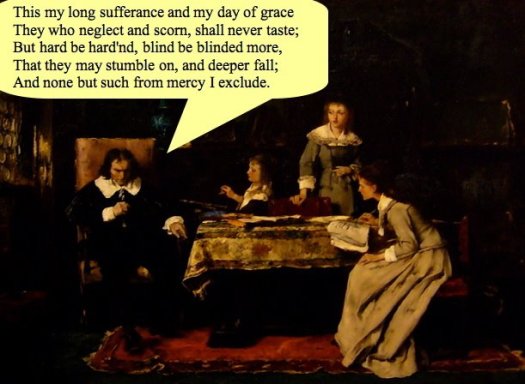
How welcome a sight was “The Blind Milton Dictating ‘Paradise Lost’ to His Daughters.” Yes, that face was familiar, as was the composition, even though I had never troubled myself to note, let alone pronounce, the name of its artist: Mihály Munkácsy. I was surprised to reencounter “Blind Milton” there, knowing it to be on permanent display at New York Public Library on 42nd Street (where it is currently the centerpiece of an exhibition celebrating Milton’s life and works). As it turns out, there are two version of Munkácsy’s painting, the one in New York City being the larger of the two.

This year marks the quatercentenary of Milton’s birth, so we are likely to come across “Blind Milton” in the arts and literature sections of our newspapers or the pages of magazines on history and culture. Even in the 19th-century, the image was frequently reproduced on paper. Indeed, we happened upon such a reproduction at a second-hand bookstore in the Hungarian capital not long after our gallery visit, on the very day it was featured in The New York Times arts section online.

The image became so familiar that, by the twentieth century, the

usual conception of John Milton in the imagination of America’s school children has been a misty mezzotint of a blind man sitting in a dark room dictating Paradise Lost to his bored but dutiful daughters.  That Milton was one of the most fearless and most revolutionary thinkers of his century few youngsters have ever been permitted to know.

.This is how, in 1939, Max Wylie prefaced “The Story of John Milton,” a script from the radio series Adventure in Reading (NBC; 1938-40). The play (by Helen Walpole and Margaret Leaf) tells of blindness, vision, and the specter of persecution as the monumental struggle of the beleaguered poet is being recalled by the voices he called forth in his art.

For twelve years, Milton’s ideas had been in the service of the Commonwealth, until the Restoration threatened to obliterate his words and legacy. Awaiting news from his friend Sir Harry Vane, Milton tries to dictate Paradise Lost to his daughter Mary:

Milton.  You aren’t writing, Mary, you aren’t writing!

Mary.  How can I father? How can I do anything … while we’re waiting for the coming of Sir Harry!

Milton.  Write.  Take down what I say.  “Wolves shall succeed for teachers, grievous Wolves, / Who all the sacred mysteries of Heav’n / To their own vile advantage shall turn. . . .”

Mary.  I cannot.  I cannot.  Paradise Lost may never be finished.

Milton.  Paradise Lost shall be finished.  I’m not a human being any longer, Mary.  I’m an instrument … a vessel … you don’t understand that … but no matter … I may seem hard to you and your sister … but that’s not important either. . . .

Mary.  I shall try to write.  Dictate it again, father.

Milton.  “Wolves shall succeed for teachers, …”

The war of ideas and the fight for their expression—a challenge as urgent in 1660 and 1939 as it is today—is a fitting subject for the so-called blind medium, a medium capable of conjuring images before the mind’s eye not grown dim from lack of exercise.

Milton is accused of treason. The burning of his books, to be executed by “a common hangman,” have been ordered. “Blind among my enemies…. How can I fight?” the poet cries in near despair, until, roused by his visions, he declares:

If, by my own toil, I have fanned the flame that burned out my eyes … then from that darkness will be born new eyes. All natural objects shut away … I can see clearer into life itself….  My vision will not be blurred or turned aside! And so, O, Highest Wisdom, I submit.  I am John Milton, whose sight was taken away that he might be given new eyes.

It is in the opening lines of the third book of Paradise Lost that Milton comments on his condition:

I sung of chaos and eternal night,
Taught by the heav’nly muse to venture down
The dark descent, and up to re-ascend,
Though hard and rare: thee I revisit safe,
And feel thy sovran vital lamp; but thou
Revisit’st not these eyes, that roll in vain
To find thy piercing ray, and find no dawn;
So thick a drop serene hath quenched their orbs,
Or dim suffusion veiled […].
Seasons return, but not to me returns
Day, or the sweet approach of ev’n or morn,
Or sight of vernal bloom, or summer’s rose,
Or flocks, or herds, or human face divine;
But cloud instead, and ever-during dark
Surrounds me, from the cheerful ways of men
Cut off, and for the book of knowledge fair
Presented with a universal blank
Of nature’s works to me expunged and razed,
And wisdom at one entrance quite shut out.
So much the rather thou celestial light
Shine inward, and the mind through all her powers
Irradiate, there plant eyes, all mist from thence
Purge and disperse, that I may see and tell
Of things invisible to mortal sight.

It seems that, in the scene depicted by Munkácsy, Milton is dictating these very lines, at the moment dramatized for Adventure in Reading. His three dutiful daughters look anything but bored. Entrusted with a solemn responsibility and not altogether ignorant of their father’s perilous position, they are rapt and apprehensive as they listen to the dictation, encoded in which is the speaker’s intimate story, a few telling lines in an epic on the fallibility of humankind.

Night Bus; or, What Nearly Didn’t Happen

”Go where the hell ever you want. But get that word ‘bus’ outta the title. It’s poison.” That is what Harry Cohn told Frank Capra when the director declared that his next picture would be Night Bus, the comedy we now know as It Happened One Night. I have to agree with Mr. Cohn as to the toxicity of said vocable. After my recent trip to Budapest, “bus” has become a four-letter word in my lexicon, spelling b-u-s-t. The night bus that was supposed to transport us from Wales to England never even turned up. There we stood, in the wind and the rain, wondering how on earth we would get to Luton (about four and a half hours eastward) to catch the early morning flight to the Hungarian capital.

There were about fifty of us, waiting not only for the chartered vehicle but also anticipating the violent storm that was to batter the coastline and move, along with us, to the continent. It was well past 11 PM when we somehow—and, quite miraculously, given our remote location—managed to hire an alternative coach. Little did we know that, when we finally got underway around 0:30 AM, that that heaven-sent conveyance would end up sputtering along at 10 mph—on the highway, no less—and give up the ghost in its machine halfway through the journey. We missed our flight and spent five hours at a truck stop making twelfth-hour arrangements to get all of us to Budapest.

Amazingly, we did secure another flight from another airport, to which the bus, now repaired, transported us. We arrived at our destination some ten hours behind schedule—too late to enjoy the boat trip on the Danube planned for the afternoon. Our hotel, we discovered, was a converted psychiatric hospital; the folks in charge of making the building fit for its new purpose needn’t have gone through what didn’t look to have been all that much trouble. I, for one, was ready to be institutionalized.

Riding a bus—or missing and waiting for same—is about as enchanting as the prospect of digging a plastic fork into a fast food dinner. Hollywood caught on quick, romancing the railroad instead. As I took time to explore in an undergraduate essay “Ladies in Loco-motion: The Train Motif in the Romantic Comedies of Claudette Colbert” (previously mentioned here), that romance commenced as early as 1895—merely a quarter of a century after the completion of the first transcontinental railroad in America—when the Lumière Brothers, showing their “Arrival of a Train at Ciotat Station” at the first public movie theater in Paris, discovered that the tracks and the camera were indeed made for each other. Sure, some spectators left screaming—but most came back for more.

In 1903, motion picture pioneer Edwin S. Porter’s The Great Train Robbery revolutionized American film, since it led to the discovery that, as Ian Hamilton put it, “movies were not just ‘motion photographs’: they could indeed tell stories, defy the unities, move compellingly from A to B.” Bound and gagged beauties left to expire on the tracks, inexorable engines speedily approaching, and courageous heroes dashing to the rescue are quintessential images and sequences of both silent-screen melodrama and comedy.

As moviemaking and film narrative became more sophisticated, the plot-propelling and symbolic potentialities of the Iron Horse—from the far-off soundings of its prophetic whistle to close-ups of its powerful wheels—were explored and exploited in virtually every emerging genre, in mystery (Strangers on a Train) and musical (The Harvey Girls), in film noir (Double Indemnity) and war actioner (The Train), in Western (Union Pacific) and weeper (Brief Encounter).

To Hollywood’s romantic comedies of the 1930s and 40s, train rides, from the daily commute on the el to adventurous journeys on the Twentieth Century, proved vital as well, with trains and stations serving as unstable, mobile communities or pervious social settings in which relationships are as readily forged as foreshortened, as easily enhanced as escaped.

At once liberating and restricting in their scheduled, track-shackled predictability, distinctly modern, pragmatic and everyday, yet steeped in pre-automotive nostalgia, episodes in transit seem ideally suited to a comic rendering of the primal and perpetual boy-meets-girl plot, in which the lovers’ temporary separation, emotionally as well as physically, is an essential device. Consequently, Hollywood’s romantic comedy and its wilder, wackier subgenre, the Hays Office dodging screwball, make ample use of departures, arrivals, and escapades en route.

For all its influence on screwball, It Happened One Night did little to get the bus rolling again; perhaps, the crammed coach began to smell too much of a New Deal gone sour. Bus travel wasn’t so much democratic as socialist, the freedom of the road curtailed by the invisible tracks that are the prescribed route. On the train, at least, the classes could be compartmentalized, and there was ample room for glamour as well as hobo nonconformity. According to Emanuel Levy’s And the Winner Is . . ., even the success story of Capra’s Night Bus concludes with a real-life train incident. Claudette Colbert, not having expected to pick up a trophy for her role as Ellie Andrews,

was boarding the Santa Fe train to New York when she was announced winner. The Santa Fe officials held up the train and she was taken by taxi to the ceremonies at the Biltmore Hotel. “I’m happy enough to cry,” she said, ‘but I can’t take the time to do so. A taxi is waiting outside with the engine running.”

The bus driver did not wait for Miss Andrews. And he drove his vehicle into a muddy ditch, too. Is it any wonder the runaway heiress was such an expert hitchhiker? Buses! Imagine the joys of our shaky return trip, during which the coach’s anti-roll bar fell off and dragged noisily on the road like so many cans proclaiming “Just Married.” Hardly a marriage of convenience, it certainly was no romance . . .

If It Can Cheer Up Karloff . . .

. . . it ought to be working wonders on a soul decidedly less gloomy than your average Karloffian antihero. A trip to Budapest, that is. It has been eleven months since last we took in the sites of the Hungarian capital. Granted, highlights included visits to awe-inspiring Statue Park and the downright dispiriting Terror House, outings for which my catchings-up with pop-acculturated Hungarians like glamorous Zsa Zsa Gabor and dashing Cornel Wilde or the radio experiments of Val Gielgud in said locale had left me thoroughly unprepared. Unexpected, too, were our encounters with FDR, Scarlett O’Hara, and assorted automata (Kempelen’s famed Turk among them).

William Henry Pratt (or Karloff, to call him by the assumed name that would become a typecasting trap) may not be a widely trusted authority on mirth, merriment or gender orientation; nor is old Hollywood with its backlot scenes and cultural insensitivities necessarily a reliable travel agent. Still, his character’s insistence that “It’s gay there,” which I heard again a few weeks ago in The Black Room (1935), is sure getting me in the mood for another Danubian interlude.

Of all the European city tours I have taken since my relocation from the United States to Wales—Madrid, Istanbul, and Prague among them—our week in Budapest has remained a delight as yet unsurpassed (the well-chosen dark spots on the schedule notwithstanding). Our nights at the opera alone were worth the inconveniences of budget air travel. My recent computer crashes have erased many of my holiday snapshots; so I am all the more eager to retrace my steps. Not that I expect to be walking around town in shorts and shirtsleeves this time around (apparently, a mere four weeks, from mid-March to mid-April, make all the difference). I won’t blame either Buda or Pest if it turns out that, to reverse an adage, you can’t go abroad again.

Not prepared to keep up with the out-of-date while abroad, the ‘castellan shuts up the keep, which will reopen upon his return.

The Starburst Galaxy

“Your name doesn’t mean anything to me, but I’m happy for you that you’re somebody around here.” That is not what I said to popular British television actress Michelle Collins when I met her backstage at the Shaftesbury Theatre in the winter of 2006 (as I mentioned here, in passing). I had been living in Britain for over two years already and still felt like a party-crashing amnesiac among a group of strangers absorbed in a game of Trivial Pursuit, the edition of which appeared to be Mesopotamian. Relocating to another country, however culturally related it may be to the universe you left behind (in my case, the microcosmopolitan hub known as Manhattan), is not unlike the sensation of tuning in to a serial that, unbeknownst to you, has been running for several successful seasons on a cable network to which you have just gotten access. You try your darndest to get into it; yet looking on only leaves you with the impression that the rock you dwelled under is not even the third one from the sun but orbiting another solar system altogether. So you lay down the telescope at last and, unless you meet them in person, give up on identifying the luminaries begot in a galaxy light-years beyond your sphere.

Tonight, the glamorous Ms. Collins returns to UK television to head the cast of Rock Rivals, a new pulp drama set in the world of reality show business, its creative forces, its performers, and its followers. The eight-part series airs on ITV, home of reality programs like The X Factor, the British revamp of American Idol. As with the shows it feeds on, Rock Rivals lets viewers decide who wins the fictional singing contest by choosing one of two possible endings.

Satire or satellite, it is another commentary on the kind of starburst galaxy the entertainment industries insists we inhabit. Starburst galaxies are the kind of systems with a particularly high star-formation rate. Who can keep up with all those newly created celebrities? Sometimes, stars have to fall or catastrophically explode before I take note.

There’s one born every minute—along with the adoring crowd on whom such upgraded gaseousness exerts its gravitational pull. As paradoxical as it might sound, that is probably why I leap at the chance of catching a star in the process of being formed. Presently, the only satellite-dished up treat I take in is American Idol, to which I keep coming back for another helping until David Archuleta is being unaccountably voted off by folks who wouldn’t recognize a rising sun if it hit them in the solar plexus.

Watching reality television has its comforts. It gives you the impression—or should that be “creates the illusion”?—that you are no mere stargazer but a starmaker with powers equal to the vast industry whose well-oiled if by now antiquated machinery is working against time, odds, and YouTube to produce the kind of temporary radiance that passes for stellar. The aging medium turns them out fast for a reason: with all those puffed up somebodies insisting on making stars or asses of themselves, the gas in this galaxy is just about used up.

"You Boig?"

“I don’t have much respect for biographers,” I once told John N. Hall, noted author of Trollope: A Biography and Max Beerbohm: A Kind of Life. I was being mischievous, knowing my professor to have a sense of humor that makes him just the man to examine the lives and fictions of the humorists who attract him. Indeed, I have rarely met an academic whose mentality was better suited to his subjects. I was not merely being facetious, though. I was also being honest. I don’t read biographies; not cover to cover, at least. I am too impatient to go through a series of incidents designed to trace the traits and career of a famous so-and-so to great-grandparents who were semi-literate peasants from Eastern Europe, to illustrate what impact the childhood agony of losing a balloon during a rainstorm had on an artist’s psyche, or explain what it really means to be a supposed nobody before becoming an alleged somebody.

You might say that I am not easily impressed by facts and downright doubtful of them; that I am unconvinced a life can be told by means of sundry scraps of evidence culled from contemporary sources or the recollections of contemporaries whose lost marbles are dutifully dredged from the gully of memory lane. It’s all that; but I would like to think that respect has something to do with it as well—respect for a creative mind expressing itself in a work of art by someone who might not be willing or able to open up otherwise. In other words, I take what an artist is willing to give, even if the limited supply of such works are dictated, to some extent, by market demands.

Nor do I believe that being told about traumas and toothaches ought to compel me to regard an artist’s works as the product of such ordeals. Nothing is more tedious than arguing that a character who slips on a banana peel was destined to break his neck because his creator was terrified of the tropical fruit a health-conscious aunt was trying to shove down his three-year-old throat. If I want a story or a picture to be a mirror, the reflection I find therein should be my own.

Autobiographies are a different kettle of fishiness altogether. They are the storied self, the persona an artist has decided to display in a public performance. (Hall, by the way, has since written his own memoir titled Belief [2007].) I accept them as such, which does not mean I am any more patient as I am being subjected to the courtship of an artist’s maternal grandparents, to Ellis Island flashbacks or dim impressions from the cradle. There is some of that in the aforementioned Molly and Me (1961), the autobiography of Gertrude Berg (pictured here in a photograph freely adapted from the March 1943 issue of Tune In).

Berg was the creator of the radio serial and subsequent television sitcom The Goldbergs, as well as the lesser known House of Glass, about which I got to read in Radio and the Jews by Siegel and Siegel, a volume I picked up at the Jewish Museum in New York during my last visit to my old Upper East Side neighborhood. Molly and Me may be short on the drama of radio, for which I initially picked it up, and lack the to researchers indispensable index, for which omission I immediately put it down again. I need not have been quite so prickly, though. Berg’s memoir, like her writings for the air, is alive with Dickensian characters, a conversational style, and challenges to literary theory that tickle the wayward scholar. Let me give you a for instance:

Well, I saw [New Orleans].  There were hot, wide streets, charming Old World houses—all hot—wonderful hot restaurants, and lovely, well-decorated, hot hotels. In the evening, when the sun goes down, the heat goes down also but the humidity goes up. It’s no wonder that Tennessee Williams and William Faulkner write such good tragedies.  With air conditioning maybe there’ll be a change in our Southern literature.

This passage, my favorite in the entire book, makes me wish Berg had been the ghost writer of Roland Barthes’s Mythologies:

The Lyceum [a New York restaurant her father managed] was a huge place that could take care of fifteen hundred people [. . .].  It was not only big, it was gemütlich, it was where people came to laugh, and it was before publicity men talked about atmosphere.  The ceilings were high and absolutely guaranteed not soundproofed. The whole idea was to have fun and not to be quiet. In those days silence was for funeral parlors, not restaurants.  There were chandeliers that were chandeliers—all cut glass with teardrops and draped strings of little glass balls, not straight pipes with blisters on the end or holes in the ceilings that drop light on you. I’m not saying that those were the good old days.  It’s just that there was something about bigness that was friendly.  Today if it’s big, it’s a bank or Grand Central or a cafeteria where you go in fast and come out fast.  There’s no place to relax any more except at home—and with the foam rubber they put into everything today, who can relax?

“You Boig?” an agent once addressed the writer at the beginning of her career. I can just see him there, facing her. I can hear him, too, thanks to Berg’s writerly gifts and a long exposure to actors like Allen Jenkins. She’s “Boig” all right. I feel that I got to know her as she wanted to be known, a woman who tells her audience not to expect the story of someone who “divorced three husbands, became a drug addict, and finally, after years of searching, found the real meaning of Life in a spoonful of mescalin.”

So what if there’s more Molly than “Me” in this production. I’m not going to tear up the cushions Berg arranged for me in hopes of finding a needle in what is too comfortable to be foam rubber . . .

The Camera, the Coast and the Canvas: A Picturesque Incident

“Let’s go for a ride,” he said. “Where to?” I dared to ask; but there was no reply more concrete than a “Wait and see.”

The sky was clear yesterday, and the afternoon seemed right for a jaunt, a break from the radio waves in which I tend to immerse myself to the point of drowning. So, off we three went. Montague, my lover, and I. We drove down the Ceredigion coast to a secluded little seaside town called Llangrannog. We climbed down the steps to Cilborth Beach, which we had all to ourselves. My eye was drawn to the mysterious Carreg Bica, the rock you see me (and Montague) contemplating here. Legend has it that it is the tooth of a giant; it has become more scraggly through the years after a large chunk of it was claimed by the Irish sea.

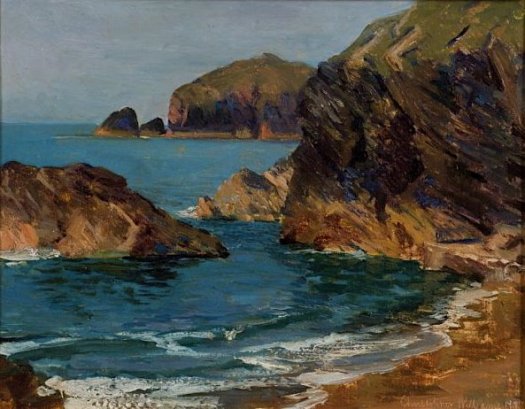
What I did not know until we got to Llangrannog is that this was to be an excursion into the picturesque. We had come in search of a specific scene as shown in this painting by the Welsh artist Christopher Williams (1873–1934). And there it was, ninety years later, the same seascape, that ever changing, never changing scene. Bica’s decaying tooth excepting. The tide was right in; so we did not get to see the coastline just as it appeared to the artist back in 1917, when its a rock solidity must have been welcoming and reassuring, far removed as it stood from the all-consuming whirlpool uncertainties of the Great War, the horrors of which Williams captured in The Welsh at Mametz Wood (1918).

Now, as I learned upon our return home, that painting is to be ours; it will join a portrait by Williams’s son, Ivor (“Suffolk Farmer,” shown in this Wikipedia entry). Whatever happened to holiday snapshots? I wondered, all the while enjoying the sheer extravagance of this picturesque experience.

Leap Year Special

So it isn’t exactly the 35th of May, the magical anything goes if you dare to imagine kind of day Erich Kästner dreamed up for our delight. Still, it is an extra day, this 29th of February, and ought to be looked upon as extraordinary. Indeed, this rarest 24-hour period in the calendar—the anniversary of Superman’s birth, no less—should really be set aside or simply seized for the carnivalesque. It strikes me as absurd to carry on as usual only to keep our system of charting time from falling apart. Being a man of leisure, confined less by schedules than by the vagaries of the season, I decided to keep out of the rain and find out how this leap year appendage was treated by those in charge of the timing-is-everything, by-the-numbers business-as-usual world of commercial radio, USA.

Rather out of the ordinary, to be sure, was Jack Benny’s 29 February 1948 broadcast. Never one to allow guests a look behind the scenes, Benny had made an exception for his girlfriend, Gladys Zybysko; but those rehearsals, dramatized in flashback, took place on the 28th. I was curious, nonetheless, considering that Sadie Hawkins Day, as it used to be known in the US, is the only day a woman could propose marriage. Would the thoroughly self-sufficient Gladys Zybysko leap at the chance of spending her days with a skinflint like Benny? I didn’t think so. Besides, it never even came to that. Benny was too busy puzzling over a place called “Doo-wah-diddy” (“It ain’t no town and it ain’t no city”), mentioned in “That’s What I Like About the South,” a song to be performed on the broadcast.

On the same night, on another network, The Shadow dealt in his customary fashion with “The Man Who Was Death.” No mention was made of the 29 February. Not that I expect any such reference, considering that those born on this day—like Gilbert and Sullivan’s Frederic in The Pirates of Penzance—remain, numerically speaking, life itself to the very last. So, I kept twisting the dial in search of that twist in our everyday.

Promising “tales of new dimensions in time and space” from “the far horizons of the unknown,” the sci-fi series X Minus One seemed likely to mark the spot. On 29 February 1956 it presented “Hello, Tomorrow,” a fantasy examining a post-apocalyptic society, anno 4195 (alas). However compelling, it is a missed opportunity to match the intercalary with the intergalactic. Say, what calendar do you use in outer space? The problems with such “transcribed” programs is that they were readily recycled and, unlike the live programs broadcast during the 1930s and early-to-mid 1940s, omitted any specific temporal or topical references that would make them appear dated. Besides, “Hello, Tomorrow” would have more aptly been called “Hello Again, Yesterday.” It was a rerun.

Nor was the 29 February 1944 edition of Your Radio Newspaper a bissextile treat. There was none to be had all round; a sobering end to my search for the exceptional. Well, never mind. I, at least, am adhering to tradition by letting my world go temporarily topsy-turvy. To wit, I have permitted my in so many ways better half to propose . . . tonight’s entertainment. “Anything goes” comes at a price: I am subjecting myself to a screening of La vie en rose. It’s French, it’s Piaf—it’s something I can stomach only once every four years. “Extra,” I concluded after this exercise in futility, is not a synonym for “special.”

Angels Over Broadcasts? Ben Hecht on the Air

I’m not sure whether I like the idea. Of me being psychic, I mean. So, I generally come up with some feeble explanation for occurrences not quite so readily explained away. I don’t like the idea of explaining things away either. What’s left to be debated or wondered about once you have gotten to the bottom of the unfathomable? If indeed you truly have. There is room for doubt; and as uncomfortable as I am in that dimly lit chamber, I keep its door unlocked—just in case something peculiar escapes that, without any such doubt, would indubitable have escaped me. This evening, for instance, I answered the question “What’s the movie tonight?”—a question generally posed to me at dinner time—by suggesting Twentieth Century (1934), said to have been George Bernard Shaw’s favorite film. The DVD has been in our library for a while and I have been waiting for just the moment to watch this screwball classic.

It was only a little later that I discovered that the screening would be a timely one, given that today, 28 February, is the birthday of Ben Hecht, who co-wrote the screenplay with Charles MacArthur. To be precise, the screenplay is based on Hecht and MacArthur’s stage comedy of that title, itself based on Napoleon of Broadway by one Charles Bruce Millholland. Anyway. My ostensible choice having having an air of the ethereal, I felt compelled to commune with the spirits by going in search of Hecht’s voice on the ether.

The writer-producer-director of Angels Over Broadway wasn’t hard to find, either. In their introduction to a reprint of Hecht’s sentimental medical mystery “The Fifteen Murderers” (first published in Collier’s Magazine in January 1943), Messrs. Ellery Queen describe its author thus:

Ben Hecht—child-prodigy[,] violinist, circus acrobat, theater owner, reporter, novelist (remember Eric Dorn?), foreign correspondent, columnist, newspaper publisher, playwright (remember The Front Page?—with co-dramatist Charles MacArthur), scenarist, and motion-picture producer, to mention in rough chronological order some of his vocations and avocations [. . .]

Regretting that Hecht “invaded the Coast of Criminalia only on rare occasions,” the editors drew the reader’s attention to the story “Actor’s Blood,” which they recommended as “sheer melodramatic fireworks.” Before the story was reworked as Actors and Sin (1952), with Hecht providing the voice-over narration, the author had narrated his own radio dramatization of it for a Suspense production starring Fredric March (24 August 1944). For Inner Sanctum Mysteries, Hecht acted as the narrator of his short story “The Specter of the Rose,” dramatized on 19 August 1946, just days prior to the premiere of the motion picture adaptation.

Hecht’s stories, stage and screenplays were often reworked for radio, and perhaps none more often than aforementioned The Front Page and its screwball remake His Girl Friday (in a 30 September 1940 Lux Radio Theater broadcast starring Claudette Colbert). As for the swift and shimmering Twentieth Century. it took off again with Elissa Landi (in a Campbell Playhouse production from 24 March 1939); even Gloria Swanson got on board, performing a scene from the play on the Big Show (31 December 1950), whose hostess, Tallulah Bankhead, had read Hecht and MacArthur’s “What Is America?” on the 29 March 1942 broadcast of Command Performance.

In 1935, Hecht and MacArthur’s musical extravaganza Jumbo, starring Jimmy Durante and featuring songs by Rogers and Hart, was lavishly staged at New York City’s giant Hippodrome, from which venue it was broadcast live in weekly instalments. As biographer William MacAdams points out, Hecht washed his hands of this production after many of his lines were cut as being not easily intelligible in such a large auditorium. He did not, however, turn a deaf ear to the medium. A few years later, he was a panellist on the quiz program Information, Please on 19 July 1938 and 30 August 1938. In the 1950s, he was interviewed for the documentary series Biography in Sound, recalling the lives of Carl Sandburg and Alexander Woollcott.

Considering his resume, it is difficult to not to be exposed to the works of Ben Hecht. That may well be an answer to my psychic experience; but, without question, I appreciate any helping hands and hints from the hereafter, especially if I am being led to a vehicle as bright as Twentieth Century. And now you’ll have to excuse me. I’ve got a reserved seat . . .

"A two-headed Zulu could do it": Irwin Shaw and the Radio

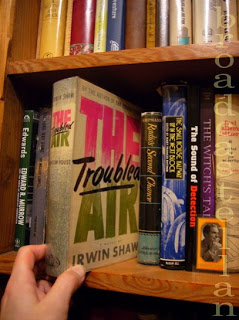
This being the birthday of novelist Irwin Shaw (1913-1984), I dusted off my copy of The Troubled Air (1951) to pay tribute to a radio writer who successfully channelled his anger and frustration by feeding it to the press, a rival medium that was only too pleased to get the dirt on broadcasting. Like his previously mentioned short story “Main Currents of American Thought,” published in 1939, The Troubled Air is a blistering commentary on the business to which Shaw was introduced by radio writer-producer Himan Brown, for whom he penned the aural comic strip The Gumps. For details on the novelist’s experience in radio, I refer you to Michael Shnayerson’s insightful 1989 biography; here, I am drawing on a few passages of The Troubled Air to document a hack-turned-published author’s urge to let off steam at a time (the McCarthy era) when the old radio mill seemed on the verge of blowing up.

Clement Archer, a former history teacher with hopes of becoming a playwright, enters radio after being persuaded by one of his students that a “ two-headed Zulu could do it. As long as you can type fast enough, you have nothing to worry about.” Archer has his doubts:

“My natural prose style,” he [tells his student], “is something of a cross between Macaulay and the editorial page of the New York Times, and my idea of how people should behave in fiction comes mostly from James Joyce and Proust. And I never had Bright’s disease and I never tried to seduce a twenty-year-old immigrant, and I actually believe that the innocent always suffer and the evil always prosper in real life. So I can’t say I feel boyishly confident about my equipment on a Monday morning when I sit down and know I have to write five fifteen-minute heart-breaking episodes before Friday. I have a lovely idea for next week. Little Catherine (the name of the program was Young Catherine Jorgenson, Visitor from Abroad) is going to California and she’s going to get caught in an earthquake and be arrested for looting when she goes into a burning building to rescue an old miser in a wheelchair. Ought to be good for ten programs, what with the arrest, the examination by the police, the meeting with the cynical newspaper reporter who is reformed by her, and the trial.

In fact, life in radio’s fiction factory turns out to be “murderously hard work.” After years of it, Archer gets a break at last when he becomes the producer-director of University Town, a series of anthology drama under the sponsorship of a drug company. When his actors and musicians are accused of Communist affiliations by Blueprint, a “belligerent” and “mysteriously” financed magazine “dedicated to exposing radical activities in the radio and movie industries,” the advertising agency in charge of the program gives Archer two weeks to find out from the five people involved—a Jewish immigrant composer, an aging actress, a gorgeous ingénue, a black comedian, as well as Archer’s best friend and former student—whether the accusations are false.

When asked by Archer why drastic measures such as the firing of his composer were deemed necessary, the agency representatives responds by arguing that radio

is not at the moment in a strong position. In fact, it is not putting it too vigorously to say that the medium is fighting for its life. A new form of entertainment, television, is gaining enormous momentum, capturing our clients and our audience; the economic situation of the country is uncertain and advertisers are retrenching everywhere—the old days when we could do anything and get away with every—are gone, perhaps forever.

Being supportive of his creative team, Archer is denounced as a Red sympathizer, even though the communists denounce him equally. His phone is tapped, his career is finished, his marriage in turmoil and a friendship exposed as a fraud.

Shaw was hardly alone in denouncing the industry in which he had worked; but, unlike former gag writer Herman Wouk (from whose satire Aurora Dawn I quoted here), he could not bring himself to make light of the experience.