Dumb? Wait!: Pinter & a Pair of Chekhov’s Shorts

Well, I’ve been struggling to keep up, which makes me feel and appear rather dumber than usual. I have gotten into the habit of editing my journal entries online, of dumping scraps here in hopes of making something of them, eventually. “We must beat the iron while it is hot, but we may polish it at leisure,” Dryden famously said. As a poet, composing in solitude, he probably never thought of doing the polishing in public. At any rate, given the relative obscurity of broadcastellan, I often assume that my composing here is very nearly done in private; but the realization that one looker-on had landed here after scouring the web for references to “Dr. Harry Heuser,” no doubt with the intention of checking my credentials, rather put me off the idea of performance editing. And yet, as dumb as it might be not to wait until such time as the half-cooked turns into a dish fit for tossing into this dumb waiter of a vehicle, I am not easily reformed. It is quite literally too late for that now.

I just got back from an evening of theater. There is always time for that; and the offerings here in the small seaside town of Aberystwyth, just outside of which I reside, is gratifyingly varied. Once again, I can’t wait to share my thoughts, however dumber they will be expressed in the shoddy prose of the moment. Before my memories go stale or my mind blank, I have got to share my thoughts on the Compass Theatre Company‘s production of Pinter’s “Dumb Waiter,” with a “Pair of Chekhov’s Shorts” thrown in.

The shorts suited us just fine. “The Evils of Tobacco” and “The Proposal” (translated by Neil Sissons), are comedy sketches Chekhov wrote for the vaudeville stage early in his career, “Evils” being a monologue and “The Proposal” a one-acter for three characters. Both pieces deal with what is generally thought of as the end of comedy, marriage, by inviting us to see the end of marriage as comedy.

The henpecked husband ostensibly lecturing about the “Evils” of smoking is really more keen on, and indeed desperate to, share his thoughts about his miserable existence as dictated by his controlling spouse. The monologue was delivered with humor and pathos by Michael Onslowe, who was seen in all three pieces. “Evils” would work well on radio, I thought. It is one of my hard-to-kick habits always to think of what I see in the light (or darkness, as it were) of its radiodramatic potentialities.

Nor does “The Proposal” pose any great challenges to the adaptor for radio, even though Sisson deftly exploits the physical aspects of comedy in the slapstick treatment of the suitor’s nervous disposition. As the title suggests, “The Proposal” tells of an intended match, the advancement of which goes awry. However old and slight these two plays, the laughter was not derived from our perception of their datedness; nor did they greatly rely for their effect on the audience’s nostalgia for this kind of entertainment. They simply still work as comic banter.

Pinter’s “Dumb Waiter” is rather more dependent on what is unexpressed, even though Gus, one of the two hapless hitmen waiting for their next job, seemed to have echoed our attitude toward this final play on the bill when he exclaimed: “It’s worse than the last one.” Commenting on the dump of a hotel in which he and his partner Ben are waiting to carry out their next assignment, he adds: “At least there was a wireless there.” Is “Dumb Waiter” radiogenic? Surely not in the way that Pinter’s “A Slight Ache” plays with your mind.

Still, the titular contraption prominently mounted in the center of the stage, and the speaking tube attached to it, made me think of the wireless that Gus was missing. Indeed, it very nearly made me go “Yoo-hoo! Is anybody?” as I thought of Molly Goldberg’s old apartment and the role her dumb waiter played in her everyday communications with the unheard Mrs. Bloom. I guess, a day without radio to me amounts to something like an existential void. It is certainly more than “A Slight Ache.”

“Isn’t she nice?”: Laraine Day (1913-2007) on the Air

Well, the first thing I thought of when I heard about the passing of screen actress Laraine Day on 10 November 2007 was this remark by Alfred Hitchcock, who directed her in Foreign Correspondent (1940): “I would have liked to have a bigger star.” He could not have been faced with a brighter one. Best known in the 1940s for her recurring role of nurse Mary Lamont in a series of Dr. Kildare movies, Day (seen left in a picture taken from my copy of the 3-9 January 1942 issue of Movie-Radio Guide) was as bright as her name suggested. There seemed to be no edge from which to push to her into more ambitious performances. She was just so darn nice . . . at least until she was forced to give back that pretty Locket.

In The Locket (1946), Day’s cheerful personality is being cleverly exploited to make audiences wonder whether her character, Nancy, is really as charming and uncomplicated as she seems. “She is nice,” a woman attending Nancy’s wedding observes. “She’s lucky,” another guest replies. “If you’re nice, you have to be lucky,” the first one counters, only to be dealt with the riposte that “[i]f you’re lucky, you can afford to be nice.”

Nancy can afford to be nice, however little happiness being a good girl managed to get her as a child; but is she just Mrs. Lucky to have landed such a well-to-do husband, or has her not being quite so nice something to do with it? The Locket, in which Day stars opposite Robert Mitchum, Brian Aherne, and Gene Raymond, is Hitchcock’s Marnie without the sex angle. It is a dark, labyrinthine thriller that casts welcome shadows on the brightness of Ms. Day.

Before making her frequent US television appearances, hosting her own program, Daydreaming with Laraine (1951), and starring in a number of Lux Video Theater productions, Day was heard on the Lux Radio Theater in recreations of her screen roles in Mr. Lucky (1943) and Bride by Mistake (1944). She was also cast in a number of original radio plays produced by the Cavalcade of America (such as in “The Camels Are Coming,” opposite her Foreign Correspondent co-star Joel McCrea).

On Biography in Sound, Day let listeners in on the home life of her husband, Brooklyn Dodgers manager Leo Durocher, with whom she also appeared on Tallulah Bankhead’s Big Show (4 February 1951), in which Day’s clean image was contrasted with that of her irascible husband:

Bankhead: Well, I must say, Laraine, that being the wife of a stormy baseball manager doesn’t seem to have changed you very much.  You still have that fresh, lovely, scrubbed look.

Day: Why shouldn’t I look scrubbed? Every time we have an argument, Leo sends me to the showers.

Considering that Day’s projected identity resembles an ad for toilet soap, it is not surprising that she made several return visits to the Lux Radio Theater. Introduced as “ever lovely” by Mr. DeMille, Day enjoyed a rather more interesting vehicle than her own comedies in the mystery “The Unguarded Hour” (4 December 1944).

In that adaptation for radio (of a movie based on a stage drama that itself was an adaptation), Day plays a valiant wife who tries to protect her husband from a scandal of which he is unaware. His words, uttered by co-star Robert Montgomery, capture what is the Laraine Day persona:

How do you think I came to worship you? Because you’re so pretty? Because you win large silver cups jumping horses or play good bridge? No, darling.  You have what’s called quality.  It’s kindness, it’s generosity, that makes all the rest of us feel just a little shoddy.

Memorials War; or, Names Are Dropped Faster Than Guns

Well, is anyone else having a hangover? This, after all, is the day after. All over Britain, people of all ages could be observed last weekend pinning poppies on their apparel, in observance or remembrance of . . . what? War? The end or the ends of it? The heroes who fought battles or those who forged peace? Or did they simply try to remember to bin that doubtful ornament of imitation flora once Remembrance Sunday had made way for another week of everydays? The period of oblivion has set in as scheduled. No doubt, the swastikas splashed days earlier on the local cenotaph here in Aberystwyth have long been expunged.

It seems that, instead of looking around, we tend to look back, probably without learning a thing about our present selves. As I tried to express it when last we were through observing Armistice Day, I am ill at ease about those fixed periods set aside for collective reflection. Not that there are any memorials in Germany, where I grew up, an absence of tributes that serves as a reminder to me that what is to be brought chiefly to mind here is national honor, not international horrors.

I am uneasy, too, when faced with responses to war as expressed by one of the readers (of this recent journal entry) with whom pride seems to go before considerations about those who fall on the other side. As the current conflict in Iraq demonstrates, blind followers are still falling for the kind of arguments for which thousands must fall, determined to stick to their guns no matter how devastating their discharges have proven to be.

Here in Britain, big gun names are being rolled out for the occasion, dropped like bombs whose aim it is to awe rather than make a political impact. Such, at least, is the rationale behind the decisions of those who stage the ratings war. Daniel Radcliffe, for instance, who is best known for having landed the title role in the Harry Potter series, appeared last night in the television drama My Boy Jack, playing the teenage son of Rudyard Kipling, the patriotic author who used his pull to push his offspring into battle, despite the young man’s visual impairment. Private Potter did not even have to drop his trademark eyewear.

Now, I chose not to follow this televised memorial on ITV. I decided instead to screen Lewis Milestone’s All Quiet on the Western Front (1930), which, rather than seeming dated or coming across like a costume drama, has lost none of its documentarian urgency, couched as its pacifist message is in symbolism. Unlike “Armistice Day,” a sentimental radio play of the same period (brought to you courtesy of OTRCat.com), All Quiet still asks the questions we must insist on asking ourselves: Why and what ought we to remember? What are the agenda of those who recall, those who call on us to hear roll calls?

Too apt to look upon history as representations of what is dead, gone, and past restoring, we fail to take note of the dying of our days, the necrology of our present lives, and the deaths that are owing to our blindness and silence.

Passport to Ridicule

Well, who needs fun house mirrors? When it comes to deriving amusement from staring at distorted reflections of yourself, there is nothing like the jack-in-the-box of old photographs. However familiar, they still manage to surprise. Sometimes, those snapshots of your past take on lives of their own as, in the eyes of others, they begin to resemble the faces of strangers. It becomes rather trying when you begin to think of your former self as a latter-day Frankenstein who, attempting to create life in his image, unwittingly gave birth to something monstrous beyond his control.

Owing to a current television program, I am the subject of much joshing here at Ty Newydd, our home (“ty” being Welsh for house). Once again, we are tuning in to The X Factor, one of those illegitimate, hyperactive offspring of the aforementioned Major Bowes so eagerly adopted these days and brought into the homes of an adoring public. And until such time as the show’s televoting devotees decide they have had their fill and be rid of him, I must expect to be mocked each Saturday evening for allegedly resembling the decidedly odd Rhydian Roberts, one of the two Welsh contestants in this year’s competition.

Each week, Rhydian is making a spectacle of himself as he appears before a panel of judges (the cocky Simon Cowell, the confidently second-rate Dannii Minogue, the feisty Sharon Osborne, and the amiable Irishman Louis Walsh) to take on a duet from The Phantom of the Opera or take the stage like an ice-sculptured Liberace in sequins and faux furs, belting like Welsh pop icon Shirley Bassey to the bewilderment of the British people who never beheld anyone quite like him.

Remote and humorless, Rhydian seems to come to life only on the stage. Thus far, he has remained an impenetrable mystery. Too straight for camp, he has a discipline and drive more chilling than the ambitions of Eve Harrington. He is a regular storm-trouper. It is no less disconcerting to be likened to him. Fortunately, the theatrical one can carry a tune, which is where any comparisons between us two, unwarrantable as they are to begin with, must most assuredly come to an end. In the words of frustrated blues singer Eve Peabody, “mine is strictly a bathtub voice.”

No, I don’t mind making a display of myself (as I have done here on numerous occasions). In fact, before I made up my mind that one journal was quite enough of me, I briefly contemplated dedicating one to the history of my hair, an autobiographical venture I intended to call The Shoulderpadded Atlas (for which this picture might have qualified). It would have been another argument for the non-visual arts, no doubt, which is better put forward here on broadcastellan. That said, it is just as well that I share my life here, given that the past preserved on my old computer seems to have been lost in yesterday’s crash.

Since then, I have had as much reason to cheer as I have sense not to burst into song. It was determined this morning that I shall have to dig up my passport again. Another trip to the old haunts of Gotham is in the offing. Considering that the above picture has changed more accurately to reflect my present exterior, I shall probably get through immigrations without suffering much ridicule (let alone comparisons to a man as yet unknown stateside). Of course, that also means I am going to miss the season finale of X Factor. Not a void a bottle of Aqua Net can’t fill.

Imitation of iLife; or, Right Now, I’d Settle for a Copy

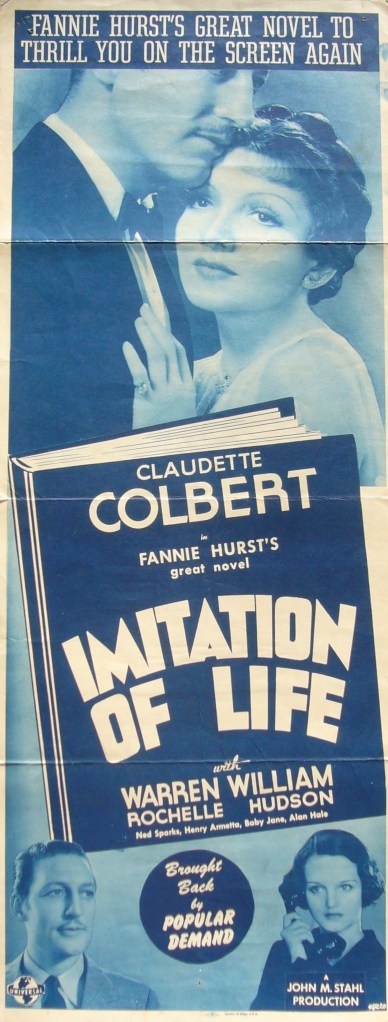
Well, never mind. I would have liked to conclude my week of listening; but I am preoccupied this evening. My old Mac seems to have given up the ghost last night—or at least it refuses to give up my files. I had been iRecording “The Expedition of Humphrey Clinker,” when my Mac began to act up. Clinker, indeed, to pick up a word of thoroughly pre-Victorian crudeness! As of now, my library of recordings and images seems to be irretrievably lost. It has been about two and a half years since the last blackout, and I don’t seem to have learned a thing. If only I had taken the time to burn a few DVDs. So, I am just going to share this latest addition to my collection of Claudette Colbert memorabilia, which arrived here earlier this week as a loving gesture to mark the third anniversary of my move here to Wales.

What I noticed right away when I looked at the poster was that no mention is made of Colbert’s Imitation of Life co-star Louise Beavers in this announcement of the film’s rerelease. That just takes the pancake, doesn’t it? After all, Beavers plays Colbert’s business partner on whose recipe the entire venture depends as much as on Colbert’s savvy to sell it. Promoters of the film were apparently less inclined to tackle race relations as the picture’s distributors. Sometimes, beautiful images tell an ugly story. An old story, too, of art imitating life . . .

". . . to hear this entertaining piece": By the Fire with Belloc’s "Matilda"

Well, I’m continuing my week before the wireless, taking in the BBC’s varied fare. It is just the thing to do on a gloomy day like this, especially when there are so many other things to be done. Though I am not literally sitting before an old bakelit set, but by the fireside instead, with the BBC’s digital “Listen Again” page for a dial, I am feeling a certain kinship to the channel hoppers of yore who went in search of sounds to sound off about.

I am reminded, in particular, of a reviewer for the American Mercury who kept his post for seventeen hours straight on a wintry Thursday afternoon in early 1932. “O my country, my country, the pains are so great you must be growing up at last!” that worn out tuner-in concluded:

A radio playlet, a love scene in which a young man and a young woman tip over a canoe. “I love you so much, I hate you . . . you, you darling!” . . . Some jokes. “When he sat at the piano somebody had pulled the stool away”. . . Dialogues between a grumpy, nasal Sherlock Holmes and a foreign villainess. “That seals your fate, Madam” . . . A young business-like voice invites those who want to make money in their spare time to “meet with me personally” at 500 Fifth Avenue, room 525, tomorrow morning. . . The Lucky Strike Hour, perhaps the best of all air jazz orchestras, with interpolations by the confidential gutter voice of Walter Winchell. . . .

Indiscriminate listening is likely to trigger similar responses today, even if those dialing or downloading the BBC’s offerings are at least spared the sales talk with which we are being accosted elsewhere. Equipped with a copy of the Radio Times, I listen selectively. As a result, my date with the wireless was like a retreat into a well-stocked library, except that it was a lot noisier.

Tuning in BBC 7, I found myself on the Expedition of Humphrey Clinker, retraced in a four-part dramatization of Smollet’s 1771 novel. Over at BBC 4, I fished for Books at Bedtime, the catch of the day being Augustus Carp, Esq. by Henry Howarth Bashford (1924). Then, catching up with last Sunday’s Adventures in Poetry, I bid farewell to “Matilda—Who Told Lies and Was Burned to Death,” and whose epitaph is currently celebrating its 100th anniversary.

Hilaire Belloc’s poem was read by children’s author Michael Morpurgo and commented upon by two pint-sized Matildas whose observations were far more engaging than the choice remarks of their scholarly elders. The girls understood that their namesake was getting burned for trying not to be bored:

For once, towards the close of day,
Matilda, growing tired of play
And finding she was left alone,
Went tiptoe to the telephone
And summoned the immediate aid
Of London’s noble Fire-Brigade.

Now, let’s examine Matilda’s situation from a listener’s perspective. Quite clearly, the girl was sick of listening, probably because she never got to ride the airwaves, where listening is an activity quite distinct from obedience, provided the ear is connected to an open mind. Instead, she insisted on making herself heard. Calling the fire department, she did not simply order the home entertainment that was wanting—she created it. Long before Orson Welles and his team staged “The War of the Worlds” to such startling effect, there was Matilda, getting a show on the road.

Not that her ingenuity was appreciated by her aunt, who was obliged “to pay / To get the men to go away!” Rather more thrilling than picking up theatricals on the electrophone (aforementioned), the dial-a-drama incident resulted in a further curtailing of Matilda’s amusements:

It happened that a few weeks later
Her aunt was off to the Theatre
To see that interesting play
The Second Mrs. Tanqueray.
She had refused to take her niece
To hear this entertaining piece:
A deprivation just and wise
To punish her for telling lies.

I’m not sure whether Matilda would have found hearing Mrs. Tanqueray nearly as “entertaining” as the issue of her lupine effusions. She was never to experience that middle-class chestnut, which would be warmed up or roasted often enough on US radio, well into the 1930s; but melodrama came home after all, even without access to the wireless:

That night a fire did break out—
You should have heard Matilda shout!
You should have heard her scream and bawl,
And throw the window up and call
To people passing in the street—
(The rapidly increasing heat
Encouraging her to obtain
Their confidence)—but all in vain!
For every time she shouted “Fire!”
They only answered “Little Liar!”
And therefore when her aunt returned,
Matilda, and the house, were burned.

Matilda just wasn’t cut out to be a newscaster, I guess, even though she had that Hearstian knack for bringing events into being by proclaiming them. Still, if she had been as good a liar as Mr. Belloc made her out or up to be, why did she ever grow “tired of play” in the first place?

What I have gathered from listening to this cautionary tale, however spurious, is this: If you don’t want to get burned and end up paying too dearly for your amusements, give listening another try . . .

Going His Way: The Bing Crosby Trail

Well, I’m on his way. Instead of Going Hollywood, where the WGA strike is beginning to make itself felt, I am listening all this week to the BBC, taking in drama, music, and talk. Late to catch up, I started on The Bing Crosby Trail, a six week tour whose first installment took me on a road to California, New York City, and Spokane, where listeners get to meet the daughter, the widow, and many of the contemporaries of the man known as Bing.

With The Bing Crosby Trail, producer and host Michael Freedland, a prolific biographer (whose audio portrait “Danny Kaye: UNICEF’s Jester” is available online until 12 November), attempts a departure from the traditional approach to telling a life story: “This is not just another biographical series,” Freedland insists in his introduction. “You could say it is more in the way of geography than history.” He also issues a “warning” to those about to follow him: “No obvious star names on the roster here. No sycophantic interviews with actors or other singers who, in Bing’s lifetime, called him great to his face and whispered other things behind his back.”

Instead, Freedland has been traveling around the US, “talking to people whose life Bing touched.” Not that those he interviews are nobodies: Buddy Bregman (“Bing Sings Whilst Bregman Swings”), veteran Paramount producer A.C. Lyles, and historian Ken Barnes (who produced the CD box set “Swingin’ With Bing”) have all gone on Freedland’s record.

“My life is like an open book,” Bing is heard singing (lines from his “That’s What Life Is All About”); and the man with the microphone who is out to capture that life is taking Bing by his word. Not content to “glance back through the pages” of printed volumes, he tries to pick up bits and pieces that perhaps never made it into any biography. Sounds good to me.

And yet, the cross-country Crosby Trail gets lost on a Road to Utopia, an ambition that must remain a dream. Freedland has gone out of his way to come away with comparatively little. The tour is not off to a promising start. We are take on a “winding mountain road above Malibu” to hear Mary Crosby sharing the insight that her father enjoyed playing golf and liked to whistle a lot. Does one really have to travel way out west for such a soundbite?

A subsequent inspection of Bing’s statue at Gonzaga University in Spokane and a tour of the Student Center housing the Crosby Museum are altogether misguided in their visual-mindedness. I’d rather be listening to Bing whistle than being given this runaround, blindfolded. At times so glossy as to make me cross, the Crosby Trail is a gross betrayal of the medium.

Napoleon Solo Dynamite: Robert Vaughn “Behind the Iron Curtain”

Well, it wasn’t exactly the Summer of Love, back in 1968, when American film and television actor Robert Vaughn, then known to millions of Americans as “Napoleon Solo” came to Czechoslovakia to play a Nazi officer in The Bridge at Remagen. Four decades later, Vaughn got the opportunity to share his experience in Tracy Spottiswoode’s radio play “Solo Behind the Curtain.” The play aired last Monday on BBC Radio 4.

Now, Spottiswoode told me about “Solo” some 18 months ago when we sat in the kitchen of her Cardiff home (as mentioned here, in passing); by now, I had almost given up on ever getting to hear it, especially since I have visited Prague in the meantime and dined at the Cafe Europa on Wenceslas Square, where Vaughn enjoys a cool drink and the warmth of late spring as the play opens.

In a nod to Vaughn’s most famous role, “Solo” comes on like a 1960s spy thriller, with suave Vaughn feeling “pretty sure” that he was “being followed. In those days, there was nothing surprising in that. An American in an Iron Curtain country, during the Cold War. It would have been unusual not to be followed. What was surprising, though, was just how pretty she was.”

Her name is Pepsi (wonderfully portrayed by Serbian actress Vesna Stanojevic), and she is used to being called “bubbly.” Perhaps it is her blood (Pepsi’s father was American communist who, in a moment of nostalgia, named his daughter after the soft drink he could no longer enjoy in his wife’s homeland of Czechoslovakia). The smart if malapropism prone young woman, who serves as the crew’s interpreter, is proud of her country’s relative freedom, but eager to leave with the Americans as those freedoms are being crushed.

Vaughn is an excellent narrator, as his father Walter had been, back in the mid-1940s, when he narrated wartime propaganda plays like “Assignment USA” for the series Words at War, aside from appearing on thriller programs like Murder at Midnight and Gangbusters.

Unlike his father, Vaughn was busy exposing propaganda, rather than delivering it. During the time of the filming, he was at work on his doctoral dissertation, which was later published as Only Victims: A Study of Show Business Blacklisting. As you will hear, it very nearly got lost as a peaceful spring gave way to a bloody summer.

His is not the voice of a 35-year-old, to be sure; but Vaughn draws you into his story all the same as he recreates his experience shooting in Czechoslovakia . . . until the shooting began in the streets. In August 1968, a short period of reformed communism under Alexander Dubček, known as the Prague Spring, came to an end as Soviet tanks rolled into the city. Not that Vaughn was ready to say U.N.C.L.E. and get stranded in a country hostile to the west in general and a film crew in particular, engaged as it was in firing explosives and blowing up things to restage a war for maximum box office impact.

Brandishing the Pen: The War of “Seeing It Through”

Well, this is Guy Fawkes Day (or Bonfire Night) here in Britain. I am hearing the fireworks exploding as I write. Last year, I dragged Tallulah Bankhead into the Popish Plot; but it really seems an occasion to handle something explosive. To write about war and propaganda, or the war of propaganda, for instance. Bonfire Night coincides with the third anniversary of my move to Wales. So, I might as well write about something relating to the Welsh. And since this 5th of November is also the first day of the WGA (Writers Guild of America) strike that is intended to cripple the television and motion picture industry in the US, I might as well express my solidarity by turning a deaf ear to overseas media and lend a keen one to the voices of Britain.

Propaganda, a Welsh Prime Minister (pictured), and a group of famous authors including H. G. Wells, Thomas Hardy, and Arnold Bennett—“Seeing It Through” promises nothing less.

“Seeing” is the latest radio play by Neil Brand—last seen here in Wales accompanying The Life Story of David Lloyd George (1918). Dining with the writer, I remarked that, these days, the BBC seems most interested in airing biographical or historical drama. No exception is today’s Afternoon Play on BBC Radio 4, Tracy Spottiswoode’s “Solo Behind the Iron Curtain” (starring Robert Vaughn as himself, caught in revolutionary Prague anno 1968, and reviewed in my next entry into this journal). What sells these days are purportedly true stories, opportunities to eavesdrop on prominent, eminent or at any rate historical personages.

If it is to fly, the drama of the air is expected to have weight, especially now that such texts are generally being relegated to the footnotes of popular culture. Those in charge of allotting time for aural play try to salvage a dying art gasping for air by turning recorded sound into sound records and reducing storytelling into a substitute for oral history. A footnote-and-mouth disease is contaminating the airwaves, a corrupting influence in the theater of the mind for which there exists no talking cure. For the record, Brand has not so much caught the disease than braved it.

Cinematic in its architecture, in its designs on the mind’s eye, “Seeing It Through” opens like a house of worship, resounding with a hymn whose words are based on John Bunyan’s Pilgrim’s Progress, written in imprisonment: “He who would valiant be / ’gainst all disaster, / Let him in constancy / follow the Master.”

The music gives way to the sounds of a crowded auditorium and the words of one of the most famous British writers of the late 19th and early 20th century. None other than the man who invented The War of the Worlds: “You know me. My name is H. G. Wells,” the novelist addresses a conservative crowd and is very nearly booed off the stage, clearly not the master of his domain.

Wells was hoping to lend support to Charles Masterman, a liberal politician to whom we are introduced as he tries to promote welfare reforms. A gifted orator, Masterman disappears from the public stage to become the mastermind or mouthpiece of the newly established War Propaganda Bureau, Britain’s response to German duplicity. “There is no such thing as a clean war,” future Prime Minister David Lloyd George warns the radical idealist. “Then, Masterman replies, “we should create one.”

Rallied to aid him are the leading novelists of the time, including Arthur Conan Doyle, Chesterton, Hardy, Galsworthy and Bennett. As Wells is heard expressing it: “The ultimate purpose of this war is propaganda, the destruction of certain beliefs, and the creation of others.” Unlike the radio propaganda penned by US playwrights, poets, and novelists in the 1940s (as discussed here), their activities in publicizing an unpopular war was being kept a secret until well after armistice was declared.

As is revealed in a well-soundstaged scene symbolizing Masterman’s struggle to navigate the moral maze of a publicly invisible office, the alcoholic in charge gets lost in the structure he is meant to control. Trying to find his way, he relies on the guidance of a suffragette who once dared to toss pig’s blood in his face and whose brother is facing a breakdown on the front that she assisted in putting up: “I’ve learned,” she tells Masterman, that “there is no truth where war is concerned, except one: that the greatest cruelty is to let it go on when it could be stopped.”

She, too, operates under the influence, hers being Frances Stevenson, personal secretary, mistress, and future wife of Lloyd George, a woman Wells calls the “sphinx that guards the labyrinth of Whitehall.” It is in this nexus of oblique channels and hidden agenda that the lives of thousands are rewritten and expended.

That this is not merely a war of the words is demonstrated in noisy reports from the front and driven home in a sequence reminiscent of Howard Koch’s adaptation of Wells’s science fictional War: as London faces its first air raid, the weaponizers of words, Wells among them, look on and listen in the dark, Masterman speechless, his master’s voice overmastered: “If they’re smart, [the British public will] never trust any of us again.”

“Seeing” is a challenge to the audience. Instead of recounting an old if little known story, Brand puts listeners right a history in the making, thereby inviting us to draw parallels between the so-called Great War that was and the nominal anti-terrorism of the present, a war that some demand we see through while others struggle to see through it. Trying to make sense of the spin you will find yourself in, the acts of betrayal and false assurances you will overhear, you may feel yourself in need of another voice “Seeing [You] Through.” As in all history lessons that matter, this voice will have to be your own . . .

In My Library: Emlyn (1973)

Like the man in the old Schlitz commercials says, “I was curious.” So, earlier this week, I went to the local second-hand bookstore in search of George, an autobiography of actor-playwright Emlyn Williams. It had been recommended to me at the recent Fflics film festival here in Aberystwyth as the insightful source of The Corn Is Green, a play and movie about the relationship between a Welsh student and his English teacher. The shelves of Ystwyth Books (shown here in a picture I found on flickr) are well stocked with titles on Welsh history and culture.

Not that titles about Hollywood or radio are wanting. In fact, the first purchase I made in this country shortly after moving here in November 2004 was made in that very store. It was a book on radio writing that had just come out (new releases can be found downstairs). Radio writing? In 2004? There was a chance, I thought, that I might feel at home here, eventually.

Anyway, there was no sign of George. The shop’s new proprietor offered to descend into the basement to check the inventory with which he is as yet not entirely familiar. After a few minutes, he emerged with Emlyn, subtitled a “Sequel” to George. Would I want it, not having been introduced to George (Williams’s other first name)? I opened the book, and it seemed to speak to me and anticipate my doubts:

I don’t think I’ll read this—it says it’s a sequel and I didn’t read the first one so I’d feel out of it from the first page . . .

And even if you did read “the first one,” your mind needs refreshing. It is up to me to ensure that the reader need know nothing of George by supplying rapid salient information about my life up to April 1927.

An author so forthright and accommodating deserves to be given a chance, I thought. Then I read on, sensing that what I wanted to learn from and about the playwright of Night Must Fall (and He Was Born Gay) was something he might not wish to share:

Before I do so, one thing: at the moment when I embarked on the “first one” I decided I would travel no further than the age of twenty-one, feeling that while a writer’s first two decades might be of interest, the third must present a formidable task.  Can he be as honest about it?

I knew that without honesty the story would deteriorate into a parade of professional ventures interspersed with cautious anecdotes.  The alternative must be a marriage between Candour and Taste, with the continuous likelihood of one partner pushing the other out of bed; even then, it would have to be a different book.

A “different” book. That is just what I expect from a self-conscious gay Welshman with a penchant for serial killers. Will he be honest about “it”? Will he lie in bed with Candour or lie about his bedfellow with Taste? Is this autobiography apologia or play-acting, an author-actor’s chance to don masks of his own design? We think of truth as being naked; but the act of self-exposure, the dropping of guises, the whole tease of the strip itself is performance.

Now, Emlyn, subtitled A Sequel to George, is one of those memoirs whose author is kind enough to provide an index, allowing those as impatient as I am to extract from the text what interests them most without having to go to so many parties, rehearsals, and opening nights. The first thing on my mind was not the open secret of Williams’s private life, but anything relating to Night Must Fall, the thriller I had seen on stage during the centenary of Williams’s birth back in 2005.

Williams recalls how the play came about and how, during a party at the house of fellow actor-playwright Frank Vosper, he discovered that his host appeared to be writing a similar thriller, also involving the case of murderer Patrick Mahon. Vosper’s play was titled Love From a Stranger, an adaptation of Agatha Christie’s story “Philomel Cottage.”

Murder must out. Must Mr. Williams?