
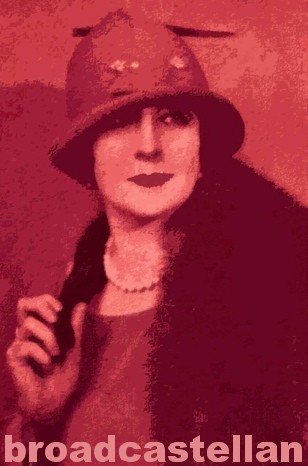
Elinor Glyn: The Madam Who Had a Name for It

Well, it is Rita Hayworth’s birthday. And that of Arthur Miller, the reluctant radio playwright. Both have featured in this journal, which is reason enough to celebrate instead the birth of the “Madam” who brought “sex appeal” to page and screen by calling it “It.” Her name is Elinor Glyn, born on this day, 16 October, in 1864. “Fate and circumstances have combined to give Elinor Glyn a halo of sensationalism,” remarked Alice M. Williamson, the authoress of the aforementioned Alice in Movieland, from whose delightful tour of 1920s Hollywood the above portrait has been taken and freely adapted. No kidding, Glyn caused a scandal with her novel Three Weeks, published back in 1907, and came from her native England to Hollywood in the early 1920s.

Glyn, to be sure, was full of “It,” even if she felt compelled to cover it up. In the American edition of Three Weeks, for instance, Madam offered the following defense:

For me “the Lady” was a deep study, the analysis of a strange Slav nature, who, from circumstances and education and her general view of life, was beyond the ordinary laws of morality. If I were making the study of a Tiger, I would not give it the attributes of a spaniel, because the public, and I myself, might prefer a spaniel!

Yes, Glyn had learned how to package “It,” wrapping it up to be presentable while promising something you could not wait to unwrap. “I am only the conductor,” Glyn reportedly remarked, “of these glorious currents of health and hope and joy and success, but it is good to help pass magnetic vitality on to others.”

“How it would surprise readers of that long ago success Three Weeks, who think of Madam Glyn as a siren on a tiger skin, to hear this “line of talk” from her,” Williamson marveled. Her readers would get a chance to spot Glyn, who had the last word in Peter Bogdanovich’s Cat’s Meow (2001), in the hit comedy Show People, starring Marion Davies, whom Glyn visited at her Welsh retreat, the previously visited St. Donats Castle.

Glyn’s move to Hollywood, as Williamson recalls, had been a difficult and frustrating one. She had

almost everything against her.  She was supposed, even then, to direct a picture which would be made from her books; but in truth she was allowed to have no authority at all.

She was merely a picturesque figure-head, to whom those really in authority tried to be polite while being evasive—she was permitted to tell a pretty young star what style of hair-dressing became her best, or what the daughter of an English duke would wear when she “followed the guns” in the shooting season […].   If Madam Glyn went east, fondly imagining that she had directed a film, she would see it on the screen and hardly be able to recognise it as her won. But all is changed now. She is trusted and respected as a director. The girl stars whom she moulds for their parts in her pictures feel her fascination, and believe that her influence upon them doesn’t end when their work together is finished.

Now, pardon me, while I am under the influence of The Price of Things, one of the novels Glyn adapted for the screen and directed as well. Its opening lines promise the tale of a married woman who did not mind the influence of a thrilling, if thrillingly ugly, stranger who encourages her “to banish all thought.”

“What do you mean by thought? How can one not think?” Amaryllis Ardayre’s large grey eyes opened in a puzzled way. She was on her honeymoon in Paris at a party at the Russian Embassy, and until now had accepted things and not speculated about them. She had lived in the country and was as good as gold. 

She was accepting her honeymoon with her accustomed calm, although it was not causing her any of the thrills which Elsie Goldmore, her school friend, had assured her she should discover therein.

Honeymoons! Heavens! But perhaps it was because Sir John was dull. He looked dull, she thought, as he stood there talking to the Ambassador. A fine figure of an Englishman but—yes—dull. The Russian, on the contrary, was not dull. He was huge and ugly and rough-hewn—his eyes were yellowish-green and slanted upwards and his face was frankly Calmuck. But you knew that you were talking to a personality—to one who had probably a number of unknown possibilities about him tucked away somewhere.

John had none of these.  One could be certain of exactly what he would do on any given occasion—and it would always be his duty.  The Russian was observing this charming English bride critically; she was such a perfect specimen of that estimable race—well-shaped, refined and healthy.  Chock full of temperament too, he reflected—when she should discover herself.  Temperament and romance and even passion, and there were shrewdness and commonsense as well.

“An agreeable task for a man to undertake her education,” and he wished that he had time.

Jigsaw Puzzled

Well, there she was again, flitting across the screen … unexpected, uncredited—and gone within seconds. You know, the kind of walk-on out of narrative nowhere they call a cameo. How strange, I thought, when I saw her passing by, having just had her on my mind (and in this journal) a few minutes earlier. I could hardly believe my eyes.  Yes (as I shared earlier today on Alternative Film Guide), Marlene Dietrich refused to get out of my head last night, even though the anniversary I had just commemorated (her guesting on the Abbott and Costello Show back in 1942) was hardly a memorable one.

There were many other radio anniversaries to consider that day; but somehow it was Marlene’s name that caught my eye, my ear pricking up to the chance of hearing her voice, forced as it was to utter lines so utterly unworthy of her allure and talent. That was that, I thought, as I closed my computer.

Most nights, just before bedtime, I roll down the blind to screen old movies, all of which are duly recorded in the list to the right of this. I watch whatever I can lay my hands on, even though those hands of mine tend to reach for Hollywood fare of 1930s, ‘40s, and early ‘50s, British and German classics or contemporary film being rare exceptions to this rule of my thumbs.

Recently, I asked a fellow web journalist, the sharer of Relative Esoterica, what it is that makes her decide which movie to watch on any given night. It would not be easy for me to answer that question. When last I was in New York City, I purchased a collection of 100 Thrillers, neatly boxed and taking up no more space than a couple of hardcover novels. Many of the titles I watched this year come from out of that one box, however exasperating the quality of the print may be at times.

Going through that box as if it were filled with candy, slowly getting to those items you either don’t care for or are suspicious of (it might have one of those awful pink fillings), I dug up an item titled Jigsaw. I knew nothing about it, other than that it promised a reencounter with the aforementioned Franchot Tone, who was well past his prime when Jigsaw was shot.

As it turns out, Jigsaw (1949) was a veritable radio drama reunion party, being that it was directed by noted radio drama actor-writer-producer Fletcher Markle (previously mentioned here), and co-written by him and fellow radio writer Vincent McConnor, once known for adapting plays and novels for anthology series like NBC University Theater. The original story is by one John Roeburt, himself an expert on radio thrillers. I recalled his name from his 1940s article “Outlook for Radio Mysteries,” in which he remarked:

In its modern adjustment, the radio mystery show, all types and kinds, lives austerely, with a sharp frugality. The fat has been burned away; costs have been trimmed to the bone. Fees and salaries, for performers, writers, directors, are minimum scale only; musical backing is mainly dubbed in from royalty-free records purchased abroad. The mystery show seldom emanates live, as in halcyon years; the rule today is the mechanical taping of shows.

Jigsaw is not a big budget production, either, a trimming of costs to which Markle must have long been accustomed. In fact, he recruited many of his actors from radio. On hand were radio stalwarts like Myron McCormick, Brainerd Duffield, Hedley Rainnie (virtually a stranger to film), and the remarkable Hester Sondergaard (whose voice I last heard in one of Norman Corwin’s plays for radio). There was no getting away from the aural medium that evening. Not that Markle tried. He employed the device of interior narration, as one character commented on another, without uttering a syllable. It is a peculiar form of narrative that only a long career in radio can explain.

Jigsaw offers rather more than it is able to deliver. It wants to be Boomerang, say, or Arthur Miller’s Focus; but it soon gets lost in a romantic tangle that seems at once conventional and imposed. Still, Markle managed to rally quite a few noted figures from screen, press, and radio to lend their support for his directorial debut. And, yes, among those players was none other than Marlene Dietrich, who, in 1948, had twice been directed by Markle in radio productions of “Arabesque” (heard on Markle’s Studio One, co-starring Rainnie) and “Madame Bovary” (soundstaged by the aforementioned Ford Theater, adapted by Duffield).

So, had I read up on Jigsaw beforehand, I might not have been quite so bewildered by this reencounter with Dietrich. Yes, I can explain it now, citing my own ignorance as the source of my surprise; but I can’t quite explain it away. After what I said last night about her desperate attempt at self-promotion on the Abbott and Costello Show, the leading lady just passed me by, noiselessly, as I stared at the screen, gasping in puzzlement. Coincidence, my eye!

Hear "What the Boys in the Back Room Will Have"

Well, they should have been slipped a Mickey Finn, for starters. Those boys in the back room scribbling gags for Bud Abbott and Lou Costello, I mean. On this day, 15 October, in 1942, the comedy duo was called upon to accommodate Marlene Dietrich, who stepped behind the mike to promote what would turn out to be yet another dud: Pittsburgh. Like Hollywood’s film producers, the writers went no farther than to hark back to Dietrich’s image-revamping comeback Destry Rides Again, released three years earlier. Once again, Dietrich was heard singing a few notes of the raucous barroom number that had pre-war audiences “Falling in Love Again” with the formerly untouchable and largely humorless goddess.

Just a few notes, mind. After which promising introduction, the echo of good old Frenchy faded and gave way for the undistinguished lines of a Wild West sketch involving an alleged bank robbery, Bud and Lou going in search of the culprit, and Dietrich, taken as far from her German roots and world politics as the sound-only, accent accentuating medium would allow, emerging as the prime suspect. “What a fresh kid!” Lou exclaims. “What a stale plot,” the guest star is permitted to sneer.

Even without much of one, Dietrich could still rely on an asset as great as her “expensive pins,” of which bespoke and highly insured commodities the writers went through great length to remind the listener by having her talk of the “pin money” her character (“Marlene,” AKA “Black Pete”) had stashing away in her stockings.

Dietrich could read out the box office receipts that qualified her as poison and still make you swallow and like whatever “leperous distilment” (to class this up with some soundbites from Hamlet) oozed into the “porches” of the ear from that celebrated throat of hers. Hope lay at the bottom of her voice box. She could wrap you around her little finger with her vocal chords alone. Pardon the mixed bag of metaphors; this writer is having an off night, too.

Not that the censors were particularly awake that day. Discovering where Marlene is hiding her savings, self-confessed “baaaad boy” Costello, who earlier told his pal about being in love with a bow-legged cowgirl who had a “terrible time getting her calves together,” is invited to take a peek at the secret spot, exclaiming: “What a place to make a deposit!”

However tacky, getting any word in between those Camel commercials on the Abbott and Costello very nearly translated into money in the bank back in 1942, the year during which the show reportedly averaged higher Hooper ratings than Al Jolson, Eddie Cantor, and Fred Allen.

“The power of radio to help careers has never been better illustrated than in the case of the Rowdy Boys of Stage, Screen, and Airwaves,” contemporary commentators Jack Gaver and Dave Stanley remarked (in There’s Laughter in the Air! [1945]). In 1938, they got their break from vaudeville on Kate Smith’s variety show, which featured them until 1940. They landed a prominent time slot filling in for Fred Allen during his 1940 summer hiatus, by which time they were well on their way to movie stardom. In 1942, they topped the popularity poll conducted by the Motion Picture Herald.

Stars and studios could not afford to ignore the “power of radio,” especially when Manpower was not enough to draw in the crowds. Earlier that year (as reported here), Dietrich had been told to get into radio. Her advisor, comedian Fred Allen, whose team of writers were sly enough to peddle a dumb script as a spoof on the drivel that passed for melodramatic radio entertainment by offering Dietrich the lead in a soap opera titled “Brave Betty Birnbaum.”

“The jokes that Abbott and Costello use are not really too important,” Gaver and Stanley summed up. “Half of the battle is their loudness and a sense of constant turmoil.” Yes, brave they had to be, those leading ladies, when they were sent out into the cornfield of radio comedy. In Dietrich’s case, the 1942 harvest would be none too rich.

Casting the Votes: Are These the 100 Scariest Movies of All Time?

Well, there’s no accounting for poor taste. That did not stop the Chicago Film Critics Association, apparently as desperate for attention as myself, from issuing a list of the one hundred “scariest movies.” Let’s have a look at the association’s choices, as they were published today, just in time to cash in on the Halloween business. Only in recent years, Halloween has become big business here in the UK and in my native country, Germany. Considering that the tradition is so ancient, it is surprising how slow marketers were to catch on.

I remember watching Spielberg’s E.T. upon its first release, being baffled by the costumes with which the children paraded on the streets. Dressing up, in my youth, was reserved for Carnival (or Mardi Gras). Nowadays, the pagan festival of Halloween is upstaging Christmas, probably because it does not pressure folks to spend on others the money whose power to shock and awe they’d rather display on themselves.

Even the small town of Aberystwyth, in mid-Wales, is having its own Halloween film festival, cheekily called Abertoir, which screens classics like The Cabinet of Dr. Caligari and Roger Corman’s The Raven, as well as recent camp like Poultrygeist (by director Lloyd Kaufman, who is a special guest of the events).

Now, I appreciate the diversity of the Chicago Film Critics Association’s list of scary movies, which, topped by Psycho, includes must-sees like Nosferatu, Frankenstein (1931), and I Walked With a Zombie; and even though I doubt that anyone is likely to be terrified watching Creature from the Black Lagoon, it qualifies as a beloved late-night drive-in staple. Then there are beauts like Eyes without a Face, which I haven’t seen in ages, and Carnival of Souls (presumably the original). Also getting a nod from the CFCA are genuinely disturbing films like Henry: Portrait of a Serial Killer, Blue Velvet, and Fritz Lang’s M. An eclectic list, in short.

Inexplicably, though, my personal favorite did not make the bloody cut. It is Jacques Tourneur’s Night of the Demon (1957), based on “Casting the Runes,” a short story by the aforementioned ghost storyteller M. R. James. On US radio the story was dramatized under its original title on the literary thriller series Escape. When it was shown on BBC 2 TV here in Britain a few nights ago, I seized the opportunity to go once more into that not so gentle Night. Much to my relief, I had not yet become immune to its powers.

Once again, I was startled by that hand on the banister; once again, my skin showed pimply evidence of the film’s workings upon my imagination. After the screening, my unimpressed partner, an incorrigible prankster who knows how to make me jump (which is not all that difficult), caught me unawares (which is easier still) and passed me a slip of paper with a runic-looking message. Upon closer inspection, though, it bore an inscription of three little words far more reassuring. Though constantly under attack, my heart is still beating for him.

In its two versions, Night (or Curse) is central to the debate about horror and terror—the former trying to shock by showing, the latter causing unease by the subtler force of suggestion. A curse on the CFCA for not casting their votes for it! Anyone got runes?

“. . . till the fat lady sings”

It seems that the proverbial one who’s got more curves than the skeletons on the catwalks has not warbled her last.  No, it ain’t over yet.  According to my students, at least, whose rallying cries generated enough interest to keep my rather esoterically titled course “Writing for the Ear” alive, death warrants and prematurely issued certificates notwithstanding. The “fat lady,” of course, is the diva who gets to have the last word in opera. I don’t know where the expression originates; but it seems to be true for much of the operatic canon.  Tonight, I am going to see Mimi expire in a production of La Bohème, performed by the Mid-Wales Opera Company.

Now, I have been going to the opera since I was a teenager, even though prohibitively high prices made for long gaps in my exposure to this kind of melo-drama.  And even though a tenor numbered among my close friends in New York, Opera-going still mostly meant finding an empty space to spread my blanket on the Great Lawn whenever the New York Opera toured the parks, taking the sandwiches out of the basket, and hoping that no cellular device would go off to mar the performance as I lost myself in the night skies in search of that rare star darting its long-delayed light through the smog and light pollution of Gotham.

My tenor friend tried to convince me that opera is the highest form of dramatic storytelling; but, for the most part, I struggled to follow the plot and keep straight just who is who and doing it with whom. Last night, watching the pre-code melodrama Secrets of a Secretary, starring Claudette Colbert and Herbert Marshall, I thought what a great plot for an opera it might have made.  A woman repentant of her follies, a sinister husband, a pining lover (a nobleman, no less), and bloodstained dress.  Perhaps, I’d rather lose track of the plot than the ability to lose myself in the drama of a moment; but I still find it strange to be confronted with a narrative only to ignore it, along with the translations flashing above the stage.

There are few plays I have seen as often as La Bohème, sat through the gloom of Rent and the glamour of Baz Luhrman; but, the music aside, I still recall little else beyond an extinguished candle and a distinct cough.  Not that I believe comedian Ed Wynn to be a reliable translator in matters operatic. Wynn, whom I previously consulted on Carmen, once tried to tell the story of La Boheme (or “La Bum,” as he called it) to tenor James Melton (pictured above), on whose radio program he was featured in the mid-1940s.

It was on the 10 March 1946 broadcast of The James Melton Show that Wynn introduced listeners to Mimi, who, preparing for a ball, had just put on her bustle and was “rearing to go.” In Wynn’s version, Mimi had been named “Miss Soft Drink of the Year” because she was “interested in any guy from seven up.” He had nothing to say about flirtatious Musetta, who had such terrible puns coming.

Now, Mimi lives in the same boarding house as Rodolfo, you see.  One day, she hears the pot, the poet [. . .] reciting.  He says: “There is an old lady who lives in a shoe.”  And Mimi says, “Well, she’s pretty lucky, the way that the room situation is.”

Not Rent-controlled, apparently. Such references to the housing crisis of the mid-1940s pop up frequently in radio entertainment, from Fred Allen to Hercule Poirot (who, as I discussed here, inexplicably relocated to the US and found himself without a flat).

The synopsis is mercifully interrupted by a few notes from the opera, sung by Annamary Dickey.  It is the kind of highhatting of the uplift that was so common an approach to the so-called high arts in the middlebrow medium of 1930s and 1940s radio. It is the working-class re-vision and consequent rejection of culture as imposition, of art as irrelevance, a way of looking without seeing to which I was conditioned as I grew up, my father being hostile toward anything that smacked of the “high classical,” a self-imposed exclusion from the beautiful, transporting and inspiring that expressed itself in crude mockery.

Fortunately, I don’t need to draw on the jovial if misfiring old Fire Chief to enlighten me. The Mid-Wales Opera’s La Bohème is “cenir mewn Saesneg,” which is to say, sung in English. For once I can just face the music, rather than being confronted with my own ignorance . . .

That Flaming Urge

Well, I have been holding my breath. Problem is, if you do that for about a week, you are bound to get a little huffy. As I mentioned recently, I was scheduled to teach a couple of courses in web journalism and audio dramatics at the local university. As it turns out, the enrollment figures just did not add up. In fact, the bureaucratic arithmetic is verging on the Kafkaesque: a course won’t run if it does not attract a certain number of students; but that official and binding number (which cannot be derived from headcounts and is properly computed only weeks after registration ends), remains uncertain to the instructor stepping into the classroom. After an unpleasant exchange with the coordinator of the program, I felt compelled to abandon the courses. It is rather a letdown after weeks of preparation and the initial meetings with those few who seemed interested in what I had to share and from whom I might have learned plenty in return.

Having slept through the opening of the previous term, I was determined to get things right this time. Yet the ride proved to be a bumpy one from the start when the students of my third course, which seems to have generated sufficient interest, were sent to another campus after the designated classroom had been burgled. I ended up staring at an announcement on a closed door, those I expected to greet already on their way to an alternate location more than a mile (and a hill) off, a place that I, not being auto-mobile, only managed to reach, on foot and by bus, some thirty minutes later. Pardon me, but I sure felt the urge to vent.

What with planning, teaching, and not exhaling, I may seem to have put the breaks on broadcastellan; but, the lack of posts notwithstanding, I have been quite busy with the upkeep of this journal. I got it into my head to edit all of it entries, removing dead links and creating working ones, correcting obvious errors (did I really write “epitomy”?) and improving the phrasing and paragraphing of my less-than-Internet-ready prose.

To some, this overhauling of what may seem out of date, undertaken in the face of rather more urgent assignments, may very well constitute obsessive/compulsive behavior. “Obsessions,” of course, are social diseases, which is to say that many of the idiosyncrasies for which others call us idiotic and crazy are simply socially inconvenient—an impediment to the effective and predictable workings of a community, however artificial or theoretical a construct that may be. Last night, I watched a peculiar and somewhat inept melodrama about such behavior, a low-budget piece of pseudo-realism salaciously titled The Flaming Urge (1953).

The one feeling that Urge is portrayed by Harold Lloyd, Jr., the homosexual offspring of the beloved silent screen comedian aforementioned. Junior is the one first to go down that slide pictured above; and he sure went down faster than the rest of his family, unable, like so many sons of famous fathers, to live up to the name he was called upon to use wisely and pass on unsullied.

Junior plays a troubled young man fascinated by fire. Dashing off whenever a siren promises a conflagration, he cannot hold a job and is forced to move from one town to another. His latest employer is surprisingly understanding; but the comfort derived from the knowledge that the older man shares his feelings does not seem to make it easier for the young man to fit in. Eventually, only marriage can quell this urge and put out the fire that got our poor firechaser so hot and bothered all those years. What the blazes!

It does not require much of a stretch to read the Urge as a metaphor for Lloyd Junior’s struggle to come to terms with his own socially undesirable desires. Coming to terms, according to Hollywood’s Tea and Sympathy logic, often translates into termination. With all those fire-extinguishers tossed their way, it is not surprising why so many longing and faltering men turn to Walter Pater, who insisted that to “burn always with this hard, gem-like flame, to maintain this ecstasy, is success in life.”

Meanwhile, dealing with my own uncertainties and certain failures, I continue to feel passionate about this journal, and I tend to it even when attention is demanded elsewhere. No, I do not require an analyst’s couch to have it all figured out, let alone out of me. I could do with a few chairs, though, virtual or otherwise, reserved for those who gather what I am trying to say.

How Screened Was My Valley: A Festival of Fflics

Well, this is right up my valley, I thought, when I first heard about Fflics: Wales Screen Classics. That was back in 2005; but this month, the festival is finally getting underway here in Aberystwyth. We went into town this afternoon for the official launch; and whatever promotional boost I might give this event I am only too glad to provide, especially since it brings our friend, the silent screen composer Neil Brand, back into town to provide his musical accompaniment to a long-lost epic whose rediscovery (in the mid-1990s) film historian Kevin Brownlow termed “the find of the century.”

The four-day, thirty events spanning festival opens, rather safely and predictably, with a Hollywood behemoth, the Academy Award winning How Green Was My Valley (1941), based on the international bestseller by Richard Llewellyn. Also on the bill is the Bette Davis vehicle The Corn Is Green (1945), adapted from a stage drama by the aforementioned Welsh playwright Emlyn Night Must Fall Williams.

Williams features prominently in the festival’s offerings, whether as writer, actor, or director. He can be seen in King Vidor’s The Citadel (1938) and Carol Reed’s The Stars Look Down (1939), two mining disaster movies I watched earlier this year, but in his only directorial effort, The Last Days of Dolwyn (1949), in which he costars opposite Edith Evans and Richard Burton in his first screen role.

Unlike in the case of Dolwyn, the story of a village threatened to expire in a watery grave to make room for a reservoir, the Welsh connections are tentative, at times. Apart from those fanciful and historically questionable portraits of life in 20th-century Wales produced in Hollywood and England, any film written, inspired by or starring those born, raised or having been creatively active here seems to have qualified. Dead of Night (1945), for instance, happens to star Welshman Mervyn Johns and The Life and Death of Colonel Blimp (1943) is portrayed by Welsh character actor Roger Livesey (among whose supporting cast members numbers the leading lady saluted in my previous entry).

Entirely justified, and much appreciated, is the spotlight on Welsh matinee idol Ivor Novello, who can be seen in The Rat (1925), with Neil Brand at the piano, and the French production of The Call of the Blood (1920; pictured). Unequivocal Wales Screen Classics, too, are films like Y Chwarelwr (1935), the first feature length Welsh language sound drama, and Proud Valley (1940), starring the great Paul Robeson (pictured and mentioned here), who first came to Wales back in the late 1920s and remained closely connected to its people and culture, despite being denied the privilege of international travel by the US State Department in 1950s.

Fflics also offers rare documentary footage of Buffalo Bill touring the North Wales seaside town of Rhyl back in 1903, introduces today’s audience to “Jerry the Troublesome Tyke,” the first animated shorts to come out of Wales back in the mid-1920s, and provides a fascinating example of British wartime propaganda with The Silent Village (1943), a restaging or reimagining on Welsh soil of the 1942 razing of the Czech village Lidice by the Nazis, with a pictorial account of which I came back from the Jewish Quarter of Prague a few weeks ago (and a poetic response to which I discussed here a couple of years earlier).

Proud Valley, The Rat, and The Silent Village apart, the highlight of the festival is, for me, the screening of the Life Story of David Lloyd George, a 1918 biographical drama, boasting a cast of ten thousand, that never reached the public and disappeared from view for over seven decades. Directed by the prolific Maurice Elvey (whose Hindle Wakes [1927] I briefly discussed here), it features Hitchcock partner and screenwriter Alma Reville in her only acting role. I shall have to report back . . .

“Whistle a Happy [Birthday]” Tune

Heaven Knows why we assume half a century to be a period spanning From Here to Eternity and think that anyone active or prominent back in the late 1950s must have long since departed. It might be the lack of respect Western cultures have for maturity that renders our elders invisible. No doubt, it is our own fear of old age that makes us close our mind’s eye to the kind of changes over which we have less control than we would like to believe. It is awkward to begin a birthday tribute with such a confession; but, truth be told, I was unaware that Deborah Kerr is still in a position to celebrate this anniversary. In the case of Ms. Kerr’s (previously featured here), birthdays were not always a joyful occasion. “I’m thinking of my birthday in Tobago, in the British West Indies” the actress once recalled for the readers of The New Film Show Annual:

We were on location there for Heaven Knows, Mr. Allison.  John Huston, our director, knowing it was my birthday, decided to give me a party the day before, as it was a day off for the company. It was a wonderful party.  Next day I thought, “There will be a cable from Tony [Bartley, Kerr’s husband],” but by lunch time nothing had arrived from England where he was on business.  I was feeling very neglected, but cheered up a bit when I found Mr. Huston had given orders for the whole unit to have lunch with me at the Blue Haven Hotel instead of on the set.  After a while the company, led by Bob Mitchum, sang ‘Happy Birthday.’  A guitar was heard—it was “Skipper” playing it; he is the famous Calypso singer of the Islands and had been brought from Tobago especially for the occasion.  He started to sing about my husband and children. “Skipper” for some reason transposed [daughter] Francesca’s name to “Manchester” which brought a good laugh from us all.  I was still feeling dispirited behind the show of gaiety I was putting up, when a waiter appeared carrying a gaily decorated tray, while he intoned “with love from Mr. Bartley.”  Now I was all smiles—real ones—and I know everyone felt relieved that I was not forgotten on my birthday.

Bartley later joined Kerr on location, on a day when she was playing a scene in a swamp and, “covered with mud,” was sure she “looked like Dracula’s wife.” Now, Kerr never got to play the bride of the bloodthirsty count; but, aside from appearing in films like The King and I, An Affair to Remember, or Separate Table (a stage production of which I discussed here), Kerr did get to star on Suspense and play the heroines of 19th-century fiction in adaptations of Persuasion and Jane Eyre.

On 17 December 1950, she was cast in a telescoped production of The Women, which was soundstaged on 17 December 1950 for Tallulah Bankhead’s Big Show (the premiere of which I celebrated here). Kerr plays Mary Haines (portrayed by Norma Shearer in the 1939 film adaptation) opposite Dorothy McGuire (as Peggy) and Ms. Bankhead (as Sylvia).

I am going to catch up with Ms. Kerr by watching Major Barbara (1941), the film that started her career in pictures; it was shown somewhat prematurely last Friday on Britain’s Channel 5. In her article for The New Film Show, Kerr (or an appointed amanuensis) expressed her gratitude for having been given the chance to play “the little Salvation Army girl,” a role that led to “bigger and better parts.” As said girl, Shaw’s Jenny, would have put it: “Oh dear! How blessed, how glorious it all [was]!”

Mad Gardener Songs

It is almost time to step into the classroom again and put my PhD to public service. I am scheduled to teach a series of writing courses at the local university this fall (Writing for the Ear, Writing for the Web, and Effective Academic Writing); and, looking through my files while preparing for them, I came across a little snippet of light verse, written in imitation of Lewis Carroll’s “The Mad Gardener’s Song.” I penned it some years back as a caveat to students of my poetry class, suggesting to eager explicators how not to treat poetry, how to let a work live and grow on you rather than cut it down to whatever size matches the reader’s intellect.

In the teaching of literature, the heart is often a more neglected organ than the ear; and in an effort to make sense of everything, we often take leave of our sensibility. As the aforementioned poet and radio dramatist Archibald MacLeish put it, “A poem must not mean/ But be.” It is an approach to art, rather than an attack on it.

Now, where does this leave the reader? Surely a poem must not simply be; it simply cannot be if it were not for the reader who brings it into being by tending to it like a gardener. After all, you cannot just leave an imaginary landscape be, let alone leave alone; you have to give it a chance to flourish before you try to yield the kinds of fruits that, according to the sensible if insensate mind, are just the stuff for good term paper.

I doubt this can happen in silent study or with an eye on the footnotes. It is our breath that brings words to life, which is why I read poetry and much else of literature aloud, feeling its rhythm and hearing it speak through me, in my voice. Call me mad, but if you tend to the imaginary landscape of poetry, you might as well sing.

It has been a while since last I expressed myself in light verse; so, without further rationalizing, hear my “Song”:

They thought they smelled ripe oranges
that teased them, “Follow me!”
They looked instead and found it was
the odd apostrophe.
“We’re proud we know what’s what,” they said,
“And move on happily.”

They thought they heard a waterfall
that shook them with its roar.
They looked instead and found it was
a plain old metaphor.
“We’re thrilled we figured that,” they said,
“Our ears were getting sore.”

They thought they felt a leaf of grass
that dared to disagree.
They looked instead and found it was
pathetic fallacy.
“We’re pleased we got that straight,” they said,
“A mere formality.”

They thought they tasted cakes and jam
that compromised their fast.
They looked instead and found they were
allusions to things past.
“We’re glad to ‘ve cleared that up,” they said,
“It all makes sense at last.”

Since He Went Away; or Ten Came Home

I could have gone on. I enjoy going on here about whatever comes to my ears or opens my mind’s eye; and even the realization that too much else is going on to warrant such going-ons generally won’t stop me from sharing it all in this journal. What did stop me (from going on about my recent trip to Prague, I mean) was our phone line, which is just as unpredictable as the Welsh weather—and apparently under it whenever it gets wet. Once again, we have been without phone or internet, owing to wires that seem to have been gnawed at by soggy sheep or are otherwise rotting away where the valley is green with mold.

What with our satellite TV on strike as well and my partner away overnight, it has been quiet here in our Welsh cottage. Just Montague and I (and an academic paper on pottery and communism I had agreed to edit some time ago). Listening to the blustery wind, the mailbox flapping in it with nothing for me in it, and the dog barking at it just made me feel all the more cut off from the world, as if being around had been postponed because of rain.

Anyway. That was yesterday. In the meantime, life has returned to the old cottage. I got to hear from a former colleague who happened to Google me after over a decade of silence; thank a friend for returning me to Prague by recommending The Amazing Adventures of Kavalier & Clay, the first chapter of which I read today, and was presented with this set of Ross Filmsterne, miniature photographs of my favorite leading lady, Ms. Claudette Colbert. I thought I’d spread them out here before adding them to my Colbert page. And I thought I’d share as well (and for once) just how much glad I am to be in the presence of the slyly (mis)leading man who came home and surprised me with those pictures today.

Now, had I been online yesterday, I might have noted the minor anniversary of Ms. Colbert’s participation in an all-star promotional broadcast titled “Movietime, USA,” a Lux Radio Theater special aired on 24 September 1951, ostensibly designed to commemorate the opening of a movie theater in downtown Los Angeles some fifty years earlier.

“Movietime, USA” features Colbert and co-star Ann Blyth in a scene from Douglas Sirk’s Thunder on the Hill, which had its premiere that month. Producer-host William Keighley sets the scene, which contains one of my favorite lines in movie melodrama:

This is England. The countryside near the North Sea. For two days now, an angry flood has engulfed the lowlands, and the villagers have fled to the only place of safety, the convent and hospital of Our Lady of Reims. Among the new arrivals are a woman and a girl . . .

That girl is rain-drenched Valerie Carns (Blyth), who doesn’t seem to care much about catching cold. When one of the nuns, Colbert’s Sister Mary, expresses her concern, the young woman explains that she was on her way to the gallows. She bursts out hysterically: “Can you see the notices. Hanging postponed . . . because of rain!” Never mind that some folks just can’t seem to find that proverbial silver lining. I settle for a working phone line.