
Charles [Memory] Lane; or, A Case of Presentimentality

This is not a trip down memory lane. I prefer not to take such excursions. It is not that I mind the detours or the seeming futility of not arriving at anything worth my time away. It’s the roadblocks that are difficult to face. According to my map, memory lane is as serpentine as Lombard Street. Remembering means climbing it upward; and all too frequently I tumble back down before I reach the address for which I was heading.

The storage capacity of my mind seems to have been exhausted some time ago and my recall is imprecise at best. Perhaps this is why I became intrigued by audio (or radio) drama. No matter how old the recording, sound drama is the play of the moment, the moment at play. It is a time art, freed from the boundaries of space, for which reason it has been called one-dimensional. It is born of sound, and sound perishes as soon as it is produced, save for the repercussions it leaves in our minds.

Why is it that we undervalue the moment and exalt eternity? Surely, the fleeting instant is not any less precious than the constant of the forever. I do not believe in the attainability of eternity; nor do I long for it. It seems to have increased my respect for the momentary. Being forgetful, I am rather in awe of what is temporary.

No, this is not a trip down memory lane. It is an inspection of alleyways; which is to say that it is introspection rather than retrospective. Writing is a matter of choosing what is worth capturing, whether for one’s own sake or the benefit of others. I used to be more highly disciplined in the strict adherence to my self-imposed boundaries, the theme of broadcastellan.

As a result, my writing began to strike me as generic; it appeared to bear little resemblance to my everyday. I still try to remain within the bounds of what this journal can hold without it bursting into some sprawling mess less defined than life itself; but I realize now that choosing requires listening, an openness to whatever might suggest itself.

Sometimes, subjects seem to choose me. Unexpected connections come to mind and I feel compelled to trace them and track down the attraction. When I wrote, for the first time, about Gloria Swanson yesterday, I neglected to say that I had just been listening to Sunset Boulevard (the only Andrew Lloyd Webber musical I can abide, chiefly due to its source of inspiration).

On the lookout for a subject, a search that often begins and ends in my checking pop-cultural anniversaries, I discovered that, sixty years earlier to the day, the star of Billy Wilder’s Sunset Blvd. had made a rare appearance in a radio thriller. I already had Swanson on my mind; now, she forcefully stepped into my frame, ready for another close-up, prompting me to dig up the recording of said broadcast and share my listening experience.

Last night, something similar occurred. I was watching Frank Capra’s silent comedy Matinee Idol (1928), followed by a documentary about the director (pictured above). When I returned to my computer, I read the news that one of the players in Capra’s repertory company, Charles Lane, had died that very day, 10 July, at the age of 102. You may catch up with his remarkably long career in film and television reading this obituary by fellow web journalist Brent McKee.

Now, I have already watched a number of films featuring Mr. Lane this year, including Second Fiddle, You Can’t Take It With You, and The Lady Is Willing; but, frankly, I did not notice him, however ably he performed these small parts (in Second Fiddle, he is only heard, not seen). It seems as if Mr. Lane insisted on my attention. So, tonight, I’ll let him change my schedule, as I take in my third successive Capra film, Mr. Deeds Goes to Town (duly recorded in my movie diet account to the right).

Thank you for insinuating yourself into my everyday, Mr. Lane. I’ll be watching out for you.

Anxious for Her Next Close-up, Gloria Swanson Murders "By the Book"

She might have been auditioning for Sunset Blvd. or hoping for some such comeback; then again, she sounded as if acting lay in a distant, silent past. Screen legend Gloria Swanson, I mean, who, on this day, 10 July, in 1947, stepped behind the microphone to make her only appearance on CBS radio’s Suspense series in a thriller titled ”Murder by the Book (a clip of which I appropriated for one of my old-time radio podcasts).

Swanson (pictured above in a scene from Music in the Air [1934]) plays a mystery writer suffering from dizzy spells, memory loss, and nervous tension, ever since her husband’s death by drowning. She’d been seeing a doctor about it; but he died as well. “You see, he has been murdered,” she declares, narrating her story. Still, she is determined to continue her latest book, a thriller “about a woman who kills her husband”; but, she admits, she’s been having “all kinds of trouble with the end. Everything was all right up until the explanation.”

For the sake of publicity, and to get her mind off her troubled new volume, she agrees to her publisher’s suggestion to turn reporter and cover her doctor’s murder, much to the distress of her stepdaughter. “She’d always been a little strange,” Swanson’s character remarks. Then again, she’s the one with the dizzy spells.

Swanson, you will agree, was not very assured in her reading of her lines, and at times scans the script downright carelessly. Then again, her best years had been silent ones. Nevertheless, she succeeds in turning the character of Emily into one cooky dame. Since we sense from the start that she cannot be trusted, the pleasure of listening to Robert L. Richard’s “Murder by the Book” lies in hearing her fall apart. It’s a fine premise for the kind of movie thriller many an aging Hollywood diva would take on in the 1950. Ready or not, Swanson had one glorious last close-up in her future . . .

The Extinguished Lamp; or, Do You See Florence Nightingale?

I have been frequently miscast in the story of my life. And matters weren’t always helped by my being in charge of the casting. I was never more out of my element, which is neither quite earth nor air, as during those twenty months of civil service that I spent vaguely resembling a nurse’s aide. The stethoscope dangling around my neck may have fooled some of the patients some of the time; but my half-hearted attempts at hospital corners soon ruined whatever impression such a prop could have made upon them. Not that Hollywood fares any better in its imitations of strife, even though more harm comes to the reputation of the nursing profession than to the sick and injured by giving the so-called White Angel a tint of the Blue. Unless cast in minor roles, Hollywood nurses are as glamorous and rhinestonian as showgirls.
How much more realistic might the portrayal of those bed-pans carrying pulse-takers be once the pressure of making them look pretty—rather than the part—is removed? I asked myself that while listening to “White Angel,” broadcast on this day, 9 July, in 1946. Adapted for radio’s Encore Theater from the 1936 melodrama of the same title, the play stars Virginia Bruce (pictured) in the role of Florence Nightingale (impersonated on the screen by Kay Francis).

Even with the lights switched off, it was difficult for me to get the image of Ms. Bruce out of my head, to picture a nurse among the suffering and picture her suffering among them. As the title, “White Angel,” suggests, the portrait is altogether too clean to be genuine. At best, it is a eulogy, as idealized as Longfellow’s “Santa Filomena”:

A lady with a lamp shall stand
In the great history of the land,
A noble type of good,
Heroic womanhood.

Hollywood stars never truly disappeared when they stepped behind the microphone; not only did their names conjure up their faces, but their voices bespoke their presence. If sponsors paid for the services of a Ms. Bruce, they insisted on her sounding like Ms. Bruce. The audience, likewise, expected no less. Ms. Bruce does not disappoint; which means, of course, that she is altogether unconvincing as Ms. Nightingale. There is not a bead of sweat, not a drop of blood in her performance. Hers is the dignity of a socialite, of a lady serving cocktails rather than mankind in the Crimean.

“Why have women passion, intellect, moral activity—these three—and a place in society where no one of the three can be exercised?” Ms. Nightingale once asked. Hollywood could take you places, but it got you there in high heals and concealed the calluses. Reality, in the case of the Encore Theater, entered the stage only for a curtain call, during which Ms. Bruce spoke on behalf of the sponsor, the drug company Schenley Laboratories. Not to push penicillin, whose healing powers were extolled during the commercial break, but to urge the “Women of America” to do something more worthwhile than to dream of being Virginia Bruce:

“Today the need for nurses is desperate. If you are a high school graduate between the ages of 17 and 35, in good health, apply at the hospital nearest your home. Remember, nursing is one of the highest vocations a woman can follow.” After which bit of practical pathos the actress exited the broadcasting studio with a check for services rendered. Did any young woman walk into a hospital that week, saying “Virginia Bruce” sent me? And how many stuck it out not cursing the “White Angel” thereafter? I wonder.

Twenty Men Singing—But Why?

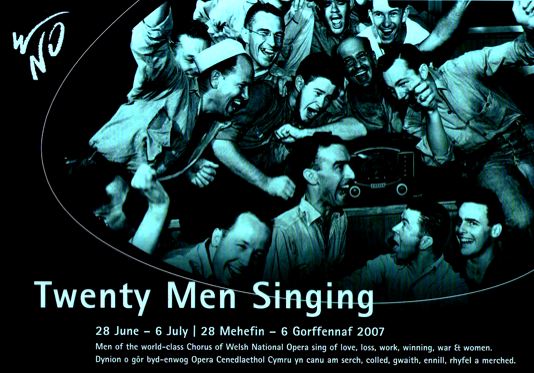
There they stood last night, singing a cappella, performing songs from Schubert to South Pacific, from the 13th-century Middle-English “Sumer Is Icumen In” to Alfred Schnittke’s “Adam Sat Weeping at the Gates of Paradise,” which premiered in 1988. Twenty they were; men of the Welsh National Opera, touring Wales with their aptly titled program Twenty Men Singing. Some of their sonic offerings were tonic, many (and for my taste rather too many) of them somber, reverent, and brooding.

Why were they singing? To amuse themselves, to entertain others, to earn a few quid or to enjoy the applause of an appreciative crowd? Why sing in unison when what you want is to stand out? If, indeed, that is what you want.

According to the program notes, those Twenty Men Singing explore just that: why men raise their voice together in song, whether to celebrate life, to protest or lament. In song, a hoped for unity is being realised in sonic unison. A chorus of disapproval is formed in resistance to voices and actions that may threaten community. Leoš Janáček’s “Sedmdesát tisíc” (1909), for instance (as translated by John Binias), many-voices the pressures inflicted on the national identity of a Czech bordertown by neighboring but less than neighborly Germans and Poles:

70,000 graves they dig for us
Outside Tesin
Beg for help from heaven
Herded like cattle
Like cattle we gaze about
Our own slaughter [ . . .]. 

Let our voices thunder out: [. . .].
Before we are finished [. . .].

This Saturday, performers around the world are singing to bring awareness to what may well be the greatest threat to humanity, regardless how much religion and nationalism, how much faith and terror (and the terror of faith) are being exploited by those who make a fortune keeping us at war with one another.

On this day of Live Earth, festivities that coincide with the anniversary of the London suicide bombings of 2005, we are asked to consider the terra we share, not the terror that divides us, to let “our voices thunder out” before we are “finished.” I cannot think of a better reason for joining a chorus.

Thanks for the Autograph. Now, Who the Hell Are You?

Don’t tell me. You’ve had a great time at the beach, enjoyed a picnic with friends and family, followed by a splendid fireworks display on a balmy evening. I mean it, don’t tell me! It’s been raining here for, let’s see, about three weeks, ever since my return from New York City; and today I read a forecast telling me that, after the “wettest June since records began,” July here in Britain is going to be a washout and that August and September “will not be worth waiting for.” Is it any wonder I am becoming more cantankerous by the minute?

To keep it gay, I dug up (and Ted Turnerized) this autograph a friend of mine from the indubitably sunnier and less lugubrious San Francisco sent me a few years ago. His mother was an avid radio listener and autograph hunter back in the pre-Television age I set out to recall in this journal. Previously, I’ve raided her collection for images of Baby Rose Marie, Rudy Vallee, and the Merry Macs.

So, who is this Del Casino? I reckon he is the same chap the Internet Movie Database insists on calling “Del Cansino,” a once popular singer whose star is rather a dark one by now. Perhaps that is not such an apt metaphor, considering that dark stars are at least detectable by their radio emissions, of which, in the case of Mr. Casino, there appear to be none.

Here he is, in an early 1940s “soundie,” crooning the pretty if none too memorable ”One Look at You.” You’d be able to tell a lot from one look at me just now; but you probably wouldn’t end up writing love songs about it. I’ll try to snap out of this mood and vow to return in good cheer anon.

I’m Not a Fan

Well, I’m not a fan of . . . anything. That is to say, I am not a fan of the word. Fan, fanatic, fanaticism. Those lexical expressions of inflexibility, those dictionary indicators of obduracy ought to be reserved for folks who are determined to blow themselves up for what they believe to be their beliefs, for the indiscriminals who are prepared to take the lives of others around them for the sake of an idea or an ostensible ideal (I’ve got Glasgow and London on my mind). No, I am not inclined to go quite so far in my devotion. It does not follow, however, that I am incapable of getting passionate or downright pigheaded, even when such fervor goes against my better judgment.

Permit me to opine for the sake of defining. For instance, I strongly disliked Britain’s former Prime Minister, Tony Blair, simply because I could not stand his grin and his (to me) mannered way of speaking; never mind his policy in Iraq, which was reason enough to disdain him. I have nothing yet to say about Gordon Brown, who mercifully abstains from mugging. I am opposed to Britain’s newly enforced smoking ban, no matter how many lives could presumably be saved by such a curtailing of pleasure. I refuse to visit my native country of Germany, along with Switzerland and France, and have choice words for those who turn down a nice cut of meat in favor of bean sprouts or tofu.

Unlike notions, opinions are never vague. Voicing them—a hazardous prerogative these days—is a retreat into what lies past caution, beyond apprehensions of censure known as political correctness, adjustments in expressed thought commonly disguised as reason, or, at any rate, as what is reasonable. Uttering what you can barely get away with can be a welcome getaway from the sincerity-divested shelter of platitude to which the mealy-mouthed have chosen to confine themselves. That goes only for the intelligent and open-minded; the unthinking, who can do nothing but opine, have no use for such relief, which makes them far more dangerous than any strongly voice opinion could ever be.

Meanwhile, I much rather rave than rant. I prefer to reserve my energy—and this little nook in the web—for things I look upon with uncommon fondness (such as radio, whose neglected virtues I extol in this journal) and people I adore in a manner that I, an atheist, refuse to label idolatry. A few decades ago, I decided that, while not fanatic, I fancied a certain leading lady of Hollywood’s aureate days. The lady in question is Claudette Colbert. French-born, no less. My latest acquisition—above poster for the 1947 thriller Sleep, My Love—arrived today and awaits a spot on whatever wall remains to display it. Space, by now, is at a premium; only yesterday, I made room for this announcement for Colbert’s 1941 vehicle Skylark. It is probably not what you’d expect to find in a Welsh cottage—unless, that is, you knew me and knew I had come to live there with someone so willing to humor my foibles and fancies.

So, what is the difference between a fan and a fancier? The fan cannot see; the fancier has a selective gaze. The fan discriminates; the fancier is discriminating. The fan is dead to the rest of the world; the fancier is alive to the idiosyncrasies of his or her passions. No, I am decidedly not a fan . . .

The Bourne Imperative

Well, I’m not sure whether I could stomach Lorna Luft and Dallas alumnus Ken Kercheval in a touring production of White Christmas; but Matthew Bourne’s Bizet ballet The Car Man was certainly worth a trip to the splendid Canolfan Mileniwm Cymru (Wales Millennium Centre) in Cardiff Bay. Inspired by James M. Cain’s oft-adapted 1934 novel The Postman Always Rings Twice (revived on 24 January 1952 on Hollywood Sound Stage, starring radio stalwart Richard Widmark), The Car Man is set in mid-20th century small town America (the fictional Harmony, pop. 375), The Car Man tells the story of the titular drifter who falls for the accommodating wife of his new boss (a vixen named Lana, after the actress who played her in the 1946 film version). Though easily duped, the cuckold is bound to find out, eventually, and to be less than accepting of the triangular situation.

Unlike his whimsical if choreographically frivolous Edward Scissorhands (my impressions of which I shared previously), Bourne’s earlier Car Man is proper dance theater, with an exceptional performance by Michela Meazza as Lana.

While firmly within the tradition of 19th-century melodrama without resorting to camp, The Car Man bears no resemblance to Carmen. Indeed, the story as told in movement, light, and a generous amount of stage blood is far easier to follow than that of Bizet’s opera or the Prosper Mérimée novella upon which it is based, a plot comedian Ed Wynn insisted on translating for the listening audience of Tallulah Bankhead’s radio variety program The Big Show on 26 November 1950, as opera star Lauritz Melchior struggled to perform Pagliacci: “And as the curtain rises, we see Carmen walking out of the cigarette factory. We know it’s a cigarette factory because there are doctors walking in and out of the building.”

Those medical practitioners, of course, were meant to endorse tobacco rather than treat the workers or assess the risks of smoking.

“Carmen has many admirers,” Wynn continued, “and to each one of them she has given a lock of her hair. Isn’t that beautiful? So, Carmen, or as she is now called by her friends, Baldy, [. . .].”

Not that Mr. Wynn could have possibly prepared me for the theatrical experience of The Car Man. In keeping with his celebrated all-male revision of Swan Lake, the old love triangle has been colored pink; or, rather, it is getting another—an outré—angle, as Bourne tosses a male admirer of Lana’s lover into the bloody mix of lust, jealousy, and murder. Being granted views of a communal shower, a private bedroom, and life behind bars—or wherever else you might expect intimate encounters of the same and opposite sex on a sultry evening, Bourne’s audiences can and should expect the full bodyworks.

Cheerio, Helen Keller!

Well, I’m not exactly a “shut-in”; but being visited by a late bout of seasonal allergies and looking out, red eyed and slightly hung over, at what has been declared the rainiest June on record, I sure can relate to The Story of Cheerio, a copy of which 1936 autobiography I picked up at the rare books room at Manhattan’s legendary Strand earlier this month. According to the cover, Cheerio is the “intimate story of radio’s most beloved character who has dedicated his life to the spreading of cheer, hope and kindliness. With inspiring human stories from the homes of his radio audience of ‘shut-ins.”
Seems like someone shut up this hero of the homebound, Charles K. Field, whom former president Herbert Hoover applauded for his “altruistic” use of the radio, but of whose fifteen years in broadcasting little survives today. A vintage recording of Cheerio in action can be heard at the close of the 19 September 1956 edition of Recollections at Thirty. Now, I’m not sure how much sentiment I can take on a biliously rebellious stomach; but I’m glad I decided to leaf through this as yet unread volume yesterday, when I came across this letter from Helen Keller, who was born on this day, 27 June, in 1880. It is a birthday letter, no less, read on the air on her 55th birthday. “Dear Cheerio,” it reads,

this is my birthday message. Please tell them I like to think God has made his shut-ins special transmitters of hope to the world. It is our lofty duty to defy the seeming omnipotence of Fate. To love. To endure. And to create, from our own wreck, the thing we desire. If we succeed in growing the sweet flowers of happiness among the rocks and crannies of our limitations, others will be inspired to nobler achievement. This alone is compensation. This is joy and victory! As I stand at the doorway of a new birthday, with its new opportunities and new tasks of faith and courage, may I ask my handicapped comrades to rejoice, with me, in that inner vision which makes us superior to outward circumstances and enables us to be one with all great ideals, all heroism, all deeds of beauty. Sincerely yours, Helen Keller.

Though not able to listen to the wireless, Keller was no stranger to the airwaves. When the story of her teacher, Anne Sullivan Macy, was dramatized on the Cavalcade of America program (on 2 March 1938), Keller stepped behind the microphone for a brief message to the multitude. Cheerio, Ms. Keller, for making me come back to my senses on this shot-through-gauze, shut-the-blinds, best-slept-through Wednesday afternoon.

Shadow Players

When I read that Lamont Cranston is being resurrected for another big screen adventure scheduled to begin in 2010, I decided to catch up with one of the earlier Shadow plays. The Shadow, of course, always played well on the radio. On this day, 26 June, in 1938, he was again called into action when a “Blind Beggar Dies” after refusing to share his pittance with a gang of racketeers. The blind beggars alive to such melodrama and asking for more were millions of American radio listeners tuning in to follow the exploits of that “wealthy man about town” who was able to “cloud men’s minds” while opening them to the wonders of non-visual storytelling.

On the screen, the Shadow never quite managed to immaterialize; a previous attempt at delineating The Shadow on the screen, in the form and figure of Alex Baldwin, failed to attract audiences large enough to warrant a franchise.

Considerably less accomplished than the 1994 adaptation was the 1937 feature The Shadow Strikes, which bears little resemblance to the myth conceived for radio (initially as a mere sales gimmick for Street and Smith story magazines, publications popular during the first half of the 20th century).

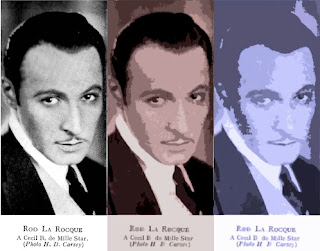
At just about the time when Orson Welles made his debut in the role on radio (as mentioned here), the mysterious crime fighter was impersonated on the screen by silent screen star Rod La Rocque, whose image I came across today while leafing through the recently acquired rarity Alice in Movieland, a gossipy little volume written back in 1927, when La Rocque was still remembered as a major Cecil B. DeMille player by, well, almost everyone:

You would have thought Rod La Rocque and Vilma Banky [the silent screen star with whom La Rocque was about to tie the knot] sure to be recognized at sight anywhere short of the South Pole. But not so!

At a preview of a DeMille picture at a Hollywood theater, seats had been roped off for the stars, as one among whom La Rocque was not being recognized by the usher.

Rod and Vilma crept away. Slow fade-out! I think, however, they did contrive later to annex the two worst seats in the theatre, behind a pillar of something. But all the easier to hold hands.

One of La Rocque’s last movies, The Shadow Strikes, is strictly of the ‘slow fade’ variety, even though the character La Rocque portrayed was so in the 1930s that a follow-up was released half a year later, featuring the same leading man.

Never mind that La Rocque does not get to utter that menacing laugh and is not equipped with mental powers superior to those of other popular crimefighting acts just outside the law, the Falcon, say, or the Saint. The producers of the movie did not even bother to check the spelling of the name of his alter ego when it appeared on the cover of a newspaper.

So, what fate awaits this great figure of 20th-century popular culture? Will he return only to receive a final blow, like a beggar too impoverished to pay up? Will those who watch him on the screen follow him back to the airwaves, into the shadows where he truly belongs?

Where Girls Get Their "fannies" Scratched; or, A Case of Censorship

Well, the cheek of it! I mean, who’d have thought anything quite this petty would come to pass nowadays in the kingdom of Benny and Fanny Hillbillies that gave the world “Pussy Galore”! Mrs. Slocombe’s pussy, for instance! Just last weekend (shortly before our digital receiver box gave up the ghost), BBC 2 presented its latest instalment of Balderdash and Piffle, a national word-hunt in which the British public is asked to dig for evidence of earlier uses of put-downs and swearwords like “tosser,” “plonker,” and “pratt” than are currently acknowledged in the street cred craving Oxford English Dictionary. Yet you won’t find the word “fanny” uttered on British cable television. Even the Golden Girls are getting their “fannies” scratched by overeager censors.

I noticed it a few days ago, listening, eyes averted, to an episode in which Rose and Blanche (recently seen—alas, not by me—at a New York City gay bar promoting her latest memoirs) are giving themselves a serious makeover in order to land a pair of eligible twins. The bathing suits were a bit tight, they had to admit; but according to Rose, the ever resourceful Blanche dreamed up a kitchen sink remedy faster than dieting: to spray their behinds with butter substitute PAM so as to be able to cheat themselves into those truth-telling garments.

Ingenious, to be sure. Yet viewers here in the United Kingdom didn’t get to hear about it. That word, “fannies” was faded out. Of course, it means something other than buttocks in the Queen’s English. Still, I thought it a rather pathetic cover-up. Come to think of it, the other day we had an e-mail message returned since it included the word “bitch,” even though it referred to the canine variety.

Since we are on the subject of “pussy” (a subject I, not numbering among the cat fanciers, rarely bring up in any company, polite or otherwise): here is my favorite scene from Elizabeth Gaskell’s Cranford (dating back to 1853, mind you). Laughing too loudly about it, without having anything in mind but a tosser-upper of a feline, got me into an embarrassing situation during my—pardon the vulgarly academic expression—”oral examination”:

The friendship begun over bread and butter extended on to cards [. . .]. 

As a proof of how thoroughly we had forgotten that we were in the presence of one who might have sat down to tea with a coronet, instead of a cap, on her head, Mrs. Forrester related a curious little fact to Lady Glenmire—an anecdote known to the circle of her intimate friends, but of which even Mrs. Jamieson was not aware. It related to some fine old lace, the sole relic of better days, which Lady Glenmire was admiring on Mrs Forrester’s collar. 

“Yes,” said that lady, “such lace cannot be got now for either love or money; made by the nuns abroad, they tell me [. . .]. I daren’t even trust the washing of it to my maid” [. . .]. Of course, your ladyship knows that such lace must never be starched or ironed. Some people wash it in sugar and water, and some in coffee, to make it the right yellow colour; but I myself have a very good receipt for washing it in milk, which stiffens it enough, and gives it a very good creamy colour. Well, ma’am, I had tacked it together (and the beauty of this fine lace is that, when it is wet, it goes into a very little space), and put it to soak in milk, when, unfortunately, I left the room; on my return, I found pussy on the table, looking very like a thief, but gulping very uncomfortably, as if she was half-chocked with something she wanted to swallow and could not. And, would you believe it? At first I pitied her, and said ‘Poor pussy! poor pussy!’ till, all at once, I looked and saw the cup of milk empty – cleaned out! ‘You naughty cat!’ said I, and I believe I was provoked enough to give her a slap, which did no good, but only helped the lace down—just as one slaps a choking child on the back. I could have cried, I was so vexed; but I determined I would not give the lace up without a struggle for it. I hoped the lace might disagree with her, at any rate; but it would have been too much for Job, if he had seen, as I did, that cat come in, quite placid and purring, not a quarter of an hour after, and almost expecting to be stroked. ‘No, pussy!’ said I, ‘if you have any conscience you ought not to expect that!’ And then a thought struck me; and I rang the bell for my maid, and sent her to Mr. Hoggins, with my compliments, and would he be kind enough to lend me one of his top-boots for an hour? I did not think there was anything odd in the message; but Jenny said the young men in the surgery laughed as if they would be ill at my wanting a top-boot. When it came, Jenny and I put pussy in, with her forefeet straight down, so that they were fastened, and could not scratch, and we gave her a teaspoonful of current-jelly in which (your ladyship must excuse me) I had mixed some tartar emetic. I shall never forget how anxious I was for the next half- hour. I took pussy to my own room, and spread a clean towel on the floor. I could have kissed her when she returned the lace to sight, very much as it had gone down. Jenny had boiling water ready, and we soaked it and soaked it, and spread it on a lavender- bush in the sun before I could touch it again, even to put it in milk. But now your ladyship would never guess that it had been in pussy’s inside.”

Go ahead, girls, get your “fannies” sprayed! Just make sure those tight-laced censors understand which end you are buttering.