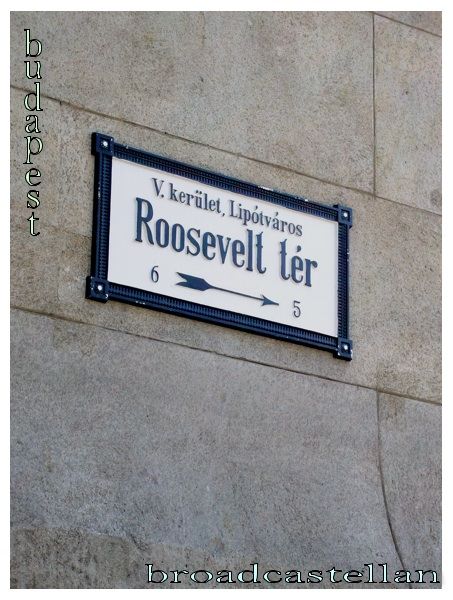
Square New Deal?

At one point it was prosaically called Uploading Square. Roosevelt tér in Budapest, that is. I decided to start our visit to the Hungarian capital by walking across the old Chain Bridge to pay my respects to the thirty-second US President who died in office on this day, 12 April, in 1945. As previously mentioned here, FDR owed much to the radio; his voice and views were known to millions of Americans who tuned in to hear his Fireside Chats. Three days after his death, his life was recalled by two special and very different broadcast, one headed by Ronald Colman and featuring an uncommonly yet appropriately somber Fibber McGee and Molly, the other featuring Canada Lee, reciting FDR’s D-Day prayer.

Roosevelt did not get a square deal, I thought, as I approached the spot named after him in 1947. These days, it is little more than a roundabout, a traffic island with a few statues in the middle—and none of them of FDR. Seen from the top of the hill in Buda, however, its prominence in the cityscape becomes apparent. Besides, as Fibber expressed it: “You know, a man is entitled to a lot of credit when people can say his family, and his community, and his country are better off for his having lived; but when a man dies and the whole world was a better place for his living, well, nobody needs much more of a monument than that.”

Meanwhile, the statues of Soviet heroes and leaders from whose rule Hungary struggled to free itself (after having lost the war siding with Nazi Germany) have been relegated to a park of their own . . .

Hungary to Hollywood; or, "seven maids with seven mops"

Well, this is it. My last entry into the broadcastellan journal before I’m off to Budapest, from which spot I hope to be reporting back on 12 April with a snapshot of Roosevelt Square, in commemoration of FDR’s death in 1945. Supposedly, our hotel room has wireless access; so I might not have to share my impressions retrospectively (as I have done on almost every previous occasion, after trips to London and Madrid, Istanbul and Scotland, Cornwall and New York City). This time, perhaps, I won’t have to catch up with myself as well as our pop cultural past.

Preparing for my trip, in an experiment you might call method blogging, I devoted the last few posts to connections between broadcasting and Budapest, between Hollywood and Hungary. Today’s association was not so much forged but found; and it is rather more remarkable for that. You’ve probably experienced it too from time to time: the feeling that, once you begin to engage with something you haven’t much thought of before, everything seems to point or relate to it. Suddenly, life is just a bowl of goulash.

Let me give you a for instance. Last night I watched a Hollywood non-classic I assumed to be entirely unrelated to our Hungarian adventure: the Ginger Rogers-starring fantasy romance It Had to Be You (1947), one of the fifty-odd movies I’ve been taking in so far this year (all listed on the right). It is a daft romance about a gal who can’t say “yes” (leaving three guys at the altar) because she cannot get her dream lover out of her head—until said dream enters her life to tell her how to lead it. Her dream lover, whose waking double eventually turns into her true love, is played by Cornel Wilde, who spends much of the picture walking around dressed like a Hollywood Indian. Anyway . . .

I generally follow up my viewings by checking out the filmographies compiled on the Internet Movie Database, which is how I came to speculate about Mr. Wilde (pictured above). Is he, or ain’t he? Hungarian, I mean. It would never have occurred to me, considering that, unlike Paul Lukas or Peter Lorre, Wilde does not have a readily distinguishable accent. Whereas most other online sources will tell you that the actor was born in New York City to Czech-Hungarian immigrants, the Database claims that he not only studied in Budapest and spoke Hungarian, but was indeed Hungarian by birth. Apparently, there are census reports confirming the former.

Wilde’s early screen name was Clark Wales. That alias does not make him Welsh, of course, but might have been chosen to suggest the foreign and rebellious. What would make him Hungarian, though? What is left of your national identity after Hollywood, like an Ellis Island checkpoint for Tinseltown hopefuls, changes your name or compels you do so? Hungarian, of course, was not a highly valued heritage in 1940s Hollywood, given the country’s suspicious proximity to the volatile Balkans, and, as the 1944 propaganda play “Headquarters Budapest” drove home, its alliance with Nazi Germany (“Admiral Horthy of Hungary, or people like him, will help to start World War III in the Balkans”).

I have long tried to get away from such a past (and, after seventeen years, am running still); but I could not hide my national origins, as much as I resent being defined by them. In stubborn grains of truth, the fatherland keeps sticking to my tongue (as you might have gathered from my podcasts). No matter how loudly I declare my past to be water under the proverbial bridge, it won’t wash. It is too prominent to be swept away or brushed aside:

“If seven maids with seven mops
Swept it for half a year.
Do you suppose,” the Walrus said,
“That they could get it clear?”
“I doubt it,” said the Carpenter,
And shed a bitter tear.”

Those lines, from Lewis Carroll’s “The Walrus and the Carpenter,” were recited by Mr. Wilde—in a broad Southern accent, no less—as he played an innocent American falling through the looking-glass in “Allen in Wonderland” (27 October 1952), a Suspense thriller involving an assassination plot, a crisis in the Balkans, and a case of mistaken identity. Earlier, in the same series, Wilde attempted an Eastern European accent playing the villain in “A Ring for Marya” (28 December 1950). It must be wonderful to have a tongue that can be twisted as readily as a broom handle.

Cleaning up the inconvenient pasts of their most valued players, Hollywood swung a lot of mops back then. It was left to the journalists to inspect the buckets. I envy those who get to sweep for themselves or learn to live with the sand.


Night Falls on Budapest: An Experiment in Broadcasting

I’ve been told to stay away from district eight; but I don’t suppose I’ll return home with impressions so graphic or lurid as to feel compelled to pen a thriller titled Murder in Budapest. BBC radio producer Val Gielgud did just that, back in 1937, after his return from the Hungarian capital. Val, brother of famed thespian Sir John Gielgud, was in town in the early fall of 1936 to accompany his colleague and friend Eric Maschwitz (both pictured above, on location) to “give a broadcasting impression of night-life in the Hungarian capital.”

Now, as I shared in one of the earliest entries into this journal, I have always been fascinated by these portraits in sound; and I intend to take my Micromemo iPod recorder around town to capture the city’s voices and noises, considering that there are plenty of photographers better qualified to supply the images; Zsolt’s splendid photo journal, for instance, to which I was referred after reading the impressions of an American visitor (attending an Arthur Miller play in Hungarian, no less).

“Budapest is—or was—a delightful and lovely city in which to spend a holiday,” Gielgud reminisced in his Years of the Locust (1947), a book I have raided on numerous occasions. He was not on holiday, though, and putting together a four-part radio documentary like Night Falls on Budapest in less than a fortnight proved a challenging undertaking. It “was an elaborate affair” that “began in old Buda, where up on the battlements Eric Maschwitz discoursed on their historic past to the accompaniment of the choir of the Garrison Church.” However enthusiastic and supportive, Hungarian broadcasters were ill equipped to handle the sound collages Gielgud and his crew had in mind.

“There were, of course, compensations,” Gielgud conceded:

It was a new experience to be driven at speed in an official motor-car, with a flag flying on the bonnet, and motor-cyclist outriders clearing the way. Just for a moment one felt it might be fun to be a dictator after all! It was strange and rather exciting to be caricatured in the newspapers, and become a central figure in an anti-semitic “incident,” when a Jewish-owned dance band declined to take part in one of the programmes. It made one feel important to be told so often and so emphatically that one was contributing to an improvement in Anglo-Hungarian relations. And, for a short period, working against time and ‘off the cuff’ could not fail to be exhilarating, especially in such surroundings. But speaking for myself, the time came which I felt that I could not face one more glass of barack, listen to one more tzigane orchestra, nor conceal from one more patriotic Magyar my profound ignorance of the detail of the Treaty of Trianon. I was not exactly encouraged to be told, after the broadcast of the second programme of the four, that the Czechs, regarding the whole affair as a diabolical piece of pro-Hungarian propaganda, had interfered with the land-line carrying the programme through Prague, and most successfully ruined the transmission.

What Gielgud took away from the experience was the “very real camaraderie and mutual sympathy that immediately prevailed between professional broadcasters regardless of nationality.” So, I’m not sure why he ended up writing Murder in Budapest; but then again, even my neck of the woods has inspired a series of neo-noir thrillers, the most recent one being Don’t Cry for Me Aberystwyth by Malcolm Pryce (whose previous Louie Knight mystery I am clutching here).

I’m not sure what I’ll be taking away from my visit to Budapest next week; but I’m sure grabbing the opportunity to be there.

Post-Cold War Days, meleg Nights: Eurovision, Idol Worship, and National Identity

I wonder whether I’ll come across any signs of support for Magdi Rúzsa next week when we wander around the Hungarian capital of Budapest. Though no politician, Ms. Rúzsa is something of an ambassador. A former Megasztar (or Hungarian Idol) contestant, she is going to Helsinki to represent Hungary in this year’s Eurovision Song Contest, to be held on 12 May. The contest, which has been staged annually since 1956 in an effort to foster a united Europe, rarely brings out the best a culture has to offer; but it often brings out the worst in nationalistic pride. As such, this noble experiment of Cold War Eurovisionaries is an abject failure, both diplomatically and artistically. That it turned out to be a sensational success and is now more popular than ever has more to do with spectacle than respectability. Hoping for musical excellence or cultural relevance would be tantamount to expecting an Academy Award-worthy performance from Hungarian mantrap Zsa Zsa Gabor, recipient of the 1958 Golden Globe in the whatever-happened-to-that category of “Most Glamorous Actress.”

As a German expatriate, and a less than proud German at that, I am too wary of nationalism to be cheering its benefits. In order to counteract nationalism,Eurovision rules stipulate that television viewers cannot call in to cast their vote in favor of a contestant representing their own country; but that rule poses no hindrance to borders-hopping fanatics, of which there are, I am pleased to say, very few Germans, if the notoriously poor performance of my native country is any indication. And yet, even a nation as divided as Iraq can be united in Idol worship, as has been suggested in this report about the Iraqi winner of Star Academy, which is rather a sign of hope than an alarm signal.

Now, I’m not sure how Ms. Rúzsa will fare. Hungary, which joined the competition along with several other reformed Eastern Bloc nations in 1994 (after a failed attempt in 1993), has a patchy record at best; in fact, Rúzsa’s “Unsubstantial Blues” has to make it through the semi-finals (on 10 May) in order to qualify for the main event. I suspect that the number will be overshadowed by some of the more outrageous acts, among which Ukrainian drag queen Verka Serdyuchka is the one to top (although the Danes got a “Drama Queen” in the running). While popular enough to get the nation’s votes, Verka Serdyuchka has enraged Ukrainian nationalists who deem the act an embarrassment, as was the case back in 1998 when transgender diva Dana International represented Israel (and won the competition). Clearly, those sing-to-win performances of Celine Dion or Lulu (recently featured on American Idol) are fuzzy Eurovision history; but is Verka merely presenting a challenge to more traditional acts or challenging the very act of representing a nation? Once you cross the boundaries of gender, are national borders to be upheld? Or is subculture proposed as a transnational superculture?

Cold war days seem to have made way for balmy postmodern nights. The iron curtain has melted into uncurtailed irony; and what once looked like a breakdancing showdown among feuding neighbors is now a free-for-all breaking with traditions. To use a scrap of Hungarian I just picked up, things are certainly meleg these days (meaning “gay” or “not cold”). And as much as I regret the lack of good tunes or taste, I can’t help but warm to this queer new world of a continent I left so long ago.

Things Eve Peabody Taught Me

Well, it is the “Little Paris of Middle Europe.” At least that’s how our newly arrived Eyewitness Travel Guide introduced me to the city of Budapest. Since I am about to visit the Hungarian capital, I’ve been flicking the pages to get acquainted with the place, its people, and its language; but whenever I find myself in need of cultural initiation I go about it in a roundabout way, with a stopover in Hollywood. Or Paris. You know, the really big Paris to the West of Middle Europe.

You can really learn a lot from old Hollywood movies, as long as you don’t get taken in or turned off by fake sets and phony accents. Take Mitchell Leisen’s 1939 screwball romp Midnight, for instance, and profit from the experience of American adventuress Eve Peabody (as portrayed by Claudette Colbert, whose career was the recent topic of an Alternative Film Guide discussion). Eve’s story, the gist of which you can follow in this recording of a Lux Radio Theater adaptation broadcast on 20 May 1940, will teach you a thing or two about traveling on a budget of little more than a centime with a hole in it, about crashing a society party with a pawn ticket, and about the perils of unwittingly impersonating a Hungarian baroness—practical stuff not generally covered by Baedekers.

Now, as the previous entry into this journal will tell you, I have just been in the company of a true Hungarian baroness last night, one with an accent to prove at least the Hungarian part of her past. The misleading lady Eve, on the other hand, has to work somewhat harder to hoodwink her way out of the hood (in her case, the Bronx). After suffering a “nasty accident” in Monte Carlo (“The roulette system I was playing collapsed under me”), down-and-out Eve is forced to depend on little more than her wits, her sex appeal having gotten her into too much trouble already.

She takes the name of the first person she met in Paris, one Tibor Czerny (Don Ameche), a Hungarian cabbie who’s been rather too eager to chauffeur her around town in her futile attempt to land a gig as a nightclub singer. “I guess, mine is strictly a bathtub voice,” she concludes, and makes a swift exit before Tibor can make good on his offer of taking her home. “No woman ever found peace in a taxi. I’m looking for a limousine.” However much she really likes the guy, it’s dough, not romance, that this dame is after.

At the swanky soiree onto which she happens when dodging those driving forces (the Hungarian, the rain, and the subconscious), the Czerny handle proves somewhat of a liability. The assembled high society assumes Eve to be one of the Czernys—a baroness, no less. And while it proves a breeze for Eve to slide around the foreign angle by alleging to be a Czerny by marriage, not birth, she slips on a treacherous bit of trivia and soon blows her cover.

When asked about that “most enchanting” city of Budapest, where she claims to have left her ailing husband, the baron, she is dealt a trick question about the town’s famous subway. “Did they ever finish that?” a guest at the dull get-together she’s managed to infiltrate inquires. “The streets are still a little torn up,” she responds, rather flustered. Her inquisitor did not need to hear any more to know this Eve from Adam. The Budapest metro, after all, is one of the oldest subways in the world, and Miss Peabody is little more than an impersonatrix eager to get away from a past that involved being squeezed each day into the Bronx local.

According to Hollywood justice, Eve gets away with it all . . . and walks away on the arm of Czerny to boot. In fact, having gotten it wrong works out all right for her. History, geography, facts and figures—none of that matters, Midnight suggests, as long as you’ve got beauty, charm and moxie. Considering that I still know so little about my destination, and a gold lamé gown like Eve’s does so little to enhance whatever charm I might have, I’d better cram plenty of moxie into that duffle bag of mine.

Man of the World (Wide Web)?

Okay, so, I tend to overdramatize. I can’t help it. I was born with a hyperbole on my lips. Turns out, I am still a man of the world wide web, despite the scheduled (and currently ongoing) landline repairs I lamented previously. At least, the prospect of not having access to the internet motivated us to realize some last-minute holiday plans by booking a trip to . . . Budapest. However eager I might be to share my experience, the challenge, as always, is not to drift too far from the format and subject of this journal and yet to make it reflect my everyday life, whether I am spending An Evening with Queen Victoria (as I will be on 22 April) or going back to my old neighborhood in New York City (on 14 May). Still, it is going to be (almost) all about Budapest from now until my royal visit.

“There is no such place as Budapest. Perhaps you are thinking of Bucharest, . . . and there is no such place as Bucharest, either,” New England wit Robert Benchley once remarked. Fortunately, especially for someone with a non-refundable ticket, there is ample proof to the contrary on the birth certificates of a number of film and radio personalities; and, as much as I love goulash or views of the Danube, I shall devote subsequent entries in the broadcastellan journal to the exploration of a few Hollywood-Budapest connections, whether prominent or obscure. To director Michael Curtiz, perhaps (whose Mildred Pierce I revisited earlier this year), or matrimonially challenged Zsa Zsa Gabor, whom I spotted not too long ago in Touch of Evil.

Then there are playwright Ferenc Molnar, whose Liliom was spun into a musical Carousel, and director Géza von Bolváry, who made movies starring the glamorous Zarah Leander (recently back in the limelight, in commemorations of the 100th anniversary of her birth). Never mind character actor Paul Lukas, who became a US citizen in 1933, or (soon to be exhumed?) escape artist Harry Houdini, who denied his Budapest birthplace. How could I, as an old-time radio aficionado, resist a few half-hours with “gorgeous” Ilona Massey, whose Top Secret adventures were blurted out on US radio back in 1950.

Now, I don’t question that Ms. Massey was indeed gorgeous; the quotation marks are merely embracing the adjective to suggest that the actress was billed in this manner when she agreed to become incorporeal for the sake of starring in her own thriller series (before materializing on television in 1954, when, years after her meeting with an Invisible Agent (a 1942 comedy-thriller co-starring Austro-Hungarian Peter Lorre) she got to host a variety program named after her).

In Top Secret, the aforementioned Hollywood actress played a Baroness on perilous assignments of “international intrigue and espionage before and during the World War II.” It all began on a “Night Train to Berlin,” in a compartment of which the Baroness found herself locked up with a Gestapo officer who threatens to break more than her silence: “Your fingernails, your knuckles, your beautiful white teeth, that golden hair. I promise you, your hair will be gray as ashes before the treatment is over.”

Not exactly the Beverly Hills spa treatment. How did she get into such a pickle? And how come she carries six lumps of poisonous sugar in her handbag and a radioactive transmitter in her heels, like some “walking Geiger counter” in search of tea or uranium? “It is very simple,” the Baroness explains in an accent thicker than the plots she was dealt. “A long time ago, a man, a very wonderful, brave man,” offered her a job and she took it.

Who would refuse a position that guaranteed “no credit in success, no protection in danger, no recognition even in death,” a career in which “your first mistake will be your last”? The job takes her to Berlin, where the Baroness works . . . as a manicurist. “It is surprising how much one can pick up in a beauty parlor. And I do not mean, er, tips.” A real nail salon-biter.

Massey got out of Hungary for that? I’ll have to study the travel brochures more carefully next time. Anyway. I may not be a Man of the World like debonair William Powell (whom I watched last night, opposite Carole Lombard, presuming to be one); but it sure is swell to be traveling to foreign countries now and again. I get to enjoy all those Hollywood stopovers.

Mind, Reader!

It seems like I am going to be cut off from the internet for a while. High winds wreaked havoc with the local landlines earlier this year, and keeping my date with the out-of-date has turned into an on-and-offline romance during the past three months. Finally, something amounting to more than darning is going to be done about those rotten wires; even the road to our house will be closed off for the duration. It is going to be a week of silent days, without signals and dispatches. Will broadcastellan have returned by the end of it? Can new wires improve the state of broadband? Might there be a future for carrier pigeons? I won’t ask you to tune in tomorrow to find out all about it because I won’t be able either to tell or share. Nor do I mingle with the crystal ball set who look to a psychic or Mind Reader like Warren William for answers.

What is worse, anyway, a phony medium or one beyond reach, a doubtful telepath or unreliable telecommunications?

Out of the Bag: The Fiction of Laetitia Prism

She could have run Hollywood. Miss Prism, I mean. You know, the governess in The Importance of Being Earnest who couldn’t tell a book from a baby. Summing up the ends (the conclusion as well as the purpose) of her novel, she explains: “The good ended happily, and the bad unhappily. That is what Fiction means.”  We know where her story ended up, of course; but what end did Miss Prism face, and what ends might she have served after and beyond Wilde?

Where do fictional characters go once their creators are done with them? What do they think, dream, or do between chapters or acts? Where have they been before entering the story their creators had in mind for them? Those are the question tackled by Celluloid Extras, a series of sketches now playing on BBC Radio 4.

What every governess knows: It is impolitic to point.

The practice of picking up familiar characters from the world of literature, disentangling them from the plots that contained them, and getting them back onto a public stage to let them tell us something else about themselves is hardly a novel idea. In January 1937, for instance, the familiar characters of Alice in Wonderland were released from the confines of “Copyright Lane” to mingle with Hamlet and assorted originals from Dickens’s Pickwick Papers and Martin Chuzzlewit in the free-for all of radio’s “Public Domain,” a play produced by the aforementioned Columbia Workshop. It is a tongue-in-cheek approach to pastiche that is both liberating and controlling of the afterlife and private lives of imaginary personages, who, even without those efforts, often do quite well in the minds of those who recall them from their excursions into drama and literature.

Natalia Power’s “Miss Prism, or the Dreadful Secret,” the first of those five Celluloid Extras promises the untold story of the absent-minded governess, whom last we saw being embraced by Dr. Chasuble, much to her delight. Now, I might have picked up some queer vibes, given that the Miss Prism I last experienced on stage was impersonated by a male actor; but Power seems to have gotten a similar impression, however her conclusions were drawn. And yet, Miss Prism seems to have been coerced into speaking up, if indeed the words coming out of her mouth were not put there by another. If it was her mouth.

In “The Decay of Lying,” one of the fictional characters through which Wilde spoke in his dialogued essays, remarked that the “only real people are the people who never existed.” In a postmodern dismissal of boundaries and binaries that would not have done for Wilde, whose stage plays and word plays depend on them, Power suggests that Miss Prism did exist as something other than the prism or lens of our changing mores, that she was, in fact, an acquaintance of the playwright to whom we are indebted for immortalizing her. By telling the fictive truth about imaginary people, “Miss Prism, or the Dreadful Secret” seems to be degrading the art of lying to a practice as indelicate and vile as tabloid journalism.

Giving Miss Prism a dirty secret (aside from the ones already out of the bag when the curtain falls on Wilde’s comedy) and by extracting it in a moment of alcohol-induced carelessness means to imitate life and, according to Wilde’s logic, to take it. Now that is character assassination.

A Bell for . . . Talafar?

It is the fuel that keeps the search engines humming. It is fodder for loudmouthed if often unintelligible webjournalists thriving on the divisive. It is the foundation of many a rashly erected platform by means of which the invisible make a display of themselves. The so-called war on terror, I mean, and the time, the shape, and the lives it is taking in Iraq. My position becomes sufficiently clear in those words, as tenuous as it sometimes seems to myself. Experiencing the uncertainty, the turmoil and sorrow that was New York City during the days following the destruction of the World Trade Center, I was anxious to see prevented what then felt like an out and out war against the democratic West; but as a descendant of Nazi sympathizers who is convinced that putting an end to thralldom is a noble cause and conflicted about the use of military force to achieve this end, I could only work myself up to a restrained fervor, which soon gave way to bewilderment, anger, and frustration.

Presented as a success story of the US led invasion of Iraq, the town of Talafar is once again in the news this week, shown in the unfavorable light of exploding bombs and insurgent violence. It has (or ought to have) become obvious that the US and its allies (reluctant or otherwise) are failing in their professed mission against terror and tyranny not because they lack military expertise or international support but because they engaged in this operation with an insufficient awareness and understanding of the different and differing cultures in a region they presumed, hoped, or misrepresented to be a unified (or at any rate unifiable) nation.

I was reminded of all this, if any reminders were required, while watching the wartime parable-turned-Hollywood romance A Bell for Adano (1945), a movie depicting the occupation of an Italian village by American forces toward the close of the Second World War. I generally dislike and avoid war pictures; at least those that reduce history to well-staged action sequences interspersed with scenes of map-pointing generals exchanging remarks about strategies and objectives as if contemplating a game of checkers. A Bell is not that kind of movie.

Based on a 1944 Pulitzer Prize winning bestseller by John Hersey (a Time correspondent and former secretary to Sinclair Lewis), it tells of the struggle for peace, order and community in a battle-scarred town whose lack of pride, hope, and unity is symbolized by the missing bell in the town square, weaponized by Italian’s fascist regime. Realizing the significance of this communal centerpiece, a New York Italian major disregards military orders to find and install an adequate replacement.

On this day, 28 March, in 1944—well over a year before the movie version premiered in US cinemas—NBC radio, in cooperation with the Council on Books in Wartime, presented an adaptation of Hersey’s novel as part of a series titled Words at War. Henry King’s film would attempt to shape parts of Hersey’s narrative into the romance of a lost “Belle” from Adano by casting Gene Tierney as John Hodiak’s Italian love interest, considerably downplaying the ugly Americans his character is up against.

The radio dramatization dispenses with such heartstringings-along to concentrate on the heart of the story: the failings of military strategy and the imperative of cultural sensitivity in the treatment of liberated civilians as exemplified by the response of one Italian-American to the challenges of ideological reorientation, his efforts to understand and assist his ancestral people after the removal of the enemy force that possessed, intimidated and estranged them.

On the radio, A Bell for Adano was announced as a story about “thoughtful Americans, and Americans not so thoughtful.” The very suggestion of America’s humanitarian blunders in an essentially propagandist series like Words at War renders this broadcast “Bell” altogether more compelling than those backlot scenes in which all-American he-fighters show the Axis what what is. The “what” here is “What to do with occupied territory?” once it appears to be under the control of the ostensible victor.

The war in Iraq has yet to deliver a bell ringing loudly enough to convince the world (or me, at any rate) that the freedom, stability, and opportunity it meant to bring about were worth all those local blasts and their global repercussions. Romancing a cracked one just won’t do.

Mining Culture: The Welsh in Hollywood

It was too pleasant an afternoon not to be warming to it. The outdoors, I mean. Though all thumbs (and not one of them green), I nonetheless tried my hands at gardening again, transplanting English-grown Californian Lilac into Welsh soil. Unless deterred by the vagaries of what goes for “vernal” here in Wales, I shall probably spend more time tending to the plants than to this journal next week, when the storm-frayed and patched-up telephone lines to our house are scheduled to be cut down and replaced, a spring renewal of telecommunications during which service is likely to be suspended.

No internet, no landline, and no traffic along the already quiet lane leading to this hermitage I call home—it’s “a proper place for a murder.” That is how the setting of Night Must Fall was described when on this day, 27 March, in 1948, the famous and oft revived thriller by Welsh playwright Emlyn Williams was performed on the US radio thriller anthology Suspense.

Along with two members of the original (1935) London cast—Dame May Whitty (as Mrs. Bramson) and Matthew Boulton (as the inspector)—Robert Montgomery was heard in the role of Dan, the lady killer he had played in the 1937 film adaptation. As I realized after seeing it on stage, Night Must Fall is not your common crop of a crime melodrama. It goes beyond the question of whether or not the victim will die by asking us whether she ought to, by making us eager for the “must” of her demise and examine the decline and “fall” of our own civilized morality. As a psychological and ethical puzzler, it translates well into other languages and media.

Now, Night falls in Essex, England, rather than the wild west of Britain; but according to Williams’s stage directions, the character of “Baby-face” Dan “speaks with a rough accent” that, unlike Montgomery’s, is “more Welsh than anything else.” On Broadway as on the London stage, this “sort of Welsh” Dan (as his girlfriend describes him) was voiced by the very Welshman who created him.

In an acting career spanning six decades, Williams was a frequent player in (mainly British) film, on stage and television; on US radio, he was heard in one of Norman Corwin’s plays for the United Nations. I recently spotted him in The Citadel (1938), his voice lending authenticity to the depiction of life in a Welsh mining town rendered unconvincing by the casting of Hollywood productions like John Ford’s Academy Award-winning How Green Was My Valley (another cinema classic I caught up with this year) or The Corn Is Green. The latter is based on an autobiographical play by Williams; but with stars like Bette Davis (on screen) and Claudette Colbert (on radio, nearly a decade later) taking on the role of a Welsh schoolteacher, it is the audience who is expected to be green.

Having lived in this country for well over two years now, I am all ears for representations and representatives of Wales in popular culture, whether in British cinema or American radio drama. What remains of this country once its landscape, language, and lore are forced through the filter of the camera or microphone, once it is translated by a popular medium like film and transferred to an international audience? During the next few months, leading up to a Welsh film festival hosted by the National Screen and Sound Archive here in Aberystwyth, I am going to mull over such matters from time to time.

To be sure, the landscape and culture of Wales have changed considerably since A. J. Cronyn’s Citadel and Richard Llewellyn’s How Green Was My Valley were bestsellers in the US back in 1937-38 and 1940, respectively. Prominently featured in 20th-century popular culture (including the previously discussed “Comedy of Danger,” reputedly the first play written for radio), the mines have been shut down years ago and wind farms have replaced collieries. Today, however, the BBC reported that coal mining is making a comeback here, as the first “deep mine” is set to open in over three decades. Could this mean that Ms. Zeta-Jones is going back to her Welsh roots for a Hollywood returns to the Citadel, the Valley or other recycled Corn?