
The Man Who Went on a Diet and Didn’t Come Back

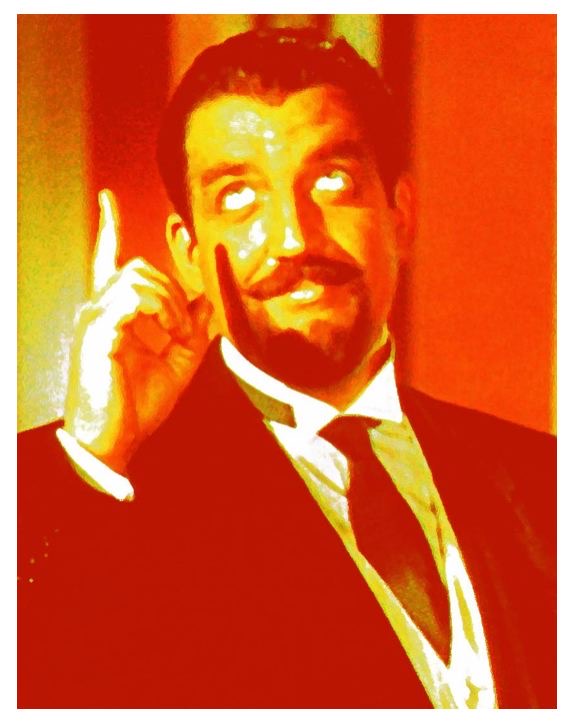
Laird Cregar in Heaven Can’t Wait

Well, I did not bother to make any.   New Year’s resolutions, I mean. Once again I let slip by the chance of this calendrical construct—a moment in which our attempts to impose the order of the chronologic on the so-called fourth dimension whose measurable expanse is being commorated with renditions of “Auld Lang Syne”—to bring about changes in the race against time that is my life. Perhaps you made up your mind (or had it made up for you) to put an end to something and start something new, an exchange of habits or a switch in attitude intended to improve life or merely to prolong it. I did resolve nothing more than to account for my everyday, aside from continuing with this journal, by counting the movies I take in this year (so far, Night at the Museum, Pan’s Labyrinth, The Gay Falcon, Gentleman’s Agreement, Gilda and The Man in the White Suit), thereby to get a clearer picture of my actual rate of consumption and to ponder, at year’s end, how much these fictions have informed or impeded my journey.

Though far from being a life-as-artist like Walter Pater, I try to think of my existence in all its failures and shortcomings as an unfinished essay, a half-published and oft edited text of which broadcastellan is both a digest and an extension. A man’s success, comedian Fred Allen remarked, “depends on which wears out first—his pencil or his eraser.” That, like most epigrams, sounds smart enough; but the real trick is to avoid getting those two writerly tools confused. Believe me, it’s not that easy to tell them apart. Here’s a for instance and how I arrived at it.

As I was thinking about a subject for another one of my “On This Day” features, I came across “The Death Laugh,” an episode of the radio thriller anthology Inner Sanctum Mysteries broadcast on this day, 8 January, in 1944. Rummaging through my library, I failed to lay my ears on the play I assumed to be there; many of the Inner Sanctum episodes available online have been mislabeled, their dates and titles inaccurately recorded. Rather than putting an eraser to this futile search and moving on to another subject, my mind lingered instead on Hollywood heavy Laird Cregar, the star of said thriller. It was as if the man demanded to be called to mind today, not content to wait even until tomorrow (which marks Cregar’s anniversary in a 1943 broadcast of the Radio Hall of Fame) or the day after that (in which he played Montezuma in Orson Welles’s propaganda series Hello Americans).  

There was no need for him to get pushy. I have always thought Mr. Cregar a fascinating and devilishly handsome fellow—ever since he first made an impression on me in This Gun for Hire (1942); so much so that I quite forgot—or was only too ready to neglect the by no means negligible performances of Alan Ladd and Veronica Lake. Playing Satan, Cregar brought wit to Lubitsch’s Heaven Can Wait, an otherwise disappointingly well-mannered and overly sentimental portrait of a scoundrel. Why hadn’t I seen more of Cregar over the years, considering my love for classic Hollywood movies?

Now, I am not in the habit of turning to an artist’s biography to assess his or her performances. Instead, I focus on the works that show people and storytellers are in the business of sharing with us. For that reason, the fact that Cregar practically starved himself to death in order to become a leading man was news to me. It seems that neither heaven nor Hollywood could wait for Mr. Cregar.

According to some sources, Cregar was born in 1913; others claim he came into this world in 1914; others still state 1916 as his date of birth. Certain, however, is that he died in 1944 of an uncommonly early heart attack, apparently brought on by a crash diet, the resulting 100 pound weightloss of which was intended to convince Hollywood to give top billing to a man considered too fat to play the dashing lead.

Even on the air, where he could have gone invisible, Cregar played the fat man when he filled in for Sidney Greenstreet in the Lux Radio Theater adaptation of The Maltese Falcon. Mr. Cregar got his wish eventually, yet only posthumously, in Hangover Square (1945)—a belated nod to a man who conformed to an image and was reduced to one in the process.

After I thought about all this, I flicked through the current issue of the Radio Times and noticed that, just as I was fiddling with computer and camera to capture Cregar’s likeness from hell, the British cable channel Film Four had been screening The Black Swan, in which the actor impersonated Henry Morgan, a Welsh pirate born in the windswept parts I now call home.

Yes, Mr. Cregar seemed adamant to turn me into his medium today. Perhaps he was out to warn anyone with the New Year’s wish of shedding pounds this year to take it easy or, better still, to reconsider whether the eraser we take to our lives is chosen by ourselves or handed to us by those who dictate just how our being ought to be shaped.

January 4, 1942: What’s On?

I am one of those forward-looking folks who peruse the television and radio listings as if they were stock market reports or racing forms. Determined not to miss a winner of a program, I prepare myself by wielding the ever ready text marker as I wend my way through the weekly offerings. Today, though, I am seriously late in my planning. Before me is the US broadcast schedule from 4 January 1942 as it appeared in an issue of the Radio-Movie Mirror.

Having just watched “Static,” a 1961 episode of The Twilight Zone—shared with me by a fellow web journalist and consummate teller of fantastic tales—I am in a time-warped frame of mind. It is not for the sake of self-indulgent nostalgia, mind you, that I am revisiting the past, but in order to reconsider the boundaries of escapism. If the present does not turn us on, how can we, in this multimediated world of ours, expect to switch off entirely?

“Static” does not look kindly on television and the getaways it promises; it suggests that there is no escaping the challenges we dare not face as we stare at that small screen on which Westerns, quiz shows, and commercials flicker while life flashes by. Instead, it romances what, by 1961, was nearly a forgotten or at any rate woefully neglected medium in America; it gives two middle-aged people a second chance at realizing their dreams by transporting them, as if on radio waves, to the early 1940s, when first they met. The radio entertainments of that period—Fred Allen, Major Bowes, and the music of Tommy Dorsey—stand ins for what was presumably a time at once rich in possibilities and free from the mindnumbing influences of that set to which Americans had gotten so attached over the years.

All this romancing aside, the early 1940s were hardly an innocent period in modern history; and rather than coming true, many a dream had to be deferred or abandoned altogether. In this moment of uncertainty, at least one business comforted consumers by attempting to keep business running as usual. Worried or bewildered about the war, wondering what changes it would impose on their everyday existence—from blackouts to rationings, from irritating inconveniences to the loss of lives—those sitting at home could still depend on radio for escapist entertainment.

On 4 January 1942, an “Appointment for Murder” was kept by Raymond, host of The Inner Sanctum, Humphrey Bogart and Claire Trevor were heard in Screen Guild reconstitution of High Sierra, and Sherlock Holmes embarked on the virtually spotless “Adventure of the Second Stain,” first related by Conan Doyle some four decades earlier. Meanwhile, Jack Benny was overhead in a flashback episode recounting his botched New Year’s Eve celebrations, a belatedness indicative of the radio industry’s reluctance to catch up with the times.

Beholden to the sponsors who footed the bills, commercial radio was slow to adjust; and none of the programs broadcast during the weeks immediately following the attack on Pearl Harbor appear to have any relation to the realities of war. By comparison, even undemanding and apolitical publications like the Movie-Radio Guide, from which the above schedule was ripped, were quick to recontextualize the entertainments they were designed to bring to the attention of prospective listeners.

“A little over three weeks ago,” the Editors of the Guide commented, “a third-rate power with autocratic, imperialist ambitions and no scruples, attacked the United States as was to be expected—by hitting below the belt.” The propaganda still wanting on the air was already being provided by publications catering to the radio industry.

Responding to the demand for information, the Movie-Radio Guide promised to keep “pace with the nation’s war effort” and the “needs” of its readers by “inaugurated” an “enlarged short-wave department.” To the reader’s inquiry “What’s on?” the Guide replied in no uncertain terms: A war, that’s what was on.

How much does your entertainment guide of choice remind you of the fact that 2007 is by no means shaping up to be a time of peace?

Daddy Cool Vs. Father Time: Getting the Better of 2006

Well, this isn’t a travel brochure; hence my taking the liberty of adding a question mark to the following: What better place to ring in the new year than in Scotland, where “Auld Lang Syne” is being sung more passionately and the ringing in goes on longer than anywhere else in the world? Having just returned from Glasgow and Edinburgh, I could think of a few alternatives, considering that Scotland’s chief tourist attractions this time of year—the famed Hogmanay festivities, were pretty much wiped out by fierce gales and lashing rains. The British weather! I have mentioned and deplored it often enough in this journal to claim that I was unprepared for its party-pooping force.

Since practically all of Glasgow takes a prolonged New Year’s holiday—including the city’s retailers and its museums, at one of which, the Kelvingrove, I spotted those heads dangling above on the day of Saddam Hussein’s hanging—there was little else to do than to seek shelter in a multiplex, mercifully kept open, and to take in a few double features. Fairly disappointed by the politics and pretensions of The Perfume, yet charmed by the slight Miss Potter and amused by the to me surprisingly bright Night at the Museum, I was enthralled at last by Guillermo del Toro’s El Laberinto del Fauno (Pan’s Labyrinth), easily the most exciting movie I have seen on the big screen in years, a film unrivalled by any piece of fiction I have come across in 2006.

Not that 2006 was lacking in cultural pearls, many of which I shared and appraised in this journal. I won’t altogether stoop to lining them up, however popular and convenient such an approach to reviewing might be. Indeed, I find it difficult to name the best and worst of the past twelve months; but let me try, anyway.

In a year during which I picked up far too few books to make up a list, my main literary find was H. G. Wells’s aforementioned Ann Veronica, an uneven but compelling portrait of the British suffragette movement. Rewarding as well was Anthony Trollope’s Cousin Henry, a Kafkaesque exploration of doubt and guilt, while Daphne Du Maurier’s Jamaica Inn, for all its romantic intensity, struck me as dark-aged (and downright fascist) in its vilification of physical otherness.

At the pictures, the most satisfying film of the year may well have been The Illusionist, which I had the fortune to catch during my trip to Istanbul last September. It quietly triumphed over that other vanishing act, Christopher Nolan’s box-office misfire The Prestige; but, as pleased as I was to find James Bond back in form (after decades of discharging tiresome one-liners to demonstrate his cool) and getting to know The Queen in Helen Mirren’s soon-to-be-Academy Award nominated performance, it took a trip to the aforementioned Labyrinth on New Year’s Day to remind me of the magic of the movies, an emotional sway entirely absent in the hackneyed and uninspiring World Trade Center, the most exasperating of my cinematic encounters.

It was a year that convinced me, an inveterate old-time radio aficionado, to pay more attention to BBC radio, having tuned in to provocative (if not always convincing) plays like “Abrogate” (discussed here) and “True West” (reviewed in this post), adaptations like “Sir Gawain and the Green Knight” (with Ian McKellen) and documentaries like “Down the Wires.” Still available online this first week of January 2007 are Alan Bennett’s “The History Boys” as well as drama by Pinter and Stoppard.

By comparison, I still look upon television chiefly as a purveyor of old movies, of which I must have taken in over a hundred this year. The BBC’s serialization of Jane Eyre felt less than fresh, the second season of Desperate Housewives irritated me with its heavy-handed bathos, while the third round of British reality show X Factor was short on personalities for which to root. More enjoyable was the Andrew Lloyd Webber judged How Do You Solve a Problem Like Maria?, which generated a new West End personality to star in the current revival of The Sound of Music.

While I have no intention to see that show, I had my share of theatrical treats, foremost among them a revival of Barrie’s What Every Woman Knows and an imaginative staging of Mervyn Peake’s imaginative staging of Mervyn Peake’s Gormenghast. The musical Daddy Cool, which I caught at London’s Shaftesbury Theatre, was not among them. Stringing together the songs of German pop-crafter Frank Farian (the man behind the late-1970s phenomenon Boney M. and the early-1990s lip-synch duo Milli Vanilli) and forcing them into a narrative that borrows from West Side Story, Romeo and Juliet, and Bollywood, Daddy is a Mamma Mia of a musical that will make even those who fondly remember some of the featured tunes go “Oh, brother!” That said, I still came out humming and, having gone backstage to see fictional gunmoll Ma Baker turn into the affable Michelle Collins, I hardly regret the experience.

Whatever I see, read, or hear this year I shall take in with glee, cheered by the thought of having in broadcastellan a journal in which to document nothing more plainly than the extent of my own folly.

Please, Mr. Memory: Concussion on The Thirty-Nine Steps

I felt torn last night. Torn between The Falcon’s Brother (in which George Sanders passes the thriller franchise to sibling Tom Conway) and John Buchan: Master of Suspense, a television documentary about the author of The Thirty-Nine Steps. Quandaries like these are peculiar to life in a single-TV household. Considering that I am going on a New Year’s trip to Glasgow (where Buchan grew up) and just saw a dramatization of his classic spy novel in London, I decided in favor of the latter. Not that the documentary (part of BBC Four’s Adventures for Boys season) did much to clear the muddle my mind, at work under the influence of Patrick Barlow’s stage adaptation, has made of the Steps, one of those books everyone claims to know but few ever read, let alone without preconceptions.

Now, I have read Buchan’s 1915 novel (available online here); and, like most readers who come to it by way of Alfred Hitchcock’s 1935 adaptation, I was astonished at the film’s brazenfaced infidelity. I was disappointed, as well. Missing was the wit that Hitchcock and writer Charles Bennett brought to the original by reworking it in the screwball comedy tradition. It Happened One Flight, they might as well have called what amounts to conclusive proof that tying a male hero to a dame (absent in Buchan’s story) does not have to slow down a fast-paced chase. Infusing sex appeal rather than sentimentality, Hitchcock’s cinematic update created a new adversary for the already much-beleaguered hero, Richard Hannay, who finds that a lot can go wrong in the effort to do right.

Barlow’s dramatization, by comparison, aims at demonstrating that a lot can go right in the effort to do wrong. When I read that John Buchan’s “The 39 Steps” was playing at London’s Criterion Theatre (where it can bee seen until April 2007), I had reason to expect an update of the novel, rather than a recreation of the film, however farcical the treatment (as reviews and poster art suggested).

As it turns out, Buchan’s novel has little to do with the nightly frivolities at the Criterion. The attribution to Buchan in the title of Barlow’s play (based on an “original concept” by Simon Corble and Nobby Dimon) seems to be part of an elaborate practical joke—a set-up in which spectators gladly take the fall since they are being coddled by travesty into assuming themselves superior to the material, whatever its source. Being tongue-in-cheek is a convenient escape, a laughing away of what could—and perhaps ought to—have been an engagement or confrontation with Buchan’s story, a tale of espionage and persecution anxities so relevant in this age of terror and so-called anti-terrorism.

Aside from the material of which John Buchan’s “The 39 Steps” makes light, the main attraction of the play lies in its being performed by a cast of only four actors, who dare to take on well over a hundred characters. With a small supply of basic props, those nimble four are shown in the ludicrous struggle to recreate the screenplay as realized by Hitchcock (who, in one of the many inspired moments of silliness, makes a cameo appearance in silhouette). This minimalist-absurdist approach to adaptation was not entirely a novelty act to me, having previously attended a production of The Importance of Being Earnest acted out by a cast of two.

Overly familiar as well felt the play’s reflexivity, its awareness of and delight in the improbability of being equal either to Buchan’s spy story or Hitchcock’s screwball caper. Many self-conscious remakes operate in this manner, escaping the challenge of finding the new in the old by making a mockery of the attempt at renewal and a mess of what is presumably so outmoded that it deserves nothing more than a send-up.

There is enjoyment in seeing things go awry, no doubt; and John Buchan’s “The 39 Steps” rewards theatergoers for their knowledge of the Hitchcock version (one of three film adaptations of the story). Cineastes will appreciate the effort that went into finding ways of making it almost work, whereas those who read and respect Buchan may regret how much is being squandered by ignoring his paradigm. After all, his thrills, too, depend on the pleasure derived from seeing things go awfully wrong, albeit with far higher stakes for the protagonist and his world.

Calling the play John Buchan’s The 39 Steps obscures the fact that the first motion picture adaptation was already a comic revision of Buchan’s rip-roaring yarn. Going after Buchan, Hitchcock managed to be fresh (both new and irreverent) without losing sight of the hunter-on the-run formula that would serve him so well, without neglecting the task of dusting off this decades-old story for action-seeking motion picture audiences. Forgoing thrills, sentiment, and politics alike, Barlow is strictly after laughs.

That said, the bungled dramatization is a chuckles-filled joyride for those who take pleasure in playing fast and loose with supposed literary classics. I gladly go along, provided I can still pride myself in being able to tell a sly impostor from the real thing. Instead, the theatrical experience has given me somewhat of a concussion, leaving me in a state of confusion that neither the aforementioned documentary nor the numerous American radio dramatizations (by the Lux Radio Theater and the Mercury Players, for instance) are likely to clear up. Was Richard Hannay a South African, a Canadian, or a Scotsman? Was he driven by the impulse to save a crumbling empire, to counter boredom, or to clear his name? Come to think of it: just who built The Thirty-Nine Steps, an unstable architectural composite of which now arises before my mind’s eye?

Even Mr. Memory won’t be of much assistance to me, I suspect. Besides, he is . . . but you know the story.

A Moody Christmas: There’s Life Yet in the Old Scrooge

Eighty-what? Bah, humbug! Age does not deter film, stage, and television actor Ron Moody from going on tour in yet another dramatization of Dickens’s A Christmas Carol, the Wales Theatre Company production of which I caught at the Aberystwyth Arts Center. In fact, Moody adapted the story as well, in collaboration with director Michael Bogdanov (whose productions of Fiddler on the Roof and Amazing Grace I have reviewed on previous occasions).

What’s more, Moody not only took on the play’s largest role but enlarged it still by taking over as Dickens’s narrator as well.  He resurrected the old miser with wit, humor, and feeling, even though his voice came across rather faintly and his lines were at times mumbled or muddled to an extent that the character’s age and grumpiness could not entire disguise or explain. When Scrooge reminds one of his ghostly guides of being “mortal” and “liable to fall,” Moody’s frame made the line utterly convincing; yet he stepped surprisingly lively after his reformation, cheerfully urging the audience to rise for a standing ovation.

The production was a busy one, meticulously recreating the story’s memorable scenes and characters with numerous set changes performed by stagehands shifting the makeshift props, activities that distracted from the endearing fairytale simplicity of the narrative and very nearly defeated the object of creating a sense of proscenium arch realism. It was all too much for poor Mrs. Fezziwig, who slipped upon entering the scene in which she was introduced to Scrooge by the Ghost of Christmas Past.

All this stagecraft brought to mind the superiority of non-visual storytelling on radio and in public readings. It is in the spoken word, aided at most by music and sound effects, that a ghost story like A Christmas Carol is most likely to thrill and enchant, as it certainly did in many of the productions heard during the 1930s and ‘40s on US radio, including this Campbell Playhouse adaptation broadcast on Christmas Eve, 1939.

There is no use trying to keep the eyes dry; their services are not required for the enjoyment of plays by radio. If tears happen to blur your vision, let them run freely.  They are testimony to the vision and insight of your mind’s eye.

To the Moon

It has been hailed as “magnificent” and “mesmerizing.” Kevin Spacey’s performance in the Old Vic production of Eugene O’Neill’s A Moon for the Misbegotten, I mean. After seeing the Old Vic’s take on The Philadelphia Story last year, in which Spacey, the theater’s artistic director, acted less-than-Cary Grantly opposite Jennifer Ehle, I was skeptical, to say the least. The Spacey age at the Old Vic has proven a troubled one.

I have yet to experience anything “mesmerizing” at the Old Vic, where, aside from Spacey’s turn in A Moon and Philadelphia Story, I also watched Sir Ian McKellen camping it up as Widow Twankey in Aladdin, which struck me, unaccustomed to the Christmas panto tradition, as disenchanting and tawdry. A Moon is well beyond both of those trifles, without quite rising above unevenness. I am not sure, though, whether to attribute my dissatisfaction with it to the script, the production, the performances, or to a perverse streak all my own—which accounts for the mess I made of these oft-revised notes.

To begin with Spacey, whose career I’ve been following since the early 1990s, when I was introduced to him by a mutual friend, backstage at the Richard Rodgers Theatre on Broadway, where the man who would be Lex Luthor appeared with whatever-happened-to-Academy-Award-winner Mercedes Ruehl in Neil Simon’s Lost in Yonkers. No doubt, I have been trying to discover the man in his parts ever since, which does not help matters. Spacey’s off-stage persona has irked me at times, an uneasy, calculated ease that threatens to render his acting as disingenuous as an act. Then again, selecting his roles for stage or screen, he seems most comfortable and convincing in the skin of the con, the trickster, or the sham.

In A Moon, Spacey is Jim Tyrone, a middle-aged, self-confessed “third-rate ham” who lays bare his conscience-tormenting past while under the influence, in a state where men are most likely to drop their masks. Spacey’s Jim is a queer duck, more likely to drop a glass than a hint of hidden truths: there are elements of camp in his gestures and postures, suggesting a self-indulgent act rather than honesty.

In his “reflections” on A Moon (published in the playbill), Spacey claims that the challenge of impersonating a drunk is to play him “so he doesn’t become monotonous.” Was it just that, or could playing the lush be an opportunity to go “gay all of a sudden” (to quote Grant’s character in Bringing Up Baby) and explain such release as temporary spasms?

A Moon is a play of lost schemes and the schemers who get lost in them, who struggle to redeem themselves by scrapping their act or getting it together. The central character is Josie Hogan, a farmer’s daughter whom O’Neill envisioned as “so oversize for a woman that she is almost a freak,” a dated, gender-stereotyping description Eve Best could not be expected to fit. Just as Spacey’s Jim may not know as much about loving women as he claims, being that he is more likely to adore or assault than to embrace them, Josie only puts on the act of a wanton to conceal that she is virtuous, a quality she derides as being “worse than decent.”

Despite his flaws, Josie has fallen in love with Jim; or, rather, she loves him for his vulnerability when exposing them. She might have more satisfaction forgoing the company of men altogether, considering that she is being manipulated into becoming a mantrap for Jim in order keep a roof over the pighead of her father (Colm Meaney). While not lacking in willfulness, she is the only one of Hogan’s children to remain on the farm, having assisted in the escape of her younger brother, a “New England Irish Catholic Puritan, Grade B” (played by an altogether miscast Eugene O’Hare, who seemed to have gotten into the first act on a Guy Madison scholarship).

Disregarding O’Neill’s instructions, Bob Crowley, the designer in charge at the Old Vic, places what there is of action in a surrealist set reminiscent of the Dust Bowl conceived by Dali instead of a September day in the Connecticut of the early 1920s. As a symbol of farmer Hogan’s crookedness and his lost dream of a plot, this hovel of a crazy house created in me a sense of dislocation that even the earthy performance of Irish actor Meaney could not counter. And yet, it is a set fit for a play that seems set on estrangement, that sets you up by setting out as comedy but never quite settles there.

There are shades of Ah, Wilderness!, the lightest, least controversial of O’Neil’s works, considered inoffensive enough to be frequently adapted for American radio during his lifetime; but then this Moon, considered unfit for Broadway until long after the playwright’s death in 1953, turns on you and the light-heartedness gives way to some heavy-handed, drawn-out confessionals.

The audience, like the titular satellite, is being compelled to keep circling what amounts to a rehearsal for a funeral during which fears and failings are exposed and confessed, talked about rather than dealt with, let alone resolved. Redemption has rarely felt quite this unredeeming. If the lack of resolution may be considered a triumph of modernism, the orbiting in the sphere of words strikes me as a failure in dramaturgy.

The circular and roundabout are not without their returns; but, I’d rather be spinning quietly in a chairoplane (like the one at the fun fair on London’s Leicester Square, pictured above) than sit through what amounts to a cycle of remorse and unfulfilled desires.

Being Here: Living Reconciled to Virtuality

Well, it has been two weeks since my last entry in the broadcastellan journal. I have been on trips to England’s two largest cities, London and Birmingham (pictured, in my rather futuristic snapshot), spending time with friends, taking in culture high and low. I rarely stay away that long from this virtual nook I call home. Whenever there is living to be done, I tend to fall behind with the chronicling of same; and when I finally catch up with myself in writing, the reporting seems pointless, the moment past. Perhaps it is this inability to reconcile actuality to virtuality that convinced me to keep a journal devoted to the presumably out-of-date.

Instead of summing up the fortnight that was, I am looking ahead, announcing the pieces I am going to share in the days to come. For what remains of the year (and of my time online), I shall file a few belated reports from the theaters, virtual and otherwise.

For the most part, it has been “otherwise” rather than otherwise. After my short trip to Birmingham, where I was introduced to Patrick Hughes’s mind-teasing “Superduperspective” (on view, free of charge, at the Waterhall until 17 February 2007), I went to see the aged Ron Moody as Scrooge in a touring production of Dickens’s A Christmas Carol. While in London, I took in A Moon for the Misbegotten starring Kevin Spacey (whose career I have been following ever since I was introduced to his work by a mutual friend); an irreverent adaptation of Hitchcock’s The Thirty-Nine Steps, performed by a cast of four; and the musical Daddy Cool, based on the once hugely popular songs of Frank Farian (of Milli Vanilli infamy), many of which provided a soundtrack for my childhood in Germany. I am going to devote one essay each to these diverse stage entertainments, and am likely to toss in the occasional reference to American radio dramatics, the formerly free theater for the multitude.

There isn’t much “free” theater to be had these days; and, judging from the American accents I picked up only infrequently while in the UK capital, London is rather too expensive to attract many Western travelers, particularly at this time of year, when many forgo culture for commerce in their search of bargains. Although I moved from the US to Britain quite some time ago, I still think in dollars and convert pounds into US currency to assess costs. It is a habit that made the ticket prices at London’s movie theaters seem all the more outrageous. I guess we laughed more at our folly than at the penguin antics when we found ourselves paying $25 per person to see Happy Feet. Somewhat less pricey were screenings of Casino Royale (an antemeridian matinee at London’s premier movie house, the Odeon Leicester Square) and Stranger Than Fiction, playing at a much smaller venue.

Going to the pictures has gotten pricey; and that applies not only to those in motion: the current exhibition of paintings by Velasques at the National Gallery requires the forking over of an eyepopping £12. As price tags raise expectations, the paintings seemed to lose some of their lustre when considered in the light losing itself in empty pockets. No wonder I keep turning to the comparatively cheap thrills of old-time radio drama for my day-to-day amusement.

Though no longer free, there was much on offer at home, if only I had been listening to the radio. Still to be enjoyed are Sir Ian McKellen in Sir Gawain and the Green Knight and a production of Shakespeare’s Cymbeline, both aired on BBC radio The BBC makes programming available online for a week, and I am now trying to catch up with some of the outstanding or noteworthy dramas presented in recent days—from the gay wedding at The Archers to the five-part adaptation of A Room to Let, a story collaboratively conceived by Charles Dickens, Wilkie Collins, and Elisabeth Gaskell—broadcasts I missed while wirelessly away in England.

Mind you, I could have enjoyed wireless access at our hotel—for the price of £15 a week; but, more than the cost itself, I resented being prompted to provide personal data in order to be granted a privilege that ought to be free like the air itself. Paying for air charged with the particles of commerce? Being charged yet again for exposing myself to a deluge of online advertising while depriving myself of an opportunity to recharge? Progress? Bah, humbug!

"We will interrupt all programs": Radio Drops a Bombshell

It certainly threw a wrench into the well-oiled works of radio as a commercial enterprise. The attack on Pearl Harbor, that is. On this day, December 7, in 1941, American broadcasters had to find ways of accommodating the “word from our sponsor” to the considerably more “important message” that would alter—or end—the lives of people the world over. Comedians Edgar Bergen and Jack Benny were both on the air as scheduled that Sunday, entertaining the multitude with their commercially sponsored programs.

Both broadcasts were prefaced by the following announcements: “Ladies and gentlemen. We will interrupt all programs to give you latest news bulletins. Stay tuned to this station.”

The bombing of Pearl Harbor and the subsequent declaration of war on Japan and its allies marked an uneasy transition of American radio as a source of advertising to one of propaganda, of information and indoctrination. As US President Franklin D. Roosevelt declared in his public radio address on 9 December 1941, “free and rapid communication” needed to be restricted in wartime.

It was “not possible to receive full and speedy and accurate reports” from all theaters of war, since even in those “days of the marvels of the radio” it was “often impossible for the Commanders of various units to report their activities by radio at all, for the very simple reason that this information would become available to the enemy and would disclose their position and their plan of defense or attack.”

Still, the medium that had long fallen into the hands of corporations, had an obligation toward the American public it ostensibly served, a duty to operate in the “public interest” that it might have neglected over the years, notwithstanding the President’s occasional and popular Fireside Chats.

Necessary delays in reporting aside, Roosevelt vowed “not hide facts from the country” if such were known and the enemy would “not be aided by their disclosure.” He reminded “all newspapers and radio stations, “all those who reach the eyes and ears of the American people,” that they had a “most grave responsibility to the nation now and for the duration of this war.”

While “sudden” the “criminal attacks” were but the “climax of a decade of international immorality,” Roosevelt argued. From Japan’s invasion of Manchukuo, Italy’s invasion of Ethiopia, Hitler’s occupation of Austria and his invasion of Czechoslovakia, Poland, Norway, Denmark, the Netherlands, Belgium, Luxembourg, and Russia; Italy’s attack on France and Greece, the Axis domination of the Balkans, and the Japanese attacks on Malaya and Thailand, to the bombing of Pearl Harbor—each occurring “without warning”—the events were “all of one pattern.”

America had “used” their awareness of that pattern “to great advantage. Knowing that the attack might reach us in all too short a time,” the US “immediately began greatly to increase” its “capacity to meet the demands of modern warfare.” The war, Roosevelt cautioned, would not only be “long” but “hard,” warning of shortages and a general cutting down on consumerism. He expressed himself confident that businesses and individuals alike would “cheerfully give up those material things that they are asked to give up,” and that they would “retain all those great spiritual things without which we cannot win through.”

Those who recall the attack on and fall of the World Trade Center towers might recall the sudden change in significance of a medium that could be relied upon for its mindless and commercials-riddled entertainment one day and then, suspending all advertising and most regular programs, engaged in an image blitz on a stunned audience that, having had so little introduction to the events leading up to them, regarded them as unprovoked, inexplicable, and without any historical connection to the dramatically altered present.

The image bombardment and the relative blackout of comprehensive world news by a largely irresponsible commercial medium did much to get Americans in the mood for the war that is still being waged and lost to this day. By comparison, the broadcasting day following the attack on Pearl Harbor proceeded pretty much according to schedule; it was only gradually that commercials made way for—or merged with—public announcements, that comedians told topical jokes and soap operas dealt with the realities of war. Before one can fully understand what it means never to forget, one has a lot of catching up to do with the world.

Having spread this “important message” about the imperative of keeping up with and following up on the allegedly out-of-date and the seemingly unrelated or tiresomely repetitive news of the world, the broadcastellan journal will go on a brief hiatus and won’t resume regular day-to-day postings until the beginning of 2007, aside from a few scattered reports of cultural events and reviews of seasonal radio and television offerings. If you have glanced at, read, perhaps even enjoyed, a few of the roughly two hundred essays shared here throughout the year, I encourage you to drop me a line.

“These Three”: Gay Lovers Straightened through Air-conditioning

The history of taboos sure is shocking. I mean, it is shocking to realize what, over the years, has been hidden from view and banned from our discourse. Interracial marriages. Same sex unions. Gender reassignments. While denial can be as harmful as our tendency to designate, you would have to have been living under that proverbial mineral formation or petrified by the religious fundamentalism that passes for faith these days to regard such realities as unmentionable. They may not be widely understood or tolerated, let alone embraced, but as the facts of life in all its complexities they are too much in the public eye to be ignored.

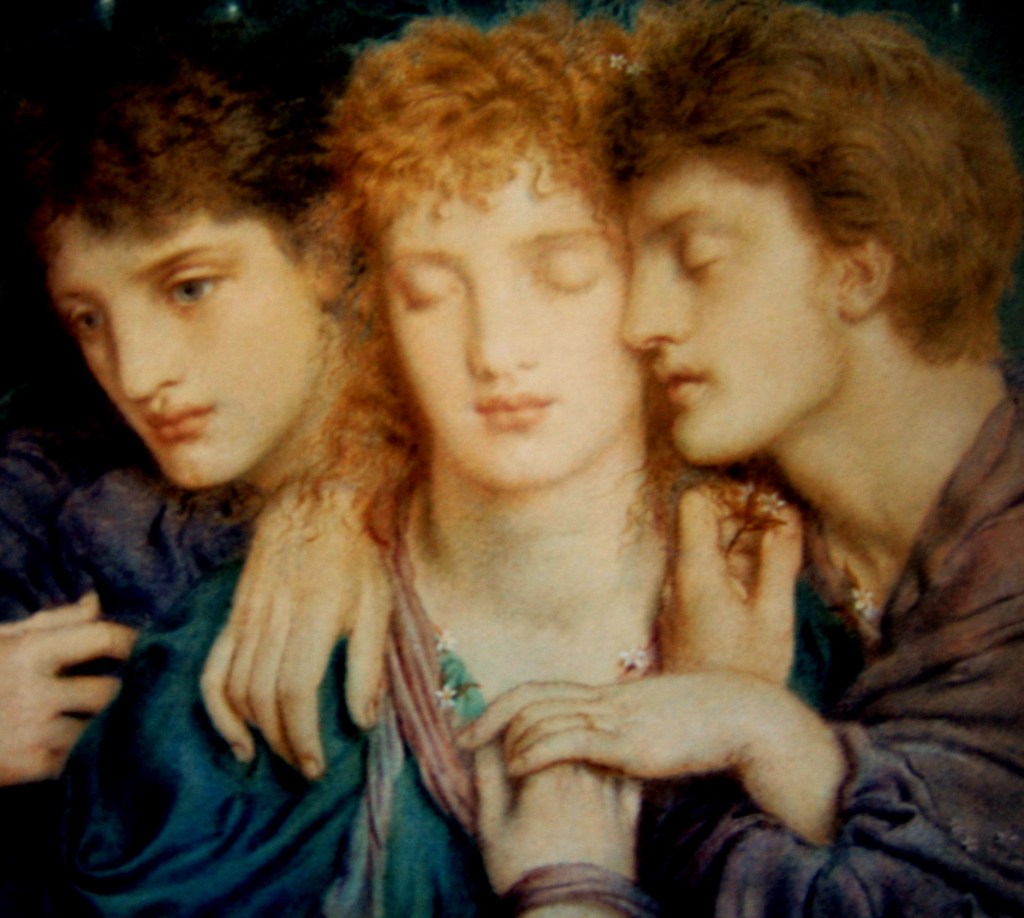
Simeon Solomon, The Sleepers and the One who Watcheth (1870; detail)

Often argued to be responsible for foisting a liberal education on the masses, Hollywood has, in fact, played an important role in keeping quiet about many aspects of our everyday lives. Beginning in the mid-1930s, and for several decades thereafter, the Production Code curtailed what could be shown or talked about in motion pictures.

It was on this day, 6 December, in 1933, that James Joyce’s Ulysses was ruled to be “not obscene,” lifting the ban on its sale in the US; but that, aside from its narrative structure, hardly made Ulysses ( 1922; previously serialised 1918-20) a hot property in Tinseltown. Writers who wanted a share of the profits to be made by selling stories or streamlining them for the silver screen had to deal with the strictures of the code and learn to rework their material accordingly.

One playwright who accepted this challenge was Lillian Hellman, whose 1934 stage success The Children’s Hour was brought to the ears of American radio listeners on this day in 1937.

The Children’s Hour tells the story of two women whose teaching careers and personal lives are wrecked when one of their pupils alleges that they are having an intimate relationship.  Like Hellman’s 1936 screen version of The Children’s Hour, titled These Three, George Wells’s radio adaptation for the Lux Radio Theatre drowns out the unspeakable by suggesting instead a triangulated relationship with a virile heterosexual male at its center.  Wedged between Stanwyck and Mary Astor that night was the presumably irresistible Errol Flynn.

Hollywood had long thrived on love triangles, although they were rarely as ambiguous as in the above painting by the aforementioned queer artist Simeon Solomon.  Indeed, the three-cornered plot is key to the first new genre of production-coded cinema—the screwball comedy, in which heterosexual marriage is challenged by old flames or new rivals until it is ultimately reaffirmed. Although—or perhaps because—These Three is more concerned with libel than with forbidden love, with allegations rather than physical acts, the revision eliminates the unmentionable to make room for a rumor that can be talked about.

As if determined to remove any doubts as to the straightness of the radio adaptation and all those associated with the production, Lux host Cecil B. DeMille opens the program by letting listeners in on a “secret,” a story that had “completely escaped the headlines.” The unheard-of item amounted to little more than the announcement of a recent marriage. According to DeMille’s anecdote, the unconventional Ms. Stanwyck had just attended the wedding of her stableboy, danced with the hired hands, and “made them all forget” that she was the “groom’s boss.” The Lux program presented itself as clean entertainment without wanting to appear stuffy.

What is more stuffy—and objectionable—than the codes governing radio and motion pictures is the subsequent silencing of the history of such hush-ups. A description of the Lux broadcast in a 1995 reference text, for instance, keeps mum about the pedigree of the adaptation by alluding vaguely to “[c]ertain aspects of the stage production’s plot” that “made a straight film version out of the question.” Phobic histories like these not only contribute to our ignorance of past inequalities. They keep us from moving beyond them.

All the Way to the Grave: Radio Laughs at Television

What do you think is the greater challenge to traditional blogging: vlogging or advertising? Like many folks who value their time and their eyesight, I try to look past commercials; if that is impossible, I will avoid the program or web journal in which they are embedded or pose as entertainment. At least, I still have a fighting chance to escape advertising on television by zapping or zipping through the image blitz that makes a rubble of storytelling by blasting holes into it so deep and for periods so prolonged that sometimes I find it hard to pick up the pieces and recall what happened just a few minutes earlier.

Advertising (and our savvy to get around it) may very well have “killed” television as many of us knew it. Yet what might have given it life (in America, at least) was the public’s resentment of the radio hucksterism that flourished at the end of World War II after years of relative restraint. It was on this day, 5 December, in 1948, that broadcast wit Henry Morgan appeared on the Fred Allen Show to tell its host that radio had “killed itself” with all those giveaway programs and “singing jingles.”

Radio was “all washed up,” Morgan declared. That’s why he was pursuing a career in television instead. To prepare for his move to the new and ostensibly superior medium, he had enrolled in a course at “television acting school.” All the “big stars of television” were in his class; among them “two trained seals,” a “dancing bear” and Ed Sullivan. Graduates would receive a PhD—a “Picture of Howdy Doody,” that is.

The less than flattering picture Morgan painted in quips was Allen’s personal and much publicized view of commercial radio. His own program would soon become a casualty of commerce, greed, and the promotional forces behind it. However dismayed at the developments in radio, which he described as a “by-product of advertising,” Allen did not have much faith in television, either, let alone a blind one. Together with Morgan, Allen sent up the media upstart that seemed to be copying what one of their contemporaries labeled radio’s “seven deadly sins.” Turning the threat of television advertising into a laughing matter, the two radio comedians seemed to be laughing at matter itself.

“The radio tells you all about a lot of things that nobody sees,” Morgan grumbled. Unlike millions of Americans lured into swapping their wireless consoles for a very small screen, Allen sensed this to be the non-visual medium’s greatest gift: “With the high cost of living and the many problems facing him in the modern world,” Allen later wrote in his memoir Treadmill to Oblivion, “all the poor man had left was his imagination. Television has taken that away from him.”

And yet, that very broadcast of Allen’s Ford motor company sponsored show pointed up how successful radio was at killing itself. Contrasting radio and television thrillers and commercials in their sketch, Allen and Morgan had the studio audience in stitches, no doubt by pulling out all sorts of props for their demonstration of television’s pull: you just had to see it in order to be relieved from the burden of having to believe.