All the Way to the Grave: Radio Laughs at Television

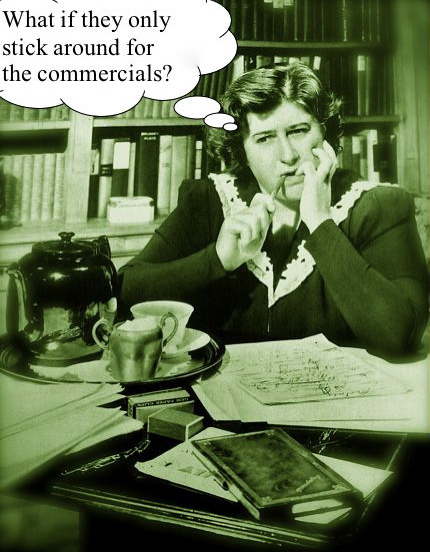
What do you think is the greater challenge to traditional blogging: vlogging or advertising? Like many folks who value their time and their eyesight, I try to look past commercials; if that is impossible, I will avoid the program or web journal in which they are embedded or pose as entertainment. At least, I still have a fighting chance to escape advertising on television by zapping or zipping through the image blitz that makes a rubble of storytelling by blasting holes into it so deep and for periods so prolonged that sometimes I find it hard to pick up the pieces and recall what happened just a few minutes earlier.

Advertising (and our savvy to get around it) may very well have “killed” television as many of us knew it. Yet what might have given it life (in America, at least) was the public’s resentment of the radio hucksterism that flourished at the end of World War II after years of relative restraint. It was on this day, 5 December, in 1948, that broadcast wit Henry Morgan appeared on the Fred Allen Show to tell its host that radio had “killed itself” with all those giveaway programs and “singing jingles.”

Radio was “all washed up,” Morgan declared. That’s why he was pursuing a career in television instead. To prepare for his move to the new and ostensibly superior medium, he had enrolled in a course at “television acting school.” All the “big stars of television” were in his class; among them “two trained seals,” a “dancing bear” and Ed Sullivan. Graduates would receive a PhD—a “Picture of Howdy Doody,” that is.

The less than flattering picture Morgan painted in quips was Allen’s personal and much publicized view of commercial radio. His own program would soon become a casualty of commerce, greed, and the promotional forces behind it. However dismayed at the developments in radio, which he described as a “by-product of advertising,” Allen did not have much faith in television, either, let alone a blind one. Together with Morgan, Allen sent up the media upstart that seemed to be copying what one of their contemporaries labeled radio’s “seven deadly sins.” Turning the threat of television advertising into a laughing matter, the two radio comedians seemed to be laughing at matter itself.

“The radio tells you all about a lot of things that nobody sees,” Morgan grumbled. Unlike millions of Americans lured into swapping their wireless consoles for a very small screen, Allen sensed this to be the non-visual medium’s greatest gift: “With the high cost of living and the many problems facing him in the modern world,” Allen later wrote in his memoir Treadmill to Oblivion, “all the poor man had left was his imagination. Television has taken that away from him.”

And yet, that very broadcast of Allen’s Ford motor company sponsored show pointed up how successful radio was at killing itself. Contrasting radio and television thrillers and commercials in their sketch, Allen and Morgan had the studio audience in stitches, no doubt by pulling out all sorts of props for their demonstration of television’s pull: you just had to see it in order to be relieved from the burden of having to believe.

Shaking the Spear: How an All-Male Cast Can Tame a “Shrew”

It’s been a while since last I saw The Taming of the Shrew performed onstage—and I didn’t even get to see the feat accomplished. Halfway through, a curtain of rain descended on the players (Tracey Ullman and Morgan Freeman among them), putting a premature end to one of those open-air affairs at New York’s Delacorte Theater. Maybe Kate was lucky that night, for Petruchio sure rains on what might have been her parade. The ending is a challenge for today’s producers and can be an ordeal for the audience, especially those who regard the theater as a political correctional facility of post-modern society. It’s an ending that can make or break both Kate and the play she’s stuck in; for, depending on how The Taming is framed, the bride may well be. So, when I finally got to see Kate reach the end of the matrimonial tether last Friday, in a production by the touring Propeller company, I felt that something had gone terribly wrong.

Propeller stages Shakespearean dramas with an all-male cast, an approach at once traditional and revisionist, considering that female roles used to be performed by male actors and that we, more than four hundred years on, are not at all conditioned to see such casting as conventional, no matter how open-minded we might think ourselves.

Last year’s Propeller production of The Winter’s Tale was so sensitive and engrossing as to de-politicize gender, despite the fact that the guys in gowns sport prominent chest hair and bald spots. It was a revelation to see those tokens of testosterone atomized in tender humanity. The man-handled Shrew, by comparison, is as subtle as the Birdcage—and that nut-strewn coop is no place for a chick-lit contender like Katherine. Strangely enough, cross-dressing had little to do with her mistreatment.

As adapted by Edward Hall and Roger Warren, The Taming refuses to put Petruchio in his place by taking advantage of the apparatus provided, a frame that, as in the 1937 radio version starring John Barrymore, is often removed, leaving the make-believe sparring of Kate and Petruchio unmediated. Petruchio is, after all, a character in a play staged for the purpose of making fun of Christopher Sly, an irresponsible, common drunkard. The frame, to be sure, can be set up as a ready excuse for the misogynist picture within. It is the shaming of Sly that can make the taming of Kate tolerable—and the Propeller players won’t have it that way.

Their version adds a prologue in which Sly is seen standing up his bride at the altar; but instead of getting his come-uppance by becoming the plaything for a nobleman disgusted by the looks of a vagrant lout he encounters, Sly himself is being cast in a raucous shrew-taming comedy and, instead of being a confused if fascinated onlooker, gets to don the mask of Petruchio, a stage costume that becomes an extension of Sly’s macho persona. He is not so much humiliated than humored. And while he has to be reminded in the end that what he performed was merely the illusion of a taming, he is still free to exit the stage as he entered it, free to take women or leave them hanging.

It is the revision of the opening scene that makes the ending so troubling. If Sly gets to play out a fantasy, one he so clearly relishes, without having to deal with the responsibilities of matrimony, the framed Taming is like an episode of the Jerry Springer show featuring the antics of a self-centered, insensitive, and hormonally overcharged jerk. Impersonated with swagger and brawn by Dugald Bruce Lockhart, Sly (in the role of Petruchio) gets considerably more sinister and less likable as the taming proceeds; but, without any chastising or moralizing, he still comes out on top, whereas Kate is reduced to a stoic Victorian heroine, suffering yet submissive.

Taming is a domestic comedy that turns on you in its bitterness; yet Simon Scardifield’s Kate is hardly in on what fun there is to begin with. Instead, she comes across like a desperately mousy housewife so little in need of taming—as all the flamboyant and badly behaved men around her are fiercer far than she—that we pity her before we had much of a chance to cheer her on. I appreciate a fresh take, if fresh it be; but, this time around, Propeller seems to have spun its gay blades out of control.

Riot Study: Hunting Catholics with Barnaby Rudge

Well, I would have been reading and writing today, had I not been caught up in upgrading my Blogger account and messing with my “classic” template while trying to take advantage of a few new features. With the exception of added labels, I ended up keeping things as they were, but I will probably tinker with the design over the weekend. Meanwhile, I just got back from the theater (an all-male production of Taming of the Shrew, which I am reviewing shortly). To remind all those of us blogging or shopping or hopping about town that it might be a “far, far better thing” to pick up one of his volumes, young Mr. Dickens has been installed here to usher in the festive season of fireside reading.

It is undoubtedly due to that sentimental ghost story A Christmas Carol and its countless re- or disincarnations that Dickens is so closely associated with December, the darkest month of the year, cheered, as if to reward or placate believers of some faiths, with tunes, tinsel, and treats. No Scrooge in the matter, I got tickets to a stage production of A Christmas Carol starring screen veteran Ron Moody, best known for his role in the musical Oliver! (a more recent production of which I discuss here). Young Twist and old Scrooge, those two have outlasted most of Dickens’s children, in the shadow of which vast nursery lies one Barnaby Rudge.

In the spirit of charity, I have picked up this ill favored Barnaby Rudge, serialized in 1841. Subtitled “A Tale of the Riots of ‘Eighty” it is a fictionalized account of the anti-Catholic uprisings in England, Protestant anxieties stirred by a member of Parliament opposed to the Catholic Relief Act. With the Pope’s visit to Turkey, a Muslim country whose faith he offended a few months earlier, and the multi-million sex abuse claim settlement by the Catholic diocese in Los Angeles making headlines these days, this old page-turner promises to be topical reading. No escapism here.

Say, what’s your literary treat for the “holidays”?

Many Happy Reruns: John Dickson Carr

Well, it has long been an ambition of mine to write a whodunit. Red herrings, fishy alibis, a murky pool of slippery suspects, and a case so deep it would have kept even the likes of Sherlock Holmes, Charlie Chan, and Hercule Poirot angling for clues, chapter after chapter, much to the delight of an equally confounded readership. Take my word for it, I have tried. Otherwise, I submit to you this piece of evidence, which I dug up from where it rightly belongs and promptly edited for the occasion:

“I am going to kill somebody, tonight,” was written on the invitations. Glossy, who had sent them, was dressed for the part, greeting the crowd that had come for the killing. She looked marvelous, her dress and body the result of careful design, a shrewd calculation in fabric and flesh [. . .]. 

It was my sister Veronica who had arranged the party. I had stayed out of it. After all, I am merely a party chronicler. Or so I thought.

“Why, it’s simply deranged,” I heard Glossy squealing, surrounded by a throng of professed admirers; it was a favored expression of hers, which she employed almost universally, except to describe her own behavior. She was sober enough to observe the crowd of friends and colleagues she had drawn toward her in an effort to gain control in a moment of crisis. Tonight, she wanted to be seen in order to see for herself. To see them all, at once. She scrutinized the scene as carefully as her condition allowed. I, for one, knew that her noisy enthusiasm was nothing but an act. Glossy had confessed as much to my sister: she feared that the days of her reign as the queen of daytime drama were numbered and suspected that someone had already planned a ruthless regicide. So, being the center of attention was not just vital for her ego, but for her alter ego as well. Glossy was on the lookout for the conspirators, and I guess the fact that she knew most of the guests provided hardly any comfort at all. . . .”

Perhaps you should have taken my word for it. It’s best to leave such murderous plots to the masters and mistresses of the craft. Experts like John Dickson Carr, for instance, who was born on this day, 30 November, in 1906. Throughout the 1940s, his plays were often heard on American and British radio, on series like Suspense, Cabin B-13 and Appointment with Fear, all of which were designed to showcase his writing. He also served as host and narrator of the mystery anthology Murder by Experts, for which services his latest novels were being duly promoted.

“Mr. Carr brings to his radio work the same superlative craftsmanship and high integrity that distinguish all his novels and short stories,” Messrs. Ellery Queen contended in their anthology Rogues’ Gallery (pictured above), prefacing Carr’s play “Mr. Markham, Antique Dealer,” which was produced by Suspense and broadcast on 11 May 1943.

Having discussed Carr’s work at length in my dissertation and on several occasions in this journal, I have come to the conclusion that the whodunit, especially when combined with the “how’sitdone”—the locked room puzzle in which Carr specialized—was best suited to the printed page, where it can unfold gradually and be appreciated at a pace determined by the reader, rather than the merciless clock of the broadcast studio.

Now, clocks feature prominently in “Mr. Markham.” One of these old-fashioned chronometers is set up to hold a clue, but their ticking is more effective in setting the scene, creating the atmosphere of the antique dealer’s establishment, and reminding the listener that time might be running out for at least one of the characters. In the one-dimensional, that is time-only medium of aural storytelling, suspense is far more effective than surprise. While not devoid of suspense, Carr’s plays attempt—and often fail to—startle the audience with a final twist that, rather than being dramatized, is tagged on in a cumbersome and less than thrilling epilogue.

Is Carr’s brand of whodunit a radiogenic genre? You may judge for yourself by listening to the British as well as the American version of “Mr. Markham.” It is hardly fitting to celebrate someone’s birthday by opening fire. Then again, there’s Glossy, lying in a pool of blood.

The History [of] Boys: Alan Bennett and the Gay Social Science

I often ask myself whether I am. History,  I mean.  Not that anyone is opening a museum dedicated to my life, a definitive space for finite time as it is now in the works for 1970s pop act Abba.  To be history, I suppose, means to be quite past it; insignificant, irrelevant, outside of what matters now, someone either to be forgotten or to get nostalgic about.  To be part of history, on the other hand of time, means not only to think of oneself in context but to be thought of as belonging to it, as fitting into its continuum. And to make history is to take part in its continual shaping, be it wilful or inadvertent, by bringing something (or someone) about.  So, am I a manifestation of history? Am I making it? Or am I beyond its bounds as determined by those who assume the authority of authoring it in word and image?

Such questions have been whirring through my mind after watching The History Boys, the film adaptation of the acclaimed stage play by Alan Bennett, the well-known British radio raconteur.  The History Boys documents the quest of a group of students who, in an effort to make something of themselves (or to please their folks), try to get into one of Britain’s most influential or prestigious institutions of higher learning by reading (that is, studying) history.

Bennett sets the action, such as it is, in 1983, which means that, by now, those ambitious, playful and bewildered youngsters would be middle-aged men, like myself (pictured), a spinning forth of their fictional lives the film encourages in its “whatever became of” epilogue.

One of them did not make it this far into the 21st century, having given his life for his country (or those governing it on his behalf) by serving in the military.  Most of his classmates, it seems, have gotten little out of their college education, other than the satisfaction of being able to brag about it.  Except for the one, most vulnerable, least sure of himself, who took his schooling to heart and decided to pass it on.  That one, according to the queer history of Mr. Bennett, is the outsider who, unlike his closeted professor, has a chance to be, make, and impart what he has learned about himself.

At first, I was irritated by the imposed pastness of the action, as much as I can relate to the period as one of adolescent confusion.  Why bother to recreate a certain historial age, to impose a make-believe historicity on the growing-up experiences portrayed, thereby diminishing or obscuring their relevance? How would their story play out if were set in the present day, rather than a past that looks, by virtue of being bygone, quaint to those who have not lived it and to those whose vision is warped by nostalgic longing?

Might not such an act of looking back serve a purpose other than to suggest a past beyond change? The history of those boys turned men, individuals who were not always in control of their paths (as accidents shaped them as much as their actions), is not so much over as it is crossing over into the present.

The History Boys strikes me as an old man’s gesture of bridging what is often thought of as a generation gap, a chasm into which recent lessons and those still present to teach them are tossed to be discarded.  It is an encouragement to learn not from books and experience alone, but from intercourse with those around us, those whose stories might not get into the books other than by being thought of while reading.

The body of our histories, like the history of our bodies, cannot be got at from a distance, scrutinized in clinical detachment by ostensibly objective onlookers; it has to be lived, felt and shared in order to matter.  Beyond the groping for bare facts in hopes of an elusive naked truth, beyond the stripping of traditions exposed as lies and the weaving of postmodern thought in a garish display of thinly veiled self-pleasuring, imparting an understanding of history is a mentoring in the half-forgotten sense of the word.

 “Pass the parcel.  That’s sometimes all you can do.  Take it, feel it and pass it on.  Not for me, not for you, but for someone, somewhere, one day.  Pass it on, boys [and girls].”

On This Day in 1930: ‘”Mystery Gun” Disappears As Lights Go Out’ in Invisible Courtroom

I don’t suppose I shall ever get used to it. The Welsh weather, I mean, the nocturnal roars and howlings of which I often drown out by listening to the familiar voices of old-time radio, reassuring and comforting voices like those of Harry Bartell or Elliot Lewis, both of whom were born on this day, 28 November, in 1913 and 1917, respectively. Storms are part of the Welsh soundscape, much like the bleating of sheep on the hills. If such climate conditions were faced by the people of New York, among whom I numbered for some fifteen years of my life, I wager that the local television newscasts would report little else. To be sure, last night’s storm did make headlines, being that a tornado wreaked havoc in a village just a few miles from my present home.

Thanks to some well-chosen radio thriller, I managed to sleep through it all, losing myself in dreams that, once radioactivated, tend to become particularly vivid. I often wonder just how much my mind, conscious or not, is influenced by the popular culture I consume by listening in. Sometimes, though, it is what we hear about, and not what we perceive, that stirs our imagination. There are a few listening experiences I can only dream of, plays I have only read or read about and consequently fascinate me no end. One such unheard soundplay is the serial The Trial of Vivienne Ware (previously mentioned here and discussed at some length in Etherized, my study of American radio dramatics). Pulled by the Hearst press and propagated on the air by station WJZ, New York, it was a spectacular publicity stunt designed to promote Hearst’s less than reputable papers.

Those tuning in did not only get to hear the proceedings, but were cast as jurors. They stood a chance of being awarded $1000 for coming up with the most convincing verdict (be it “guilty” or “innocent”), thus making it unnecessary for the author of the story—one Kenneth M. Ellis—to determine upon a reasonable conclusion and the fate of his titular character.

From the 25th to the last day of November, the fictional trial was broadcast live, with eminent figures of law and politics, New York Senator Robert F. Wagner and prominent attorney Ferdinand Pecora, heading a cast that included noted stage actress Rosamund Pinchot. Here is how the New York American, the Hearst paper sponsoring the series, described the session of 28 November 1930:

It was almost at the close of the session that the lights suddenly were extinguished and the court plunged into total darkness. Women’s screams, the shouts and bustle of court attaches, and the hammering of the gavel filled five or six black seconds with sound. Then the lights came on again—but the .38 caliber revolver which George Gordon Battle, chief counsel for Vivienne Ware, had just introduced as evidence had disappeared from the table where it lay.

Now, that’s a melodramatic conjuring act fit for the airwaves. It probably wouldn’t do much good during a stormy night, though, since such interactive thrills—let alone the pondering of the verdict, and what to do with the prize money—are, unlike much else that was presented on American radio with comforting predictability, anything but soporific.

Between You, Molly and Me: Should We Settle for Squirrels?

Well, it’s like looking for a park bench. Picking up a book, I mean. If I find one I like, I tend to stick around to enjoy the vistas it opens, willing to overlook its more or less obvious faults. Otherwise, I move on fairly quickly, knowing that there are seats out there that suit me better. Sometimes, however, I get stuck on something that I did not reckon with, something that remains long after I left, like a bit of chewing gum you sat on and struggle to remove. It makes you work, it irritates you as it forces you to deal with it, and you remember it (rather than the bench to which it was appended) for just this unexpected bit of friction and activity. Let me give you a “for instance.”

Last weekend, I picked up Molly and Me, an autobiography by actress-playwright-businesswoman Gertrude Berg. For several decades, Ms. Berg was best known as Molly (or Mollie) Goldberg, a character she created and kept pushing from medium to medium, from print to stage, from radio to television. Now, I haven’t gotten to the point in the book where Molly comes to life. I got stuck on her pre-history, which, in Berg’s 1961 memoir, begins with her grandfather, Mordecai, a tinsmith who opened a store on the Lower East Side of Manhattan (come to think of it, not all that far from the store where I bought the book last August).

The following piece of wisdom is that bit of gum I found myself struggling with. In an attempt to advertise his store, Mordecai carefully crafted a fine model of a steamship, five foot long and all made of tin. He placed it in the shop window in hopes of attracting customers. Sure, a few people stopped by and looked; but the time he spent on the display stood in no fair relation to the number of people he drew in. So, Mordecai decided on another way to dress his window: a cage with a wheel. In it, he placed a squirrel; and as it kept running in circles, people stopped by to look, far more than had been interested in the boat.

From that experience, Mordecai extracted a simple moral and applied it to all manner of situations, Berg explained:

Grandpa worked hard to make a boat that he was proud of. It was practically a masterpiece but what did people come to see? A squirrel running around in a cage! So what was the lesson? The lesson was, you can’t joint them, you can’t beat them, you can’t even understand them, so don’t bother. Hope for the best and maybe somebody’ll come in who’ll appreciate the boat. Meanwhile feed the squirrel, it’s not his fault.

Undoubtedly, this anecdote appealed to Ms. Goldberg, a popular wordsmith who found her niche by giving people—listeners and advertisers alike—what they wanted, even though what she came up with did not receive much respect as a craft, let alone as an art: the soap opera. Mordecai, you sure got me thinking. Keeping this journal, I wonder whether I should not tear apart the boat I put together and settle instead for a squirrel in a cage . . .

"The Party’s Over": Anita O’Day and Betty Comden

Well, by pronouncing the “Party” over I am not referring to Thanksgiving (which I only observed from afar this year), but to a popular song and two remarkable women closely associated with it: “The Party’s Over” from Bells Are Ringing, a musical revived on Broadway, if unsuccessfully, back in 2001, when I saw it with Faith Prince in the part made famous by Judy Holliday. Yesterday, lyricist Betty Comden, who wrote it, and singer Anita O’Day, who performed it, both passed away at the ages of 89 and 87, respectively. I spent some time this weekend researching their careers in search of a radio angle.

Being that Ms. O’Day was a popular singer in the 1940s, that angle was not hard to find. Here you may hear her sing the “Drum Boogie,” accompanied by Gene Krupa’s orchestra on the Command Performance program, broadcast 4 September 1942. “Brother, that is solid sending,” mistress of ceremony Tallulah Bankhead put it in the slang of the day.

The “fine little red-headed vocalist,” as Bob Hope introduced her, would return to the Command Performance microphone on 16 December 1944, this time singing “And Her Tears Flowed Like Wine.” Together with bandleader Stan Canton, O’Day is heard reading the names (and the fanciful monikers) of the servicemen who requested the number and to whom it was dedicated.

Just a few days after this broadcast, the musical On the Town opened on Broadway, capturing the mood of a war-weary nation by following three marines on shore leave, out for fun in the “wonderful town” of New York, New York (which is where I caught the show in 1997, at the Delacorte Theater in Central Park). On the Town was the first of many shows written by Betty Comden and her lifelong collaborator, Adolph Green, who started out with a comedy act in Greenwich Village, called “The Revuers.” As early as 1939, the team took their act to the airwaves. Fun With the Revuers, which featured Judy Holliday (then still performing under the name of Judy Tuvim), became a weekly series on NBC radio and ran until November 1940 (as I learned here).

Comden and Green understood how to maximize their exposure; not only did they perform in the plays they wrote, they also recycled their material for various media. One such piece was the operetta “The Baroness Bazooka,” which was shoehorned into the “Cliche Expert,” a radio comedy produced on 2 May 1944 by Columbia Presents Corwin (for a recording of which I am indebted to the keeper of BlogAdvance’s “Blog of the Month” for October 2006). Based on a character created by Frank Sullivan, “Cliche Expert” is a courtroom farce of sorts, with Comden and Green playing themselves, as “star witnesses” called in to testify to the titular character’s expertise on the subject of trite phrases. Being a burlesque, rather than cliche, “The Baroness” is rudely interrupted and stricken from the record.

This is not to say that Ms. Comden was not an expert in the matter; indeed, she wrote so many memorable lyrics that strike us as overly familiar today. “The Party’s Over” is riddled with cliches like “It’s time to call it a day,” “They’ve burst your pretty balloon” and “the piper must be paid.” Yet somehow such lines lose little of their pathos when delivered with conviction by an artist like Anita O’Day.

Now As Then: "Thanksgiving Day—1941"

Well, it took me some time to get it. Thanksgiving, I mean. Being German, I was unaccustomed to the holiday when I moved to the United States in the early 1990s. I didn’t quite understand what Steve Martin’s character in Trains, Planes & Automobiles was so desperately rushing home to . . . until I had lived long enough on American soil to sense the significance of this day. Now that I am living in Britain and, unlike last year, not flying back to America to observe it, I wish I could import the tradition.
I don’t mean to ship over all the trimmings and fixings, the pies and the parade. Just the concept of an annual get-together that encourages one to reflect upon what matters in life—provided that those who matter as “family” are understood to be any gathering of people (and, Montague insists, pets) whose presence spells home.

To the horror of some, an Americanized Halloween has caught on big time here during the last few years. Why not a grown-up holiday like Thanksgiving, regardless of the direction in which the Pilgrims were heading? With an eye to the future, I am not even being ahistorical.

A feast in defiance of the old saw that you can’t go home again, Thanksgiving is often thought of as an occasion to wax nostalgic. Sure, it is a time to look back; but that does not mean it should exhaust itself in sentimentality. It can be an incentive to pull through, an event for which people pull themselves and one other together in the face of adversities.

Belittled as a ritualistic tripping on tryptophan, bemoaned as an annual family headcount that starts with the headache of getting there and ends in a bellyache getting back, Thanksgiving still compels millions to travel hundreds of miles and, unlike Christmas, has remained remarkably free from commercialism. It mobilizes more folks than a national election. It is a day of the people, not of corporation (unless you are running an airline). And despite its culinary excesses, it is simple, solid, and reassuringly primal in its cheering of the harvest and the life we owe the land and its natural riches.

A celebration “wholly of our earth,” is how the aforementioned American poet Stephen Vincent Benét expressed the meaning of the day in a speech delivered by actor Brian Donlevy and broadcast on 19 November 1941, just a few weeks before the US entered the Second World War. “This year it is and must be a sober feast,” Benét reminded the listener. Even if the attack on Pearl Harbor was a surprise, the bombs over London were clear enough signs of the perils ahead:

Today, one hundred and thirty million Americans keep the day they first set apart.  We all know what Thanksgiving is—it’s turkey day and pumpkin pie day—the day of the meeting of friends and the gathering of families.  It does not belong to any one creed or stock among us, it does not honor any one great man.  It is the whole family’s day when we can all get together, think over the past months a little, feel a sense of harvest, a kinship with our land. It is one of the most secure and friendly of all our feasts.  And yet it was first founded in insecurity, by men who stood up to danger.  And that spirit is still alive.

“The democracy we cherish,” Benét concluded,

is the work of many years and many men.  But as those first men and women first gave thanks, in a dark hour, for the corn that meant life to them, so let us give thanks today—not for the little things of the easy years but for the land we cherish, the way of life we honor, and the freedom we shall maintain.

If it is set aside to cherish land, life, and liberty, Thanksgiving cannot mean a retreat into the home, a shutting of doors and a closing of one’s eyes to the responsibilities that lie beyond the closest circle of relatives and friends: the duties of citizenship and the challenges of living in a global community. Some of the liberties fought for, the life and the land enjoyed in the past are now being threatened; not by foreigners alone, but by those of us who rely on or deal in outmoded constructs, who promote the concept of nation while defying the communal for their own profit.

“There are many days in the year that we celebrate,” Benét remarked, “but this one is wholly of our earth.” Although he might have meant his native ground—his speech being a pep talk to potential soldiers and a rallying cry for the home that soon would turn front—it won’t hurt to misread him, to consider “our earth” to be that truly common ground we share and to reflect on the global crises that may lie ahead and that, if at all, can only be met jointly. I hope we are “still alive” to this “spirit” and am thankful to those who keep on conjuring it.

George Gershwin, "Composer of the Week"

Well, I gave up on it years ago. I lost touch, or the desire to catch up with it. With Pop music, I mean. You know, whatever it is that is being presented to you as the latest and therefore presumably the hottest. The “hottest” is rarely what anyone tells you it is; it is something you’ve got to discover for yourself, no matter how odd, old, or remote it may be from current, industry-generated trends. Trends are for those too inert to develop an individual taste, those who listen, wear, read or see whatever sly marketers have styled “stylish.” There’s a lot of this trendsetting by proxy going on in the blogosphere, which has at last turned into an extension of the advertising racket.

I do not feel sorry for web journalists who go in for and are let down by schemes that promise them a few bucks, at the mere mention of which they forsake their integrity and turn hawkers. No, I do not pity them—I despise them for subjecting me to what can only be described as more or less inept infomercials. For once, amateurs and professionals alike, writers and artists with a creative impulse quickened by exhibitionism are given a chance to publish and display whatever they please, whenever they choose, without any interference from patrons or sponsors. Never before has such an opportunity presented itself to so many. Why squander it all to become a mouthpiece for someone else, rather than your own product, idea, or person?

However incompetent in the arts of self-promotion, I am not averse to conjuring the entrepreneurial spirit; nor am I condemning advertising outright. If that were the case, I could hardly endure, let alone enjoy, American radio drama, the first entertainment designed to sell something above and beside itself. It just ain’t for me, this kind of double-dealing. Instead, I relish in the freedom of sharing whatever crosses my path or tickles my still sensitive fancy. And (commercial free) BBC Radio 3 is certainly doing some tickling these days: its “Composer of the Week” is George Gershwin, a song plugger (some kind of human demo tape) who Tin Pan Alley-ooped himself to the top of the perennial pops.

A tuneful if cursory biography of the composer and the many people who shaped his career (Astaire, Max Dreyfuss, Paul Whiteman and Walter Damrosch, impersonated by accomplished if unidentified radio actors, including Kenny Delmar, Frank Readick, Tom Collins, and Agnes Moorehead) was presented on the Cavalcade of America program on 27 February 1939, a year and half after after Gershwin’s death.

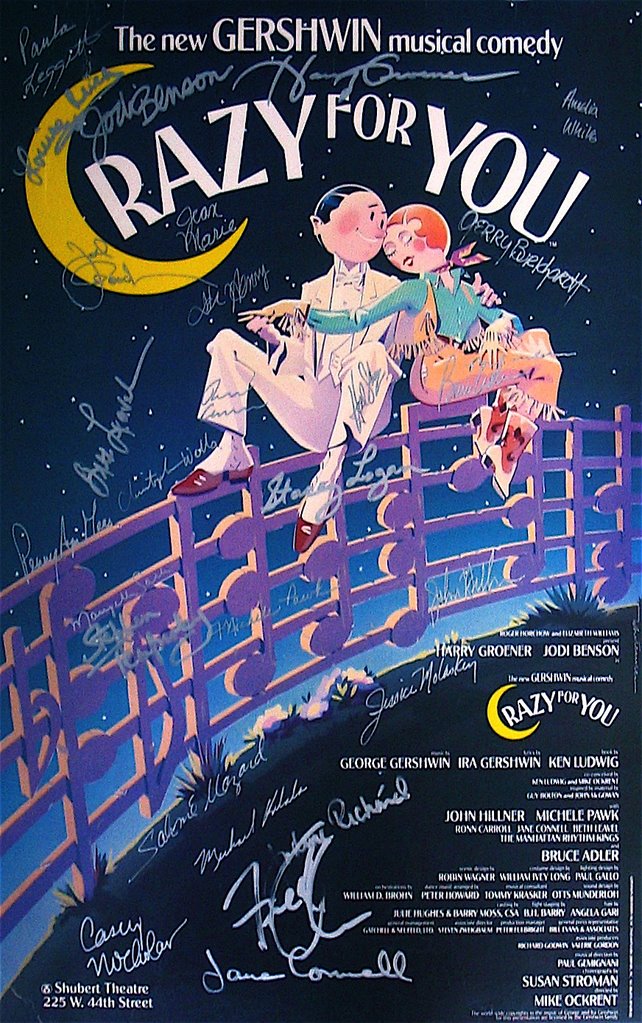
I developed a taste for Gershwin’s music some five decades later when a close friend of mine, himself formerly in show business, invited me to see the cheerful pastiche Crazy for You on Broadway (the above poster, signed by the entire cast, being a memento of that memorable event). Now, I have seen plenty of musical theater since then, anything from Show Boat and Gypsy to Sweeney Todd and The Drowsy Chaperone; but no show has left me humming quite as many long familiar yet ever thrilling tunes as Crazy for You, cleverly billed as a “New Gerswhin Musical Comedy.” Now, I don’t know how I might have felt about it had I seen Pia Zadora and Brady Bunch alumna Ann B. Davis in it (the latter getting far more requests for autographs than the former); let’s just say I was lucky to have experienced it being performed by the original cast.

The five broadcasts of BBC Radio 3’s Composer of the Week series are a serviceable introduction to Gershwin’s works, featuring the voices of Fred and Adele Astaire (“Fascinating Rhythm,” “So Am I”), Al Jolson (the inevitable “Swanee”), Ukulele Ike (“Lady, Be Good!”), Ella Fitzgerald (“The Man I Love”), Audrey Hepburn (“How Long Has This Been Going On”), excerpts from Of Thee I Sing, Strike Up the Band, Porgy and Bess—and plenty of Gershwin at the piano.