On-the-Air Travel: Meeting A Man Named Jordan at the Café Tambourine

Well, I am off to Istanbul tomorrow; and instead of studying my travel guide or practicing my language skills for the inevitable bartering, I am once again delving into popular culture for some dubious impressions of my destination. Earlier this year, I picked up Daphne Du Maurier’s Jamaica Inn to learn about Cornwall. I shall probably comment on that reading experience later this fall, considering that I recently found a contemporary article on the release of the film version starring Maureen O’Hara. Last summer, I watched Charlie Chan in Eran Trece to prepare for my trip to Madrid. Once again, I learned little and ended up eating tapas for a week.

Tuning in for some make-believe Turkish delights as offered to American radio listeners in the 1940s and early 1950s, I had my share of unreliable travel companions. I would have enjoyed going astray with Marlene Dietrich in her radio adventures at the Café Istanbul. Yet unlike its follow-up, the globetrotting romance Time for Love, the Café is no longer open for inspection; nor was it located in the city from which it took its name. A Man Called X (played by wooden-legged Herbert Marshall) ventured to Istanbul on at least one occasion and there is an episode of The Chase called “Flight to Istanbul.” The most obvious choice for some Istanbul escapes, however, is A Man Named Jordan, the serialized precursor of the episodic Rocky Jordan adventures.

Starring Jack Moyles and airing from January 1945 to April 1947, A Man Named Jordan took listeners to the Café Tambourine, which was initially located in Istanbul before being relocated to Cairo. That alone should suffice in answering any questions about the authenticity of such adventures set in a world gradually becoming open once more to tourists, rather than the military. That it was still an uncertain world seems to have been exploited by the spy thrillers of the day, cloak and dagger adventures that not so much romanced the world as relied on and fostered the audience’s suspicion of foreign places.

“In those places in the world where intrigue and danger still go hand in hand, where death and disaster are the rewards of weakness—in such places will be found, A Man Named Jordan,” the announcer-narrator introduced each installment. The location was as easily set as it was later changed. In those early days, Jordan’s establishment, the Café Tambourine, was to be found in “a narrow street of Istanbul’s Grand Bazaar not far from the Mosque Valide Sultan.” The Bazaar, more Byzantine than the plot of the serial, was established some five hundred years before Jordan opened his fictional Café there, a hazardous locale “clouded with the smoke of oriental tobaccos, crowded with humanity, alive with the battle of many languages.”

No doubt, I am going to have my share of linguistic challenges and will fail as miserably as on my trip to Morocco many years ago to negotiate the streets or haggle with the peddlers with dignity and success. Once back at the hotel Tash Konak, I shall pick up my iPod to compare notes with Rocky and that Man Called X before filing my report at the end of next week.

Terror of Judgment: "The Path to 9/11"

Firefighter memorial, Upper East Side, NYC

I decided to see for myself. So, I watched the first part of The Path to 9/11, which aired last night on BBC2. I am not sure whether or in how far this version differs from the one that aired, a few hours later, on ABC in the US; and aside from the word “Pathetic” hissed by John O’Neill (Harvel Keitel) in response to anti-terror efforts of the Clinton administration, I found little that smacked of partisan fingerpointing. This fictional documentary strikes me as far more significant, thought-provoking and accomplished than Oliver Stone’s World Trade Center, the subdued disaster movie I saw on its opening night in New York City and wrote about in the first of a series of Gotham impressions that is herewith coming to an end.

As I remarked previously, Oliver Stone’s film was exasperatingly a-political, reducing a world-historical event to an intimate portrait of personal suffering. It had more pathos than Path, which, in its first instalment, went astray only once, namely with the emotional outburst of the pseudonymous (and hence factually suspicious) CIA analyst “Patricia.” Otherwise, I commend the forgers of Path, whether they forged history or not, for driving home that the collapse of the Twin Towers was not a senseless tragedy but a hostile response to the west that had been long in the planning.

AOL Tower, NYC

To be sure, what a visual dramatizations like The Path to 9/11 cannot but fall short of showing is the ideological/theological conflict underlying the series of attacks in which we now find ourselves. A clash of ideologies is portrayed as a clashing of minds, and masterminds are made flesh so that they can be tracked, trapped, and presumably rendered innocuous. Fanaticism is far more hazardous than “The Most Dangerous Game.” However comforting the thought, however rewarding the execution, the terror it begets won’t end in the capture of a few ruthless misleaders, just as fascism—to which we still surrender many of our democratic ideals today—did not perish with Hitler in his bunker.

I am not about to reduce this anniversary of the attacks known as 9/11 to another opportunity to advocate sound (or radio) plays as the drama of ideas, even though we might do well to pay more attention to words the articulation of powerful ideas than absorb images of their physical manifestations. New York City is in need of visual reminders of its past. Too often, gleaming surfaces (like the façade of the post-9/11 AOL Tower, shown right) smooth over the scars that document the city’s path and its pathology.

"Panic" Shopping at the Argosy

Sure I love books; but even more than reading, I enjoy hunting them down. It must be an instinct stronger than intellect that makes me want to sniff out volume after volume, many of which remain unread. Last Friday, for instance, en route to Birmingham International Airport to pick up two old friends from Germany who came to visit me for the first time here in Wales, we spent some two hours at Sunnycroft, a late-Victorian suburban villa once owned by a well-to-do, upper middle-class family.

As is often the case on such National Trust properties, there was a second-hand bookstore on the premises, however small and dingy. The piles of paperback romances did not bode well; and still I could not resist and stepped inside what, if I read the map right, was formerly the Sunnycroft boiler room. For something amounting to less than a dollar, to be left in a basket standing in for a salesperson, I snatched up a bound volume of The Snow Image, a British edition of some of Nathaniel Hawthorne’s Twice-told Tales, probably as old as Sunnycroft itself. Here it lies, next to me, waiting for some wintry evening by the fire or such time I deem fit for its perusal.

Nineteenth-century treasures like this one aside, I am thoroughly modern in my choice of books, my library consisting chiefly of texts on that mid-20th century phenomenon known as radio drama. And while I do much of my shopping online nowadays, I still prefer walking around town—be it New York City or Hay-on-Wye—in search of well-worn volumes on my favorite subject.

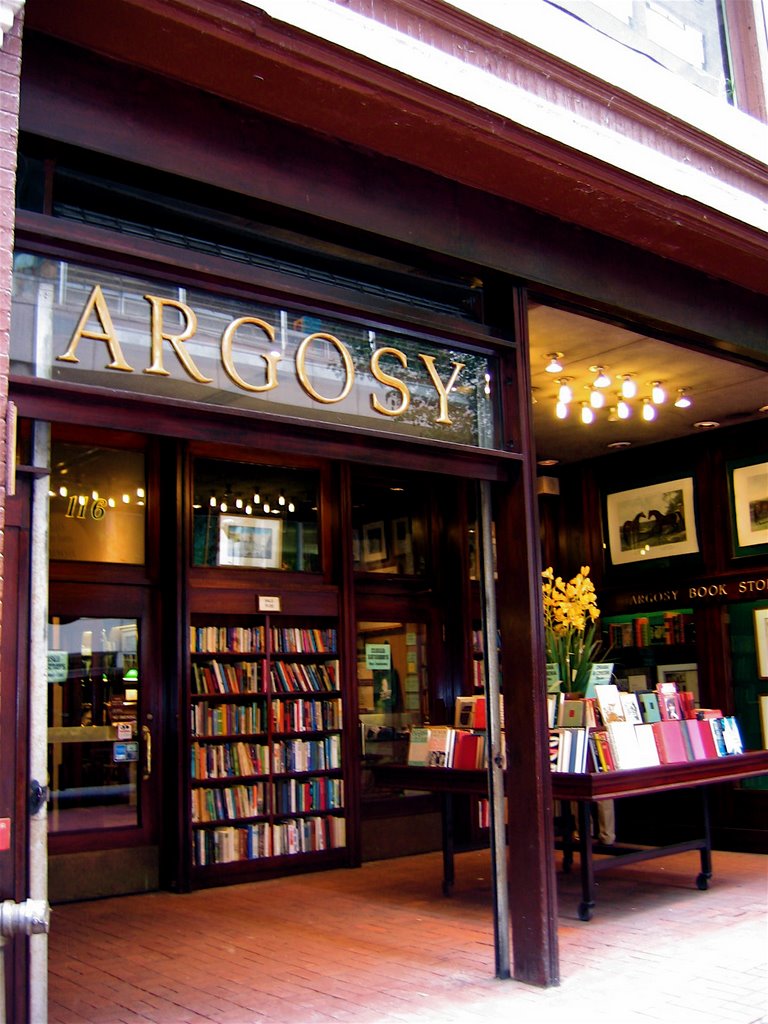
On the Upper East Side in Manhattan, just around the corner from Bloomingdales, one such supplier of old books on film, theater, and radio is the aptly named Argosy. As I mentioned in the comments section of a previous journal entry, the store is run by the wife of Stuart Hample, whose all the sincerity in Hollywood is a fine introduction to the wit of radio comedian Fred Allen.

On my tour of the Manhattan’s fast disappearing used and antiquarian bookstores a few weeks ago, I was pleased to discover that the Argosy had one of its themed sales, the theme being drama and television. Among the $3 items displayed in front of the store, I found a 1944 copy of Behind the Microphone by one John J. Floherty, a prolific writer of supposed non-fictions like Inside the FBI, Your Daily Paper, and Board the Airline. I expected neither insights nor entertainment; this, I thought, was merely one for the collection. As it turns out, Mr. Floherty was quite the storyteller. Listen to this Daphne du Maurier rivalling introduction to the miracle of Marconi, whose Poldhu station I failed to visit during my Cornwall trip earlier this year:

The State Troopers’ lodge at Montauk Point on the easternmost tip of Long Island stands on one of the loneliest spots along this seaboard. Rolling sand dunes and high bluffs, at which the Atlantic has gnawed for centuries, stretch drearily westward to Montauk village nine miles away. 

It was here that Captain Flynn of the New York State Troopers had me enthralled one stormy Sabbath night with tales of the early days in the lumber towns on the Canadian border, when troopers and lumberjacks fought it out with the accepted weapons of the period and place—bare knuckles. 

Outside the night was storm mad. A sixty-five mile gale machine-gunned rain pellets with battering force against the windowpanes. The pounding surf on the beach a few steps from the door vied with the thunder that came in frequent peals. The crackling fire of driftwood gave the room a coziness for which I was thankful on such a night. 

The captain was in the middle of a story when the door was flung open violently and a woman, tall and blonde, hurled herself into the room in an onslaught of rain and wind. At that hour, on such a night and in such a place, it was as if she had been flung from another planet. She was drenched and dishevelled. Terror was in her eyes. She tried to speak, but gasped instead. She was followed presently by a bedraggled wisp of a man and a thoroughly frightened boy. 

“What’s all the excitement?” the captain said, as calmly as if he had been asking the time. The intruders stared at him for a moment with popping eyes. The woman spoke. “Haven’t you heard, Captain!? Haven’t you heard!!? Thousands of people are being killed in New York and New Jersey. Twenty of your troopers have been murdered. People are jumping into the Hudson River and drowning like rats. It’s a gas or something? Our children are in Brooklyn—do you think they are safe? Do you think the soldiers, or whatever they are, will attack over there?”

I have never read a more melodramatic—yet supposedly authentic—account of the “War of the Worlds” panic. I am glad the industrious Mr. Floherty had enough zest to spin such a yarn, which surely deserves a mention in Etherized, my study on old-time radio. And I am glad I returned to the Argosy, which, after some eighty years, is still afloat in a sea of corporate sameness.

Manhattan Transcript: Why The Drowsy Chaperone Might Have Done Well on the Air

Well, there I was this afternoon, walking Montague, our terrier, and picking sloes along the lane near our house halfway up in the Welsh hills. I was walking him in order to get to the sloes, truth be told. Unlike Montague, though, the sloes won’t be seen again until Christmas, as I learned, much to my dismay, after having spent half an hour pricking them. I had heard of a Sloe Gin some time ago; but I always assumed it to be spelled “slow” and work as fast as the regular kind. Now I know that my ear hadn’t led me altogether astray, considering that it will take so long to appreciate this potent concoction. At any rate, a predilection for booze is something I share with that celebrated Broadway dame known as The Drowsy Chaperone, who may currently be seen failing her charge in the Tony Award-winning “Musical Within a Comedy” of the same name, a show that reminded me of my love not only for stiff drinks but old-fashioned radio drama.
I might not have learned about The Drowsy Chaperone had it not been for some of my New York City pals, some of whom work in the theater. Now, Broadway isn’t exactly “My Beat.” As much as I enjoy “How Do You Solve a Problem Like Maria?” (a West End Sound of Music audition-turned-TV reality show starring Andrew Lloyd Webber presently unfolding on BBC television), I am rather selective in my choice of musical treats. I would not be caught dead watching Cats, to be sure, and have refused to attend a performance of Phantom even when a close friend of mine was one of its featured actors on Broadway.

A few years ago, I enjoyed Drowsy Chaperone‘s leading lady Sutton Foster in a revival of Thoroughly Modern Millie, and her presence, as long as it does not remind me of Leslie Caron (as indeed it sometimes does), suffices to make me shell out some $75, the highest price I have yet paid for a TKTS ticket, to see a show that is an amusing trifle rather than a certified classic.

Now, on that particular night (the date of which you may glean from the ticket displayed above), Ms. Foster was rather subdued and lackluster. Too bad, considering that her “Show Off” routine is the smartest number in the whole production, which opens with Mary Tyler Moore alumna Gloria Engel going on about her “Fancy Dress,” a tune that is insipid rather than comically inspired. Worse still, the eponymous character (the Drowsy one) was played by an understudy, as that dreaded white slip in my Playbill informed me. Understudy, in this case, meant second best. Luckily, the same was not true for the whole production.

There is a self-reflexivity about The Drowsy Chaperone that is so subtle and commercially slick as to render this musical comedy charming rather than clever. In fact, the play struck me as decidedly dumb—in a manner that ingratiates instead of irritates. The smartest thing about it all is the opening of the play and its concept. After all, The Drowsy Chaperone begins in utter darkness, with the voice of a middle-aged Broadway aficionado (who, traditionally, does not speak in a booming baritone) telling you about the costly experience of going to the theater these days before sharing a record (vinyl, no less) from his collection of show tunes.

One of those forgotten gems is The Drowsy Chaperone, the forgotten (and entirely fictional) 1929 musical our host (the “Man in a Chair”) has never seen but imagined often enough sitting in front of his outmoded home entertainment system and listening to an old and not altogether groove-proof record in his rundown New York City apartment. As he tells the audience about the show, the impressions made by the recording come to life and The Drowsy Chaperone materializes before us as it presumably might come alive in our MC’s mind. Of course, for seventy-five bucks or more, we demand to see our theater. Most of us go to a Broadway show for sheer dazzle, not dialectics. We rely on Off-off Broadway for the subversive and provocative—and the clear demarcation makes it easy for most to avoid such intellectual challenges.

And yet, nothing I saw onstage quite matched the excitement or warranted the enthusiasm of that middle-aged man (wonderfully portrayed by Bob Martin), an unassuming cardigan-clad homebody whose visions, no doubt, were more potent than anything devised by the set designers of this show. I wonder how theatregoers might have reacted had the scene been cast in darkness for the entire eighty-odd minutes (a short enough time for a Broadway play). They might have concurred with the guy.

Aside from “Show Off,” “Accident Waiting to Happen” and the surprising “Message from a Nightingale,” The Drowsy Chaperone wasn’t all that much to look at. Then again, who would pay this much for a single radio play? The eyes had it, as usual—but they did not quite have their fill . . .

Where Silent Partners Join for Noisy Crime

White trousers may be out of fashion; but there are still a lot of ways to tell that summer is officially over. And I am not even talking about the mist rolling in from the Irish Sea this afternoon. After all, I am reporting from New York City, even though my reports are filed a few weeks late and some three thousand three hundred miles away.

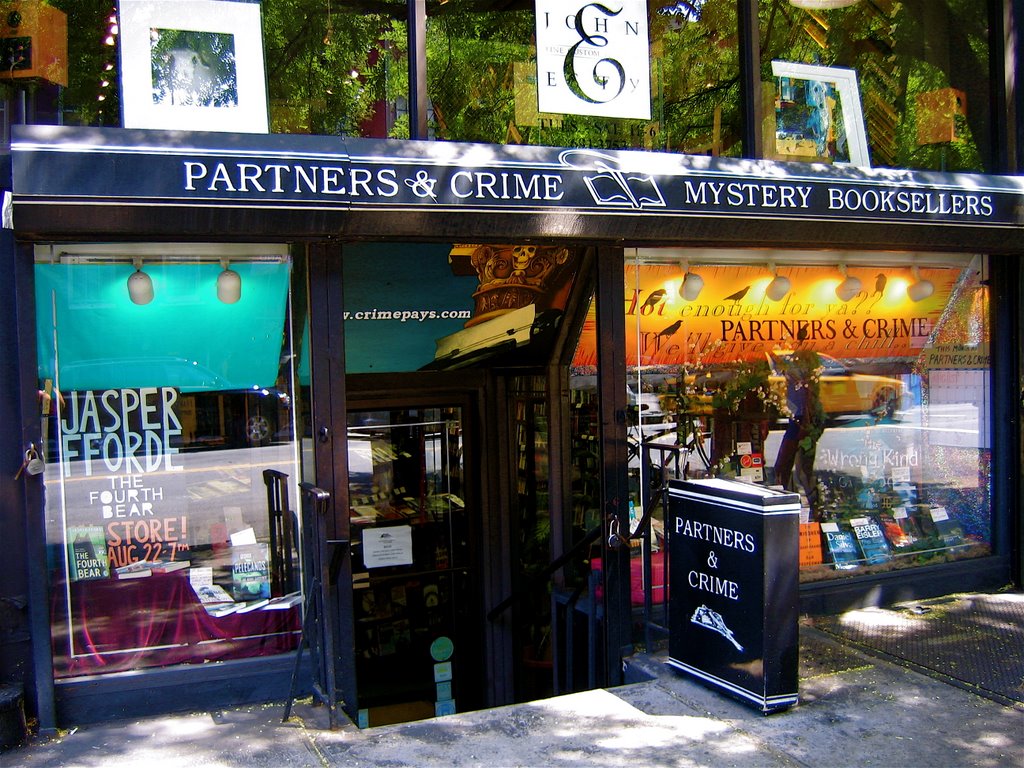
In the United States, the summer season traditionally ends on the first weekend in September, a time when millions of college students abandon beaches for bookstores and a certain band of players reclaims its space behind the shelves. Unlike those students I used to teach during my ten years of adjunct lecturing in the metropolis, the W-WOW! troupe only frequents one exclusive—if academically less than sound—venue: the Partners & Crime bookstore in the West Village.

Ever since the mid-1990s, when the city that presumably never sleeps still bore a slight resemblance to the bawdy and raucous town it had been before naps (and a lot else) became mandatory or derigueur, the W-WOW! players have been gathering on the first Saturday of each month (summer excepting) to re-enact the cases of Sherlock Holmes, Harry Lime, Philip Marlowe, and The Shadow as they were heard on US radio during the 1940s and early 1950s. You know, those days when the city had so much character to spare that a shadier one of it could be knocked off and tossed into the East River without causing more than a RIP-ple. Those days when the city was divided into distinct and clashing neighborhoods rather than being homogenized for the purpose of corporate milking. Those pre-television days during which keeping ones eyes shut to the world to share an imagined one was a national pastime rather than a geo-political hazard.

Anyway. Partners & Crime is a terrific store, one of the few sites that somehow managed to withstand the pressures imposed by chains like Borders or Barnes and Noble. One day, when the millennium was still very young and terrorism something that, from an American perspective, happened mainly to people in Europe and the distant Middle East, I discovered that Partners & Crime had become somewhat of an old-time radio institution—without ever going on the air. In short, it was an intriguing anachronism in a town about to trade in its past for clean facades and the promise of crime-free streets. I’d rather look at the scar above my left eye, dating back to a nightly stroll anno 1989, than walk what now goes for 42nd Street. But, back to fictitious felonies . . .

I was probably browsing for an old copy of Seven Keys to Baldpate or some such chestnut brought to light in my dissertation, when, much to my astonishment and joy, I spotted a microphone at the back of the store. As it turned out, there was an entire studio in the tiny, windowless backroom, a space modelled after station WXYZ in Detroit, as the playbill informed me.

I don’t suppose the goings-on behind the shelves do much for the sales at Partners & Crime. I, for one, immediately forgot all about the volumes around me and inquired about the microphone and its purpose. I was thrilled to learn that it was not set up for a reading of a contemporary crime novel, but for some old-fashioned radio mystery, to be performed for the benefit of a small group of theater-of-the-mind goers who eagerly squeezed into this nook beyond the books. I joined them, of course.

The W-WOW! players recreate old-time radio thrillers—commercials ‘n all—by placing their audience inside the make-believe Studio B of the equally imaginary W-WOW Broadcast Building. It may not further or elevate the art of radio drama and be done largely for camp (a way of misreading I can do without); but watching the performers as audiences once watched live broadcasts over at Radio City is nonetheless an enjoyable experience, particularly if you happen to eye the sound effects artist eager to elicit a few laughs while playing to the onlookers.

It is unfortunate that the W-WOW! troupe, unlike the Gotham Radio Players, do not go on the air to put their skills to the ultimate test of prominent invisibility. Theatrical training insures that some of the voices are fit for radio; and the actors are passionate even when the scripts are ho-hum. One among them, a certain Darin Dunston, not only appeared in a production of Under Milk Wood, but was the lead in Radioman, an award-winning student film about drama.

For a mere five bucks (less than one tenth of the cost of a half-price theater ticket), you may still take in a double feature of thrillers, transcribed from original recordings. Never mind that most of those in attendance at Partners & Crime seem more interested in the corny sales talk than in the plot of the mysteries or in the history of radio dramatics. I, for one, often listen to audio plays to get lost in sound instead of bothering to find much sense in them; and the noise made in the back of that West Village bookstore is quite in keeping with the shots, thuds, and wisecracks heard on US radio during the 1940s.

Larks, Turkey(s), and the Not-so-friendly Skies

Well, Jell-O again! To me, these past four weeks offline seemed like a summer hiatus, except that they were unscheduled and open-ended. Still sustaining and not in pursuit of a commercial sponsor, I am less certain than ever of an audience (save those lost souls who happen upon these pages in hopes of finding some dirt on—or salacious images of—Lois DeFee, a lesser-known burlesque queen I once mentioned in passing). I wonder who took my place during the interim and whether I will succeed in reclaiming my none-too-prominent slot. Just what has kept me so long (I hope that someone set apart from the apathetic might ask)? Here is the long and very nearly short of it.

After some two-and-a-half weeks of playing broadbandit in New York City, piggybacking rather than coffee-shopping for internet access to so little avail as to manage to file only a single report while on location, I returned to Wales to find our wireless network collapsed, the router having given up the proverbial ghost during a summer storm. And now, just as things are sliding back into their groove, I am taking off again for a weeklong trip to Istanbul. Not that air travel, let alone to Turkey, is a particular delight these days of tourism-targeting terrorism.

Air travel has always been rather uncomfortable; present security measures are even less comforting. Despite several checks and hassles, I still managed to board with a bottle of mouth freshener, which, much to my embarrassment, I discovered at the bottom of my hand luggage while fishing for my generally dormant cellular phone. I sunk into my seat feeling like a felon in flight, at least until I settled down to an episode of Tallulah Bankhead’s Big Show a New York pal of mine had shared with me.

It is with some delay, therefore, that, starting tomorrow and leading up to the fifth anniversary of the World Trade Center attack, I carry on with my NYC impressions as they relate to old-time radio, including accounts of my tour of various second-hand bookstores, landmarks and museums, a review of the rather radiogenetic musical The Drowsy Chaperone, assorted remarks about the construction of the Second Avenue subway and the current state of Yorkville (my old neighborhood in Manhattan). The news, such as they are, won’t be altogether current; but then again, I am forever catching up with the out-of-date and my own life need not be an exception.

Indeed, I find it difficult to gather experience and gather my thoughts at the same time. It is far easier when the experiences about which I write are lived vicariously, through radio plays, books, or movies; I gather, it is easier to gather thoughts along with dust. The time is ripe for some house cleaning and perhaps even some reventilating of the old broadcastle I am keeping here. Not only will I catch up with some of my favorite internet journals, but I will also make a few long overdue additions to my mossy blogroll.

The above image, meanwhile, constitutes the latest addition to my collection of Claudette Colbert memorabilia. While in New York City, I purchased the Cecil B. DeMille Collection, containing three of Colbert’s films (one of which, Four Frightened People, I reviewed for the Internet Movie Database earlier this year). And, more than two decades after discovering and losing sight of Mitchell Leisen’s Hands Across the Table (mentioned here), I could once again soak in the bubbles of this frothy charmer, along with Leisen’s Big Broadcast of 1938 about which I will have more to say in the none too distant future.

All this by way of reintroduction. However small the interstice until I take flight again next week, it sure feels good to spend some time sweeping the dust out of my cyberspatial niche . . .

Manhattan Transcript: Why Oliver Stone Left Me Cold

Well, I am back in town. Getting here (from Wales) was a considerably less sentimental journey than Oliver Stone’s journeyman tribute to the city and its indomitable spirit—and a far more telling reminder of the changes resulting not just from the terrorist attack on the World Trade Center but the subsequent efforts in the so-called war on terror. At our airports, unlike a court of law, we all are presumed guilty unless proven innocent. After a sleepless night in Manchester, England, I was being questioned regarding my passport, asked to provide evidence of my stay in the United Kingdom—the country where I now live and from which was about to leave.

Although issued in London and stating my residence as being Wales, my German passport marks me as a visitor, a cosmopolitan spirit, or some such suspicious subject. Airport (in)security has made international traveling considerably more challenging of late, given the current security alerts and precautionary measures at UK and US airports. Far more than a series of inconveniences, air travel has become an endurance test for a free world locked in a system of terror and liberties impounding counter-terrors.

It seemed right for me to go see World Trade Center on its opening night here in New York City, especially since some of the proceeds will go to charity. I lived in Manhattan on the day of the attack and the anguish of its aftermath. Reminders and memorials far more eloquent and than Stone’s film lined the city’s crowded if quiet streets—candles on the doorsteps, “missing persons” photographs on the walls, and distress signals in the faces of those lingering among strangers whose presence offers some reassurance that the world had not yet come to an end. Today, the World Trade Center site (pictured above, in a photograph I took last Tuesday), is a gash in the cityscape bespeaking the pathology of terror.

Telling the events of that day from the perspective of first responders and their families, Stone’s World Trade Center struck me not merely as sentimental but spurious. Denying the politics of terror and offering instead something akin to Backdraft with a “based on a true story” tag, the film plays a game of “Good cop, bad Capra” with those who are most anxious to attack it. It refuses to be sensationalistic, but falls far short of making much sense of matters so staggering to most of us. It has nothing to share beyond the uplifting message that the human body can endure great pain if sustained by a will to live.

We all are living and fighting for the basics, for the love of someone or the passion for something—including those in our midst who love to hate us and are willing to be consumed by and give their lives for that love. It is the realization of the potential destructiveness of fierce attachments that makes terrorism such a frightening presence in our lives. It is this disconcerting realization that World Trade Center leaves out of the picture, thereby falsifying an historical event that gave rise to the passion-stirring and hate-begetting war on terror.

Unlike the riveting United 93, Stone personalizes the event, embedding the extraordinary in ordinary stories of everyday middle-class and endorsed-as-traditional family living. With a narrative structure fit for a Lifetime television movie of the week and performances so perfunctory as to collapse under the burden of sentiment they are supposed to carry, World Trade Center is an abject failure in Hollywood storytelling.

Turning a landmark event into a Hallmark card, it even manages to reduce the eponymous structure and the smoke rising from its rubble look to a poorly executed CGI effect. Given the footage we have all seen and shed tears over, this faking was most distressing to me. Then again, even the homeless and the streetwalkers—stock figures meant to suggest urban grittiness in films set in the metropolis—came across like so many Hollywood extras dressed up for the occasion.

It was distressing that I could not be made to feel anything but dissatisfaction, having suffered so greatly on that day and being generally so receptive. Other around me even burst into uneasy laughter at the sight of Jesus holding a water bottle, an image of astonishing tackiness. It is telling that the most poignant moments in the film flickered before me in news footage of the world’s response to the attack, images of people who did just what I did when the towers came down: watch in horror.

These snippets also carry the political message that Stone’s dramatizations obscure: that the world’s love for America, so evident on the day of the attack, has been squandered and that neither our homes nor the world beyond are any safer in the age of counter-terrorism.

The Next Voice You Hear; or, Blogging Away

The next voice you hear will still be mine; but it will come to you from the metropolis. Tomorrow morning, I am leaving Wales (my man and Montague, the latter, being more compact, pictured in my arm). After a stopover in Manchester, England, it’s off to New York City, my former home of fifteen years. Last time I was there, I found myself in the middle of an old-time radio serial (I Love a Mystery), the keeping up with which turned out to be somewhat of a chore, appreciated by too few. I also did not enjoy wireless access and was piggybacking wherever I could, a haphazard signal chasing that complicated the webjournalistic experience.

This time around I will suspend all regular programming and write instead about popular culture in relation to Gotham. I am planning to visit and report from various New York City locations where radio drama was produced, is being presented these days, or has been set. I’ll also conduct tours of second-hand bookstores, cultural sites that are fast becoming extinct in the corporately co-opted rental space for advertising opportunities that is today’s cityscape. In short, it will be an old-time radio travelogue.

I might also write about any play or movie I get to see while in town. Unfortunately, the Film Forum has decided upon a retrospective of swashbucklers, as well as a series of Buster Keaton features. Since I don’t care much about either (and went to see Keaton’s The General only a few weeks ago, with silent film music composer Neil Brand at the piano), I don’t think I’ll spend much time at the local movie houses, most of which play the fare that you get to see anywhere else in the western world or the non-hostile elsewhere. I’ll stack up on a few good DVDs while there, snatching whatever bargain I can get my hands on.

I might also flick through the US channels I miss here in the UK, such as the Independent Film Channel, Sundance, and Turner Classic Movies, which has scheduled a Carole Lombard day on August 17, and catch up on some of the television series I’ve read about on the web journals I regularly peruse. I might also take in a few Broadway or Off-Broadway shows. Whatever comes my way or catches my eye, you’ll read about it here.

So, to borrow from Archibald MacLeish’s “The Fall of the City” (previously discussed here), the next “broadcast comes to you from the city,” technology and the general vagaries of life permitting. I hope you’ll tune in.

“Dark World”: Arch Oboler Makes Paralysis Sound Like Paradise

Nothing ends a joyful gathering more abruptly than an emergency phone call. We were taking in the sun on this mild afternoon here in Ceredigion when one in our party was being told that her mother had a wasp in her tea and was rushed to the hospital. I refrained from relating the story I had been told a few months ago during our trip to Cornwall, where I heard that the same dietary supplement had meant the end of a beloved pet. Best wishes and hopes for a speedy recovery was all I could impart at parting. True, I prefer looking on the bright side and make light of dark matters—an approach to life it has taken me decades to adopt. Still, sometimes the bright side is downright garish and irritating, a neon artifice that cons or comforts none. Take the story melodramatist Arch Oboler shared with US radio listeners on this day, 3 August, in 1942.

The play was “Dark World” and was soundstaged for the anthology program This Is Our America. Heard in the leading role was screen actress Kay Francis, who is enjoying considerable critical attention these days and is being celebrated in one of my favorite webjournals, Trouble in Paradise. On that August day back in 1942, Ms. Francis had several million Americans in her spell—but what a dizzying one it was.

As might be expected, particularly given the title of the series in which it was featured, “Dark World” is a comment on the horrors of warfare. It certainly was a change from the jingoism of the day, delivered by the creator of the fiercely pacifist and similarly themed “Johnny Got His Gun,” adapted by the same playwright. And yet, Mr. Oboler was one of the chief advocates of hate as a motivator in wartime; and “Dark World,” which was first produced nearly two-and-a-half years prior to the attack on Pearl Harbor, is ambivalent, which is the academic term for murky and muddled.

“Dark World” opens as two nurses lean over and contemplate the body of a dead patient, the paralytic Carol. “I just don’t get it!” one nurse tells the other. “All the time you’ve been on the staff, I’ve never seen you act this way over losing a case! And especially this one—blind—paralyzed—helpless. . . .” “That’s just it!” her colleague responds. “For twenty-five years—from the hour she was born—Carol Mathews had nothing but loneliness and misery! And then to die like this—never having known anything but darkness—it isn’t fair—it isn’t fair!” Has Carol’s existence been worthless? Is her death a relief? It is the dead woman herself who has the last word on the matter:

Hello, Amy. . . .  Hello, Amy. . . .  No, you can’t hear me, can you? And yet I must speak—while I’m still here close to you.  You said I’d never known anything but darkness. . . . You’re very wrong, Amy.  There was never any darkness in my world. How cold there be? The skies that I saw never clouded.  The flowers never faded.  The trees were always green and fresh.  I saw a lovely world in my darkness, Amy—lovely. . . .

It was a world inhabited by the words of Victor Hugo and Joseph Conrad, “and all the rest,” Carol insists; “theirs weren’t just words printed on white pages as you read them to me! They were white, flaming magic that carried me so far away from here—to the sea. . . .” It was a “world of space and freedom, where each man had a dignity of self so great the he could not bear the hurt of other men who are all as himself.”

Carol’s friends were the “Brownings—oh, such charming people—and Shakespeare—I used to argue with him! And Keats”; and “Walt Whitman—yes, he was here, too. . . . He taught me not to be afraid!” and “Schubert and Brahms and Mozart and Tschaikowsky—all of them—my friends!”

Carol claims to have “made a world” in her” darkness,” a world “where everyone walk in loveliness—where things were as they might some day be.” Thanking the nurse for her pity, she reminds her that “pity is for those who have nothing—and I had a world where all was beauty.”

Is “Dark World” advocating isolationism? Is it a perverse escape fantasy in which passivity, however involuntary, is deemed preferable to resistance and strife? In the triumph of mind over matter, Oboler’s play celebrates the medium; and in its sentimentalizing of inaction, it takes the side of the radio audience, those having stories read to them, stories that take on a life in the imagination of each receptive listener. It was the very passivity and solitary play that most propaganda drama, including Oboler’s own, worked hard to combat.

Dark is the world in which a case of paralytic blindness may be presented as a prelapsarian vision.

Fiddle/Sticks; or, When Broadway Comes to Town

Well, there’s milk in the old cow yet. The cash cow that is Fiddler on the Roof, I mean, which started giving in 1964 and ran for a record-breaking 3,242 performances. Forced to abandon the town of Anatevka, Tevye and his neighbors have travelled the world to inhabit the small but rich territory that is the theatrical stage. One of those theaters giving a temporary home to the Fiddler is the Arts Center in Aberystwyth, Wales, where the plight of the Russian Jews and their threatened “Tradition” are now being re-enacted by a mostly Welsh cast, headed by Welsh-born Peter Karrie in the role of Tevye.

Karrie (“The World’s Most Popular Phantom”) performed in the same venue last summer, when he impressed me with his sensitive portrayal of Fagin in Lionel Bart’s Oliver! (as discussed here). This time around, the show truly revolves around him, which is somewhat of a problem for his fellow actors, who can’t hold a candlestick to him. Karrie is a musical actor; he does not merely saunter or dance across the stage to belt out tunes like the familiar “If I Were a Rich Man.” Even with a microphone coming unglued and protruding from his cheek like a handle on a paper bag, he is thoroughly convincing and engrossing.

Holding up well enough opposite him as his wife is Andrea Miller, who takes on Golde with a long-faced, comical severity that reminds me of Edna May Oliver. Her sentimental duet with Tevye, “Do You Love Me?” is one of the highlights of a show whose greatest shortcoming is that it is rather devoid of darkness. After all, the pogroms, the razing of entire villages and the exodus of the Jews from their Russian homes, are not to be treated like an occasion for so many routinely staged showstoppers. This Fiddler came across like a Jewish version of Pride and Prejudice, with hard-up Golde, like Jane Austen’s Mrs. Bennett, trying to get her five daughters married to well-to-do suitors while her permissive husband caves in to the youngsters’ concept of matrimony as a union of loving partners.

Central to this plot is the matchmaker Yente, a role originated by Golden Girl Bea Arthur (whom I last spotted autographing DVDs at a Manhattan bookstore). In this production, a shtick-figure of a Yente slips in and out of her Yiddish accent. Less fitting still were most of the wigs and beards, rendering the Rabbi, as performed by a juvenile, so laughable as to compromise the sincerity of the entire production. Now, Aberystwyth is a summer resort for Hassidic Jews, who take over one of its beaches during the month of August. Should any of them venture out to see this production, as directed by BAFTA-award winning Michael Bogdanov, they might very well hiss this unfortunate miscast off the stage.

Studying the playbill, I came across one intriguing radio dramatic connection–a wireless connection I invariably seek and find without fail. Apart from Andrea Martin, who is an award-winning writer of radio plays, the playbill names Arnold Perl as the man by whose “special permission” the Tevye stories of Sholem Aleichem were adapted for Fiddler.

I am not sure how Perl got to acquire the rights to these late 19th/eary 20th-century tales; but, as a writer whose old-time radio play “The Empty Noose” commented on the inconclusiveness of the Nuremberg Trials (as mentioned here), he was undoubtedly drawn to them due to their special cultural and political significance, a heritage of horrors now playing itself out in the uneasy compromise that is Israel, a heritage that Bogdanov, himself a descendant of Ukranian Jews, merely fiddles with his amiable roof hoofers for the sticks.