
 Well, I am feeling rather languid. I rarely take naps in the afternoon—but today I’m as supine as Montague, our terrier, who arose this morning with a pronounced limp. A limp, that is, pronouncing his exhaustion. Sunday’s outing on Cardigan Bay has taken its belated toll. Monty has been with us for less than a week now and I am not sure just how much exercise he can handle (or would that be pawdle?). Apparently, rock climbing and sea diving are new disciplines for the less than limber chap. Perhaps, I should not grumble at his temporary torpor. It has been a while since last I worked on my little play. My play for radio, I mean.
Watching the video clips of Montague frolicking on those rocks (clips I am editing for a potential webjournal of Missives from Montague) made me ask a question I had not considered before: the question of music. Pardon my synesthesia, but some of those images sounded as if they had been scored by Bernard Herrmann, the radio composer who went on to make it big in pictures. There was an abandon in the seascape, a pathos in the scene of small dog staring into the foamy waters from the doubtful perch of a slippery rock as a decidedly more daring dog plunged into the surf to leap for a small rubber ball as if his life depended upon it. From Montague’s point of view (or from my perspective imposed upon his), it was exhilaration tempered with anguish, a longing and lingering in a tempest of impulses.
No doubt, I will hear these pictures differently if I look at them again; perhaps they will be altogether soundless. Right now, this muteness would spell indifference. If I don’t hear anything while looking at them I fear that I might have lost the sense of replaying a personal memory, however excessive my indulging in sentiment may seem at presence. Is music theatrical—or, as the name implies, melo-dramatic—while natural sound and stillness are matter of fact? Are silent images any more objective than musically underscored ones? Am I not being manipulated by the picture, an image that seems to supply its own score?
I have been wondering about the soundscape of my play. Supposedly, there is something called extradiegetic sound. That is, music superimposed on a diegesis, the story as experienced by its characters. Now, if my play included a scene in which the old lady (one of the two main characters) played a musical instrument, that strain would be considered diegetic. Everything else—music not heard by the characters, but by the audience only—is understood to be beyond their senses. Sounds clear. But might not the distinction be rather too neat and exclusive?
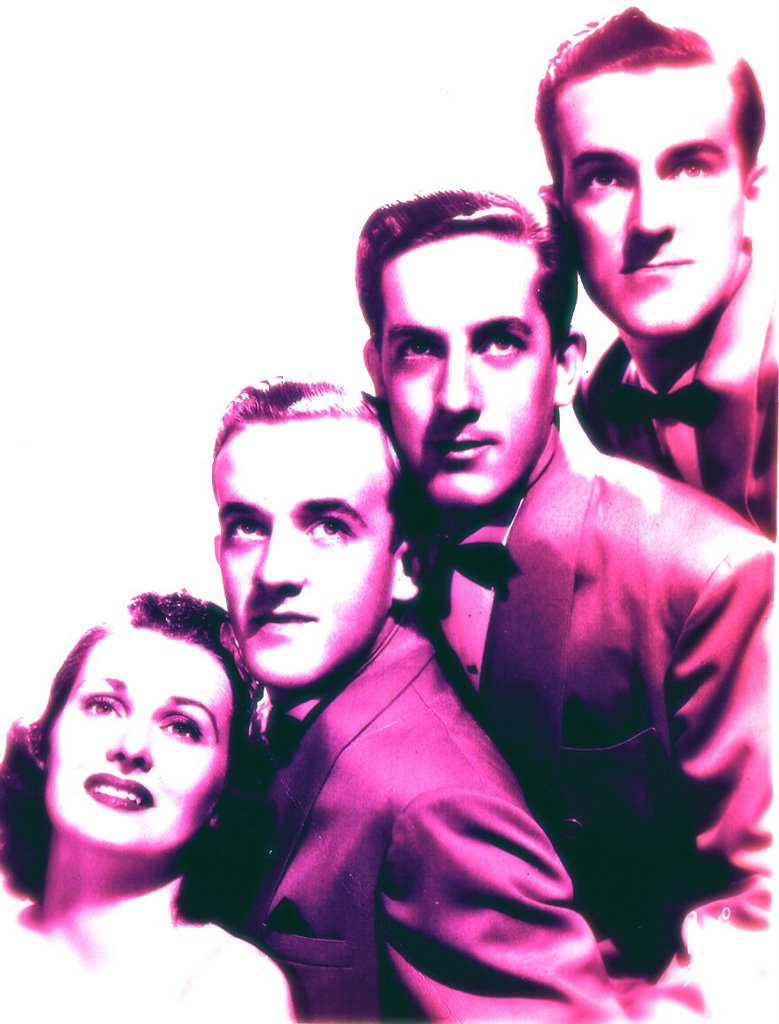
Now, the old lady won’t be playing any instrument; she might know how to play the organ—and she would most certainly enjoy the harp. Old enough, she might even remember the Merry Macs (pictured above), tune trillers featured on Fred Allen’s radio program. Right now—that is, for the duration of the play as soundstaged—she is too busy playing with that young man, the stranger she has lured into her dark house or, rather, the darkness of her mind. How about the music playing in that mind, unsound but not necessarily unsounded? Might she be scoring the melodrama in which she has cast that strange man? Might the young man, gradually turning suspicious, begin to hear John Carpenter’s theme from Halloween (or some such Psycho score with which he is familiar), just as I mentally soundtracked my pictures of Montague?
Should I play around with such potentialities? Or should I tell myself to stop the music, despite the fact that its effective use has enriched scores of radiogenic performances, including the “glitter” of harps and strings heard on Norman Corwin’s “Odyssey of Runyon Jones”—a fantasy in which a harp, playing a harpy, “holds a conversation” with a boy in search of his late dog?
“Stop the Music”? That, of course, was the name of a popular quiz program often being blamed, and not unjustly, for the slow but certain death of radio playfulness. “Radio is the Marshall Plan with music,” quipped the aforementioned Allen, who, on this day, 27 June, in 1948, tried to stand up against the giveaway shows that prompted millions of his listeners to twist the dial in hopes of getting rewarded for waiting by the telephone: “The slogan of the quiz program is, ‘If you can’t entertain people, give them something.'”
To Allen, and anyone with a keen, uncommon sense for the aural medium, this was a dead giveaway that radio artistry was being slaughtered for commerce, that those in charge of broadcasting were ready to renounce the sounds of the imagination for the common sense of the “ka-ching.”
Considering today’s economy of radio dramatics, which advises against what is conveniently dismissed as old-fashioned or corny in storytelling, I will rely on the music playing in the mind’s ear of the audience. Perhaps, characters and setting will succeed in suggesting the soundtrack I had in mind—theirs and mine.
 Well, I’ll probably laugh about it—eventually. Not a day in my life passes without mishaps, some major, some trivial, all vexing. Sure, I could blame it now on Montague, our new canine companion. After all, dogs are expected to be inept, to be indifferent to our technological comforts and headaches; but a few remaining bristles on that scouring brush called conscience go against the grain of my indolence and continue to tickle until I make a clean breast of it. The “it,” this time around, is a cordless phone plunged into the watery grave of a bathtub. The rest, as they say (in Hamlet) is silence.
 Well, how are you feeling today? According to one British study, 23 June is the

 Well, what does it suggest? My silence, I mean. Is it a sign of indifference or an exercise in difference? Does it bespeak failure or betoken activity elsewhere? Does it spell death, metaphoric or otherwise? Mind you, I have merely extended my customary weekend retreat from the blogosphere for a single day; and, such is the nature or curse of keeping a public journal—of being nobody to anyone—it may have gone virtually unnoticed. My absence, after all, is no more eloquent than your silence. It requires your presence to come into being.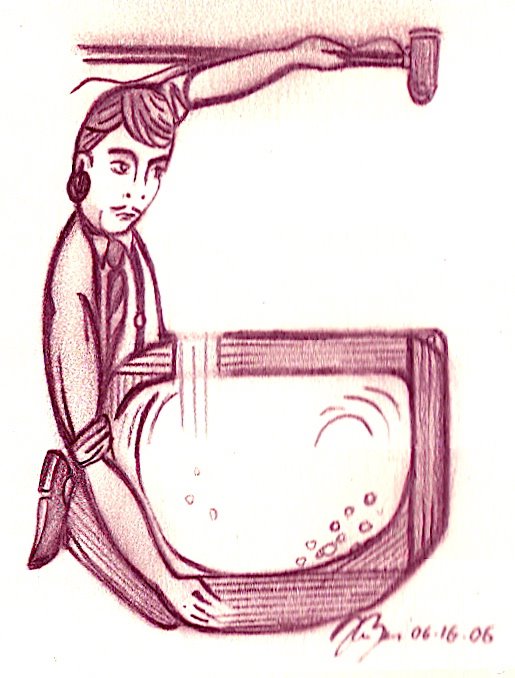

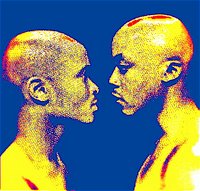 Chicken pox. That’s what had kept the Johannesburg Market Theatre players from coming down to Cardigan Bay to perform in Athol Fugard’s The Island. Last night, the two (Mpho Osei-Tutu as Winston and Thami Mngqolo as John) made up for it, even though their audience (students at the local university) had taken off by then for some holiday destination. It was worthwhile hanging on to the ticket, though. And since I enjoy debating myself, I dug up an old college paper I had written on The Island for a graduate course in drama back in the mid-1990s. Aside from its title “Carrion Antigone,” that essay, while not outright dismissed by its academic audience, is rather too slight a performance to warrant reproduction here. It told me more about myself than the play, which I argued to be less concerned with historical facts than with cultural universals.
 Harry Heuser
