
 Well, we’ve all pulled stunts the memories of which are best pushed back into the farthest recesses of our cranial database—unless, of course, such anecdotal evidence of our dimwittedness might serve some educational purpose or is just too temptingly absurd not to be passed on for a few laughs at our expense. Ever tried walking on water? I sure did—and very nearly drowned in the realization that slipping your feet into a pair of water wings won’t do the trick.
Some folks, myself included, never entirely grow out of this awkward—and at times perilous—stage of rationed rationality, a protracted dizzy spell during which life unfolds as a series of trials by misfire. How comforting it is then to find one’s preposterous self in fictional characters—and to find oneself outdone by them in folly and futility.
At a period in not-too-distant American history—the Great Depression of the 1930s—when formerly secure or relatively well-to-do folks were suddenly forced to live by their wits and found them wanting, radio was a reliable purveyor of reassuring fall-guy tales, stories of crazy schemers like Lum and Abner, proprietors of the Jot-Em-Down Store in the imaginary backwoods community of Pine Ridge, Arkansas.
Never quite satisfied to run their unassuming store, Lum and Abner were always in search of a sure-fire get-rich-quick venture, whether it meant digging for oil or running a matrimonial bureau. Their common sense did not match their ambitions, creating plenty of opportunities for quacks and swindlers.
On this day, 27 April, in 1942, for instance, they were dreaming of real estate, a mighty complex of “Wonderful World Apartments,” for the erection of which they were promised, free of charge, a contractor who, they had not reason enough to doubt, had been responsible for the construction of the Empire State Building.
During the lean years of the depression and the time of personal sacrifices that was World War II, Lum and Abner’s antics were occasionally rendered relevant by drawing attention to a particular need or service, be it the demand for scrap metal or the benefits of local bookmobiles.
Shortly after the end of the war, however, such built-in public service announcements and dramatized propaganda seemed out of touch with listeners who had been told to do without (or do with less) for too long. Freed from the constraint imposed upon them during the war, the creators of radio entertainment could once again be unabashedly escapist and thoroughly commercial.
The dropping of the atomic bomb—a drastic act of getting it done and moving on at last—was greeted as the dawn of a new era: a peaceful one, it was hoped; but certainly one of renewed and indeed unprecedented consumerism, of wish-fulfilment and instant gratification. Rather than being rendered dreadful and threatening, radioactivity was sold to the public as a boon, the very fount of ready-made enrichment.
Barely a month after V-J Day (14 August 1945), Lum and Abner believed themselves to be in possession of this new and most magical source of energy—uranium. If only their neighbor, Cedric Weehunt, had not attempted to boost his own strength by having a sip from the cup supposedly containing “that uranium stuff.” In one of the serial’s ostensibly comic cliffhangers, Lum and Abner assume their friend to have been transformed into a dog as a result of imbibing the substance.
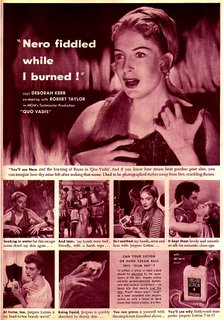
Such clowning around, such Enola Gayety, was a heavy-handed attempt at making light of an incredible burden. Even if the long-lasting effects of radiation were not fully grasped for some time—a horrifying discovery exploited in the sci-fi thrillers of the 1950s—the trivializing of uranium so shortly after the bombings of Hiroshima and Nagasaki now comes across as a distasteful act of raising a cup to nuclear fallout, of toasting the loss of thousands of civilians.


 Well, I am feeling strangely liberated. A few days ago, I learned that my BlogMad account had been wiped out as a result of some database corruption—a common occurrence, if comments from fellow web journalists are any indication. I chose not to sign up anew right away, luxuriating instead in the thought of temporarily forgoing those new-fangled ways in favor of an old-fashioned book. Despite my doctorate in literature, I don’t read nearly as much as I ought to these days. So, I took advantage of the first warm day of the season, ripped off my shirt, and grabbed . . . a Trollope. Anthony Trollope, that is, who happens to be one of my favorite authors. Recently, I picked up his Cousin Henry (my, doesn’t this begin to sound so Carry On!) after discovering that this novel is set in Wales, that strange and wild country west of England I am still struggling to call my home.

 I have often found comfort in the notion that the dead may survive in the minds of those who recall them. It is no mere vanity to desire such afterlives. Indeed, the concept of lingering in each other’s thoughts by virtue of some worthy deed or memorable word can be a significant motivational force in our lives. I am not sure, however, whether the self-images we try to instill in the minds of others as potential extensions of our corporeal existence are to be considered a noble attempt at rescuing our finite lives from triviality or whether these transferable or continuing selves are a construct that trivializes the finality of death. After all, does not the realization that we are perishable render each hour we have left so much more significant?
 I had intended to spend much of today al fresco, our long-neglected garden being in serious need of attention. Dragging the old lawnmower out of hibernal retirement a while ago, I had managed to knock over a can of paint and, the spilled contents being blue, very nearly ended up looking like a Smurf in the process. No sooner had we unleashed the noisy monstrosity, engulfed in a cloud of smoke, than one of its wheels broke off, which immediately put a stop to my horticultural endeavors. It is to the latter mishap on this Not-So-Good Friday and the fact that I am all thumbs (none of which green) that you owe the questionable pleasure of this entry in the broadcastellan journal.
 Harry Heuser