Get Out! Tintin Is Eighty?

When a good friend of mine told me earlier this week that comic strip reporter Tintin had been “outed” by a fellow journalist, I was not the least bit surprised. The Tinky Winky controversy of the late-1990s came to mind, in which Jerry Falwell—discard his soul!—denounced the handbag-clutching purple creature of Teletubbies fame as being a “gay role model” for television’s newest and youngest target audience, the toddler. As if, with parents plonking them down in front of the box at that age, those poor impressionables did not have enough worries about their future already.

Now, Matthew Parris, who purports to know the Belgian reporter more intimately than anyone except Snowy, had no such agenda; that is, he did not equate “gay” with “dangerous.” Still, I would not be so presumptuous as to drag the perennially adolescent Tintin, who turns 80 today, into what some assume to be a camp (well, it can be camp, as I demonstrated here). Instead, I did a little outing myself by dragging the above sculpture, my most recent addition to a small collection of Tintin memorabilia, onto our patio, whereupon I took in the animated Secret of the Unicorn, based on the strip rumored to be the source for Steven Spielberg’s Tintin project now in pre-production.

I don’t suppose that the gossip about Hergé’s boy will in any way affect the box-office chances of the film and its intended sequels, about the success of which there has been so much doubt already that it was slow in receiving the green light. After all, if one source is to be believed, Tintin enthusiasm in the US and Britain amounts to “little more than a cult.” However unfortunate the phrase in this overstatement, nothing sinister or questionable other than doubt about the figure’s bankability is implied. Still, the boy reporter, who has a somewhat shady past in propagandist cartoons and only gradually matured into the open-minded, worldly youth he became in his Tibetan adventure (the stage version of which I discussed here), has had his share of detractors.

Warning labels other than “Caution: content may damage your kid’s chances to turn out straight” have been attached to Tintin’s exploits in the Congo (as mentioned here), and his tendencies have been denounced as right-wing. A globetrotting reporter who is racist, fascist, and gay? A rather incongruous picture; but then, the Tintin of 1929 is not the same young man who cleared the gypsies accused of having stolen the Castafiore emerald in 1963.

When first I encountered Tintin, no such thoughts occurred to me. Still, in part for reasons made plain by Mr. Parris, I was intrigued by the cub reporter and his freedom to travel around the world, unencumbered by homework, filial duties, or anxieties about puberty. He was as exciting and comforting in this respect as Pippi Longstocking, only neater and more mature.

As an adventure-starved, working-class latchkey kid unsure and downright scared about his own sexuality, I was only too eager to relate to an independent teenager whose parents are never seen or talked about, who does not appear to have girls on his mind, whose closest human pal is a hunk of a sea captain, and who is devoted to a fluffy pet dog named Snowy. I guess that makes me whatever Mr. Parris just labeled him.

When I now add another label in honor of Tintin’s birthday, realizing just how often the lad has found his way into this journal, it simply reads . . . Tintin.

Even Reindeer Get the Flu

Four weeks and a day! As the exclamation mark suggests, being that I use it so sparingly, I am not counting down the days to New Year’s Eve here or marvel at the seemingly accelerated passing of time. It is the time my cold has been taking thus far to run its collision course and me crazy into the not so welcome bargain. It could be, though, that today’s headache has been exacerbated by Mickey Rooney.

My attempt to book tickets to his latest show, that is. I tried to get in touch with a sales representative to make sure that the tickets I ordered online won’t be sent to our home, as requested, given that, as it dawned on me only after I had finalized the booking, we are elsewhere during the latter part of December.

The apparently unstoppable octogenarian, Judy Garland’s co-star in a series of musical-comedies, is going to be in one of those pantomimes so popular in Britain during the holiday season; this time, some eighty-two years after his acting debut in motion pictures, he appears at the Hippodrome in Bristol, England, where we had planned to spend the final forty-eight hours of 2008.

The busy Mr. Rooney, slated to appear in four films in the upcoming months, stars opposite British stage and television actress Michelle Collins, whom last we saw backstage at the Shaftesbury Theatre in London (and whose autograph I displayed here). Anyway, I eventually sorted out the mailing situation and can only hope that the constitution of the man formerly known as Andy Hardy will prove sturdier than mine.

I am in the mood for a seasonal tale, tall or otherwise, but would much rather close my eyes than read Christmas Stories with its selection of fiction by Conan Doyle, Damon Runyon, Evelyn Waugh, and, a personal favorite, Anthony Trollope. So, once again, I rely on the radio, or recordings of plays once produced for the medium. On this day, 2 December, in 1945, The Philco Radio Hall of Fame presented a new story, which it predicted to “become a Christmas classic.”

Never mind that this prediction did not quite come true. After all, the woman who made it was not chiefly known as a clairvoyant, even though she had a voice that could induce millions to spend millions on war bonds and forge stars in the smithy of her own radio shows. Announcer Glenn Riggs somewhat needlessly reminded the public that, “as commentator, singer, forceful personality and discoverer of stars,” she had “no equal on the air.” Yes, it was Kate Smith who ventured that guess, no doubt boosting the sales of the volume. When Smith sings, you can count on sales as well as volume.

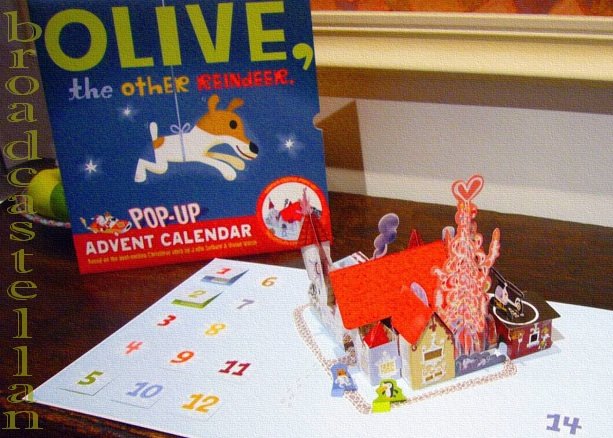
On the Hall of Fame, Smith not only belts out a number of tunes, including “If I Loved You” from the latest Rodgers and Hammerstein musical Carousel and her celebrated rendition of “God Bless America”; as story lady, Smith narrates a dramatized version of Roger Duvoisin’s “The Christmas Whale,” a whimsical paean to ingenuity involving the breakout of a flu epidemic at Santa’s toyshop and the reindeer that flew not because they all came down with it. Perhaps, such susceptibility explains why this year’s advent calendar featuring Olive, the Other Reindeer, arrived a day late in the mail.

The title of Duvoisin’s story leaves no doubt as to the creature lending a helping fin. Perhaps, the sudden substitution was a metaphor for the death of FDR just at the time when things were beginning to look up and the theaters of war were closing, not merely for the duration of the holidays. There is no mention of Harry Truman; but, when asked what Christmas gift she would make General Eisenhower, Smith remarks: “Well, I’d give him a future as great as his past.” Perhaps, she was prophetic after all . . .

“War of the Worlds”: The Election Edition

View from a London bus, 2005

Teaching undergraduate English in the Bronx while researching my dissertation on old-time radio, I found it difficult if necessary to relate nightly study to daytime work in the classroom.  I did not want to be one of those educators who think of their ‘job’ as an educator as being at odds with—or in the way of—an academic careers, success in which is largely dependent on self-promotional efforts rather than years of service.

Reluctant instructors tend to become resentful of their charge, a feeling that is hardly conducive to the far from mutually exclusive activities of teaching and learning.  Writing this journal has been a way of vindicating my approach, of coming to terms with my inability to squeeze the most out of the degree I earned.  broadcastellan is not a series of unheard lectures, but a record of my enthusiasms.

Now, where was I going with this? Ah, yes.  “The War of the Worlds,” the infamous “Panic Broadcast” that was first heard on this day, 30 October, in 1938. The Mercury Theater’s iconic dramatization of Wells’s futuristic parable and the resulting Hullabaloo (also the title of a 1940 musical comedy inspired by the event) provided me with a rare opportunity to forge a connection between classroom and study.  “The War” was the first recording of a radio play I shared with my students, whose listening experience was followed by the inevitable question whether such a performance could still hornswoggle us today.

Being that one of my enthusiasm is American radio drama, I have already discussed the Mercury Theater production and its rival broadcast on previous occasions. Tonight, though, “The War of the Worlds” comes to a mind that is about as uneasy as the minds of those tuning in back then.

Not surprisingly, most of my students argued that we are too sophisticated nowadays to fall for such claptrap.  There is more access to alternative media, more awareness of what is going on around the world.  However comforting it might be to think so, I have never permitted myself to share this view.  I do not conceive of the past as being inferior to the present by virtue of some supposedly natural progression.

Sure, you might snicker at preposterous styles and passing fads.  You might say, in hindsight, that certain political decisions were wrong and that those living in the past should have seen things coming. In short, there are any number of ways to demonstrate your ostensible superiority to folks back then.  Doing so, however, you should have the honesty to admit that your argument is designed to make yourself feel better about the uncertainties and anxieties of the present.

I do not hold with those who look at past generations as an older, hence inferior, model of themselves.  I reject the notion that there has ever been what is frequently referred to as “innocent” times.  Retrospection breeds contempt.  Too often, it is an act of distancing yourself from events that the present, if properly inspected, proves to be not altogether beyond the possibility of recurrence.

So, could something akin to the headlines-making broadcast be restaged tonight and elicit a similar response, a response frequently attributed to the threat of war that was about to shatter hopes of stability, peace, and prosperity? Are we not on edge enough now to have reached the point of sustainable gullibility? Or are cynicism and apathy an adequate shield against deception?

Have not many of us lived a myth constructed by those who benefit from our desire to believe in something, be it a falsehood about terror and the war on it, be it the promise of economic progress to which every aspect of our existence is made subordinate? The times, it seems, are ripe for a shake-up.

One reader of the so-called panic broadcast, Peter Lowentrout, suggests that listener belief in an attack from Mars was rooted in a “loss of spirit,” the 1920s and 1930s having been “decades in which the influence of secularization peaked in our general and elite cultures.” Are we more eager to believe in a hoax if we are incapable of or reluctant to believe in anything else? Or is a return to faith a prerequisite for a susceptibility to apocalyptic visions?

In a way, the “panic” is itself an historical construct; its extent has been exaggerated to permit us that look of superiority we tend to cast on the past.  Yet what about the present fear change and its mongers, those who look upon of the presidential candidates as a false Messiah and claim him to be alien to the economic needs of an ailing nation, if not downright hostile to those intent on clinging to a status quo that hardly seems worth maintaining?

What about those who think of ecological crises as a matter of fate or charlatanry rather than challenge and opportunity; and who, by claiming it to be either inevitable or false, go on living as if their individual conduct had no influence on the future of this planet? What about those who are disillusioned by the stock market, yet feel threatened by concepts of alternative living that involve something other than the amassing of greenbacks?

Orson Welles’s introductory remarks, at least, are readily applied to our present condition:

With infinite complacence people went to and fro over the earth about there little affairs, serene in the assurance of their dominion over this small spinning fragment of solar driftwood which by chance or design man has inherited out of the dark mystery of Time and Space.

At present, I find it difficult to think of anything other than the US election, which is what reminded me of the challenge I faced in the classroom, the challenge I am facing when keeping a journal that attempts to keep up with the out-of-date? To find relevance in the past and to relate it to the uncertainties that constitute my present, that is the challenge.  

While I have no official say in the matter, I shall have certainty next Wednesday.  On that day, I may even have renewed confidence in the democratic West; but certain and confident is not who I am tonight . . .

Hattie Tatty Coram Girl: A Casting Note on the BBC’s Little Dorrit

They are still after him, those producers of television drama. And they know that many of us are eager to follow. In a way, we cannot help being After Dickens, to borrow the title of a study on “Reading, Adaptation and Performance” by John Glavin. It is a sly title, that. After all, we are belated in our pursuit; we do more than simply try to catch up. We are bringing something to the game that is the act of reading. We are making sense, and we remake it, too.

Andrew Davies, the writer responsible for the award-winning dramatization of Bleak House, subsequently tackled Little Dorrit (1855-57), one of the lesser-known works in the Dickens canon. Having greatly enjoyed Bleak House when it first aired back in 2005, I was again drawn away from the wireless, to which most of the posts in this blog are dedicated, to go after what is being shared out—in installments, not unlike in Dickens’ day—by radio’s distant and rich relation.

Now, it has been some time since I read Little Dorrit. During my graduate studies, the novel tantalized me with its perplexing nomenclature, an uncrackable code of names and monikers that inspired me to dabble in the dark art of onomastic speculation. The result of my academic labors, “Nominal Control: Dickens’s Little Dorrit and the Challenges of Onomancy,” is available online.

While many of the names heard in the adaptation of Little Dorrit still ring the proverbial bell for me, some of the faces, as made up for us by the adaptor, seem less familiar. Never mind Arthur Clennam, who is rather younger than the middle-aged man Dickens was so bold to place at the center of his novelistic commentary on the manners, mores, and money matters of Victorian Britain. The character of Tattycoram is the one to watch out for and puzzle over: a foundling turned changeling.

In the original story, Tattycoram (alias Harriet Beadle, alias Hattey—the act of naming is that complicated in Little Dorrit) is introduced as a “handsome girl with lustrous dark hair and eyes, and very neatly dressed.” As portrayed by Freema Agyeman, the televisualized Tatty certainly fits the bill: a young woman with dark hair and eyes, and, my metaphorical hat off to the costume department, handsomely outfitted.

Hang on, though. The color of her skin, to which no reference is made in the novel, appears to have been adjusted; and, in a crowd of pale faces, it is a change that really makes a difference. Has Tattycoram just “growed” that way?

It surely is not simply a case of equal opportunity for television actors like Agyeman, if such cases are ever simple. A black Tattycoram transforms the very fabric of Little Dorrit. It imposes an historical subtext on our reading of the story and the young woman’s part in it.

Adaptors, like translators, frequently engage in such updates, if that is the word for what can amount not only to anachronisms but to presentism, the latter being the imposition of a viewpoint contemporary with the audience of the new version. I was not bothered by the lesbian characters the BBC insisted on sneaking into the staid and psychologically none too complex mysteries of Agatha Christie, even though such reorientations seem gratuitous. The determination adaptors made regarding Tattycoram’s ethnicity is altogether more problematic.

While slavery was abolished in Britain prior to its publication, Little Dorrit is set some thirty years in the past, the possible implications of which present-day television audiences are not given sufficient context to ponder and may not even notice. I had certainly forgotten about the dating of the action prior to the coronation of Queen Victoria. Little Dorrit, unlike Dickens’ A Tale of Two Cities and Barnaby Rudge, is not an historical novel, however; nor is it a commentary on the slave trade.

Concerned with prison reform, and the injustices of the debtor’s prison in particular, the novel refers to slavery only metaphorically to signify systems of oppression and forms of thraldom, perceived or actual. At one point, the orphan Harriet is taken in as a companion by the fiercely independent Miss Wade who, in readings of the novel, has been outed as a lesbian. In a first-person narrative, Miss Wade reflects on her earlier experience as a governess: “I was not bought, body and soul. She [Miss Wade’s employer] seemed to think that her distinguished nephew had gone into a slave-market and purchased a wife.” Clearly, in this questionable equation of servitude and slavery, no comment on the reality of the slave trade was intended by Dickens in this expression of a character’s anger regarding her station and the transgression of which she believes herself to have been accused.

In the Victorian novel, the black or “mulatto” figure remained largely invisible, or else was the brunt of derision. One such laughing-stock character is Thackeray’s Miss Swartz, the “rich woolly-haired mulatto from St. Kitt’s” who parades through Vanity Fair being “about as elegantly decorated as a she chimney-sweep on May-day.” In Dickens’ Bleak House, concerns about black lives in the colonies are dismissed as the folly of “educating the natives of Borrioboola-Gha, on the left bank of the Niger.”

Of the nearly one hundred, mostly flat characters that flit in and out of Little Dorrit—which, according to the Radio Times, were reduced to around seventy-five in the process of compression—it is Tattycoram, an orphan named after the notorious Coram hospital in London, who now stands out as an individual struggling to emerge from a socially imposed conspicuous invisibility that, the adaptation insists, is owing to her ethnicity. Thus, a marginal character takes center stage by an imposed discourse on the nature of her marginalization. In other words, the attention paid to her, belatedly, is justified mainly by the postcolonial narrative grafted on the novel in which the Harriet in question is treated as if she were the brainchild of Beecher Stowe.

Showing a little skin, and revealing it to be black, Davies’ retailoring may strike some audiences who are acquainted with the genuine article as a bold new cut. And yet, in the process of giving the old Empire new clothes, the Dickensian fabric is suggested to be more than a little Tatty. Perhaps, instead of such alterations, the assumption that, with strategic trimming, Dickens can still meet our aspirations needs adjusting.

They are still after Dickens, all right. The question is: are they even trying to get him or, riding on his coat-tails, are they out get at something he just hasn’t got?

The Transplanted Mind: A Caligari for Radio?

“Poor print.” That was all I had to say after attending a screening of Das Kabinett des Dr. Caligari (1920) at the Museum of Modern Art in New York City. I was dreadfully disappointed. It felt like walking through an exhibition of Expressionist art in which all the paintings were covered in plastic, the lights dimmed, and the space brightened only by an occasional flash of a camera. I pretty much had the same impression when, preparing for a trip to Prague, I tried to take in Der Golem by exposing myself to the horrors of a cheap copy I had dug out of a bargain bin at a third-rate department store. You might as well experience these films on the radio, where the visuals are as clear and bold as you can make them, provided your mental camera is both creative and focused enough to take pictures that are worth keeping.

Tonight, BBC Radio 3 attempted no less with “Caligari,” a radio adaptation of Robert Wiene’s seminal horror film, one of the few classics of the cinema to rank among the top 250 films on the Internet Movie Database. In the exposition, poet/playwright Amanda Dalton slyly comments on the challenges of such a project. “Caligari” opens with the sound of a board (an advertisement for the fair, a title card for the film, a piece of scenery) being painted and hammered into position. The question this gesture begs is whether the brush and the hammer are being passed on to us. Are we the artist, the audience, or the subject? Can we choose? Must we?

A “strangely arresting” film that succeeds in giving “pictorial interpretation to a madman’s vision,” one early commentator (Carlyle Ellis) said of Caligari. Such a statement drives home that Caligari is itself an exercise in translation: a bringing to light and darkness the workings of a crooked, crazy mind in crooked, crazy images. Rather than a translation, then, Dalton’s “Caligari” (available online until 2 November 2008) should be performing nothing more—and nothing less—than a transplant, a projection of a madman’s vision onto the screen of our own mental theater, sound or otherwise.

By installing a narrator at the changing scene, “Caligari” insists on translating and interpreting, at times so facetiously as to undermine any sense of terror. Irritation, perhaps, but not anxiety. More clamorous and voluble than radio needs to be, Dalton’s frantic, play, whose light-heartedness is weighed down by anachronistic cliches like “over my dead body,” is, for all its irreverence, an unsatisfactorily literal transliteration. Too many voices shouting down our imagination, “Caligari” reviews familiar images it does not permit our mind’s eye to see, let alone re-envision or remake. A running commentary on the original on a familiarity with which it depends, “Caligari” plays itself out as a series of aural footnotes.

Last Friday, during an ostensible lecture on German film prior to a screening of Germany’s latest cinematic export, Die Welle (2008), I once again caught glimpses of Wiene’s seminal work; but its images were taken out of a context that the dull, rambling talk could not create. I had a similar attitude toward Dalton’s adaptations.

A few bars of the German national anthem, as it was once sung (that is, including the first stanza, “Deutschland, Deutschland über alles”), can hardly suffice in assisting us to adopt a Weimar Republican mindset; nor can mentions of an “intricate design” recreate an expressionistic set. And while a babble of tongues may make a failed democratic system audible, “Caligari” is little more than a poor substitute for the experience of either art or history.

Meanwhile, I am sure that the jack-o’-lantern I carved today (and display above) would look better on the air or in anyone’s mind, especially now that Montague, our terrier, has already begun to disfigure it. Is he adopting traits you may have decided to attribute to me?

Radio at the Movies: Golden Earrings (1947)

Placing Mitchell Leisen alongside Hollywood’s top flight directors is likely to raise eyebrows among those whose brows are already well elevated. Most others will simply shrug their cold shoulders in“Who he? indifference, a stance with which I, whose shoulders are wont to brush against the dusty shelves and musty vaults of popular culture, am thoroughly familiar by now. Respected for his knack of striking box-office gold but dismissed by his peers, the former art director was not among the auteurs whose works are read as art chiefly because it is easier to conceive of artistic expression as a non-collective achievement: something that bears the clearly distinguishable signature of a single individual. Their careful design aside, little seems to bespeak the Leisen touch, which is as light as it is assured. Stylish and slick in the best Paramount tradition, a Leisen picture stunningly sets the stage under the pretense of drama; otherwise, it has few pretensions.
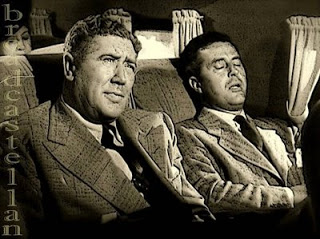
The epitome and pinnacle of Leisen’s dream factory output is Golden Earrings (1947), a sumptuously lensed romance that makes Nazi Germany look like fairyland, replete with quaint villages, enchanted forests, and lusty gypsies. It is a false image conjured up by the words of a paramour with pierced ears. For the darker side of the tale, nearly hidden from view, we are referred to McLuhan’s “tribal drum”—the radio.

One of those gypsies is played by German expatriate Marlene Dietrich, who approaches the brown-face role of Lydia tongue-in-famously-hollow-cheek. To Leisen, Dietrich “was the most fascinating woman who ever lived,” as he later told David Chierichetti, the chronicler of his career. Cast as reluctant lover, Col. Ralph Denistoun, is Ray Milland, whose lack of regard for his older co-star only enhances the screwball dynamics of this improbable coupling. Sheltered by and disguised as one of her kind, Milland’s Romani wry officer is on a perilous mission to evade his Nazi pursuers and get hold of a formula for poison gas, the kind of weapon that would exterminate thousands of gypsies.

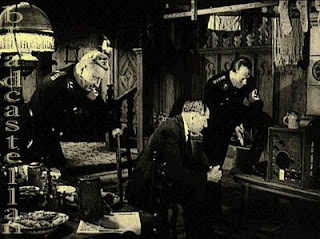
Having previously been captured by the Nazis, Denistoun owes his escape to the master race’s slavish devotion to their master’s voice. He takes full advantage of a radio address by the Führer, guaranteed to distract his captors. The scene in which the Nazi officers rise to hear Hitler’s speech and fall at the hand of their prisoner is an apt metaphor for blind faith and mass-mediated control. Unlike those gypsy earrings, the silence of a people whose ears ring with the brass of Teutonic rhetoric is not golden. A mind closed to independent thought and voices at variance, Golden Earrings suggests, is readily silenced. To be sure, this is retrospective romance; and, its ersatz gypsies roaming quite freely, Leisen’s film shows nothing of the silencing perpetrated by the fascists.

Leisen was not about to denounce the medium he had romanced in two of his earlier revues, The Big Broadcast of 1937 and its 1938 follow-up. Instead, Golden Earrings confronts nationalistic, state-run radio with a distinctly American voice of commercial broadcasting. In the narrative frame, the English officer is seen relating his story to Quentin Reynolds (pictured here with Milland), a news commentator known for his on-air missives to Doktor Goebbels and Herr Schickelgruber.
Rather than spouting anti-Axis propaganda or post-war wisdom, Reynolds is shown as a receiver, a listener tuning in to the wondrous adventure of the strangely un-British Englishman who has come under the influence of a nomadic culture foreign to his people. It is a tall tale a commentator like Reynolds, who would later be libeled in the Hearst press for his alleged lack of patriotism, is not obliged to debunk.

The frame permits Leisen to construct Golden Earrings as a romance, told as it is from the perspective of an unconventional officer summoned by his gypsy love. It is all so fabulously escapist that the enormous gamble of glamorizing Germany so soon after the war paid off without causing much offense. That, in short, is the Leisen touch.

Cruikshank Running Away With Dickens: Oliver Twist (1909)

The Oxford English Dictionary devotes an astonishing number of pages to the definition and history of the word “old.” Thus far, I have not been entered as an example. To be sure, whether or not something or someone is “old” depends largely on the age and attitude of the beholder; but it also depends on the history and evolution of what is being beheld and judged. Based on the history of film alone, one can safely describe Vitagraph’s “Oliver Twist” as “old” without incurring many objections as to the subjectiveness of the chosen adjective. After all, “Oliver Twist” was released back in 1909. At the time, some of the first readers of Dickens’s serial novel still numbered among the living. They might have looked upon those images in motion as a novel approach to an old favorite, while we, who have come to realize that technology dates faster than art, look at it as a creaky and inadequate translation.

The thought of film as a bridge between us and the early Victorian age is awe-inspiring; not that extant constructions rising above that gap are particularly trustworthy, considering the cardboard sets and threadbare production values of films like “Oliver Twist.” Directed by Englishman J. Stuart Blackton, it is all but nine minutes long; and as such, it is more or less a synopsis of the novel.

Indeed, it is rather less. Here we have the richly descriptive words of Dickens, a master of penning indelible if none-too-intricately sketched word-portraits, translated into the moving images that are, to this date, the competitors of moving English. Intertitles are sparse, an economy of words that turns the spectacle into a set of tableaux in the service of a moral whose statement even a sentimentalist like Dickens might well reject as rather too obvious and prosaic.

Owing to the film industry’s raiding of the Dickens canon, the author’s original illustrator, Cruikshank, appears to have run away with the show. In film, now and then, the word is largely an adjunct to the image, reversing the precedent set by the illustrated novel, itself the product of modern printing technology. Without any close-ups and a style of emoting that makes Lana Turner’s acting look like the epitome of realism, “Oliver Twist,” unlike Dickens’s Oliver Twist, can no longer engross us as anything but a curio to be marveled at and studied. Unless, of course, one thinks of those sitting in the auditorium back then, finding their books to be projected onto a screen in the most peculiar form of translation, with authors and actors alike removed from the scene.

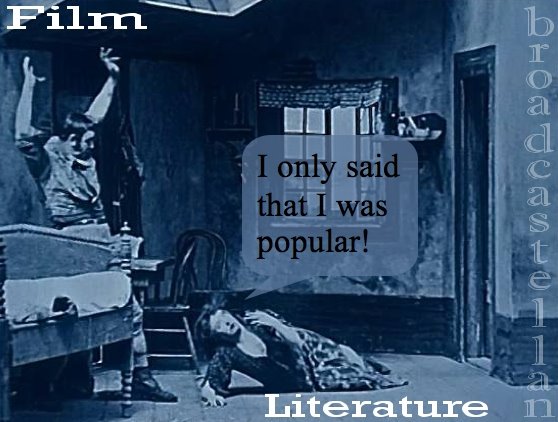
What a comfort it might have been to pick up the novel anew and give it life in one’s own breath, to learn that Oliver’s story was the story of modern, industrial society in which even the living things of our imaginings are reduced to commodities. Nancy is literature, I kept thinking, and the thieving Bill Sikes is film. It will require a screening of Frank Lloyd’s 1922 version, starring Lon Chaney and Jackie Coogan, to adjust this image; I am very much looking forward to the latter, being that our friend, the aforementioned silent film composer and (radio) dramatist Neil Brand, showed me his studio as he was in the process of scoring the film. 

Both versions, along with a lantern show of “Gabriel Grub” (from an episode in Pickwick Papers), are included in the collection Dickens Before Sound, compiled and preserved by the British Film Institute. At the sight of this feast in small doses, nutritiously dubious as some may be, I can hardly refrain from echoing Oliver’s familiar plea for “more.”

The Lilt of the Lilliputian

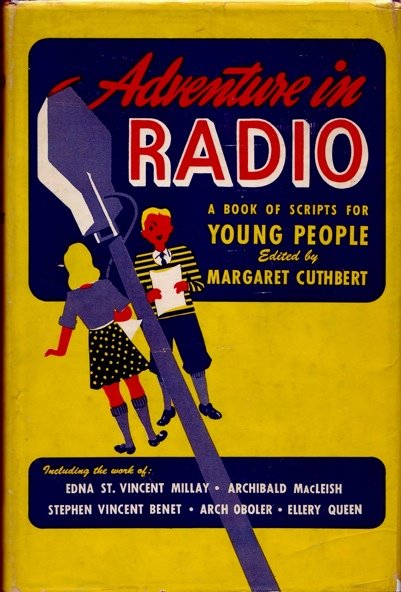
The cover of Adventure in Radio, from my collection

A few years ago, walking home from graduate school one afternoon, I stopped by at a second-hand bookstore in my old neighborhood of Yorkville, Manhattan. Judging from the window display, the shop seemed to specialize in children’s books and memorabilia. While this did not deter me, I hardly expected to make any significant acquisition of a volume on the subject to which this journal is chiefly devoted. I mean, I was not looking for a decoder ring or some such souvenir from the bygone age of radio dramatics. I was, after all, researching my dissertation. There was on the shelves a beautiful copy of Adventure in Radio (1945). Subtitled “A Book of Scripts for Young People,” it may be expected to include juvenile playlets written for the medium, although not necessarily produced on network radio. On such compilations, of which there are many, I was not inclined to waste money or time.

Spiting my assumptions, Adventure in Radio not only contains a number of broadcast scripts from programs like Jack Armstrong and Let’s Pretend but also propaganda plays and wartime commentaries geared toward an adult audience. In addition, it offers insights on the production of radio plays, on sound effects, announcing, and “radio language.” It took a little salestalk from the owner of the by now long closed store, but I was soon convinced. Where (I did not know much about eBay back then) would I ever find such a book again? And how could I claim to be serious about old-time radio if I did not snatch up this copy? So, I handed over my $40 (it was the price tag that made me hesitate) and walked off, eager to continue my studies . . . and determined to find the recordings to match the published scripts now at my fingertips.

That often proved quite difficult; but I had made up my mind that I was not going to write about words divorced from performance. I wanted to hear what was being done with those scripts, how they were edited and interpreted. Take the NBC University Theater’s production of “Gulliver’s Travels,” for instance. It was broadcast on this day, 24 September, in 1948. My appreciation of the challenges of soundstaging the play grew after reading the comments with which Frank Papp, a director of radio drama for NBC, prefaces the script, originally written for the series World’s Great Novels. Papp points out the “unusual problems” Frank Wells’s adaptation posed in production:

In the matter of casting, the Lilliputian was the most difficult.  Here was needed a voice which gave the illusion of a tiny man.  A trick voice in itself would be only a caricature.  What was required was a voice that created a picture of a real human being of Lilliputian size.  After extensive auditioning, an actor was found whose talent and vocal capabilities fulfilled these requirements.

The actor portraying Gulliver was placed in an isolation booth, Papp explains, “so that the Lilliputian’s voice would not spill over into his microphone” and the two voices could be miked separately, with a volume reflecting the size of each character. The voice of the King of Brobdingnag, meanwhile, was “fed” both through an electronic filter to amplify its base quality and through NBC’s largest echo chamber to create the illusion of a giant.

The 24 September 1948 presentation of “Gulliver’s Travels,” starring Henry Hull in the title role, does not quite live up to the expectations raised by Papp’s introduction. Under the direction of Max Hutto, child actor (Anthony Boris) is cast in the role of the Lilliputian, a choice that infantilizes the character and renders pointless the effects achieved by the sound engineer.

While Wells’s script downsizes Swift’s story and diminishes its bitterness and bite, it is the production that contributes to a sense that Gulliver’s Travels is, at heart, a juvenile fantasy, despite its airing on the ambitious if misguided NBC University Theater, a program that linked listening to such bowdlerizations with courses in distant learning. I may have been able to match the script with a production, but it was not the one described in Adventure in Radio.

Squeezed as I am into the isolation booth of my preoccupations, it is my mind’s voice that supplies the lilt of the Lilliputian . . .

Pop-cultural Auscultations: Dr. Poggioli in the Murder Clinic

I am wont, in these posts, to drop the kinds of names few of my contemporaries would bother to pick up—at least not here, in this cobwebbed corner of the net, so unlikely to restore luster to the no longer illustrious. Who, though, is concerned with luminaries these days? Luster does not denote excellence; it merely means to have a reflective surface, one in which the nameless try to find themselves as they glide toward oblivion. Ignominy is to have no name; for the purposes of today’s fame claiming, even a bad one will do.

A good name, in turn, is worthless if it is not on the tongues of the multitude whose gossipy repetitions translate into the notorious business of celebrification. What kind of name, then, is Dr. Poggioli? What kind of place is the Murder Clinic, where I came across it first?

Dr. Poggioli in my library

You don’t need to check into a Clinic to find out that Dr. Henry Poggioli is the name and title of an American psychologist with a penchant for solving crimes committed in places rather more exotic than Ohio, where he earned his PhD. T. S. Stribling came up with the name, the man, and all that befell him. Stribling. Now, there’s another name not much talked of these days. Apparently, even a Pulitzer Prize is no guarantor of a lasting reputation or a prolonged lifespan in print.

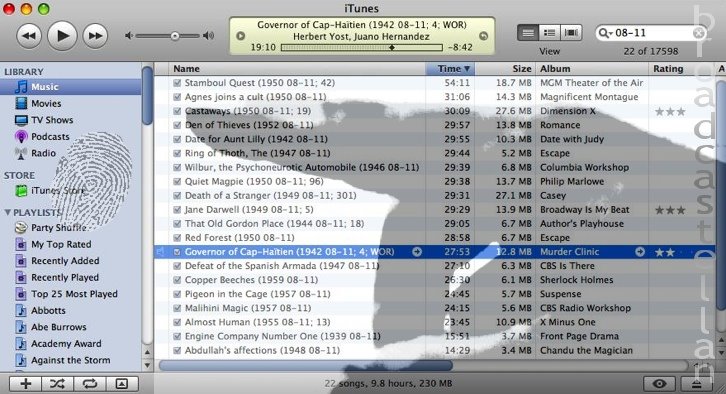
On this day, 11 August, 1942, the name Poggioli reverberated in the halls of the Mutual network’s Murder Clinic, itself a by now forgotten institution set aside for the keeping alive of fictional criminologists, if only in the memory of the public. Owing to the efforts of Mssrs. Ellery Queen, who kept publishing Stribling’s stories, Dr. Poggioli still had the benefit of a pulse; but his circulation had been healthier in the 1920s. In the Clinic, Poggioli was somewhat feebly resuscitated by one Herbert Yost, an actor known as Barry O’Moore before pictures and radio began to talk. During his encounter with “The Governor of Cap-Haïtien,” Yost kept stumbling over his lines as if he had come across them for the first time in the very moment they crossed his lips.

His name notwithstanding, the Clinic‘s Poggioli is equipped with little amounting to personality. Heard in the more memorable title role, a black governor beleaguered by the practitioners and believers in voodoo, is character actor Juano Hernandez (whom I recently saw in Trial and Ransom!, two thrillers starring Glenn Ford).

The governor was “quite a guy,” the host of Murder Clinic commented at the conclusion of the broadcast, set aside for a brief interview with the “Voodoo inspector.” “If you don’t mind my saying so,” the man from the Clinic remarked, “I think we should have had him here instead of you.”

Now, I’m not sure whether that trip to the Clinic did Poggioli any good; but a mere six weeks later he was back on the air in ”A Passage to Benares” as dramatized on Suspense (23 September 1942). On that occasion, Paul Stewart infuses him with some vigor, even though Stribling insisted on drugging him and had something altogether different in mind than the character’s well-being, as becomes apparent in the story’s startling conclusion.

As is often the case, the radio served as an introduction, however dubious, to an author and his creation. I followed up the listening experience with the perusal of the first Poggioli story I could lay my hands on. Originally published in 1932, “The Cablegram” was reprinted in the aforementioned anthology Rogues’ Gallery, which previously introduced me to another forgotten pulp hero by the name of Thubway Tham. It was while reading “The Cablegram” that I appreciated Stribling’s creation, his irony and humanity: “[T]here is no tyranny so inescapable and so difficult to prove as that of the police department,” Stribling permits the ostensible villain to proclaim as he outsmarts Poggioli and gets away with it, along with his crime.

Radio did not exactly give detective fiction a bad name, even though it was often accused of doing just that. It was more successful at heralding and advertising than in creating well-crafted whodunits. Provided those amateur sleuths and private eyes had made a name for themselves in print, radio could do much to keep it (or its author’s) in the public ear.

Stribling’s own voice was heard at least once on the air, as you may glean from this clipping. Such promotional efforts are more effective than any good word I could put in here for anyone or thing. Even so, I shall go on flinging those slippery handles into the air, the very element that once turned them into household names. In the days and weeks to come, I am going to concern myself with the more obscure titles in my newly restored library of recordings; that is, with plays, playwrights and personalities as yet unnamed in this journal.

Meanwhile, for another one of Stribling’s radio-readied tales, I refer you to ”Green Splotches,” as adapted for Escape and broadcast on 31 March 1950.

Twice Behind the High Wall; or, It’s Not the Sane on the Radio

Every once in a while I catch a sound and solid studio era thriller that has heretofore escaped me. One such welcome find is the Curtis Bernhardt-directed High Wall (1947) starring the dark and deadly serious Robert Taylor as an amnesic who finds himself in an asylum for the criminally insane for a murder he may or may not have committed. Initially refusing treatment for fear of having his guilt confirmed along with a sanity that could prove the death of him, he is soon faced with evidence convincing him that he is not beyond hope and sets out to mount the titular structure and leave no stone unturned in an attempt to emerge a free, upright man and levelheaded parent.

In this process of tearing down the wall that silences him, Taylor’s character is supported by a member of the staff (Audrey Totter), but all the while impeded by the to him unknown schemer who laid those bricks and is determined to make them insurmountable (Herbert Marshall).

In the architecture of High Wall, the three figures operate with the predictability of trained mice. We know—and are meant to know—that Taylor is innocent, that Totter will be so unprofessional as to confess her love for him, and that Marshall has erected the High Wall to cover up his own guilt. Knowing as much makes us the privileged observers of a neat and well-staged rehabilitation drama, a character study of the three mice in a maze that begins to crumble and lose some of its high tension only after the wall has been taken. A solid suspense drama, nonetheless.

Suspense. That is precisely where I had previously hit upon this High Wall, or, as it turned out, some rudiments thereof. The title rang a bell loudly enough to make me check for such a radio connection. Produced on 6 June 1946, eighteen months prior to the release of the film, “High Wall” presents a similar situation but an altogether different outcome.

Both radio version and screen adaptation were based on a story and play by one Bradbury Foote (the motion picture also credits Alan R. Clark). Subsequently, the film that was a radio play that was a stage play and story was reworked anew as a radio play. Starring Van Heflin and Janet Leigh, the remake was soundstaged in Lux Radio Theater on 7 November 1949.

Unlike, say, Sorry, Wrong Number, the property remains sound whether it is thrown onto the big screen or pulverized into thin air. Nothing about the motion picture suggests that what we see has been remodeled from a stage set; likewise, the radio play is so much in keeping with the Suspense formula that it might well have been an original radio drama, written especially for the series.

Those at work in structuring and reconstructing both High Wall, the film, and “High Wall,” the radio play, clearly understood the limitations and potentialities of the media for which the product was headed. Whatever his initial idea, Foote did not insist that his words were written in stone.

So, rather than arguing which version is superior, I noted the differences between the Suspense drama and the screen thriller. On the air, the story is decidedly more noir than on the screen. It is more concerned with the demoralizing than with morals; less involved in the cure than in the kill. It draws us in, behind that wall, without signaling a way out. No outline of romance and redemption; no hope foreshadowed. Just the shadow of which we are puppets.

Whereas High Wall is concerned with a man’s struggle to clear his name, “High Wall” deals with a man who barely remembers it. That he is telling us his own story does not make him any less suspicious. Why did he end up in an asylum? Or is he merely stonewalling? We need to know that before we can feel at ease about taking his side.

The omniscient film narrative provides us with a villain whose workings are clear to us before they become known to the main character. In the radio play, we don’t know any more than an apparent amnesiac whose mental state and progress are uncertain. As it turns out, what he doesn’t know might just kill you!