On This Day in 1944: Montgomery Clift Gets Lost in Radio’s “Wilderness”

Before heading out on this appropriately wild and gloomy evening to see a touring production of Gormenghast at our local theater, I am going to listen to one the lesser known drama programs of American old-time radio: Arthur Hopkins Presents (1944-45), which took its name from the noted Broadway producer-director who hosted the series. On this day, 24 May, in 1944, Mr. Hopkins presented an adaptation of Eugene O’Neill’s popular comedy Ah, Wilderness! starring Broadway legend Dudley Digges and featuring a young if experienced stage actor who would become one of the most sought-after actors of 1950s Hollywood—Montgomery Clift.

In the spring of 1944, Arthur Hopkins took to the airwaves in hopes of introducing to radio a “people’s theatre and a repertory theatre.” Hopkins held that radio offered a temporary “solution to the unavoidable extravagance of the commercial theater in shelving a play when the immediate audience has been served,” and to the “economic encumbrances” that made repertory “impractical” in a Broadway venue. By reprocessing recent stage successes, Hopkins sought to “create adult theatre audiences for them and eventually for Broadway.”

The series premiered promisingly that April with Thornton Wilder’s Our Town, whose use of a narrator makes it one of the most radiogenic of stage dramas. Subsequent plays were not nearly as ideally suited to the airwaves; at least, they were not suited to the demands of the one-dimensional (that is, sound only) medium. Hopkins was vehemently opposed to making changes to the original scripts. He insisted that the “two pillars on which dramatic productions stand are identical in theater and radio. They are text and cast.”

Rejecting the addition of a narrator and keeping both music and sound effects to a minimum, Hopkins deemed the challenge of adaptation to be no more than a matter of sagacious cutting. As a result of such ill-advised fidelity, “Ah, Wilderness!” begins in medias res and ends in somewhat of a muddle. 

The mind receiving no assistance in setting the scene—help provided by a guiding narrator like the one installed in Arthur Arent’s Theater Guild version of the same play—what is left of O’Neill’s nostalgic recreation of small town Connecticut in the year 1906 is a Babel of voices, a sonic jungle that at times suggests a forest of microphones behind which performers, whose scripts you can hear rustling, rush to and fro in a frantic attempt to recite as much of the original text as possible within the allotted fifty-five minutes.

For all their shortcomings, such transcribed theatricals are living records of a tradition we can otherwise only glimpse at in a couple of still photographs. Digges (as Nat Miller) and Clift (as his young son Dick) turn in fine performances, Clift being most convincing in the scene at the notorious Pleasant Beach House, where he is easy prey for one of the “swift” dames who prefer cash over matrimony.

The young man, we readily believe, doesn’t understand what is going on; nor is he corrupted by it. His father is pleased to forgive a son who has been naïve rather than wayward. “I don’t believe in kissing between fathers and sons after a certain age,” Nat remarks, having just received such a token of filial love; “seems mushy and silly—but that meant something.” To Nat, it meant that his son was “safe—from himself.” In Cliff’s case, it might have meant something else altogether.

Surprisingly, the man responsible for this Arthur Hopkins adaptation was none other than Wyllis Cooper (pictured above), whose thriller programs were the finest and most literary ever to be soundstaged for American radio. Now, there was a man who’d done well bringing a Gothic nightmare like Gormenghast to the public’s ear. I wonder how the visualization of Mervyn Peake’s 1950 novel will succeed tonight. But more about that tomorrow . . .

On This Day in 1937: Claudette Colbert Gets Her “Hands” on Lombard’s Part

Well, we’ve all got them, I guess. Those lists of favorite books, or blogs, or breakfast cereals, or some such itemized accounts of our current predilections. They are supposed to tell others something we deem important about ourselves at some point of our lives; but, looked upon in retrospect, they can become a revelation to us, confronting us with time capsules of our likes, longings, and limitations. Here, for instance, are the top three entries on a list of all-time favorite movies as I compiled it back in 1986:

  1. Holiday (George Cukor; 1938)
  2. Hands Across the Table (Mitchell Leisen; 1935)
  3. Fade to Black (Vernon Zimmerman; 1980)

Now, I have not seen Fade to Black since the 1980s. It is a slasher movie for cinemaniacs, which is why I could identify with it back then. For reasons I did not yet fully comprehend, I was drawn, fairly early in my life, to the films and figure of Mitchell Leisen, a tremendously successful designer-director, but not a particularly well-remembered or highly regarded craftsman nowadays.

Claudette Colbert and Joel McCrea
on Lux Radio Theatre

Hands Across the Table is a simple you-can-have-your-beefcake-and-eat-it romance starring Carole Lombard as a penniless manicurist, Ralph Bellamy as a rich invalid who’d like to get his hands on her, and Fred MacMurray as a carefree man-about-town with dubious work ethics who eventually sweeps her off her feet. That pretty much sums it up—unless, of course, I’d have to explain the feeling of being torn between having my nails polished by gorgeous Lombard and running my fingers through MacMurray’s hair.

On this day, 3 May, in 1937, Hands Across the Table went on the air in an adaptation produced by that most prestigious and popular of radio theatricals, the Cecil B. DeMille hosted Lux Radio Theatre. It was this series, along with my love for 1930s and early 1940s screwball comedies that got me interested in old-time radio.

Once you have exhausted the classics, you will find a worthwhile substitute in American radio programs like Lux, which give you not only an opportunity to catch a different reading of films so familiar to you that they play before your mind’s eye, but also allow you to re-imagine them with alternate casts.

What, for instance, if Suspicion had starred Olivia de Havilland, rather than her sister, Joan Fontaine? How would Barbara Stanwyck or Ida Lupino fare in Merle Oberon’s role as Cathy in Wuthering Heights [thanks to André Soares for editing]? And what, if anything, could Loretta Young do when called upon to take over for Bette Davis in Jezebel? It all happened on the Lux program.

In Lux‘s audio version of Hands Across the Table, Carole Lombard’s role was performed by Claudette Colbert, who would later be Leisen’s leading lady in Midnight (1939). It was Colbert’s fourth appearance on the show, whose sponsors not only paid handsomely for such brief encounters with the microphone (up to $5000 for top-notchers), but also promoted the stars’ movie careers (by mentioning, in Colbert’s case, the upcoming releases I Met Him in Paris and Tovarich).

Heard in the Fred MacMurray part is Colbert’s Palm Beach Story co-star Joel McCrea (pictured above, with Colbert, reading the “Hands Across” script). Introducing the two leads, showman DeMille credited himself with their discovery:

Greetings from Hollywood.  Tonight’s event, with its glittering stage, its scientific wizardry that carries our voices to all corners of the earth and its audience of millions is a thing that I couldn’t have predicted when I first knew Claudette Colbert and Joel McCrea.  The Lux Radio Theater was then as remote from Hollywood as the moon.  But I predicted the eventual triumph of these two young people and was privileged to contribute to it.  I gave Joel McCrea his first motion picture contract.  Claudette was not then the favorite of millions, allowed to choose her stories, directors, and writers. The studio insisted I give her a dialogue test before casting her.  I did—and starred her in The Sign of the Cross and Cleopatra.

For the privilege of putting her hands on Lombard’s part—and the generous remuneration on the table—Colbert was obliged to declare that they had touched nothing but Lux toilet soap ever since her first appearance on the New York stage (in the 1920s). As I put it in Etherized Victorians, my doctoral study on old-time radio, it was all a matter of one hand washing the other.

On This Day in 1949: US Listeners Are Transported to Mexico

Well, it might just make it after all. Our elm tree, that is. It was uprooted and replanted over a year ago and did not take kindly to the forced relocation. This morning, when I replenished the bird feeder that dangles from its bare branches, I noticed a few tentative buds. Encouraged by those signs of life, I am going pay more attention to this horticultural casualty over the next few weeks. The uprooted and transplanted don’t always adjust well to their new environs. Sometimes, they seem altogether out of place. Take Miss Marple, for instance.
Last night, a new dramatization of Agatha Christie’s Sittaford Mystery premiered on British TV channel ITV1. Now, what was Miss Marple doing at Sittaford? She sure wasn’t sent there by her brainmother, who created Sittaford without Marple in mind.

Nothing quite fits together in this adaptation, which tries to update Christie’s early 1930s séance mystery with noirish touches and hard-boiled wit. Transport the story into the 1950s, throw in an ex-James Bond (Timothy Dalton), a dash of Indiana Jones, a taste of not-so-sweet honey (an enigmatically skeletal Rita Tushingham), and some hints at lesbianism—and, voila (now I am being Poirot), you’ve got yourself a caper with a serious identity crisis.

I have always been driven by and torn between two impulses: to stick to what I know and try to stay away from it. The familiar can be comforting and reassuring. In my readings, for instance, or in my appreciation of drama, I tend to be downright Victorian in my tastes. As much as I was intrigued by the story of (or behind) Bennett Miller’s Capote, with which I caught up this weekend, I would have preferred it to be a little less analytical. I did not get to feel for or identify with any of the characters, as fascinated as I was by the situation in which they found themselves.

Miller seems to have taken a Terrence Rattigan approach by trying to concretize ideas rather than plots and characters. Such attempts are, perhaps, best left to essays, writings in which blossoming ideas are more likely to reach maturity and take root in the mind of an audience to whose efforts in abstraction any singled-out specifics might be distracting.

And yet, the familiar can also be stultifying and stifling, making the getting away from it seem a matter of life and death. On this May Day—the celebration of spring and renewal, that, not altogether inappropriately, shares its name with the internationally recognized distress call—I am looking westward, toward my former home, observing how the subject of immigration develops in the country of immigrants, and how US-Mexican relations received yet another blow, as millions are encouraged to stay away from work or refuse the purchase of US goods. However contentious the subject, it is not one to be avoided; and, rather than being a vehicle for escape, old-time radio, once again, serves as a reminder of some of Mexico’s other migratory misfortunes.

On this day, 1 May, in 1949, listeners of You Are There, a series of fictionalized radio documentaries, were given the opportunity to witness the assassination of emperor Montezuma, presumably by his own people. Among the voices from the past “interviewed” for the program, Canada Lee can be heard as an Aztec prince, the oppression of African-Americans being thereby likened to the life of the Aztecs under Montezuma.

Also on mike to give her views of the situation is the emperor’s daughter, who vows to leave Mexico with her husband, the invading Spaniard Cortez: “If the house of my father must be overthrown to deliver my people from hideous darkness, I say let it be overthrown.” That Cortez returns to Mexico to plunder its treasures is offered as a “footnote” at the conclusion of the broadcast.

On that same day, conceited skinflint Jack Benny went down to Mexico (or some Hollywood simulacrum of it, such as the above scene from Masquerade in Mexico) in hopes of a better life—one enriched by foreign gold or by a shiny Oscar—in an irreverent take on The Treasure of the Sierra Madre. He neither succeeded in the quest, nor in its dramatization, but delighted his audience as he died trying.

The radical tourism we label “immigration” has frequently been romanticized as adventurous or trivialized as opportunist; to criminalize it now will do still less to explain, let alone discourage, such wayward and often desperate acts of displacement. I, for one, have not set foot on my country of origin for nearly sixteen years. Anxious to fall away from the family tree, to take root elsewhere or rot, I migrated to New York City. A decade and a half (and some degrees) later, I moved on, to Britain, a country that seems stranger to me than I had anticipated.

Many who leave their native land are not unlike that elm tree in our garden, struggling and unstable; but I know that whatever it is that uproots us must be stronger than that which holds us in place.

Totalitarian Vistas, Orwellian Dystopias, and the Myopics of Chernobyl

Well, are you ready for United 93, the movie dramatizing the experience aboard one of the planes hijacked on 11 September 2001? New Yorkers were the first to view the film, which premiered last night at the Tribeca Film Festival, where it is being screened alongside sequels and remakes like Mission: Impossible III and Poseidon. Are the popcorn-littered, digital surround-sound blasting multiplexes the most appropriate places to remember the past and commemorate the dead?

Having lived in Manhattan during the terror and aftermath of the World Trade Center attacks—days of fear, frustration, anger and uncertainty—I am doubtful that any traditional film narrative, whether somber of sensational, could deepen our understanding of terrorism, let alone supersede the horrific images that continue to replay in our minds.

Our desire to see for ourselves is sometimes best left unsatisfied, unless the act of seeing—and of not finding—drives home that we must probe not elsewhere, but differently. However impressive, suggestive or manipulative, pictures cannot show us our thoughts that, at best, they can merely provoke. More often, they become too overwhelming or altogether numbing, leaving us in a state of stupefaction in which complex ideas become dim and indistinct, a state quite advantageous to propagandist efforts. I am reminded of the description of the movie theater experience in George Orwell’s Nineteen Eighty-Four, a devastating portrait of an insensate mind:

April 4th, 1984. Last night to the flicks. All war films. One very good one of a ship full of refugees being bombed somewhere in the Mediterranean. Audience much amused by shots of a great huge fat man trying to swim away with a helicopter after him, first you saw him wallowing along in the water like a porpoise [. . .]. then you saw a lifeboat full of children with a helicopter hovering over it. there was a middle-aged woman [ . . .] sitting up in the bow with a little boy about three years old in her arms. little boy screaming with fright and hiding his head between her breasts as if he was trying to burrow right into her and the woman putting her arms round him and comforting him although she was blue with fright herself [. . .]. then the helicopter planted a 20 kilo bomb in among them terrific flash and the boat went all to matchwood. then there was a wonderful shot of a child’s arm going up up up right up into the air a helicopter with a camera in its nose must have followed it up and there was a lot of applause. [. . .]

Orwell’s dystopian fiction proved highly useful during the Eisenhower years, when it was appropriated for the purpose of demonizing communist ideals and socialist ideas that, in the depression-stricken period of the FDR administration, had been widely embraced, sanctioned, and partially implemented. A radio adaptation of Nineteen Eighty-Four that aired on this day, 26 April, in 1953, underscored the timeliness of Orwell’s “prophetic reporting of the future,” by casting newscaster Kenneth Banghart in the role of the narrator.

“Perhaps you’re wondering why a newsman is appearing in a Theatre Guild on the Air dramatization,” Banghart introduced himself and the play.

It’s because George Orwell’s great novel, Nineteen Eighty-Four, deals with the most terrifying subject in the news today: the threat to all free men of communism or totalitarian domination in any form. In fiction, Orwell creates for us a picture of what life might be, should the totalitarian forces succeed with their plan to become the earth’s masters.

It was a masterplan that—according to the disposable logic of America’s emerging consumer culture—was the due course of communism itself.

Thirty-three years after this broadcast—on 26 April, in 1986—the iron curtain was still firmly in place, keeping much from view and leaving more to the imagination of cold-war stirred westerners. It did not keep the radioactive cloud from moving westward, however well guarded the secret of the nuclear disaster of Chernobyl—or of its extent, at any rate—might have been. The boundaries we create in our minds, those we mind, and those we mindlessly accept, are no hindrances to the invisible force of destruction unleashed by hubris, ignorance, and greed.

Being pointed to it by someone who is generally a purveyor of visual treats, I took a virtual tour of the wasteland that is the area around Chernobyl today: a ghost world that will remain uninhabitable for generations to come. Not surprisingly, what renders these images—and the video clip above—most profound is what we do not get to see, what becomes tangible only to our receptive minds: the hazards of the half-life, the sorrow of lives lost, and the misery of life’s blind ambitions.

Many Happy Reruns: Charlotte Brontë

Well, I am feeling strangely liberated. A few days ago, I learned that my BlogMad account had been wiped out as a result of some database corruption—a common occurrence, if comments from fellow web journalists are any indication. I chose not to sign up anew right away, luxuriating instead in the thought of temporarily forgoing those new-fangled ways in favor of an old-fashioned book. Despite my doctorate in literature, I don’t read nearly as much as I ought to these days. So, I took advantage of the first warm day of the season, ripped off my shirt, and grabbed . . . a Trollope. Anthony Trollope, that is, who happens to be one of my favorite authors. Recently, I picked up his Cousin Henry (my, doesn’t this begin to sound so Carry On!) after discovering that this novel is set in Wales, that strange and wild country west of England I am still struggling to call my home.

Now, Trollope was a decidedly pragmatic novelist. His novels, on the whole, do not concern boys and girls in the throes of love, but—how refreshing!—mature men experiencing various kinds of moral dilemmas or sophisticated quandaries. Elizabeth Bowen wrote a radio play about the author and his characters, but I have yet to come across a production of it. For romance I turn instead to something like Jane Eyre, whose author, Charlotte Brontë, was born on this day, 21 April, in 1816.

What it does not tell you, of course, is that Jane Eyre happens to be one of the most frequently radio-dramatized novels of the Victorian era or, for that matter, of any era. Next to Dickens’s “Christmas Carol,” no other story has aired more often than Jane’s, even though she was often rendered next to unrecognizable in the process.

To those familiar with and fond of the original narrative, the liberties taken by the version-crafters for screen and radio can be rather exasperating. Yet the disdainful sophisticates who dismiss the resulting pop-cultural bastards sight unseen (or sound unheard) sure miss out on some audacious rackets, such as the pitch made by the announcer of the Lux Radio Theatre in the introduction to the 14 June 1948 broadcast of Jane Eyre (or some such gal’s tale)! To accommodate the show’s sponsor, the spokesperson for Lever Brothers was called upon to ponder the question how Ms. Brontë—who, according to one biographer, liked lace—ever managed to wash her clothes without the benefit of Lux Flakes.

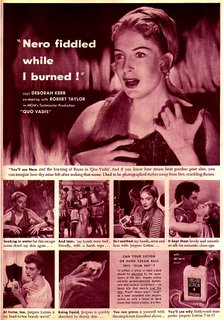
Rather more insightful was a radio lecture delivered on 3 April 1949 during the NBC University Theater production of Jane Eyre, in which Deborah Kerr (pictured above, in another kind of commercial dilemma) portrayed the titular heroine. Noted novelist James Hilton provided a brief but smart commentary, touching upon the reception of the novel, its biographical background, its historical significance, and its relevance for twentieth-century audiences.

To be sure, Hilton conceded, Jane Eyre was a “good story with all the popular ingredients—melodrama, romance, and a happy ending”; but

what gave it life is what gave it birth: a quality of passionate imagination which could make a shy spinster governess the equal, in her own mind and by her own showing, of a Sappho or a Cleopatra.

Come to think of it, Hilton’s mentioning of H. G. Wells’s Ann Veronica in this context recently induced me—someone more readily influenced by smart authors than smarmy advertisers—to get hold of a copy of the latter novel as well.

Many cuts and bruises were inflicted upon plain Jane during those supposedly aureate days of radio; and, with an emphasis on romantic melodrama at the expense of narration, more attention was drawn to that screaming madwoman in the attic than to the reflections of the troubled young governess who discovered her secret. In this respect, old-time radio was like a Victorian orphanage: expect to find negligence, exploitation, and very little recognition, let alone respect, for the suffering brainchild.

Through it all, Jane Eyre survived considerable hardship and cruelty to remain, to this day, one of the most robust heroines of all fiction.

On This Day in 1952: “An Ideal Husband” Must Face Charges of Infidelity

Tomorrow, I am once again crossing the border for a weekend up north in Manchester, England. “Crossing the border” may seem a rather bombastic phrase, considering that I won’t have to show my passport, get fingerprinted or have my luggage inspected at customs. Yet, as I learned after moving from New York City to Wales, the border to England is much more than a mere line on the map, very much guarded by those whose thoughts are kept within that most rigid and impenetrable of confinements—the narrow mind. Urbanites can be most provincial. Thoroughly walled-in, they are often ignorant of a fact stated by Oscar Wilde in An Ideal Husband (1895): “Families are so mixed nowadays. Indeed, as a rule, everybody turns out to be somebody else.”
That the proud and prejudiced lack discernment is rather what I’m counting on when next I walk over to the Royal Exchange Theatre, which is currently promising seats at Separate Tables. During my previous visit to Manchester, I was fortunate to catch a splendid production of What Every Woman Knows (as mentioned here).

Indeed, Jenny Ogilvie portrayed Barrie’s heroine, the knowing Maggie Wylie, so brilliantly that I was quite disappointed when, sauntering over to the theater of the mind, I took in a Theatre Guild on the Air adaptation of the play only to find it wanting, notwithstanding the valiant efforts of Ms. Helen Hayes to act against the clock.

It was on this day, 30 March, in 1952, that the Theatre Guild presented An Ideal Husband, with Rex Harrison as Lord Goring and Lilli Palmer as the scheming Mrs. Cheveley. Now, An Ideal Husband, not unlike the plays of George Bernard Shaw, is scripted with such novelistic attention to stage business that it is nearly impossible to perform as the text attempts to dictate.

I mean, who, beyond the second row, would be able to discern that Mrs. Cheveley has “gray-green eyes” or that Sir Robert Chilterns’s “romantic expression” contrasted with a “nervousness in his nostrils”? That “Vandyck would have liked to have painted his head” is an interpretative aside reserved for the reader and unlikely to become legible to the theater audience, however attentive.

Plays like An Ideal Husband were designed to counter the crudeness of Victorian melodrama, which was appreciated for its staging rather than its writing, lines borrowed, bowdlerized, or anonymously penned. The late-Victorian playwrights insisted on being authors— and accordingly approached drama as a composition to be published as well as performed.

Radio theater can—and must—do without such minutiae. It must permit audiences some liberties in designing the set, in staging and casting a play. The voices of the actors will curtail that freedom, suggesting the age, gender, origin, and cultural background of the speaker. Harrison is not altogether suited for the part of Lord Goring, whom I picture as suave, rather than gruff; but perhaps my mind’s eye, long conditioned visually, simply could not see beyond Harrison’s memorable impersonation of Professor Henry Higgins. I have become too accustomed to his face to allow his voice to suggest another.

It is Lord Goring who takes center stage in Arthur Arent’s adaptation, whereas the “ideal” husband being put to the test in Wilde’s play is Sir Robert, a man who comes to regret having made his fortune by dubious means. The moral dilemma of a powerful politician who becomes the prisoner of his secret, both the telling or keeping of which may cost him not only his social standing, but his marriage to a morally upright woman, is sacrificed to telescope the intricacies of the plot, which are played strictly for laughs in the radio version.

I’m not sure whether this is altogether a loss, since Wilde’s paradoxical bon mots seem at odds with his less than convincing exploration of morality. The last time I saw a production of An Ideal Husband was in April 1996, at the Ethel Barrymore Theater in New York City. As I noted in my diary (still written in German at that time), the hideously chintzy production, starring Martin Shaw, was very much a disappointment. The staging was too Ibsenesque, I thought, and wit was its casualty. I would have been only too glad to do away with the moral ideals to savor the play’s beyond-good-and-evil twists. Arent’s adaptation made these cuts for me—but was the play being acted out for me still An Ideal Husband or an act of unprincipled imposture instead?

As I put it forward in the current broadcastellan survey, American radio of the 1930s, ‘40s, and 1950s often stood in as an everyman’s theater. Dating back to the early 1920s (as evidenced by the above picture, from a 1923 magazine), it is a concept and a function of broadcasting culture I explore at some length in my dissertation. The drama of the air is potentially boundless—and it often falters when it tries to recreate the stage or dwell in its precincts.

Thneaking Up on "Thubway Tham"

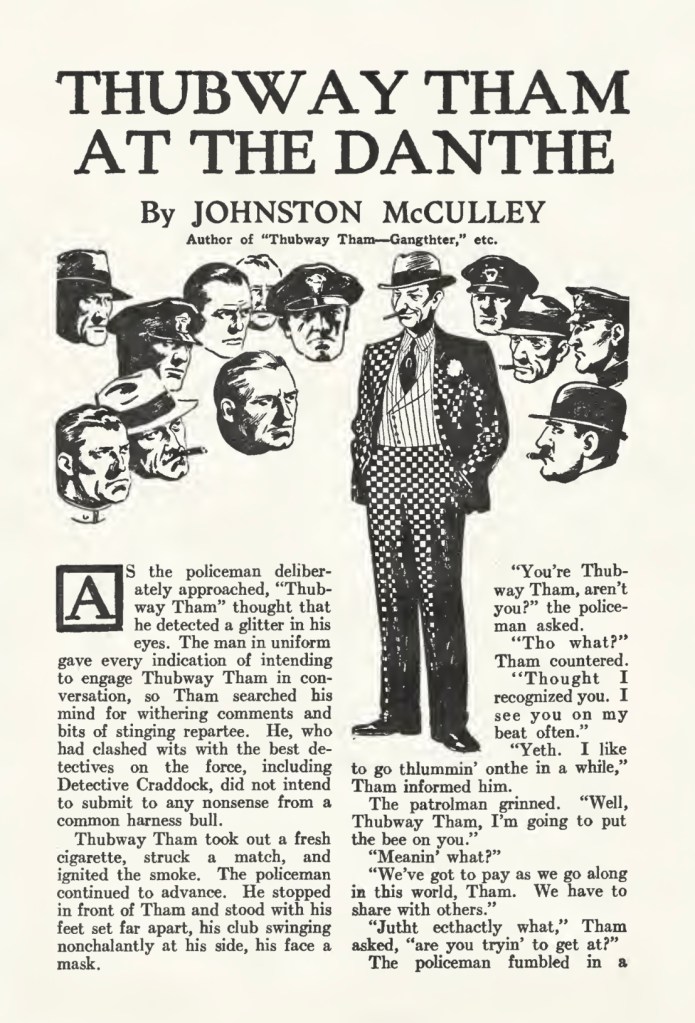
Thubway Tham, as he appeared in Detective Story magazine, 25 Jan. 1934

The other day I called detective Ellery Queen to the rescue when I found myself in need of some pop-cultural assistance while dealing with a certain case of bigotry in the blogosphere. Searching for a visual aid to prop up my improbable prose, I dug up my copy of Ellery Queen’s Rogues’ Gallery, a 1945 anthology of crime fiction containing radio scripts by Dannay/Lee and John Dickson Carr.

It occurred to me that, aside from those two scripts, I hadn’t read any of the other pieces in said volume. So, leafing through, I happened upon a story about a small-time crook with a big-time speech impediment, a lisp so thick that it earned him the nickname “Thubway Tham.”

Now, Tham never hit it big in radio or the talkies (with that voice, he had about as much of a chance to make it there as silent-screen siren Dolores Costello). That said, he was a rather popular pulp hero in his day, which is reason enough for me to make his acquaintance.

Thubway Tham was the brainchild of Johnston McCulley, creator of the recently if not altogether successfully resuscitated Zorro. According to McCulley (as retold by Mssrs. Ellery Queen), Tham first sprang into action during his author’s visit to New York City in 1919. Observing the crowds being “spewed out of the subway,” McCulley realized that those Big Apple commuters were a veritable herd of cash cows for a clever pickpocket.

In need of a saleable story, McCulley came up with “Subway Sam”; but, somewhat intoxicated at the time, the writer found that his mouth would not cooperate in pronouncing the name and settled for “Thubway Tham” instead.

An artful little dodger who forever thumbed his nose at the luckless Detective Craddock, his arch-enemy, Tham kept appearing and disappearing in story after story (some 182 by 1945, according to his prolific father); yet the times were changing, and what might have been amusing in the prosperous 1920s or reassuring in the lean 1930s was no longer appropriate during the war years, when paper was too precious for the spreading of questionable romances of self-serving criminals and the glorification of devious individualism.

Even less-than upright characters, such as the Saint, were being recruited for the war effort. And unless Tham was satisfied to go underground for the duration, disappearing from public view along with other misfits like honorable, but propagandistically irredeemable Mr. Moto, he was expected to take his hand out of other people’s pockets long enough to lend it to Uncle Sam.

Here is how McCulley’s aging lawbreaker, anno 1944, saw his dilemma:

Thubway Tham found his favorite bench unoccupied, and sat upon it.  He was thinking of the war.  Many of his younger friends had enlisted or been drafted.  Familiar faces were missing.  Even certain of the gentry habitually under the eyes of the police had accepted honest toil in shipyards and factories turning out munitions and war supplies.

Tham was sad.  A few days before he had tried to enlist and get into a uniform.  But there were several things wrong with him physically, the army surgeons found.  Tham had started the physical examination feeling rather fit, but by the time they got through with him he was wondering which hospital l would be the best when he unexpectedly collapsed on the street.

He was contemplating now seeking work in some defense plant.  But, frankly, that did not appeal to him.  Tham was a creature of habit, and a part of that habit was to ignore manual labor.  Moreover, work in a war plant would keep him away from his beloved subway.

So, McCulley confronted poor Tham with “the lowest of the low,” with con artists whose prey were “hicks from the sticks,” the “real men” about to fight for their country. Tham could continue stealing, but, punishing those more selfish than he and redistributing his loot, morphed into some simulated Saint, a decidedly less daring and debonair Robin Hood of Modern Crimes.

However valuable such sentimental propaganda might have been, the wartime heroics of turnabout Tham, as recorded in “Thubway Tham, Thivilian,” made for a rather dull and disingenuous Oliver! twist.

What might Thubway Tham be doing these days? Is he still trying his shaky hand at subway robbery? Or has he turned to that superhighway in the sky, where latter-day tricksters, unhampered by physical defects, find ample opportunity to keep their fingers busy and their pockets full?

Don’t let me catch you again, Tham.  Disguised as a conscientious “thivilian,” you pretty much wore out your welcome.

Another “Wrong Number,” a False Start for Marilyn, and the Right Answer at Last

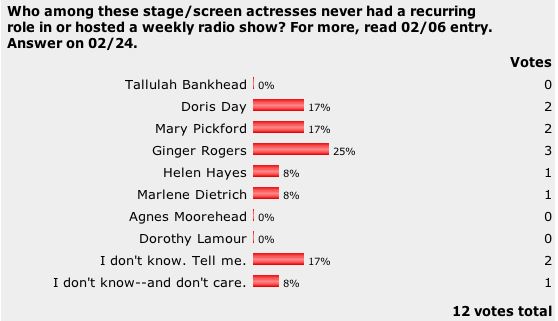
For the past three weeks I have been commemorating the dames, gals, and ladies of the airwaves; but now, the correct answer to the question posed in first broadcastellan quiz can finally be revealed. Thanks to all those who guessed or knew or couldn’t care less—and told me so. Tallulah Bankhead, Doris Day, Mary Pickford, Helen Hayes, Marlene Dietrich, Agnes Moorehead, and Dorothy Lamour—they were all radio regulars at some point in their careers, whereas others, including Ginger Rogers, the lady in question (as guessed by three readers), limited their air time to occasional guest appearances on dramatic programs like the Lux Radio Theatre. And others still, Marilyn Monroe among them, started out in commercials.

On this day, 24 February, in 1947, more than five years before she became a major star, a noticeably nervous Monroe, having waited months for her first movie role while already under contract at Fox, was pushed before the microphone to appear in a commercial break for the Lux production of “Kitty.” Within the few seconds allotted for her radio debut, Monroe was faced with the task of initiating her career (by mentioning her first Technicolor screen test), plugging Betty Grable’s The Shocking Miss Pilgrim (whose costume she got to wear during the test shoot), and peddling Lux “flakes” (which ostensibly kept those costumes fresh and colourful). However alluring her timbre, Monroe fumbled. She could not even get the name of the announcer straight; her voice was rarely broadcast thereafter, even as her film roles remained scarce and undistinguished.

A pleasant voice, while an asset, was not a radio requisite. As I mentioned previously, Louella Parsons did quite well without one, notwithstanding her consternation when being told she had to do without the larynx of Ms. Rogers, who allegedly insisted on getting paid to be interviewed. The giggles and high-pitched screechings of comedy actresses aside, the most celebrated woman’s voice on American radio was the less than pleasing one emanating from Agnes Moorehead. Her virago vocals, by which Joseph Cotton’s character in Since You Went Away claims to have been haunted across the Atlantic, was ideally suited to the role of irate Mrs. Stevenson in that most famous of original old-time radio plays, Lucille Fletcher’s “Sorry, Wrong Number.”

On this day in 1944, Moorehead, shown left during a performance of “Sorry,” once again starred in the role she had originated on the radio thriller anthology Suspense in May 1943. The part was subsequently translated for motion picture audiences and television viewers (by Barbara Stanwyck, Mildred Natwick, Ida Lupino, and Shelley Winters); but, however bitter Moorehead might have been losing the role to Stanwyck on the big screen, no actress would snatch the original from the “First Lady of Suspense.”

It was not until long after Moorehead’s death that Claire Bloom (recently seen on UK television in the last of the second season of Marple), made an attempt at superseding the “First Lady,” not only by recreating the role for radio in 1999, but by starring in a sequel of sorts.

While she had nothing to do with that sequel, radio dramatist Lucille Fletcher was responsible for the 1948 film adaptation. Her involvement did not, however, assure the aesthetic success of the latter, which, for all its high melodrama, has little of the tension generated by the original play. With its numerous flashbacks, the film destroys the intensity of a drama unfolding in real time. Like Allan Ullman’s novelization of Fletcher’s screenplay, it fails to approximate, let alone recreate, the excitement of eavesdropping on someone in mortal danger, someone whose life, like the live broadcast during which it plays out—runs on a decidedly tight schedule beyond our control and influence.

“I wanted to write a show that was ‘pure medium,'” Fletcher remarked about “Sorry, Wrong Number.” She succeeded so well that any adaptation would amount to nothing short of mediocre impurity.

On This Day in 1956: Aldous Huxley Opens a Radio Workshop and Talks About Our Brave New World

Rummaging through old photographs and notes, I came across a list of favorite books, a personal and highly incongruous assortment of titles I jotted down when I was twenty-one. Put together before I moved to New York City and went to college, that paper-thin time capsule is filled with thrillers like Maurice Leblanc’s The Double Life of Arsene Lupin and Agatha Christie’s And Then There Were None. There is Truffaut’s wonderful book on Hitchcock, as well as The Adventures of Huckleberry Finn, which I eventually got to teach in a college course on friendship in American literature. Also on that chart are the author and work I am featuring today—because they happened to be featured on the previously discussed CBS Radio Workshop.

Architecture for a brave new world: Selfridges, Birmingham

There was little room for the Workshop in my doctoral study, whose subject is the rise and fall of American radio drama between 1929 and 1954—the quarter century during which audio drama (as a form, rather than radio as a medium) made the most significant advances and had its greatest cultural and socio-political influence in the US. This is not to say that there weren’t any notable radio plays either before or after the period defined by me as the form and the medium’s golden age, even though music and talk once again dominated the dial in the mid-50s as they had prior to the 1930s. The CBS Radio Workshop, however belated it may have seemed to a nation obsessed with television, was certainly first-rate.

On this day, 27 January, in 1956, the Workshop opened with a provocative piece of 20th-century fiction, introduced and narrated by its author, Aldous Huxley and scored by radio drama alumnus-turned-movie composer Bernard Herrmann. Addressing the audience, Huxley sounded very British indeed, avuncular, educated, opinionated, and somewhat frail; rather like E. M. Forster, who read several of his works for the record and was heard on US radio as a commentator on the NBC University Theater. What Huxley has to say, however, is anything but mellow or dated. It is still shocking today, mainly because his dark vision has already become reality.

As a teenager—I was sixteen or so when I first read Brave New World—I thought of Brave New Work as a work of science fiction. It was altogether more inviting than George Orwell’s dreary Nineteen Eighty-Four, which I was forced to read at school. In Nineteen Eighty-Four, none of the characters or situations were agreeable to me; everything described seemed too nasty and bleak to be endured even by the meek or uninspired.

In Brave New World, I was confronted with a seemingly uncomplicated future, a life not devoid of pleasures and comforts, a world not entirely unrecognizable—if cleaner and less hostile—in which I could imagine myself existing happily as long as I didn’t question myself or the system for whose workings I was being conditioned. Gradually, this rendered the novel all the more disconcerting to me: I realized that I was complaisant and complicit, willing to denounce my freedoms for relief and security.

Introducing William Froug’s two-part dramatization of his story, Huxley insisted on its relevance:

Brave New World is a fantastic parable about the dehumanization of human beings. In the negative utopia described in my story, man has been subordinated to his own inventions. Science, technology, social organization—these things have ceased to serve man; they have become his masters. A quarter of a century has passed since the book was published. In that time, our world has taken so many steps in the wrong direction that if I were writing today, I would date my story not six hundred years in the future, but at the most two hundred. The price of liberty, and even of common humanity, is eternal vigilance.

It seems that sixty years would have been more accurate. Perhaps, Huxley’s dystopia has already become our present. As in the novel, we are being nursed and kept alive to keep business going; we are programmed to consume, hate, be shallow, satisfy those of our desires that are economically advantageous, and to go about our life without questioning how much we really are in control of it.

Established democracies are becoming more fascist in their curtailing of personal choice, freedoms whose realization may be harmful to our bodies and those of others and thus detrimental to long-term consumerism, a world of designer-labelled clothes and legalized designer drugs in which anyone who openly contradicts or loudly confronts is argued to be someone who sides with whose who have designs on our supposed liberties.

I’m still not sure what a tolerable alternative would be to such a Brave New World, one to be braved each day anew without the benefit of Soma.

On This Day in 1949: The Radio Tells Americans All About “Eve”

Well, before I make an appointment with The Phantom President, another one of the lesser known motion pictures starring my favorite actress, Ms. Claudette Colbert, I am going to listen again to a radio adaptation of a story that was initially considered as a vehicle for Colbert, but fell into the lap of lucky Bette Davis instead. I am referring of course to “The Wisdom of Eve,” a dramatization of which was broadcast on this day, 24 January, in 1949—thus nearly two years prior to the general US release of the celebrated movie version known as All About Eve.

This is another adventure in recycling, an exploration of radio’s mediating position in the every widening web of multimediacy. Like Eve Harrington, radio was a spider—a yarn-spinning upstart snatching a principal role from its respected elders. Talking itself into the confidence of promoters and audiences alike, radio not only surpassed the theatre and the press in influence and mass appeal, but continued to take advantage of the talent it lured away from those competing media.

“Radio, of itself, has developed almost no writers. It has appropriated almost all of them, at least all of those who could tell a good story.” This assessment of the so-called writer’s medium was made in 1939 by Max Wylie, a former director of script and continuity at US network CBS; he went on to work for the radio department of a major advertising agency and wrote several handbooks for writers or producers of radio drama and edited a number of radio play anthologies.

Wylie knew what he was talking about. Although original plays became more prevalent during the Second World War, when radio served as a major purveyor of propaganda packaged as entertainment, this observation remained essentially an accurate one and does much to explain the gradual decline of radio dramatics in the US during the 1950s, when television assumed this mediating, central position in American culture. Proving the infinite adaptability of popular culture, radio programmed its own redundancy.

“The Wisdom of Eve” first appeared as a short story in the May 1946 issue of Cosmopolitan; before it became All About Eve, author Mary Orr adapted her nearly forgotten piece of magazine fiction for the airwaves. And quite a radiogenic production it turned out to be when it was presented on NBC’s Radio City Playhouse.

“If you were listening to the radio last night,” a female voice addresses the audience, “perhaps you heard what [a certain] radio commentator had to say about Eve Harrington.” On a filter microphone, a device often used to recreate the distortion of voices on the wire or the wireless, the enthusiastic commentator spreads the word about the meteoric rise of one Eve Harrington, “the most-loved, most sought-after, most talented actress Hollywood has seen in a generation.”

Without contradicting or mocking this statement, the narrator takes over again, and her encounter with the “hauntingly lovely” Eve is played out for us in dramatic flashbacks. The speaker is not the bitter and disillusioned Margo, the aging diva, but her friend, Karen Richards, wife of the playwright of Margo’s latest stage success.

What unfolds is the familiar story of Eve’s progress, her seeming innocence, her ambition, and her successful scheming. For the sake of her husband, a man being “made miserable by a temperamental actress,” Karen sides with Eve, too late undeceived about the young woman’s character.

In this play, the radio (the voice of the gossip columnist) is complicit in the world’s deception about Eve. Forever the snake in the make-believe garden west of Eden, it tells us what we want to hear, rather than what we ought to know. Luckily, the listeners of the Radio City Playhouse got just what they wanted that day: a darn good story. What’s more, the motion picture people tuned in as well, and the little piece Orr had trouble selling for years was turned into box-office gold.