“A symmetry of unborn generations”: A Guernica for Radio

One of the many attractions of Madrid I will make sure not to miss is Picasso’s Guernica (1937), the most famous 20th-century painting in the Reina Sofía collection. A report from the commonplace-turned-combat zone, Guernica is a piece of anti-totalitarian propaganda commemorating the world’s first civilians-targeting air attack: the 26 April 1937 raid on the busy market town of Gernika-Lumo, masterminded by General Franco and carried out by the Condor Legion of Nazi Germany.

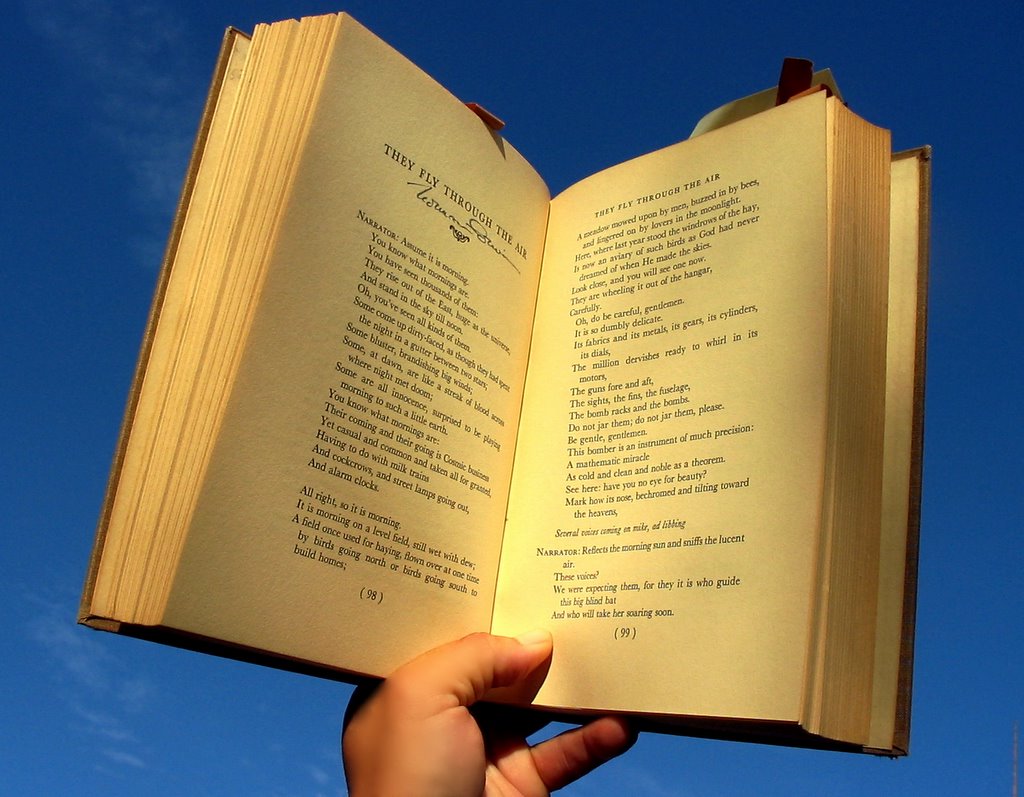
Holding up to the sky my copy of Corwin’s play “They Fly Through the Air,” signed by its author

For a long time, the painting was kept out of Spain and was mostly on display at the MoMA in New York City, where, during the Vietnam War, it became a site for vigils held by members of the peace movement, one of whom went so far as to deface it with red spray paint. It was Picasso’s wish that Guernica be returned to his homeland only after the reestablishment of democratic rule. A swiftly executed and brutally manipulative commentary on modern warfare, it invites comparisons to the three best-known American verse plays for radio, Archibald MacLeish’s “Air Raid,” Edna St. Vincent Millay’s “Murder of Lidice,” and Norman Corwin’s “They Fly Through the Air with the Greatest of Ease.”

MacLeish’s “Air Raid,” in contrast to Picasso’s painting, overtly implicates the civilian population, including his radio listeners, castigating them for their supposed ignorance and inertia. As in “The Fall of the City,” MacLeish attacks those falling rather than sentimentalizing their plight. His are bold performances, but his cruel warning turns listeners eager for news into silent partners of war who are asked to “stand by” as they tune in while women and children, refusing to heed warnings of an impending blitz, are being attacked and annihilated:

You who fish the fathoms of the night
With poles on roof-tops and long loops of wire
Those of you who driving from some visit
Finger the button on the dashboard dial
Until the metal trembles like a medium in a trance
And tells you what is happening in France
Or China or in Spain or some such country
You have one thought tonight and only one:
Will there be war? Has war come?
Is Europe burning from the Tiber to the Somme?
You think you hear the sudden double thudding of the drum
You don’t though . . .

Not now . . .

But what your ears will hear with in the hour
No one living in this world would try to tell you.
We take you there to wait it for yourselves.
Stand by: we’ll try to take you through. . . .

Millay’s “Murder of Lidice” recalls the innocent lives of those slain by Richard Heydrich, Deputy Reich Protector of Bohemia and Moravia, in Lidice. Artistically, the play is indefensible and shockingly inept in its bathos. In Millay’s Grand Guignol of Nazi terror, Heydrich the Hangman, whom the villagers have assassinated, is heard, from the beyond, planning his revenge:

He howls for a bucket of bubbly blood—
It may be man’s or it may be of woman,
But it has to be hot, and it must be human!
Oh, many’s the sweet warm throat he’ll suck.

In “They Fly Through the Air,” Corwin’s narrator goes in search of a language appropriate to the negotiation of art and propaganda. As I point out in Etherized Victorians, the play is a response to the perversion of poetic diction by the fascist cause. Viewed from above, Mussolini reportedly remarked, exploding bombs had the beauty of a “rose unfolding.” Throughout the play, metaphors are at war with plain speech, both in the service of motivating the masses:

What words can compass glories such as we have seen today?
Our language beats against its limitations [. . .].

Our rhythms jangle at the very start.
Our similes concede defeat,
For there is nothing that can be compared to that which lies beyond compare.
You see? We are reduced already to tautologies.
It’s awe does that.
The wonder of it all has set us stammering.

What is the language of war? How does it differ from the idiom of peace? And how shall war—often furious but not always futile—be rendered, recorded, and remembered in words or images? When I look at Guernica this week, I will ask myself these questions. Quite possibly, I will shiver when exposing it to the limitations of my shrinking lexicon.

“Reviewing the Situation”: Catching Up with Fagin in the Way West End

Moving from Manhattan to Mid-Wales was bound to lower my chances of taking in some live theater now and then (not that Broadway ticket prices had allowed me to keep the intervals between “now” and “then” quite as short as I’d like them to be). I expected there’d be the odd staging of Hamlet with an all-chicken cast or a revival of “Hey, That’s My Tractor” (to borrow some St. Olaf stories from The Golden Girls). Luckily, I’m not one to embrace the newfangled and my tastes in theatrical entertainments are, well, conservative. I say luckily because even if you’’re living west of England rather than the West End of its capital, chances are that there’s a touring company coming your way, eventually.
What came my way last night was a well-oiled production of Oliver!, with Peter Karrie in the role of Fagin. It was my second reunion with Oliver Twist this year, having watched playwright/composer Neil Brand at work on a new score for the 1922 silent screen version in his London studio last June. Apparently, the age of political correctness has not yet torn down or effaced all the melodramatic caricatures in the western portrait gallery of villains and scoundrels.

Never mind the play’s eponymous tyke, who wriggled through the miseries of his youth predictably well, in keeping with the plans laid out for him by “Mr. Popular Sentiment” (as Dickens was mockingly called by fellow novelist Anthony Trollope). Aside from Lionel Bart’s eminently hummable tunes, it was Karrie’s con brio portrayal of Fagin that kept this superannuated warhorse of a melodrama from coming across as lame and lumbering.

While often considered sure-fire, revivals are not quite so easy to pull off; too often they are self-conscious about the dateness of the material. Apart from the half-heartedness of uneasy reverence (as achieved by the Old Vic production of The Philadelphia Story I saw earlier this summer), there’s nothing worse than camp, the postmodernist disease of arrogant, willful misreading and flaunted emotional impoverishment. Oliver! was refreshingly, that is unabashedly, old-fashioned, brought to life by force of Karrie’s sense of bathos, at full throttle in the musical number “Reviewing the Situation.”

Well, it was not difficult for me to identify with the situation under review, that is, with Fagin’s assessment of his outsider status and his pondering of the pressure to adjust: “I’m finding it hard to be really as black as they paint,” he sighs, addressing the audience. Twice authored—by the creators of the play and the society they depict—Fagin conforms both to melodramatic conventions and societal expectations (he’s a “bad ‘un” who cannot change) while all along defying such standards (aware of his “situation,” he grapples with it and implicates the class system that stamped him an outcast):

Left without anyone in the world,
And I’m starting from now,
So how to win friends and to influence people?
So how?
I’m reviewing the situation:
I must quickly look up ev’ryone I know [. . .].

So where shall I go—somebody?
Who do I know? Nobody!
All my dearest companions
Have always been villains and thieves.
So at my time of life I should start
Turning over new leaves?

There simply aren’t enough leaves in the book for old Fagin. So, having reviewed the situation, he is very nearly resigned to a condition that a less reflective person would call fated:

I’m a bad ‘un and a bad ‘un I shall stay!
You’ll be seeing no transformation,
But it’s wrong to be a rogue in ev’ry way. 

I don’t want nobody hurt for me,
Or made to do the dirt for me.
This rotten life is not for me.
It’s getting far too hot for me.
Don’t want no one to rob for me.
But who will find a job for me?
There is no in between for me,
But who will change the scene for me?
I think I’d better think it out again!

Between a rock and a hard place, between Scylla and Charybdis, Fagin is forever reviewing a situation he is at a loss to improve; for him, there’s no silver lining (like the one above, which I spotted in the sky this morning). Taking advantage of the anonymity and visibility technology can offer the latter-day rogue with a touch of Hamlet and Werther, he would probably be blogging about it today.

The Caterpillar and the Butterfly: Fantasy Metamorphosed, from Corwin’s “Curley” to Burton’s “Charlie”

When I dipped my toe into the cool Irish Sea yesterday afternoon, I thought to myself “How detached I am from the enveloping present, how remote from the surrounding world.” Sure, I dip into the currents of culture now and again, but little of what is current seems to have any grip on me. I just shake my mind like that wet toe and retreat. Not that the beach was any more comforting for being terra firma. I was chilled by a feeling of rootlessness, intensified, no doubt, by my relatively recent transplantation to the west of Britain. And yet, here I am, nowhere and anywhere, tending to my journal. Well, according to Technorati, there is one born every second.

Not permitting myself to become wistful, I slipped into the darkness of a movie theater to take on the latter-day mongrel that is Charlie and the Chocolate Factory.  What a reassuring experience it turned out to be. Once again, I know where I am—and why I am there and loving it. The “there,” of course, is nothing but the sanctuary of my confirmed biases.

Tim Burton’s re-adaptation of Roald Dahl’s 1964 story is a mongrel indeed. It is a cautionary tale for children playing itself out as a computer game. Curb your greed, your arrogance, and your precociousness, it tells children, or you will suffer the fate of obnoxious brats like Augustus, Violet, Veruca and Mike. Obey your elders, even a deranged manchild like Willy Wonka, and your humility will be amply rewarded. The eponymous kid is too much of a goody-two-shoes to make a compelling hero (and, given the lesson learned by Wonka himself, retaining the title of the 1971 adaptation would have made more sense).

The trouble with Charlie is not its muddled message about innocence and purity, however; it is that, in its now treacly, now quirky delivery, in its very conception, there is too much of Augustus Gloop and Mike Teavee to render it sincere.  Charlie is a self-conscious if diverting botch. It is eye candy with a cavity built in; it is at once a celebration and a negation of fantasy. Does not Dahl’s description of Augustus Gloop sound like a critique of Hollywood blockbusters, of the spirit of Disneyfication? Listen:

How long could we allow this beast

To gorge and guzzle, feed and feast

On everything he wanted to?

Great Scott! It simply wouldn’t do!

However long this pig might live,

We’re positive he’d never give

Even the smallest bit of fun

Or happiness to anyone.

So what we do in cases such

As this, we use the gentle touch,

And carefully we take the brat

And turn him into something that

Will give great pleasure to us all . . .

It is telling that Burton’s movie very nearly drowns out these words in its lavish production numbers. In time it will metamorphose into DVDs and computer games, into the videodorous playthings of Mike Teavee. Conveying the warning about being a guy like Burton’s movie once again drowns the message by dreamcoating it in Technicolor:

The most important thing we’ve learned,


So far as children are concerned,


Is never, NEVER, NEVER let


Them near your television set—


Or better still, just don’t install


The idiotic thing at all.

In almost every house we’ve been,


We’ve watched them gaping at the screen.


They loll and slop and lounge about,


And stare until their eyes pop out.


(Last week in someone’s place we saw


A dozen eyeballs on the floor.)


They sit and stare and stare and sit


Until they’re hypnotised by it,


Until they’re absolutely drunk


With all the shocking ghastly junk. . . .


IT ROTS THE SENSES IN THE HEAD!


IT KILLS IMAGINATION DEAD!


IT CLOGS AND CLUTTERS UP THE MIND!


IT MAKES A CHILD SO DULL AND BLIND


HE CAN NO LONGER UNDERSTAND


A FANTASY, A FAIRYLAND!


HIS BRAIN BECOMES AS SOFT AS CHEESE!


HIS POWERS OF THINKING RUST AND FREEZE!


HE CANNOT THINK–HE ONLY SEES!

And what else, other than reading, “used the darling ones to do?” in the days “[b]efore this monster was invented?” Well (you may have guessed it, coming from me), they listened to the radio, that forgotten generator and amplifier of fantasy. Long before colorful butterflies like Charlie and the Chocolate Factory dazzled kids with a flutter of images, there was “My Client Curley,” Norman Corwin’s madcap adventures of a boy, Stinky, and his dancing caterpillar.

Stinky has to learn what Charlie seems to know and Burton doesn’t quite remember: money talks so loudly at times, it threatens to mute happiness and muffle the imagination. Unlike Burton, who clutters his film with pointless references to popular culture (Busby Berkeley, Psycho, the Beatles), Corwin offers a poignant mass media satire, of a world of commerce, sensationalism, and mediocracy.

Throughout it all, the dancing caterpillar comes vividly alive without uttering nary a syllable. There he is, in all his terpsichorean splendor. I’m there, too, knowing why I love old-time radio. Not because it is past, but precisely because it is present whenever I put my mind to it. So, to appropriate Dahl’s words for a plea for the theater of the mind, “please, oh please, we beg, we pray, / Go throw your TV set away, / And in its place you can install /A lovely [radio] on the wall.” Well, okay, keep the TV—but do give Corwin’s “My Client Curley” a try.

“War of the Worlds”: A Report from the Sensorial Battlefield

We know that in the early years of the twentieth century this world was being watched closely by intelligences greater than man’s and yet as mortal as his own.  We know now that as human beings busied themselves about their various concerns they were scrutinized and studied, perhaps almost as narrowly as a man with a microscope might scrutinize the transient creatures that swarm and multiply in a drop of water.  With infinite complacence people went to and fro over the earth about there little affairs, serene in the assurance of their dominion over this small spinning fragment of solar driftwood which by chance or design man has inherited out of the dark mystery of Time and Space.  Yet across an immense ethereal gulf, minds that are to our minds as ours to the beasts in the jungle, intellects vast, cool and unsympathetic, regarded this earth with envious eyes and slowly and surely drew their plans against us.  In the thirty-eighth year of the twentieth century came the great disillusionment. . . .

This 1950s paperback from my collection includes the script of the 1938 “War of the Worlds” broadcast.

With these ominous lines, read by Renaissance ham Orson Welles, opened what is now the best-remembered and most widely discussed of all US radio plays—Howard Koch’s adaptation of H. G. Wells’s “War of the Worlds” (30 October 1938).  Apart from this introduction, a slightly tweaked passage of Wells’s original narrative, the infamous Mercury Theater production took great liberties with its source.  It was an infidelity that proved most felicitous; for rarely has any story been transferred from one medium to another with greater ingenuity and with such sensational results.

Steven Spielberg’s cinematic update, which I experienced yesterday, pays homage to both Wells and Welles by quoting these words, by delivering them in a sonorous, Wellesian voice (Morgan Freeman’s), and by employing them as a literary bookend for an episodic melodrama that unfold as a series of more or less stupendous set pieces.  Freeman’s voice-over narration notwithstanding, Spielberg’s conventional sci-fi thriller—some kind of intergalactic Jurassic Park—has none of the qualities that made the radio play such an engaging and provocative experiment in adaptation.

Like all filmic reworkings, Spielberg’s spectacle struggles with and falters under the pressure of making terror visible, of equating the evocative with manifest dread.  The opening montage sums up the war to be fought by zooming in on the sources of threat and salvation, cosmos and microcosm.  Neither infinite outer space nor infinitesimal innerspace remains hidden from view.

The camera soon assumes the role of the terrorizing invader alluded to in Wells’s introductory remarks, as the menaced protagonists are being “watched closely,” “scrutinized and studied, perhaps almost as narrowly as a man with a microscope might scrutinize the transient creatures that swarm and multiply in a drop of water.”  As in our daily lives, captured by infiltrating webcams and ubiquitous close-circuit security equipment, vigilance and violence coincide; the act of surveillance has become the art of assailants.  And still, the demand for ocular proof has to be satisfied at all costs.

Throughout the movie, the hero’s daughter is cautioned not to look as camera and special effects expose the audience to the horrors of alien warfare and the consequences of human frailty.  In one scene, she is being blindfolded by her father in an attempt to shelter her from the murder he feels compelled to commit.  For one brief moment, the audience is spared a graphic scene.  As the crime is being perpetrated behind closed doors, a close-up of the girl’s face reveals that her mind’s eye creates an image no less terrifying than the atrocities she had witnessed before.  The father, like most western adults, has become too dependent on visuals to recall the power of suggestion and the thrills produced by the insinuating ear.  The movie thus manages to disclose his failings—and our sensorial loss—but cannot combat the empire of the eye to which it is beholden.

However futile, the radio artists of the 1930s and ‘40s were among the last dramatists to wage war against the dominion of the visual world.  Howard Koch’s adaptation proved to be one of the last victorious battles, dealing such a blow as to put censors on guard against the forgotten force of non-visual stimulation.  Then, “in the thirty-eighth year of the twentieth century came the great disillusionment. . . .”

Related writings

“Thousands Panic When Nelson Eddy Begins to Sing”
“‘War of the Worlds’: The Election Edition”