“Ministry of All Fools”: Carol Carnac’s Murder as a Fine Art (1953), “Cozy” Crime, and the Crisis of the “Contemporary”

Digging into my collection of British Library Crime Classics

You do not need to be a card-carrying member of the Thursday Murder Club to have spotted the signs, superabundant as they are.  Like red herrings surreptitiously slipped into a vegan barbeque, the pattern of mischief and deceit is too conspicuous to go unnoticed: murder mysteries, whether freshly prepared, reheated or rehashed à la mode, are back with the vengeance particular to them.

Fictional murders are just what we assume the doctor would order if reliable medical advice, especially in this age of unfounded attacks on science—were within easy reach of our purse.  I won’t go so far as to call mysteries the patent medicine of our day; but I am convinced they are taken freely and frequently as a temporary remedy for the widespread malady of which they are symptomatic.

Not to generalize from the small sample of my experience, but only yesterday—and “yesterday” only because I can never get my act together so as to leave “today” unedited—I walked home after paying an overdue visit to the Gayberystwyth Books, that indispensable local dispensary of diversity-affirming queerness, with a copy of Jaime West’s Death on the Pier (2022), a murder mystery set in 1933 Brighton.  All the while, I am screaming bloody murder at the sight of division sowers like Trump and Farage who are determined to push the democracies they blight ever closer toward Berlin 1933.

Meanwhile, so-called “cozy crime” is back on the pop-cultural menu.  Mysteries have become part of a regular diet, healthy or otherwise, followed, like a regimen of killer recipes from a keto cookbook, by millions of contemporary fiction bingers, be they bookworms or streaming service subscribers.  Defying the warning label, I am currently ingesting Not to Be Taken (1937-38), a serialized whodunit by Anthony Berkeley published in the US under the title “A Puzzle in Poison.”

“One Man’s Poison” might be a suitable alternative title for Murder as a Fine Art (1953), my previous dose of the genre, even though the weapon employed by “another man”—whose identity I shall refrain from divulging here—is, despite its material refinement, rather less sophisticated once applied: a pompous government employee at the fictional Ministry of Art is brought down—splatter of brains and all—by a giant Canova bust, for which the victim had long expressed a violent dislike.

The crime novelist determining upon that choice weapon was Edith Caroline Rivett (1894-1958), writing as Carol Carnac.  Some five years before assuming this guise, Rivett had started her career as a mystery writer under the decidedly more ambiguous name of E. C. R. Lorac.

Continue reading ““Ministry of All Fools”: Carol Carnac’s Murder as a Fine Art (1953), “Cozy” Crime, and the Crisis of the “Contemporary””
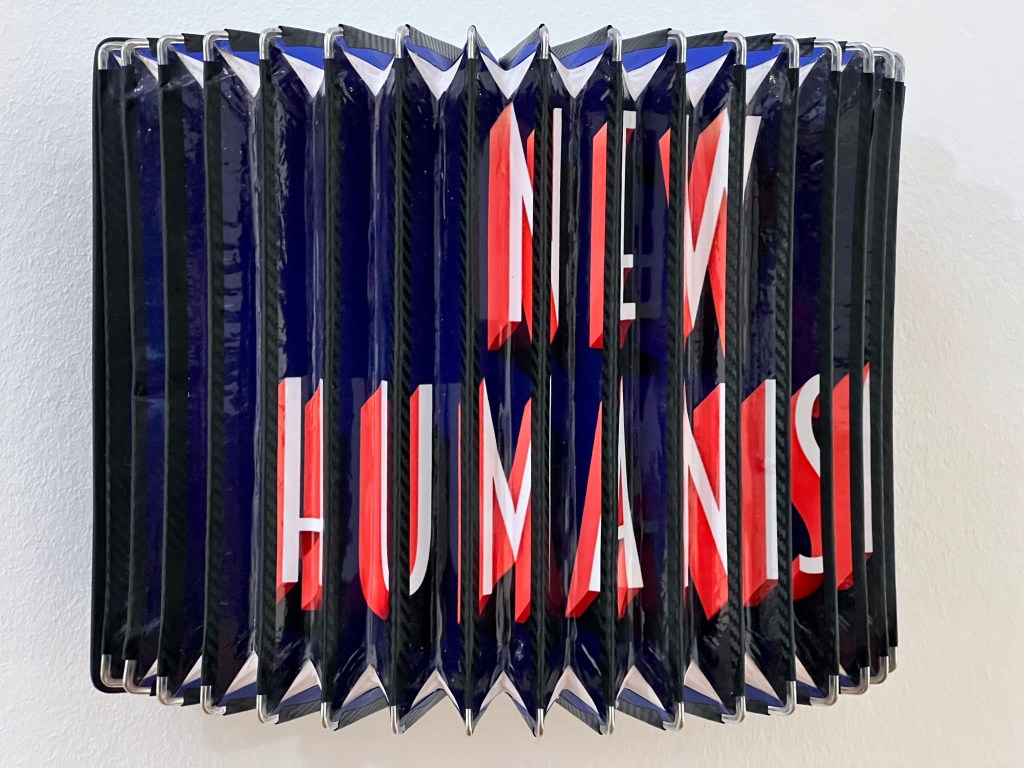
Resonant Bodies, Wandering Mind: Indirections Leading to Pável Aguilar’s “Acordeones Anticoloniales” (2022) via Naples, Cologne, New York City and Aberystwyth

Pável Aguilar, Acordeones Anticoloniales (2022), “New Humanism”; installation view, Museum Ludwig; photograph by Harry Heuser

Get out much? Going places? Ready to take the part of “tourist”? Loaded with loathsome connotations, “tourist” has become a tainted word associated with a lack of regard for the cultures and customs of people who are forced to host the multitudes heading south for a few rays of sunshine and a dip in the sea, or whatever the local attractions the attractiveness of which the locals are promptly deprived by strangers that temporarily lay claim to them.

I am a “visitor,” not a “tourist.”  That is a distinction I have always insisted on making when the latter label is affixed to me by New Yorkers, native or otherwise, who assume that my non-native tongue will stop wagging eventually to lick stamps set aside for picture postcards showing sights in the absence of which, once my “vagabond shoes” are back where they presumably belong, I am destined to suffer those “little town blues.”

To my mind, “visitor” better represents the close relationship that I—made in Germany, remade in/by NYC and based in Wales, as my Instagram profile proclaims—have with certain places, including Manhattan, whose sounds I recorded during my first visit in 1985 so that I might envelop myself in the metropolitan air by playing them back in the smalltown confines of my parents’ house.

Not that returning to places we once called home always feel like a homecoming, as my visit to that house in December 2022, after an absence of thirty-four years, persuasively drove home.

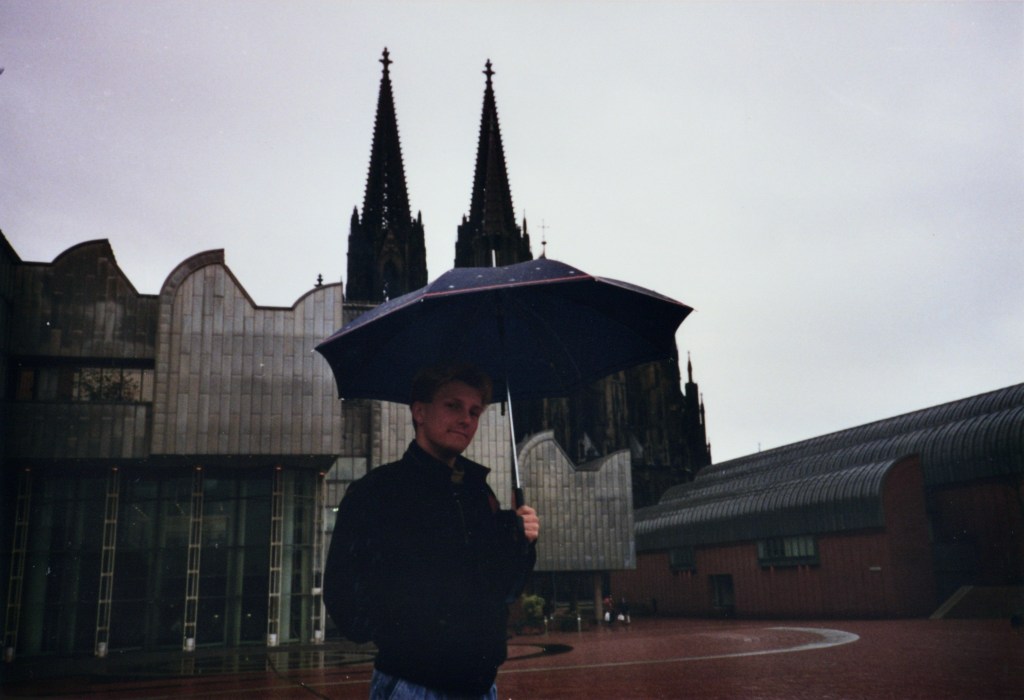
It was on that trip to the motherland that I went back as well, albeit not for the first time, to Museum Ludwig, the opening of which in 1986 I had greeted as a sign that Cologne had finally moved out of the shadow of the cathedral that towers over the cityscape like a two-fingered salute.

In front of Wallraf-Richartz Museum and Museum Ludwig, with Cologne Cathedral in the background, 20 Nov. 1988

Coming back, I was relieved to find that, during my absence, Museum Ludwig had not stood still and was still committed to engaging with the here and now, as its exhibition series Hier und Jetzt promises to do.  Especially reassuring to me was the series’ 2022/23 iteration Anti-colonial Interventions (8 Oc­t. 2022 – 5 Fe­b. 2023).  “Identity and Otherness” had long been a thematic strand of my art history teaching, whose attention to the marginalized derives from a personal history of dislocation, estrangement, and longing.

Continue reading “Resonant Bodies, Wandering Mind: Indirections Leading to Pável Aguilar’s “Acordeones Anticoloniales” (2022) via Naples, Cologne, New York City and Aberystwyth”

Retroactive Selfies: Hidden Snapshots, Open Wounds

“Keeping up with the out-of-date” am I? Well, sometimes the motto I chose for this journal hits home like a slap in the face.  Not a knock-out punch, mind.  Just the kind of cuff that crimsons the cheek all the more because it is unnervingly public.  Now, I am not slap-happy.  If I keep going way back for more and go on reflecting at length on the ostensibly passé that others could care less about it is because, to my mind, time is not of the essence.  That lingering tingle is, and I sting easily.

Whether or not we engage with it, there is no out-of-date as long as our memory serves.  Or, rather, it dictates, like a fingerpost redirecting us into the remotest regions of our mental landscape.  When it comes to our past, it matters little how long ago an experience dates back or however long in the tooth we are getting.  The past can still get at us, provided we are fortunate enough—if indeed we feel quite so appreciative—to have faculties that keep us from letting bygones be … well, you know the rest.

Continue reading “Retroactive Selfies: Hidden Snapshots, Open Wounds”

Asphalt Expressionism: The Creativity of Looking

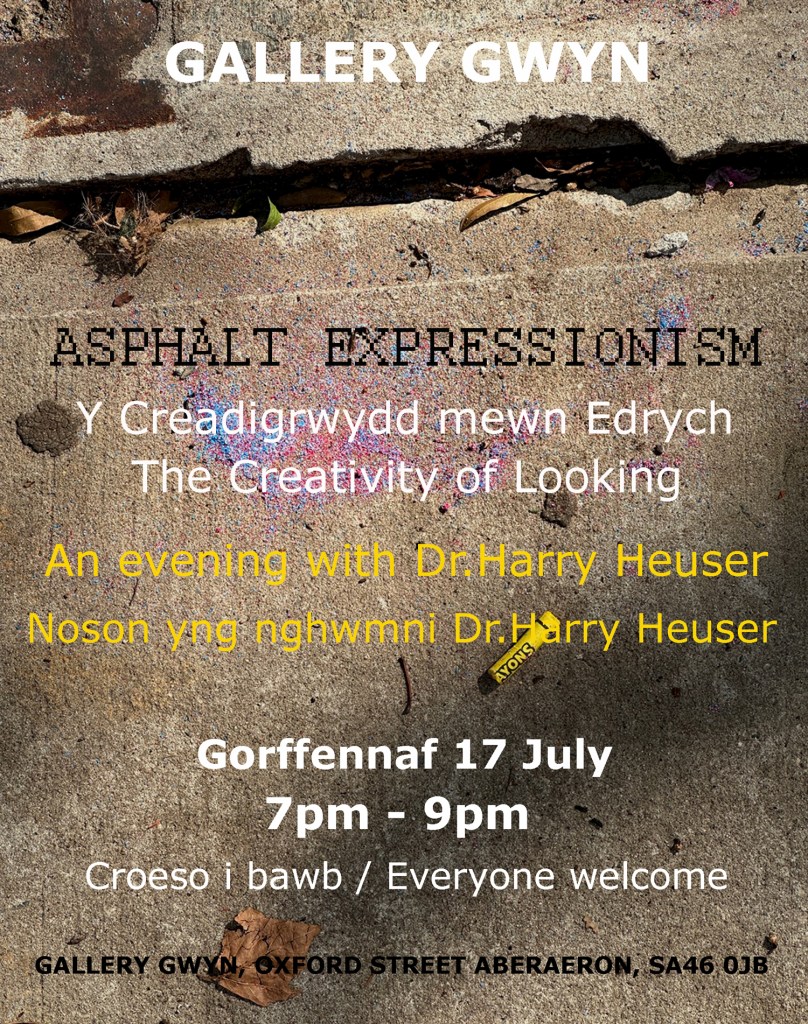
I have been asked, at some point during the run of my exhibition at Gallery Gwyn, to give a talk.  I requested that the event be announced as ‘an evening with.’  Asphalt Expressionism was intended to be inclusive and interactive, and the scheduled get-together, likewise, should promote exchange.  A conversazione, perhaps, but not a lecture.

Given that the smartphone is my primary means of creating the images huddled under the fanciful umbrella of Asphalt Expressionism—a series of digital photographs of New York City sidewalks—reference to the ubiquitous technology strikes me as an effective way of connecting with those who, phone no doubt in hand, might be joining me that evening.

Continue reading “Asphalt Expressionism: The Creativity of Looking”

“[P]eople are always interesting wherever they are”: My Tribute to Claudia Williams for the London Times

With Claudia Williams at one of her exhibition openings following the publication of An Intimate Acquaintance

I had not long arrived in sweltering New York City for a month-long stay in my old neighbourhood on the Upper East Side when I learned that, across the pond, in my second adopted home in Wales, the painter Claudia Williams had died at the age of 90. I first met Williams in 2005. She was conducting research on a series of drawings and paintings commemorating the flooding of a rural Welsh community to create a reservoir designed to benefit industrial England. With my husband and frequent collaborator Robert Meyrick, who had known Williams for years and staged a major exhibition on her in 2000, I co-authored An Intimate Acquaintance, a monograph on the painter in 2013.

A decade later, an article by me on Williams’ paintings was published online by ArtUK on 28 May 2024; and just days before her death on 17 June 2024, I had been interviewed on her work by the National Library of Wales. So, when given the opportunity to write a 1000-word obituary for the London Times, I felt sufficiently rehearsed to sketch an outline of her life and career, as I had done previously on the occasion of her artist-husband Gwilym Prichard’s death in 2015.


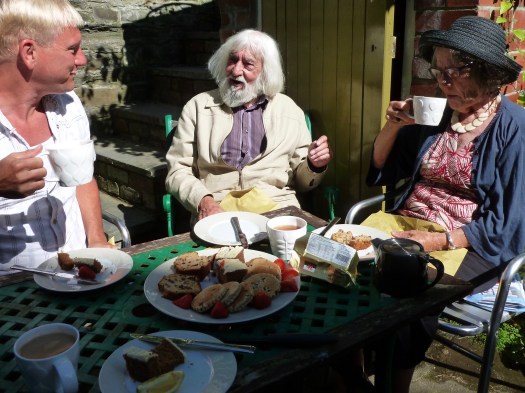
Lunch in the yard with Gwilym Prichard and Claudia Williams

All the same, I was concerned that it might be challenging to write another “original” essay, as stipulated by the Times, on an artist about whom I had already said so much and whose accomplishments I was meant to sum up without waxing philosophical or sharing personal reminiscences. In an obituary, salient facts are called for, in chronological order, as is a writer’s ability to determine on and highlight the essentials.

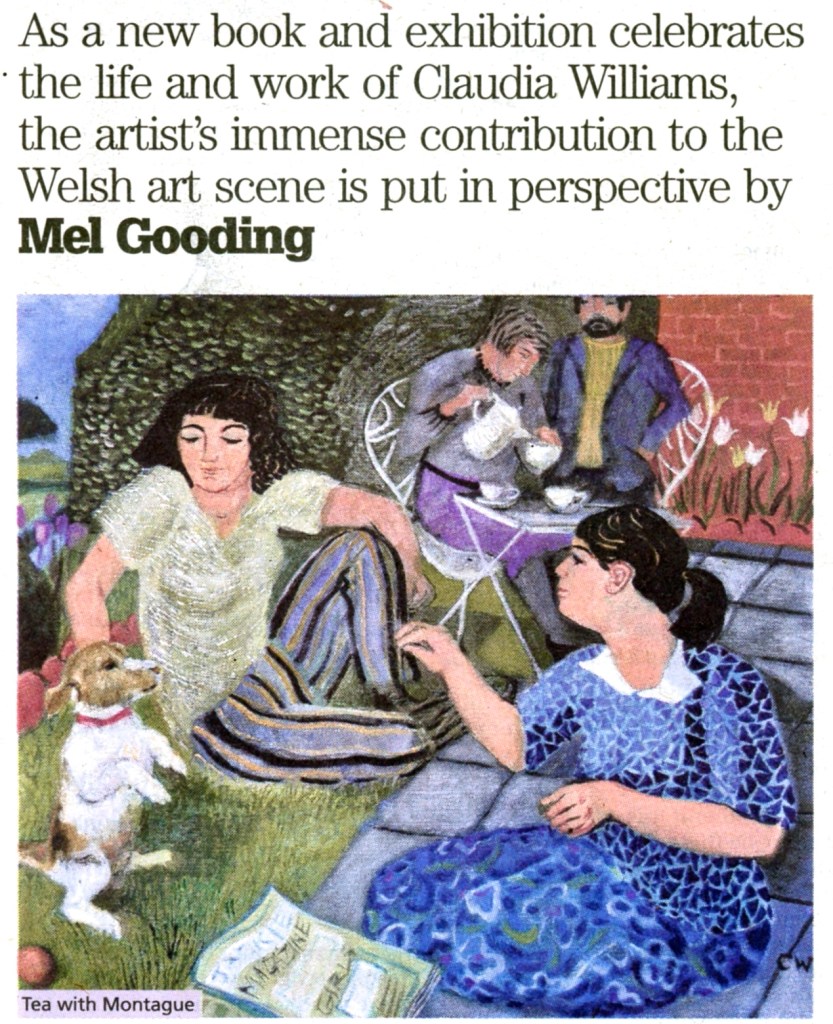
So I omitted recalling the enjoyment Williams derived from watching my Jack Russell terrier begging for food on his hind legs, a sight that inspired her painting Tea with Montague, or the “Mon Dieu” emanating from our bathroom when Williams and her husband, both in their seventies, intrepidly and jointly stepped into the whirlpool bathtub – slight episodes that, for me, capture Williams’ joie de vivre and her enthusiasm for the everyday.


Clipping of a newspaper article on An Intimate Acquaintance featuring my dog Montague as painted by Claudia Williams

In preparation for the monograph, Williams had entrusted me with her teenage diaries and other autobiographical writings, which meant there was plenty of material left on which to draw. Rather than commenting authoritatively on her contributions to British culture, I wanted to let Williams speak as much as possible in her own voice, just as her paintings speak to us, even though we might not always realize how much Williams spoke through them about herself.

What follows is the tribute I submitted to the Times.

Continue reading ““[P]eople are always interesting wherever they are”: My Tribute to Claudia Williams for the London Times”

Lying Down/Sitting Up: “Significant Othering” in Cat People (1942)

Never equals: Irena at Oliver’s feet

Cat People (1942) is a legendary and much-loved B-movie […] that, as Geoffrey O’Brien has argued in “Darkness Betrayed,” his notes on the Blu-ray release of Jacques Tourneur’s fantasy film, “manages, over multiple viewings, to break free from its own legend.”  Despite the fact that viewers—professional critics, academics and horror film enthusiasts alike—“have sifted every shot and every situation of this seventy-three-minute feature,” O’Brien adds, a “fundamental mysteriousness remains, a slippery unwillingness to submit to final explanation.”

There is no danger of that slippage into certainty happening here.  My mind, too, has a “slippery” nature.  It is resistant to, and indeed incapable of, any thought amounting to an “explanation” that could possibly be taken for a “final” solution—a terminal reasoning that, bearing my Germany ancestry in mind, has demonstrably shown to bring about and justify no end of horrors.  

A lack of understanding: Irena and Oliver

Cat People was produced at a particular time of uncertainty—and of particular uncertainties—about democratically enshrined equalities, about the limits of reason and the extent to which the stirring of irrational fear could be instrumental in the unfolding of millionfold death.  It is fantasy that, rather than being escapist, gets us to the core of uncertainties about the state of humanity, the doubtful definition and futurity of which, a year after the raid on Pearl Harbor and the end of US isolationism, many a cat got many a tongue.

Cat People is “fantastic” in the way the term was proposed by Tzvetan Todorov.  In his seminal study The Fantastic(1973), Todorov argues that the phrase “I nearly reached the point of believing” constitutes the “formula” that “sums up the spirit” he calls “fantastic.”  Perhaps, that thought, being proposed so declaratively and summarily, itself sounds rather too conclusive.  Subverting such reasoning, the “fantastic” exists only because it resists any summing up.  To grasp it in this way is to deny it.  Its existence is predicated on its elusiveness, on its perceived indeterminacy.

Continue reading “Lying Down/Sitting Up: “Significant Othering” in Cat People (1942)”

Mirror/Lamp: “Significant Othering” in The Old Dark House (1932)

The last time I approached that Old Dark House – the titular edifice of a 1932 Hollywood thriller directed by the queer English filmmaker James Whale and founded on a novel by the English social critic J. B. Priestley—my eyes were not focussed on any particular visual detail.  I was remarking generally on the house as a concretization of Priestley’s views on the condition of Britain after the so-called Great War, as the film and its source, Priestley’s Benighted (1927), are often understood: Interwar Britain as an empire haunted by its past and a kingdom lacking a vision as unifying as the largely unchallenged rule of its alleged heyday.

Never mind the map. Now entering gothic territory

Not that British moviegoers, let alone US American audiences, would have considered this perspective, partially obscured by the retitling of the property, as being essential to the experience of the fun house-ghost train atmosphere the film conjures.  Sure, the house, with its shadowy corridors, massive oaken doors and branching staircases, is as ill-lit as any old Gothic-fictional castle; but the unenlightened ones at the heart of this picture are its denizens, the backward, dim-witted and intractable Femms in whose midst we, along with a small group of unfortunate travelers, find ourselves.

Continue reading “Mirror/Lamp: “Significant Othering” in The Old Dark House (1932)”

Apart/in Parts: “Significant Othering” in The Lodger (1927)

In conjunction with “Gothic Imagination,” a visual culture module I teach at the School of Art, Aberystwyth University, I host an extracurricular festival of films by way of which to skirt the boundaries of the gothic beyond the landmarks and hallmarks of the Gothic as genre.

The Alfred Hitchcock-helmed silent romance thriller The Lodger (1927), a loose adaptation of a short story (1911) and novel (1913) by the suffragette Marie Belloc Lowndes, has featured in each of these series of film screenings—“Treacherous Territories” (2019), “Uneasy Threshold” (2021) and “Significant Othering” (2023). Approaching The Lodger anew, “Significant Othering” concentrates on the gothic or gothicized bodies that—in whole or in parts—figure in the sprawling landscape of movies in the gothic mode.

None of the prime embodiments of the literary Gothic materialize in the films screened.  The modally gothic does not depend on the presence of Frankenstein’s creature, Jekyll and Hyde, or Dracula; the multiplicity and hybridity that characterize those familiarly strange bodies are alive—make that “undead”—in the mutations of the gothic mode beyond the permutations of the genre.

As The Lodger drives home, what makes bodies what we might call gothic—although others may argue otherwise—is their otherness or, more precisely, the othering of them.

Continue reading “Apart/in Parts: “Significant Othering” in The Lodger (1927)”

Picasso and Lobsters: My “Rendez-Vous” with Heidi Horten

To say that I had misgivings about visiting the Heidi Horten Collection during a recent stay in Vienna is an understatement, especially in light of the scandal surrounding the scrapped auction of Horten’s jewelry, misappropriated as it was from Jewish families from whose disenfranchisement Horten and her husband demonstrably profited.  

The Heidi Horten Collection. All photographs: Harry Heuser

“Christie’s Cancels Sale of Jewelry Connected to Nazi-Era Fortune,” a 31 August 2023 headline in the New York Times read.  According to the article, the “decision follow[ed] a backlash from Jewish organizations after the auction house generated $202 million” in an earlier sale of Horten’s hoarded treasures.

My views on the Heidi Horten Collection—just like my viewing of the temporary exhibition “Rendez-Vous: Picasso, Chagall, Klein and Their Times” then on show there—were no doubt skewed.  And yet, I am certain that I would have felt just as disturbed and affronted had I been unaware of the controversy.

Continue reading “Picasso and Lobsters: My “Rendez-Vous” with Heidi Horten”

Crying Bleeding Kicking Screaming: Curating Prints by Marcelle Hanselaar from the School of Art Collection

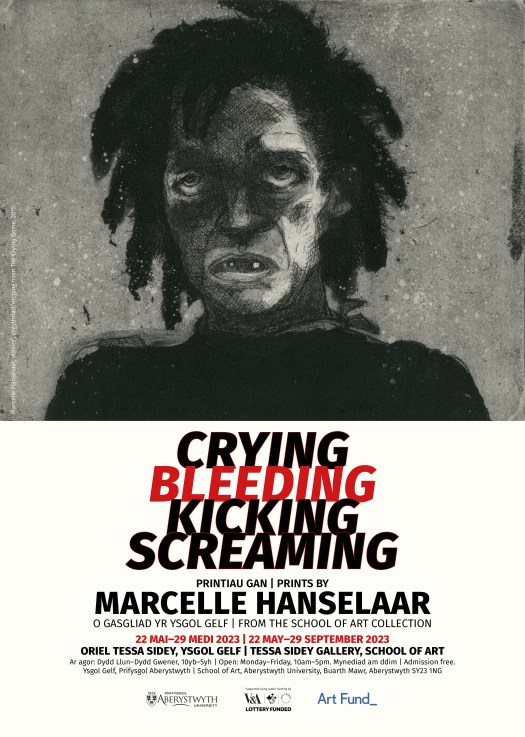
Poster design by Neil Holland featuring Marcelle Hanselaar’s print “The Addict” (2015)

“I love it when curators come up with juicy titles.”  That is how London-based painter-printmaker Marcelle Hanselaar announced the exhibition Crying Bleeding Kicking Screaming in one of her newsletters.

As Hanselaar put it, a title like that offers a “glimpse” of how others read her work and “how it might impact the viewer.”  It is “part preparation and part enticement to what will be shown and the very least it will do is to put visitors in a state of mind of curiosity.”

Hanselaar’s prints – and their titles – do just that: they make us curious, and they play on our inquisitiveness.  They do not necessarily show and tell us what we want to see, but they remind us that we are eager and anxious to look.  Providing another chance to view works in public, an exhibition can and should also facilitate the act of looking.

Continue reading “Crying Bleeding Kicking Screaming: Curating Prints by Marcelle Hanselaar from the School of Art Collection”