“Alone Together”: A Portrait of the Artist as an Artist’s Spouse

“So, here he is. My father. In a churchyard in the furthest tip of Llŷn. Eighty years old. Wild hair blowing in the wind. Overcoat that could belong to a tramp. Face like something hewn out of stone, staring into the distance.” The man observing is Gwydion, the middle-aged son of R. S. Thomas (1913-2000)—“Poet. Priest. Birdwatcher. Scourge of the English. The Ogre of Wales.” With this terse description opens Neil McKay’s “Alone Together,” a radio play first aired last Sunday on BBC Radio 3 (and available online until 28 March).

The voice of the Nobel Prize nominated poet (as portrayed by Jonathan Pryce) is heard reading lines from his works, the words that are, to us, a stand-in for the man. None of them escape the commentary of his estranged son: “Yes, you could tell yourself this is him, the real R. S. Thomas,” the observer, filial yet unloving, remarks. “But you’d be entirely wrong.” As his father’s old voice keeps on reciting, he adds: “Oh, he’d be happy enough for you to fall for it . . . and to fall for the version he tells of his own life.”

What compels the son to revise this “version” of a life is the life of another, a figure that, to his mind, is concealed or mispresented in the autobiography of the father. The figure is Elsi, the Welsh poet’s English wife (1909-1991), whose fifty-year-relationship with R. S. was compressed by him in these lines:

She was young;
I kissed with my eyes
closed and opened
them on her wrinkles.

Speaking of their first encounter, R. S. introduces Elsi as “a girl who was lodging fairly close by,” the kind of icy understatement with which Thomas, writing about himself in the third person, kept his distance from his readers, just as the people he knew and wrote about were turned into abstracts on a page. “He doesn’t even give her a name,” the son comments, “and that’s where it starts to unravel.”

The churchyard in which we are introduced to the father is Elsi’s burial place; it is Gwydion’s ambition and quest to bring her to life for us, to let us see her in something other than the austere words of an introverted, discontented, and tormented man—an Anglican rector who sought isolation in the remote west of “the real Wales,” who, advocating Welsh independence and separation from England, was consumed by what the Welsh call “Hiraeth”: a longing for home. In how far did this longing, this radical yet futile attempt at forging an identity alien to him, prevent R. S. from making a home for the two, the three, of them?

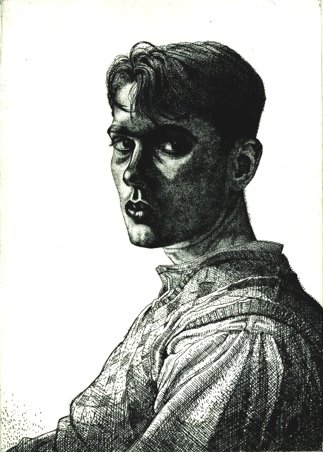
Searing, severe, yet profoundly moving, “Alone Together” is a compelling play at biography; listening to it, I was reminded of the above self-portrait of Elsi, who, as an artist, was known as Mildred Eldridge, respected and sought-after long before R. S. published a line of poetry. Until now, whenever I looked at it, hanging there on a wall of our home, I have never considered it as an autobiographical act.

Both their approaches to rendering the self seem indirect, his being the third person singular, hers a reflection. Eldridge does not assume the center of the frame; nor does she give us a close-up of the face in the looking-glass; and yet, her self-portrait, tentative as it may be, allows us a glimpse at her perception. The distant self in her husband’s performance, by comparison, seems a construct, the artifice of an entire controlled performance. Unlike her husband, Eldridge appears before us the first person singular, letting us see her as only she sees herself: a mirror image.

In how far are written or spoken words a path to—or a vessel for—the essence of the one writing or speaking? Is anyone knowable through the vocables that are a locum for self and experience? Cautioned not to take a father’s word for whatever “it” amounts to verity, can we now trust the estranged son in his voice-over, his over-writing of the words he claims to be false or misleading?

“Alone Together” suggests that, for all his accomplishments as a writer, R. S. Thomas—who yearned to be Welsh but could not speak it, who, as Elsi puts it, “adopted the vowels of an Oxford Don” to hide the shame of being, as he puts it, an “ignorant Taff from Cardiff”—envied the ease with which his accomplished artist wife communicated in a language beyond words, expressed herself freely on a blank canvas . . . and felt at home there.
Death Draws No Line: Edgar Holloway (1914-2008) Remembered

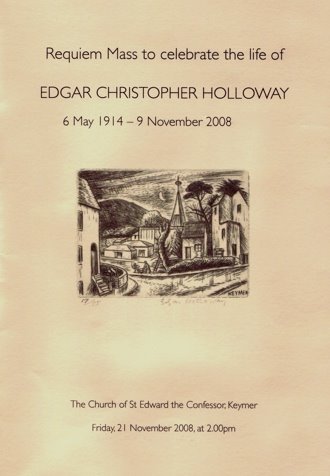
It was an honor to write the farewell that, at last, appeared in The Guardian today. It was agony, too, this assignment to capture, in the scant space allotted, the likeness of an artist who told of himself in etched lines more lasting than those far from final words of mine. Indeed, what I had intended to be the last line was clipped by that dispassionate, faceless Atropos of the publishing world, the editor. It read: “Holloway was that rarest of prodigies: he lived up to his promise.” Edgar Holloway, who passed away at the age of 94 on 9 November 2008, was just that: a promising young artist who continued to share his gifts into old age, no matter how fickle the fortunes, how mutable the market.

It is this picture of success in adversity that I wanted to paint: a teenager without means and formal education who got to etch the portrait of T. S. Eliot and other illustrious sitters; a self-conscious young man who, afflicted with a skin disease, examined and displayed a face he often felt compelled to hide; a boy wonder born too late and raised in an age that seemed past miracles; a skilled chronicler of life denied the chance to serve his country at war by recording its devastation; a distraught teacher who went into the countryside to restore his health only to find his fortunes fall in the city that could keep his career alive; an artist who found a lover in the model of another; a young father who taught himself to be practical to provide for his growing family; a printmaker who sold his tools for scrap metal when the once lively trade appeared to have died; a mature man who returned to art after machines had put an end to the demand for his craft; a painter active in old age, whose gifts were unimpaired yet whose newfound acclaim was based chiefly on a likeness he had etched in adolescence—a likeness so unlikely to represent all that he had to share.

Being a relative newcomer to the British Isles, I was ignorant of Edgar Holloway’s accomplishments, as familiar as I soon became with the face that looks out at me from that handsome self-portrait on our kitchen wall. My partner, who has written extensively on him and who was privileged to befriend him, could tell me much about Edgar; but it was not until I greeted the man in our home that I learned more fully to appreciated the stories a portrait can tell and withhold: “Here I am,” it whispers, and “find me.”

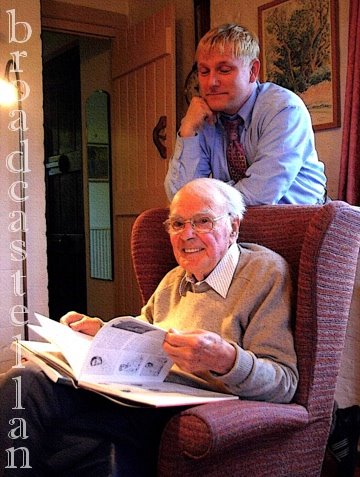
Last April, when we visited Edgar and his wife Jennifer in their home in Sussex, England, I glanced over the artist’s shoulders as he browsed the catalogue of his oeuvre and recalled scenes and events of a long, rich life. His memory was fading; but many of his impressions remained strongly etched in his mind and could be reproduced for inspection.

“My memory is not nearly as good as yours,” I told him when the task of recalling became more frustrating than rewarding; “but unlike you,” I added, “I have done so little that seems worth remembering.”

A Slice of Bacon . . . to Go

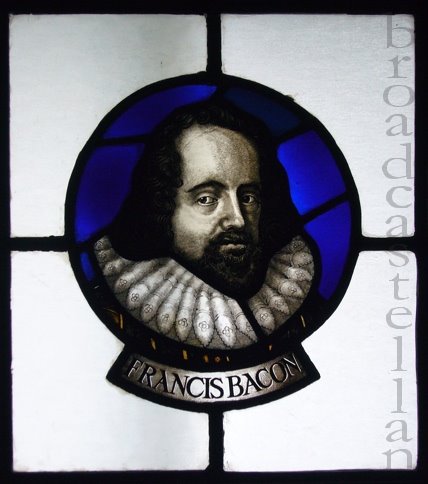
It seems I am going back to school.  If I take Francis Bacon literally, that is. Considering that his stained-glass likeness greets me whenever I turn on the boiler or am induced by allergies to reach for the vacuum cleaner, it is high time I start quoting him now. According to the aforementioned essayist, “He that travelleth into a country before he hath some entrance into the language, goeth to school, and not to travel.” A timely reminder, as we are off tomorrow on a last-minute trip to Riga, Latvia.

Stained-glass likeness of Francis Bacon in our home

Es nerunāju latviski.  That is to say, I am a stranger to the native tongue (which is related to Sanskrit); and, having just gotten my hands on a couple of guidebooks, I realise that I am a stranger as well to much of the culture and history of the Baltic nation, even though German influences are pronounced—being that Riga was founded by Albrecht von Buxthoeven, a German bishop, and rarely enjoyed independence for long—and English, as is the case in most larger Western cities nowadays, is widely understood.

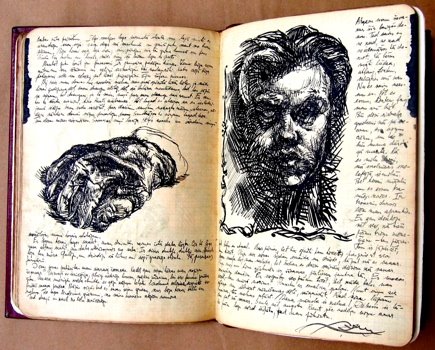
Francis Rudolf’s diary with self-portrait

Much could be gleaned, no doubt, from the journal of a local, that is, a Latvian Francis, meaning the expatriate Renaissance man Francis Rudolf or Rudolph (1921-2005), some of whose paintings, drawings and diaries (shown here) were gifted a few years ago to a university here in Aberystwyth, the town where I currently reside.

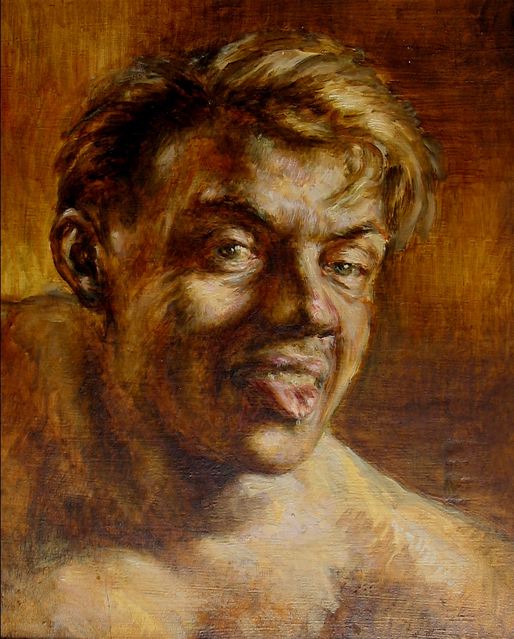
“Expatriate” is too clinical a term: Rudolf was forced to migrate during his youth, when Latvia was being invaded by the Nazis and the Red Army.  There he is, sticking out his tongue at us who are still largely ignorant of his world; yet it was he who put Latvia on the map for us and got me intrigued about Riga.

Francis Rudolf, undated self-portrait

Richard Wagner and Sergei Eisenstein aside, there are few names in the Riga travel guides to which a journal devoted to US radio dramatics can readily relate.  Determined not to stoop to the sharing of random snapshots, I shan’t continue broadcastellan until the conclusion of my “scholarly” outing, which is preceded and followed by sojourns in familiar destinations in Wales (Cardiff), England (Manchester), and the Netherlands (Amsterdam). Technology permitting, I might file the occasional report.

It rather irks me to be silenced by the marginal nature of my chosen subject.  What a failure of self-expression, what a missed opportunity a journal like this is if it cannot accommodate whatever its keeper happens upon, sees and undergoes; yet such is the curse of the concept blog.

“Let him keep [. . . ] a diary,” Bacon rightly advises.  I often regret my own strictures in this respect, as I imagine that my experiences may be rather more relatable to some than the dramatics of radio are to most.  Besides, an online diary is ideally suited to the recording of everyday observations.  

As has been demonstrated rather conclusively by the dead air I left behind on past travels, I seem incapable of reconciling the peripatetic with the armchair reflective.  Still, I hope my experiences are going to enter into this journal somehow.  As Bacon recommends,

[w]hen a traveller returneth home, let him not leave the countries, where he hath travelled, altogether behind him […].  And let his travel appear rather in his discourse, than his apparel or gesture; and in his discourse, let him be rather advised in his answers, than forward to tell stories; and let it appear that he doth not change his country manners, for those of foreign parts; but only prick in [that is, plant] some flowers, of that he hath learned abroad, into the customs of his own country.

Now, I have long been confused as to what “his own country” might mean, being that I have not lived in what is presumably and legally “home” to me for nearly two decades; but, in lieu of on-the-spot reports, I shall endeavor to gather and display such “flowers” as may withstand the airwaves or can be securely propped against a microphone . . .

Audiophile, My Eye!

Has my ear been giving me the evil eye? For weeks now, I have been sightseeing and snapping pictures. I have seen a few shows (to be reviewed here in whatever the fullness of time might be), caught up with old friends I hadn’t laid eyes on in years, or simply watched the world coming to New York go by—all the while ignoring what I set out to do in this journal; that is, to insist on equal opportunity for the ear as channel through which to take in dramatic performances so often thought of requiring visuals. When. in passing, I came across this message on the facade of the Whitney Museum, my mind’s eye kept rereading what seems to be such a common phrase” “As far as the eye can see.”

It is the article that began to overshadow the empty nest below the dead eye of the cyclopean window in the austere façade, features that might well be to some what Roland Barthes referred to as the punctum—the point(s) to which the eye is drawn, the dot(s) that end up in the question marks we make of art that engages us.

What might that be, “the eye”? Are we to assume that one eye looks out into the world as any other, that the act of seeing is objective, divorced from outlook, range and perspective? Does “the eye”—untrained or jaundiced or unfocused—invariably begin to see things as it seeks what lies beyond perceiving, such as an imaginary bird returning to the nest of our senses?

A few days ago, I suffered an eye infection (come to think of it, the second one since my arrival here in late May), which brought the above picture back to mind. I am not sure just how it happened, but my right eye became alarmingly inflamed, my lid swelled up and my cornea buckled. It is still pounding now, even though there no longer exists any ocular proof of my discomfort. Perhaps, my eyes are aching for a break upon which they now begin to insist.

A day after the incident I ran into a former neighbor of mine. I had seen him only a few days earlier. This time around, he was wearing an eye patch. As I later learned, he had just lost his sight in one eye, yet too distressed to explain or share his grief. What would I do without my vision, imperfect as it has become over the years? I could not help pondering. Suddenly, my insistence on rooting for the ear as a sensory underdog began to sound rather hollow. I want to keep going out in public and see the world before I allow myself to be dragged away by the ear into the privacy of my inner visions . . .

The “greatest Hungarian sculptor of our time”: A Memo to Blanche Devereaux

You don’t derive much comfort from a musty expression like “let a smile be your umbrella” when you are walking around Óbuda on a wet and gloomy afternoon. It was pretty much wet and gloomy throughout our second stay in Budapest, and even the statues seemed to be putting up their defences against the elements. I was cheered nonetheless by Imre Varga’s “Women with Umbrellas” (pictured here); and when we walked around the gallery dedicated to the work of the greatest Hungarian sculptor of our time,” a scene from The Golden Girls came to my mind, which tends to operate that way.

In an episode originally aired on 19 December 1987 (about a year and a half before I first caught sight of the gals from whose exchanges I learned American English), Blanche, Rose, and Dorothy all agree to pose nude for a sculptor. A Hungarian sculptor, that is. Aside from the thrill of being immortalized in art, what is most on the minds of the three is that Laslo is a bachelor, and a virile specimen at that. They are all pretty much smitten with the self-assured man with the magnificent voice who, as played by Tony Jay, comes across like a cross between Monty Woolley (radio’s “Magnificent Montague”) and Mischa Auer (briefly known as “Mischa the Magnificent” on the air).

When the artist’s work is done, it remains to be seen whether he is interested in pursuing one of them:

Blanche. Laslo, before you make your choice, just let me say what a privilege it has been for me to come here and work with the man whom I consider to be the greatest Hungarian sculptor of our time.

Dorothy. Yes, and just let me say that if Blanche can name two other Hungarian sculptors of any time I shall eat that statue.

I’m getting close, Blanche, should you ever choose to “phone a friend” (even though, as you soon realized, Laslo is a “friend of Dorothy’s”). Imre Varga is a magician who can make sheet metal seem like sheer silk or imbue it with the weight of human suffering, who can make dead matter sway and sway us into believing that the dead matter. His work, which has withstood the political upheavals that relegated many of his contemporaries to the scrapheap (or the ghetto that is Statue Park), is a chronicle of a people and the individuals among them who influenced the course of its history (like St. Stephen, pictured above). Through his portraits in metal, Varga will make you look up names and never let you forget his own . . .

The Great Dictation: Milton, Munkácsy and the Blind Medium

I did not know what to expect when I stepped inside the Hungarian National Gallery, a war-battered royal palace turned into a public museum during the days of Communist rule in Budapest. Somehow, Hungarian culture has remained a closed book—or rather, a neglected volume—to me; and looking at rooms filled with art depicting scenes from Magyar history made me come face to face again with my own ignorance.

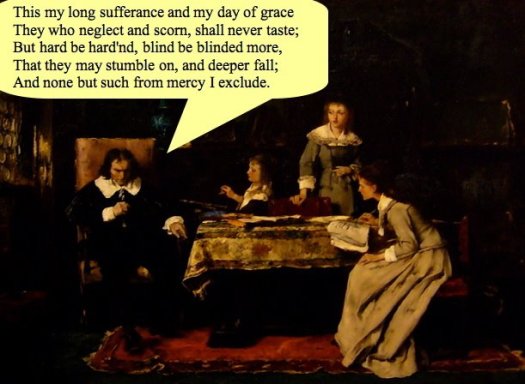
How welcome a sight was “The Blind Milton Dictating ‘Paradise Lost’ to His Daughters.” Yes, that face was familiar, as was the composition, even though I had never troubled myself to note, let alone pronounce, the name of its artist: Mihály Munkácsy. I was surprised to reencounter “Blind Milton” there, knowing it to be on permanent display at New York Public Library on 42nd Street (where it is currently the centerpiece of an exhibition celebrating Milton’s life and works). As it turns out, there are two version of Munkácsy’s painting, the one in New York City being the larger of the two.

This year marks the quatercentenary of Milton’s birth, so we are likely to come across “Blind Milton” in the arts and literature sections of our newspapers or the pages of magazines on history and culture. Even in the 19th-century, the image was frequently reproduced on paper. Indeed, we happened upon such a reproduction at a second-hand bookstore in the Hungarian capital not long after our gallery visit, on the very day it was featured in The New York Times arts section online.

The image became so familiar that, by the twentieth century, the

usual conception of John Milton in the imagination of America’s school children has been a misty mezzotint of a blind man sitting in a dark room dictating Paradise Lost to his bored but dutiful daughters.  That Milton was one of the most fearless and most revolutionary thinkers of his century few youngsters have ever been permitted to know.

.This is how, in 1939, Max Wylie prefaced “The Story of John Milton,” a script from the radio series Adventure in Reading (NBC; 1938-40). The play (by Helen Walpole and Margaret Leaf) tells of blindness, vision, and the specter of persecution as the monumental struggle of the beleaguered poet is being recalled by the voices he called forth in his art.

For twelve years, Milton’s ideas had been in the service of the Commonwealth, until the Restoration threatened to obliterate his words and legacy. Awaiting news from his friend Sir Harry Vane, Milton tries to dictate Paradise Lost to his daughter Mary:

Milton.  You aren’t writing, Mary, you aren’t writing!

Mary.  How can I father? How can I do anything … while we’re waiting for the coming of Sir Harry!

Milton.  Write.  Take down what I say.  “Wolves shall succeed for teachers, grievous Wolves, / Who all the sacred mysteries of Heav’n / To their own vile advantage shall turn. . . .”

Mary.  I cannot.  I cannot.  Paradise Lost may never be finished.

Milton.  Paradise Lost shall be finished.  I’m not a human being any longer, Mary.  I’m an instrument … a vessel … you don’t understand that … but no matter … I may seem hard to you and your sister … but that’s not important either. . . .

Mary.  I shall try to write.  Dictate it again, father.

Milton.  “Wolves shall succeed for teachers, …”

The war of ideas and the fight for their expression—a challenge as urgent in 1660 and 1939 as it is today—is a fitting subject for the so-called blind medium, a medium capable of conjuring images before the mind’s eye not grown dim from lack of exercise.

Milton is accused of treason. The burning of his books, to be executed by “a common hangman,” have been ordered. “Blind among my enemies…. How can I fight?” the poet cries in near despair, until, roused by his visions, he declares:

If, by my own toil, I have fanned the flame that burned out my eyes … then from that darkness will be born new eyes. All natural objects shut away … I can see clearer into life itself….  My vision will not be blurred or turned aside! And so, O, Highest Wisdom, I submit.  I am John Milton, whose sight was taken away that he might be given new eyes.

It is in the opening lines of the third book of Paradise Lost that Milton comments on his condition:

I sung of chaos and eternal night,
Taught by the heav’nly muse to venture down
The dark descent, and up to re-ascend,
Though hard and rare: thee I revisit safe,
And feel thy sovran vital lamp; but thou
Revisit’st not these eyes, that roll in vain
To find thy piercing ray, and find no dawn;
So thick a drop serene hath quenched their orbs,
Or dim suffusion veiled […].
Seasons return, but not to me returns
Day, or the sweet approach of ev’n or morn,
Or sight of vernal bloom, or summer’s rose,
Or flocks, or herds, or human face divine;
But cloud instead, and ever-during dark
Surrounds me, from the cheerful ways of men
Cut off, and for the book of knowledge fair
Presented with a universal blank
Of nature’s works to me expunged and razed,
And wisdom at one entrance quite shut out.
So much the rather thou celestial light
Shine inward, and the mind through all her powers
Irradiate, there plant eyes, all mist from thence
Purge and disperse, that I may see and tell
Of things invisible to mortal sight.

It seems that, in the scene depicted by Munkácsy, Milton is dictating these very lines, at the moment dramatized for Adventure in Reading. His three dutiful daughters look anything but bored. Entrusted with a solemn responsibility and not altogether ignorant of their father’s perilous position, they are rapt and apprehensive as they listen to the dictation, encoded in which is the speaker’s intimate story, a few telling lines in an epic on the fallibility of humankind.

The Camera, the Coast and the Canvas: A Picturesque Incident

“Let’s go for a ride,” he said. “Where to?” I dared to ask; but there was no reply more concrete than a “Wait and see.”

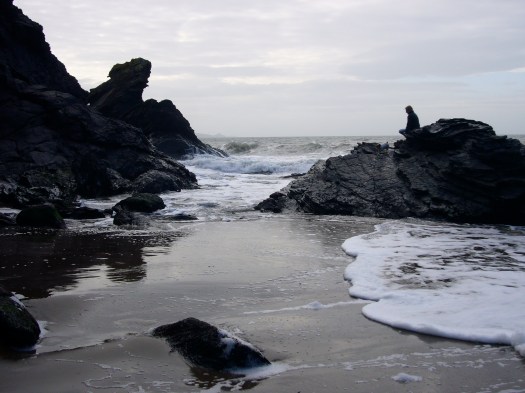
The sky was clear yesterday, and the afternoon seemed right for a jaunt, a break from the radio waves in which I tend to immerse myself to the point of drowning. So, off we three went. Montague, my lover, and I. We drove down the Ceredigion coast to a secluded little seaside town called Llangrannog. We climbed down the steps to Cilborth Beach, which we had all to ourselves. My eye was drawn to the mysterious Carreg Bica, the rock you see me (and Montague) contemplating here. Legend has it that it is the tooth of a giant; it has become more scraggly through the years after a large chunk of it was claimed by the Irish sea.

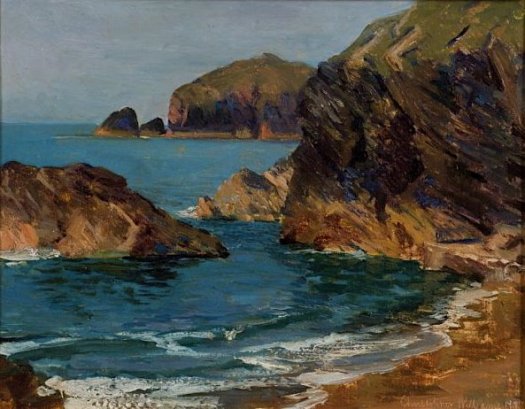
What I did not know until we got to Llangrannog is that this was to be an excursion into the picturesque. We had come in search of a specific scene as shown in this painting by the Welsh artist Christopher Williams (1873–1934). And there it was, ninety years later, the same seascape, that ever changing, never changing scene. Bica’s decaying tooth excepting. The tide was right in; so we did not get to see the coastline just as it appeared to the artist back in 1917, when its a rock solidity must have been welcoming and reassuring, far removed as it stood from the all-consuming whirlpool uncertainties of the Great War, the horrors of which Williams captured in The Welsh at Mametz Wood (1918).

Now, as I learned upon our return home, that painting is to be ours; it will join a portrait by Williams’s son, Ivor (“Suffolk Farmer,” shown in this Wikipedia entry). Whatever happened to holiday snapshots? I wondered, all the while enjoying the sheer extravagance of this picturesque experience.

Hang On! It’s That Girl from Number Seventeen

As I recently remarked in a comment on another intriguing entry in the Relative Esoterica journal, I live in a house that is filled with art—with etchings, drawings, paintings and pottery. Yet I still lower a blind on it all and turn down the lights each night to screen copies of moving pictures, few of which would seem relevant to the cinemagoers of today. I have been just as slow or reluctant to relate to the art on the walls and shelves that surround me, not having been actively involved in selecting it. There are pieces I pass without perceiving, unmindful of their cultural significance, indifferent to their monetary value. Others I insist on declaring mute, being that they seem incapable of speaking to me without denouncing me as an ignorant trespasser. There are those I am fond of and care to wonder about, that I permit to involve me in musings and study. Well, I needn’t tell you what art can do to you if you let it.

Quite by design, then, there is a general disconnect between the Hollywood images flickering on our screen and the Welsh landscapes, still lives, and portraits bordering or facing that square of blank canvas set up and aside for my cinematic getaways—my “blind” spot, you might say. Sometimes, though, the still images in our collection begin to mirror those we set in motion. That is just what happened last night during a screening of Alfred Hitchcock’s Number Seventeen (1932).

By the director’s own admission, Seventeen is somewhat of a “disaster.” It is one of those old dark house thrillers in the short-lived but lively manner of Earl Derr Biggers’s aforementioned Seven Keys to Baldpate, a theatrical heritage Hitchcock acknowledged only to blast it in a fast and furious finale set on a runaway train. As in many of those Cat and Canary affairs, you struggle to keep track of who’s who, aware that the identities of the two-dimensional characters are interchangeable, or chameleonic, at best. The biggest surprise in this at times frantic picture is none that Hitchcock and his team could have anticipated. Trapped within Number Seventeen is a girl whose age has not quite reached said number. Ann Casson! my partner exclaimed, the name having appeared in the credits. And there she was, whoever she was, playing a handcuffed damsel hanging from a broken railing of the winding staircase in that old, dark house (as pictured above).

Now, who exactly is Ann Casson (1915-1990)? Trust me, I did not have as much as an inkling. She is, to begin with, the daughter of Dame Sybil Thorndike, the noted British stage and screen actress with whom Casson, as Phaedra, toured in Hippolytus by Euripides; during the Second World War, the actress also toured Wales, my present home. By that time, she had given up on a career in motion pictures. She had appeared in a small number of films in the early 1930s, making her debut in an adaptation of Galsworthy’s Escape (1930) under the direction of Basil Dean (whose Sing as We Go we had already decided on watching tonight). To me, though, Casson is now “that girl in the picture.” Not Number Seventeen, mind you, but one of the images in our collection.

The picture in question is a portrait by Christopher Perkins (1891-1968), a British artist best known in New Zealand, where he lived, painted, and taught during the early 1930s. The drawing is not dated, but, judging from the dress and hair style of the sitter, must have been executed some time between Perkins’s return to England in 1934 and the outbreak of the Second World War. It came into our home some six decades later, a purchase from a dealer who acquired it from the descendants of the artist. If it hadn’t been for Number Seventeen, I would not have gone on this trip of discovery and returned with a sense of relationship. Like Hitchcock’s model train, my mind went off the track, carrying me where I hadn’t thought of ever going. We did not have a strong attachment to this modest drawing; but now I am determined to hang on to it, if only as another reminder of the thrills of research, the art of making other lives relevant to our own . . .

In this spirit of connecting I would like to acknowledge the generosity of Reg Adkins (of ElementalTruths.com), who took the time to review broadcastellan on Blogexplosion, and of the Blogged.com team, who have done the same for their site. Long accustomed to the blindness of strangers, I no longer aspire to mattering or making sense to others—but it is gratifying to learn that our voices from the niche have the potential to echo beyond the hollow we dig for ourselves.

The Hirst Noel

Well, New York City is looking more festive than ever, “ever” starting from the first Christmas I spent here back in 1989. There are outdoor markets on Union Square and Bryant Park, and a holiday fair at Grant Central Station. A departure from the city’s traditional Christmas windows, to say the least, was the above installation at the Lever House on Park Avenue in midtown Manhattan. I recall a Christmas carousel in the window; but this year, there was something else on display that is sure to make your head (and possibly your stomach) turn.

Damien Hirst’s “School: The Archaeology of Lost Desires, Comprehending Infinity, and the Search for Knowledge” (12 November 2007 to 9 February 2008) is billed as a “complex and thought provoking presentation that makes numerous references to art, science, art history, authority, knowledge, culture, religion, and beliefs,” as the curator of the $10 “School,” which took about $1 to assemble, describes it in the handout you may pick up as you walk in from the street.

Lever House, designated an official landmark in 1992, is one of those buildings you walk past without looking up; it takes an installation like Hirst to make you stop and wonder. We had just come from SYMS to pick up a few ties (where else would you buy ties in New York!) when we spotted the glass tanks filled with animal carcasses. Discomfortingly well-ordered and awfully beautiful, Hirst’s “School” is even more disturbing than the rate at which our money is going . . .

Kaboom! Kerplunk! Ka-ching!

Well, being that I am off to Cardiff on Thursday to see the touring Young Vic production of Hergé’s Adventures of Tintin, I thought I’d make this serial and comic strip week here on broadcastellan. “Blistering barnacles” and “Cushion footed quadrupeds”! I am smack in the middle of the “Funny Book War” as staged by Michael Chabon in The Amazing Adventures of Kavalier & Clay; and even though my comic treats were generally of not of the superheroic kind (to which this recent portrait attests), comics are very much on my mind.

It so happens that the aforementioned (and by now controversial) boy reporter and his creator are also the subject of the BBC Radio 4 documentary “Tintin’s Guide to Journalism” (available online here until 23 November). In this broadcast, which also features the voice of Tintin creator Hergé, journalist Mark Lawson investigates cases of real-life reporters who were inspired to enter their profession by books like King Ottokar’s Sceptre. In my case, comics simply inspired imitation.

The Germans are said to have papered the way to the comics with the picture books of Wilhelm Busch (Max und Moritz), which is where I started out as well. After graduating from the Katzenjammer Kids inspiring Max und Moritz, I became an avid comic collector, spending virtually all of my Taschengeld (distributed as it was back then in Deutsch Marks) on weeklies like Fix und Foxi.

Sigh! My family could not afford to have me shod there; but I still sneaked into the Salamander shoe stores to browse just long enough to grab my copy of Lurchi, another treat being the stories of Mecki the hedgehog I clipped from the pages of the German radio and television magazine Hörzu. More inclined toward the buzz of Maya the Bee than to the “THWIP!” of Spiderman, my comic book phase ended as I entered my teenage years. Make that my “comic reading phase,” since I kept drawing them. My own creations often mocked those among my pubescent schoolmates who kept up with the exploits of guys like Superman or The Phantom.

It was only after I graduated from the comics that I discovered a connection between cartoon bubbles and comic speech, the kind of connection to which the Americans owe the serial adventures of Amos ‘n’ Andy, the kind of affinity that made it possible for New York City Mayor La Guardia to read Little Orphan Annie on the air during the 1945 newspaper strike.

Even though I had very little exposure to radio drama, being the walking TV Guide in my family, I created in the character of Inspektor Bullauge (Inspector Bull’s Eye) a comic for the ear. I made up the story as I played the parts, more interested in the sound effects I could use and record to bring my cardboard creation to life.

Zowie! Despite dedicating an estimated 300,000 words of this journal to popular culture (and radio dramatics in particular), I have never explored here the relationship between onomatopoeia and the equally imaginative world of sound effects . . .