
Hustle Bustle

Generally, I don’t leap at the chance of gawking at gowns worn by Nicole Kidman, Uma Thurman, or Kate Beckinsale, period costumes currently on view at the American Museum in Britain just outside Bath. Still, I was intrigued by the museum’s exhibition Dollar Princesses and, on a trip to the old spa town last Thursday, we trotted up to Claverton Manor (pictured) to have a look.

Dollar Princesses tells the story of what Oscar Wilde referred to as the “American Invasion”—the eastern migration of moneyed American women dead set on a title and deigning to take any destitute Englishman yet attached to it in the bargain. Take Jenny Jerome, for instance, who courted in record speed—a mere three days—to beat the moneyed crowds so as to become Lady Randolph Churchill. Her son Winston, incidentally, made his first political speech at Claverton Manor back in 1897.

As I looked at the artifacts and read the literate panels, I was reminded of the impression made by American heiress Isabel Boncassen on Lord Silverbridge, characters of The Duke’s Children (1879-80) by the Victorian novelist Anthony Trollope:

Thrice within the next three weeks did Lord Silverbridge go forth to ask Mabel to be his wife, but thrice in vain [. . .]. It was no doubt true that he, during the last three weeks, had often been in Miss Boncassen’s company [. . .]. But Mabel had certainly no right to complain. Had he not thrice during the same period come there to lay the coronet at her feet;—and [. . .] was it not her fault that he was not going through the ceremony?

“I suppose,” she said, laughing, “that it is all settled.”

“What is all settled?”

“About you and the American beauty.” 

“I am not aware that anything in particular has been settled.”

“Then it ought to be,—oughtn’t it? For her sake, I mean.”

“That is so like an English woman,” said Lord Silverbridge. “Because you cannot understand a manner of life a little different from your own you will impute evil.”

“I have imputed no evil, Lord Silverbridge, and you have no right to say so.”

“If you mean to assert,” said Miss Cass, “that the manners of American young ladies are freer than those of English young ladies, it is you that are taking away their characters.”

“I don’t say it would be at all bad,” continued Lady Mabel. “She is a beautiful girl, and very clever, and would make a charming Duchess. And then it would be such a delicious change to have an American Duchess.” 

“She wouldn’t be a Duchess.” 

“Well, Countess, with Duchessship before her in the remote future. Wouldn’t it be a change, Miss Cass?”

“Oh decidedly!” said Miss Cass.

“And very much for the better. Quite a case of new blood, you know. Pray don’t suppose that I mean to object. Everybody who talks about it approves. I haven’t heard a single dissentient voice. Only as it has gone so far, and English people are too stupid you know to understand all these new ways,—don’t you think perhaps—?”

“No, I don’t think. I don’t think anything except that you are very ill-natured.” Then he got up and, after making formal adieux to both the ladies, left the house.

As soon as he was gone Lady Mabel began to laugh, but the least apprehensive ears would have perceived that the laughter was affected. Miss Cassewary did not laugh at all, but sat bolt upright and looked very serious. “Upon my honour,” said the younger lady, “he is the most beautifully simple-minded human being I ever knew in my life.”

“Then I wouldn’t laugh at him.”

“How can one help it? But of course I do it with a purpose.”

“What purpose?”

“I think he is making a fool of himself. If somebody does not interfere he will go so far that he will not be able to draw back without misbehaving.”

“I thought,” said Miss Cassewary, in a very low voice, almost whispering. “I thought that he was looking for a wife elsewhere.”

“You need not think of it again,” said Lady Mab, jumping up from her seat. “I had thought of it too. But as I told you before, I spared him. He did not really mean it with me;—nor does he mean it with this American girl. Such young men seldom mean. They drift into matrimony. But she will not spare him. It would be a national triumph. All the States would sing a paean of glory. Fancy a New York belle having compassed a Duke!”

“I don’t think it possible. It would be too horrid.”

These days, titles are still a big draw in the United Kingdom; as the recently concluded “Cash for Honours” investigation drove home, they are as desirable as ever among those with a few thousand pounds to spare. The latter-day “Dollar Princess,” on the other hand, is not so eager to spend her precious ducats on a Duke. That kind of hustling went out with the bustle. Lords, after all, are a dime a dozen around here.

Thanks for the Autograph. Now, Who the Hell Are You?

Don’t tell me. You’ve had a great time at the beach, enjoyed a picnic with friends and family, followed by a splendid fireworks display on a balmy evening. I mean it, don’t tell me! It’s been raining here for, let’s see, about three weeks, ever since my return from New York City; and today I read a forecast telling me that, after the “wettest June since records began,” July here in Britain is going to be a washout and that August and September “will not be worth waiting for.” Is it any wonder I am becoming more cantankerous by the minute?

To keep it gay, I dug up (and Ted Turnerized) this autograph a friend of mine from the indubitably sunnier and less lugubrious San Francisco sent me a few years ago. His mother was an avid radio listener and autograph hunter back in the pre-Television age I set out to recall in this journal. Previously, I’ve raided her collection for images of Baby Rose Marie, Rudy Vallee, and the Merry Macs.

So, who is this Del Casino? I reckon he is the same chap the Internet Movie Database insists on calling “Del Cansino,” a once popular singer whose star is rather a dark one by now. Perhaps that is not such an apt metaphor, considering that dark stars are at least detectable by their radio emissions, of which, in the case of Mr. Casino, there appear to be none.

Here he is, in an early 1940s “soundie,” crooning the pretty if none too memorable ”One Look at You.” You’d be able to tell a lot from one look at me just now; but you probably wouldn’t end up writing love songs about it. I’ll try to snap out of this mood and vow to return in good cheer anon.

Bloodshed: Did Freddy Kruger Slay Cocteau?

It can do serious damage to one’s sensibilities. Popular culture, I mean. I sensed its deadening force tonight when I attended a screening of Jean Cocteau’s first film, Le sang d’un poète (1930). It was shown, together with the Rene Clair short Entr’acte (1924), at the National Library of Wales here in Aberystwyth, where it was presented with live musical accompaniment by composer Charlie Barber, who also conducted. However animated the score, the images left me almost entirely cold. Why? I wondered.
There was a time when I was thrilled—or at least tickled—by surrealism. Reproductions of Magritte’s paintings lined the walls of my room. In my drawings and watercolors, I ransacked the surrealist inventory, ripping off Dali’s shadows and reshaping the landscapes of Tanguy and de Chirico. Getting experimental with the camera, I posed in front of designer-cracked mirrors, something standing in for blood oozing from my cheek or brow. That was just about the time when early 20th-century art was being reprocessed on MTV, in music videos and horror film franchises like Phantasm, A Nightmare on Elm Street, and The Evil Dead. This New Wave swept over and wiped out what was once avantgarde but nowadays generate about as much excitement as a can of Campbell’s soup.

Our jaundiced eyes have stared down a multitude of visual assailants. How many times can you be surprised by a mirror turning into a pool of water, startled by violent juxtapositions, or amazed at facile paradoxes? How long does it take to turn an outrage of images into an outage of imagination? Video, it seems, killed something other than the radio star.

Popular culture can make Cocteau’s Poet look like Mr. Potato Head. It exterminates the life of art in the very process of reproduction. Was it this frustration with the fading power of pictures that made me turn to the non-visual arts, to broadcasting in the pre-television age? If so, video did not kill the radio star after all. When you run those digital pictures until the recycled blood on the screen runs dry, you might begin to hunger for a blank slate on which to give new expression to your personal terrors and intimate desires.

Give the poet in you a blood transfusion by taking your eyes from the plasma screen. Close them a while . . . if you have the sang-froid to open your mind’s eye to such a world of possibilities.

"This . . . is London": Casting John Donne’s Shadow

If Gothic Nightmares at the Tate Britain failed to send shivers down my receptive spine, the National Portrait Gallery’s Searching for Shakespeare sure did nothing less. I am generally not one to wax poetic at the sight of artefacts that may or may not have belonged to some literary so-and-so. For the most part, I don’t really care what a writer looked like, as long as his or her prose or poetry is to my liking. To be sure, having studied and taught Shakespeare during my college and university days, I am sufficiently impressed by the sight of an old Folio edition. Something else caught my mind’s eye at that exhibition; and it was not one of the supposed likenesses of Shakespeare—many of which have long been proven spurious—but the portrait of one of his contemporaries.

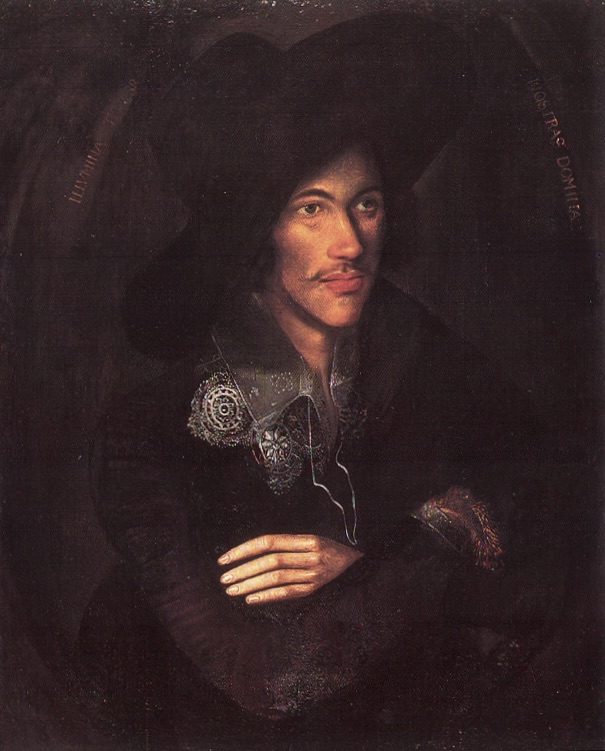
Portrait of John Donne by an unidentified artist (c. 1595) National Portrait Gallery, London

The portrait in question is that of John Donne, a painting currently being offered to the National Portrait Gallery, which is trying to raise funds in the amount of £1,652,000 to obtain it before the purchasing opportunity expires at the end of May. So, the picture now hangs in the Shakespeare exhibition, where visitors have to pay to get a glimpse of it. It is well worth a glimpse, I assure you. I confess the pleasures I derive from being moved by a work of art, whether considered trifling or momentous, and it is not rare that I stand before a painting with tears welling in my eyes or goose bumps sprouting on my skin. Composed by an unknown artist around 1595, the Donne portrait is decidedly of the gooseflesh variety.

It is in poems like “His Picture” and “Witchcraft by a Picture” that Donne speaks to us about attempts at portraiture, about the art or hubris of capturing life, the act of imitating nature or surpassing creation—troubling thoughts for a former Roman-Catholic growing up in the turmoil of the Reformation and its sanctioned smashing of images. In the former poem, Donne writes:

I fix mine eye on thine, and there
Pity my picture burning in thine eye;
My picture drown’d in a transparent tear,
When I look lower I espy;
Hadst thou the wicked skill
By pictures made and marr’d, to kill,
How many ways mightst thou perform thy will?

But now I’ve drunk thy sweet salt tears,
And though thou pour more, I’ll depart;
My picture vanished, vanish all fears
That I can be endamaged by that art;
Though thou retain of me
One picture more, yet that will be,
Being in thine own heart, from all malice free.

In the latter piece, Donne suggests the mental image and the imaged man to be at odds; a painting is a memento mori, which, fixed in time, turns into an unlikeness of fleeting life.

Here take my picture; though I bid farewell,
Thine, in my heart, where my soul dwells, shall dwell.
‘Tis like me now, but I dead, ’twill be more,
When we are shadows both, than ’twas before.

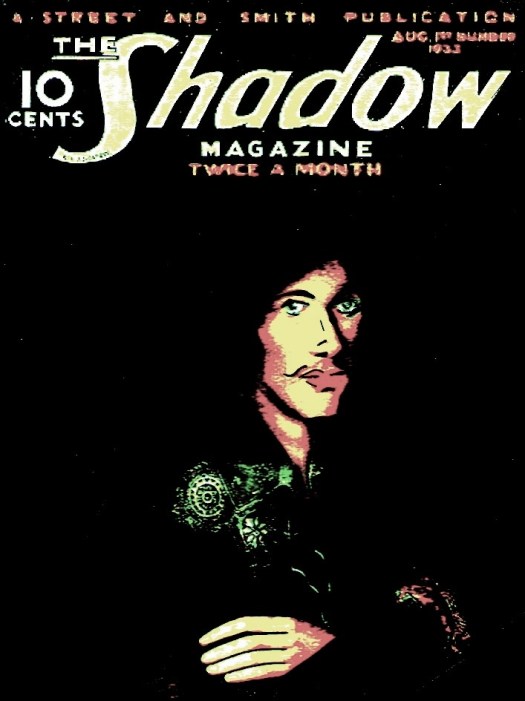
To his own portrait, lost and mislabeled for centuries, Donne referred as “that picture of mine which is taken in shadows.” In my irreverent mind, the striking features of Donne’s shadow-cast face began to resemble that of The Shadow, Lamont Cranston—the secret avenger who, striking hidden from view, laughed death in the face and had a sermon for all who dared to defy the law: “The weed of crime bears bitter fruit.”

Sermonizing Donne, who once wrote “A Lecture upon the Shadow,” approached the challenge of death in one of his most famous sonnets:

Thou art slave to fate, chance, kings and desperate men
And dost with poison, war and sickness dwell,
And poppy or charms can make us sleep as well
And better than thy stroke; why swell’st thou then?
One short sleep past, we wake eternally,
And death shall be no more; death, thou shalt die.

Donne’s portrait has captured my imagination; yet, having too often crossed—and all but crossed out—the uncertain boundaries between high art and low, it is The Shadow who now runs away with it. In my mind, I hear Lamont Cranston’s defiant laugh as I gaze at the poet’s likeness, “taken in shadows.”

"This . . . is London": Fuseli’s Nightmare Revisited

Sometimes it takes questionable taste in art to make us realize how unpalatable or insipid our ready-meal answers to life’s challenges can be. In the bourgeois mediocrity of German suburbia, where I was obliged to wade through the quagmire of adolescence, an installation by performance artist Santiago Sierra is currently creating no inconsiderable controversy by daring to turn a synagogue into a gas chamber.

Media Nightmare

I suspect that quite a few of Sierra’s detractors who think such confrontations of violent history with artistic violence reprehensible will be less disturbed to learn that, some forty years after the end of World War II, the building had been a symbol of Germany’s inability to deal with its horrible past: obscured from public view and unknown to schoolboys like myself, who passed it daily, it had been permitted to deteriorate to such a state of dereliction that it was only deemed fit to serve as a barn or pigsty.

Fuseli’s Nightmare

Iconoclasm, barbarism, and unreason—these were also pre- occupations of 18th-century Gothic art, samples of which are now on display at the Tate Britain. Unfortunately, Gothic Nightmares: Fuseli, Blake and the Romantic Imagination suggests nothing more forcefully than that visual representations of horror are often less than horrifying; less horrifying, that is, than the terrors of which a fertile imagination can conceive and a methodic mind rent from humanity can implement without scruple. Instead, the shock-and-schlock artistry of Fuseli and his followers comes across as juvenile rather than rejuvenating, as cheap rather than free-spirited, as exhausted rather than inspired.

Gothic images are often too crude and obvious to stir the emotions, not unlike the gag-reflex testing effects achieved by today’s horror movies. Aiming at our throats, these lesser Romantics often extract mere giggles and at times guffaws.

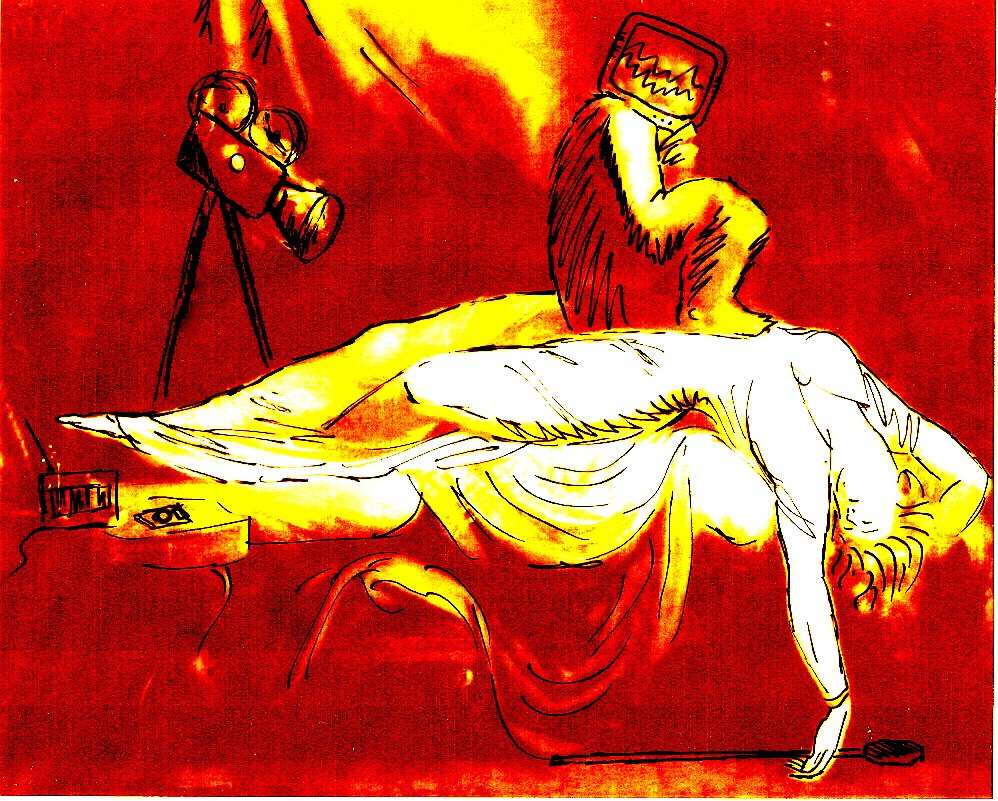
Another version of Fuseli’s Nightmare

Not surprisingly, Fuseli’s (in)famous Nightmare painting was frequently mocked, especially in its day, when it served as a template for political caricatures such as the one attempted by me here, one in which liberty is being haunted by images of the Middle East (the camel in our bedrooms) and the ineptitude or rampant ambitions of a certain world leader.

How infinitely more stimulating, I thought, while wandering through the exhibition—which does some violence of its own by pairing sublime Blake with silly Fuseli, or by confronting the pre-cinematic Phantasmagoria with French-revolutionary Romanticism—is the suggestive terror of the airwaves, compared to the horror of the image, whether still or moving.

Of course, I am resorting to another caricature of my own to support—and thus undermine—my point: that the imagination, stifled or silenced by clamorous images, suffered its greatest defeat with the deposition of short-reigning radio by the matter-over-mind medium of television.

On This Day in 1959: A Ghost of Crises Past Shares "A Korean Christmas Carol"

Yesterday, we took the train up and across the border to Birmingham, England, to see the exhibition Love Revealed: Simeon Solomon and the Pre-Raphaelites at the Birmingham Museum & Art Gallery. Deceptively saccharine, the title of this show (borrowed from Solomon’s fanciful dream narrative “A Vision of Love Revealed by Sleep”) also refers to the Victorian artist’s troubled life, to the disclosure of his secret and the end it meant for his career as a commercially viable painter.
There was nothing sensationalistic about this staged revelation; and even though Solomon’s paintings and drawings do not always stand up particularly well when placed alongside the works of his better known contemporaries, “Love Revealed” did not leave me with the impression that this rather obscure artist is being deemed due for a revival chiefly because certain academics with an agenda think his private life under public scrutiny, his outing and ousting, fascinatingly queer or historically significant enough to warrant such a tribute. The past may come back to haunt us—but it may also be revealed, at last, in a light that is different without being garish.

Christmas, of course, is just the time to conjure up haunting spirits; the telling of ghost stories during the season when days are darkest is a tradition in Britain, Dickens’s “A Christmas Carol” being the most famous of them all. On US radio, updates of Ebenezer Scrooge were attempted on programs as diverse as Blondie (“Scrooge,” 15 Dec. 1939), The Six Shooter (“Britt Ponset’s Christmas Carol,” 20 Dec. 1953), and the syndicated propaganda series Treasury Star Parade (ca. 1942), in whose seasonal offering, “The Modern Scrooge ($18.75),” the reformed old miser becomes an air-warden.

The past was not always the exclusive domain of pastiche, however. On this day, 20 December, in 1959, a rather more gritty ghost story was presented by Suspense, an anthology of radio thrillers heard over the Columbia Broadcasting System in the United States between 1942 and 1962. Titled, “A Korean Christmas Carol,” the play tells the strange tale of an American soldier stationed in Korea, Christmas 1958.

On his way to Seoul, he picks up a hitchhiker, a fellow soldier who relates his own experience fighting in Korea some seven Christmases earlier. Insensitive to the icy weather and oblivious to the cigarette smoldering between and singeing his fingers, the stranger seems to be dwelling wholly in the past. When he steps out of the car and disappears into the darkness, he leaves behind his AWOL bag, forcing his listener to follow his path. But instead of taking him straight to some barracks or military installation, the path leads to a secluded orphanage. It is here that the ghosts of Christmas past, present, and future crowd in on our haunted storyteller.

Featuring the non-traditional holiday sounds of fierce machine gunfire, the play opens and closes with a choir of Korean children—the orphans of the war to whom the mysterious hitchhiker, himself a casualty of war, sets out to deliver a bag of toys by turning the driver-narrator into his earthly messenger. Having died to save his comrades, he now returns to remind and guide his countrymen to look after the offspring of those whose lives he took.

“A Korean Christmas Carol” is a story of sacrifice and redemption, a story of making amends—a story of love revealed in a vision of death. Will the present war on terror produce or inspire any such ghost stories to be shared underneath the Christmas tree in the decades to come?

Collecting Thoughts; or, What I Learned About Blogging from Baroness Thyssen-Bornemisza

Calle de las Huertas, Madrid

Well, I have returned from my weeklong trip to the center of the Iberian peninsula (that is, a stay in Madrid, with an excursion to Toledo) and am pleased to report how invigorating it can be to go away, come face to face with one’s own ignorance, and return in a confusion of humility and inspiration—souvenirs to be put to better use than dust-gathering bric-a-brac.

To be sure, I still cannot tell one Spanish monarch from another—except for the baby-faced Fernando VII and the big-nosed Carlos III, on the representation of whose none too prepossessing visages a fair amount of oil and canvas were expended. I still cannot order a Spanish meal without half-guessing what might end up on my plate—except that the tapas-and-cervezas cuisine is so lacking in variety as to render an extensive culinary lexicon unnecessary. And I still cannot relate to bullfights, flamencos, or devotional art—except that I know better now than to reduce arcane passions to patent stereotypes. I did learn something about blogging, though—and it was the Baroness Thyssen-Bornemisza who, however unwittingly, conveyed the lesson.

Carmen Thyssen-Bornemisza, of course, is the wife of Baron Thyssen-Bornemisza, the steel magnate-collector who displays his artistic riches at the magnificent Thyssen-Bornemisza Museo Nacional in Madrid, a generous sharing of his increasing wealth for which he gets amply rewarded in contracts throughout the city (you’ll notice the name of Thyssen wherever there’s a construction site—and there were plenty all over town).

Unlike her husband, the Baroness only started collecting in the 1980s. She seems to have a taste for the famous and nominal alike, but little sense of what is first-rate or exemplary. Her collection is overwhelmingly large and, for the most part, put together without much discernible grace, wit, or discrimination. She bought up third-rate paintings of first-rate artists, apparently at great speed, and caught many a masterful painter on an off day. Her husband had an eye—she’s got the Euros. That, at least, was my impression when I walked through the vast and ultimately stultifying Thyssen-Bornemisza National Museum. So, what have I learned?

In the broadest sense, a blog is a collection of thoughts. It may be regarded as a museum, a virtual storehouse of words and images that are culled from various sites, commenting, like all art does, on the world of today—be it on society, politics or religion.  Many bloggers are savvy name-droppers; quite a few exploit their writing for advertising purposes; some are merely providing the odd caption to the works they borrow. Others, like myself, simply try to share what they care about but disseminate thoughts without quite knowing how to reach either a specific or general audience, without being fully aware of the potentialities of their enterprise.

In other words, not all bloggers are good curators of their thought museums. Their growing collections may lack direction or purpose—rendering all but useless what might be of some small service to the few or many; unless, that is, the viewer, aware of the individual pieces in the museum, has the freedom to steer past the profusion to approach directly what matters to her or him. In this respect, a virtual collection, like the online version of the Museo Thyssen-Bornemisza, is more useful than a traditional one, since visitors can direct their curiosity so as to move specifically into the presence of the works they choose to see or care to know about (as some of my readers did, Googling their way to what I wrote about Valentine Vox or The Free Company, for instance).

And yet, a collection loses its cohesion and falls apart as a result of such selective viewings; it becoming as fragmented as the interests of the diverse public to which it is being made available.  How to keep an online journal like this together—and keep it going?

Any smart museum is, to some degree, self-reflexive about the collection it houses. A truly smart museum, like the Museo Lázaro Galdiano, acknowledges its shortcomings rather than trumpeting its ostensible merits. Over the next few weeks, I shall try new approaches to collecting my thoughts for subjection to the splintering vision of the public gaze. I am aware, for instance, that broadcastellan is missing a unifying narrative arch, mainly because I do not want to turn this journal into an intimate if public diary.

Some of the connections between what I label “unpopular culture” and our—or, rather, my—present everyday seem forced or arbitrary precisely because the personal link between what I experience and choose to discuss has been obscured: why am I watching this or that film; why am I listening to a specific radio play or reading a certain book just now?

Rather than becoming more personal, I aim to make more of an effort to relate to others by providing a historic connection to the works I choose to discuss without turning my musings into history lessons.

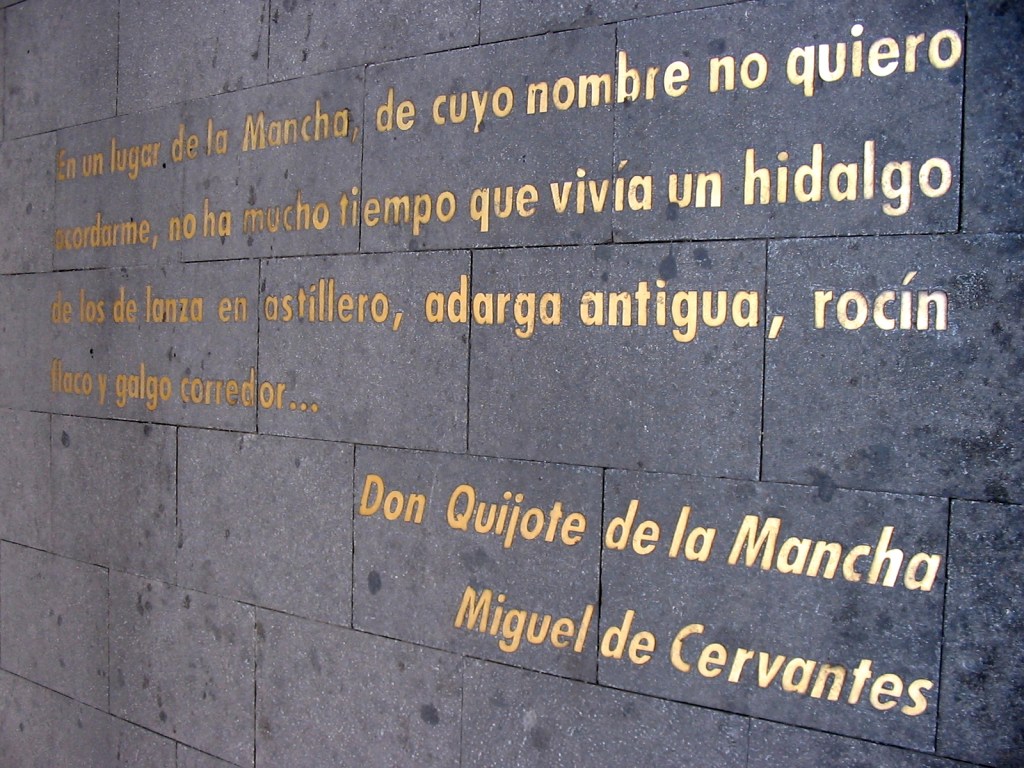
Thoughts can be gathered anywhere; in fact, Madrid’s streets are a veritable gallery of thoughts—to which above lines from Don Quixote, found on the Calle de las Huertas, attest. Words and images are dirt cheap and trivial unless a thoughtful collector sets out to render them precious and significant.  

Yes, it was the arbitrariness and the flaunting of Baroness Thyssen-Bornemisza’s wealth that made me reconsider the acts of collecting, exhibiting, and sharing my humble thoughts.

A Soundscape of Britain?

Princess Diana Memorial Fountain,
Hyde Park, London

A few days ago I went to the Tate Gallery in London to see A Picture of Britain. This exhibition of paintings, coinciding with a BBC television series, did not exactly get rave reviews. Critics complained that the real Britain was, for the most part, left out of the picture. The works on display mainly feature idyllic representations of what Britain could be or ought to be, according to followers of the Picturesque or romantically inclined artists. In short, plenty of nature, little naturalism. I wonder how A Soundscape of Britain would turn out, if ever there were such a showcase devoted to national noise. What would be the representative sounds of Britain?

In the US, during radio’s so-called golden age, the Columbia Workshop and the later CBS Radio Workshop offered listeners aural snapshots and panoramas of New York, London, and Paris. “A Portrait of London,” for instance, which aired over CBS on 20 July 1956, took listeners to Big Ben, the city zoo, and Buckingham Palace, with Sarah Churchill (daughter of the former Prime Minister) serving as tour guide.

A few weeks earlier (7 July 1956), the Workshop had taken tuners-in to Paris, while “The Sounds of a Nation” (18 November 1956) sonically evoked the history of the United States. Some twenty years earlier, the Columbia Workshop had presented a “Broadway Evening” (25 July 1936), a noisy report from the bustling Big Apple. Other such programs include “Crosstown Manhattan” (8 December 1938) and Norman Corwin’s “New York: A Tapestry for Radio” (14 May 1944).

While more concerned with the spoken word than with the creation of collages in sound, Corwin conducted frequent experiments in bringing faraway places home to the radio audience with travelogue series like An American in England (1942) and Passport for Adams (1943), as well as the ambitious documentary One World Flight (1947), which consisted of interviews and recorded sounds from actual locations in Italy, India, and Australia.

Corwin’s travelogues did not simply revel in sound qua spectacle; they were propagandistic or didactic in nature, designed to glean messages from or impose meaning on bits and bites of sound. As Alexander Pope once put it, the “sound must seem an echo to the sense.” How, then, could one make sense of Britain through sound? What, besides the tolling of Big Ben, or the water gurgling in the Diana, Princess of Wales Memorial Fountain (pictured above), or the chirping of robins, or the roaring North Sea, or raindrops falling on hedgerows, might be A Soundscape of Britain?

Many years ago, visiting New York City for the first time, I walked through the streets of Manhattan to capture the sounds of the sirens, the pedestrians on the pavement, the honking of cars and the hollering of cabbies during rush hour. It gave me immense pleasure listening to these recordings back in the misery that was my home across the Atlantic. I could drown out the silence and loneliness in ways that a few pictures in my photo album could not accomplish. I have always loved wrapping myself in sound’s cape, escaping in sound . . .