Digging into my collection of British Library Crime Classics
You do not need to be a card-carrying member of the Thursday Murder Club to have spotted the signs, superabundant as they are. Like red herrings surreptitiously slipped into a vegan barbeque, the pattern of mischief and deceit is too conspicuous to go unnoticed: murder mysteries, whether freshly prepared, reheated or rehashed à la mode, are back with the vengeance particular to them.
Fictional murders are just what we assume the doctor would order if reliable medical advice, especially in this age of unfounded attacks on science—were within easy reach of our purse. I won’t go so far as to call mysteries the patent medicine of our day; but I am convinced they are taken freely and frequently as a temporary remedy for the widespread malady of which they are symptomatic.
Not to generalize from the small sample of my experience, but only yesterday—and “yesterday” only because I can never get my act together so as to leave “today” unedited—I walked home after paying an overdue visit to the Gayberystwyth Books, that indispensable local dispensary of diversity-affirming queerness, with a copy of Jaime West’s Death on the Pier (2022), a murder mystery set in 1933 Brighton. All the while, I am screaming bloody murder at the sight of division sowers like Trump and Farage who are determined to push the democracies they blight ever closer toward Berlin 1933.
Meanwhile, so-called “cozy crime” is back on the pop-cultural menu. Mysteries have become part of a regular diet, healthy or otherwise, followed, like a regimen of killer recipes from a keto cookbook, by millions of contemporary fiction bingers, be they bookworms or streaming service subscribers. Defying the warning label, I am currently ingesting Not to Be Taken (1937-38), a serialized whodunit by Anthony Berkeley published in the US under the title “A Puzzle in Poison.”
“One Man’s Poison” might be a suitable alternative title for Murder as a Fine Art (1953), my previous dose of the genre, even though the weapon employed by “another man”—whose identity I shall refrain from divulging here—is, despite its material refinement, rather less sophisticated once applied: a pompous government employee at the fictional Ministry of Art is brought down—splatter of brains and all—by a giant Canova bust, for which the victim had long expressed a violent dislike.
The crime novelist determining upon that choice weapon was Edith Caroline Rivett (1894-1958), writing as Carol Carnac. Some five years before assuming this guise, Rivett had started her career as a mystery writer under the decidedly more ambiguous name of E. C. R. Lorac.
The Bookshop by the Sea, where I purchased A Century of Detective Stories
The Welsh seaside town of Aberystwyth, where I live, has no shortage of bookstores, first-hand and otherwise. At one of them—The Bookshop by the Sea, which sells both old and new volumes—I purchased, some time ago, A Century of Detective Stories. Published in 1935, it is an anthology of crime and mystery tales introduced by G. K. Chesterton, whose outrageous “Fad of the Fisherman” I found occasion to discuss here previously.
Ystwyth Books, where I purchased Death by Marriage by E. G. Cousins on the day I posted this blog entry.
Trying to live up to its title, A Century of Detective Stories is a brick of pulp, and it is not easy to handle when you are reclining in a lounge chair hoping to catch those rare vernal rays that are the oft unfulfilled promise of summer on the typically temperamental and frequently bleak west coast of Britain.
Oxfam Bookshop, Aberystwyth, where someone beat me to a large selection of Three Investigators books on the day of writing this entry.
Aberystwyth and its environs have, in part for that reason, been the setting of murder mysteries, among them the noirish detective series Hinterland and the quirky retro-noir novels of Malcolm Pryce. And, as I am writing this, the place is a veritable crime scene, with local booksellers displaying mystery novels and hosting literary events dedicated to the art of murder. It is all part of Gwyl Crime Cymru, billed as “Wales’ first international crime fiction festival.”
Waterstones, Aberystwyth, where I tend to purchase copies of British Library Crime Classics.
Meanwhile, I am still catching up with A Century of Detective Stories. Selections include narratives by Edgar Allan Poe, Wilkie Collins and Marie Belloc Lowndes, as well as works by some of the biggest names in crime fiction written between the two World Wars: Agatha Christie, H. C. Bailey, Dorothy L. Sayers, and Edgar Wallace, to drop just a few. The diversity of this collection is part of its strength and appeal. Its title is nonetheless misleading.
To say that I had misgivings about visiting the Heidi Horten Collection during a recent stay in Vienna is an understatement, especially in light of the scandal surrounding the scrapped auction of Horten’s jewelry, misappropriated as it was from Jewish families from whose disenfranchisement Horten and her husband demonstrably profited.
The Heidi Horten Collection. All photographs: Harry Heuser
“Christie’s Cancels Sale of Jewelry Connected to Nazi-Era Fortune,” a 31 August 2023 headline in the New York Times read. According to the article, the “decision follow[ed] a backlash from Jewish organizations after the auction house generated $202 million” in an earlier sale of Horten’s hoarded treasures.
My views on the Heidi Horten Collection—just like my viewing of the temporary exhibition “Rendez-Vous: Picasso, Chagall, Klein and Their Times” then on show there—were no doubt skewed. And yet, I am certain that I would have felt just as disturbed and affronted had I been unaware of the controversy.
Early in 2023, I participated in a workshop at Aberystwyth University exploring collectibles and the collection of ephemera. I was the only participant, among academics and museum staff, to talk about my private collection of ephemera. So as to give that fruit fly of a presentation an afterlife, I have gathered my notes for this entry in my journal, which, after all, was created for the purpose of ‘keeping up with the out-of-date.’
The presentation was titled “Making It Matter: Ephemerabilia, Queer Identity, and the Imperative of Being Out of Touch.”
I know, titles are like jokes. If you have to explain them, they don’t work. But, here goes:
“Ephemerabilia,” meaning, the love of the fugitive, the fragile, and perhaps even the futile. All of the above – which may apply to any of our lives and bodies. All of the above – but not ‘trivial.’ Nothing is trivial in itself. Just like nothing is memorable in itself. Someone has to make it matter.
For that reason, the word “minor” in Maurice Rickards’ definition of ephemera is problematic, as it devalues what it defines. To quote myself: “Trivia is knowledge we refuse the potential to matter,” whereas “Memorabilia is matter we grant the capacity to mean differently.”
The need to make something matter and mean something, something else, no matter what, is, to me, intimately bound up with queer identity, with my sense of being, thinking, feeling, and loving differently.
And that is where, to me, the compulsion of being out of touch comes in: being drawn to what has been relegated to the margins, to matter that has been disregarded and discarded as presumably nonessential or unrepresentative.
I could have put the last two words in parenthesis; because sharing my passion for the untouchable – or the “not touched much lately” – means coming out with what drives me. Making something neglected and presumably immaterial matter and mean something anew is an act of reification.
It means saying I matter. But the question I keep asking myself, in relation to my collection habits, is “What’s the matter with me?”
Let’s say I say “I am a collector.” Which question should I expect to follow? Is it “What are you collecting?” How about: “Why are you collecting?” “Why do you collect what you collect?”
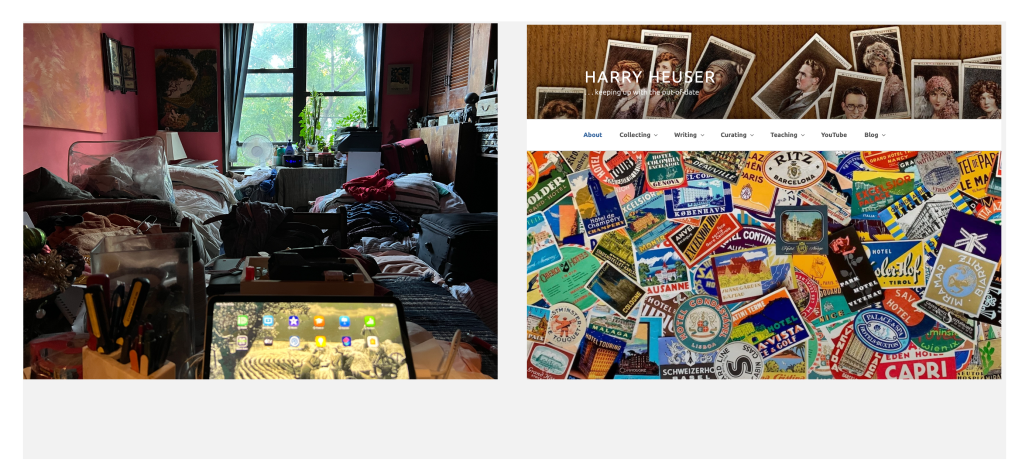
What I collect is stated – and illustrated – on my website. I collect ephemera related to products of what once was popular entertainment – early-to-mid twentieth-century, mainly US American, film, theatre and radio – that are lesser-known now. I call it “unpopular culture.”
My collection is all fairly methodically put into actual and virtual drawers. Unlike in this scenario.
The image on the left shows my ex’s apartment on the Upper East Side of Manhattan. I once lived there, for about fifteen years, and, for over 33 years now I have stayed at that place whenever I am in the city.
Due to the pandemic, I hadn’t been back in three years. In the fall of 2022, my ex had a heart attack just days before I was set to arrive there. I looked after the apartment while visiting him at the hospital. Anyway, I was shocked when I saw the place in such disarray. My ex has always been a hoarder. But the place had become almost unnavigable in the intervening years.
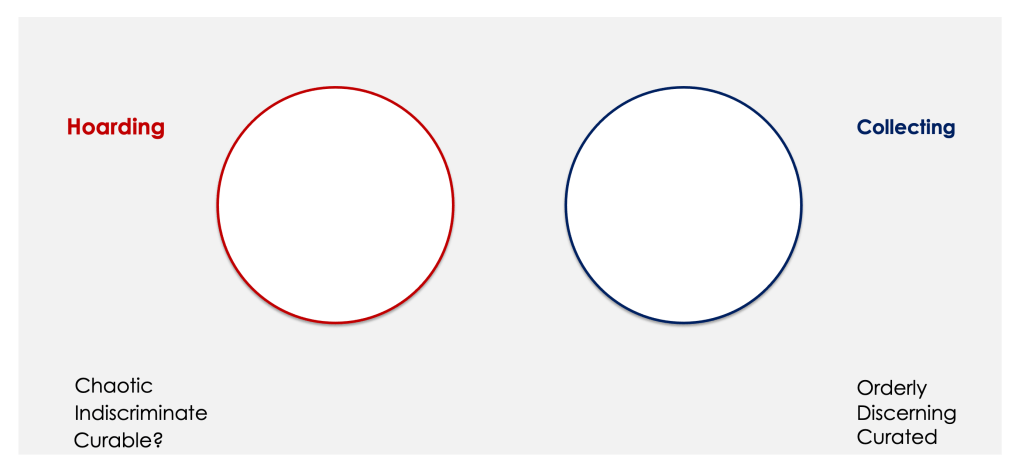
Obviously, hoarding is not collecting. But is it so obvious? Is the distinction perhaps too obvious? Sure, hoarding is chaotic. It is indiscriminate, whereas collecting is orderly and discerning. Collections are curated. whereas the compulsion of the hoarder may strike us as an infliction, an illness that may or may not be curable.
Curating is derived from the Latin word “curare,” meaning to care. Does it follow that the hoarder is careless? While staying in my ex’s apartment, I took it upon myself to discard of some items I deemed trash.
Given that chaos, I thought my ex would never notice. When my ex returned to the apartment after three months of intensive care, hospital care and aftercare, he emailed me and inquired about some of the objects I had discarded.
And he was so incensed about my attempt at tidying that he pretty much ended our 33-year-old friendship.
Seriously, to give up a friendship over a pile of cheap Chinese take-away containers, most of them without matching lids? That struck me as unreasonable, disproportionate.
But the fact that my ex remembered where what is in that chaos made me rethink the relationship between hoarding and collecting.
And it made me question whether collecting is not like hoarding in its illogical, perhaps even pathological clinging to matter that may not matter to most. Something that takes up so much time and space, it can threaten to diminish rather than enrich our experience of life.
Possessions can take possession of us. This is not vanity. It is not conspicuous consumption. For gay men born into decades of intolerance and legal discrimination, it may be a stab at making our existence more concrete and at leaving a trace or trail of it behind. I should have known better than to mess with the mess that I found.
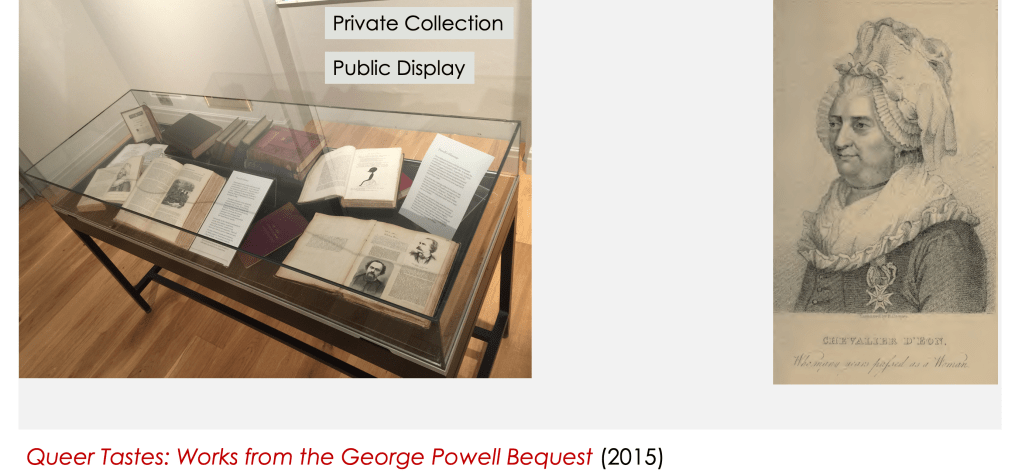
Powell had no offspring, even though he married toward the end of his short life. Stating his intention to leave his collection to our museum, he referred to it as all he possessed of bigotry and virtue, meaning, bijouterie and vertu – trinket and treasure.
Powell left the lot to what is now Aberystwyth University. In his book collection, for instance, was a popular volume called Book of Wonderful Characters, which contains a short account of the life of Chevalier D’Eon, who lived as a crossdresser for half a century and to whom we owe the term “eonism.”
I sensed that Powell created through that bequest a diary of sorts – an invitation, by way of visual and material clues among the objects he once possessed, to go in search of him.
The “it” in “making it matter” refers less to the collection than it does to the collector. Powell did not curate his collection to take care that what might reflect poorly on his character or cause suspicion as to his tastes. To filter anything out would mean to erase what was at the core of his being, which is why Powell initially insisted that a museum be built to house it and that the collection be kept in one place, Aberystwyth, in its entirety.
He did not want to disappear behind his collection but reappear through it. He wanted to be become readable, to be understood. The Powell case made me more aware of the relationship between the private act of collecting and the public act of sharing a collection, of remaining visible through one’s collection.
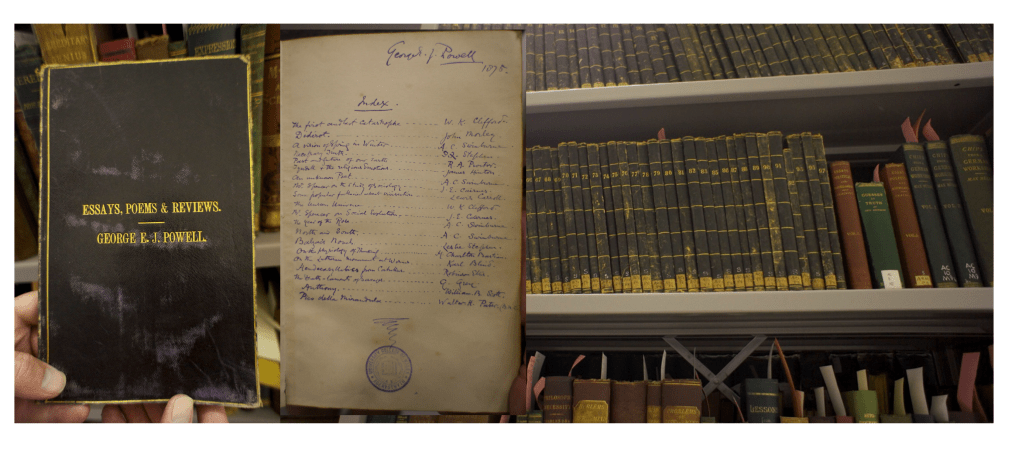
Powell’s desire to remain visible, become readable and be understood becomes clearer to me in the contemporary periodicals he bequeathed to our University. Here, he did not give us the lot – the magazines, cover to cover – but he cut out which articles he wanted to preserve and bound them in leather. There is no telling whether he read the articles. But it is clear that he thought they mattered and should matter to others. And they are quite eclectic, ranging from articles on animal cruelty to drunkenness and insanity.
Articles on ‘Consanguinity in Marriage’ and ‘Marriages between First Cousins in England and Their Effects,’ which were no doubt of particular interest to him because his grandmothers were sisters and his parents first cousins.
Powell appeared to have been drawing attention to his struggle to figure out who he was and why he was the way he was.
‘Do we collect things simply to indulge our passion for them? If so, why make a display of that passion? Showcasing seems calculated to raise certain objects to the status of ‘collectibles’ so as to advance the collector as connoisseur. And yet, might not the urge to exhibit our personal belongings be rather more elemental?’
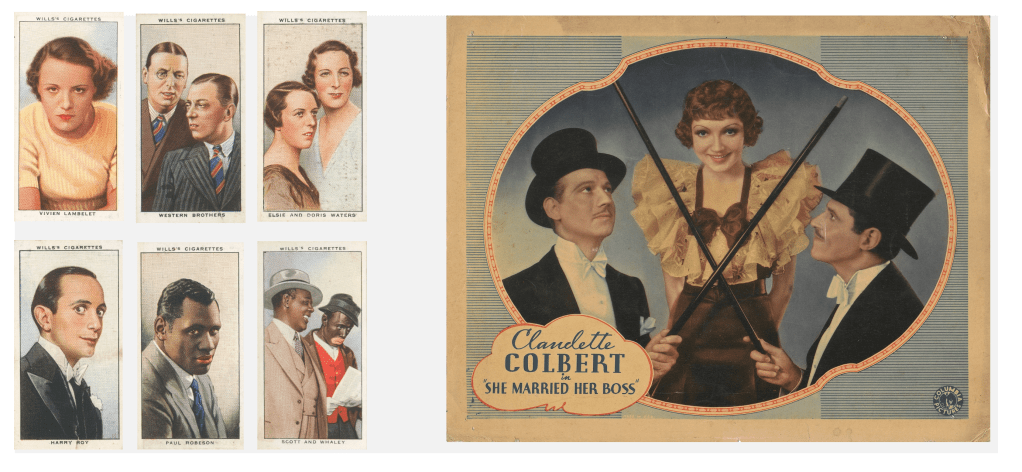
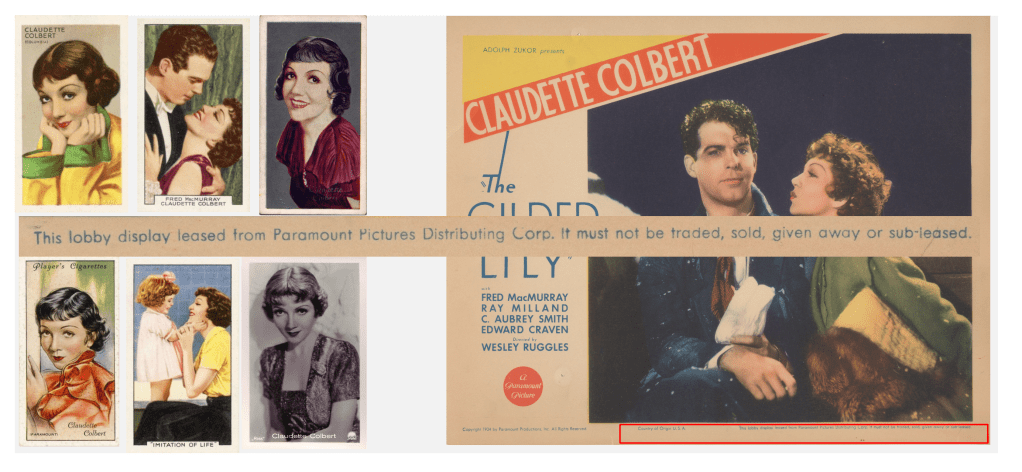
What are ‘collectibles’? What is collectible? Take, for instance, two different but related types of objects in my collection. Cigarette cards of once well-known but now mostly forgotten performers, in this case radio stars. As well as movie posters and lobby cards of films of roughly that same period.
Both feature performers from the world of popular – or now less popular – entertainment. Both are finite. Lobby cards were generally produced in sets of eight. Cigarette cards in sets of up to fifty.
The main difference is that cigarette cards were designed to be collected. They were meant to be habit-forming, to encourage addiction.
Lobby cards on the other hand were not designed as collectibles. In fact, as the fine print states, collecting them was prohibited by the studios whose property they remained.
By now, the industry that cigarette cards once served has become detached from them. They no longer advertise and encourage addictive products, which makes them candidates for my belated affection, and which makes it possible for me to make them matter differently.
I became intrigued by the French-born US American actress watching a movie on television with my grandmother when I was 8 or 9. I didn’t start collecting until decades later. Nor did I know then that Colbert was rumoured to be queer.
My collection is also a catalogue of the love: more than 90% of my collection has been gifted to me by gay men, and almost all of which by my husband. Original film posters are now almost out of my league as a collector.
I do not collect objects because of their monetary value, of which, due to the fact that the items were given to me, I often have no knowledge. I have always been attracted to what is of little value to others.
A queer friend told me once that, as a child, he used to pick the crayon no other kid would pick up – the least popular colour. Embracing neglected objects to me is related to the feeling of having been unwanted and misunderstood as a child.
Exhibiting my collection, I realized just how intimate collecting is. I was very self-conscious about opening my drawers to display those objects – paper dolls, mass-produced pictures of performers few people today still relate to. When I tried to exhibit the cigarette cards, I also realized they were too small to be impactful or readable for display.
So I created a slideshow of them. There are objects in my collection that matter more once they are dematerialized. I scan many books and scripts so that I need no longer handle the physical artifact. It preserves the object. But it also makes the object less meaningful if what matters is the visual or written information it conveys. Not that I dispose of ephemera in my collection once I have scanned them.
The most ephemeral items in my collection are literally untouchable. They are digitized sound recordings. The cigarette cards of radio performers are, like scripts and contemporary books on radio, not the real thing. They are a means to materialise the immaterial culture they commemorate: the world of sound broadcasting.
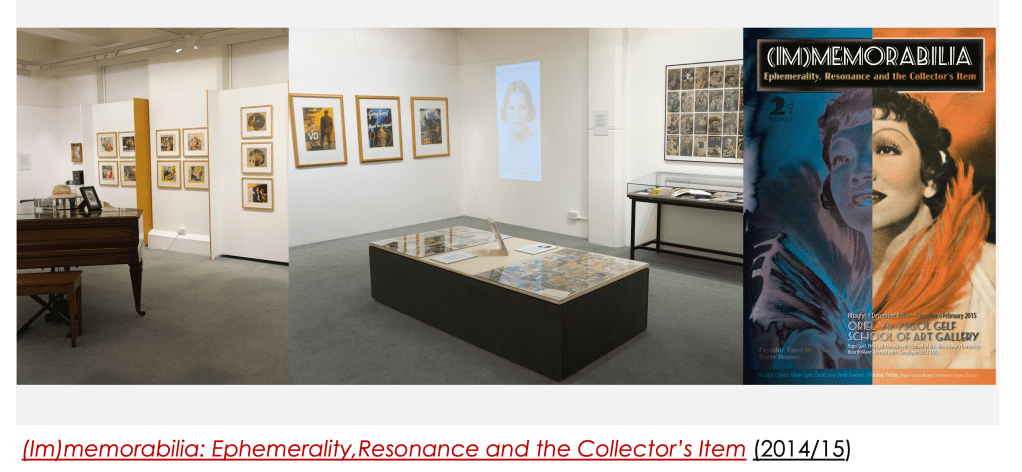
My (Im)memorabilia exhibition contained a listening station and featured a soundtrack of clips on a loop. They are from my collection of audio recordings, now widely available online. The files contain recordings of radio broadcasts from the 1930s to 1950s, most of them plays, almost all of which were part of episodes of series or chapters of serials.
The vast majority of plays were also broadcast only a single time. Despite the recordings that gradually materialized from the vaults, they were as ephemeral as soundwaves. That they survive at all is owing to their commercial value.
The recordings are evidence for the sponsor that the programme they funded actually existed and could be inspected – or audited. As cultural products they were not valued. They still are not valued much. They certainly never received the scrutiny or status accorded to motion pictures or television programmes.
I organize the folders alphabetically by each series title.
And each subfolder contains recordings of broadcasts from those series. Some subfolders contain close to one thousand recordings per series. Cataloguing these immaterial objects, which I have written about at some length in my study Immaterial Culture and on my blog broadcastellan, involves adding and correcting information about talents involved in a broadcast play; verifying air dates by referencing old newspapers and magazines; checking for sound quality and recording speed; and replacing files with newer, cleaner, more authentic recordings.
It is not possible to listen to all of those recordings in full. There are now over 30,000 of them. It is almost impossible to keep track of them.
Unlike my ex, I have forgotten about many of the items in my collection. But like my ex, I would be very upset if only a single item went missing. Most of these recordings are readily available on the internet, copyright being a murky issue. In my writing, I have argued for their cultural significance, their artistic merit. But I have not been successful in making a career out of my caring. I am wary of intellectualising my desire, and I am suspicious of such attempt by academics.
The difference between hoarding and collecting lies in the adding of value. Hoarding is an act of accumulation. Collecting is an act of accretion, of value added.
The ‘imperative’ in my title is the imperative of the matter – what drives us, what makes us who we are. The ‘it’ in “Making it Matter” refers both to the ephemeron and the life of its collector who deems it worth preserving. That my efforts have been futile only seems to fuel a desire that has been termed “The Queer Art of Failure.”
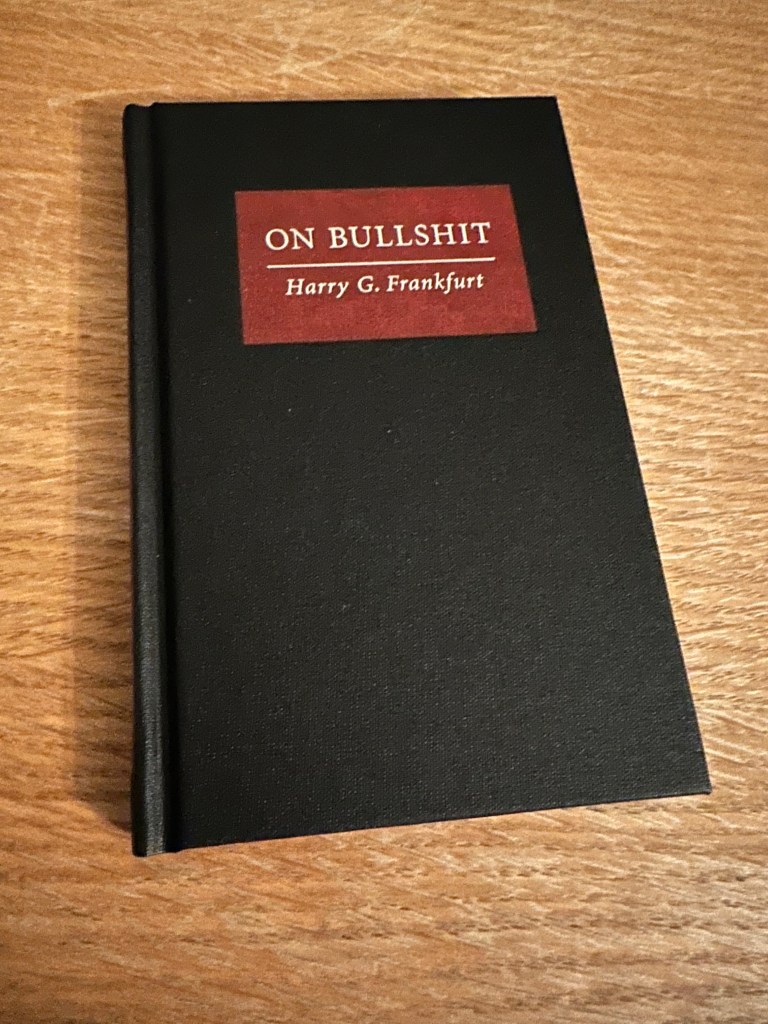
A few weeks ago, a former graduate student of mine dropped a copy of Harry G. Frankfurt’s essay “On Bullshit” into my pigeonhole. In an accompanying letter, the sender stated that it was meant as a “thank you” for the thoughts my seminars inspired and the readings to which they led – but there is room for self-doubt on my part.
While replying to the student by “acknowledging [his] welcome addition to my shelf space-exceeding library, well suited as the volume in question is to the bedside table once occupied by chamber pots,” it occurred to me that my thoughts on the subject might be worth an entry in the broadcastellan journal, not the least since I penned my response to the sender – and to Frankfurt’s essay – on April Fool’s Day.
Having translated – for publication in an anthology of literary criticism – Nietzsche’s essay “Über Wahrheit und Lüge im aussermoralischen Sinne” (“On Truth and Lie in an Extra-Moral Sense”) and written about Thomas Carlyle’s classic but initially rejected and subsequently anonymously published Sartor Resartus – “Thoughts on Clothes; or Life and Opinions of Herr D. Teufelsdröckh D.U.J.” (1833–34) – in my post-graduate days, I may be permitted to lay claim to a fleeting acquaintance with the material some crudely refer to as “bullshit,” whatever its qualities, its substance or its purported lack thereof.
Perhaps I may even argue myself to be an authority on the matter, given that I have long been a voluble piler-up and at times unwitting purveyor of abject failures in reasoning and, I must insist, to a lesser degree, imagination, the latter being more essential to “bullshit” than the former.
My memory is poor, generally, and getting worse. My desire to remember the forgotten – the ostensibly unmemorable – remains strong. It is a love rooted in the need to champion the unloved, or, rather, the dis-loved, and to abandon myself to the abandoned. It is a queer thing, to my thinking, which is queer always and could not be otherwise. To love, perversely, what has been discarded or deemed unworthy of consideration, means disregarding what is widely held to matter and instead be drawn – draw on and draw out – what is devalued as immaterial. It involves questioning systems of valuation and creating oppositional values.
Commenced in 2005, this journal was dedicated to what I termed “unpopular culture,” the uncollected leftovers that linger on a trash heap beyond our mythical collective memory. To this day, down to my current project, Asphalt Expressionism – a curated collection of images engaging with the visual culture of New York City sidewalks – I carry on caring about the uncared-for and neglected, the everyday past which others tend to walk without taking notice.
There is no such thing as trivial matter. Nothing is negligible in itself. What makes something worthless is not a particular quality or lack thereof. Rather, it is an attitude, an approach, a judgment – itself often a product of a cultural conditioning. Nothing is intrinsically trivial, but anything may be trivialized. As I put it, years ago, when I curated (Im)memorabilia, an exhibition largely of mass-produced prints entirely from my collection – “Trivia is knowledge we refuse the potential to matter,” whereas “Memorabilia is matter we grant the capacity to mean differently.”
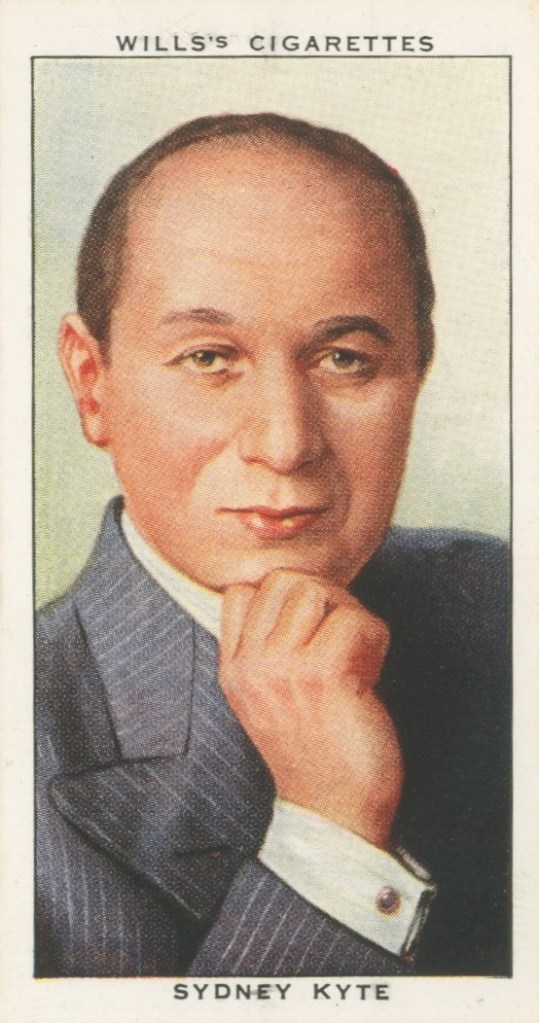
Low as a Kyte? A 1934 Wills’s Cigarette card featuring Sydney Kyte, a bandleader to whom no Wikipedia page is dedicated. The card sells online for under £1.
A 1930s cigarette card, for instance, may have once served the purpose of boosting sales by prompting smokers to collect cheaply mass-produced images of film stars or flowers or tropical fish. Collecting them nearly a century later – long after the advertising campaign has folded and the image has become removed from the product it was designed to promote – means to extend the lives of such devalued objects by moving them into the sphere of our own temporary existence of which they in turn become extensions.
Whether or not we take measures to preserve their afterlife, we instill collectibles with new meaning, give them value by investing them with our longings. I, for one, never regard my belongings as financial investments; I do not collect calculatedly, anticipating that what I gather might be the worth something to someone else some day.
I also refuse to intellectualize my desires; I am wary of turning passion into an academic exercise. That is, I do not rescue the marginalized for the purpose of demarginalizing my own existence by convincing others of the cultural value or historical significance of devalued objects – and of the case I make for their value. Still, there is that longing to be loved, to feel validated, for all the reasons that many, I suspect, would regard as wrong.
Why waste time on what is waste? Why dig up – and dig – what has become infra-dig through the process of devaluing, a hostile attitude toward the multiple, the unoriginal and commercially tainted to which we appear to be conditioned in a capitalist system that makes us feel lesser for consuming the mass-produced within our means so that we aim to live beyond those means, always abandoning one product for another supposedly superior? There can be no upgrading without degradation, no aspiration without a looking down at what has been relegated to refuse.
I remember a gay friend telling me, decades ago, that when he was a child, drawing in kindergarten or elementary with other children, he would pick the color that was least liked by his fellow creatives. I did the same thing when toys were being shared. This unwanted thing could be me – this is me – is what must have gone through my mind when I took temporary ownership of the object of just about nobody’s affection. And this, I believe, is at the heart of my impulse to make keepsakes of the largely forsaken.
I started writing this on the one-hundredth anniversary of the first radio broadcast in Britain – 14 November 1922 – by what was then not yet the BBC. Sound, after all, is the ultimate ephemera, fleeting if uncollected, lost if not cared for. The BBC used to erase recordings of its broadcasts, turning the potentially memorable into the immemorabilia beyond my grasp, and, in turn, turning my determination to lift them into my presence into futile longing, a nostalgia for the unrecoverable past.
The original dust jacket makes no mention of The Lodger; instead, it reminds readers of a more recent crime novel by Lowndes, which was adapted for the movies in 1932: Letty Lynton.
There is a lot of talk these days about ‘toxic masculinity.’ Making a strong case for the correlation of venom and virility, war criminal Vladimir Putin recently mocked the physique of world leaders who, by rolling their eyes at his shirtless posing, permitted themselves a moment of levity at his expense amid a crisis talk on Ukraine. Meanwhile, COVID-19-rules violating British Prime Minister Boris Johnson, himself a noxious cocktail of mendacity and indiscretion, opined that, had Putin been born female, the invasion of Ukraine would not have happened. Seriously, would the US Supreme court have decided differently on undoing environmental protection if more earth mothers were among the judges?
I thought the claim that toxicity is masculine had been conclusively laid to rest by Lucretia Borgia – or by Margaret Thatcher, at the very latest. That the flip side of our fancies is still deemed to be “another man’s poison” makes me long for gender fluidity, itself a noisome notion to some. Apart from lamenting the bane of binaries, I have nothing further to say here about exposed torsos or the merits of any remarks made by a disreputable Prime Minister. And yet, there is no escaping the everyday – not even in the attempt to retreat into the presumably out-of-date, of pop past its sell-by date, for the sampling of which this journal was conceived.
Mystery-and-detective fiction, in Britain at least, has been experiencing a decided revival since the mid 2010s, in part owing to – and evidenced by – the re-release of so-called golden-age whodunits by the British Library. What the public’s readiness to soak up all that blood of yesteryear might tell us about the mores of the present day I shall leave to sociologists to unravel. I, for one, welcomed that reopening of landmark trials and half-forgotten cases, not only as a chance at armchair detection – especially during pandemic times standing eerily still – but as an opportunity to reflect on my murderous past by returning to those crime scenes in middle age, knowing full well and being quite relieved that, by catching up, I could never go home again to what did not feel like home to begin with.
That said, picking up the clues and piecing together the puzzle we are to ourselves, I feel a queer consistency – or consistent queerness – at the racing, bleeding or prematurely failing heart of it all.
My transition from children’s literature to ostensibly grown-up fiction did not happen via the young adult section of a lending library. Fictions about growing up rarely spoke to me, as, back then, they were largely silent about desires that, while no longer criminalized, were deemed unfit for titles on general display.
Murder mysteries, in their indiscriminate pronouncements of death sentences, were reassuring in that respect. Anyone could be a suspect or victim, and eventually the act of victimization would be disclosed. Murder, at least, will out. The most formulaic mysteries were the most agreeable to me. I did not care for social realism that did not match my felt reality. Agatha Christie whodunits, in particular, I appreciated for the perfunctory relentlessness of their nursery rhyme catechism in counting down and categorical settling of accounts.
Returning now to detective fiction via some of Christie’s notable but lesser-known contemporary competitors, I look for and find a renewed relevance. Ngaio Marsh’s Clutch of Constables (1968), a copy of which I spotted in a local charity shop, makes considerable efforts to encourage such a reassessment.
To begin with, those Constables referred to in the title are not officers of the law: they are patches of the outdoors featured in landscape paintings by the artist of the same name. I would not have been alive to Marsh’s wordplay that all those years ago, when I was reading A Clutch of Constables in a German translation, removed from the culture in which they were produced and of which they speak. To be sure, the German title of Marsh’s mystery – Mord auf dem Fluss – is so generic as to leave neither a hint of its origins nor a trace in my memory; I had to consult an old diary to discover that I had indeed read it some thirty-five years earlier.
Significantly, the Constables in question are not the real thing – and, as I know now, being a reader and writer of art’s histories, even the real thing was not a true picture of parts of Britain but a commentary on changing times. The same can be said about A Clutch of Constables.
The action of Marsh’s novel takes place aboard the “pleasure-craft Zodiac” as it leisurely cruises on a meandering river. “For Five Days you Step out of Time,” the operators promise in their advertising – but there is no sidestepping the sign of the times. And however picturesque the scenery, the river has not escaped pollution, with “detergent foam” muddying the waters and our image of an England steeped in history and yet somehow untouched by it. Want your murders “cozy”? No soap, says Marsh.
By the time Clutch of Constables was published, Marsh had been in the guessing game for decades, and the whodunit was well past its prime. Her aim, clearly, was to make her later work resonate with a new generation of mystery readers while remaining within the established boundaries of the genre.
What caught my attention was the self-consciousness with which Marsh’s mystery, for all its adroit plotting, reflected on its grappling with social relevance. Marsh’s portrayal of two American, er, tourists, at once conservative and conniving, both reflects and reinforces changing attitudes towards the United States during the Vietnam War. One of the characters, the surgeon Doctor Natouche – black and British – is the subject of harassment, stereotyping and suspicion. And while readers are not encouraged altogether to rule out his guilt, those who judge him based on the color of his skin – the visiting Americans among them – are proven wrong both morally and intellectually.
Marsh’s narrative also enables the spouse of her series detective, Inspector Alleyn, to assume center stage. Agatha “Troy” Alleyn is an exhibiting artist and an astute observer reporting from the scene of the crime. Even though, eventually, she is unceremoniously dismissed so her husband can take over and solve the crime, that position is justified by Marsh, and a reference to a popular franchise character serves as a reminder that latest developments in crime fiction are far from advanced: “In the Force our wives are not called upon to serve in female James-Bondage and I imagine most of you would agree that any notion of their involvement in our work would be outlandish, ludicrous and extremely unpalatable.”
In A Clutch of Constables, Marsh was making a plea for whodunits as a force for good, capable of making a difference by exposing prejudices rooted in the widely held but erroneous notion of a homogenous British society. Take this passage, for instance, in which Inspector Alleyn – who is also an educator in and of the police force – reflects on the task of detection:
The moral is: that it takes all sorts to make a thoroughly bad lot and it sometimes takes a conscientious police officer quite a long time to realise this simple fact of unsavoury life. You can’t type criminals.
Detective fiction need not be removed from the lives and causes that matter, Marsh seems to say, anticipating the debates of the present day. Taking the policing genre to task, A Clutch of Constables releases it from the grasp of those clinging to the false memory of a none-too-golden past. “We are not a starry-eyed lot,” Alleyn insists:
But at the risk of getting right off the track – a most undesirable proceeding – I would like to say this. You won’t be any the worse at your job if you can keep your humanity. If you lose it altogether you’ll be, in my opinion, better out of the Force because with it you’ll have lost your sense of values and that’s a dire thing to befall any policeman.
That “dire thing” may also “befall” the writer of cleverly crafted whodunits. To avoid such failings, Marsh not only communicates her values but, in those asides, advises her peers to not to let go of their fellow feeling at the profitable drop of another clutch of lifeless bodies.
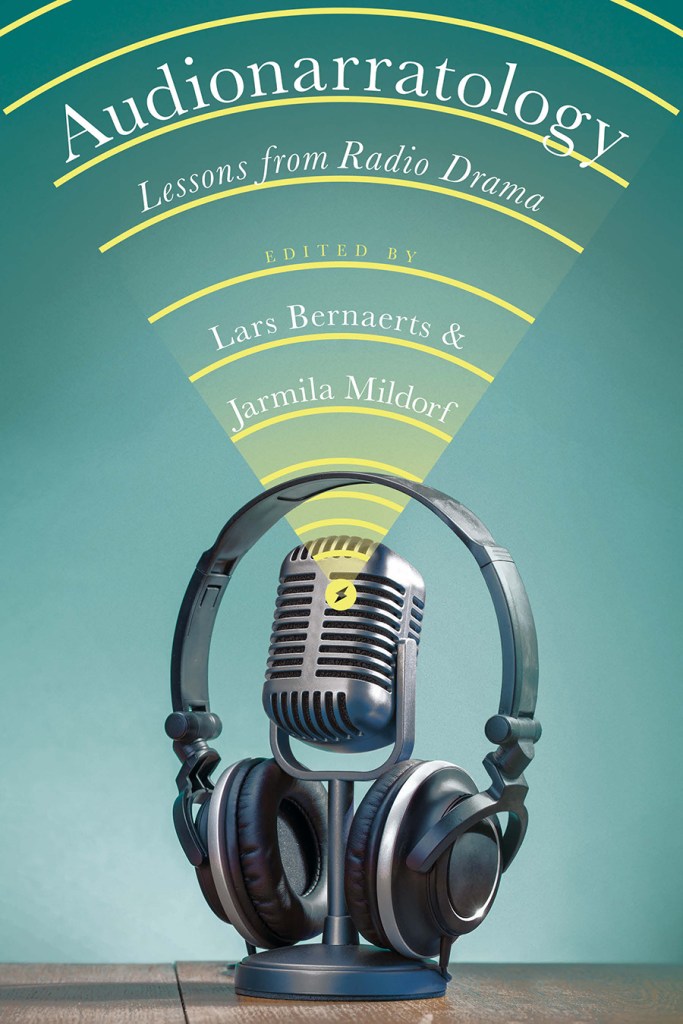
“Home at last,” I could almost hear myself sigh as, out of the narrow slit in our front door, I yanked the packet arriving today. Bearing my name, as few pieces of mail of any consequence or sustenance do nowadays, it contained the volume Audionarratology: Lessons from Radio Drama, to which I had been invited a few years ago to contribute a chapter. The book was published in July 2021 by Ohio State University, a press renowned for its contribution to the evolving discourse on narratology.
The titular neologism suggests that an engagement with aural storytelling is proposed as one way of broadening a field that has enriched the interpretation not only of literature but also of visual culture. Whether such aural storytelling should be subsumed under the rubric ‘radio drama’ is something I debated in my study Immaterial Culture, for which I settled on the term ‘radio play,’ as, I argued, the fictions written for radio production and transmission are hybrids whose potentialities remained underexplored and whose contribution to the arts underappreciated in part due to the alignment of such plays with works for stage and screen. Nor am I sure that, by adding the prefix, “audionarratology” will be regarded as a subgroup of narratology – which would defeat the purpose of broadening said field.
To the question what “Lessons” may be learned from plays for radio, or from our playing with them, the quotation that serves as title of my essay provides a serviceable response: “There ain’t no sense to nothin.” The line is uttered by one of the characters in I Love a Mystery, the thriller serial I discuss – and it is expressive of the bewilderment I felt when first I entered the world created in the 1930s and 1940s by the US American playwright-producer Carlton E. Morse. My cumbersome subtitle is meant to suggest how I responded to the task of making sense not only of the play but also of the field in which I was asked to position it: “Serial Storytelling, Radio-Consciousness and the Gothic of Audition.”
By labelling ‘gothic’ not simply the play but my experience of it, I aim to bring to academic discourse my feeling of unease, a sense of misgivings about explaining away what drew me in to begin with, the lack of vocabulary with which adequately to describe my experience of listening, the anxiety of having to theorise within the uncertain boundaries of a discourse that I sought to broaden instead of delimiting.
Throughout my experience with radio plays of the so-called golden age, I felt that, playing recording or streaming play, I had to audition belatedly for a position of listener but that I could never hear the plays as they were intended to be taken in – serially, via radio – during those days before the supremacy of television, the medium that shaped my childhood.
In the essay, I try to communicate what it feels like not knowing – not knowing the solution to a mystery, not quite knowing my place vis-à-vis the culture in which the play was produced or the research culture in which thriller programs such as I Love a Mystery are subjected to some theory and much neglect. Instead of analysing a play, I ended up examining myself as a queer, English-as-second-language listener estranged from radio and alien to the everyday of my grandparent’s generation – never mind that my German grandfather fought on the Axis side while the US home front stayed tuned to news from the frontlines as much as it tuned in to thrillers and comedies that were hardly considered worthy of being paraded as the so-called forefront of modernism. So, a measure of guilt enters into the mix of emotions with which I struggle to approach or sell such cultural products academically.
The resulting chapter is proposed as a muddle, not as a model – although its self-consciousness may be an encouragement to some who are struggling to straddle the line between their searching, uncertain selves and the construct of a scholarly identity. Its failings and idiosyncrasies are no strategic efforts to fit in by playing the misfit or refitting the scene – they are proposed as candid reflection of my mystification.
They also bespeak the fact that the essay, unfinished or not fully realised though it may seem, was a quarter century in the making. It started out by twisting the dial of my stereo receiver and happening on Max Schmid’s ear-opening program The Golden Age of Radio on WBAI, New York, agonising whether to turn my newly discovered hobby into the subject of academic study, enrolling in David H. Richter’s course “The Rise of the Gothic” at CUNY, and by responding to the essay brief by exploring gothic radio plays and radio adaptations of Gothic literature.
Once I had decided to abandon my Victorian studies in favor of old-time radio, the essay was revised to become a chapter of my PhD study Etherized Victorians. It was revisited but removed from Immaterial Culture as an outlier – the only longer reading of a play not based on a published script – during the process of negotiating the space allotted by the publisher. It had a lingering if non-too-visible presence on my online journal broadcastellan as an experiment in interactive blogging, and it now appears in a volume devoted to a subject of which I had no concept when I started out all those years ago.
The draft, too, has gone through a long process of negotiation — of editing, cutting and rewriting – at some point of which the frankness of declaring myself to be among the “outsiders” of the discourse did not make the editors’ cut.
So, home the essay has come; but the home has changed, as has its dweller, a student of literature who transmogrified into an art historian with a sideline of aurality, and who now has to contend with tinnitus and hearing loss when listening out for clues to non-visual mysteries and, ever self-conscious, waits for his cue to account for the latest of his botches, or, worse still, to be met with silence. Estrangement, uncertainty, and the misery of having to account for the state of being mesmerised by mysteries unsolved – such is the gothic of audition.
This curated window at the Oxfam Bookstore, Aberystwyth, drew me in.
The themed window of our local Oxfam bookshop here in Aberystwyth was something to behold on that bright July afternoon. A row of handsome, second-hand but well-preserved copies of once popular fiction beckoned, reminding me of the tag I had chosen for this blog devoted to unpopular culture upon its inception back in 2005: “Keeping up with the out-of-date.”
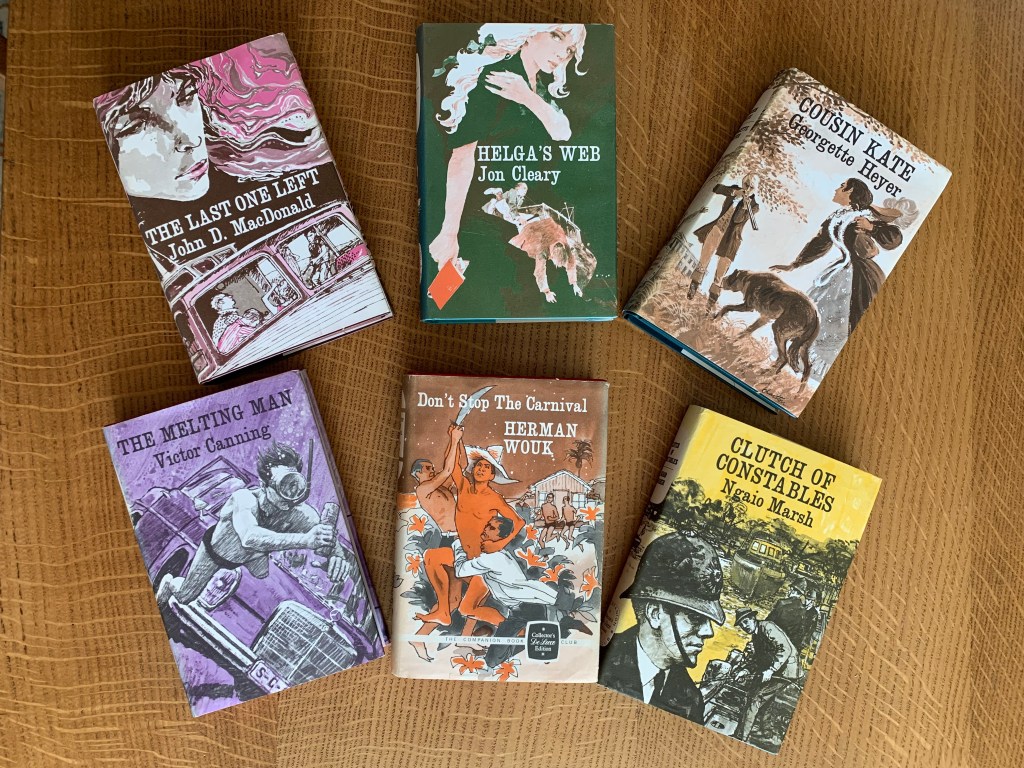
A novelist friend and avid reader, who had come from London for a visit, treated me to a volume of my choice. Three of them, in fact, as the £5-for-three deal made it unnecessary to be quite so discriminating. I passed up on erstwhile bestsellers by A. J. Cronin and Pearl S. Buck, both of whom had vanished from the display a day later, when I returned for another three titles (all six are pictured above). My first choice, however, had been Herman Wouk’s Don’t Stop the Carnival (1965).
I remember picking up Wouk’s tome Youngblood Hawke (1962), in a German translation, from my parent’s sparse bookshelves. My grandfather, likewise, was a Wouk reader, even though his chief interest lay in the writer’s Second World War subjects, to which Opa Heinrich, a former POW, could relate. In my late teens, desultory though my readings were, I enjoyed Wouk’s earlier City Boy (1948) and Marjorie Morningstar (1955).
Volumes I recent additions to my bookshelf
My next encounter with Wouk’s writings dates from my years of graduate studies in New York. I had decided to ditch Thomas Carlyle as a subject and instead write a PhD study on US radio plays. Wouk, as I discussed here previously, had started as a radio writer or gagman. He satirized the industry in Aurora Dawn (1947) and reflected on his experience it in his autobiographical novel Inside, Outside (1985). From the latter I snatched the phrases “Hawkers of feces? Costermongers of shit?” – a reference to laxative commercials on the air – for the title of one of the chapters of Immaterial Culture to capture the dismissal of commercial radio as a legitimate literary forum by those who had written for broadcasting during the 1930s and 1940s but who gained prominence later as published writers and dramatists.
Long story short, I have a kind of casual relationship with Wouk as a writer, a relationship that at one point turned serious (or academic) due to my interest in radio. So, when I spotted that copy of Don’t Stop the Carnival, an old book new to me, I felt inclined to get reacquainted. It turned out to be a bad date.
Don’t Stop the Carnival is a story of middle age. The action, of which there is plenty, is mainly set on an imaginary island in the Caribbean, anno 1959. The novel relates the misadventures of a New Yorker – Norman Paperman – who falls in love with what strikes him as a tropical paradise and decides to take over a hotel, having had no prior experience either with the business or with life on a tropical island. Complications abound, some less comical than others.
Paperman is a Mr. Blandings of sorts, a familiar figure in American fiction. He’d rather lay an egg elsewhere than suffer his ‘disenchantment with Manhattan’ a day longer:
the climbing prices, the increasing crowds and dirt, the gloomy weather, the slow bad transportation, the growing hoodlumism, the political corruption, the mushrooming of office buildings that were rectilinear atrocities of glass, the hideous jams in the few good restaurants, the collapse of decent service even in the luxury hotels, the extortionist prices of tickets to hit shows and the staleness of those hits, and the unutterably narrow weary repetitiousness of the New York life in general, and above all the life of a minor parasite like a press agent.
Perhaps, as his name suggests, Norman is not to be looked at as man but as a page – scribbled on, rather than blank, over the course of nearly fifty years. He may feel like turning over a new leaf – but his life is already scripted in ink that is indelible. Don’t Stop the Carnival sets us up for its conservative moral: stick with what you know, stop kvetching, and don’t even think that the grass could be greener than in Central Park in May.
While it responds to the modernity of its day – to the threat of nuclear war and the growing doubt in the progress narrative of the 1950s – the novel nonetheless shelters in the makeshift of retrospection: it looks back at the end of the Eisenhower years from the vantage point of the violent end of the Kennedy presidency to reflect on the so-called modern liberalism of the early to mid-1960s.
Was this choice of dating the action meant to suggest the datedness of the views expressed by the characters? What were the attitudes of the author toward race relations, civil rights and liberalism? In other words, what comments on the turmoil of the 1960s did Wouk make – or avoid making – by transporting back the readers of his day and dropping them off on an island that, for all its remoteness is nonetheless US territory, and that is about to be developed and exploited for its exoticism and natural resources?
The titular carnival is both figurative and metaphoric – an extended topsy-turvydom (or chaos) in which black mix and mate with white, queer live along straight folks, and Jews like Wouk’s protagonist Norman Paperman mingle with Catholics, Protestants, agnostics, pagans and atheists. He encounters bad infrastructure, worse bureaucracy, and political corruption. This island ain’t that different from Manhattan – which argues getting away from his former life to be futile and pointless.
The Carnival is not only shown to be a dead end but a deadly one. In the final pages of the novel, two characters are killed in quick succession – one central to the narrative, the other – the decidedly other – being marginal. The central one is Norman’s island fling, Iris Tramm, whom he knew as a celebrated actress two decades earlier and is surprised or reencounter, washed up but still alluring, as one of the guests in the hotel he decides to buy.
The island carnival is exposed as a tropical fever that means either death or cure – a cure for an uncommon warmth of non-traditional bonds and realized desires. Paperman recovers, and his understanding wife takes him “home.” His lover, meanwhile, must first lose the companionship of her dog, and then, trashing Paperman’s car while trying to reunite with her wounded pet at a veterinarian’s, her life. Was this the only out Wouk could conceive for a white woman who was the mistress of a black official who dared not to marry her?
It is the treatment of the marginal character of Hassim and his swift, unceremonious and unlamented disposal that lays bare Wouk’s fear of change: the antique dealer Hassim, introduced as a “rotund bald man” with a “bottom swaying like a woman’s,” who openly flirts with young men. In fact, the island is awash with middle-class homosexuals of all ages. Even Paperman’s hotel is pre-owned by a gay couple. And although he must have come across some of them in his former job as a Broadway press agent, Paperman is uneasy in their presence when he and Iris, his illicit love, visit an establishment frequented by gays:
Norman found the proprietor amusing, and he was enjoying the songs of his youth. But the Casa Encantada made him uneasy. Men were flirting with each other all around him; some were cuddling like teen-agers in a movie balcony. The boy in the pink shirt, biting his nails and constantly looking around in a scared way, sat at a small table with one of the rich pederasts from Signal Mountain, a pipe-smoking gray-haired man in tailored olive shirt and shorts, with young tan features carved by plastic surgery, and false teeth. Norman was glad when the proprietor finished a run of Noel Coward songs and left the piano, so that he and Iris could politely get out of the place.
Hassim is shot dead by a policeman, despite posing no risk and committing no crimes. The killing, which occurs in Paperman’s hotel and bar, the Gull Reef, is described in few words and elicits less of a response than the stabbing of a dog a few pages before this incident near the close of the novel.
“As a matter of fact, […] I feel sorry for the poor bugger,” is the response to the death of Hassim by one character, “munching on his thick-piled hamburger” not long after the killing.
“I’ve known thousands of those guys, and there’s no harm in ninety-nine out of a hundred of them. It’s just a sickness and it’s their own business. Though gosh knows, when I was a kid working backstage, I sure got some surprises. Yes ma’am, it was dam near worth my life to bend over and tie my shoelace, I tell you.” He laughed salaciously. His once green face was burning to an odd bronze color like an American Indian’s, and he looked very relaxed and happy. “Actually, Henny [who is Paperman’s wife], I almost hate to say this, but I think this thing’s going to prove a break for the Club. I bet the nances stop coming to Gull Reef after this.”
Such views are unchallenged by the narrator and the main character, who decides to sell his business – to the man expressing those views, no less – and return to New York. “People thought that this [his death] was a bit hard on Hassim,” the narrator sums, “but that the cop after all had only been doing his duty, and that one queer the less in the world was no grievous loss.” Case closed. Business open as usual.
Clearly, queers like me were not considered by Wouk to be among his readers. Targets, yes, but not target audiences. Even the academic treatment of homosexuality – the suggestion that famous writers of the past, too, might have been homosexuals – is ridiculed in the novel, with one PhD student, the lover of Paperman’s teenage daughter, nearly drowning in the sea.
Wouk, who died shortly before his 104th birthday in May 2019, lived beyond the middle age of Don’t Stop the Carnival for more than half a century. I doubt that I shall make him a companion again on whatever is left of my journey.












 Harry Heuser