In My Library: Radio Drama and How to Write It (1926)

The man behind the counter looked none too pleased when I handed over my money. This one, he said, had escaped him. The item in question is a rare little volume on radio drama, written way back in 1929, at a time when wireless theatricals were largely regarded, if at all, as little more than a novelty. In his foreword, Productions Director for the BBC, R. E. Jeffries, expressed the not unfounded belief that its author, one Gordon Lea, had the “distinction of being the first to publish a work in volume form upon the subject.”

Nothing to get excited about, you might say. I know, it is not exactly a prize pony, this old hobbyhorse of mine. Few who come across it today care to hop on, let alone put any money on it, particularly now that it has been put out to the pasture known as the internet, the playing field where culture is beaten to death. So, should not any bookseller be pleased to part with Mr. Lea’s reflection on echoes? Not, perhaps, when the money exchanged amounts to no more than a single pound coin. History often comes cheaply; it is the price for ignoring it that is high.

I had been on the lookout for Radio Drama and How to Write It while researching for Etherized Victorians, my doctoral study on old-time radio in the United States. After no volume could be unearthed in the legendary and much-relied on vaults of the New York Public Library, let alone anywhere else, I gave up the search, comforted by the thought that Mr. Lea was, after all, a British hobbyhorse fancier, far removed from the commercial network circus in which I had chosen to study that ill-treated bastard of the performing arts.

It helps to take the blinders off. After all, I spotted the obscure volume last weekend, on another trip to Hay-on-Wye, the Welsh bordertown known the world over (by serious collectors, at least) as the “town of books.” Now, I am always anxious to put my loot on display. And so, rather to let it sit on my bookshelf, I shall let Mr. Lea’s pioneering effort speak for itself:

It is asserted that no play is complete until it has an audience. This is untrue. One might as well say that a tragedy of emotion between man and wife, enacted in the privacy of their own drawing room, is not a tragedy, because the general public are not invited to watch it. A play is complete when once it is conceived by its author. But, inasmuch as this fallacy is still popular, playwrights still construct their plays with an audience in mind.[. . .].

Thus, Lea reasons, the stage play

must be such as can appeal to a crowd, as distinct from the individual. This is a difficult thing to do, but such is the power of crowd-psychology, that if the play appeals to a section of the crowd, the disparate elements can be conquered and absorbed into the general atmosphere. An audience may, at the beginning of the play, be a company of individuals, but before long hey are by the devices of stage-production welded into one mass with one mind and one emotion. If the play is incapable of this alchemy, it fails to please and becomes a thing for the solitary patron. 

There, then, are the conditions which govern the production of the stage-play, and [ . . .] within the limitations of the theatre are wonderfully efficacious. 

But, is it necessary to accept these limitations? Is there no other medium more flexible?

In stage drama there is “always the problem of the fourth wall,” the solving (or dissolving) of which lead to intriguing if unsatisfactory compromises. In a production of The Passing of the Third Floor Back, for instance, the footlights were turned into an imaginary fireplace. “[V]ery ingenious,” the author quips,

but the effect is that, when the players sit before the fire, you have the spectacle of people staring straight at you, and, unless you imagine yourself to be a lump of coal or a salamander, you don’t get the right angle.

I was reminded of my experience seeing What Every Woman Knows at the Royal Exchange in Manchester, which thrust me into a similar hot spot I did not relish.

Sure, sound-only drama can readily break the barriers of convention. Yet when Lea dreams of the new medium and its potentialities, he has technology, not commerce or politics, in mind. Whether state-run or commercially sponsored, radio was never quite as free and free as the air. The audience, its size and sensibilities, always mattered more than the voice of the single speaker.

Nor am I convinced that a play is a play without playing itself out before or within an audience, whatever its number. A thought must be communicated to mean, and indeed to be. It is for this reason that I air out my library from time to time, to dust off those forgotten books and share what I find there in this, the most flexible medium of all . . .

Lance Sieveking, “The Man with the Flower in His Mouth”

Let me be the first to admit my ignorance. The world being largely ignorant of me, I simply cannot depend on anyone else to do so. That said, I might as well turn the keeping of this journal (complicated as it was today by internet-disrupting hailstorms) into occasions to pick up a little something rather than disperse whatever scraps of knowledge I may already lay claim to after years of study (or intellectual loafing).

One such occasion might be the birthday of British radio and television pioneer Lancelot Sieveking, born, as the Internet Movie Database informed me, on this day, 19 March, back in 1896. Sure, I had come across his name during my research for Etherized Victorians; but, concentrating my efforts on American radio dramatics, I had conveniently overlooked Sieveking’s accomplishments. Even the folks over at the Database have yet to catch up with this man of all media; at least, his death (back in 1972) has thus far escaped them.

It is no overstatement to say that the author of The Stuff of Radio (1934) is a neglected figure today; his name has most recently been dropped in connection to Disney’s first entry in the Chronicles of Narnia series. Narnia author C. S. Lewis had approved of Sieveking’s radio dramatization but dismissed the idea of a film adaptation. During the first season of BBC2 television’s Oxford English Dictionary challenge Balderdash and Piffle, there was some debate about the origin of the phrase “back to square one,” which was argued to lie in an eight-squared drawing meant to assist BBC radio’s football commentators back in 1927. That design, as it turns out, was Sieveking’s.

Fellow BBC radio drama producer Val Gielgud had this to say about the “not altogether fortunate” Sieveking: “He was perhaps over much influenced during his most impressionable years by G. K. Chesterton, and by the theory of that master of paradox that because some things were better looked at inside out or upside down such a viewpoint should invariably be adopted. Talented and imaginative beyond the ordinary, his eyes gazing towards distant horizons, he was liable to neglect what lay immediately before his feet.”

In other words, Sieveking was an audio-visionary, a trier of radiogenic techniques at whom actors and colleagues would “gaze with a certain dumb bewilderment” as he “exhorted them to play ‘in a deep-green mood,’ or spoke with fluent enthusiasm of ‘playing the dramatic-control panel, as one plays an organ.'” There was not much use for such an one in radio. As Gielgud put it, even British radio broadcasting, “provided him with no laboratory in which experiments could be carried out.”

In 1930, when radio drama was still in its protracted infancy (despite earlier trials-by-air like the aforementioned “Comedy of Danger”), Sieveking found a “laboratory” in the still newer medium of television. He collaborated with Gielgud in bringing to British television “The Man with the Flower in His Mouth.” An adaptation of Luigi Pirandello’s short play L’uomo dal fiore in bocca (1923), it aired on 14 July 1930.

Little remains today of Sieveking’s work in sound and images, aside from its blueprints—long-out-of-print scripts and theories. Now, I live in a town with a five-million-volume copyright library (which celebrated its 100th anniversary today); but for a snippet of sound, you might as well saunter over to tvdawn, where you may hear Sieveking’s spoken introduction to “The Man.”

On This Day in 1930: ‘”Mystery Gun” Disappears As Lights Go Out’ in Invisible Courtroom

I don’t suppose I shall ever get used to it. The Welsh weather, I mean, the nocturnal roars and howlings of which I often drown out by listening to the familiar voices of old-time radio, reassuring and comforting voices like those of Harry Bartell or Elliot Lewis, both of whom were born on this day, 28 November, in 1913 and 1917, respectively. Storms are part of the Welsh soundscape, much like the bleating of sheep on the hills. If such climate conditions were faced by the people of New York, among whom I numbered for some fifteen years of my life, I wager that the local television newscasts would report little else. To be sure, last night’s storm did make headlines, being that a tornado wreaked havoc in a village just a few miles from my present home.

Thanks to some well-chosen radio thriller, I managed to sleep through it all, losing myself in dreams that, once radioactivated, tend to become particularly vivid. I often wonder just how much my mind, conscious or not, is influenced by the popular culture I consume by listening in. Sometimes, though, it is what we hear about, and not what we perceive, that stirs our imagination. There are a few listening experiences I can only dream of, plays I have only read or read about and consequently fascinate me no end. One such unheard soundplay is the serial The Trial of Vivienne Ware (previously mentioned here and discussed at some length in Etherized, my study of American radio dramatics). Pulled by the Hearst press and propagated on the air by station WJZ, New York, it was a spectacular publicity stunt designed to promote Hearst’s less than reputable papers.

Those tuning in did not only get to hear the proceedings, but were cast as jurors. They stood a chance of being awarded $1000 for coming up with the most convincing verdict (be it “guilty” or “innocent”), thus making it unnecessary for the author of the story—one Kenneth M. Ellis—to determine upon a reasonable conclusion and the fate of his titular character.

From the 25th to the last day of November, the fictional trial was broadcast live, with eminent figures of law and politics, New York Senator Robert F. Wagner and prominent attorney Ferdinand Pecora, heading a cast that included noted stage actress Rosamund Pinchot. Here is how the New York American, the Hearst paper sponsoring the series, described the session of 28 November 1930:

It was almost at the close of the session that the lights suddenly were extinguished and the court plunged into total darkness. Women’s screams, the shouts and bustle of court attaches, and the hammering of the gavel filled five or six black seconds with sound. Then the lights came on again—but the .38 caliber revolver which George Gordon Battle, chief counsel for Vivienne Ware, had just introduced as evidence had disappeared from the table where it lay.

Now, that’s a melodramatic conjuring act fit for the airwaves. It probably wouldn’t do much good during a stormy night, though, since such interactive thrills—let alone the pondering of the verdict, and what to do with the prize money—are, unlike much else that was presented on American radio with comforting predictability, anything but soporific.

"Panic" Shopping at the Argosy

Sure I love books; but even more than reading, I enjoy hunting them down. It must be an instinct stronger than intellect that makes me want to sniff out volume after volume, many of which remain unread. Last Friday, for instance, en route to Birmingham International Airport to pick up two old friends from Germany who came to visit me for the first time here in Wales, we spent some two hours at Sunnycroft, a late-Victorian suburban villa once owned by a well-to-do, upper middle-class family.

As is often the case on such National Trust properties, there was a second-hand bookstore on the premises, however small and dingy. The piles of paperback romances did not bode well; and still I could not resist and stepped inside what, if I read the map right, was formerly the Sunnycroft boiler room. For something amounting to less than a dollar, to be left in a basket standing in for a salesperson, I snatched up a bound volume of The Snow Image, a British edition of some of Nathaniel Hawthorne’s Twice-told Tales, probably as old as Sunnycroft itself. Here it lies, next to me, waiting for some wintry evening by the fire or such time I deem fit for its perusal.

Nineteenth-century treasures like this one aside, I am thoroughly modern in my choice of books, my library consisting chiefly of texts on that mid-20th century phenomenon known as radio drama. And while I do much of my shopping online nowadays, I still prefer walking around town—be it New York City or Hay-on-Wye—in search of well-worn volumes on my favorite subject.

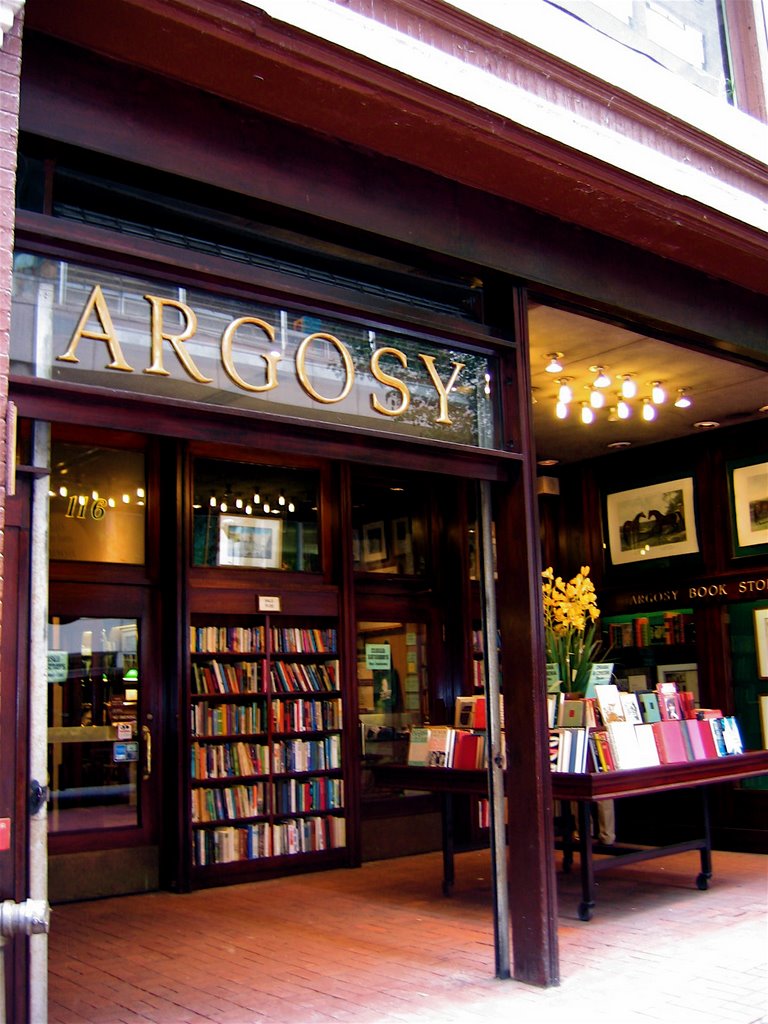
On the Upper East Side in Manhattan, just around the corner from Bloomingdales, one such supplier of old books on film, theater, and radio is the aptly named Argosy. As I mentioned in the comments section of a previous journal entry, the store is run by the wife of Stuart Hample, whose all the sincerity in Hollywood is a fine introduction to the wit of radio comedian Fred Allen.

On my tour of the Manhattan’s fast disappearing used and antiquarian bookstores a few weeks ago, I was pleased to discover that the Argosy had one of its themed sales, the theme being drama and television. Among the $3 items displayed in front of the store, I found a 1944 copy of Behind the Microphone by one John J. Floherty, a prolific writer of supposed non-fictions like Inside the FBI, Your Daily Paper, and Board the Airline. I expected neither insights nor entertainment; this, I thought, was merely one for the collection. As it turns out, Mr. Floherty was quite the storyteller. Listen to this Daphne du Maurier rivalling introduction to the miracle of Marconi, whose Poldhu station I failed to visit during my Cornwall trip earlier this year:

The State Troopers’ lodge at Montauk Point on the easternmost tip of Long Island stands on one of the loneliest spots along this seaboard. Rolling sand dunes and high bluffs, at which the Atlantic has gnawed for centuries, stretch drearily westward to Montauk village nine miles away. 

It was here that Captain Flynn of the New York State Troopers had me enthralled one stormy Sabbath night with tales of the early days in the lumber towns on the Canadian border, when troopers and lumberjacks fought it out with the accepted weapons of the period and place—bare knuckles. 

Outside the night was storm mad. A sixty-five mile gale machine-gunned rain pellets with battering force against the windowpanes. The pounding surf on the beach a few steps from the door vied with the thunder that came in frequent peals. The crackling fire of driftwood gave the room a coziness for which I was thankful on such a night. 

The captain was in the middle of a story when the door was flung open violently and a woman, tall and blonde, hurled herself into the room in an onslaught of rain and wind. At that hour, on such a night and in such a place, it was as if she had been flung from another planet. She was drenched and dishevelled. Terror was in her eyes. She tried to speak, but gasped instead. She was followed presently by a bedraggled wisp of a man and a thoroughly frightened boy. 

“What’s all the excitement?” the captain said, as calmly as if he had been asking the time. The intruders stared at him for a moment with popping eyes. The woman spoke. “Haven’t you heard, Captain!? Haven’t you heard!!? Thousands of people are being killed in New York and New Jersey. Twenty of your troopers have been murdered. People are jumping into the Hudson River and drowning like rats. It’s a gas or something? Our children are in Brooklyn—do you think they are safe? Do you think the soldiers, or whatever they are, will attack over there?”

I have never read a more melodramatic—yet supposedly authentic—account of the “War of the Worlds” panic. I am glad the industrious Mr. Floherty had enough zest to spin such a yarn, which surely deserves a mention in Etherized, my study on old-time radio. And I am glad I returned to the Argosy, which, after some eighty years, is still afloat in a sea of corporate sameness.

Up to My Eyes in Dog-eared Books

This is one of those rare, lugubrious days of landscape-swallowing fogginess on which you might as well retreat, brandy in hand, into the confines of your small but reassuringly familiar study. My thought being as opaque as the wintry sky, my mind as obnubilated as the mist-shrouded hills, I have put aside all semi-intellectual or quasi-artistic endeavors for the moment. Instead, I busy myself cataloguing the books in my radio drama library, another four dusty volumes of forgotten plays having arrived by mail yesterday. During my years of researching so-called old-time radio in New York City, I had access to several excellent public and academic libraries, however deficient my own.

While a vast number of recordings have been preserved, there are some plays you can only find on paper, among them rare pieces by noted American authors like Sherwood Anderson, who died on this day, 8 March, in 1941. Writing my dissertation, I was determined not to discuss at length any play I had never set my ears upon. The page seemed to be a poor substitute for a performance. Who, I ask you, would claim to know a movie having only read the screenplay? I thought. And yet, once your eye is becoming accustomed to the language of radio, you can almost hear the plays as they might have been produced.

Distrustful of my less than reliable memory, I used to photocopy much of what I read and carefully filed away each text for ready reference. After I had earned my doctorate and decided, propelled by romance, to move to the United Kingdom, I took those thousands of sheets out of their assigned ring binders, boxed them up, and posted them, along with most of my belongings, to be shipped overseas.

Upon my arrival in Blighty, I was not only confronted with stacks of paper (relieved to find them there), but with the problem of making a new and orderly home for them. Little did I know when I decided to be economic by dumping the old binders that the paper sizes in the UK differ from those in the US, that British sheet protectors are too narrow for American paper, and that such incompatibilities would spell many a tedious hour punching holes or cropping paper. Eventually, I resigned in frustration from such labors and resolved to ditch some of the copies in exchange for the originals, however obscure.

Tossing another photocopied script into the bin this morning, I noticed that the play thus preserved was broadcast on the first anniversary of Anderson’s death on this day in 1941. The piece in question is “The Test” by radio dramatist Joseph Ruscoll, and I have not yet come across a recording of it.

Produced by the Columbia Workshop, it concerns adolescent lovers Janet and Joseph who, thirty years after parting, are nothing but joyful memories and pangs of regret to one another. They separated as the result of a dare—the eponymous “test”—that was to prove Joseph’s love for Janet: would he give up his harmonica for their harmonious union? No, he would not stoop to accepting the challenge—and the two were twained no more. Through the miracle of the pre-cellular phone wireless, a radio commentator interviewing both brings about a reunion of sorts. After all, radio was, as Gerald Nachman put it, “yesterday’s internet”:

Narrator: And you never spoke to him again, Janet?

Janet.  Never.  (Sorrowfully)

Narrator: Or you to her, Mr. Pike? 

Joseph: I had my pride.  (Lowly)

Narrator (sighs): And that was thirty years ago?

Janet (flaring up): Pride! If he had really loved me, he wouldn’t have had any pride!

Joseph (flaring up in turn): And if she really loved me, she—what about her foolish pride?

Janet (indignantly): Foolish?

Joseph (crying out): Foolish! Foolish!

Janet: What do you think, Mr. Narrator?

Narrator (sadly): I think you were both very, very foolish.

Perhaps, we’d better put our keyboard to some special use tonight by searching for old friends or else put it aside altogether, seeking instead the company of neglected loved ones rather than dwelling in the sheltering obscurity of our inconsequentiality or sweltering in the ersatz heat of emboldening internet anonymity. I write for myself and strangers—but I live for a hug and a smile.

On This Day in 1930: Murder Trial Broadcast Summons Millions to Court

Well, it is Black Friday here in New York—the stores are opening at preposterously early hours and shoppers are lured away from their leftover turkey with promises of early bird specials and nest egg busting savings. Too lazy after a sumptuous Thanksgiving meal, I am not partaking of any 5 AM bargain debasements. Instead, I am going to celebrate yet another milestone in radio drama history—The Trial of Vivienne Ware, which opened on this day, 25 November, in 1930 and ushered in a new age of cross-promotional multimediacy.

“There’s murder in the air,” the New York Times had announced in its Sunday radio section, predicting that The Trial of Vivienne Ware would “occupy the attention of listeners over WJZ’s network for six consecutive nights beginning Tuesday.” Considerably more enthusiastic was the New York American, which declared the six-part serial to be “one of the most stirring mystery radiodramas ever presented,” quoting NBC president M. H. Aylesworth as saying that its script “established a new standard in the creation of radio plays. The simplicity and fidelity of the theme, together with the colorful word and character pictures, stand out in this new field of adaptive writing.”

The New York American—the Hearst “paper for people who think”—had good reason to eulogize the as yet unaired serial as “one of the best radio dramas ever written,” given that the program had been conceived by one of its own feature writers.

Every effort was made to prevent the program from appearing like a cheap marketing ploy and to convince WJZ, New York—the flagship station of NBC’s Blue network—to produce the series in its glass-curtained Times Square studio atop the New Amsterdam Theatre and to broadcast the event locally instead of making the required six half-hour spots available to national advertisers.

Certain to impress NBC executives was the fact that—along with Ferdinand Pecora, Assistant District Attorney of New York, and prominent New York attorney George Gordon Battle—none other than US Senator and Supreme Court Justice Robert F. Wagner had agreed to participate in the mock trial by assuming the role of the presiding judge. The titular heroine was played by Rosamund Pinchot, a stage actress who had appeared in Max Reinhardt’s celebrated staging of The Miracle, and the entire spectacular was supervised by well-known Broadway producer John Golden.

“Ladies and Gentlemen of the Radio Jury,” Wagner addressed the audience during the inaugural broadcast:

You have been called to one of the most trying tasks which befalls the lot of a citizen. You are to try a fellow being on a charge of first degree murder.  It is the more difficult for you in that this defendant has everything which would make life for any young woman most desirable.  Yet it may become your solemn duty to deprive her of her enjoyment of that life.

Standing to gain cash prizes for the most convincing verdict, readers of the New York American were advised to prepare themselves by taking in the published “information” daily, since they might miss “important loop-holes” if they did not “carefully follow the testimony and the evidence” as presented on the radio. “By reading the New York American every morning” throughout the trial and by “tuning in on WJZ each night at the specified time,” readers should be able to form their verdict as to Miss Ware’s guilt or innocence—“just like any other juror.”

According to Radio Digest, verdicts, letters of congratulations, and demands for a sequel were received from places as remote as Canada and Virginia, as well as from ships at sea; an estimated 14,000 listeners eventually acquitted the fictional heroine on trial, with about 2000 arguing the “society girl” to be guilty. More significant for the publisher was that the serial had increased the circulation of the New York American “far in excess of expectations,” as a result of which Hearst papers in San Francisco, Chicago, Los Angeles, Washington, and Omaha sponsored the trial with different casts of local luminaries.

A follow-up trial involving the murder victim’s less privileged “friend,” nightclub singer Dolores Divine, was staged a few weeks after the acquittal of the first defendant. A generic version of the radio scripts for both serials, prefaced by excepts from the printed reports and concluding with the audience verdict, was subsequently published by Grosset and Dunlap, which marketed Kenneth M. Ellis’s The Trial of Vivienne Ware as the “first radio novel, an innovation in both the radio and publishing worlds.”

Unfortunately, no recordings of this interactive multi-media event seem to have survived. I sure would have enjoyed tuning in . . .

Listening to “The Thing That Cries in the Night”; (Chapter Fifteen): Radio Is a Deserted Home

Well, Heavenly Days! This morning, I caught a glimpse of the Great Gildersleeve and the McGees (Fibber and Molly, that is), who were featured in a triple bill of radio-takes-the-pictures comedies on Turner Classic Movies. Of course, radio always takes the pictures, provided the audience has a mind’s eye keen enough to develop them. Soon I’ll head out to pay a visit to the Museum of Television and Radio. As I noticed yesterday, the bookstores, second-hand or otherwise, are not exactly well stocked with radio-related publications; the late-1990s resurgence of interest in radio dramatics and pre-TV broadcasting here in the US seems to have died before it could mature as an independent, sustained, and regenerative field of study.

My own study on the subject of old-time radio, Etherized Victorians, doesn’t have much of a chance in a market that caters to people with short memories or nostalgic longings, instead to those who, like me, think of audio drama as alive if largely abandoned.

Today, my rather unsuccessful attempt at creating enthusiasm about Carlton E. Morse’s I Love a Mystery must come to an end. On this day, 18 November, in 1949, “The Thing That Cries in the Night” stopped bawling at last.

In his fifteenth and final chapter of “The Thing,” Morse keeps on postponing the prosaic business of making sense, until he eventually explains away the mystery of the voice without a body and solving the case of the name without a face.  Not that Jack Packard, one of Morse’s trio of adventurers, finds pleasure in lifting the veil.

“The House of Martin has fallen,” he concludes, soberly; the collapse has proven too devastating and deadly to call for celebration.  The story of a house under the corrupting influences of Hearst and Hollywood, “The Thing That Cries in the Night” is also a chapter in the history of radio, the medium for which Morse chose to write. Exposing the double life of the not-so-sweet Charity, the secret career and inglorious demise of a radio voice and its bodied double, Morse turns ventriloquism into a metaphor for the depersonalizing business of commercial broadcasting and its body of tongue-tied artists and scribes who, generally barred from speaking their mind and forced to mind their speech, stomached ignominy while devising various modes of indirection.

The dark art of casting voices, narrowly or broadly, is exposed as a duplicitous act, an impersonation in whose impersonal nature we can descry the corruption of communication and the unwholesome fragmentations of modern life.

Thus concludes my adventure in radio listening. Had it met with a more favorable reception—or just more of a reception, for that matter—I might have fixed my mind’s eye on a longer serial, such as Chandu the Magician. Instead, I will listen to the sounds of the city for a while as I mingle with the more tangible multitude. Perhaps you’ll be here when I return.