Filling in the Blanks

I’ve had quite a few “silent nights” here at broadcastellan lately (to use an old broadcasting term); and yet, I have been preparing all along for the weeks and months to come, those dark and cheerless days of mid-winter when keeping up with the out-of-date can be a real comfort. Not that the conditions here in our cottage have been altogether favorable to such pursuits, given that we had to deal with a number of blackouts and five days without heating oil, during which the “room temperature” (a phrase stricken from my active vocabulary henceforth) dropped below 40F. Not even a swig of brandy to warm me. I have given up swigging for whatever duration I deem fit after imbibing rather too copiously during the New Year’s Eve celebrations down in Bristol.

Those are not the blanks (let alone the ones in my short-term memory) that I intend to fill here. The gaps in question are in my iTunes library, which currently contains some 17500 files ranging from the recent BBC adaptation of Anthony Trollope’s Orley Farm to World War I recordings. The vast majority of these files are American radio programs. They are readily gathered these days; but the work involved in cataloguing them for ready retrieval can be problematic and time consuming. For now, I am not lacking time; at least not until our long planned and much delayed move into town, real estate crisis be damned. Anyway . . .

For the past few weeks, I have been filling in each of the fields as shown above, verifying dates, checking the names of performers, comparing the sound quality of duplicate files, and researching the source materials for adaptations. It took a while to arrive at a convenient system. When I started the project anew (after the crash of an earlier Mac), I made the mistake of entering the date after the title of the broadcast (entries in lower case denoting descriptive ones).

As a result, I could not readily listen to a serial in the order in which its chapters were presented. I would have been at a loss to follow and follow up today’s installment of Chandu the Magician (1949), as if having missing out on the chance of getting my hands on Chandu’s “Assyrian money-changer” by sending in a White King toilet soap box top sixty years ago were not difficult enough to bear.

The effort should pay off, though, as it allows me to select more carefully the programs worth my time. On this day, 21 January, the highlights, to me, are the second part of “Freedom Road” (1945), a dramatization of Howard Fast’s historical novel about the post-Civil War era (currently in my online library); Norman Corwin’s examination of life in post-World War II Britain on the previously discussed One World Flight (1947), a documentary featuring an introduction by Fiorello La Guardia and a brief commentary by author-playwright-broadcaster J. B. Priestley pop-psychologizing the causes of human conflict; and the aforementioned debut of The Fat Man (1946). Not that I’d turn a deaf ear to Ingrid Bergman in Anna Christie as produced by the Ford Theater (1949) or to the Campbell Playhouse presentation of A. J. Cronin’s Citadel (1940).

And then there is another address by Father Coughlin (1940), about whose Shrine a fellow web-journalist sporting Canary Feathers in his cap had much to say recently in his personal reminiscence.

Listing, though, is to me almost always less satisfying than listening; it is also far less difficult and engaging. Listening often results in research, in comparing adaptation to source, in reading up on the performers, or in finding contemporary reviews. About the 21 January 1946 premiere of I Deal in Crime, for instance, broadcast critic Jack Gould complained that it “creeps along at a snail’s pace” and that Ted Hediger’s monologue-crowded narrative style was “not helped” by William Gargan’s “rather lackadaisical” delivery.

While he did not have instant access to thousands of such programs, Gould nevertheless noted the sameness of such nominal thrillers and their “stock situations.” To him, Paul Whiteman’s Forever Tops was the “real lift” of the evening’s new offerings on ABC, a reference that compels me to find a recording of that broadcast . . . .

In this way I spend many an hour before once again sending another missive into the niche of space I, as keeper of past broadcasts, have grandiloquently styled broadcastellan.

" . . . within the limits": Radio and the Code

“Will radio writing always be in demand? What will television do to radio writing? Why should anyone learn a new technique in writing when some unexpected development might wipe out the demand for this sort of work almost overnight? Is radio broadcasting basically sound? Will it endure and develop?” Such is the battery of questions with which readers eager for pointers on How to Write for Radio were being confronted upon opening one of the earliest books on the subject. The co-author of this 1931 manual, Katharine Seymour, was an accomplished radio playwright whose work was heard on prestigious programs such as Cavalcade of America. On this day, 12 January 1941, Seymour talked to announcer Graham McNamee about her experience entering the broadcasting business in the mid-1920s, back when it bore little resemblance to the confident, respected, and efficient medium it had become by the late 1930s, by which time Seymour had co-written another book on Practical Radio Writing.

Many such how-to guides followed throughout the 1940s, a testament to the vastness of the industry, its demand for written words and for talent familiar with the codes and regulations to which they were expected to adhere. In the 1920s, when Seymour tried to promote herself from typist to writer, she was told by her boss at WEAF, New York, that “no radio station will ever need more than one script writer,” to which shortsighted remark McNamee, himself one of the old-timers, responded with a resounding “Wow!”

The days of largely unchecked improvisation were over. Being obliged to keep their word, broadcasters had learned that the spoken word needed to become copy (that is, text) and that every dramatic dialogue had to be played by the book the FCC would otherwise throw at them.

One of the latest addition to my library, Albert R. Crews’s Professional Radio Writing (1946), acquainted readers with what was known as the NAB code. As the author, then production director at NBC, explained, the code was a measure of self-censorship undertaken by the National Association of Broadcasters and adopted on 11 July 1939 to outline the “handling of children’s programming, controversial public issues, educational programming, news, [and] religious broadcasts,” as well as to set down the “acceptable length of commercial copy and its content.”

In keeping with this code, the National Broadcasting Company developed its own guidelines for “continuity acceptance,” “continuity” being anything read on the air. Anyone learning how to write radio drama with the view of hearing it produced had to keep in mind, for instance, that “[w]hite slavery, sex perversion or the implication of it may not be treated in NBC programs” and that the “fact of marriage must never be used for the introduction of scenes of passion excessive or lustful in character, or which are clearly unessential to the plot development.”

In the treatment of crime, the “use of horrifying sound effects as such” was “forbidden.” According to the code, no character was to “be depicted in death agonies,” nor could the “death of any character be presented in any manner shocking to the sensibilities of the public.” The very “mention of intoxicants” had to “be held to a minimum” and “suggestive dialogue and double meaning” was “never [to] be used.”

Responding to the hullaballoo over CBS’s “War of the Worlds” broadcast, NBC also stipulated that

[f]ictional events shall not be presented in the form of authentic news announcements. Likewise, no program or commercial announcement will be allowed to be presented as a news broadcast using sound effects and terminology associated with news broadcasts. For example, the use of the word “Flash!” is reserved for the announcement of special news bulletins exclusively, and may not be used for any other purpose except in rare cases where by reason of the manner in which it is used no possible confusion may result.

Was it any wonder that, as Crews put it, there had been a “tendency on the part of many outstanding writers in [the US] to scoff at radio as a possible medium for their talents”? Such talent-repelling strictures notwithstanding, he found it “heartening” to note just

how many writers of importance radio has itself created. There are dozens of highly skilled dramatic writers who are, for the most part, completely unknown to the public, but who each day do distinguished work in their field. The anonymity of such writers is no measure of their skill or their success.

It is with the efforts of those mostly unheard of and almost entirely forgotten writers that I shall continue to concern myself in this journal; writers who skillfully interpreted the code and somehow managed to subvert it, or who at least found leeway for play “within the limits” set down for them; writers whose works, to take up one of Seymour’s questions, have endured in recordings even if American radio drama, as an art, has largely ceased to develop further.

Having lost their purpose as instruction manuals for an essentially defunct business, books like Professional Radio Writing nonetheless instruct us how to read the plays that went on the air, to account for their limitations and appreciate their qualities.

Let George Say It

I penned my first autobiography at the age of sixteen. With the bombast befitting an insecure teenager eager for validation, I called it a “memoir.” It was a short, handwritten volume I passed around to fellow students, a performance designed at once to justify, expose, and invent myself. Like so many pieces of juvenilia, those “memoirs” were destroyed in an act of reinvention, or, not to be fanciful, embarrassment. I fear that many of the instances I recorded, however embellished, edited or carefully selected my memories, may be far more difficult to recreate, faded as my recollections have during all those intervening years that have made me a stranger to my former selves. I seem to have made forgetting a virtue by looking at it as the ability to move on and start over as if from scratch.

Perhaps, one reason for my dwelling in and on the presumably out-of-date in a journal reflective of my readings, viewings, and listening experiences is that it allows me to discover myself in a researchable past other than that which is chronologically and biologically my own: movies, radio programs, books that precede my past and inform my present. To research my story, I must rely on a memory I dare not trust. When it comes to my early life, I have little to go on, other than flashes of dreamlike recollections.

One of the problems involving the autobiographical act is to arrive at a narrative frame that fits the picture without distorting, let alone creating, it. It is difficult to determine where an autobiography ought to end, considering that, as its writer, one is still in engaged in the creation of memories. One is alive and, apparently, compelled to prove it. A future event might call for an entirely new arrangement of facts—a life-changing event may lie ahead, rendering negligible much that seems important at present.

Not quite as problematic, but troublesome nonetheless, is the beginning. Does one begin with one’s family, with one’s ancestors, with a description of the birthplace that, presumably, shaped our early life? Should an autobiography start with an explanation, an apology for the hubris of taking oneself serious enough to warrant such a performance, or an acknowledgement of whomever we construe as our audience? Dear reader, is this my life? Should, as in James Joyce’s Portrait of the Artist, the voice reflect the age, mind and intellect of the subject, the self turned object, in various stages of existence?

One man who knew how to begin was the aforementioned Emlyn Williams, born on this day, 26 November, in 1905; he grew up in a remote town in Wales, his parents hardly proficient in English, to become a well-known actor and playwright (a production of whose Night Must Fall I briefly discussed here), personae or roles that no doubt influenced his performance and may well have created the impetus to for it. He could count on an audience, a public that presumed and demanded to know him.

Williams’s lyrical introduction to George: An Early Autobiography (1961) is one that compels me both to read on and revisit the idea of writing my own life. Aware of the task at hand, of the challenges of starting, of devising a beginning reflective of one’s own start in life and the impossibilities of doing so ab ovo, it is disarmingly reflective:

The world was waiting. Waiting for me, to whisper my incantations. “I am George Emlyn Williams and . . .” I was lying with my head on my fist on morning grass, dry of dew and warm with the first heat of the year. All was still, even the stalks clutched in my hot fingers. I had come up into the fields to gather shaking-grass, a week with a hundred beads tremulous to the touch, which my mother would inter in two vases where it would frugally desiccate and gather dust forever. Spring smells and earth feelings crept into my seven-year-old boy; nine-tenths innocent, one-tenth conscient, it responded. I rolled one cheek up till it closed an eye, and squinted down at the sunlit village. A dog lay asleep in the road. Mrs. Jones South Africa was hanging washing, and quavering a hymn. Cassie hung on their gate and called for Ifor. “Time to go to the well!” The bleat of a sheep. A bird called, careless, mindless. Eighteen inches from my eye, a tawny baby frog was about to leap. It waited.

Everything waited: the hymn had ceased, the bird was dumb and suspended. “I was born November the 26th 1905 and the world was completed at midnight on Saturday July the 10th 4004—our Bible stated the year at the top of page one, the rest I felt free to add—“and has been going ever since, through Genesis Revelation the six wives of Henry the Eighth the Guillotine and the Diamond Jubilee right until this minute 10 AM. Sunday April the 14th 1912, when the world has stopped. The sun will not set tonight, or ever again, and I am the only one who knows.”

No sound: the spool of time has run down, the century is nipped in the bud. I shall never grow up, or old, but shall lie on the grass forever, a mummy of a boy with nestling in the middle of it a nameless warmth like the slow heat inside straw. This is the eternal morning.

The frog jumped. Cassie called again. I scrambled up, brushed my best knickerbockers, pulled the black stockings up inside them, raced down and hopped between my water buckets into the wooden square which kept them well apart so as not to splash. The sun did set, and by the time it rose next morning the Titanic had been sunk. If the world had stopped, they would not have drowned; I thought about it for a day.

The century, un-nipped, has crept forward, and the knickerbockers are no more. They encased one brother till he burst out of them, then another till they fell exhausted away from him, turned into floor rags and at last were decently burned. But I am still here, not yet decently burned or a floor rag or even exhausted, George Emlyn Williams, born November the 26th, 1905.

Autobiographies are performances, to be sure; but the audience, however large, also includes the one in the scrutinizing self in the mirror. Staring at it, it gives me no hints as to how, or whether, to write one. Regardless of all the personal reflections I have offered in this journal, I no longer have the confidence, or the illusions, of a sixteen year old who presumes that his life matters; nor is mine the life of a man like Emlyn Williams, who did.

Blind Justice; or, ‘1000 for Verdicts’

“It does not matter whether your verdict is ‘guilty’ or ‘not guilty.’ If your reasons for it are good enough you will share in the prizes.” With this peculiar invitation, millions of US Americans were lured to their radios, tuned in to WJZ, for a trial in which they, the listening public, were called upon to act as jurors. As previously mentioned here, it all began on this day, 25 November, in 1930.

The judge in the case was none other than New York Senator Robert F. Wagner, lending gravitas to a spectacle that was, in more sense than one, a trial broadcast. Would listeners find fictional society beauty Vivienne Ware guilty of the murder of millionaire architect Damon Fenwicke, a crime for which she could be sentenced to the electric chair? And would they leap out of their armchairs to boost not only their own circulation but that of their local paper by rereading what they just heard on the air?

“It is no part of your duty to decide whether or not she shall die,” Senator Wagner insisted. That, he told the listeners,

is the function of the Court and the Law.  But you must remember that in endeavoring to secure a conviction of this young and beautiful defendant the District Attorney is but pursuing the business to which you, the people of this State, have set him.  You will consider carefully all the evidence as it is presented for you from the witness stand.

Whether or not their voices could kill, those tuning in nevertheless derived their thrills from the importance of the interactive role granted to them. Tune in, have your say, all for a chance to win a substantial amount of dough—what’s not to love!

Leave it to a Hearst paper to conceive of a reality show like The Trial of Vivienne Ware—a trial that sold papers and bought the jury. Those who caught up with the daily broadcasts from the courtroom and read transcripts and analyses in their daily Hearst paper were rewarded for being informed enough to arrive at the verdict they were invited to mail in. No attendance, no deliberations with fellow jurors required. All that was needed, aside from a radio set and a few cents for daily tabloids, was curiosity, rhetoric, and greed.

You might say it was just fiction, this fictitious call for justice; but the Hearst press, known to have started a war with mere words, was doing its utmost to make the trial seem as real as the joined media of radio and the press could make it, all with the aim of a very real boost in sales through a cleverly manipulative marketing campaign.

More than a radio serial, The Trial of Vivienne Ware is one of the most elaborate and dubious media events ever staged. All that remains of it now are a number of newspaper articles and a book touted as “an innovation in both the radio and publishing worlds”—the “first radio novel.”

To be sure, Kenneth M. Ellis’s “novel”—a combination of faux news reportage and courtroom dialogue—has none of the thrills of the original experience. Its failure to excite and convince convincingly argues the power of the media to create a sense of reality through the realities we glean from sensation.

Not Every Tome, Dick, and Harry; or, How to Approach Claudette Colbert

It had been two decades since last a biographer was given the chance to shed light on the life of a woman whose name was written in the bright lights of Broadway and whose radiant presence lit up the silver screen. Considering that the radiant one is my favorite actress, I was eager to clap eyes on Claudette Colbert: She Walked in Beauty (University Press of Mississippi, 2008), a promisingly scholarly tome by Bernard F. Dick. Not that the title inspires clapping, Byronic, bastardized, and bromidic that it is. It sure gave me the first clue, though: whatever it was that Colbert walked in—beauty, grace, wit—was being thoroughly trampled in a clumsy and inept performance that brings out the lambastard in me.

As I advised students attending my seminar in Effective Academic Writing yesterday, a gaffe can be so distracting as to drown out an argument in guffaws and undermine a reader’s trust in a professional writer. Dick’s editors left us with ample occasions to titter and groan. I put down the book often enough just to get some fresh air; but I had not gotten past page two when I was confronted with “the Prince of Whales.” That’s a fine kettle of mammals, I thought.

Not that the royalty thus referred to has anything to do with Colbert; Edward VII, along with Oscar Wilde and Theodore Roosevelt, is merely listed as one of the admirers of Lily Langtry after whom Colbert may have been named. Cumbersomely piled up, trivia like this slows the plodding, meandering account of how She Walked down to a crawl. However thorough a detective, Dick is unable to fashion the evidence he compiled into any cohesive—let alone compelling—narrative. Instead, he rehearses the biographer’s role of examining data:

Without school records, it is impossible to verify whether Claudette was still at Washington Irving in February 1919 [ . . .]. Although she told Rex Reed that she appeared in Grammar in December 1918, she could have graduated at the end of the fall term, in January 1919. Initially, Washington Irving, which opened its doors in February 1913, did not observe the traditional September-June school year.Then, too, there was the matter of Claudette’s missing at least four months of school, and possibly more, in 1916, which would also have affected her graduation date.

The “matter” in question was an accident that very nearly crippled his subject. It is commendable that Dick resists being melodramatic; but his idea of bringing an event like Colbert’s immigration to life for us is to check the records revealing that, “for the end of November, the temperature was a comfortable 45 degrees.” It is difficult to warm to such storytelling.

Fortunate for those who have not burned the book to beat the chill, She Walked gathers momentum once Colbert makes the move from stage to screen. Having watched virtually all of her films, Dick can fill in many of the blanks people are likely to draw when they try to remember any of the films in which Colbert starred before or after It Happened One Night. Most of these movies are not classics; and Dick does not pretend that they are. He nonetheless succeeds in offering a thorough overview of a career that might have been brighter had Colbert not been such a shrewd businesswoman. One of the highest paid actresses, she generally chose projects based on their financial worth to her rather than on their artistic value to us.

Demonstrating that her film career declined in the late 1940s, Dick is faced with an anticlimax that cannot be countered by references to stage performances to which we no longer have access. So, he holds back with the gossip some might have expected from him: was Colbert a lesbian or what? Once again, her biographer lays out the facts with admirable restraint. There is no evidence, besides her childless marriages, the fact that she did not so much as share a house with her first husband, that she had female live-in companions, and that she enjoyed being around gay people. No evidence, in short.

Dick confuses our desire to speculate about an artist’s gender orientation with untoward curiosity. Does it matter whether Colbert (whom Dick refers to as Claudette throughout, while according last names to her male co-stars) ever derived sexual pleasure from the company of another woman? Are those who, like me, are not born heterosexuals, inappropriately trying to appropriate another luminary by pushing her into the dark corner of our longings?

I have often wondered just what attracts me to Colbert, to whose Academy Award-winning performance I was introduced by my grandmother. Even as the pre-adolescent I was then, I sensed that I was gay. It would take nearly two decades more to make me feel cheerful about it. During that time, I rejected most of the gay icons to come out of Hollywood. In the dignified, understated performances of Claudette Colbert I seemed to detect something understood. Her sexuality was not threatening to a boy troubled by the realization that he could not get aroused at the sight of feminine beauty. To me, Colbert was a woman who charmed when others seemed to chide.

When I speculate about Colbert’s intimate life, I do so not with the intention of outing her, but in the hope of learning something about myself. She Walked is designed to put such speculations to rest. Yet no matter how many facts we can gather about others, even those close to us, we never stop wondering about them and our love for them. Once we have people all figured out, they tend to be more dead to us than alive. Such is the effect of setting a queer record straight.

Writing a speech about Colbert in college, I concentrated on her career, of which my fellow students knew little and for which they could not have cared less. That I mentioned the mystique in which her sexuality was shrouded did not seem to have bothered either Colbert or her secretary/companion much. Weeks after sending the only copy of my speech to Colbert’s home in Barbados, I received the autographed image shown here. While I would have liked to engage in conjecture, it was mainly to come out to my own audience, an autobiographical act I ultimately rejected as self-indulgent. A biographer’s predilections and prejudices must not get in the way of the project.

This, I felt, was precisely what kept She Walked from taking flight. Never mind the fanciful title with which Dick tries to evoke the romance he never found or instilled in his subject. Approaching biography with the mind of a bureaucrat, the scholar falls short of meeting the creative challenge at which he balked in duty.

As a failed opportunity to revive interest in someone who, to my great relief, is alive and well in films like the aforementioned Midnight and The Palm Beach Story, She Walked may well put an end to future studies. Yet even if an open-minded publisher can prevent this from being the last word on Colbert, Dick’s eulogy stands out as an act of unpardonable bumbling. Just how graceless a performance it is can be demonstrated by these two consecutive paragraphs, which I have mercifully abridged:

The end came on 30 July. Claudette, barely breathing, said, “I want to go home,” pointing upwards. O’Hagan stayed with her until the end [. . .]

Claudette was fortunate to have a friend in Helen O’Hagan, a celebrity in her own right. Widely known as the voice of Saks, she numbered the leading designers among her circle. In 2000, she hosted a retirement party for Bill Blass at the Waldorf, where she presented a slide show of his career, followed by a luncheon consisting of his favorite foods: meat loaf and oat meal cookies.

Not even if such culinary treats had been served at Colbert’s wake do I want to hear about them, especially not in the wake of the deathbed scene. If “The end came on 20 July” brought a tear to my eye, “oat meal cookies” made me choke—an unpleasant sensation that even the imminent conclusion of book could not alleviate. “A film actor’s life is a palimpsest,” Dick remarks in his Preface; She Walked in Beauty qualifies as an effacement I would like to see overwritten.

He Calls Them As He Hears Them: Joseph Julian Remembers

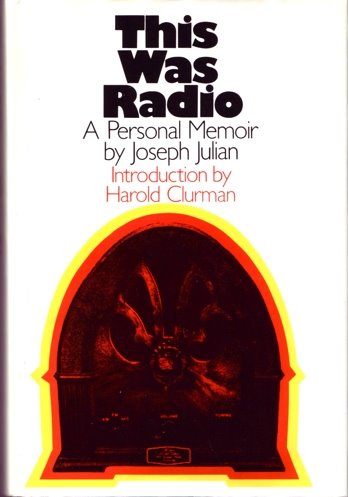
“The small but rich body of radio literature, which [Norman Corwin] brought so lovingly to life, lies languishing in a few libraries and second-hand book shops, under the titles Thirteen by Corwin and More by Corwin—a great shame and deprivation for the present generation!” My sentiments, entirely. Not my words, though, which is why I had to slap quotation marks on them. The man who said so was Joseph Julian, a once highly acclaimed and sought-after radio actor who starred in a number of plays written and directed by Corwin during the early-to-mid 1940s. Today, Julian’s memoir, a copy of which I recently added to my own library of out-of-print books on broadcasting, is one among those “languishing” volumes, a forgotten voice from a medium whose dramatic potentialities have remained largely unsounded since the late 1950s.

This Was Radio came out in the mid-1970s, a time widely deemed ripe for a reassessment of the aural medium and its derelict theater of the mind. Rather than waxing nostalgic—thereby squeezing the last few bucks out of a defunct business which, back then, most American adults still recalled experiencing first-ear, and fondly at that—Julian takes readers on a trip down memory lane that leads into neighbourhoods they would not get to hear about on an official tour.

His Corwinian class acts aside, Julian appeared on thriller programs like The Falcon, The Shadow, Inner Sanctum, Mr. Keen, Broadway Is My Beat, and The Mysterious Traveler. He was first heard on The March of Time, but as an also-ran-off-the-mouth, in re-enactments that called for crowd scenes. Briefly, he served as a sound man, during which stint he learned what noise a human body produces when it is turned inside out.

I can imagine just what kind of sounds emanated from Julian when he learned that the same thing was happening to his career. An established actor by the early 1940s, Julian remained highly successful throughout the decade, until, in 1950, his name appeared in Red Channels. His career as a radio actor declined rapidly; by 1953, his annual income had dwindled to a mere $1630.

Barred from work at CBS, Julian fired back by filing a lawsuit for libel. Character witnesses during Julian’s 1954 trial were Edward R. Morrow (last talked of here) and the aforementioned Morton Wishengrad. It was “an ugly period in American life and in mine,” Julian comments. His “urge” was “to skip over it”; but he felt a

responsibility as a victim to record some of what [he] went through. A whole new generation hardly knows that such a thing ever happened. But the fact is it could easily happen again if we relax our vigilance in defending our freedoms. Control of broadcasting is one of the first major objectives of those who would take them away.

His lawsuit was dismissed; thereafter, Julian virtually unemployed until William Fitelson, a theatrical lawyer and executive producer of the Theater Guild’s US Steel Hour television series staged one of the actor’s own plays in December 1954. Julian’s fortunes changed as quickly as they had declined; and he once again “getting calls for radio acting jobs.”

Without bitterness, Julian tells it as it is. About Myrna Loy, for instance, he remarks that, “if she had to win [her radio] role in a competitive audition with radio actresses, she wouldn’t have been there. Her voice, isolated from her other attributes, was dull and flat. She was selling her name, not her art.” More problematic still was it to perform a dramatic scene with Veronica Lake, who had such a weak, wispy voice” that the sound engineer could not get her and Julian “in proper balance.”

Lake was handed a “separate microphone across the stage” so that the engineer could “could mechanically raise her voice level to mine.” However effective for listeners at home, her faraway whispers had Julian straining to hear his cues. “Especially since they had her facing front so the audience could see her famous peek-a-boo hairdo. Hardly the way to play an intimate love scene with a lady!”

Of the notorious Hummerts, who “grimly dominated their empire” of soap operas, Julian remarks:

There was something darkly foreboding about [them].  Their stiff presence always evoked a sense of insecurity.  And with good reason.  They had a reputation for firing actors who incurred their slightest displeasure.  And authors.  When Mrs. Hummert once told a writer that she wanted “God” on every page of a script, and his answer was “Who will we get to play Him?” he was fired on the spot.  And whey you were fired from one of their shows it was a catastrophe.  It meant being banned from all their nine or ten others that might be on the air at any given time.

Call him fortunate or not, Julian continued to act on the air well into the medium’s decline. On this day, 4 October, in 1959, he was heard on Suspense, one of radio’s last remaining drama anthologies, in the routine thriller “Room 203.” It is a far cry from Julian’s greatest work; but these days, almost any cry uttered on radio seems distant.

The Lilt of the Lilliputian

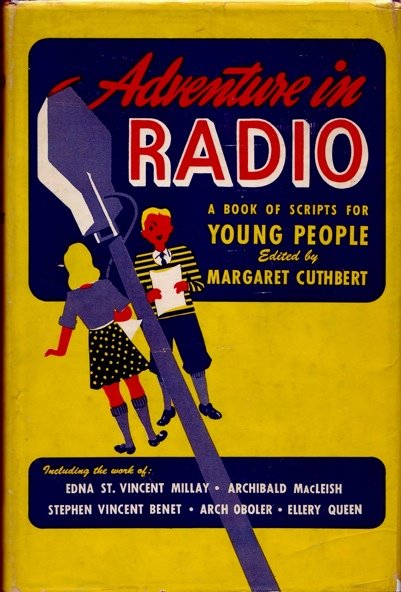
The cover of Adventure in Radio, from my collection

A few years ago, walking home from graduate school one afternoon, I stopped by at a second-hand bookstore in my old neighborhood of Yorkville, Manhattan. Judging from the window display, the shop seemed to specialize in children’s books and memorabilia. While this did not deter me, I hardly expected to make any significant acquisition of a volume on the subject to which this journal is chiefly devoted. I mean, I was not looking for a decoder ring or some such souvenir from the bygone age of radio dramatics. I was, after all, researching my dissertation. There was on the shelves a beautiful copy of Adventure in Radio (1945). Subtitled “A Book of Scripts for Young People,” it may be expected to include juvenile playlets written for the medium, although not necessarily produced on network radio. On such compilations, of which there are many, I was not inclined to waste money or time.

Spiting my assumptions, Adventure in Radio not only contains a number of broadcast scripts from programs like Jack Armstrong and Let’s Pretend but also propaganda plays and wartime commentaries geared toward an adult audience. In addition, it offers insights on the production of radio plays, on sound effects, announcing, and “radio language.” It took a little salestalk from the owner of the by now long closed store, but I was soon convinced. Where (I did not know much about eBay back then) would I ever find such a book again? And how could I claim to be serious about old-time radio if I did not snatch up this copy? So, I handed over my $40 (it was the price tag that made me hesitate) and walked off, eager to continue my studies . . . and determined to find the recordings to match the published scripts now at my fingertips.

That often proved quite difficult; but I had made up my mind that I was not going to write about words divorced from performance. I wanted to hear what was being done with those scripts, how they were edited and interpreted. Take the NBC University Theater’s production of “Gulliver’s Travels,” for instance. It was broadcast on this day, 24 September, in 1948. My appreciation of the challenges of soundstaging the play grew after reading the comments with which Frank Papp, a director of radio drama for NBC, prefaces the script, originally written for the series World’s Great Novels. Papp points out the “unusual problems” Frank Wells’s adaptation posed in production:

In the matter of casting, the Lilliputian was the most difficult.  Here was needed a voice which gave the illusion of a tiny man.  A trick voice in itself would be only a caricature.  What was required was a voice that created a picture of a real human being of Lilliputian size.  After extensive auditioning, an actor was found whose talent and vocal capabilities fulfilled these requirements.

The actor portraying Gulliver was placed in an isolation booth, Papp explains, “so that the Lilliputian’s voice would not spill over into his microphone” and the two voices could be miked separately, with a volume reflecting the size of each character. The voice of the King of Brobdingnag, meanwhile, was “fed” both through an electronic filter to amplify its base quality and through NBC’s largest echo chamber to create the illusion of a giant.

The 24 September 1948 presentation of “Gulliver’s Travels,” starring Henry Hull in the title role, does not quite live up to the expectations raised by Papp’s introduction. Under the direction of Max Hutto, child actor (Anthony Boris) is cast in the role of the Lilliputian, a choice that infantilizes the character and renders pointless the effects achieved by the sound engineer.

While Wells’s script downsizes Swift’s story and diminishes its bitterness and bite, it is the production that contributes to a sense that Gulliver’s Travels is, at heart, a juvenile fantasy, despite its airing on the ambitious if misguided NBC University Theater, a program that linked listening to such bowdlerizations with courses in distant learning. I may have been able to match the script with a production, but it was not the one described in Adventure in Radio.

Squeezed as I am into the isolation booth of my preoccupations, it is my mind’s voice that supplies the lilt of the Lilliputian . . .

As Jane Airs; or, Going KUKU

My copy of Jane Woodfin’s novel Of Mikes and Men

“Jane Woodfin has worked for a West Coast radio station, in practically every known capacity, for more than twenty years—a period which almost spans the life of modern radio.” That is pretty much all I know about the wit that penned Of Mikes and Men, a narrative promising the “humorous inside story of early radio, when announcers doubled as soundmen and microphones went dead once a program.” I should not be quite so petty or perplexed—but the broadcast historian in me still doesn’t know quite what he’s reading.

At least, “humorous” is an entirely appropriate tag for Woodfin’s tale, that, tall or not, was published in 1951, when radio was still the source of mystery, romance, and adventure, but only in a programming sense. Otherwise, it was a big business, a well-oiled if somewhat past its prime machinery that bore little resemblance to the “anything goes”—or “nothing quite works”—broadcasting of the 1920s recalled by Woodfin.

Of Mikes and Men, which I picked up at a bookstore in Dryden, New York (aforementioned), opens like a prequel to Remember WENN. You know, the nostalgic sitcom set in a broadcasting studio, which aired on AMC during the mid-to late 1990s. Woodfin’s narrator, presumably the author, relates how she, penniless and none too skilled, got a job at a radio station in Portland, Oregon just after Wall Street laid that infamous “Egg.” Perusing the want ads, the young woman applied for the only position offered to female job searchers—that of “continuity writer” at station KUKU.

Not that she had any idea what a “continuity writer” was. She beat out a number of applicants and, being paid partly in cash, partly in the goods the station’s sponsors tried to peddle, was expected to deliver not only advertising copy and chatter (the so-called “continuity”) but also her own cooking program. That Jane, as her friend and neighbor points out, would be lost without a can opener, was something she kept to herself, until the audience, trying to follow her recipes, found out as much while gazing at the indigestible mess sticking to their pots and pans.

This is all rather jolly and preferable to leafing through I Hid It under the Sheets, the at times exasperatingly ungrammatical and disorganized reminiscences of journalist, sports writer, and radio listener Gerald Eskanezi, which I mentioned previously. At least, Woodfin knew how to turn a phrase and tell a story. So, why am I not just sitting back and enjoying that story?

For one, I am wondering just whose story it is. I mean, is it based on actual experiences? Is there anything between the covers that might tell me something factual about what it was like working in broadcasting before radio reached what is generally referred to as its “golden age”? Or is it a calculated, well timed antidote to the run-of-the-mill radio of the post-war years with whose Hucksterism Americans became so thoroughly disenchanted?

Playing it sly, Woodfin dedicates her book to those who presumable worked with her by stating:

To my dear friends and co-workers in early radio who will attempt in vain to find themselves in the pages of this book.  You aren’t here. I couldn’t put you in because you are normal.  But you may recognize some of the screwballs we both knew.

Station KUKU? I assumed Woodfin’s book to be an account of an early radio comedy of the same name. It was created by Raymond Knight, one of whose later Cuckoo programs you may find in the Internet Archive. According to the aforementioned Messrs. Gaver and Stanley, Knight began broadcasting on 1 January 1930 and distinguished himself by being one of the first radio satirists to poke fun at the medium. Groucho Marx reputedly thought him to be “the best comedian on the air.”

Turns out, Of Mikes and Men does not concern Mr. Knight, who broadcast from the East Coast. Nor have I come across any names that I recognize as referring to an actual radio pioneer. Still, leafing through Woodfin’s book, wondering whether Jane ever aired, I feel not unlike the earliest reader’s of Jane Eyre, who assumed the novel to be a biographical account of a governess in love with her master.

That Woodfin loved the radio, and knew it well, I do not doubt. I was just hoping for a bit of dirt I could trace to some of the real men and women behind those carbon mikes; but then I remembered my Aunt Ilse, the baby crier, bit my captious tongue, and let Woodfin keep hers firmly lodged in her unblushing cheek. Besides, those distinctions between fact and fiction, well nigh incomprehensible to today’s reality-TV audiences, went out of fashion in the days of the Spanish-American War . . .

“[A]iring the secret despair of a great many million people”: On Being Too Late to Be John Crosby

Assuming the role of an old-time radio columnist is like being coy in a funeral parlor. I mean, you can go on dropping those long-forgotten names like so many mended handkerchiefs—but you shouldn’t expect anyone to take the hint and pick them up along with the rest of you. So, you pick yourself up instead, make an orderly pile of those disregarded squares, and wait for the next sneeze. If the cold shoulder you’ve gotten from leaning against that wall of silence is any indication, there’s a good one coming on. I envy John Crosby, who had a radio column at that just the right moment in the history of the medium, when the multitudes were still tuning in but were getting increasingly cross with the old Crosley—the giveaway programs, the soaps, and whatever dross wafted across. The late 1940s, in short. Crosby, whose Out of the Blue I snatched up when last I was at the Strand, “greatly enjoy[ed] those things of which [he] most heartily disapprove[d].” Luckily, there was not much on the dial to fill him with boundless admiration, a reaction less tolerable than a rash, since it had the nasty side effect of striking him “dumb.” As he observed in his Afterword “most critics,” including himself, are “incoherent” in their “admiration but afflicted with a formidable coherence when [they] disapprove.”

So, what did Mr. Crosby disapprove of, aside from the novels of Taylor Caldwell, which he bought and displayed to remind himself what not to read? Mr. District Attorney, for instance, which he found “vastly more irritating” than most of the crime dramas so prominent on the programming schedule of the national networks during the years between VJ-Day and the Korean War. He went so far as to opine that Mr. DA was the “most reprehensible piece of trash ever dramatized.” Even the voice of the lead was so obnoxious to him that he felt obliged to string together a few adjectives the aptness of which you may test by sampling here what Crosby was sounding off about):

A few of [those adjectives] are pompous, complacent, sonorous, humorless, dogmatic, unconvincing and—I don’t know how this one got in here—superfluous. Mr. DA, to put it more succinctly, sounds like a bad Shakespearean actor in an empty auditorium.

I know that sound, having made it often enough. Sure, a scolding tongue wags faster than one tied in a lover’s knot. And the pen, the keyboard, or whatever implement you use to churn the bile, is really giving your hands a workout when it is propelled by or pounded with utter contempt. I learned that when I wrote my first play—the only one I did not tire of before its completion. It concerns a pair of sisters who delight in being mean; but at least their targets still numbered among the living (until, that is, one of them hung himself in despair). I thoroughly enjoyed feeding them lines that I might not have had the chance or the nerve to administer otherwise. I have mellowed since then, although some remarks I made about Kevin Spacey incited one reader to accuse me of sounding like a “bitter old queen.” I may be a “queen,” I’d even admit to being “old.” But “bitter”?

Besides, what is the point of spitting in the face of old Mr. Keen (whom I loathe as much as Crosby despised Mr. District Attorney) when he is best left in the welcome peace that ensued after the cancellation of the incomprehensibly long-running mystery series named after him? I am the Tracer of a lost culture, or one to which too few have found back; and, so as not to get lost in the miasma of stale air shrouding the tomb of John’s Other Wife or some such dearly departed, it is best to open up about what I am truly keen on. That doesn’t mean I don’t envy Mr. Crosby . . .

Notes on a “Note”: Milton Allen Kaplan’s Radio and Poetry

“If radio literature is worth study and analysis, it must be filed, classified, and catalogued accurately. The variety of programs would necessitate an intricate library system in order to permit a student to find such categories as poetry, music, historical drama, documentaries, readings, adaptations, and discussions.” Thus remarked Milton Allen Kaplan in his 1949 study Radio and Poetry, one of the most recent additions to my library of books on American broadcasting. To this day, such catalogues remain inaccurate and incomplete, at best, even at the Library of Congress or the broadcasting museums in New York and Chicago. Radio verse plays, in particular, are an immaterial thing—a nothing—of the past; they are almost entirely forgotten or ignored, especially in the teaching of literature and drama.

Literary critics seem to assume that, since radio was chiefly an advertising tool, the spoken yet scripted words that aired had only the most tentative connection to the arts. The study of what presumably were mornings with Stella Dallas, afternoons with The Lone Ranger and evenings with Jack Benny should be left to cultural historians whose trade it is to dig into the trash heap of Western civilization.

When Radio and Poetry was published, network radio was pretty much dead as a medium for verse. Even the most distinguished practitioners, Norman Corwin and Archibald MacLeish, found the networks less than accommodating. Corwin, of course, had come under suspicion by the House un-American Activities Committee and, in 1949, left CBS to write and produce plays for UN Radio instead. Only a few short years earlier, his works had been heard by tens of millions and were deemed vital to the war effort.

As Kaplan points out, Corwin was “the first poet brought up with radio,” as opposed to being among the “notable poets who turned to radio.” While not recruited, he was often importuned to write occasional verse, to speak to and for the nation, to erect aural monuments in commemoration of the momentous.

On this day, 13 May, in 1945, Corwin’s “On a Note of Triumph” was once again produced; the aforementioned play had originally been heard on V-E Day (8 May), which it was expected to celebrate. “Coming as it did at a climactic moment in our history,” Kaplan remarks, the play “won nationwide attention, and was rebroadcast, published, and transcribed.”

Corwin did not altogether embrace his role as a national chorus in the theater of war; and the “Note” he struck was hardly a positive one. Instead, it is cautiously optimistic, daring to consider the future rather than seeing victory as a happy ending to a drama staged with a cast of millions. The “Note” was also one of Corwin’s last major plays; the “triumph” of peace gave way to the whispers of anti-Communist hysteria and further war cries in Korea, the conflict that would not trigger any poetic responses on US radio. “So they’ve given up,” the play opens. “. . . on radio,” Corwin might as well have added after V-J Day.

Norman Corwin, who recently turned 98 (and whose 97th I commemorated here), is hardly unheard of today. His V-E Day broadcast was subject of the Academy Award-winning documentary A Note of Triumph: The Golden Age of Norman Corwin (2005). Still, his name is not frequently uttered among those whom Kaplan sought to engage, the literary scholar and educators whom he encouraged to consider radio plays as aural art.

Indeed, Kaplan’s study, long out of print, is just about as triumphant as the medium upon whose life it depended. Radio verse being a dying art back then, Radio and Poetry was doomed to be buried alongside it. The author’s enthusiasm seems to have fallen on deaf ears.

“Today,” he concluded in a passage sounding very yesterday,

we have many aspects of poetry on the air—the advertising jingle, the popular song, the cadenced prose of the announcer, the verse play, the radio opera.  Tomorrow, as our audiences comes to demand more and more of the medium and as that medium changes, what new aspects will be revealed, what new alliances effected, what new forms developed?

Heard any new “radio opera” or “verse play” lately? Apparently, those jingles and popular songs are the notes triumphant . . .