
Charles [Memory] Lane; or, A Case of Presentimentality

This is not a trip down memory lane. I prefer not to take such excursions. It is not that I mind the detours or the seeming futility of not arriving at anything worth my time away. It’s the roadblocks that are difficult to face. According to my map, memory lane is as serpentine as Lombard Street. Remembering means climbing it upward; and all too frequently I tumble back down before I reach the address for which I was heading.

The storage capacity of my mind seems to have been exhausted some time ago and my recall is imprecise at best. Perhaps this is why I became intrigued by audio (or radio) drama. No matter how old the recording, sound drama is the play of the moment, the moment at play. It is a time art, freed from the boundaries of space, for which reason it has been called one-dimensional. It is born of sound, and sound perishes as soon as it is produced, save for the repercussions it leaves in our minds.

Why is it that we undervalue the moment and exalt eternity? Surely, the fleeting instant is not any less precious than the constant of the forever. I do not believe in the attainability of eternity; nor do I long for it. It seems to have increased my respect for the momentary. Being forgetful, I am rather in awe of what is temporary.

No, this is not a trip down memory lane. It is an inspection of alleyways; which is to say that it is introspection rather than retrospective. Writing is a matter of choosing what is worth capturing, whether for one’s own sake or the benefit of others. I used to be more highly disciplined in the strict adherence to my self-imposed boundaries, the theme of broadcastellan.

As a result, my writing began to strike me as generic; it appeared to bear little resemblance to my everyday. I still try to remain within the bounds of what this journal can hold without it bursting into some sprawling mess less defined than life itself; but I realize now that choosing requires listening, an openness to whatever might suggest itself.

Sometimes, subjects seem to choose me. Unexpected connections come to mind and I feel compelled to trace them and track down the attraction. When I wrote, for the first time, about Gloria Swanson yesterday, I neglected to say that I had just been listening to Sunset Boulevard (the only Andrew Lloyd Webber musical I can abide, chiefly due to its source of inspiration).

On the lookout for a subject, a search that often begins and ends in my checking pop-cultural anniversaries, I discovered that, sixty years earlier to the day, the star of Billy Wilder’s Sunset Blvd. had made a rare appearance in a radio thriller. I already had Swanson on my mind; now, she forcefully stepped into my frame, ready for another close-up, prompting me to dig up the recording of said broadcast and share my listening experience.

Last night, something similar occurred. I was watching Frank Capra’s silent comedy Matinee Idol (1928), followed by a documentary about the director (pictured above). When I returned to my computer, I read the news that one of the players in Capra’s repertory company, Charles Lane, had died that very day, 10 July, at the age of 102. You may catch up with his remarkably long career in film and television reading this obituary by fellow web journalist Brent McKee.

Now, I have already watched a number of films featuring Mr. Lane this year, including Second Fiddle, You Can’t Take It With You, and The Lady Is Willing; but, frankly, I did not notice him, however ably he performed these small parts (in Second Fiddle, he is only heard, not seen). It seems as if Mr. Lane insisted on my attention. So, tonight, I’ll let him change my schedule, as I take in my third successive Capra film, Mr. Deeds Goes to Town (duly recorded in my movie diet account to the right).

Thank you for insinuating yourself into my everyday, Mr. Lane. I’ll be watching out for you.

I’m Not a Fan

Well, I’m not a fan of . . . anything. That is to say, I am not a fan of the word. Fan, fanatic, fanaticism. Those lexical expressions of inflexibility, those dictionary indicators of obduracy ought to be reserved for folks who are determined to blow themselves up for what they believe to be their beliefs, for the indiscriminals who are prepared to take the lives of others around them for the sake of an idea or an ostensible ideal (I’ve got Glasgow and London on my mind). No, I am not inclined to go quite so far in my devotion. It does not follow, however, that I am incapable of getting passionate or downright pigheaded, even when such fervor goes against my better judgment.

Permit me to opine for the sake of defining. For instance, I strongly disliked Britain’s former Prime Minister, Tony Blair, simply because I could not stand his grin and his (to me) mannered way of speaking; never mind his policy in Iraq, which was reason enough to disdain him. I have nothing yet to say about Gordon Brown, who mercifully abstains from mugging. I am opposed to Britain’s newly enforced smoking ban, no matter how many lives could presumably be saved by such a curtailing of pleasure. I refuse to visit my native country of Germany, along with Switzerland and France, and have choice words for those who turn down a nice cut of meat in favor of bean sprouts or tofu.

Unlike notions, opinions are never vague. Voicing them—a hazardous prerogative these days—is a retreat into what lies past caution, beyond apprehensions of censure known as political correctness, adjustments in expressed thought commonly disguised as reason, or, at any rate, as what is reasonable. Uttering what you can barely get away with can be a welcome getaway from the sincerity-divested shelter of platitude to which the mealy-mouthed have chosen to confine themselves. That goes only for the intelligent and open-minded; the unthinking, who can do nothing but opine, have no use for such relief, which makes them far more dangerous than any strongly voice opinion could ever be.

Meanwhile, I much rather rave than rant. I prefer to reserve my energy—and this little nook in the web—for things I look upon with uncommon fondness (such as radio, whose neglected virtues I extol in this journal) and people I adore in a manner that I, an atheist, refuse to label idolatry. A few decades ago, I decided that, while not fanatic, I fancied a certain leading lady of Hollywood’s aureate days. The lady in question is Claudette Colbert. French-born, no less. My latest acquisition—above poster for the 1947 thriller Sleep, My Love—arrived today and awaits a spot on whatever wall remains to display it. Space, by now, is at a premium; only yesterday, I made room for this announcement for Colbert’s 1941 vehicle Skylark. It is probably not what you’d expect to find in a Welsh cottage—unless, that is, you knew me and knew I had come to live there with someone so willing to humor my foibles and fancies.

So, what is the difference between a fan and a fancier? The fan cannot see; the fancier has a selective gaze. The fan discriminates; the fancier is discriminating. The fan is dead to the rest of the world; the fancier is alive to the idiosyncrasies of his or her passions. No, I am decidedly not a fan . . .

The Bourne Imperative

Well, I’m not sure whether I could stomach Lorna Luft and Dallas alumnus Ken Kercheval in a touring production of White Christmas; but Matthew Bourne’s Bizet ballet The Car Man was certainly worth a trip to the splendid Canolfan Mileniwm Cymru (Wales Millennium Centre) in Cardiff Bay. Inspired by James M. Cain’s oft-adapted 1934 novel The Postman Always Rings Twice (revived on 24 January 1952 on Hollywood Sound Stage, starring radio stalwart Richard Widmark), The Car Man is set in mid-20th century small town America (the fictional Harmony, pop. 375), The Car Man tells the story of the titular drifter who falls for the accommodating wife of his new boss (a vixen named Lana, after the actress who played her in the 1946 film version). Though easily duped, the cuckold is bound to find out, eventually, and to be less than accepting of the triangular situation.

Unlike his whimsical if choreographically frivolous Edward Scissorhands (my impressions of which I shared previously), Bourne’s earlier Car Man is proper dance theater, with an exceptional performance by Michela Meazza as Lana.

While firmly within the tradition of 19th-century melodrama without resorting to camp, The Car Man bears no resemblance to Carmen. Indeed, the story as told in movement, light, and a generous amount of stage blood is far easier to follow than that of Bizet’s opera or the Prosper Mérimée novella upon which it is based, a plot comedian Ed Wynn insisted on translating for the listening audience of Tallulah Bankhead’s radio variety program The Big Show on 26 November 1950, as opera star Lauritz Melchior struggled to perform Pagliacci: “And as the curtain rises, we see Carmen walking out of the cigarette factory. We know it’s a cigarette factory because there are doctors walking in and out of the building.”

Those medical practitioners, of course, were meant to endorse tobacco rather than treat the workers or assess the risks of smoking.

“Carmen has many admirers,” Wynn continued, “and to each one of them she has given a lock of her hair. Isn’t that beautiful? So, Carmen, or as she is now called by her friends, Baldy, [. . .].”

Not that Mr. Wynn could have possibly prepared me for the theatrical experience of The Car Man. In keeping with his celebrated all-male revision of Swan Lake, the old love triangle has been colored pink; or, rather, it is getting another—an outré—angle, as Bourne tosses a male admirer of Lana’s lover into the bloody mix of lust, jealousy, and murder. Being granted views of a communal shower, a private bedroom, and life behind bars—or wherever else you might expect intimate encounters of the same and opposite sex on a sultry evening, Bourne’s audiences can and should expect the full bodyworks.

The Confidante Game: Trading on That Old Acquaintance

Well, here’s an acquaintance worth making. Old Acquaintance, that is, the Roundabout Theatre Company’s revival of which is currently in previews at the American Airlines Theatre. Judging from the walkers and hearing aids on display at last Tuesday’s performance—not to mention the gas passed noisily in the lobby—I suspect that quite a few of the folks in attendance that evening got to see John Van Druten’s comedy during its original run back in 1940-41, while some of the friends of Dorothy’s we passed in the aisle were most likely on intimate terms with the 1943 film adaptation starring Bette Davis and Miriam Hopkins, two leading ladies on less than friendly terms.

Whether or not you (think you) are familiar with this story of a longtime rivalry redefined as friendship, the Roundabout production is likely to teach you a lesson or two about the nature of that least clearly defined of social compacts and about Hollywood’s (s)elective affinities with Broadway.

I caught up with Vincent Sherman’s soon-to-be-remade melodrama (and one of its radio versions) only after seeing the play, which made me appreciate the stage version’s maturity all the more. Van Druten, who was involved in the screen adaptation of Old Acquaintance, sure learned how to compromise in order to make it in Tinseltown. That he turned his sparkling comedy into an even larger crowd-pleasing sentimental melodrama is all the more remarkable considering that the English playwright’s first drama, Young Woodley (1925), had initially been banned in Britain for its treatment of sexual awakening. Production code conformity in the case of Old Acquaintance—as in most cases—meant turning mature women with careers as well as sex lives into silly girls or stoic old maids.

The silly girl in the Hollywood version is Miriam Hopkins, whose Millie is so envious of the publicity enjoyed her novelist friend Kit that she, however ill equipped for literary fame, turns to the writing of romances. The old maid is Bette Davis, whose romantically luckless Kit is willing to hand down her much younger lover to Millie’s daughter, Deidre, for which sacrifice she is duly rewarded with a cup of human kindness, shared with a remorseful Millie by the fire that warms them when the heat of passion is no longer in the Hallmark cards.

All this bears little resemblance to Van Druten’s original three-act play, a witty, tightly constructed comedy of manners. As one astute online reviewer of the movie points out, it becomes difficult to understand why Kit and Mollie became such old acquaintances once their careers are pushed into the background. In the stage play, it is Millie who, though a trash novelist herself, enjoys Kit’s respect as a keen and candid editor of Kit’s ponderous, overly analytic storytelling. However different in temperament, Kit and Mollie come across as equals, which explains at once their closeness and their rivalry.

On stage, Old Acquaintance echoes La Rochefoucauld’s maxims that friendship is “nothing but a transaction from which the self always means to gain something” and that in the “misfortunes of our friends we always find something that isn’t displeasing to us.” Concurring with the latter, satirist Jonathan Swift remarked about his relationship with fellow authors:

To all my Foes, dear Fortune, send
Thy Gifts, but never to my Friend:
I tamely can endure the first,
But, this with Envy makes me burst.

In the 2007 Broadway revival, Margaret Colin’s Kit is less pathetic than Davis’s, while Harris’s portrayal of Mollie is more sympathetic than that of Hopkins (who reprised her role, opposite miscast Alexis Smith, in the 29 May 1944 Lux Radio Theatre production). If not nearly as assured and brilliant in her comic timing or line reading as Rosalind Russell, with whom in mind the rights to Old Acquaintance were secured by Warner Brothers, Colin is both real and regal. Davis, who was asked to drop her pajamas to expose her less-than-glamorous legs, is matronly by comparison, suggesting that she sacrificed her juvenile beau to play surrogate mother to her best friend’s daughter.

The marvellous Harriet Harris, in turn, hands Millie back her brains. Whereas Hopkins’s character comes across as an impulsive, overgrown schoolgirl, spiteful and pouting, Harris’s Millie is calculating, smart, and rather dangerous (not unlike her Tony Award winning Mrs. Meers, in Thoroughly Modern Millie and her scheming Felicia Tilman in Desperate Housewives). Not content to see her best friend succeed, Millie intends to succeed her in fame and fortune. Her dramatic outbursts are an expression of her frustration when she realizes that the unmarried and childless Kit is not only a better mother to her daughter, but that she might also have been a better, and more desirable wife to her former husband.

If you prefer expensive theatre seats to cheap Hollywood sentiment, the revival of Old Acquaintance is your ticket.

[At the time of writing this I was as yet unaware that, before becoming a playwright, John Van Druten taught in Aberystwyth, the Welsh town to which I relocated from New York City in 2004.]

Being Out, Staying In

Well, I know. You can’t catch cold getting caught in the rain. At least, that’s what people keep telling me straight to my weather-beaten face. Meanwhile, I got soaked during one of those torrential New York City downpours a few night’s ago and was not up to meeting an old friend for dinner last night, notwithstanding the fact that my days in the city are numbered and I might have to wait another year for another opportunity to see him. I ended up watching television instead; it’s something I rarely do nowadays, especially while vacationing.

Luckily, I was in for a treat at Turner Classic Movies, whose Screened Out series opened last night with “Algie, the Miner” (1912), a one-reeler concerning an effete Easterner getting the Western treatment to prepare him for the challenge of matrimony. Say—and I say this quoting a line from the subsequently presented comedy-thriller The Monster (1925)—have you “dropped in for some pansy seeds” yet?

Hollywood logic has it that those “seeds” may very well yield hardy perennials; in fact, that is the reason for spreading them in the first place. The conversion myth of growing up straight permitted writers and directors to create outré characters that are both likeable and socially acceptable. Judges according to the mores of early-to-mid 20th-century America, the pansy was an aberration that could be shown to suffer for and snap out of its condition of non-conformity by turning straight. In other words, the pansy was a milquetoasts redeemed by hearty helpings of ham and exorcism.

Otherwise, gender transgressive characters were either buffoons or villains, depending on the state of their sexual (in)activity and their willingness to reform. The Monster, you might say, involves a case of rehabilitation in which feeble Johnny Goodlittle (whose very name suggests the both the need for and possibility of redemption) has to prove his manhood not only by trapping a monster, but by demonstrating himself to be far from one.

The buffoon, by comparison, is a sexually unreformed and consequently frustrated male. Exit Smiling (1926), starring the delightful Beatrice Lillie (in a cross-dressing role), features a supporting player whose Hollywood career depended on such roles: Franklin Pangborn, the Queen of Paramount. “This nervous tension will positively slay me!” his irritable stage actor Cecil Lovelace exclaims when his leading lady is late for the show. On the radio, where his queer voice was heard only infrequently, Mr. Pangborn was simply made out to be “Allergic to Love”.

TCM is also sponsoring the multimedia exhibition Celluloid Skyline, currently (25 May to 22 June 2007) on display at New York City’s Grand Central Station (pictured above). I only had a few moments to walk through before catching a train to the Moving Image museum in Queens, my head not being clear enough to say much more on the subject at present.

Come to think of it, I have yet to post my review of the new Broadway musical Curtains starring the Tony nominated and recently de-closeted David Hyde Pierce. Perhaps I need to stay in more; but it sure feels great to be out . . .

The Doll Who Made Puppets of Men

I won’t be in town in time to celebrate her 100th birthday and join in the festivities currently (if somewhat prematurely) underway at the Brooklyn Academy of Music. The celebrated one is Brooklyn-born Barbara Stanwyck, who, on this day, 2 May, in 1943, added a piece of wood to the pile of men she knew how to manage. Charlie McCarthy, that is, a ventriloquist dummy oozing sap after a period of protracted prepubescence. Suddenly, he was sprouting facial hair, some not so hot fuzz with which he hoped to attract “women of the opposite sex.” Yet unlike Marilyn Monroe after her, the Ball of Fire hadn’t come to woo, wow, or wed Charlie. She was going to burn him without having to turn on the heat.
After cutting this log down to size by reminding him that he still worked for a measly salary of 75 cents per week, the shrewd Lady Eve offered Charlie her services as a manager: “Just place yourself in my hands and I’ll put you on a solid basis,” she promised. Apparently, Indemnity wasn’t the only thing this Lady of Burlesque preferred double. And Charlie, eager for a little independence after years of service, promptly rose to the bait.

As he would a few weeks later, when Claudette Colbert invited him to her beach house, Charlie learned another important wartime lesson: not to be too selfish or greedy while Americans were called upon to make sacrifices and lend their support to neighbor and nation alike. As for Ms. Stanwyck, she still walked away with a few extra nickels she had managed to squeeze out of the timbered twerp, who, for once, ended up not having the last word.

Whether or not she had any desire to handle or caress men, she could manage them, all right.

Earwitness for the Prosecution

Being that this is the anniversary of the birth of Guglielmo Marconi, a scientist widely, however mistakenly, regarded as the inventor of the wireless, I am once again lending an ear to the medium with whose plays and personalities this journal was meant to be chiefly concerned. Not that I ever abandoned the subject of audio drama or so-called old-time radio; but efforts to reflect more closely my life and experiences at home or abroad have induced me of late to turn a prominent role into what amounts at times to little more than mere cameos. Besides, “Writing for the Ear” is a course I am offering this fall at the local university; so I had better prick ’em up (my auditory organs, I mean) and come at last to that certain one of my senses.

The English lexicon amply documents the western bias against listening, generally “seen” as being secondary to sight. Compared to the commonly used “eyewitness,” for instance, the expression “earwitness” sounds rather unusual. What’s more, it is rejected by my electronic dictionary and, when typed in defiance, promptly marked as a spelling error. That is perhaps the victorious eye thumping its nose at the once superior ear, which, prior to the invention of the printing press, played a greater or at any rate more respected role in the sharing and absorption of information than it does in this our age of gossip and hearsay. If the always favored ocular proof cannot be discovered, it is the eyewitness report that carries more weight than the overheard.

I am going to refrain from channeling McLuhan, however, and concentrate instead on a notable fictional witness whose testimony was brought before an audience in the strictest sense of the word. I am referring to Agatha Christie’s Witness for the Prosecution, a courtroom melodrama initially conceived as a short story and subsequently adapted, albeit not by Dame Agatha herself, for US radio, whose early experiments in courtroom dramatics have been previously discussed here.

According to the Wikipedia, the “very first performance of Witness for the Prosecution was in the form of a live telecast which aired on CBS’s Lux Video Theatre on 17 September 1953. Now, this is accurate only if Witness is meant to denote Christie’s stage play, rather than her story. The latter had already been dramatized nearly four and a half years earlier. Produced by NBC’s Radio City Playhouse, it was broadcast on this day, 25 April, in 1949.

Such a hold has visual storytelling on our imagination today that it is difficult to approach this audio performance of Witness without seeing before one’s mind’s eyes the features and the legs of the legendary Marlene Dietrich (of whom I have seen quite a bit this year [see my movie lineup on the right] and to whose voice I intend to devote my next podcast). Then there is that prominent scar in the face of the titular character, more prominent still than Ms. Dietrich’s invaluable German accent. Can a sound-only adaptation without access to Dietrich’s features or voice succeed in rendering Christie’s cheeky deception?

Unlike the character of Leonard Vole, the accused, whose innocence is laid on rather too thickly by David Gothard in the Radio City Playhouse production to escape the listener’s suspicion, the mysterious woman who comes to his aid (ably portrayed by theater actress Lotte Stavisky) might just manage to pull the wool over your ears. The radio dramatization handles the challenges of duping the audience, both the listeners at home and in the fictional courtroom, remarkably well, the scar being made audible in the gasp of its beholder. Like the members of a jury, when called upon to examine accusations and protestations of innocence, the listener deals with interpretations of reality, on someone’s word taken for an otherwise unknowable “it.”

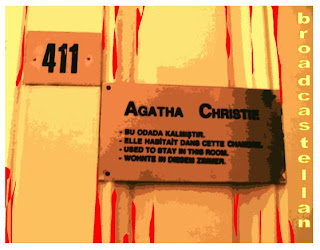
I confess, though, that, as much as I value my hearing, I frequently feel compelled to see for myself; which is why, on the anniversary of Dame Agatha’s birthday, I went up to her room at the Pera Palas Hotel in Istanbul last fall and had a look. There wasn’t much to see, really; not so much as an air of her presence. And, after paying the concierge who escorted us up to room 411, which the enterprising management has shrouded in a mystery of its own, I felt as if I were getting a box on the ear for not having had more sense.

Hungary to Hollywood; or, "seven maids with seven mops"

Well, this is it. My last entry into the broadcastellan journal before I’m off to Budapest, from which spot I hope to be reporting back on 12 April with a snapshot of Roosevelt Square, in commemoration of FDR’s death in 1945. Supposedly, our hotel room has wireless access; so I might not have to share my impressions retrospectively (as I have done on almost every previous occasion, after trips to London and Madrid, Istanbul and Scotland, Cornwall and New York City). This time, perhaps, I won’t have to catch up with myself as well as our pop cultural past.

Preparing for my trip, in an experiment you might call method blogging, I devoted the last few posts to connections between broadcasting and Budapest, between Hollywood and Hungary. Today’s association was not so much forged but found; and it is rather more remarkable for that. You’ve probably experienced it too from time to time: the feeling that, once you begin to engage with something you haven’t much thought of before, everything seems to point or relate to it. Suddenly, life is just a bowl of goulash.

Let me give you a for instance. Last night I watched a Hollywood non-classic I assumed to be entirely unrelated to our Hungarian adventure: the Ginger Rogers-starring fantasy romance It Had to Be You (1947), one of the fifty-odd movies I’ve been taking in so far this year (all listed on the right). It is a daft romance about a gal who can’t say “yes” (leaving three guys at the altar) because she cannot get her dream lover out of her head—until said dream enters her life to tell her how to lead it. Her dream lover, whose waking double eventually turns into her true love, is played by Cornel Wilde, who spends much of the picture walking around dressed like a Hollywood Indian. Anyway . . .

I generally follow up my viewings by checking out the filmographies compiled on the Internet Movie Database, which is how I came to speculate about Mr. Wilde (pictured above). Is he, or ain’t he? Hungarian, I mean. It would never have occurred to me, considering that, unlike Paul Lukas or Peter Lorre, Wilde does not have a readily distinguishable accent. Whereas most other online sources will tell you that the actor was born in New York City to Czech-Hungarian immigrants, the Database claims that he not only studied in Budapest and spoke Hungarian, but was indeed Hungarian by birth. Apparently, there are census reports confirming the former.

Wilde’s early screen name was Clark Wales. That alias does not make him Welsh, of course, but might have been chosen to suggest the foreign and rebellious. What would make him Hungarian, though? What is left of your national identity after Hollywood, like an Ellis Island checkpoint for Tinseltown hopefuls, changes your name or compels you do so? Hungarian, of course, was not a highly valued heritage in 1940s Hollywood, given the country’s suspicious proximity to the volatile Balkans, and, as the 1944 propaganda play “Headquarters Budapest” drove home, its alliance with Nazi Germany (“Admiral Horthy of Hungary, or people like him, will help to start World War III in the Balkans”).

I have long tried to get away from such a past (and, after seventeen years, am running still); but I could not hide my national origins, as much as I resent being defined by them. In stubborn grains of truth, the fatherland keeps sticking to my tongue (as you might have gathered from my podcasts). No matter how loudly I declare my past to be water under the proverbial bridge, it won’t wash. It is too prominent to be swept away or brushed aside:

“If seven maids with seven mops
Swept it for half a year.
Do you suppose,” the Walrus said,
“That they could get it clear?”
“I doubt it,” said the Carpenter,
And shed a bitter tear.”

Those lines, from Lewis Carroll’s “The Walrus and the Carpenter,” were recited by Mr. Wilde—in a broad Southern accent, no less—as he played an innocent American falling through the looking-glass in “Allen in Wonderland” (27 October 1952), a Suspense thriller involving an assassination plot, a crisis in the Balkans, and a case of mistaken identity. Earlier, in the same series, Wilde attempted an Eastern European accent playing the villain in “A Ring for Marya” (28 December 1950). It must be wonderful to have a tongue that can be twisted as readily as a broom handle.

Cleaning up the inconvenient pasts of their most valued players, Hollywood swung a lot of mops back then. It was left to the journalists to inspect the buckets. I envy those who get to sweep for themselves or learn to live with the sand.

Things Eve Peabody Taught Me

Well, it is the “Little Paris of Middle Europe.” At least that’s how our newly arrived Eyewitness Travel Guide introduced me to the city of Budapest. Since I am about to visit the Hungarian capital, I’ve been flicking the pages to get acquainted with the place, its people, and its language; but whenever I find myself in need of cultural initiation I go about it in a roundabout way, with a stopover in Hollywood. Or Paris. You know, the really big Paris to the West of Middle Europe.

You can really learn a lot from old Hollywood movies, as long as you don’t get taken in or turned off by fake sets and phony accents. Take Mitchell Leisen’s 1939 screwball romp Midnight, for instance, and profit from the experience of American adventuress Eve Peabody (as portrayed by Claudette Colbert, whose career was the recent topic of an Alternative Film Guide discussion). Eve’s story, the gist of which you can follow in this recording of a Lux Radio Theater adaptation broadcast on 20 May 1940, will teach you a thing or two about traveling on a budget of little more than a centime with a hole in it, about crashing a society party with a pawn ticket, and about the perils of unwittingly impersonating a Hungarian baroness—practical stuff not generally covered by Baedekers.

Now, as the previous entry into this journal will tell you, I have just been in the company of a true Hungarian baroness last night, one with an accent to prove at least the Hungarian part of her past. The misleading lady Eve, on the other hand, has to work somewhat harder to hoodwink her way out of the hood (in her case, the Bronx). After suffering a “nasty accident” in Monte Carlo (“The roulette system I was playing collapsed under me”), down-and-out Eve is forced to depend on little more than her wits, her sex appeal having gotten her into too much trouble already.

She takes the name of the first person she met in Paris, one Tibor Czerny (Don Ameche), a Hungarian cabbie who’s been rather too eager to chauffeur her around town in her futile attempt to land a gig as a nightclub singer. “I guess, mine is strictly a bathtub voice,” she concludes, and makes a swift exit before Tibor can make good on his offer of taking her home. “No woman ever found peace in a taxi. I’m looking for a limousine.” However much she really likes the guy, it’s dough, not romance, that this dame is after.

At the swanky soiree onto which she happens when dodging those driving forces (the Hungarian, the rain, and the subconscious), the Czerny handle proves somewhat of a liability. The assembled high society assumes Eve to be one of the Czernys—a baroness, no less. And while it proves a breeze for Eve to slide around the foreign angle by alleging to be a Czerny by marriage, not birth, she slips on a treacherous bit of trivia and soon blows her cover.

When asked about that “most enchanting” city of Budapest, where she claims to have left her ailing husband, the baron, she is dealt a trick question about the town’s famous subway. “Did they ever finish that?” a guest at the dull get-together she’s managed to infiltrate inquires. “The streets are still a little torn up,” she responds, rather flustered. Her inquisitor did not need to hear any more to know this Eve from Adam. The Budapest metro, after all, is one of the oldest subways in the world, and Miss Peabody is little more than an impersonatrix eager to get away from a past that involved being squeezed each day into the Bronx local.

According to Hollywood justice, Eve gets away with it all . . . and walks away on the arm of Czerny to boot. In fact, having gotten it wrong works out all right for her. History, geography, facts and figures—none of that matters, Midnight suggests, as long as you’ve got beauty, charm and moxie. Considering that I still know so little about my destination, and a gold lamé gown like Eve’s does so little to enhance whatever charm I might have, I’d better cram plenty of moxie into that duffle bag of mine.

A Bell for . . . Talafar?

It is the fuel that keeps the search engines humming. It is fodder for loudmouthed if often unintelligible webjournalists thriving on the divisive. It is the foundation of many a rashly erected platform by means of which the invisible make a display of themselves. The so-called war on terror, I mean, and the time, the shape, and the lives it is taking in Iraq. My position becomes sufficiently clear in those words, as tenuous as it sometimes seems to myself. Experiencing the uncertainty, the turmoil and sorrow that was New York City during the days following the destruction of the World Trade Center, I was anxious to see prevented what then felt like an out and out war against the democratic West; but as a descendant of Nazi sympathizers who is convinced that putting an end to thralldom is a noble cause and conflicted about the use of military force to achieve this end, I could only work myself up to a restrained fervor, which soon gave way to bewilderment, anger, and frustration.

Presented as a success story of the US led invasion of Iraq, the town of Talafar is once again in the news this week, shown in the unfavorable light of exploding bombs and insurgent violence. It has (or ought to have) become obvious that the US and its allies (reluctant or otherwise) are failing in their professed mission against terror and tyranny not because they lack military expertise or international support but because they engaged in this operation with an insufficient awareness and understanding of the different and differing cultures in a region they presumed, hoped, or misrepresented to be a unified (or at any rate unifiable) nation.

I was reminded of all this, if any reminders were required, while watching the wartime parable-turned-Hollywood romance A Bell for Adano (1945), a movie depicting the occupation of an Italian village by American forces toward the close of the Second World War. I generally dislike and avoid war pictures; at least those that reduce history to well-staged action sequences interspersed with scenes of map-pointing generals exchanging remarks about strategies and objectives as if contemplating a game of checkers. A Bell is not that kind of movie.

Based on a 1944 Pulitzer Prize winning bestseller by John Hersey (a Time correspondent and former secretary to Sinclair Lewis), it tells of the struggle for peace, order and community in a battle-scarred town whose lack of pride, hope, and unity is symbolized by the missing bell in the town square, weaponized by Italian’s fascist regime. Realizing the significance of this communal centerpiece, a New York Italian major disregards military orders to find and install an adequate replacement.

On this day, 28 March, in 1944—well over a year before the movie version premiered in US cinemas—NBC radio, in cooperation with the Council on Books in Wartime, presented an adaptation of Hersey’s novel as part of a series titled Words at War. Henry King’s film would attempt to shape parts of Hersey’s narrative into the romance of a lost “Belle” from Adano by casting Gene Tierney as John Hodiak’s Italian love interest, considerably downplaying the ugly Americans his character is up against.

The radio dramatization dispenses with such heartstringings-along to concentrate on the heart of the story: the failings of military strategy and the imperative of cultural sensitivity in the treatment of liberated civilians as exemplified by the response of one Italian-American to the challenges of ideological reorientation, his efforts to understand and assist his ancestral people after the removal of the enemy force that possessed, intimidated and estranged them.

On the radio, A Bell for Adano was announced as a story about “thoughtful Americans, and Americans not so thoughtful.” The very suggestion of America’s humanitarian blunders in an essentially propagandist series like Words at War renders this broadcast “Bell” altogether more compelling than those backlot scenes in which all-American he-fighters show the Axis what what is. The “what” here is “What to do with occupied territory?” once it appears to be under the control of the ostensible victor.

The war in Iraq has yet to deliver a bell ringing loudly enough to convince the world (or me, at any rate) that the freedom, stability, and opportunity it meant to bring about were worth all those local blasts and their global repercussions. Romancing a cracked one just won’t do.