Having Legs: The Calm After the Storm

Well, I don’t know whether hard luck can be said to have them. Legs, I mean; but this one sure lingers. So, just in case you were wondering: the violent storm mentioned in my previous post caused greater problems than the alluded to runaway trash can. I have been without phone and internet ever since and am typing these lines while sipping tea at a wireless cafe, repairs (or, at any rate, inspection and assessment of the problem) being scheduled for next week. Until the service is restored, I am biding my time watching old movies, reading even older books while broadcastellan—not designed for hurried oneliners from a cell phone or anything requiring a rushed update—remains dormant. I bet I am missing this more than any of you. . . .

My comparatively trivial “affliction” is well expressed in these lines by Walter Scott, whose Guy Mannering; or, The Astrologer (1815) I picked up to while away the hours:

Here was a country gentleman, whose most estimable quality seemed his perfect good nature, secretly fretting himself and murmuring against others for causes which, compared with any real evil in life, must weigh like dust in the balance. But such is the equal distribution of Providence. To those who lie out of the road of great afflictions, are assigned petty vexations, which answer all the purpose of disturbing their serenity [. . .].

The legs on display here, by the way, belong to Claudette Colbert; I spotted them some time ago when flicking through an issue of the British Picture Post from December 1938. Ah, the joys of lagging behind the times . . .

Blandings Waves: Cary Grant’s “Dream House” Annex

Well, glamorous it ain’t! Chasing a runaway trash can down the lane and harvesting stray garbage bags from the hedges—before dawn, no less, with little more than a tiny flashlight to guide me. The storm that has been wreaking havoc across Europe swept over Wales this morning, however accustomed folks here may be to such violent weather conditions. Barring outages of power, as experienced by thousand of households in the wild west of Britain, I am going to get my dose of glamour and sophistication yet, by celebrating the career of Cary Grant, born on this day, 18 January, in 1904.

I regret not to have spotted the statue erected in his honor down in Bristol, England, where Grant (or Archibald Alexander Leach) came into this world. He left it in 1986, which prompted me, a sour-faced and romance-starved youth, to compose a eulogistic piece of poetry (not to be dug up for this or any other occasion). This year, I have already revisited two of Grant’s performances—the one truly Grant (George Cukor’s charming adaptation of Holiday), the other cash-and-Cary (Leo McCarey’s World War II oddity Once Upon a Honeymoon). I very nearly caught a third—Destination Tokyo—which is frequently showing on the very poor cousin of Turner Classic Movies here in Britain. Tonight, I might pair him with Mae West, Katharine Hepburn, or Rosalind Russell.

Like so many Hollywood actors of his generation, Grant was frequently heard on US radio; here, for instance, you may listen to Grant singing in a 1936 broadcast trailer for Suzy. On his very birthday, back in 1955, he was once again heard in a Lux Radio Theater adaptation of his screwball hit The Awful Truth. After having been cast opposite Claudette Colbert (in 1939), he was reuniting with his original screen co-star, Irene Dunne.

Yet Grant was also among a number of leading men—including Alan Ladd, Glenn Ford, Humphrey Bogart, and James Stewart—to seize the opportunity of starring in a radio program of his own. Together with wife Betsy Drake, who also wrote some of the scripts, he was heard in Mr. and Mrs. Blandings (1951), a situation comedy based on the novel Mr. Blandings Builds His Dream House, filmed in 1948 with Grant and Myrna Loy. By the late-1940s, radio shows were no longer performed live, which made the medium attractive to busy film actors interested in making a few thousand bucks on the side, for the comparatively easy assignment of spending a few hours in a recording studio reading (rather than memorizing) a short script.

Radio, in turn, had its influence on Grant’s career in motion pictures. In 1944, he starred in Once Upon a Time, a film based on Norman Corwin’s radio fantasy “My Client Curley.” Yes, once upon a time, radio played a significant role in the lives of actors and audiences who, like ambitious Mr. Blandings, managed to evaporate the humdrum of the everyday by building castles in the air.

"Rest in Peace," He Said: Yvonne De Carlo (1922-2007) on the Air

We web journalists are often, and not altogether unjustly, accused of recycling news rather than generating it. I’ve done my share of reprocessing yesterday by reporting the unearthing of Marlene Dietrich’s lost earring at an amusement park in Blackpool; but, recycling being the process of transforming and putting back to use, I turned this tidbit into a hook from which to dangle a reminder of Ms. Dietrich’s lost or rarely recalled career in radio. So, when I now reflect on the passing of actress Yvonne De Carlo, I am trying to avoid mirroring the tributes that appeared elsewhere.

As pop culture maven Ivan Shreve suggests in his ever instructive Thrilling Days of Yesteryear, the role for which Ms. De Carlo is “best remembered” these days should not overshadow the career she enjoyed prior to getting the Lily Munster makeover. And if you can’t recall anything else, the act of commemoration can be an opportunity to get to know a performer all over again. Like most people who wish to refresh their memories of a certain film or television actor, I turned to the Internet Movie Database, according to which, as of 5 PM EST on this Wednesday, 11 January 2007, Ms. De Carlo (who died on Monday) still numbered among the living. I guess, that is where our personal journals come in, spreading the news a little faster than those slow-firing big shots.

Inspecting her resume, I realized how little I have seen of Ms. De Carlo over the years. In fact, the last time I ran into her, I didn’t even notice her at all. That was in November 2006, when I watched So Proudly We Hail, a 1943 wartime drama starring Claudette Colbert (discussed here). Would I be able to spot her in This Gun for Hire, in which the aforementioned Laird Cregar made such an impression on me? Nor have I ever tried on her Sombrero, in which she had Vittorio Gassman at her feet (as pictured above).

So, instead of flaunting my ignorance, it is probably best to let Ms. De Carlo introduce herself, however belatedly. On 24 February 1947, the young actress, no longer the bit player she had been during the early and mid-1940s, appeared on Tom Breneman’s radio program Breakfast in Hollywood—sporting a feather in her hat—to promote her latest picture, Song of Scheherazade, released earlier that month.

You can tell from the reaction of the studio audience—responsive as trained seals to whatever Breneman and his sponsors tossed at them—that Ms. De Carlo was not yet a star. She was getting there—and she was there to get there. “Who are you, honey?” Breneman prompted the unaffected newcomer, whose response was greeted with no more enthusiasm than the names of the many unknowns whom the host granted exposure to the microphone that day. Apart from confessing some embarrassment about the millinery curiosity on her head, the soft-spoken actress did not get to say very much, the garrulous host being too busy reaping whatever laughs he could from the docile crowd.

He presented her with a bouquet of Camellias, named, in honor of her latest role, Scheherazade. So funereal and grand must the corsage have looked that, when Breneman was permitted to pin it on his charming and good-humored guest, he commented on its startling effect with the ominous words “All she needs there is ‘Rest in Peace.'”

When I listened to this exchange today, it struck me as a bit of gallows humor as dark as Lily Munster’s home. It was Breneman who had wreaths thrown at him not long thereafter (he shut up in 1948 at the age of 46), while the dame with the Camellias, who went on to enjoy another five decades in show business, proved more resilient than Scheherazade.

Lost and Found: A Blackpool Romance

Well, this is a story sure to give hope to all those who, like me, are prone to misplacing things. Things will show up . . . eventually. In my case, it all started with a set of house keys I buried in a sandbox. Then went my retainers, which disappeared into the trash before they could do much straightening. Nowadays, I am constantly fishing for my glasses, rarely in places where I could have sworn to have left them. So, when I learned today that an earring lost by Marlene Dietrich has been unearthed at last, I just had to pass on the good news. My thanks to James Robert Parish, author of The Paramount Pretties (one of my Christmas presents last year) and It’s Good to Be the King, a new Mel Brooks biography, for alerting me to the story. It goes something like this:

Back in 1934, the glamorous Blue Angel descended upon the spa town of Blackpool, England, where she mingled with the vacationing multitude—purely for the sake of publicity, no doubt—at the Pleasure Beach amusement park. As if to prove that she was almost down to earth, Dietrich took a ride on the Big Dipper, the park’s new wooden rollercoaster. That is pretty much what I did when I went there some seventy years later—except that, rain-drenched as I was, I looked about as glamorous as a pair of wet socks. I sure wasn’t wearing anything that I could not afford to lose. Experience had taught me as much.

Ms. Dietrich, on the other hand, couldn’t afford not to look her most fetching as the stepped into the coaster. She probably looked just as smart leaving the park, with just the one, her hat covering the denuded lobe. At any rate, the earring was missing. No mere bauble, it was dear enough to the future star of Golden Earrings—a romance not based on her Blackpool experience—that she later inquired about it in writing, albeit to no avail. Today, said pearl was dug up from the mud, of which there is plenty in Blackpool, a place so vulgar that it makes San Jose look like a haven of cultural refinement. That, at least, was my impression, not having had the thrill of encountering a star of Ms. Dietrich’s calibre (or any calibre, for that matter), however pleasant the company in which I travelled.

No doubt, the folks who run (or ran down) Blackpool are delighted at this find. It is as if Ms. Dietrich were giving an encore performance from the grave, once again lending allure and intrigue to that aptly named dump of a seaside resort. To me, there could not be a more poignant illustration of the decline of Western civilization than the picture presenting itself to the workers who found said piece of jewelry among false teeth, glass eyes, and a wig, objects not claimed to have been lost by the star. According to a spokesperson for Pleasure Beach, the pearl “appears to have withstood the test of time quite well.” The same can certainly not be said of the site of this dig.

One thing Marlene Dietrich never lost—aside from her place in Hollywood history and the items aforementioned—was her German accent. Nor have I, as you can plainly tell by listening to one of my old-time radio podcasts; but in Ms. Dietrich’s case, the accent was both an asset and an impediment, accounting in part for the many ups and more downs of her career before, during, and after the Second World War.

Just before the golden era of Hollywood and radio drama was up, the aging actress could once more exploit the exotics of her Teutonic timbre. Having to rethink her media exposure at a time when rollercoaster rides and appearances at popular spots like Blackpool were not enough to keep alive a film career that had very nearly run its course, the aging diva began to take full advantage of the magic of radio to star in two dramatic series of her own. Dietrich and the radio—there’s an idea for a future podcast. Now, where did I leave my iPod?

Where Does The Lady from Shanghai Come From?

Well, my head’s still spinning from last night’s screening of The Lady from Shanghai. You know, that fascinating, pieced together puzzler for the making of which star and director Orson Welles decided to give his celebrated redhead wife Rita Hayworth the old peroxide treatment and turn her Lana. Now, I got lost somewhere in the cross-and-double-cross scenario; but even before the plot unravelled and ultimately revelled in its fun house mirroring of noirish nightmares, my willingness to go along for the ride got deflected by the film’s opening scenes. Although I had never before watched this picture in what now goes for its entirety, l sensed that I had come across it (or something rather like it) before. Trust me, “Where does The Lady from Shanghai come from?” isn’t meant to be one of those “Who’s buried in Grant’s Tomb” questions.

Welles is known to have borrowed ideas, narrative devices and storylines, from his radio programs and recycled or reworked them for his motion pictures and stage productions. Examples of these trans-mediations are the 1938 Mercury Theater productions of “A Heart of Darkness” (which Welles had hoped to adapt for the movies) and “Around the World in Eighty Days” (with a musical version of which he belly-flopped on Broadway in the late spring of 1946), as well as the 1939 Campbell Playhouse revisitation of the William Archer’s 1921 melodrama The Green Goddess (with which he toured some six months after its initial radio broadcast). Based on the novel If I Die Before I Wake by one Sherwood King, a book that Welles initially did not bother to read, the troubled Lady might very well might have some roots in radio.

At any rate, The Lady brought to mind the 15 October 1939 Campbell Playhouse update of John Galsworthy’s Escape (1926). Both Lady and “Escape” are initially set in Manhattan and tell the story of a man (played by Welles) who finds himself in Central Park after dark and in trouble thereafter. Both men ride around in that most romantic and impractical means of urban transportation, the horse-drawn carriage, and encounter a seductress whom only the most chivalrous nature would take for a damsel in distress. In each case, the hero comes to the aid of the questionable dame, and thereby implicates himself as he, in the Thirty-Nine Steps tradition of botched heroics, is caught and tried for a violent crime. While on the run from the law, both men manage to extract themselves and set things right at last.

So, just where does The Lady from Shanghai come from? Aside from tracing her origins to the melodramatic tradition—and a mind like mine that is steeped in it—I do not presume to have a conclusive answer. In Welles and Mercury Player Everett Sloane, The Lady has several tangible connections to the world of the wireless, another link being Fletcher Markle, a radio playwright who had a hand in reshaping the material. Approaching this sordid portrait of a The Lady while under the influence of countless pieces of fiction, I cannot help but draw such parallels; getting carried away in my own speculations, I am being drawn in and out of the pictures I thus reframe.

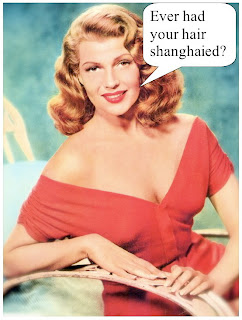
My pursuit having taken me to the Internet Movie Database, I discovered that I am not alone one who’s reframing The Lady these days. After receiving more ill-advised nips, tucks and facelifts than Cher and Joan Rivers combined, The Lady from Shanghai is now being readied for a radical makeover. According to the Internet Movie Database, the titular dame will soon assume the likeness of altogether un-Hayworthy Rachel Weizs, whose transformation into a femme fatale would require more than the services of a daring hairstylist. Thus, another iconic film is being shanghaied by the new and far from improved Hollywood.

The Man Who Went on a Diet and Didn’t Come Back

Laird Cregar in Heaven Can’t Wait

Well, I did not bother to make any.   New Year’s resolutions, I mean. Once again I let slip by the chance of this calendrical construct—a moment in which our attempts to impose the order of the chronologic on the so-called fourth dimension whose measurable expanse is being commorated with renditions of “Auld Lang Syne”—to bring about changes in the race against time that is my life. Perhaps you made up your mind (or had it made up for you) to put an end to something and start something new, an exchange of habits or a switch in attitude intended to improve life or merely to prolong it. I did resolve nothing more than to account for my everyday, aside from continuing with this journal, by counting the movies I take in this year (so far, Night at the Museum, Pan’s Labyrinth, The Gay Falcon, Gentleman’s Agreement, Gilda and The Man in the White Suit), thereby to get a clearer picture of my actual rate of consumption and to ponder, at year’s end, how much these fictions have informed or impeded my journey.

Though far from being a life-as-artist like Walter Pater, I try to think of my existence in all its failures and shortcomings as an unfinished essay, a half-published and oft edited text of which broadcastellan is both a digest and an extension. A man’s success, comedian Fred Allen remarked, “depends on which wears out first—his pencil or his eraser.” That, like most epigrams, sounds smart enough; but the real trick is to avoid getting those two writerly tools confused. Believe me, it’s not that easy to tell them apart. Here’s a for instance and how I arrived at it.

As I was thinking about a subject for another one of my “On This Day” features, I came across “The Death Laugh,” an episode of the radio thriller anthology Inner Sanctum Mysteries broadcast on this day, 8 January, in 1944. Rummaging through my library, I failed to lay my ears on the play I assumed to be there; many of the Inner Sanctum episodes available online have been mislabeled, their dates and titles inaccurately recorded. Rather than putting an eraser to this futile search and moving on to another subject, my mind lingered instead on Hollywood heavy Laird Cregar, the star of said thriller. It was as if the man demanded to be called to mind today, not content to wait even until tomorrow (which marks Cregar’s anniversary in a 1943 broadcast of the Radio Hall of Fame) or the day after that (in which he played Montezuma in Orson Welles’s propaganda series Hello Americans).  

There was no need for him to get pushy. I have always thought Mr. Cregar a fascinating and devilishly handsome fellow—ever since he first made an impression on me in This Gun for Hire (1942); so much so that I quite forgot—or was only too ready to neglect the by no means negligible performances of Alan Ladd and Veronica Lake. Playing Satan, Cregar brought wit to Lubitsch’s Heaven Can Wait, an otherwise disappointingly well-mannered and overly sentimental portrait of a scoundrel. Why hadn’t I seen more of Cregar over the years, considering my love for classic Hollywood movies?

Now, I am not in the habit of turning to an artist’s biography to assess his or her performances. Instead, I focus on the works that show people and storytellers are in the business of sharing with us. For that reason, the fact that Cregar practically starved himself to death in order to become a leading man was news to me. It seems that neither heaven nor Hollywood could wait for Mr. Cregar.

According to some sources, Cregar was born in 1913; others claim he came into this world in 1914; others still state 1916 as his date of birth. Certain, however, is that he died in 1944 of an uncommonly early heart attack, apparently brought on by a crash diet, the resulting 100 pound weightloss of which was intended to convince Hollywood to give top billing to a man considered too fat to play the dashing lead.

Even on the air, where he could have gone invisible, Cregar played the fat man when he filled in for Sidney Greenstreet in the Lux Radio Theater adaptation of The Maltese Falcon. Mr. Cregar got his wish eventually, yet only posthumously, in Hangover Square (1945)—a belated nod to a man who conformed to an image and was reduced to one in the process.

After I thought about all this, I flicked through the current issue of the Radio Times and noticed that, just as I was fiddling with computer and camera to capture Cregar’s likeness from hell, the British cable channel Film Four had been screening The Black Swan, in which the actor impersonated Henry Morgan, a Welsh pirate born in the windswept parts I now call home.

Yes, Mr. Cregar seemed adamant to turn me into his medium today. Perhaps he was out to warn anyone with the New Year’s wish of shedding pounds this year to take it easy or, better still, to reconsider whether the eraser we take to our lives is chosen by ourselves or handed to us by those who dictate just how our being ought to be shaped.

Please, Mr. Memory: Concussion on The Thirty-Nine Steps

I felt torn last night. Torn between The Falcon’s Brother (in which George Sanders passes the thriller franchise to sibling Tom Conway) and John Buchan: Master of Suspense, a television documentary about the author of The Thirty-Nine Steps. Quandaries like these are peculiar to life in a single-TV household. Considering that I am going on a New Year’s trip to Glasgow (where Buchan grew up) and just saw a dramatization of his classic spy novel in London, I decided in favor of the latter. Not that the documentary (part of BBC Four’s Adventures for Boys season) did much to clear the muddle my mind, at work under the influence of Patrick Barlow’s stage adaptation, has made of the Steps, one of those books everyone claims to know but few ever read, let alone without preconceptions.

Now, I have read Buchan’s 1915 novel (available online here); and, like most readers who come to it by way of Alfred Hitchcock’s 1935 adaptation, I was astonished at the film’s brazenfaced infidelity. I was disappointed, as well. Missing was the wit that Hitchcock and writer Charles Bennett brought to the original by reworking it in the screwball comedy tradition. It Happened One Flight, they might as well have called what amounts to conclusive proof that tying a male hero to a dame (absent in Buchan’s story) does not have to slow down a fast-paced chase. Infusing sex appeal rather than sentimentality, Hitchcock’s cinematic update created a new adversary for the already much-beleaguered hero, Richard Hannay, who finds that a lot can go wrong in the effort to do right.

Barlow’s dramatization, by comparison, aims at demonstrating that a lot can go right in the effort to do wrong. When I read that John Buchan’s “The 39 Steps” was playing at London’s Criterion Theatre (where it can bee seen until April 2007), I had reason to expect an update of the novel, rather than a recreation of the film, however farcical the treatment (as reviews and poster art suggested).

As it turns out, Buchan’s novel has little to do with the nightly frivolities at the Criterion. The attribution to Buchan in the title of Barlow’s play (based on an “original concept” by Simon Corble and Nobby Dimon) seems to be part of an elaborate practical joke—a set-up in which spectators gladly take the fall since they are being coddled by travesty into assuming themselves superior to the material, whatever its source. Being tongue-in-cheek is a convenient escape, a laughing away of what could—and perhaps ought to—have been an engagement or confrontation with Buchan’s story, a tale of espionage and persecution anxities so relevant in this age of terror and so-called anti-terrorism.

Aside from the material of which John Buchan’s “The 39 Steps” makes light, the main attraction of the play lies in its being performed by a cast of only four actors, who dare to take on well over a hundred characters. With a small supply of basic props, those nimble four are shown in the ludicrous struggle to recreate the screenplay as realized by Hitchcock (who, in one of the many inspired moments of silliness, makes a cameo appearance in silhouette). This minimalist-absurdist approach to adaptation was not entirely a novelty act to me, having previously attended a production of The Importance of Being Earnest acted out by a cast of two.

Overly familiar as well felt the play’s reflexivity, its awareness of and delight in the improbability of being equal either to Buchan’s spy story or Hitchcock’s screwball caper. Many self-conscious remakes operate in this manner, escaping the challenge of finding the new in the old by making a mockery of the attempt at renewal and a mess of what is presumably so outmoded that it deserves nothing more than a send-up.

There is enjoyment in seeing things go awry, no doubt; and John Buchan’s “The 39 Steps” rewards theatergoers for their knowledge of the Hitchcock version (one of three film adaptations of the story). Cineastes will appreciate the effort that went into finding ways of making it almost work, whereas those who read and respect Buchan may regret how much is being squandered by ignoring his paradigm. After all, his thrills, too, depend on the pleasure derived from seeing things go awfully wrong, albeit with far higher stakes for the protagonist and his world.

Calling the play John Buchan’s The 39 Steps obscures the fact that the first motion picture adaptation was already a comic revision of Buchan’s rip-roaring yarn. Going after Buchan, Hitchcock managed to be fresh (both new and irreverent) without losing sight of the hunter-on the-run formula that would serve him so well, without neglecting the task of dusting off this decades-old story for action-seeking motion picture audiences. Forgoing thrills, sentiment, and politics alike, Barlow is strictly after laughs.

That said, the bungled dramatization is a chuckles-filled joyride for those who take pleasure in playing fast and loose with supposed literary classics. I gladly go along, provided I can still pride myself in being able to tell a sly impostor from the real thing. Instead, the theatrical experience has given me somewhat of a concussion, leaving me in a state of confusion that neither the aforementioned documentary nor the numerous American radio dramatizations (by the Lux Radio Theater and the Mercury Players, for instance) are likely to clear up. Was Richard Hannay a South African, a Canadian, or a Scotsman? Was he driven by the impulse to save a crumbling empire, to counter boredom, or to clear his name? Come to think of it: just who built The Thirty-Nine Steps, an unstable architectural composite of which now arises before my mind’s eye?

Even Mr. Memory won’t be of much assistance to me, I suspect. Besides, he is . . . but you know the story.

“These Three”: Gay Lovers Straightened through Air-conditioning

The history of taboos sure is shocking. I mean, it is shocking to realize what, over the years, has been hidden from view and banned from our discourse. Interracial marriages. Same sex unions. Gender reassignments. While denial can be as harmful as our tendency to designate, you would have to have been living under that proverbial mineral formation or petrified by the religious fundamentalism that passes for faith these days to regard such realities as unmentionable. They may not be widely understood or tolerated, let alone embraced, but as the facts of life in all its complexities they are too much in the public eye to be ignored.

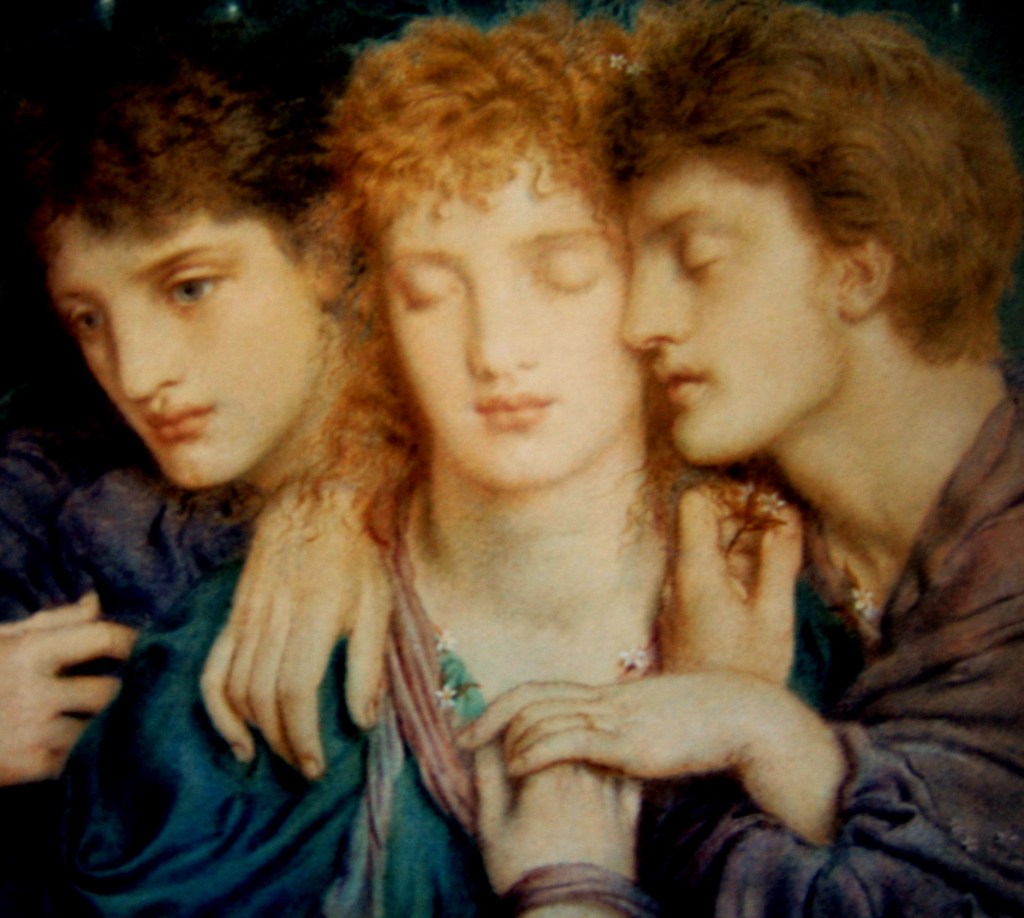
Simeon Solomon, The Sleepers and the One who Watcheth (1870; detail)

Often argued to be responsible for foisting a liberal education on the masses, Hollywood has, in fact, played an important role in keeping quiet about many aspects of our everyday lives. Beginning in the mid-1930s, and for several decades thereafter, the Production Code curtailed what could be shown or talked about in motion pictures.

It was on this day, 6 December, in 1933, that James Joyce’s Ulysses was ruled to be “not obscene,” lifting the ban on its sale in the US; but that, aside from its narrative structure, hardly made Ulysses ( 1922; previously serialised 1918-20) a hot property in Tinseltown. Writers who wanted a share of the profits to be made by selling stories or streamlining them for the silver screen had to deal with the strictures of the code and learn to rework their material accordingly.

One playwright who accepted this challenge was Lillian Hellman, whose 1934 stage success The Children’s Hour was brought to the ears of American radio listeners on this day in 1937.

The Children’s Hour tells the story of two women whose teaching careers and personal lives are wrecked when one of their pupils alleges that they are having an intimate relationship.  Like Hellman’s 1936 screen version of The Children’s Hour, titled These Three, George Wells’s radio adaptation for the Lux Radio Theatre drowns out the unspeakable by suggesting instead a triangulated relationship with a virile heterosexual male at its center.  Wedged between Stanwyck and Mary Astor that night was the presumably irresistible Errol Flynn.

Hollywood had long thrived on love triangles, although they were rarely as ambiguous as in the above painting by the aforementioned queer artist Simeon Solomon.  Indeed, the three-cornered plot is key to the first new genre of production-coded cinema—the screwball comedy, in which heterosexual marriage is challenged by old flames or new rivals until it is ultimately reaffirmed. Although—or perhaps because—These Three is more concerned with libel than with forbidden love, with allegations rather than physical acts, the revision eliminates the unmentionable to make room for a rumor that can be talked about.

As if determined to remove any doubts as to the straightness of the radio adaptation and all those associated with the production, Lux host Cecil B. DeMille opens the program by letting listeners in on a “secret,” a story that had “completely escaped the headlines.” The unheard-of item amounted to little more than the announcement of a recent marriage. According to DeMille’s anecdote, the unconventional Ms. Stanwyck had just attended the wedding of her stableboy, danced with the hired hands, and “made them all forget” that she was the “groom’s boss.” The Lux program presented itself as clean entertainment without wanting to appear stuffy.

What is more stuffy—and objectionable—than the codes governing radio and motion pictures is the subsequent silencing of the history of such hush-ups. A description of the Lux broadcast in a 1995 reference text, for instance, keeps mum about the pedigree of the adaptation by alluding vaguely to “[c]ertain aspects of the stage production’s plot” that “made a straight film version out of the question.” Phobic histories like these not only contribute to our ignorance of past inequalities. They keep us from moving beyond them.

The History [of] Boys: Alan Bennett and the Gay Social Science

I often ask myself whether I am. History,  I mean.  Not that anyone is opening a museum dedicated to my life, a definitive space for finite time as it is now in the works for 1970s pop act Abba.  To be history, I suppose, means to be quite past it; insignificant, irrelevant, outside of what matters now, someone either to be forgotten or to get nostalgic about.  To be part of history, on the other hand of time, means not only to think of oneself in context but to be thought of as belonging to it, as fitting into its continuum. And to make history is to take part in its continual shaping, be it wilful or inadvertent, by bringing something (or someone) about.  So, am I a manifestation of history? Am I making it? Or am I beyond its bounds as determined by those who assume the authority of authoring it in word and image?

Such questions have been whirring through my mind after watching The History Boys, the film adaptation of the acclaimed stage play by Alan Bennett, the well-known British radio raconteur.  The History Boys documents the quest of a group of students who, in an effort to make something of themselves (or to please their folks), try to get into one of Britain’s most influential or prestigious institutions of higher learning by reading (that is, studying) history.

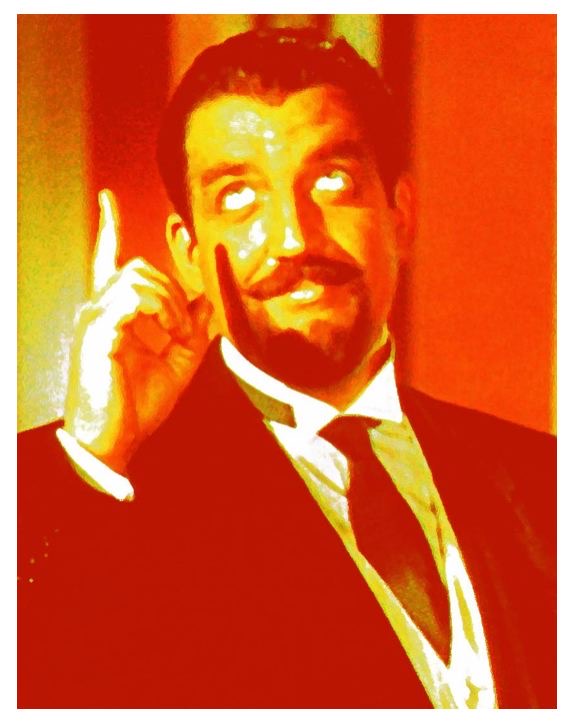
Bennett sets the action, such as it is, in 1983, which means that, by now, those ambitious, playful and bewildered youngsters would be middle-aged men, like myself (pictured), a spinning forth of their fictional lives the film encourages in its “whatever became of” epilogue.

One of them did not make it this far into the 21st century, having given his life for his country (or those governing it on his behalf) by serving in the military.  Most of his classmates, it seems, have gotten little out of their college education, other than the satisfaction of being able to brag about it.  Except for the one, most vulnerable, least sure of himself, who took his schooling to heart and decided to pass it on.  That one, according to the queer history of Mr. Bennett, is the outsider who, unlike his closeted professor, has a chance to be, make, and impart what he has learned about himself.

At first, I was irritated by the imposed pastness of the action, as much as I can relate to the period as one of adolescent confusion.  Why bother to recreate a certain historial age, to impose a make-believe historicity on the growing-up experiences portrayed, thereby diminishing or obscuring their relevance? How would their story play out if were set in the present day, rather than a past that looks, by virtue of being bygone, quaint to those who have not lived it and to those whose vision is warped by nostalgic longing?

Might not such an act of looking back serve a purpose other than to suggest a past beyond change? The history of those boys turned men, individuals who were not always in control of their paths (as accidents shaped them as much as their actions), is not so much over as it is crossing over into the present.

The History Boys strikes me as an old man’s gesture of bridging what is often thought of as a generation gap, a chasm into which recent lessons and those still present to teach them are tossed to be discarded.  It is an encouragement to learn not from books and experience alone, but from intercourse with those around us, those whose stories might not get into the books other than by being thought of while reading.

The body of our histories, like the history of our bodies, cannot be got at from a distance, scrutinized in clinical detachment by ostensibly objective onlookers; it has to be lived, felt and shared in order to matter.  Beyond the groping for bare facts in hopes of an elusive naked truth, beyond the stripping of traditions exposed as lies and the weaving of postmodern thought in a garish display of thinly veiled self-pleasuring, imparting an understanding of history is a mentoring in the half-forgotten sense of the word.

 “Pass the parcel.  That’s sometimes all you can do.  Take it, feel it and pass it on.  Not for me, not for you, but for someone, somewhere, one day.  Pass it on, boys [and girls].”

What Those Who Remembered Forgot: Robert Altman (1925-2006) on the Air

Well, news is spreading fast these days; and by now anyone within reach of a computer will have learned that film director Robert Altman has died on Monday, 20 November 2006, at the age of 81. Since my own web journal can do little to propagate this message, it will provide instead an addendum to the small number of long-prepared and oft-copied obituaries currently circulating in the blogosphere. I have attempted as much on previous occasions by sharing a lesser known aspect of the careers of Don Knotts, Shelley Winters, and composer Cy Feuer, all of whom had connections to the world of radio to which broadcastellan is largely dedicated. As it turns out, Robert Altman is no exception. Indeed, his debt to the medium was far more profound than that of the other artists aforementioned.

To be sure, Altman’s name is already being closely linked to the so-called golden age of radio by virtue of what would be his last film, A Prairie Home Companion (2006), a filmic realization of a world evoked by radio romancer Garrison Keillor. Altman was greatly influenced by 1940s radio. He revealed as much in a National Public Radio documentary broadcast in May 1995 (a recording of which you may find here). In a tribute to Corwin’s “On a Note of Triumph,” Altman made the following statement:

“Anything I know about drama today comes more from Norman Corwin than anybody. If I had to list my mentors, I would say Norman Corwin, David Lean, Fellini, Bergman, Kurosawa, and then a countless number of people whose names I forget where I learned what not do.”

Now, what could Altman have learned “about drama” from Corwin, America’s foremost radio playwright (whose first letter to me I cheered recently)? As a film director, Altman did not fare well on the stage. His production of Arthur Miller’s Resurrection Blues earlier this year was widely panned; indeed, the reviews were so unfavorable that, while in London at the time, I decided to pass on it, despite my interest in the career of Miller, a former radio writer (one of whose works I discuss here). Perhaps, what Altman did take from Corwin—and what he could do on film more readily than on a stage—was the idea of an ensemble piece comprised of a large cast, a sprawling drama of many voices (such as The Player and Gosford Park). Everybody‘s in it, you think, when you look at the cast for an Altman production.

The same can be said for the signature pieces written and directed by Norman Corwin—plays with a vast number of characters, their stories intersecting, their voices adding up to something, to an idea, a statement, about Hollywood, for instance, about politics, about the state of American society. Corwin’s seminal On a Note of Triumph was such a piece, a play for voices; not a choir, mind you, but a cacophony; not a traditional drama of linear storytelling, but a fictionalized documentary, a record of a moment. Of this play, Altman said, some fifty years after its initial broadcast: “I can recite 40% of On a Note of Triumph from memory,” having listened to it “time and time again.”

I had not been aware of Altman’s admiration of Corwin’s work, until today. Come to think of it, both Corwin and Altman were belatedly honored at the Academy Awards this year, Altman receiving a lifetime achievement award, and Corwin being the subject of an Oscar-winning documentary about the making of “On a Note of Triumph.” Now, when I watch Altman’s films, I will look for Corwin and “Anything” he might have brought to the craft of the late director.