
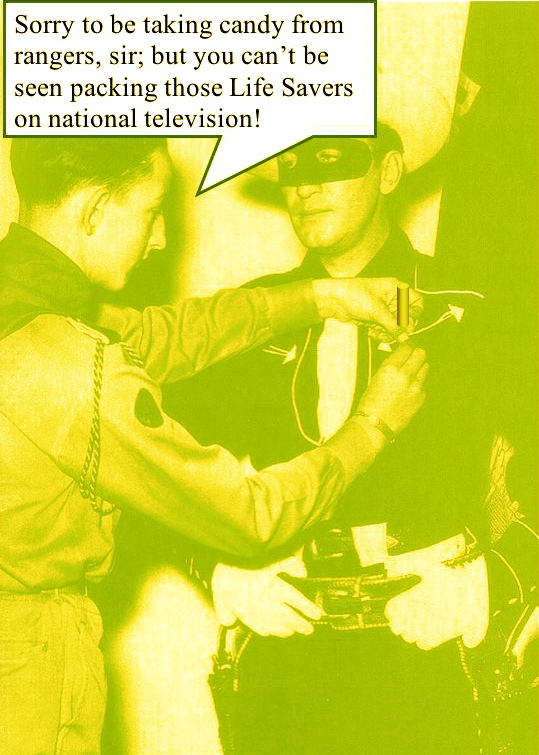
The Candy Man Can’t: "Junk Food" Advertising Outlawed on British Television

Well, it’s been a bad day for Willy Wonka. The snack manufacturers in the UK are in a state of sugar shock. Sure, the chocolate factories will remain open; but the popsicle peddlers and potato chip pushers have been dealt with a restraining order, forced to keep a low profile when it comes to accosting their most valued customers. The golden ticket—or any such gimmick designed to promote so-called “junk food” on television—is a thing of the past. Count Chocula will have to go underground in search of fresh blood, and millions of hyperactive and hypoglycemic kiddies might have to learn about candy from strangers, now that cable channels are closed to the trans-fat movers and saltshakers that thus far defined and financed much of children’s television.

The ban on “junk food” advertising is to go into effect in January 2007, the BBC reports. The measures are surprisingly far-reaching, considering that such commercials will no longer be permitted on any “pre-school children’s programs,” “programs on mainstream channels aimed at children” or “cable and satellite children’s channels,” “programs aimed at young people,” including those featuring music videos, and “general entertainment programs” that “appeal to” a “higher than average” number of viewers under the age of sixteen.

The decision, presumably on behalf of an obesity-prone or malnourished public, was made by Ofcom (Office of Communications), a new regulatory body established in 2002 and authorized by Britain’s Office of Communications Act in 2003. Will this catch on elsewhere? Are ice cream, soda pop, and French fries going the way of the cigarette, now that health fascism is on the rise in the west?

What might have happened to American action heroes like Buzz Corry, commander in chief of the Space Patrol, had the FCC clamped down on US radio advertising in the 1930s and ’40s (whose jingles you may hear and see discussed here)? Would Buzz have had to load his tank with corn flakes or oatmeal, like most of the competition? Space Patrol, after all, “was brought to you by Nestle’s Eveready, the instant cocoa, and famous Nestle chocolate bars. Remember N-E-S-T-L-E’-S.” And, as the announcer promised, those listening in could get their own “rocket cockpit” and fly “into space” with Buzz Corry if only they sent in those Nestle labels.

Are we, in this happy meal age of movie tie-ins and product placement, really Buzz Lightyears removed from such sponsorship models? No doubt, there’s lots of dough in cookies, and those protective of commercial television foresee great losses in revenue; losses, they argue, that might very well lower the quality of programming in Britain, as advertisers lose interest in a large group of potential viewers previously seen as a target audience, thus decreasing the purchasing power of advertising-dependent cable channels.

So, who is to gain as kiddies trim down (if indeed such a widespread downsizing of pint-sizers will follow)? The outlawing of “junk food” advertising might prove a boon to those with poor parenting skills, those who rely on legal strictures and thrive on lawsuits to raise a new generation of leaner, healthier consumers, sturdier taxpayers with fewer cavities and lower blood sugar, calm little low-sodium dieters deprived of the catchy tunes that used to cheer our everyday.

Live and Let Die: Is It Time to Give Bond the Boot?

Well, I know, it is an old argument. One that is being dusted off every time a new man slips into the suit. Always a man, mind you. And the man in question is Bond, James Bond. With Casino Royale now in theaters, and the less-than-favored Daniel Craig assuming the role of 007, the question arises anew: does Bond still matter, over fifty years after he was introduced to the world in Ian Fleming’s spy stories? Should he die another day, right this minute, or some time tomorrow (which presumably never dies)? What does his resilience tell us about the crumbled British Empire, about the state of international diplomacy, about the ways of the warring world?

A new Bond picture is still a media event, some forty-five years after the release of the first entry in what turned out to be a highly lucrative franchise. For me, it all began with The Spy Who Loved Me, the second movie I ever got to see in a theater; as such, it made quite an impression on me. Okay, he did not love me (little did I know how much he loathed me and my kind). The villain was played by a fellow German (Curt Jurgens); but dubbing, as it is still being practiced in my native country, all but obscured the lingering animosity toward Germany as expressed in such castings. It is easy to watch James Bond thrillers without noticing their cultural and political agenda. It is convenient to do so; but it also renders those films irrelevant.

Bond did much to keep the Cold War alive—or any crisis beneficial to the West. He has always been On Her Majesty’s Secret Service (rather than the people’s)—and a grateful Queen Elizabeth II once again attended the Royal Premiere of the latest 007 mission she thus endorsed. Bond is the anti-diplomat—ultra-conservative, xenophobic, and unapologetically sexist. Dame Judy Dench was brought in as a response to decades of Pussy Galore and the casting cat calls it provoked; but “Octo” never did denote octogenarian and female sidekicks still get the kittenish outfits, the headlines and centerfolds, along with those less than subtle names suggestive of slippery bodies just waiting for a firm . . . well, you know.

Bond is an institution—perhaps one that is ripe for abolishment. Austin Powers may have mocked the machismo, as others have done before him, but left the Bond franchise unshaken if slightly stirred.

The producers of the latest installment could have responded to such claims of obsolescence by turning Casino Royale into a period piece, setting it in the political climate in which it was conceived. It would have been a bold move for Bond, at once an acknowledgment of the datedness of the character and its historical significance, a topical significance long obscured in favor of gadgetry and reduced to pop-cultural nods to celebrities of the day (such as Goldie or Grace Jones, last seen at a Guinness Book-making gathering of the Joneses). Diamonds Are Forever—but traditions? Upon reflection, the Bond image might be as timeless as a rhinestone on an extravagant designer suit: dernier crie one day, but “for crying out loud” thereafter.

That said, I am looking forward to the latest James Bond, if only to take him on. If Freddy Kruger can be confronted with Jason, how about a match-up of Bond versus Shaft, to kick the imperial highness right out of 007’s pants? How about Bond having the living daylights scared out of him by Lara Croft? I’d put my Moneypenny on such a fight. How about, Goldfingers crossed, Shaft and Lara Croft as James Bond? You might get to witness just that . . . if you only live twice.

An Inspector Calls Our Bluff

Yesterday’s gloomy afternoon gave way to a splendidly sinister evening at the theater. The play was J. B. Priestley’s An Inspector Calls, which I had previously seen back in 1995, with 80’s heartthrob Maxwell Caulfield in his Broadway debut. In that production, the set pretty much upset the text—a huge, dark house confronting the audience from behind a curtain of rain. It was an impressive spectacle calculated, it seemed, to veil or countermand Priestley’s directives, the stark simplicity and artifice of his didactic play. Yet, as I realized last night, watching a touring Clwyd Theatr Cymru production directed by Barry Kyle, An Inspector Calls loudest when the lines are clear and the stage bare.

I had prepared for the evening by reviewing the 1934 film adaptation of Priestley’s Dangerous Corner, starring Virginia Bruce and Melvyn Douglas.  The movie struggles to open Priestley’s play to the demands of a dynamic camera.  The cinema audience wants, or is at any rate accustomed to, something other talking heads and sedentary bodies.  Even Martyn Bainbridge’s design, while effectively sparse compared to the melodramatic Broadway treatment of An Inspector Calls, at times displayed a doubt in the sufficiency of Priestley’s script by underscoring his words with visuals, turning walls into movie screens and tilting the stage to demonstrate the downfall of a supercilious and self-centered family.

Do we need images to get the picture? The theater of ideas is best accommodated by radio, a non-visual medium that forces our mind to focus on the spoken word and telling silences. Back in the early 1930s, Priestley may not have been convinced of this. After all, Dangerous Corner is a rather scathing commentary on the wireless as a soundcarpet under which the unspoken and unspeakable can be swept: the receiver has to break down to crack the surface of idle chatter among the civilized yet rotten.

In An Inspector Calls, which reworks the central idea of the earlier play, the part of the radio is performed by a telephone that rings to shut up a group of culpable and contemptible individuals talking themselves back into a state of calm. Unreliable or intrusive, both means of telecommunication are called upon to penetrate the walls of bourgeois conventions, obliging those standing apart to connect and disclose what has been carefully concealed from others.

Priestley could and did rely upon the wireless to spread the word and to popularize his ideas. His novels and plays were often heard on American and British radio during the 1930s and ‘40s, among them adaptations of Angel Pavement and Laburnum Grove, as well as the two works discussed here. The author-dramatist even made an appearance on Rudy Vallee’s show, as I read in a September 1939 issue of the Radio Times, and agreed to let the BBC serialize one of his novels prior to publication, with its author reading the first installment.

While expressing his reservations about the experiment and its effect on book sales, Priestley nonetheless decided to reach out to the populace he was eager to unite. Perhaps, some six years prior to the completion of An Inspector Calls, he had already gotten the call from his inquisitive messenger. It is a call that still resonates strongly today, not so much as socialist propaganda, but as an appeal to think beyond economics, beyond present self-interest, for the sake of turning a Dangerous Corner in the path of the planet we share.

Bloodshed: Did Freddy Kruger Slay Cocteau?

It can do serious damage to one’s sensibilities. Popular culture, I mean. I sensed its deadening force tonight when I attended a screening of Jean Cocteau’s first film, Le sang d’un poète (1930). It was shown, together with the Rene Clair short Entr’acte (1924), at the National Library of Wales here in Aberystwyth, where it was presented with live musical accompaniment by composer Charlie Barber, who also conducted. However animated the score, the images left me almost entirely cold. Why? I wondered.

There was a time when I was thrilled—or at least tickled—by surrealism. Reproductions of Magritte’s paintings lined the walls of my room. In my drawings and watercolors, I ransacked the surrealist inventory, ripping off Dali’s shadows and reshaping the landscapes of Tanguy and de Chirico. Getting experimental with the camera, I posed in front of designer-cracked mirrors, something standing in for blood oozing from my cheek or brow. That was just about the time when early 20th-century art was being reprocessed on MTV, in music videos and horror film franchises like Phantasm, A Nightmare on Elm Street, and The Evil Dead. This New Wave swept over and wiped out what was once avantgarde but nowadays generate about as much excitement as a can of Campbell’s soup.

Our jaundiced eyes have stared down a multitude of visual assailants. How many times can you be surprised by a mirror turning into a pool of water, startled by violent juxtapositions, or amazed at facile paradoxes? How long does it take to turn an outrage of images into an outage of imagination? Video, it seems, killed something other than the radio star.

Popular culture can make Cocteau’s Poet look like Mr. Potato Head. It exterminates the life of art in the very process of reproduction. Was it this frustration with the fading power of pictures that made me turn to the non-visual arts, to broadcasting in the pre-television age? If so, video did not kill the radio star after all. When you run those digital pictures until the recycled blood on the screen runs dry, you might begin to hunger for a blank slate on which to give new expression to your personal terrors and intimate desires.

Give the poet in you a blood transfusion by taking your eyes from the plasma screen. Close them a while . . . if you have the sang-froid to open your mind’s eye to such a world of possibilities.

My Anglo-American Diet

Well, I consume plenty of them. Movies, I mean. Almost every night I take one in, along with some potato chips and a tall glass of gin and tonic. Now, looking in the mirror, I pretty much know where the chips and the gin are going, being that the residue lingers prominently around my waste. I don’t mind that much. I’m talking celluloid, not cellulite.
So, how does this motion picture diet affect me? What remains of these pictures after my eyes have lapped them up, my mind downed them? Granted, I don’t always ingest; once in a while I drop off in the very act of feasting (Elia Kazan’s Boomerang didn’t come home some nights back). Sometimes my attention throws in the napkin, losing itself like a crumb in the pleat of a leading lady’s dress or finding itself deserting the table at the sight of a mustachioed villain. Still, I pretty much finish off about three or four movies a week; and I’d sure like to know just where they are going and what they are doing to me once they have rolled off our screen, a large window blind serving as a conveyor belt for digitized treats.

I have been living in the UK for two years now; but, aside from a few British favorites such as Brief Encounter (pictured, and discussed here) or the occasional TV dinner (with the recently reunited Royle Family for instance), I still take in almost exclusively American fare. Last night, for instance, I took out two DVDs: Alfred Hitchcock’s pre-Hollywood melodrama Juno and the Paycock and Orson Welles’s post-Holocaust thriller The Stranger; it was the latter that got a viewing, the former being once again returned to the drawer, yet unwatched. Perhaps I was just not in the mood for Irish stew; but the “go west” pattern in my viewing habits is all too apparent.

In fact, I am so American in my pop-cultural intake that I even missed yesterday’s 15,000 broadcast of The Archers, that British institution of a radio serial. I was too busy thinking about the mid-term elections in the US to devote time to a venerable program that, truth be told, I have never listened to even once, despite my love for radio dramatics. Do I need to point out that I am a German native (something I’d prefer to forget)? What is it, aside from having lived in the US for fifteen years and devoting an inordinate number of them to the study of American radio drama, that makes me embrace American culture of the 1930s, ‘40s and ‘50s yet ignore or outright dismiss so much else, contemporary and internationally?

For one thing, I know what to expect from traditional Hollywood entertainments. I appreciate their formula, accept their limitations. Not unlike Victorian novels, they please me even when they leave me wanting (and Welles’s Stranger is surely a less than satisfying dish of hokum, squandering nearly all its potential to explain what it merely exploits—post-war doubts about a reformed Germany, a policing of thought for the sake of a secure nation, and a global peace founded on democratic principles). They agree with me, even when my mind insists they are nutritionally deficient and dangerously high in sodium, considering that you have to take many of these melodramas with so much more than a grain of salt. And as long as my heart’s still pumping enough blood through those hardening arteries, I keep the transatlantic meals on reels program going.

Sure, watching Hollywood movies does not make you an American. You might as well try to enter the Green Card lottery with a ticket stub. Instead, you keep circling Ellis Island, feasting your eyes on the Statue of Liberty looming in the haze. Marveling at the prospect in light of last night’s election, you can almost imagine yourself chewing the scenery in a Frank Capra feature.

So Proudly We Hail(ed); or, Movies They Dare Not Make Today

Well, they sure don’t make them as they used to. I don’t know how many times you have uttered that line, indifferent to the rules of grammar, whether as a lament or a sigh of relief. Take So Proudly We Hail, for instance, the 1943 war drama I watched last night. Until I decided that doing so would be rather too self-indulgent (considering my love for a certain leading lady), I thought of discussing it yesterday, corresponding with the anniversary of the radio version in which stars Claudette Colbert, Paulette Goddard, and Veronica Lake reprised their original roles (along with the long forgotten Sonny Tufts) on the Lux Radio Theatre.

So Proudly We Hail is a well-crafted, surprisingly unsentimental, and highly engaging melodrama about US army nurses serving their country in the battlefield that was the Philippines during the Second World War; as such, it is also unabashed wartime propaganda. I do not think that any producer in Hollywood today would dare to remake it, say, with Julia Roberts, Winona Rider, and Scarlett Johansson (to pick three contemporary actresses approximately of the respective ages of the three original leads). Why not? Allow me to speculate.

There’s a war on, lest we forget; but it doesn’t seem to reunite the West (or any Western nation) against a clearly defined enemy. Instead, we find ourselves in a war on terror—and the terror appears to be as much the cause as it is the effect, violence and violations being brought on by so-called anti-terrorist measures that continue to provoke it.

This is not a time in which to express pride in one’s country or its elected representatives; and those making decisions in Hollywood today seem least inclined foster a sense of loyalty and regard. I don’t think, though, that widespread dissatisfaction and skepticism—a critical attitude only the thoughtless or unthinking ever entirely suppress—account for the current rejection of propaganda drama.

As the reception of Clint Eastwood’s latest film suggests, people are not lining up to see movies with a political message. They might accept a controversial documentary inviting us to take sides; but they no longer appreciate being manipulated or swayed by dramatic fare. Propaganda is a dirty word these days, dirtier by far than advertising, which is still being tolerated.

However much we might groan, we tend to allow the promotion of a product, but get squeamish when it comes to the advancement of an idea. Corporations have taken a prominent place in—or even taken the place of—the government; and when peddling products, advertisers appeal to the individual, whereas propaganda seeks to motivate the community. It simply pays to stimulate division and selfishness, a targeting strategy generally marketed as choice. There no longer is a public, it seems; there are only people; and for advertising purposes, several million of these supposed individuals will do.

Unlike today’s conflicts, the Second World War was not endorsed by big business; companies were not eager to surrender sales or give up the production of consumer goods for a nation that needed to consolidate precious resources. So, I don’t think we’ll get to see Scarlett Johansson grabbing a hand grenade and blowing herself up for the sake of her country (as Veronica Lake’s character does) or picking up an empty can of soda for the benefit of the planet. Instead, she’ll grab that soft drink or lipstick or pair of designer shoes and fight for what she believes in . . . or what those placing the products in her hands want us to believe.

I did not grow up in a country or an age in which it was easy or felt right to be proud of one’s people; and, watching a film like So Proudly We Hail I sense that to be a profound loss. We so proudly hail individuality these days because corporations hand out the flags and buttons to match, knowing that we are at our most receptive and vulnerable when we are at our greediest.

Loaded Trifles: Killing Time, Wasting Life, and Assassinating George W. Bush

Well, “It doesn’t matter, does it?” That is a pivotal and oft-repeated line in Pulitzer Prize winning novelist J. P. Marquand’s Thank You, Mr. Moto (1936), the aforementioned thriller I finally put down tonight. Does it matter? The novel, I mean. Was it just a way of passing some dull hours before, in a few minutes from now, the Death of a President—the assassination of George W. Bush, no less—is being televised here in Britain, a media event you may look at as just another opportunity to “kill time”? I have always been revolted by the phrase “killing time.” Sure, I take in plenty of popular culture; but I do not consider my engagement with such alleged trifles to be quite so destructive. Instead of getting away with murder, I try to come away with something rather more meaningful and life affirming.

Last night, after watching another instalment of the four-part adaptation of Jane Eyre, one more glossy take on the classic novel (previously reviewed here) to which I am warming against my better judgment of the original, I had a glance at Reader, I Married Him. It is a documentary that borrows its title from the most famous line of Jane Eyre—the very line denied me by this latest adaptation, since those at work on visualizing the novel decided to drop the first-person narration that served actresses like Ingrid Bergman, Madeleine Carroll, or Deborah Kerr so well in radio versions of this bold if bogus autobiography.

Now, the common argument for (or against) pageturners like Jane Eyre—and the lesser works inspired by or ransacking it—is that they provide vicarious relief. They allow those reading (or viewing or listening) to leave their restricting bodies and circumstances and become fictional characters who are daring and courageous despite the recognizable shortcomings that enable us to identify with them in the first place.

Escapism is often thought of as beneficial or at any rate innocuous. It gives hope to those who deem themselves beyond escaping, those swallowed up by the mundane and too feeble or frightened to realize that the everyday is all we’ve got. Others contend that this losing oneself in make-believe mainly serves the interests of those who would rather preserve the status quo and encourage alternate realities where everyday life ought to be.

What use is any novel, any film or play, if it only leads away from the present like a cul-de-sac littered with dreams deferred? What can we take away from novels before we put them away to grab another? Is a novel or film or radio play worth our while if it does nothing but help us to while away the hours?

Luckily, I am not the kind of person who is ever bored, even though I might spend an entire day doing what many would think of as nothing at all. Early in adulthood I decided that killing time is a deadly pursuit. I left behind my former self, my miserable nine-to-five job, and turned my back on my native country because such a lethal rejection of life began to disturb and depress me. It roused me to move to the United States, where I learned in time to live for the day rather than wait for a presumably better tomorrow, a period consumed by watching diverting films and reading distracting books.

No, I did not gain this courage from reading any piece of fiction; but since escaping home I have stopped perceiving any work of fiction as being escapist. Unless I put it aside as something not worth my while, I generally manage to find something in cultural pop, however devoid of fizz, that reflects or refreshes me. Making time for such works is no longer a fast getaway but a gradual getting at something. Weaving myself in and out of fictions, I no longer find myself sneaking out of what I think of as my own life.

Now, before I witness the assassination of George W. Bush—which I will not accept as wishful thinking—I am going to share a few lines that I took away from Thank You, Mr. Moto, words be thought of long after the plot and characters have become a blur in the vapor of experience pulverized by time. The first lines are uttered by the American narrator, the second by the one who makes him change his “it doesn’t really matter” attitude toward life:

I could see myself as others may have seen me [. . .] a stranger in a strange country, living in a fool’s Paradise; and I could see myself as something uglier than that.  I could see myself as one of those misfits who cumber the earth, like spoiled children, incapable of adjustment to the life where they were placed and indulging instead in illusory futilities of existence which certainly were no part of life.  I could see myself as one of those unfortunates, unable to face incontrovertible fact, constantly escaping from reality, and at the same time endeavouring to gain applause.  That vision of myself made me lonely, empty.  More than that, it filled me with distaste. 

You can be as much of a fatalist as you like, but don’t forget there are times when you can do something.  There are times when anyone can make fate change a little [. . .].  People may be altered by circumstances but they can alter circumstances too. At any rate I’ve taught you that.

The novel hasn’t exactly taught me anything; but the relevance of these lines, so obviously designed to validate the novel as something other than a time-waster, has not escaped me. They have returned me to my own story, my inescapable past, my retreat abroad, and my current remoteness from much that I once believed to be giving life meaning. You’ve got to be prepared to sustain a few injuries when handling such loaded trifles.

Manhattan Transcript: Why Oliver Stone Left Me Cold

Well, I am back in town. Getting here (from Wales) was a considerably less sentimental journey than Oliver Stone’s journeyman tribute to the city and its indomitable spirit—and a far more telling reminder of the changes resulting not just from the terrorist attack on the World Trade Center but the subsequent efforts in the so-called war on terror. At our airports, unlike a court of law, we all are presumed guilty unless proven innocent. After a sleepless night in Manchester, England, I was being questioned regarding my passport, asked to provide evidence of my stay in the United Kingdom—the country where I now live and from which was about to leave.

Although issued in London and stating my residence as being Wales, my German passport marks me as a visitor, a cosmopolitan spirit, or some such suspicious subject. Airport (in)security has made international traveling considerably more challenging of late, given the current security alerts and precautionary measures at UK and US airports. Far more than a series of inconveniences, air travel has become an endurance test for a free world locked in a system of terror and liberties impounding counter-terrors.

It seemed right for me to go see World Trade Center on its opening night here in New York City, especially since some of the proceeds will go to charity. I lived in Manhattan on the day of the attack and the anguish of its aftermath. Reminders and memorials far more eloquent and than Stone’s film lined the city’s crowded if quiet streets—candles on the doorsteps, “missing persons” photographs on the walls, and distress signals in the faces of those lingering among strangers whose presence offers some reassurance that the world had not yet come to an end. Today, the World Trade Center site (pictured above, in a photograph I took last Tuesday), is a gash in the cityscape bespeaking the pathology of terror.

Telling the events of that day from the perspective of first responders and their families, Stone’s World Trade Center struck me not merely as sentimental but spurious. Denying the politics of terror and offering instead something akin to Backdraft with a “based on a true story” tag, the film plays a game of “Good cop, bad Capra” with those who are most anxious to attack it. It refuses to be sensationalistic, but falls far short of making much sense of matters so staggering to most of us. It has nothing to share beyond the uplifting message that the human body can endure great pain if sustained by a will to live.

We all are living and fighting for the basics, for the love of someone or the passion for something—including those in our midst who love to hate us and are willing to be consumed by and give their lives for that love. It is the realization of the potential destructiveness of fierce attachments that makes terrorism such a frightening presence in our lives. It is this disconcerting realization that World Trade Center leaves out of the picture, thereby falsifying an historical event that gave rise to the passion-stirring and hate-begetting war on terror.

Unlike the riveting United 93, Stone personalizes the event, embedding the extraordinary in ordinary stories of everyday middle-class and endorsed-as-traditional family living. With a narrative structure fit for a Lifetime television movie of the week and performances so perfunctory as to collapse under the burden of sentiment they are supposed to carry, World Trade Center is an abject failure in Hollywood storytelling.

Turning a landmark event into a Hallmark card, it even manages to reduce the eponymous structure and the smoke rising from its rubble look to a poorly executed CGI effect. Given the footage we have all seen and shed tears over, this faking was most distressing to me. Then again, even the homeless and the streetwalkers—stock figures meant to suggest urban grittiness in films set in the metropolis—came across like so many Hollywood extras dressed up for the occasion.

It was distressing that I could not be made to feel anything but dissatisfaction, having suffered so greatly on that day and being generally so receptive. Other around me even burst into uneasy laughter at the sight of Jesus holding a water bottle, an image of astonishing tackiness. It is telling that the most poignant moments in the film flickered before me in news footage of the world’s response to the attack, images of people who did just what I did when the towers came down: watch in horror.

These snippets also carry the political message that Stone’s dramatizations obscure: that the world’s love for America, so evident on the day of the attack, has been squandered and that neither our homes nor the world beyond are any safer in the age of counter-terrorism.

We Now Resume Our Regularly Scheduled Life

It has been a week of local excursions here in Wales, days spent sunbathing and splashing in the radioactive sea, bookhunting in Hay-on-Wye (the world-renowned “Town of Books”), dining al fresco, stargazing outdoors and on screen, playing with Montague, our unruly terrier, and being among friends (even after having been critiqued with the candor I reserve for those who matter to me). The occasion of it all was a weeklong visit by my closest if mostly long distance friend, the fatherland I haven’t set foot on for seventeen years. It is to him that I owe the wonderful book pictured above, a splendid addition to my collection of Claudette Colbert memorabilia.

Whenever I venture out to Hay, I return home with a few treasures. This time, I added a book on Harold Lloyd (my favorite silent screen comedian, whose films The Kid Brother, The Cat’s Paw and Girl Shy we screened during the past few days), as well as a coffee-table topper on screwball comedies (a book which I had previously gifted to abovementioned best pal, but with which I was pleased to get reacquainted). However convenient and economic it might be to browse and shop online, the thrill of the hunt (as previously described here), is something a carnivore of a booklover like me does not like to go without.

Now, the people of Film Pictorial, a British publication, are full of it. Legend, I mean, which is a term I much prefer to trivia when it comes to describing pieces of nothing from which to weave whatever your mind is up to at the moment. Trivia is for the mercenary; legend for the mercurial. I shall raid said volume from time to time here on these virtual pages. Where else might you learn whether or not you have a “Film Hand” from a writer who examines the “long little finger on the hand of Katharine Hepburn” or the “thickish fingers” of John Boles and Warren William to tell their temperament and acting skills?

The book also contains longer articles on “The Gallant Life of Norma Shearer” and takes readers to the homes of stars like Harold Lloyd, Bette Davis, and . . . Gordon Harker? Robert Montgomery, meanwhile, debates, along with Jeanette MacDonald, “At What Age Are Women Most Charming” and Myrna Loy reveals her “Own Ideas.” It’s all glossy but telling gossip, which I am looking forward to sharing, along with old news from , over the next few days.

Of course, my week was not without pain and what there is of sorrow in my life, among which my tumble down the slippery steps to my room and the breaking down of our car are the most dramatic examples. My lower back and my left toe still ache; the car might not be salvageable at all. In a matter of weeks, I reckon, such woes—which led to dipped feet in cooling springs and a ride through Wales in an Auto Club truck—will be nothing but cheerful anecdotes to be shared among chums. For now, they are inconveniences, at most.

As I have mentioned before, the weeks to come will be somewhat less than regular. On 7 August, I shall return, however briefly, to my old home in New York City. In the meantime, I resume my journal, hoping it will be appreciated by those who make it a habit to keep up with someone as gleefully out-of-date as yours truly, broadcastellan.

The Anarchy of Silence: Being Absent/Absent Being

Well, what does it suggest? My silence, I mean. Is it a sign of indifference or an exercise in difference? Does it bespeak failure or betoken activity elsewhere? Does it spell death, metaphoric or otherwise? Mind you, I have merely extended my customary weekend retreat from the blogosphere for a single day; and, such is the nature or curse of keeping a public journal—of being nobody to anyone—it may have gone virtually unnoticed. My absence, after all, is no more eloquent than your silence. It requires your presence to come into being.

The house is quiet once more. It resounds with absence. After a weekend of entertaining and sight-seeing, of silent film (with our house guest, Neil Brand, accompanying Buster Keaton’s Cops and The General at the local university’s Arts Center) and talks about radio drama in the still of a summer garden halfway up in the Welsh hills, I alone remained behind.

It is quiet, but never quite silent. There is the storm, rain lashing against the pane of the window, winds strong enough to make the walls of my room shiver. There were the shouts of “goal” on the television earlier today, as even I could not keep myself from having a peek at the World Cup goings-on. There were a few phone calls. There was a moment of reflection on the career of director Vincent The Damned Don’t Cry Sherman, who died last Sunday at the age of 99. And then there was my own voice, reading aloud the lines I have been writing. Yes, I have been writing.

As announced, I have begun anew to write a play. I decided upon a ghost story, a story of absence and presence—the very presence of absence. After looking at various scraps, jotted down ideas for radio plays, I kept in mind what I hinted at in my recent remarks about sound effects. I have used a problem in sound as the starting point for aural play. I won’t relate here and now just what the play is about, lest it should not come about after all if thus prematurely released. It will have to suffice that it features a disembodied voice, imagined sounds, and an improbable architecture. Echoes of that tower I mentioned previously.

In all this, the play is hardly experimental. It is a rather plain story; but one that insist on being told on the air, rather than any other medium. It aims at conveying a mood, at casting suspicion on the speakers, a shadow of doubt cast by the sounds and silence they make. Yes, they “make silence.” Too often we think of silence as being nothing, even though we insist on it being golden by virtue of its rarity. It is glorified as much as it is dreaded. It is a malevolent deity that renders us speechless by holding its tongue.

Now, in old-time radio, silence was anathema. It was not deemed golden enough to fill time on the air, time set aside to fill the coffers of the sponsors. It was dreaded, all right; but tunes and talk and sound effects trickery were let loose upon it to assure its sound defeat.

As Charles Addams suggests in the above visualization of the shrieks, shots, and thuds—the sound and the fury—of 1940s radio thrillers, silence was rarely called upon to make that difference, to speak of promises or signal impending doom. It was talked to death and yet survived in my favorite chapter of Carlton E. Morse’s “The Thing That Cries in the Night,” a noisy serial thriller that confronted a soldier of fortune with a silent and invisible adversary (which I discussed here at length)). If a speaker confronts an uncertain someone without getting a response, does the silence mean the certain absence of the addressee? Or is it a mark of the listener’s defiance? The anarchy of the unseen unheard!

I am hoping to create such uncertainties in my play—a mystery that depends to some degree on the listener’s picking up of a prominently dangled clew. If it goes unnoticed, the revelation might yield a moment of surprise; if it is perceived by the audience before the character in the play catches on, there may come into being a prolonged thrill of suspense. Radio is the very medium for such turns of the screw.