
On This Day in 1936: Silent Vamp Talks of Revamping

Well, it can be cruel. It can be tempting and frustrating. It may be doing something for you—but it can also be your undoing. And just when you think you’ve caught up with and mastered it, it dashes off and kicks the dust of your futile endeavours straight into your bloodshot eyes. Technology, I mean—the vamp that demands constant revamping. As a blogger and tyro podcaster, I am not sure whether I reproduce myself by means of technology or whether I am myself the product of technology. These perhaps overly binary reflections were brought on, at least, by an encounter with Elbot (whose wit, I learned today, is inspired in part by an episode of the old-time radio thriller anthology Quiet Please). Apparently, even a supposedly outmoded medium like radio can continue to be regenerative. A consummate tease, radio enjoys being turned on by receptive minds.

Rather counting on that garrulous generatrix was Theda Bara, cinema’s original vamp, who, on this day, 8 June, in 1936, was media savvy enough to grab a microphone and announced to the world (or some western region of it) that she was back in business. Oh, but how that business had changed since the queen of silent melodrama last tempted audiences, anno 1926.

In Hollywood, a ten-year hiatus is a one-way ticket to oblivion. And when your metier is quite dead, a comeback is just about out of the question. Bara was nonetheless asking for a return engagement. She could count on an audience of millions—the “public” she was in hopes of recapturing—when she stepped inside the Lux Radio Theatre for a chat with motion picture director W. S. Van Dyke. “Woody” Van Dyke admitted to having “admired” Bara “from afar when she was doing such magnificent spectacles as Cleopatra” and he was “just an extra.” Considering that Van Dyke had the voice of a gruff senior, that must have sounded a lifetime ago even then.

Reminiscing about that role, Bara talked of the challenges of silent moviemaking. Yes, Hollywood entertainment had “developed amazingly” since Cleopatra was released in 1917; but film is an actor’s medium, and dedicated performers like herself could do and did much to turn nickelodeon thrills into cinematic art. Preparing for that role, Bara claimed to have worked for months with a curator of Egyptology at the Metropolitan Museum in New York City. Now that silent movies were treated like the ancient history she once studied, it may have been too late to excavate her own career.

Her bold announcement that she was “going to do some motion picture work” was followed by a more tentative explanation: “I am considering an offer now, running through scripts and ideas. Oh, I just hope everyone will be as happy about another Theda Bara picture as I am. The public has been very good to me in the past.” The public—good, bad or indifferent—never heard her emote on the screen thereafter.

Ms. Bara, as you may hear in my next podcast, had a charming voice, quite capable of delivering lines of sophisticated comedy. She would have done well on the air, even as the lines in her face might have argued against her reappearance in sizeable movie roles. Perhaps, producers were not willing to see the vamp in any other way. When confronted by the narrow minds of big business, dazzling technology has the tendency to turn into a mute siren. She isn’t tamed, mind you. She is just not turned on by the calculating kind.

Silents, Please!; or, How to Prepare for the World Cup Doldrums

Well, it is supposed to be busting out all over tomorrow. June, that is—the month during which television entertainment goes bust. In the US, at least, a generally enforced leave-taking from your favorites is a programming pattern that predates television. Looking through my radio files, I came across an article in the June 1932 issue of The Forum, discussing what Americans could expect to find “On the Summer Air.” It is an interesting piece, especially since it serves as a reminder that, during the early years of broadcasting, the summer hiatus was a response to technical difficulties. The shutting down of broadcast studios, like the closing of Broadway theaters, was directly related to the rising mercury, to the heat that made the asphalt buckle and urbanites escape to their vernal retreats.

“Formerly,” the reviewer remarks,

June marked the beginning of the radio doldrums, an enjoyable period lasting through three splendidly quiet months. Hot weather static raised so much hell with radio transmission that many sponsors permitted their public to amuse itself until September. But no longer! This year modern superheterodyne radio sets, the new pentode tubes, and more powerful, efficient transmitting equipment will help to put the Indian sign on summer static.

Did such technological advances improve matters for the home audience? Did static give way to ecstasy?

The gentleman from the Forum suggested that programmers made ample use of the re-conditioned air, but did not quite live up to the medium’s potential. There was Broadway legend Florenz Ziegfeld, for instance, who promised to widen the Great White Way with his Ziegfeld Follies on the Air. He also promised to present listeners with the lovely Lupe Velez. “We need television for a program like this,” the frustrated reviewer commented, and Ms. Velez was “the victim” of such a visual approach to sound-only broadcasting. “The microphone has yet to be built which will bring gestures and wriggles, no matter how seductive and amusing, to your front room.” The home audience was not likely to join in the applause with which the performers were greeted in the studio.

Even in its heyday, some two decades before television finally took off as a mass medium, radio was being compared to the supposedly superior medium that offered images and noise. Television, of course, is no less superior to radio than talkies are to silent films. The creators of art are called upon to explore the limitations and strength of the medium in which they work; but commercial radio rarely received such respect for the arts. In fact, the producers of broadcast entertainment often counted on its alleged defects.

Radio could be tantalizing by virtue of its inability to show, by hinting at rather than revealing. It could be tame or racy, largely depending on the imagination of the listener. Such teasing could be exploited, employed to draw listeners out of their homes and into the theaters, the lack of visuals reminding them that what they heard was a mere substitute, rather than the real thing. It was a concept ideal for advertisers, but at times frustrating to those who were hoping for free home entertainment.

Flicking through the Radio Times, anno June 2006, I was pleased to discover that television, though no longer free, occasionally offers programming that fits the medium as well as the moment: silent movies, the storytelling that is most purely vision. There will be quite a few silent nights in the next few weeks, UK television going eloquently speechless with moving pictures such as Chaplin’s The Immigrant, British classics like A Cottage on Dartmoor, Hindle Wakes, and Piccadilly, as well as Lubitsch’s Eternal Love, starring John Barrymore and Camilla Horn (which is shown on the digital channel artsworld). These small-screenings coincide with a series paying tribute to cinema’s Silent Clowns (Keaton, Laurel and Hardy, Chaplin, and Lloyd), as well as the biographical drama Stan (as in Stan Laurel), by the aforementioned writer/composer and silent film aficionado Neil Brand.

It is the calm before the storm, the madness that is World Cup soccer. If only the BBC offered an hour of silence for every shout of “Gooooooal.”

“Boom Bang a Bang”: Mae West, Eurovision, and the Re-education of Charlie McCarthy

Well, it’s one of those drab and dispiriting whatever-happened-to-summer kind of days on which even morale-boosting Carmen Miranda might have thrown in the technicolored towel. Yesterday, the house was shrouded in mist; and now, as if to mock the recently announced drought warning and water restrictions, the slow-moving clouds across the Welsh hills have assumed a washed-out shade of gray that looks about as cheerful as the fur of a middle-aged rat trying to waddle off with your last piece of cheese. Not that there was any more merriment to be had last night when I lowered the blind to screen the less-than-classic Mae West vehicle The Heat’s On (1943).

Watching West’s caricature of back-alley “come hither” cut the rug with dithering Victor Moore, whose hairpiece had just fallen off while hers remained as conspicuous as a comb-over, had all the gayety of a fancy dress party at a retirement home in a northern suburb of Minsk.

To be sure, West was already past her prime in the mid-1930s, an obsolescence determined not so much by biology than by the enforcement of the Hollywood Production Code, the same code that made similarly cartoonish Betty Boop lower her skirts. Such strictures notwithstanding, West continued to keep censors busy by causing the greatest sex scandal on US radio, when, in 1937, she impersonated the original lady Eve in a Garden of Eden sketch presented on the Chase and Sanborn Hour (as previously mentioned here). West’s delivery was so suggestive that she was subsequently deemed too hot for radio.

Now, the star of the Chase and Sanborn Hour, ventriloquist dummy Charlie McCarthy, got away with considerably more verbal tease and naughtiness than anyone else on the air. Saved by his image—the picture of a wooden chap on Bergen’s knee, that is—Charlie didn’t have to worry much about his reputation. Without such widely circulated likenesses, Charlie would undoubtedly have come across as a rather more adult toy—a stunted youth Peter-Pandering to the randy fantasies of the frustrated heterosexual middle-aged male.

While The Heat’s On made a farce out of censorship in the theaters, Charlie was amusing himself with many a leading lady of the silver screen—and a few misleading ones. On this day, 16 May, in 1943, for instance, Charlie’s heart went a-racing at the sight of Claudette Colbert, who invited the lucky log to spend his summer on her island farm. (At this point, I usually refer readers to my collection of Colbert memorabilia; but one of the finest sets of Claudette images are now on display at the glamour sanctuary known as Trouble in Paradise, a treat not to be missed.)

Charlie was soon disillusioned, however, when it became clear that Ms. Colbert had something other than romance in mind. He was to get busy on the farm, rather than enjoying the fruits without labor. There was a war on, and the Pinocchio among Romeos had to learn to be a little less selfish and irresponsible. As a piece of carved wood, he was certainly expendable—unless his antics could both delight and teach. After all, even old Victor Moore was seen promoting Victory Gardens in The Heat’s On, while Hazel Scott—the only performer to get The Heat up to temperature—tickled the ivories in an attempt to appease disenfranchised African-Americans, racial harmony being essential to the war effort.

On the same evening Charlie learned that flirting with Colbert was futile, Jack Benny’s valet Rochester took center stage singing a number from Cabin in the Sky on his boss’s program; meanwhile, Benny’s rival Fred Allen tried to sell a pan-American ditty to singing sensation Frank Sinatra. Like pleasure-seeking Charlie McCarthy, America’s musical entertainers had all become recruits in the fight against the Axis.

A decidedly more frivolous war will be waged all over Europe this weekend, when the Eurovision Song Contest, responsible for tunes like “Volare,” “Waterloo” and the abovementioned “Boom Bang a Bang” (also the title of a Eurovision documentary to air on UK television tonight) gets underway for the fifty-first time. Assault weapons include rap from the UK, Country from Germany, and Death Metal from Finland. It’s the showdown of the year on European television; and the US, slow to catch on for once, is planning to copy the concept.

And why not? As Shakespeare might have put it (had he not said otherwise): “If music be the [fuel of war], play on; / Give [us] excess of it, that, surfeiting, / The appetite may sicken, and so die.”

Many Happy Reruns: Katharine Hepburn and Leslie Charteris

Well, I prefer doing it slowly, in narrow, dusty aisles, surrounded by strangers. Browsing for second-hand books, I mean. Nowadays, it is so much easier, and often cheaper, to pick up that elusive volume by going online, rather than making a day of it in out-of-the-way bookstores, antique shops, or flea markets. I’m not giving up on that experience, though—on the thrill of the hunt and the triumph of the catch. Hay-on-Wye, where I went yesterday, is the very place for such a literati safari. It is a tiny Welsh village with a population of about 1500; but its narrow streets are lined with about forty bookstores, some of which specialize in Hollywood cinema and crime fiction. That’s where Hepburn and Charteris, both born on this day in 1907, will come in . . . eventually.

Yesterday, I came home with a little something for my Claudette Colbert collection (pictured), with another copy of Norman Corwin’s Thirteen by Corwin (a fine one with dust jacket, previously owned by the BBC research department), and a title from the Directors Guild of America Oral History series, an interview with television pioneer Worthington Miner.

Prior to entering television in the late 1930s (yes, NBC did have a television schedule back then, even though only a few thousand Americans owned a set), Miner had been a theatrical producer in the 1930s; and, in March 1937, his leading lady was none other than Ms. Hepburn, who starred in an adaptation of Jane Eyre (previously discussed here).

According to Miner,

Katie was a wonderful Jane; it was her cup of tea, and she sparkled. But we had a dreadful Rochester and an even worse last act. [. . .] As a result, we decided to book it on the road for a few months and not risk bringing it into New York. For weeks on end it battled the elements, storms and tornados, floods and disasters, without an empty seat in the house. Katie’s name was already a prodigious drawn in the hinterlands. Jane Eyre made a tidy profit, but the kudos was nil for any of us, even Katie herself.

Years, later, Miner was involved in securing the rights Long Day’s Journey Into Night for another producer, with whom Miner strongly disagreed about Hepburn in the role of Mary Tyrone. Miner believed that Hepburn—a “mercurial, unpredictable performer”—was utterly “wrong” for the part. In the “right” role (Tracy Lord in The Philadelphia Story, for instance, which she reprised in several radio productions) she was “incomparable, a class unto herself.” When miscast, however, she could be “aggressively, monstrously bad.” To me, Undercurrent comes to mind; Hepburn was just not cut out to be the victim, even when permitted to fight back.

Someone very much angered by Hollywood casting was Saint creator Leslie Charteris, who shares Hepburn’s birthday. I have mentioned previously (and have been corrected on some muddled facts by Saint expert Burl Barer), that Charteris was not at all pleased when George Sanders took over the role of his Robin Hood of Modern Crime. He much preferred Louis Hayward, who had portrayed Simon Templar in The Saint in New York.

Now, one of the writers involved in adapting Charteris’s novel for the screen was Irwin Shaw, whose play Bury the Dead Miner had produced on Broadway and whose final radio play, “Supply and Demand,” he directed for the Columbia Workshop in the spring of 1937, when Hepburn was touring with Jane Eyre.

Perhaps I am overly fond of such six-degrees-of-separation games; but with some Miner assistance, I could almost send Hepburn and Charteris on a dinner date, discussing a role that might have been swell as a follow-up for Bringing Up Baby: a sophisticated screwball-mystery of The Thin Man variety.

On This Day in 1937: Claudette Colbert Gets Her “Hands” on Lombard’s Part

Well, we’ve all got them, I guess. Those lists of favorite books, or blogs, or breakfast cereals, or some such itemized accounts of our current predilections. They are supposed to tell others something we deem important about ourselves at some point of our lives; but, looked upon in retrospect, they can become a revelation to us, confronting us with time capsules of our likes, longings, and limitations. Here, for instance, are the top three entries on a list of all-time favorite movies as I compiled it back in 1986:

  1. Holiday (George Cukor; 1938)
  2. Hands Across the Table (Mitchell Leisen; 1935)
  3. Fade to Black (Vernon Zimmerman; 1980)

Now, I have not seen Fade to Black since the 1980s. It is a slasher movie for cinemaniacs, which is why I could identify with it back then. For reasons I did not yet fully comprehend, I was drawn, fairly early in my life, to the films and figure of Mitchell Leisen, a tremendously successful designer-director, but not a particularly well-remembered or highly regarded craftsman nowadays.

Claudette Colbert and Joel McCrea
on Lux Radio Theatre

Hands Across the Table is a simple you-can-have-your-beefcake-and-eat-it romance starring Carole Lombard as a penniless manicurist, Ralph Bellamy as a rich invalid who’d like to get his hands on her, and Fred MacMurray as a carefree man-about-town with dubious work ethics who eventually sweeps her off her feet. That pretty much sums it up—unless, of course, I’d have to explain the feeling of being torn between having my nails polished by gorgeous Lombard and running my fingers through MacMurray’s hair.

On this day, 3 May, in 1937, Hands Across the Table went on the air in an adaptation produced by that most prestigious and popular of radio theatricals, the Cecil B. DeMille hosted Lux Radio Theatre. It was this series, along with my love for 1930s and early 1940s screwball comedies that got me interested in old-time radio.

Once you have exhausted the classics, you will find a worthwhile substitute in American radio programs like Lux, which give you not only an opportunity to catch a different reading of films so familiar to you that they play before your mind’s eye, but also allow you to re-imagine them with alternate casts.

What, for instance, if Suspicion had starred Olivia de Havilland, rather than her sister, Joan Fontaine? How would Barbara Stanwyck or Ida Lupino fare in Merle Oberon’s role as Cathy in Wuthering Heights [thanks to André Soares for editing]? And what, if anything, could Loretta Young do when called upon to take over for Bette Davis in Jezebel? It all happened on the Lux program.

In Lux‘s audio version of Hands Across the Table, Carole Lombard’s role was performed by Claudette Colbert, who would later be Leisen’s leading lady in Midnight (1939). It was Colbert’s fourth appearance on the show, whose sponsors not only paid handsomely for such brief encounters with the microphone (up to $5000 for top-notchers), but also promoted the stars’ movie careers (by mentioning, in Colbert’s case, the upcoming releases I Met Him in Paris and Tovarich).

Heard in the Fred MacMurray part is Colbert’s Palm Beach Story co-star Joel McCrea (pictured above, with Colbert, reading the “Hands Across” script). Introducing the two leads, showman DeMille credited himself with their discovery:

Greetings from Hollywood.  Tonight’s event, with its glittering stage, its scientific wizardry that carries our voices to all corners of the earth and its audience of millions is a thing that I couldn’t have predicted when I first knew Claudette Colbert and Joel McCrea.  The Lux Radio Theater was then as remote from Hollywood as the moon.  But I predicted the eventual triumph of these two young people and was privileged to contribute to it.  I gave Joel McCrea his first motion picture contract.  Claudette was not then the favorite of millions, allowed to choose her stories, directors, and writers. The studio insisted I give her a dialogue test before casting her.  I did—and starred her in The Sign of the Cross and Cleopatra.

For the privilege of putting her hands on Lombard’s part—and the generous remuneration on the table—Colbert was obliged to declare that they had touched nothing but Lux toilet soap ever since her first appearance on the New York stage (in the 1920s). As I put it in Etherized Victorians, my doctoral study on old-time radio, it was all a matter of one hand washing the other.

Up Frenchman’s Creek; or, How (Not) to Prepare for a Vacation

Well, I’ve been home barely twenty-four hours and already I am packing my suitcase again. After a weekend up north in Manchester, I’ll be off tomorrow on a weeklong trip down south to Cornwall. Instead of flicking through my travel guides this morning, I started reading Daphne du Maurier’s Jamaica Inn. Now, there’s a description of scenery you wouldn’t get from your travel agent:

[There] was a lashing, pitiless rain that stung the windows of the coach, and it soaked into a hard and barren soil. No trees here, save one or two that stretched bare branches to the four winds, bent and twisted from centuries of storm, and so black were they by time and tempest that, even if spring did breathe on such a place, no buds would dare to come to leaf for fear the late frost should kill them. It was a scrubby land, without hedgerow or meadow; a country of stones, black heather, and stunted broom. 

There would never be a gentle season here. [. . .] 

Not much more hospitable is the seascape depicted in the opening chapter of du Maurier’s Frenchman’s Creek:

When the east wind blows up Helford river the shining waters become troubled and disturbed and the little waves beat angrily upon the sandy shores [. . .].

The long rollers of the Channel, travelling from beyond Lizard point, follow hard upon the steep seas at the river mouth, and mingling with the surge and wash of deep sea water comes the brown tide, swollen with the last rains and brackish from the mud, bearing upon its face dead twigs and straws, and strange forgotten things, leaves too early fallen, young birds, and the buds of flowers.

Perhaps reading du Maurier’s Cornish romances is not such an ideal way to get into the spirit of things, especially not when one is hoping for spring and renewal. At least their author was familiar with the locations described. Listening to the 10 February 1947 Lux Radio Theatre version of Frenchman’s Creek, I got no sense of the locale at all; nor, for that matter, much sense of the story. There was too little of it left to suggest the illicit passion of a married woman for a dashing pirate.

The radio version is not so much an adaptation of the novel, but of radio dramatist Talbot Jennings’s screenplay for Paramount’s 1944 technicolor production, which cleaned up du Maurier’s act in accordance with Hollywood’s production code. Mitchell Leisen’s film, of course, was not shot in Cornwall either, but in Jenner, California, which also stood in as Devon in The Uninvited, an old-fashioned ghost story featuring the novelty of a sun rising in the west.

I don’t suppose Alfred Hitchcock’s reworking of Jamaica Inn is any more useful as an introduction to Cornwall; I’ve always confused it with Under Capricorn, another one of Hitchcock’s misguided forays into period piece froufrou (although I confess having enjoyed his Waltzes from Vienna). And since there is little time to dip into the poetry of John Betjeman, I think I’d better get back to my travel guide after all—and finish packing. I will try to relate my impressions upon my return next Wednesday—provided I can find a radio drama angle.

Wouldn’t You Rather Have . . . “picked up Anna May Wong at the Park Wilshire”?

There are days when you are in desperate need of vicarious living. While the world marvels at the latest solar eclipse, you wonder whether there’ll be any sun at all his spring, the prospects for your upcoming trip to Cornwall looking decidedly grim. So, you grab a book from your shelves and, presto, you assume the identity of some personage whose existence strikes you as being rather more colorful than your own present self. I wouldn’t have minded trading places with a certain Val Gielgud, who, on this day, 29 March, in 1938, “as nearly as possible passed out over the soup!” I should add that the soup was served at the home of Isabel Jeans, Hollywood actress, and that Mr. Gielgud, brother of distinguished thespian John Gielgud (whom I heard only last night in a 1951 radio production of Hamlet) and a noted radio writer-director in his own right, was on a month-long tour of Tinseltown.

Now, I’ve never been much of a namedropper, being that the only vintage Hollywood notable I’ve been around for any longer period of time was stage and screen actress Viveca Lindfors, whose dog Willie I used to walk during my college days in New York City. I’ve got pictures of the dog, but no mementos of his owner, save for a few messages she left on my answering machine. Gielgud, on the other hand, found himself surrounded by luminaries and duly recorded each encounter in his 1938 diary, excerpts of which he later shared publicly in his biography Years of the Locust. When he was not nearly passing out in a bowl of soup, he was dining or gambling or drinking among the late greats of the motion picture industry.

“So this is Hollywood!” Gielgud exclaimed upon his arrival in Beverly Hills on 26 March 1938. He was visiting his friend, Eric Maschwitz, a novelist-playwright then at work on an adaptation of Goodbye, Mr. Chips. “One’s first impression,” Gielgud noted,

is of a place without form and void, sprawling, unfinished; a forest of oil-derricks; wide roads and fast cars; low houses; far more lights than Budapest, infinitely less effective. Whirled up to Beverly Hills, where Eric has a charming little house that belongs to [screenwriter] John Balderstone. Our nearest ‘stellar’ neighbour in Rodeo Drive—nomenclature perfect—is Rosalind Russell, who has a big house about two blocks away, marked by a police patrol. Fears of Kidnapping or just Publicity?

In this manner the diary continues. On 17 March, Gielgud recorded having had lunch “at a tennis club, where Cesar Romero, looking regrettably unshaven, was playing backgammon with a concentration that seemed [. . .] excessively gloomy.” He then went on to dine at “‘La Maze,’ where among other people were Greer Garson and Tilly Losch.” Tilly Losch? Okay, I had to look that one up. Turns out, she was a Viennese-born actress-ballerina who played Lotus in The Good Earth. From there Gielgud sauntered over to the “Clover Club—dancing and gambling—which reminded [him] of a cross between a Corner House and one of the minor circles of hell. Charles Bennett and his wife, and [Henry] Wilcoxon among others. Dolores Costello, looking tragically passee, Claire Trevor, and various large-size executives with remarkable names represented the Studios. Most people were quite simple and normally drunk.”

On 28 March, Gielgud lunched at the Brown Derby, where he met director Lewis Milestone. In the evening, Eric “collected a party [ . . ] of people whom [Gielgud] had at one time or another known in London: Isobel Jeans [is it Isobel or Isabel, now?], looking as always just out of a band-box; Reggie Gardiner, of train-imitation fame; Heather Thatcher; Greer Garson, very decorative in a pink hat and green gloves.”

In the days to follow, he also spent some time on the MGM lot, where, as he put it, “[o]ne expected to run into Garbo or Shearer or Tracy any moment—and had to be contented with a sight of Robert Young.” Sure, he was less than impressed when being “introduced to John Barrymore, who looked pathetically old and flabby,” but he also got to shake hands with the “certainly most decorative” Dorothy Lamour, “that admirable actor Lloyd Nolan,” and “Una Merkel, who turned out to be as amusing in real life as on the screen, with the most charming manners to boot.”

Within a few weeks, the visitor from Britain got to drive around town alongside glamorous Anna May Wong, with whom he is pictured above. The lucky devil! I’d sure have risked conking out in a bowl of wontons for a few afternoons with Ms. Wong.

On 21 April 1938, Gielgud left Hollywood for New York City, where, on 30 April, he directed his play “Fours into Seven Won’t Go” for the Columbia Workshop. I don’t always agree with Gielgud’s view of American radio, or America in general. In fact, I find his attitude rather haughty and his dismissals too sweeping; but I sure envy his Hollywood excursion, of which I might have more to write anon, should I find myself in need of another dose of hobnobbing by proxy . . .

An Eye for an Ear: An Oscar "Triumph" for Radio Drama

Well, you’d expect me to go on about it, wouldn’t you? About the Academy Award for the documentary short “A Note of Triumph: The Golden Age of Norman Corwin,” I mean. Now, I haven’t actually seen the ceremony, shown live in the UK on one of those premium channels that test your willingness to pay yet a little extra for something that used to be free; on the night prior to the Oscars, I enjoyed instead “An Audience with Norman Corwin” (a recording of which is available on the BBC homepage until 10 March). The program features clips of several of the plays I wrote about in my study, including “We Hold These Truth,” “The Odyssey of Runyon Jones,” and experts from the World War II propaganda series An American in England.
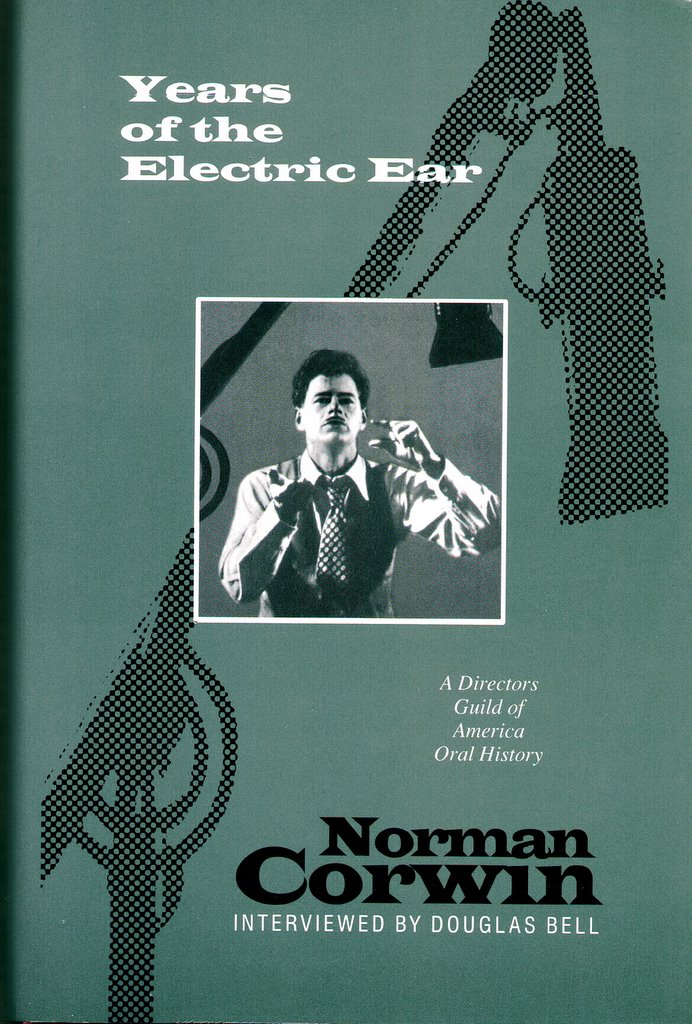
To borrow the title of one of Corwin’s own commemorative pieces celebrating the triumph of the medium, “Seems Radio Is Here to Stay” after all. It is a rare occasion indeed when the visual arts are called upon to serve as a promotional vehicle for the theater of the mind, a theater that stood on shaky ground on the soil of American culture. Too often, old-time radio drama was reduced to the billboarding of motion pictures, to sly efforts of teasing home audiences out of their seats and into the theaters or the arms of the retailers.

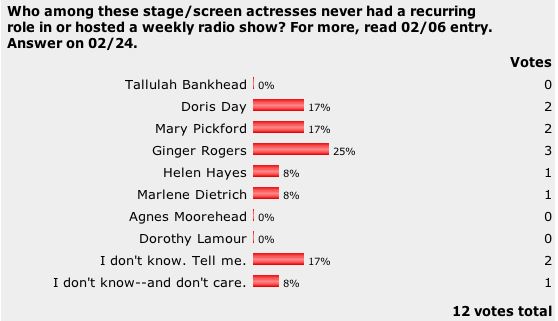
So unless you choose to align yourself with the three unsympathetic passers-by who answered my poll question by stating that they simply “don’t care,” this Oscar win is an occasion for cheer and cautious optimism. I say “cautious” because I also don’t hold with those who argue my statement about the sorry state of and wanting respect for radio drama in the USA to be somewhat exaggerated, let alone patently false.

I assume those aficionados of the wireless are too much among their kind to notice how little the public knows about writers like Corwin, how little evidence there is of their works on the shelves of our stores and libraries. Even Corwin added a tentative “Seems” to his title. Not that he had doubts about its potential excellence, having so often provided evidence of it himself.

What’s so great about keeping one’s eyes closed? Is it an irresponsible drowning out of reality, or a hapless fishing in the shrinking pool of our imaginings? Or is radio just a plaything for those who missed the boat when it comes to modern technology? While I would not recommend it for viewers of American Idol, who’d realize that much of what we think we appreciate in sound is augmented by visuals, a time-out for our over-worked oculars may be a stimulating and downright exciting if perhaps disorienting workout for one of our often underestimated senses.

As Corwin put it in his salute to those already tuning in,

. . . it is good to take a nip of fancy every now and then,
A swig or two of wonderment
To jag the mind.
It’s good to send your thoughts excursioning
Beyond the paved and well-worn alleys of your life
If only as a form of exercise
Especially in wanton days like these.

The “days,” of course, are always “like these,” which makes this a time as good as any to go take that excursion on the airwaves. And should you decide to go sailing, surfing, or simply dipping your toes into that vast sea, come back again, if only long enough to tell me about your adventures. In the meantime, I am going to embark upon my own experiments in radio dramatics, the issue of which, if seaworthy, I might be sharing with you before long.

Oscar Nods, Corwin Winks, and Red Carpet Wrinkles

Unless they missed the 28 February 2006 deadline, the members of the Academy of Motion Picture Arts and Sciences have cast their votes for this year’s nominees in the various categories. The long list of winners and losers will be read aloud in one of those excruciatingly drawn-out and rather tiresome displays of self-aggrandizing common among the tinseltownies.

Apparently, most of those celebrating celebrities are still unaware of the increasing likelihood that their nip/tucked tuchuses and streamlined features, boxoted-out-of-all expressiveness, will soon be replaced by the real thing in perennial flawlessness: tantrum-free CGI stand-ins who have that airbrushed and anorexic look to which so many of these cartoonish red-carpet crawlers aspire. Once again, it is left to the British to put a few creases back into Logan’s runway; but Dame Judy Dench stands as much of a chance to take home a trophy as quasi-live audiences have staying awake long enough to find out.

At least, one of the documentaries nominated this year pays tribute to the world of radio—that refuge of the bald and wrinkled, that last frontier and Lost Horizon for those among us who leap at the opportunity of supplying in our minds all that is wanting on the screen, warts ‘n all. The subject of that documentary, of course, is poet, playwright, and journalist Norman Corwin, age 95.

This Friday, BBC 4 radio will feature an hourlong “Audience with Norman Corwin,” which listeners worldwide can pick up here. An Oscar nominee himself (in the category of best adapted screenplay for Lust for Life in 1957), Corwin enjoyed lambasting the pomp and frippery of Hollywood’s long-gone studio era. Some of what he had to say, however, still rings true.

“Let nothing interfere with your enjoyment, / We’ll waltz away through war and unemployment.” This is how Corwin’s 1944 “Movie Primer” sends up the “Ostrich studio” approach to filmmaking, as expressed in the studio theme song, the “Graustark national anthem”:

Have you got those ‘need-a-vacation-from-a-world situation’ blues?
Oh, those blues.
Then cheer up, neighbor, fear no capital or labor.
Keep smiling, sweety, why fret about a treaty?
Chin up, fella, we give you Cinderella,
And you’ll never have, you’ll never have those headline blues . . . 

Let nothing interfere with entertainment,
The screen was not for sadness or for painment.
We’ll cuddle you and kiss you, and guard your free issue.
We manufacture syrup to cheer up your blues. 

Have you got those ‘need-a-vacation-from-a-serious-consideration’ blues?
Oh, those blues.
Keep grinning, oh you kiddoes, buck up, you widows.
You must never sink as low as to have to think.
So, chin up, fella, we give you Cinderella,
And you’ll never have, you’ll never have those headline blues.

Granted, many of the old production codes have long been cracked, and, from what I’ve read, this year’s nominated pictures are a little less frivolous than of old. Epics, fantasies, and new-fangled musical are taking a backseat and the tired boy-meets-girl formula has received some gender adjustments. That said, playing it safe in order to generate potential blockbusters is still common practice, and Hollywood producers either continue to drag storylines out of the same moldy vault or abandon intelligible storytelling altogether in favor of special effects and noisy action.

All right, the stories have some new wrinkles; it’s the faces that seem to be getting more insipid each year.

Another “Wrong Number,” a False Start for Marilyn, and the Right Answer at Last

For the past three weeks I have been commemorating the dames, gals, and ladies of the airwaves; but now, the correct answer to the question posed in first broadcastellan quiz can finally be revealed. Thanks to all those who guessed or knew or couldn’t care less—and told me so. Tallulah Bankhead, Doris Day, Mary Pickford, Helen Hayes, Marlene Dietrich, Agnes Moorehead, and Dorothy Lamour—they were all radio regulars at some point in their careers, whereas others, including Ginger Rogers, the lady in question (as guessed by three readers), limited their air time to occasional guest appearances on dramatic programs like the Lux Radio Theatre. And others still, Marilyn Monroe among them, started out in commercials.

On this day, 24 February, in 1947, more than five years before she became a major star, a noticeably nervous Monroe, having waited months for her first movie role while already under contract at Fox, was pushed before the microphone to appear in a commercial break for the Lux production of “Kitty.” Within the few seconds allotted for her radio debut, Monroe was faced with the task of initiating her career (by mentioning her first Technicolor screen test), plugging Betty Grable’s The Shocking Miss Pilgrim (whose costume she got to wear during the test shoot), and peddling Lux “flakes” (which ostensibly kept those costumes fresh and colourful). However alluring her timbre, Monroe fumbled. She could not even get the name of the announcer straight; her voice was rarely broadcast thereafter, even as her film roles remained scarce and undistinguished.

A pleasant voice, while an asset, was not a radio requisite. As I mentioned previously, Louella Parsons did quite well without one, notwithstanding her consternation when being told she had to do without the larynx of Ms. Rogers, who allegedly insisted on getting paid to be interviewed. The giggles and high-pitched screechings of comedy actresses aside, the most celebrated woman’s voice on American radio was the less than pleasing one emanating from Agnes Moorehead. Her virago vocals, by which Joseph Cotton’s character in Since You Went Away claims to have been haunted across the Atlantic, was ideally suited to the role of irate Mrs. Stevenson in that most famous of original old-time radio plays, Lucille Fletcher’s “Sorry, Wrong Number.”

On this day in 1944, Moorehead, shown left during a performance of “Sorry,” once again starred in the role she had originated on the radio thriller anthology Suspense in May 1943. The part was subsequently translated for motion picture audiences and television viewers (by Barbara Stanwyck, Mildred Natwick, Ida Lupino, and Shelley Winters); but, however bitter Moorehead might have been losing the role to Stanwyck on the big screen, no actress would snatch the original from the “First Lady of Suspense.”

It was not until long after Moorehead’s death that Claire Bloom (recently seen on UK television in the last of the second season of Marple), made an attempt at superseding the “First Lady,” not only by recreating the role for radio in 1999, but by starring in a sequel of sorts.

While she had nothing to do with that sequel, radio dramatist Lucille Fletcher was responsible for the 1948 film adaptation. Her involvement did not, however, assure the aesthetic success of the latter, which, for all its high melodrama, has little of the tension generated by the original play. With its numerous flashbacks, the film destroys the intensity of a drama unfolding in real time. Like Allan Ullman’s novelization of Fletcher’s screenplay, it fails to approximate, let alone recreate, the excitement of eavesdropping on someone in mortal danger, someone whose life, like the live broadcast during which it plays out—runs on a decidedly tight schedule beyond our control and influence.

“I wanted to write a show that was ‘pure medium,'” Fletcher remarked about “Sorry, Wrong Number.” She succeeded so well that any adaptation would amount to nothing short of mediocre impurity.