
Wireless Women, Clueless Men: Louella Parsons, Dirt Dispenser

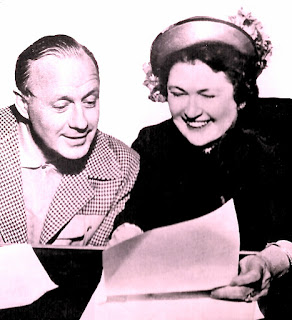
Today, I am closing my series of tributes to women in American radio by devoting this final edition to one of the biggest names in Tinseltown hearsay: Hearstian columnist Louella Parsons. I leave it to Ms. Parsons to dish a little dirt about her on-air scandalmongering, even though that dirt is no more messy than a dusting of confectionary sugar on a well turned cuff. “Well,” Parsons told readers of Radio and Television Mirror Magazine (from an issue of which this picture has been taken), “I can safely say that no one else in the business can boast that her program was almost a radio casualty because of a toothache, a can of soup, and Audie Murphy’s cold! Likewise, I’m the only woman in these parts who’d had the dubious distinction of being almost ‘stood-up’ by Clark Gable. . . .”

Now, she does say “almost.” As it turns out, Gable was scheduled to appear on Parsons’s Hollywood Hotel when he got “snarled up” in a traffic accident. Shortly before the broadcast, he showed up with assorted bruises, welts, and a torn coat; but, according to Parsons, he insisted on going ahead with the live broadcast as scheduled, since, as the enterprising secret sharer put it, “he knew the program was very important to me, and didn’t want to disappoint me.”

He also knew better than to stand up this formidable career ender. So, Parsons’s wounded pride was mended—and Gable’s stardom secure. “Since that day,” Parsons added, “he has had a very special place in my book of friends.” Merely pencilled in, no doubt. This lady dealt in muck, after all, which in her profession is more precious than friendship.

I’ve mentioned Joan Crawford’s mike fright before in this journal. It was a well-known fact the first lady of gossip enjoyed repeating, claiming that the star “ran like a startled faun” every time a microphone was as much as “mentioned” to her. Eventually, the actress’s fear of bad press must have been more pronounced than her microphonophobia, as Parsons got her to go on the air talking about “what an advantage it was to be born on the wrong side of the tracks.”

Carole Lombard, on the other hand, was “completely unruffled when she lost two whole pages of her script. She merely ad libbed her way through, without a pause, and you’d never have known the difference.” Abbott and Costello, in turn, “turned the tables” on Parsons by reading her lines instead of their own. So, the chat hostess obliged by reading theirs, and, “as mad as it may sound,” she discovered that “the program had some semblance of sense to it.” These recollections are not exactly an endorsement of Parsons’s writing; but, by her own admission, “lack of talent has never dimmed [her] enthusiasm.”

Her first program, Hollywood Hotel, was off to a shaky start back in 1934: “My show was probably the worst in existence—I wrote, produced, and directed it all by myself.” Perhaps, it was not so much the writing and directing that were most amiss. Unlike rival columnist Hedda Hopper, Parsons did not have a trained voice, let alone a pleasing one; but she “knew too that is wasn’t how [she] said anything that mattered, because people were interested in what [she] was talking about.”

Sure, she couldn’t “close [her] eyes to television indefinitely,” she concluded. “But until better make-up and lighting are developed,” she vowed to “stick with [her] Hooper” (Hollywood jargon for radio audience).  And stick she did, for better and worse.

Wireless Women, Clueless Men: Benita Hume, Colman’s Mustard

Fair weather convinced me to spend the afternoon in the garden, where I busied myself with saw and secateurs. All that vigorous communing with nature felt like a tonic, especially after last night’s screening of Humoresque, an acrid Joan Crawford melodrama co-starring John Garfield and Oscar Levant, all of whom (but particularly Levant) rather overdid the acerbic one-liners with which the screenplay is riddled. Just about everything is wrong with this overwrought picture, from the drearily predictable and uninvolving plot to Crawford’s atrocious eyewear, the exceptions being J. Carroll Naish as Garfield’s father and the to me intriguing Peg La Centra as an underappreciated nightclub singer.

La Centra was a seasoned radio performer, as, of course, was Levant, whose quips enlivened Information, Please, the celebrity quiz program on which he was a regular. Further wireless connections can be established by pointing out that Tallulah Bankhead (one of the leading ladies featured in the current broadcastellan quiz) took on Crawford’s part in the 19 April 1951 Screen Directors Playhouse production, which offers listeners a somewhat altered ending—and some of Levant’s lines to Bankhead.

Enough of the bilious Humoresque, though. Continuing my “Wireless Women” series, I shall pay tribute instead to one of Crawford’s co-stars in The Last of Mrs. Cheyney (1937), an actress generally billed as Mrs. Ronald Colman.

Having given up her rather undistinguished film career in the late 1930s, when she became Mrs. Ronald Colman, Benita Hume began to perform alongside her husband on the radio. Together, the Colmans were heard on the Lux Radio Theatre and The Doctor Fights (scripted by playwright Arthur Miller). In the mid-to-late 1940s, the couple made frequent and memorable guest appearances on the Jack Benny Program.

In January 1950, Hume assumed the role of Victoria Hall, exuberant and forgiving spouse of absent-minded college president William Todhunter Hall in The Halls of Ivy (1950-52), an urbane if sentimental situation comedy conceived and co-written by Fibber McGee and Molly creator Don Quinn.

Now, I have been nothing more than a contributing writer of a public access college soap opera, and my only stage play has never been produced; but if ever I were to conceive a situation comedy, I would very much like it to be as charming, witty, and uplifting as Ivy. Not that I believe there is much of a market today for such romance-infused cleverness.

Originally considered and auditioning for the role of Victoria was stage veteran Edna Best, wife of the show’s producer; but, as you will notice when comparing the auditions, Hume brought a warmth and gaiety to the role that was wanting in Best’s reading. The part stands apart from the ditzy or meddling housewife types you’ll encounter in the domestic comedies of Hollywood’s late-Truman/Eisenhower era.

On this day, 17 February, in 1950, the Halls faced a case of racial bias. A brilliant Chinese student, unable to cope with the rejection by her peers, decided to quit college. It is Mrs. Hall who intervenes by reaching out to the young woman and relating the matter to her clueless but quick-to-act husband.

More than a devoted companion, Victoria Hall is a translator and cultural interpreter to her intellectual, world-removed spouse, a man so highbrow he refers to one of radio’s great comedians as “Jack Bunny.” Victoria once was a comedy star on the English stage. Not the classics, mind you. We’re talking musicals like Lulu’s Mad Moment, youthful follies that are not just fond memories to the former actress, but a font of common sense and practical advice.

Whenever Dr. Hall gets lost in reveries, recalling his first encounter with the lovely Vickie and the early days of their romance, his wife yanks him back to the present. She may be British—but she sure is with it.

Whether or not you are opening a can of Schlitz, you might find yourself repeating the sponsor’s catchy slogan, which suits the vintage comedy far better than the beer it was meant to promote: “I was curious. I tasted it. Now I know why. . . .” Much of this is owing to Hume. The Halls of Ivy was her only slightly “mad” Lulu of a moment . . .

Wireless Women, Clueless Men: Mercedes McCambridge, Airwaves Advocate

Last night, I watched The Damned Don’t Cry (1950), a seedy but glamorous rags-to-riches-to-rags melodrama starring Joan Crawford. Crawford was a perfectionist on screen, even though producers like Jerry Wald determined that, by the mid-1940s, her physiognomy was less than ideal and called for that extra layer of gauze in front of the lens to soften her mature looks (because most leading roles in Hollywood are, to this date, a little too young for anyone over forty). No doubt, Crawford’s need for control contributed to what those in the radio business called mike fright.  When Crawford went on the air, starring in dramatic programs like Suspense, she insisted on being recorded for later broadcast rather than going on the air live. Apparently, to someone as protective of her persona as Crawford, any screw-up in radio insinuated something tantamount to crow’s feet on screen. Not to Crawford’s Johnny Guitar (1954) co-star and rival, though, the radio-trained and true Mercedes McCambridge.

Her career in film and on stage notwithstanding, McCambridge was a genuine radio actress; and unlike many aspiring thespians, she would not have objected to the term. Sure, her voice was so distinct that even the hearing impaired could not fail to spot her in any of her many notable radio roles; but, however obvious her vocal disguises, McCambridge, whether performing in night-time thrillers, daytime soap operas, or wartime propaganda plays, rarely did less than throwing herself, larynx and soul, into each and every part she accepted to play.

On this day, 8 February, in 1950, for instance, McCambridge was “Jack Dempsey,” the rambunctious teenage daughter of a prize-fighting crazed rancher. Determined to get married to a man of whom her father does not approve, she convinces a trio of adventurers to defend her rights in what was billed as “The Battle of the Century.” That was just one of the adventures in which McCambridge played a part in 1939—and again a decade later—in a thriller serial called I Love a Mystery. The program, and McCambridge’s role as the maniacal Charity in “The Thing That Cries in the Night,” has been discussed at some length previously in this journal.

She was also heard in many other Chicago-originating drama broadcasts, including episodes of the legendary horror program Lights Out!. My favorite among those is an episode in which McCambridge plays a spoiled teenager on a school trip to Paris. Abducted by a man who claims to know her family, she is dragged into the sewers, where she is forced to make necklaces out of the bones of those killed by her capturer. It’s Grand Guignol, all right—ghastly melodramatics that don’t require images to conjure up unimaginable horrors.

To moviegoers, McCambridge is best known as the demon voice in the The Exorcist, a performance she attributed to a fortuitous bout with childhood bronchitis. McCambridge thought of this role, in which she is never seen, as a radio performance. Until the 1970s, when radio enjoyed a renaissance, she returned to the airwaves with former colleagues, enjoying the freedom that radio afforded the performer, notwithstanding the limitations imposed by producers and sponsors.

“In radio you had to be a tiger or you didn’t last,” McCambridge wrote in her autobiography, The Quality of Mercy, “If you didn’t keep your toes curled under, you would fall of the edge of that marvelous world. For me, nothing in films, or theater, or certainly TV as ever touched the magical kaleidoscope of radio.” Most television and film producers may have been clueless about radio; but you sure got us, tiger! I consider myself mauled.

Stripping on Camera, Teasing on Air: Cecil B. DeMille, Four Frightened People, and the It of Radio Trailers

I just returned from the steamy jungle adventure that is Four Frightened People. It is one of the lesser-known—and lesser—melodramas directed by Cecil B. DeMille, maker of epic spectaculars and master of sensational showmanship. Before I compose myself and submit my review of this early 1934 pre-code effort to the Internet Movie Database, I am going to discuss it here in relation to, what else, old-time radio. I was fortunate to have come across an on-air trailer for the film, a rare recording from the archives of WFUV in New York.

Claudette Colbert in Four Frightened People

Introducing his latest motion picture on the Paramount Movie Parade, DeMille began to set up his persona as the swanky pimp of Tinseltown, an image so skillfully exploited during his tenure as host of the well-oiled and powerful advertising engine that was the Lux Radio Theater. DeMille sure knew how to hawk his salacious wares, even as Hollywood was facing the pressure of the Production Code, which was responsible for timed kisses and screwball cheek.

An expert at unwrapping his leading ladies for public display, and at packaging such lowbrow peepshows as high art, DeMille found a great extension to his lure in radio. On the air, he could stimulate his potential audiences to picture in the dirtier recesses of their minds what they just had to go see for themselves at the theaters.

We have “a surprise for you,” the Paramount Movie Parade barker promises the listener. Instead of disembodying another heartthrob, the program brings before us one of Hollywood’s invisible VIPs—”a celebrity never seen in the films, but a man whose artistry nevertheless has been manifested on the screen many times. He’s one of the real pioneers of the motion picture industry, responsible for many of its history-making productions.”

The legendary director expresses his gratitude and is only too glad to seize the microphone: “It isn’t often that we who work behind the cameras have an opportunity to speak to those who view the results of our work on the screen.” That he has “just returned to Hollywood after months spent in the South Seas” where he “underwent many hardships, unexpected thrills, and even dangers” makes this an occasion for exciting storytelling.

What follows is a selection of snippets from the film’s soundtrack (rather than restaged scenes, as those heard on the Lux program) introduced and commented on by the director. We can readily imagine what might happen if four civilized people—two men and two women—get lost in a tropical wilderness. “They reveal just how rapidly the polite mold of civilization disintegrates under the influence of the jungle. These people shed civilization when they shed their clothes. They become like animals of the jungle, fighting and loving, like the beasts who terrify them.”

And shedding her clothes for him as she had done before (in The Sign of the Cross) was that favorite among DeMille’s leading ladies, Ms. Claudette Colbert. This time, however, the director did not use the context of antiquity as a pretext for showcasing her beauty; instead, he dwells on the film’s “authenticity” as a nature study.

DeMille has all the braggadocio of King Kong‘s Carl Denham; but with Colbert as his Ann Darrow, an awakening sex goddess pursued by two none too moral mortals (one married, no less), this Hollywood showman is not in need of a supersized ape to symbolize libido. It’s all in our minds already—and the radio trailer does its darndest to keep it burning within us until we are all fired up to see this Paramount paradise and follow Colbert, along with the boys, to that less than cooling waterfall in the deep woods.

On This Day in 1949: The Radio Tells Americans All About “Eve”

Well, before I make an appointment with The Phantom President, another one of the lesser known motion pictures starring my favorite actress, Ms. Claudette Colbert, I am going to listen again to a radio adaptation of a story that was initially considered as a vehicle for Colbert, but fell into the lap of lucky Bette Davis instead. I am referring of course to “The Wisdom of Eve,” a dramatization of which was broadcast on this day, 24 January, in 1949—thus nearly two years prior to the general US release of the celebrated movie version known as All About Eve.
This is another adventure in recycling, an exploration of radio’s mediating position in the every widening web of multimediacy. Like Eve Harrington, radio was a spider—a yarn-spinning upstart snatching a principal role from its respected elders. Talking itself into the confidence of promoters and audiences alike, radio not only surpassed the theatre and the press in influence and mass appeal, but continued to take advantage of the talent it lured away from those competing media.

“Radio, of itself, has developed almost no writers. It has appropriated almost all of them, at least all of those who could tell a good story.” This assessment of the so-called writer’s medium was made in 1939 by Max Wylie, a former director of script and continuity at US network CBS; he went on to work for the radio department of a major advertising agency and wrote several handbooks for writers or producers of radio drama and edited a number of radio play anthologies.

Wylie knew what he was talking about. Although original plays became more prevalent during the Second World War, when radio served as a major purveyor of propaganda packaged as entertainment, this observation remained essentially an accurate one and does much to explain the gradual decline of radio dramatics in the US during the 1950s, when television assumed this mediating, central position in American culture. Proving the infinite adaptability of popular culture, radio programmed its own redundancy.

“The Wisdom of Eve” first appeared as a short story in the May 1946 issue of Cosmopolitan; before it became All About Eve, author Mary Orr adapted her nearly forgotten piece of magazine fiction for the airwaves. And quite a radiogenic production it turned out to be when it was presented on NBC’s Radio City Playhouse.

“If you were listening to the radio last night,” a female voice addresses the audience, “perhaps you heard what [a certain] radio commentator had to say about Eve Harrington.” On a filter microphone, a device often used to recreate the distortion of voices on the wire or the wireless, the enthusiastic commentator spreads the word about the meteoric rise of one Eve Harrington, “the most-loved, most sought-after, most talented actress Hollywood has seen in a generation.”

Without contradicting or mocking this statement, the narrator takes over again, and her encounter with the “hauntingly lovely” Eve is played out for us in dramatic flashbacks. The speaker is not the bitter and disillusioned Margo, the aging diva, but her friend, Karen Richards, wife of the playwright of Margo’s latest stage success.

What unfolds is the familiar story of Eve’s progress, her seeming innocence, her ambition, and her successful scheming. For the sake of her husband, a man being “made miserable by a temperamental actress,” Karen sides with Eve, too late undeceived about the young woman’s character.

In this play, the radio (the voice of the gossip columnist) is complicit in the world’s deception about Eve. Forever the snake in the make-believe garden west of Eden, it tells us what we want to hear, rather than what we ought to know. Luckily, the listeners of the Radio City Playhouse got just what they wanted that day: a darn good story. What’s more, the motion picture people tuned in as well, and the little piece Orr had trouble selling for years was turned into box-office gold.

On This Day in 1942: Bette Davis Gives Birth to Arch Oboler’s “American”

The retrograde activity of keeping up with the out-of-date seems generally ill-suited to blogging. I doubt whether to keep looking back—and looking forward to doing so as I do—is such a forward-looking thing to do. A blog signifies little to most readers if it cannot bring them up-to-date on its declared subject matter, be it popular culture, politics, or fly-fishing. I have often felt compelled—and more often been compelled by others—to defend my engagement with the outmoded; indeed, the first comment left for me in the Blog Explosion directory was a terse “why?”

The answer, if I felt obliged to dignify such a monosyllabic and misologic remark with a reply, is this: I enjoy the challenge of discovering the relevance of a cultural artefact or an obscure piece of writing not created with me or my present in mind, and debating to what degree my thinking and being might be indebted to the attitudes reflected in such products. Besides, not being able to relate or connect to the supposed bygone is a personal loss, and, given the potential of history repeating itself, often a dangerous one at that.

Now, it would require some degree of mental obduracy or lack of imagination not to be able to relate to “An American Is Born,” a play that aired on US radio on this day, 19 January, in 1942. After all, “An American Is Born” deals with persecution and immigration in wartime, which makes it eminently topical. It is also a deliberate and unabashed work of propaganda, composed at a time when the word did not yet carry quite as negative a connotation as is attached to it these days.

Just how accepting would today’s audiences be of a play like “An American Is Born”? How likely would they find it produced and disseminated by the mass media?

“An American Is Born” was adapted by radio playwright Arch Oboler from a novella by Peter Jefferson Packer and Fanya Lawrence Foss. Written when the US had not yet entered World War II, and first sound-staged in late 1940 with Elisabeth Bergner in the lead, it was again produced a little over a year later for the Cavalcade of America program, with Bette Davis heading the cast. Clearly, this “American” was reborn to be recruited for home front duty.

In the 1942 production, Davis, who was one of Oboler’s favorite leading ladies, played opposite the versatile radio actor Raymond Edward Johnson. Johnson and Davis took on the roles of Czech immigrants Karl Kroft and his pregnant wife Marta. Their US visa having expired, the young couple cross the border to Mexico, where they wait for their quota numbers to come up. “With the left foot first,” Marta insists as they touch Mexican soil. “That means we’ll be back soon.”

Marta, whose father fought for democracy in her native Prague, desires nothing more than for her child to “be an American from his first cry.” In a “world gone mad with the ravings of little men, he should be born in a country that remains sane and firm. A country that believes that man, as an individual, has certain inalienable rights.”

Initially as idealistic and hopeful as the speech Oboler puts in her mouth, Marta is confident that their stay will only last a few days; but she is soon undeceived about the process of immigration. For those waiting, the weeks and months across the border are filled with uncertainties, threatened by corruption, extortion, and political persecution.

When a fellow European offers to assist the young couple, Marta little suspects that he is a member of the Gestapo. She is unaware as well that her openness about her father’s political convictions endangers the lives of her parent and her unborn child.

Another immigrant who is thus intimidated commits suicide, but not before doing away with the enemy in their midst. At the risk of her own life and that of her unborn child, Marta manages to convince Karl to make a run for it. As the title suggests, the two find their way across the border to the US, where their child takes the first breath of freedom as an American citizen.

When was it that such an overtly propagandistic melodrama last reached a large American audience? The 1991 movie adaptation of the Reagan-era bestseller Not Without My Daughter comes to mind, a film in which even a Coca-Cola sign in a Turkish bordertown was greeted as a herald of US American freedom. Seeing it as an international student living in New York City, I thought the film distressingly simplistic, shamelessly manipulative and, in the context of the Gulf War, rather nauseating at the time.

Are narratives like “An American Is Born” rarer now because Americans have less to be proud of as a nation or because today’s purveyors of popular culture, with an international market in mind, doubt that the brand of one-message-suits-all patriotism can still reach a sizeable enough audience to make it pay off.

US network radio did much to hold a nation together, both during the Depression and the Second World War. I suspect, especially on the subject of immigration, this is no longer a role the media are ready, willing, or even able to play.

What Those Who Remembered Forgot: Shelley Winters (1920-2006) on the Air

From Mary Pickford to Marilyn Monroe, every actress who made a name for herself in Hollywood made use of the promotional facility of radio to keep that name on the minds and lips of American moviegoers. Winters’s radio credits include appearances on notable dramatic programs such as Screen Director’s Playhouse (5 June 1949), Stars Over Hollywood (22 November 1952), and the Lux Radio Theatre (5 January 1953). In comedic turns, she was heard as a guest on the Martin and Lewis program (16 November 1951) and played an unlikely Valentine for Archie on Duffy’s Tavern (16 February 1950).

The recent passing of Academy Award winning actress Shelley Winters compelled me to inaugurate a new column, a recurring feature I shall call “What Those Who Remembered Forgot.” The title is meant to suggest that the obituaries of people active in Hollywood during the 1930s, ‘40s, or early to mid ‘50s, often omit references to their work on radio—the single most important source of home entertainment in the United States prior to the ascendancy of television.

The BBC’s obituary of Shelley Winters is no exception. It informs readers that Winters’s “television appearances spanned several decades,” but has not a word to spare on the actress’s radio performances, a dozen of which are listed in David Goldin’s invaluable database of old-time radio recordings.

In what appears to be her first dramatic role in a piece written especially for radio—Family Theater‘s “Throw Your Heart in the Ring” (27 April 1949)—Winters plays Maggie, a city nurse who proudly claims never to have broken a rule, but at last breaks her own record when she finds herself torn between acting by the book and following her heart.

Told about a man in need of her assistance, she comes to the aid of an aloof, gun-carrying stranger apparently hiding from the law. He might be a killer; but Maggie decides to violate regulations by not reporting the case while she treats the initially ungrateful patient secretly in his hotel room. As the two get to know each other, and as she learns the truth about him, she manages to convince the disheartened man to face his own responsibilities.

A forgettable play? Perhaps. Yet it is the medium we are apt to forget along with such performances, thereby denying ourselves not only access to a marginal aspect of an actor’s career, but the appreciation of her craft as it unfolds beyond her physical presence. Here, Winters is all voice; and so strong is the hold images have over most of us that we find it difficult to engage in this disembodiment, as if a voice without a body were somehow not the real thing, artistically insubstantial—in a word, immaterial.

The First to Take Her Out; or, My Date with a Misleading Lady

It is increasingly rare these days to come across a star-powered American movie of the 1930s that hasn’t already been reviewed by at least one person submitting a review to the Internet Movie Database. I did not set out to dig up such an unexamined rarity, but was rather surprised—and pleased—to have unearthed one by dusting off The Misleading Lady, a 1932 comedy starring my favorite leading lady, Ms. .

Now, as those who have indulged me in sharing my passions and foibles may already be too keenly aware, I enjoy gathering and gazing at the likenesses of this sophisticated comedienne on posters, magazine covers, and, yes, paper dolls. As an undergraduate, I wrote a speech about her, which I sent to her home in Barbados—and received her autograph. Later, she became the subject of an honors paper titled “Ladies in Loco-Motion.” And later still, thoughts of her got me started on what turned into my doctoral study on radio drama (Etherized Victorians), which has its origin in my joyous discovery that Colbert not infrequently performed on the air.

Come Christmas time, I go so far as to insist on dangling cardboard replicas of the good woman from our tree—but that’s about as fanatical as I get. Still, there is nothing more gratifying than the real thing: to watch or hear Colbert act. Having missed the opportunity to see her perform on the Broadway or London stage, I find great consolation in the fact that she had starring roles in about sixty motion pictures.

While in New York City last, I packed a few more videos in my trunk; but there remained—and still remain—gaps in my knowledge of Colbert’s cinematic achievements (and occasional misfires). So, how wonderful was it to find under aforementioned piece of dislodged pine a number of films I had only read about until then: Secrets of a Secretary, The Man from Yesterday, The Phantom President, Four Frightened People, and The Misleading Lady. Having been ill (and ill-tempered) of late, I did not want to squander these flickering gems by heaping them onto my thick head; so I kept myself tolerably amused watching films like The Saint Strikes Back (a sly caper challenging one of my more simplistic conclusions about Hollywood law and order). Yesterday it was time at last to screen one of these five films, and the Lady took the lead.

The Misleading Lady is no classic, to be sure; few of the films are. Their construction and moral ambiguities render many of them incongruous or downright irritating. We expect such digressions from a contemporary independent film, but are still surprised to encounter it in an old—and therefore presumably stodgy—production of Hollywood’s studio era.
As my IMDb review, once approved, will tell you, The Misleading Lady is not without daring and rather disconcerting scenes involving a bored socialite being trapped in her own scheme to land a man. She doesn’t want the guy, mind you (not at first, at least); but he might just be her ticket to a starring role in a stage play. Once he realizes that he’s been had, he sets out to restore his pride and win the dame in the process. Too bad Colbert doesn’t get to wield the gun more often, but is being terrorized and tamed instead as the farce veers into something more akin to lurid melodrama.

There is a radio angle, of course. Clark Gable played the role of the macho dupe in a 1935 Lux Radio Theatre production of The Misleading Lady. Transcriptions of this broadcast (not starring Colbert, Gable’s partner in It Happened One Night) are unfortunately no longer extant—but I’ve always got this Lady to return to . . .

Original? Sin! Romancing the Reproducers (Part One)

Well, it seems that complimentary wireless internet access is not yet a standard feature of the average London hotel room. Jury’s Inn, Islington, for instance, charges £10 per day for a broadband connection. That’s about 20 to 25 percent of the cost for a room, and as such no piffling add-on to your bill. So I felt compelled to take a prolonged but not unwelcome break from blogging, taking the small fortune thus saved to the theater box office, the movies, and the temples of high art. Meanwhile, my lingering cold (the New York acquisition mentioned previously) was worsening into something well-nigh debilitating; a numb skull and eyeballs ablaze in their dried up sockets kept me from keeping up with the out-of-date—ever the broadcastellan motto—for another week.

Time healing (or hardening you into accepting) most anything eventually, I am returning at last with something approaching gusto and will try now to sum up my recent pop cultural experiences in a few lines that, it is hoped, add up to a composition fit for your perusal.

Even though I have used the phrase myself, I have always pitied those who, when asked “What’s new?” merely offer the wan reply of “Same old, same old.” There is an art to finding the new in the old—and those who don’t possess this life-skill are likely to be miserable, dissatisfied creatures. There is a difference, however, between making the old merely seem new—which is a form of deception—and making new what merely seemed old—which is a philosophy. Hollywood has always been great at deception; but either its powers or my willingness to be duped are beginning to fade with age.

Take The Producers and King Kong, for instance. In the theater, where revisiting old favorites generally means playing it safe, revivals can be corny or cozy, as Once in a Lifetime and And Then There Were None demonstrated to me. At the museum, people are forever flocking to see the oldest and most reproduced objects of visual culture, such as those on display in the exhibition Samuel Palmer: Vision and Landscape. And on the radio . . . ahh, now there’s a repository for the lost and found. Listen!

The Producers hoofed into UK theaters on what is celebrated here as Boxing Day, which is precisely when I saw it. Nothing screams indifference louder than rows of empty seats on opening night (make that “matinee”). I’m not sure whether the Bialystock and Bloom formula of making money by staging a flop will serve those involved in bringing back the original leads of the stage remake of the 1968 film.

I have seen the stage musical twice; back in September 2003 at the St. James Theater in New York City, with John Treacy Egan and Don Stephenson heading the cast; and again in January 2005 starring Lee Evans and Brad Oscar at the Theatre Royal, Drury Lane, in London. Watching a filmed musical is like clutching an opera glass—parts at the expense of the sum. As a motion picture, The Producers was all picture and little motion. Opportunities to flesh out the Little Old Lady Land routine as some suitably bizarre Technicolor spectacle or to go all Busby Berkley with the Swastika dance were squandered in this stagy hokum of hummable tunes and ho-hum jokes.

And King Kong? While hardly an abject failure, this Titanicized remake of Jurassic Park (or the 1925 film adaptation of Conan Doyle’s The Lost World) comes across like a momentarily diverting thrill ride rather than a definitive version of a cinematic classic, let alone anything worthy of a nook in a time capsule.

Like The Producers, which mainly serves to preserve the performances of Nathan Lane and Matthew Broderick for posterity, King Kong makes little effort to be of its time, to provide any commentary save the by now tiresome postmodernist winks of self-reflexivity. The 1933 film smartly commented on the Great Depression, on the big city dreams gone bust; Peter Jackson’s film recreates the era with all the passion of a miniature train collector (from the shantytowns in Central Park to the Amos ‘n’ Andy sign in Times Square), but has little to say about our times.

Even when referencing Conrad’s familiar and perennially relevant novella The Heart of Darkness, the flashy new King Kong, unlike Apocalypse Now, does this pointlessly. Nor were the sexual tensions in this love triangle played out any more overtly than in the Hollywood pre-code version dreamed up by Cooper and Schoedsack. Might not there be accommodation for a few comments on, say, America’s anxieties about the constitution of marriage, terrorism and its countermeasures, or the future of immigration in a melodrama about an abducted alien forced into slave labor and desperate enough to die for a dream the realization of which those professing to be civilized are prepared to prevent at all cost?

It was beauty killed the beast, all right; but it’s a lack of vision that’s killing the movies. As the considerable decline in revenues suggests, the traditional cinema is about to die out like vaudeville; interactive computer games for the sit-at-home folk are taking their place. No longer able, let alone content, to follow the storylines so carelessly strung together by today’s filmmakers, audiences will want to create their own stories with the narrative fragments tossed to them by the Xbox builders now axing box office profits . . .

Hold on, while I am applying a fresh coat of Vicks VapoRub. Better make that “See you tomorrow.” Promise!

‘Tis the Season to Reappraise

Well, you know ‘tis the season when you are pleased to find the cardboard likeness of Ms. Claudette Colbert dangling from the branches of a chopped down evergreen. After all, ‘tis the season to revisit old favorites, living, dead, or imagined—the season when the prefix “re-“ becomes the hook on which to fasten our sentiments as we remember old tunes, reflect upon past times, and return unwanted presents. To be sure, it takes a bit of effort (and a want of respect for etymology) to respond to each wintry gale with the determination to regale; but as I am eager to rejoice even while battling a relentless cold with ever-diminishing resilience, I am applying any remedy I can get my hands, eyes, or ears on.

So, once I had finished decking the halls with belles of Hollywood, I caught up with the week’s worth of serialized Dickens I had recorded while still in London. I am referring to Mike Walker’s twenty-part radio adaptation of David Copperfield. Having given up on the BBC’s thrilling television series of Bleak House after missing a few installments, I was anxious to get my Victorian fix for the holidays.

The first five chapters of Walker’s serial faithfully dramatize David’s birth and childhood, bringing before us the acquaintances of his youth—shapeless Peggotty, little Em’ly, hopeful Micawber, and the ever-willing Barkis were all there. Only David was missing, or his point of view, at least. Instead of retaining the first-person narration, Walker decided to install Dickens as the teller of this tale, rather than David, whom the author appointed partly as a stand-in for himself.

The charming, well-remembered opening was chopped in favor of some well-nigh inarticulate blather: “When you care greatly about something or someone . . . well, this is a story about a lot of things and a lot of people. It is a story, . . . but is it my story?” A rather bumbling, awkward start, isn’t it, especially considering that the narrator was not only a first-rate storyteller, but a celebrated orator and performer of his own material.

This is how the real Mr. Dickens, who still wrote in complete, structurally sound sentences, had David introduce himself: “Whether I shall turn out to be the hero of my own life, or whether that station will be held by anybody else, these pages must show. To begin my life with the beginning of my life, I record that I was born (as I have been informed and believe) on a Friday, at twelve o’clock at night. It was remarked that the clock began to strike, and I began to cry, simultaneously.” And these are pretty much the lines Richard Burton utters at the opening of the US Theatre Guild’s radio adaptation of the novel back on 24 December 1950. The BBC may be a refuge for radio drama—but it frequently blunders where US commercial broadcasting used to succeed.

Is anyone else tuning in? The last broadcastellan poll suggested that radio drama is not quite as doornail-dead as I may have made it out to be. I guess I ought not to infer from the silence of cyber-space that no one is familiar with the culture I chose to recover here. And yet, while researching for my dissertation, I realized just how many plays by noted American novelists, playwrights, and poets have been kept out of earshot by those who have us believe that radio drama is neither remarkable nor marketable. It is the act of refusal that turns art into refuse, and it takes some digging to resist it.

My latest poll is meant to draw further attention to this neglect. Few of these plays are still are heard on radio today, and fewer still are in print. Are these works really any worse than the television offerings that spawn glossy companions and trivia books?

But I am being prickly, aren’t I? And ‘tis the season to be otherwise . . .