Some Like it . . . How? Youth, Vampires, and Marilyn Monroe

Del Coronado mirage

There I stood, in the shimmering sands of Coronado Beach, California. I had come, of course, to see the famous Hotel—and to share the views once taken in by Marilyn Monroe during the filming of Some Like It Hot. Marilyn was here. Now I was.

Footsteps. Sand. The old hourglass. I won’t indulge in such clichés here; but there is something pathetic about this kind of out-of-sightseeing, this belated catching up and impossible reaching out to which I am prone. The inclination to seek out what is long gone is more than morbid curiosity: it is an approach to life as a retreat from living in which even the here-and-now becomes dreamlike and chimerical. How did this get to be my way of not facing the world?

Marilyn Monroe died before I was born; yet her life and times became a fascination of my teenage years.  Mine were not erotic fantasies.  I did not long for her body.  Nor did I think of her as being gone.  She was never absent for long from the television screen, ever present on the iconic posters I pinned onto the wall above my bed.  Records spinning on the old turntable, her voice filled my room. I had no regrets about never being able to meet her in the flesh; rather, it was a relief.

The wonder of her incorporeal existence made living in the body I loathed more tolerable; and it made the physical relationships I dreaded easier to contemplate in the abstract.  Marilyn—and we call her by her first name because she is more familiar than famous, more girl than goddess—was not some facile paradox: “I Wanna Be Loved by You” and “I’m Through with Love” she sings in the same movie, expressing the hurt and hunger that are far from mutually exclusive.

Our teenage selves are preoccupied with the demands that both nature and society make on us, propositions and impositions captured in that horrible phrase haunting and taunting us until death: “grown up.”  As a response to and rejection of the implied threat—the finality and premature stunting of our infinite potentialities—Marilyn’s afterlife was as much a reproof of society as it was a society-proof alternative: a twilight life, expired and undying, bright though snuffed out, a fragile, indomitable spirit-presence in whose shadowy glow I could luxuriate, just as many a young person nowadays revels in the gothic gloom inhabited by zombies and vampires, except that my imaginings transported rather than dispirited me.

No doubt, this twisted bent of casting myself into times preceding my birth is born of a desire to bring forth alternate selves of mine without having to bear the vagaries of the present or the uncertainties of the future.  Like a life presumably squandered in reverie, bending the past to our will is a testament to a vestigial will power—or would-be power—in which the retrospective becomes invested with the prospect of an ever glimmering what if . . .

Cinegram No. 14 (Because You Can’t Rely on Air Mail These Days)

I am taking the passing ash cloud as an occasion to dust off my collection of Cinegrams, a late-1930s to early 1940s series of British movie programs I recently set out to acquire. Immemorabilia, you might call them. Not quite first-rate souvenirs of, for the most part, less-than-classic films like The Return of the Scarlet Pimpernel, or worse. These cheaply printed ephemera were designed—quite pointlessly, it seems—to encourage folks to keep alive their memories of something that may well have been forgettable to begin with. Sure, why not pay a little extra for a few stills of a picture that wasn’t much to look at while in motion? And why not pay still more to keep your “Film Memories” in a self-binding case, with your name on it— in gilt-lettering, no less? That was the offer made to British moviegoers anno 1937, who purchased Cinegram No. 14 to prevent Non-Stop New York from seeming all too fleeting.

Perhaps, I am confusing “forgettable” with “forgotten.” Non-Stop New York which is readily available online, has a lot going for it, quite apart from being a fast-paced romantic vehicle for John Loder and Anna Lee, helmed by Lee’s husband, Robert Stevenson, who would go on to make Flubber and Mary Poppins soar at the box office.

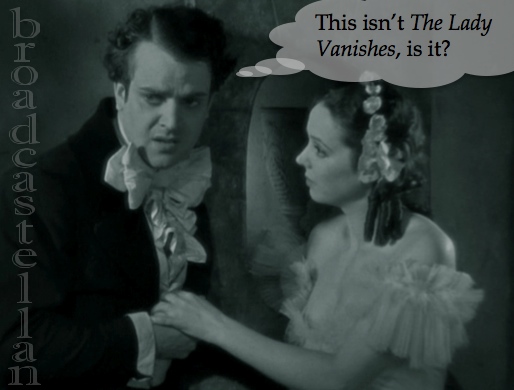
Efficiently if somewhat routinely lensed, this Gaumont-British production might have served as a project for the company’s most notable director, Alfred Hitchcock. Substituting airlanes for tracks, it’s the The Lady Vanishes in the realm of the birds. Except that, in this case, the lady—the young and innocent girl who knew too much—refuses to vanish, which makes the man whose secret she knows all the more eager to see to her disappearance.

The main attraction of Non-Stop New York is not its contrived plot, its charming leads or its rich assortment of goons and ganefs. Rather, it is the film’s setting, the futuristic plane aboard which this pursuit reaches its thrilling climax. It is a large, multi-story aircraft resembling a luxury liner—right down to the outdoor deck on which windblown lovers kiss by moonlight and villains go for the kill. There’s plenty of room for some old-fashioned hide and seek, as passengers are not crowded together but retreat into the privacy of their own cabins. Quite an extravagance, this, considering that the imagined travel time of eighteen hours hardly warrants accommodations fit for on a sea voyage, which mode of transatlantic crossing yet served as a point of reference to the production designers who conceived the vessel.

It took Christopher Columbus ten weeks to cross the Atlantic Ocean, Cinegram No. 14 educated its readers. “Today, ten hours seem to be sufficient to complete the same journey.” Set in the seemingly foreseeable future of 1939, Non-Stop New York

anticipates the regular air service which before long [that is, after the end of the wartime air raids that, even in the age of Guernica, purveyors of escapist entertainment did not trouble themselves to predict] will be flying regularly across the North Atlantic and carrying passengers overnight between London and New York. Already survey flights are being carried out by Imperial Airways and Pan American Airways and these flights have shown that such a service is not longer a dream of the fiction writer, but something which to-morrow will be as commonplace as the many daily services of to-day between London and Paris.

The first experimental flights were made in the Summer of 1937. The British company made a series of flights with two of the Empire class flying boats, the “Caledonia” and the “Cambria.” The terminal points of these flights were Southampton and New York and the route followed was by way of Foynes, on the west coast of Ireland across the Atlantic, 1992 miles, to Botwood, Newfoundland. From there the flying boats went to New York by way of Montreal.

In all, 5 two-way crossings were made and these were carried out without incident and with such certainty that they reached the other side of the Atlantic within a few minutes of schedule.

On the last eastward journey the “Cambria” set up an all time record, making the 1992 miles in 10 hrs. 33 min. or at an average speed of nearly 190 m.p.h.

These flying boats will not be used for the Atlantic service when passengers are carried but it is probably that flying boats of the same type, but with greater power and greater ranger will be used. These flying boats may have a cruising speed of 250 m.p.h., and carry 20-30 passengers in a degree of comfort equal to that of the present luxury liner.

With its promise of a jet-setting tomorrow, a title like Non-Stop New York must have sounded thrilling to picture-goers anno 1937, albeit not nearly as thrilling as such a promise is to any present-day passenger awaiting the all-clear for departure at one of Britain’s dormant airports—among them a friend of ours whose plans for a birthday celebration in Gotham are being pulverized by the largest export of a cash-strapped nation to whom volcanic activity appears to be a natural substitute for banking.

Movies like Non-Stop New York and collectibles such as Cinegram No. 14 remind me that, in living memory, long distance air travel was rare and special indeed. They remind me as well of one momentous April morning in 1985—some quarter century ago—when my younger self first boarded a transatlantic flight to the exhilarating and treacherous metropolis that was New York City. Back then, we still applauded the captain who returned us safely to earth; nowadays, we merely moan when we are grounded for whatever strikes us non-stoppers as too long . . .

“Mike”; for the Love of It

“What is there to say about what one loves except: I love it, and to keep on saying it?” Roland Barthes famously remarked. Sometimes, getting to the stage of saying even that much requires quite a bit of effort; and sometimes you don’t get to say it at all. Love may be where you find it, but it may also be the very act of discovery. The objective rather than the object. The pursuit whose outcome is uncertain. Methodical, systematic, diligent. Sure, research, if it is to bear fruit, should be all that. And yet, it is also a labor of love. It can be ill timed and unappreciated. If nothing comes of it, you might call it unrequited. It may be all-consuming, impolitic and quixotic. Still, it’s a quest. It’s passion, for the love of Mike!

“Mike” has been given me a tough time. It all began as a wildly improbable romance acted out by my favorite leading lady. It was nearly a decade ago, in the late spring of 2001, that I first encountered the name. “Mike” is a reference in the opening credits of the film Torch Singer, a 1933 melodrama starring Claudette Colbert. Having long been an admirer of Ms. Colbert—who, incidentally made her screen debut in the 1927 comedy For the Love of Mike, a silent film now lost—I was anxious to catch up with another one of her lesser-known efforts when it was screened at New York City’s Film Forum, an art house cinema I love for its retrospectives of classic—and not quite so classic—Hollywood fare.

Until its release on DVD in 2009, Alexander Hall’s Torch Singer was pretty much a forgotten film, one of those fascinatingly irregular products of the Pre-Code era, films that strike us, in the Code-mindedness with which we are conditioned to approach old movies, as being about as incongruous, discomfiting and politically incorrect as a blackface routine at a Nelson Mandela tribute or a pecan pie eating contest at a Weight Watchers meeting. Many of these talkies, shot between 1929 and 1934, survive only in heavily censored copies, at times re-cut and refitted with what we now understand to be traditional Hollywood endings.

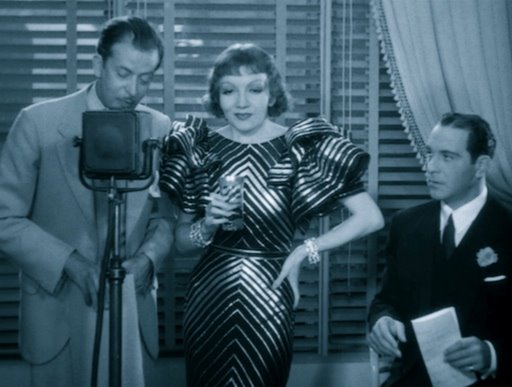
Torch Singer, which tells the Depression era story of a fallen woman who takes over a children’s program and, through it, reestablishes contact with the illegitimate daughter she could not support without falling, has, apart from its scandalous subject matter, such an irresistible radio angle that I was anxious to discuss it in Etherized Victorians, the dissertation on American radio drama I was then in the process of researching.

Intent on presenting radio drama as a literary rather than historical or pop-cultural subject, I was particularly interested in published scripts, articles by noted writers with a past in broadcasting, and fictions documenting the central role the “Enormous Radio” played in American culture during the 1920s, ‘30s, and ‘40s. I thought about dedicating a chapter of my study to stories in which studios serve as settings, microphones feature as characters, and broadcasts are integral to the plot.

Torch Singer is just such a story—and, as the opening credits told me, one with a past in print. Written by Lenore Coffee and Lynn Starling, the screenplay is based on the story “Mike” by Grace Perkins; but that was all I had to go on when I began my search. No publisher, no date, no clues at all about the print source in which “Mike” first came before the public.


Little could be gleaned from Perkins’s New York Times obituary—somewhat overshadowed by the announcement of the death of Enrico Caruso’s wife Dorothy—other than that she died not long after assisting Madame Chiang Kai-shek in writing The Sure Victory (1955); that she had married Fulton Oursler, senior editor of Reader’s Digest and author of the radio serial The Greatest Story Ever Told; and that she had penned a number of novels published serially in popular magazines of the 1930s. That sure complicated matters as I went on to turn the yellowed pages of many once popular journals of the period in hopes of coming across the elusive “Mike.”

Finally, years after my degree was in the bag—and what a deep receptacle that turned out to be—I found “Mike” between the pages of the 20 May 1933 issue of Liberty; or the better half of “Mike,” at least, as this is a serialized narrative. Never mind; I am not that interested anyway in the story’s other Mike, the man who deserted our heroine and with whom she is reunited in the end. At last, I got my hands on this “Revealing Story of a Radio Star’s Romance,” the story of the “notorious Mimi Benton,” a hard-drinking mantrap who’d likely “end up in the gutter,” but went on the air instead—and “right into your homes! Yes, sir, and talked to your children time and time again!”

“Mike,” like Torch Singer, is a fiction that speaks to Depression-weary Americans who, dependent on handouts, bereft of status and influence, came to realize—and romanticize—what else they lost in the Roaring Twenties when the wireless, initially a means of point-to-point communication, became a medium that, as I put it in my dissertation,

not merely controlled but prevented discourse. Instead of interacting with one another, Depression-era Americans were just sitting around in the parlor, John Dos Passos observed, “listening drowsily to disconnected voices, stale scraps of last year’s jazz, unfinished litanies advertising unnamed products that dribble senselessly from the radio,” only to become receptive to President Roosevelt’s deceptively communal “youandme” from the fireside.

Rather than “listening drowsily,” disenfranchised Mimi Benton, anathema to corporate sponsors, reclaims the medium by claiming the microphone for her own quest and, with it, seizes the opportunity to restore an intimate bond that society forced her to sever. These days, Mimi Benton would probably start a campaign on Facebook or blog her heart out—unless she chose to lose herself in virtual realities or clutch a Tamagotchi, giving up a quest in which the medium can only be a means, not an end.


Related writings
“Radio at the Movies: Torch Singer (1933)”
“Radio at the Movies: Manslaughter (1922)”

A “kind of monster”: Me[, Fascism] and Orson Welles

It doesn’t happen often that, after watching a 21-century movie based on a 21-century novel, I walk straight into the nearest bookstore to get my hands on a shiny paperback copy of the original, the initial publication of which escaped me as a matter of course. Come to think of it, this never happened before; and that it did happen in the case of Me and Orson Welles has a lot to do with the fact that the film is concerned with the 1930s, with New York City, and with that wunderkind from Wisconsin, the most lionized exponent of American radio drama, into which by now dried up wellspring of entertainment, commerce and propaganda it permits us a rare peek. You might say that I was the target audience for Richard Linklater’s comedy, which goes a long way in explaining its lack of success at the box office.

And yet, despite the film’s considerable enticements—among them its scrupulous attention to verisimilitudinous detail and a nonchalant disregard for those moviegoers who, having been drawn in by Zac Efron, draw a blank whenever references to, say, Les Tremayne or The Columbia Workshop are being tossed into their popcorn littered laps—it wasn’t my fondness for the subject matter, much less the richness of the material, that convinced me to pick up Robert Kaplow’s novel, first published in 2003. Indeed, it was the glossiness of the treatment that left me with the impression that something had gotten lost or left behind in the process of adaptation—and I was curious to discover what that might be.

On the face of it, the movie is as faithful to the novel as the book is to the history and culture on which it draws.  Much of the dialogue is lifted verbatim from the page, even though the decision not to let the protagonist remain the teller of his own tale constitutes a significant shift in perspective as we now get to experience the events alongside the young man rather than through his mind’s eye.  In one trailer for the film, the voice-over narration is retained, suggesting how much more intimate and intricate this story could have been—and indeed is in print—and how emotionally uninvolving the adaptation has turned out to be.

Without Samuels’s narration and with a scene-stealing performance by Christian McKay as Welles, the screen version gives the unguarded protégé, portrayed by the comparatively bland Efron, rather less of a chance to have the final word and to claim center stage, as the sly title suggests, by putting himself first.

The question at the heart of the story, on page and screen alike, is whether successes and failures are born or made.  Prominence or obscurity, life or death, are not so much determined by individual talent, the story drives home, but by the circumstances and relationships in which that talent can or cannot manifest itself.  We know Welles is a phony when he goes around giving the same spiel to each member of the cast who is about to crack up and endanger the opening of the show, insisting that they are “God-created.”  They are, if anything, Welles-created or Welles-undone.

Finding this out the hard way—however easy it may have looked initially—is high school student Richard Samuels who, stumbling onto the scene quite by accicent, becomes a minor player in a major theatrical production of a Shakespearean drama directed by a very young, and very determined, Orson Welles.  Samuels’s fortunes are made and lost within a single week, at the end of which his name is stricken from the playbill and his life reconsigned to inconspicuity, all on account of that towering ego of the Mercury.

The premise is an intriguing one: a forgotten man who lives to tell how and why he did matter, after all—a handsome stand-in for all of us who blew it at some crucial stage in our lives and careers.  Shrewdly concealing that it was he who nearly ruined the Mercury during dress rehearsal by setting off the sprinklers, Samuels can luxuriate in the belief that he may have inadvertently saved the production by reassuring a superstitious Welles that opening night would run smoothly.

Speculating about the personalities and motives of historical figures, dramas based on true events often insert an imaginary proxy or guide into the scene of the action, a marginal figure through or with whom the audience experiences a past it is invited to assume otherwise real.  And given that Me and Orson Welles goes to considerable length capturing the goings-on at the Mercury Theater, anno 1937, I was quite willing to make that assumption.  Hey, even Joe Cotten looks remarkably like Joseph Cotten (without the charisma, mind).

It was not until I read the novel that I realized that Kaplow and the screenwriters, while ostensibly drawing their figures from life, attributed individual traits and behaviors to different real-life personages.  Whereas actor George Coulouris is having opening night jitters on screen, it was the lesser-known Joseph Holland who experienced same in the novel.

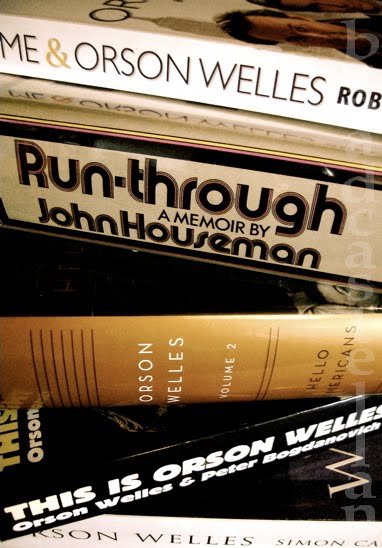
Although quite willing to let bygones be fiction, I consulted Mercury producer John Houseman’s memoir Run-through, which suggests that the apprehensive one was indeed Coulouris.  Houseman’s recollections also reveal that the fictional character of Samuels was based in part on young Arthur Anderson, a regular on radio’s Let’s Pretend program who, like Samuels, played the role of Lucius in the Mercury production.  According to Houseman, it was Anderson who flooded the theater by conducting experiments with the sprinkler valves.

Never mind irrigation; I was trying to arrive at the source of my irritation, which, plainly put, is this: Why research so thoroughly to so little avail? Why be content to present a slight drama peopled with folks whose names, though no longer on the tip of everyone’s tongue, can be found in the annals of film and theater? The missed opportunity—an opportunity that Welles certainly seized—of becoming culturally and politically relevant makes itself felt in the character of Sam Leve, the Mercury’s set designer—a forgotten character reconsidered in the novel but neglected anew in the screenplay.

Anderson’s contributions aside, it is to Leve’s account of the Mercury’s Julius Caesar that Kaplow was indebted, a debt he acknowledges in the “Special thanks” preceding the narrative he fashioned from it.

“[P]oor downtrodden Sam Leve”—as Simon Callow calls him rather patronizingly in his biography of Orson Welles—was very nearly denied credit for his work on the set.  Featuring prominently in the novel, he is partially vindicated by being given one of the novel’s most poignant speeches, a speech that turns Me and Orson Welles into something larger and grander than an intriguing if inconsequential speculation about a brilliant, egomaniacal boy wonder.

Confiding in Leve, with whom he has no such exchange in the movie, Samuels calls Welles a “kind of monster,” to which Leve replies: “We live in a world where monsters get their faces on the covers of the magazines.”  In this exchange is expressed what might—and, I believe, should—have been the crux of the screen version: the story of a “kind of monster,” a man who professes to turn Julius Caesar into an indictment of fascism, however conceptually flawed (as Callow points out), but who, in his dictatorial stance, refuses to acknowledge Leve’s contributions in the credits of the playbill and shows no qualms in replacing Samuels when the latter begins to assert himself.

“As in the synagogue we sing the praises of God,” Leve philosophizes in the speech that did not make it into the screenplay, “so in the theatre we sing the dignity of man.”  Without becoming overly didactic or metaphorical, Me and Orson Welles, the motion picture, could have put its authenticity to greater, more dignified purpose by not obscuring or trivializing history, by reminding us that Jews like Leve and Samuels were fighting for recognition as the Jewish people of Europe were facing annihilation.

To some degree, the glossy, rather more Gentile film version is complicit in the effacement of Jewish culture by homogenizing the story, by removing the Jewish references and Yiddish expressions that distinguish Kaplow’s novel.  Instead of erasing the historical subtext, the film might have encouraged us to see the Mercury’s troubled production of Julius Caesar as an ambitious if somewhat ambiguous and perhaps disingenuous reading of the signs of the times, thereby making us consider the role and responsibility of the performing arts—including films like Me and Orson Welles—in the shaping of history and of our understanding of it.


Related writings
“On This Day in 1938: The Mercury Players ‘dismember Caesar’”
“On This Day in 1937: The Shadow Gets a Voice-over”

A Room With a View-Master; or, Four-Eyes in the Third Dimension

What the Bwana Devil! I’ve been trying on various kinds of glasses to take in Channel 4’s 3D fest—but none transport me into the third dimension. Turns out, viewing the weeklong series of films and specials, culminating in a “3-D Magic Spectacular” and a clipfest of “The Greatest Ever 3-D Moments”—requires special goggles that can only be obtained from a certain chain of supermarkets whose reach does not extend to Mid Wales. By the time we got around to driving some 100 miles down south, the glasses had already been snatched up. The thought of having a digital recording of “The Queen in 3-D”—contemporary film footage of the 1953 coronation—without being able to take it in makes me want to jump out and hurl flaming arrows at whoever devised this regionally biased marketing scheme.

Had the coronation taken place only a year or two later, this experimental and previously unseen documentary might never have been shot right at you. After all, 1953 was a big year in three-dimensional filmmaking; but it proved little more than a fad. By the time Hitchcock’s Dial M for Murder was released in the spring of 1954, the novelty had already worn off and, to this day, few viewers get to experience the climactic scene in the way it was re-conceived for the film.

I caught up with the stereoscopic movies of the 1950s—among them It Came from Outer Space, House of Wax, and Miss Sadie Thompson—when they aired on German television back during the early 1980s 3D craze, which was similarly brief yet decidedly less distinguished: Parasite, Metalstorm, Spacehunter, and the inept Indiana Jones knockoff El Tesoro de las cuatro coronas.

Ever since I got my first stereoscope, known as a View-Master, I have been enthralled by three-dimensional images, or at least by the idea thereof. Rather peculiar, this, considering that those of us fortunate enough to have a set of matching peepers get to experience the same effect without having to sport ill-fitting, nausea-inducing eyewear.

So far this year I have put up with putting on special spectacles to see five 21st-century 3D movies, among them Coraline, The Final Destination, and Up (not counting the partially 3D IMAX presentation of Harry Potter and the Half-Blood Prince).  It seems that 2009 is even a bigger year for 3D than 1953. Yet while I rejoice in the prospect of further excursions into space, it strikes me that, as 3D goes mainstream at last, the technology has lost some of its rogue appeal.

Movies like Ice Age: Dawn of the Dinosaurs do not exploit the potentialities of the medium with the abandon the added dimension invites. I mean, why throw money at 3D films if they don’t throw anything back at you? Maybe I’m wearing rose-colored glasses, but I am still hoping for a throwback to those 1950s throwaways. In the meantime, I’ll gladly return to radio drama, the invisible, immaterial theater whose action unfolds in the fourth dimension.

“Anyone we know?”: An Absentminded Review of The Royal Family

What a tramp my mind has turned into lately. I would like to think that I still got one of my own, to have and to hold on to, for richer or poorer, and all that; but every now and again, and rather too frequently at that, the willful one takes off without the slightest concern for my state of it. It used to be that I could gather my thoughts like keepsakes to store a mind with; these days, I wonder just who’s minding the store. And just when I feel that I’ve lost it completely, there it comes ambling in, disheveled, unruly, and well out of its designated head. With a little luck, the suitcase of mementoes with which it absconded turns up again, similarly disorganized, rarely complete if at times strangely augmented. Perhaps, minds resent being crossed once too often. That has crossed mine, to be sure.

Anyway, where was I going with this? Ah, yes. Straight back to New York City. The Biltmore Theatre. Make that the Samuel J. Friedman, as it is now called. Built in 1925 and steeped in comedy theater tradition, the former Biltmore is just the venue for the current revival of The Royal Family, of which production, scheduled to open 8 October 2009, I had the good fortune to catch the second preview a few weeks ago. Classic crowd-pleasers like Poppa (1929), Brother Rat (1936-38), My Sister Eileen (1940-42), and the long-running Barefoot in the Park (1963-67) were staged here, where Mae West caused a sensation in October 1928 with Pleasure Man, a play they let go on for all of two performances.

While Ethel Barrymore might have wished a similarly compact run for The Royal Family, the play amused rather than scandalized theatergoers who appreciated it as a wildly flamboyant yet precisely cut gem of wit set firmly in a mount of genuine sentiment—which is just what you’d expect from a collaboration of George S. Kaufman and Edna Ferber. Histrionics, theatrical disguises, a bit of swashbuckling—this screwball of a jewel still generates plenty of sparks, even if the preview I attended needed a little polish to show it off it to its full advantage.

Informed that her son may have killed a man, the matriarch of the family inquires: “Anyone we know?” Among the somebodies we know to have slain them with lines like these in the past are Broadway and Hollywood royals like Otto Kruger, Ruth Hussey, Eva Le Gallienne, Fredric March, Rosemary Harris, and . . . Rosemary Harris. As is entirely in keeping with the play’s premise—three generations of a theatrical family congregating and emoting under one roof—Ms. Harris is now playing the mother of the character she portrayed back in 1975. Regrettably, unlike Estelle Winwood in the cleverly truncated Theatre Guild on the Air production broadcast on 16 December 1945, Ms. Harris as Fanny Cavendish was not quite eccentric or electric enough, although she certainly possesses the curtains-foreshadowing vulnerability her character refuses to acknowledge.

Decidedly more energetic and Barrymore or less ideally cast were the other members of the present production, which includes Jan Maxwell as Julie, Reg Rogers as Tony, Tony Roberts as Oscar, John Glover as Herbert Dean and Saturday Night Live alumna Ana Gasteyer as Kitty. Whenever the pace slackened and the madcap was beginning to resemble a nightcap or some such old hat, I could generally rely on Ms. Gasteyer’s gestures and facial expressions to keep me amused.

There was a moment, though, when my attention span was being put to the test—and promptly failed. I looked at the fresh though not especially fascinating face of Kelli Barrett (as Gwen) and found myself transported to the 1920s, those early days of the Biltmore. I started to think of or hope for a youthful, vivacious Claudette Colbert performing on Broadway at that time, a few years before she left the stage to pursue a career in motion pictures. Why, I wondered, was my mind walking off with her?

Well, eventually it all came home to me—my mind sauntering back in with a duffle bag of stuff I didn’t remember possessing—when I perused the playbill to learn about the history of the Biltmore. Colbert, I learned, had performed on that very stage back in 1927, the year in which The Royal Family was written, enjoying her first major success in The Barker. Decades later, she returned there for The Kingfishers (1978) and A Talent for Murder (1981). So, there was something of a presence of Ms. Colbert on that stage, even though she never played young Gwen.

Today, researching a little to justify what still seemed like a mere digression in a half-hearted review of the play, I discovered (consulting the index of Bernard F. Dick’s recent biography of Colbert) that the actress did get hold of a minor branch of the Royal Family tree when she seized the opportunity to portray Gwen’s mother in a 1954 television adaptation of the play. That version, the opener for CBS’s The Best of Broadway series, was broadcast live on 16 September—which happens to be the day I stepped inside the Biltmore to catch up with The Royal Family.

Perhaps it is just as well that I give in and let my mind go blithely astray. For all the exasperation of momentary lapses, of missed punch lines, plot lines or points my thoughts are beside of, the returns are welcome and oddly reassuring. Besides, the old tramp wouldn’t have it any other way . . .

Kitsch as Hitch Can: Waltzes, Missteps, and a Sense of Direction

Ernst Lubitsch, Preston Sturges, and Alfred Hitchcock—those were the Hollywood directors in whose films and careers I became interested in my youth, a by now but vaguely remembered period in my life during which most movie-going adolescents associated the business of making pictures with names like Rocky Balboa, Indiana Jones, or Luke Skywalker. My folks rarely went to the cinema, least of all together; so, my image of Hollywood emerged on the small screen and its dated, black-and-white offerings. Owing to my father’s lingering doubt about the advances of tube technology, film to me had been chiefly a monochrome medium anyway; and as much as it irked me at the time to be missing out on the colorful and the current, I am retrospectively grateful for this early if belated introduction to classic filmmaking—the happy by-product of a less happy family life.

Prolific, long-lived and distinctive, Hitchcock is a particularly good usher into the world of traditional cinema, to dramatic and filmic technique, even though we are rather too readily drawn—with him and by him—into the mythos of auteurism, of a director’s control of what is presumed to be his work. Why is it that we think of classic cinema as being “directed by,” whereas stage and radio drama are primarily thought of (if thought of at all) as being written? Granted, from the framing of a shot to the editing of the reels, the director of a motion picture is called upon—or in a position—to supervise and coordinate more aspects of the creative process than the director of a stage play or radio production. Still, filmmaking is much more collaborative than we tend to recognize.

Quite a few pictures directed by Alfred Hitchcock are hardly what we think of as Hitchcock, for which reason we conveniently overlook or dismiss them, just as Hitch tended to brush them aside to preserve his auteur image. One of those non-Hitch Hitches is the 1934 confection Waltzes from Vienna, shot during a period when the director was not yet in a position to choose his projects. Irreverent as I am, I screened it last night in commemoration of the 110th anniversary of the celebrated suspense meister’s birth.

“It had no relation to my usual work,” Hitchcock told François Truffaut in an interview that served as the source for one of the most insightful books on filmmaking. I bought my first (German) copy of it when I was sixteen; my mother and I were about to visit my father, who was working at a plant in Libya at the time. Faced with the prospect of spending seven weeks in a land hostile to Western culture (those visa stamps sure looked suspicious to the immigration officials when first I traveled to the US), I decided to pack plenty of page-turners, the Truffaut volume among them. Too excited to sleep on the night before our journey, I had turned the pages of the Truffaut volume before we headed for the airport. I don’t recall ever reading a non-fictional book quite this fast and with such enthusiasm.

Still, familiar only with the director’s most iconic works, I was unable to enter the conversation, let alone contest Hitchcock’s self-assessment. It was not until 1999, the centennial of Hitchcock’s birth, that I caught up with Waltzes at the Museum of Modern Art in New York City; before then, the supposed misstep had been little more than a few brusque words and a couple of stills to me.

As it turns out, Waltzes, a “musical without music,” is not quite the, “cheaply” done and “very bad” movie its director made it out to be; nor is it true that it bears “no relation” to his “usual work,” unless “usual” refers strictly to genre, in which case one would have to regard as unrelated comedies and costume dramas like The Trouble With Harry and Jamaica Inn. What relates these and most of Hitchcock’s works to each other is not suspense but irony, not thrills but bathos. Waltzes—which tells of Johann Strauss Jr.’s attempt to come into his own as a composer and the intervention on his behalf of a sly benefactress who, in turn, is a threat to the son’s lover—may have been a more suitable project for Lubitsch, just as Hitchcock’s Mr. and Mrs. Smith is the kind of screwball material in which we expect Preston Sturges to excel; but it is only when Hitchcock looks more like Fritz Lang that he strikes me as The Wrong Man for the job.

In his setting of scenes, as in his staging of the battle of the sexes, Hitchcock relies on queer juxtapositions that elicit laughter even as they excite us. In the opening scenes of Waltzes, set in and around a burning building, those most at risk are entirely indifferent to danger, consumed as they are by the flames of passion.

In the climactic scene, a confrontation between young Strauss and the jealous husband of his benefactress, the crowds cheer the new composer, believing him to be having the time of his life, while the rhapsodized one is being thrashed by his ostensible rival, just as the true competitor, Strauss Sr., over at a deserted bandstand, comes to term with the fact that he has been upstaged. Whether employed to unsettle or amuse, incongruity plays a key role in Hitchcock’s storytelling.

While hardly danced as masterly or memorably as The Thirty-Nine Steps, Waltzes, too, benefits from clever and far from haphazard cinematography, as well as a strong interplay between image and sound, be it word or music. I suppose that in most cases, the collaborative effort is so successful that we ultimately give credit chiefly to the one we assume to have been at the helm of it all.

These days, though, a director seems to matter far less than an investor in pulling the strings, which are mostly wrapped around purses. Now that popular motion pictures are increasingly, if not primarily, a medium for special effects artists, one might be forgiven for turning to a misstep like Waltzes for a sense of direction, and for pursuing the auteur—a mere Hitchcock-and-bull story such a romance may be—along the meandering, mythical and nominally blue Danube.


Related writings
The (T)error of Their Ways: Conrad, Hitchcock, and the Aftermath of the London Bombings
Hang On! It’s That Girl from Number Seventeen

His Words, Her Voice: Errol Flynn, Olivia de Havilland, and the Resonance of “Enough”

“Oh, I have seen enough and done enough and been places enough and livened my senses enough and dulled my senses enough and probed enough and laughed enough and wept more than most people would suspect.” This line, as long and plodding as a life gone wearisome, was recently uttered by screen legend Olivia de Havilland, now in her 90s. You may well think that, at her age, she had reason enough for saying as much; but Ms. de Havilland was not reminiscing about her own experiences in and beyond Hollywood. She was reciting the words of one of her most virile, dashing, and troubled contemporaries: Errol Flynn, who was born one hundred years ago, on 20 June 1909, and apparently had “enough” of it all before he turned fifty, a milestone he did not live to enjoy.

In her brief talk with BBC Radio 3’s Night Waves host Matthew Sweet, de Havilland talks candidly, yet ever so decorously, about her swash-buckled, devil-may-careworn co-star, about his temperament, his aspirations, his fears. Hers is an aged voice that has a tone of knowing in it. A mellow, benevolent voice that bespeaks understanding. A voice that comforts in its conveyance not of weariness but of awareness, a life well lived and not yet spent.

I could listen for hours to such a voice. I might not care for, learn from or morally improve by hearing what is said—but the timbre gives a meaning to “enough” that the forty-something Flynn never lived to express or have impressed upon him. It is the “enough” of serenity, the “enough” of gratitude, the “enough” of not asking for more and yet not asking less . . . or stop asking at all.

My own life is marked and marred by a certain lack of inquisitiveness, it sometimes strikes me. Being blasé is one of the first masks we don not to let on that we don’t know enough, that we know as much, but don’t know enough simply to ask. I wore such a mask of vainglory when I set out in life, the dullest of lives it seemed to me. My fellow employees had a nickname for me then.

It was my moustache that inspired it. Errol Flynn they called me. Little did they know that, even at age 20, I felt that I had “enough” even though I so keenly felt that I had not had much of anything at all. I simply had enough of not even coming close to the glass of which I might one day have had my fill; but, for three long years, I did not have sense enough to leave that dulling life behind. No voice could talk me out of that barren existence but my own.

It was not easy for me to regain a sense of curiosity; it was as if the pores beneath the mask had been clogged after being concealed so long, my skin no longer alive to the breeze and its promises. I had brushed off more than I dared to absorb. One morning, I took a walk around Central Park with one of Errol Flynn’s leading ladies, Viveca Lindfors, and was neither startled nor thrilled; nor did I not seize the opportunity to inquire about her past or permit her to draw me into her presence as she offered me advice and assistance.

Instead, I preserved the sound of her voice on the tape of my answering machine—like a butterfly beyond the magic of flight—her words saying that she had enough of me was dispensing of my humble services as her dog walker. I am left with canned breath, quite beyond the chance of living what might have been a great story.

Enough of my regrets. I can only hope that, when next I feel that I had “enough,” the word will sound as if it were uttered in what I shall henceforth refer to as a de Havilland sense, with dignity, insight and calm—and an acceptance that is not resignation.

Radio at the Movies: Torch Singer (1933)

“Yoo-hoo, is anybody?” I guess that, from time to time, many of us amateur journalists feel compelled to ask the question so catchily phrased by the matriarch of the Goldbergs. At least Molly Goldberg could hope for a response from her friend and neighbor Mrs. Bloom, to whom her shouts into the dumb waiter shaft were directed. To Mrs. Goldberg, “anybody” was a certain someone. Many who approached the World Wide Web as their means of telecommuning have given up on waiting for a reply to their “Yoo-hoos,” or, instead, have taken the resounding silence for an answer equivalent to “nope.”

According to a 2008 survey conducted by Technorati (which, earlier this month, was referred to in a New York Times article on the blogging phenomenon), 95 percent of all online journals have been essentially abandoned. Tens of millions who saw blogging as an opportunity to cast their thoughts broadly and make their voices heard by the multitudes decided that, once this vast crowd of followers did not, well, immaterialize, their words were wasted on the one or another for whose arrival they would not be dumb enough to wait and to whose apparently exclusive tastes they would not lower themselves to cater.

Like broadcasting before it, the blogosphere lures those creative spirits who might otherwise be dispirited nobodies with that one-in-a-million chance at fame while its ability to connect us to the one-in-a-million willing to connect with us frequently goes unappreciated. As public performers, we won’t settle for “anybody”—but we seem more inclined to aim at the elusive everyone than the dependable someone. One of the most intriguing motion pictures to address our narrow-mindedness about broadcasting is the Depression-era melodrama Torch Singer (1933), one of those startlingly unconventional, non-classic Hollywood pictures referred to as Pre-Code.

Torch Singer stars Claudette Colbert as an unwed mother (that is Pre-Code for you) who, failing to find employment, is forced to give up her infant daughter. After that intimate bond is severed, the motherless child of a childless mother avenges herself on an impersonal, dehumanizing society by tantalizing those who made her suffer, selling the mere appeal of sex to the highest bidder. “Give Me Liberty or Give Me Love,” she warbles, achieving neither. Her body having been robbed of its fruit and the warmth of nestling, she turns her voice into a commodity, first by making a(nother) name for herself a nightclub singer, then by accepting the offer to become a disembodied siren on the radio.

When a newly hired storyteller for a children’s program is struck dumb with mike fright, the reckless Torch Singer takes over as the fictitious “Aunt Jenny,” comforter by proxy, singing lullabies so far removed from any cradle that they are devoid of sincerity, all the while tickled by her own moxie as she promotes the sponsor’s kiddie beverage, long drink in hand.

This perversion of motherhood comes to an end when she realizes that it is possible to subvert the medium instead and seize the microphone to reach the child she gave up for adoption. Rather than performing for everyone and no one, she now sings directly to her daughter, devising a contest that would compel radio listening kids to call in and claim their birthday surprises, thereby revealing their identity to her. Once taken into her own hands, the very medium that seemed to have promised nothing but the belated fame for which she never cared becomes the means through which she can reestablish the intimacy she long believed to be past recapturing.

Its melodramatic shortcomings notwithstanding, Torch Singer serves as a compelling reminder that the media, as extensions or offshoots of telecommunication, have not lost—and should never be divested of—their potential to establish point-to-point connections far more meaningful than the often disappointing stabs at mass exposure in which we are apt to lose sight of one another.

Related writings
“Between You, Molly and Me: Should We Settle for Squirrels?”
“Wireless Women, Clueless Men (Part Five): Gertrude Berg, Everybody’s Mama”


Manus Manum . . . Love It: Lever Brothers Get Their Hands on Those Nine Out of Ten

“Ladies and gentlemen. We have grand news for you tonight, for the Lux Radio Theater has moved to Hollywood. And here we are in a theater of our very own. The Lux Radio Theater, Hollywood Boulevard, in the motion picture capital of the world. The curtain rises.”

Going up with great fanfare on this day, 1 June, in 1936, that curtain, made of words and music for the listening multitude in homes across the United States, revealed more than a stage.  It showed how an established if stuffy venue for the recycling of Broadway plays could be transformed into a spectacular new showcase for the allied talents at work in motion pictures, network radio, and advertisement.

Marlene Dietrich and Clark Gable at the premiere of the revamped Lux Radio Theater program

“Frankly, I was skeptical when the announcement first reached this office,” Radio Guide’s executive vice-president and general manager Curtis Mitchell declared not long after the Hollywood premiere. The program was “an old production as radio shows go,” Mitchell remarked, one that was “rich with the respect and honors” it had garnered during its first two years on the air. Why meddle with an established formula?

Mitchell’s misgivings were soon allayed. The newly refurbished Lux Radio Theater had not been on the air for more than two weeks; and Radio Guide already rewarded it with a “Medal of Merit”—given, so the magazine argued, “because its sponsors had the courage to make a daring move” that, in turn, had “increased the enjoyment of radio listeners.” There’s nothing like a new wrinkle to shake the impression of starchiness.

“I cannot help but feel,” Mitchell continued, that the “two recent performances emanating from Hollywood have lifted it in a new elevation in public esteem. Personally, listening to these famous actors under the direction of Cecil De Mille, all of them broadcasting almost from their own front yards, gave me a new thrill.”

That DeMille had, in fact, no hand in the production did little to diminish the thrill. An open secret rather than a bald lie, the phony title was part of an elaborate illusion. The veteran producer-director brought prestige to the format, attracted an audience with promises of behind-the-scenes tidbits, and sold a lot of soap flakes throughout his tenure; and even if the act wouldn’t wash, he could always rely on the continuity writers to supply the hogwash.

As DeMille reminded listeners on that inaugural broadcast (and as I mentioned on a previous occasion), Lux had “been a household word in the DeMille family for 870 years,” his family crest bearing the motto “Lux tua vita mea.” Oh, Lever Brother!

Perhaps the motto should have been “Manus manum lavat.” After all, that is what the Lux Radio Theater demonstrated most forcibly. In the Lux Radio Theater, one hand washed the other, with a bar of toilet soap always within reach. As I put it in Etherised Victorians, my doctoral study on the subject of radio plays, it

was in its mediation between the ordinary and the supreme that a middlebrow program like Lux served to promote network programming as a commercially effective and culturally sophisticated hub for consumers, sponsors, and related entertainment industries.

With DeMille as nominal producer and Academy Award-winner Louis Silver as musical director, the new productions came at a considerable cost for the sponsor: some $300 a minute, as reported in another issue of Radio Guide for the week ending 1 August 1937. Of the $17,500 spent on “The Legionnaire and the Lady,” the first Hollywood production, $5000 went to Marlene Dietrich, while co-star Clark Gable received $3,500. Those were tidy sums back the, especially considering that the two leads had not even shown up for rehearsals.

The investment paid off; a single Monday night broadcast reportedly attracted as many listeners as flocked to America’s movie theaters on the remaining days of the week. As DeMille put it in his introduction to the first Hollywood broadcast, the audience of the Lux Radio Theater was “greater than any four walls could encompass.” Besides, the auditorium from which the broadcasts emanated was already crowded with luminaries.

“I see a lot of familiar faces,” DeMille was expected to convince those sitting at home: “There’s Joan Blondell, Gary Cooper (he stars in my next picture, The Plainsman), Stuart Erwin and his lovely wife June Collier.”

Also present were Al Jolson, Ruby Keeler, and Franchot Tone. “And I, I think I see Freddie March,” DeMille added in a rather unsuccessful attempt at faking an ad lib. While there is ample room for doubt that any “nine out of ten” of those stars named actually used Lux, as the slogan alleged, they sure made use of the Lux Radio Theater. It was an excellent promotional platform, a soapbox of giant proportions.

A visit to the Lever Art Gallery in Port Sunlight

As I was reminded on a trip to the Lady Lever Art Gallery in Port Sunlight last year, Lever Brothers had always been adroit at mixing their business with other people’s pleasure. Long before the Leverhulmes went west to hitch their wagon on one Hollywood star or another, they had disproved the Wildean maxim that the greatest art is to conceal art and that art, for art’s sake, must be useless.

It is owing to the advertising agents in charge of the Lever account that even the long frowned upon “commercial” did no longer seem quite such a dirty word.


Related recording

“The Legionnaire and the Lady,” Lux Radio Theater (1 June 1936)

Related blog entries

“Cleaning Up Her Act: Dietrich, Hollywood, and Lola Lola’s Laundry”

Tyrone Power Slips Out to War on a Bar of Soap”

“After Twenty Years of Pushing Stars and Peddling Soap, a Hollywood Institution Closes Down”