My Evening with Queen Victoria

Considering that it is St. George’s Day (as well as the anniversary of the birth of the Bard), I am going to stay a little closer to home this time and, forgoing a return to Budapest, report instead on my audience with the Queen. Victoria Regina, I mean, whom last I captured towering over Birmingham’s German Christmas market (pictured) and imagined listening to her Electrophone. Yesterday, we went to An Evening with Queen Victoria, a one-woman show in which British stage, screen, and television actress Prunella Scales, accompanied by a lyric tenor and a pianist (who is also the husband of the play’s creator and director), has toured the new and old world, including England, Australia, Canada and the United States. So, it was bound to make it to Wales, eventually.

Just in time, I might add. Ms. Scales, whose life now spans as many decades as the play, was called upon to read, in character, selections from the queen’s published reminiscences (Leaves from the Journal of Our Life in the Highland) and personal correspondences, from her youthful comments on her German cousins to her reflections on marriage and motherhood, duty, loss, and old age.

Along the way, the star struggled with some of her lines and had to be prompted audibly at one point (Fawlty Powers, I could not help thinking), while the aged pianist, who at one time loudly cleared his throat as if he had quite forgotten that there was a performance going on, played pieces of classical pieces by Rossini, Schumann, and Mendelssohn, which were interpreted with much feeling by the tenor, who thus painted himself into the queen’s portrait. The three of them joined forces to sing “Duties of a Monarch” from Gilbert and Sullivan’s Gondoliers:

Oh, philosophers may sing
Of the troubles of a King,
But of pleasures there are many and of worries there are none;
And the culminating pleasure
That we treasure beyond measure
Is the gratifying feeling that our duty has been done!

The whole royal affair might have faired well on radio, I thought, since it is largely a first-person narrative involving little action, aside from the queen’s efforts to rise from her easy chair to pick up various letters and books, to fetch a cane or wrap herself up as she gradually ages before us. I was not surprised, therefore, to learn that An Evening has indeed been produced for BBC radio.

It was on the air that the Her (Imperial) Majesty had been introduced into the living rooms of America, voiced by Helen Hayes, who inhabited the part on the Broadway stage in Laurence Housman’s Victoria Regina (1934), a play initially banned in England for daring to impersonate British royalty yet living.

An Evening was based largely on actual reminiscences of the monarch, as this somewhat unfortunate line from the leaflet that served as a playbill informed me: “The words of this programme are compiled entirely from Queen Victoria’s own journals and letters, together with some additional material from contemporary sources,” which is like saying that a loaf of bread is whole grain, except for a few preservatives and added flavors, natural or otherwise, however difficult to detect.

A similar claim was made by radio announcer Ernest Chapell, who introduced the 2 June 1939 broadcast of Orson Welles’s Campbell Playhouse by declaring that in order to “complete the true picture of this great queen, Mr. Welles has used still another source, one which only a few years ago was still a closed book, locked away in the official archives of the royal family: the personal diary of Queen Victoria.”

Containing the same material and creating a similar effect, An Evening is essentially a non-dramatic version of Victoria Regina, which Hayes revived once again for her Electric Theater on 14 November 1948, the day the queen’s great-great-great grandson, Prince Charles, was born. Intimate without being indiscreet, informal without being vulgar, both sketches create the quiet sensation of familiarity by bringing alive, in her own words, a woman who is more often thought of as an institution or the name crowning an era.

In an age favoring uncompromising exposés and compromising snapshots, close-ups with which we distance ourselves, such personal introductions are a charming and welcome illusion.

Replications of Life: Kempelen and the Art of "Turking" It

I appreciate a good hoax; and no hoax is any good unless it wrings from you the admission that you have been had. My common sense yields to the artistry of the con, the handiwork of cheeky tricksters who can cheat you out of your trousers by presenting you a with a hook from which to suspend your disbelief. And however desperately I might try to cover up and recover my composure by juggling an assortment of polysyllables, I am just the kind of fall guy you’d love to be around on April Fools’ Day—or any other day, if you are among those who practice their legerdemain without a license.

To cry foul at the art of faking, as Oscar Wilde put it, to “confuse an ethical with an aesthetical problem.” Not that such a defense would have done for Orson Welles and his Mercury Players, whose aforementioned Halloween make-believe gave broadcasters cause for alarm after some radio listeners panicked at the announcement of a Martian invasion back in 1938. In the case of the famous Turk, the fakery was comparatively inoffensive and harmless, excepting perhaps for the wretch squeezed into the apparatus, a replica of which (by illusionist supplier John Gaughan) I encountered at the Műcsarnok in Budapest. It is on display there until 28 May 2007, after which time it may be seen in Karlsruhe, Germany, from 15 June until 19 August 2007, over two hundred years after its first appearance in that town.

The chess-playing automaton was the creation of Austro-Hungarian baron Wolfgang von Kempelen (1734-1804), who, according to Edgar Allan Poe, “had no scruple in declaring it to be a ‘very ordinary piece of mechanism—a bagatelle whose effects appeared so marvellous only from the boldness of the conception, and the fortunate choice of the methods adopted for promoting the illusion.'”

The marvel of the Turk was that it kept audiences guessing, not so much what his next move might be, but how he moved and whether he actually contemplated the movements of the pieces in the game. What was the ghost in this machine? Was it some precursor of “The Automaton” that, on 27 July 1953, stalked radio’s Hall of Fantasy? Might the Turk have a mind of his own (a thought to cause suspicious westerners unease)?

Poe became intrigued by the mystery of the Turk when this player of mind games toured America after having been acquired by a German inventor-showman who shrouded the creation in further mystery by refusing to say whether it was “a pure machine or not.” As Poe speculated in “Maelzel’s Chess-Player,” the “notoriety” and “great curiosity” of the Turk were “owing more especially to the prevalent opinion that it is a pure machine, than to any other circumstance.” It was, therefore,

in the interest of the proprietor to represent it as a pure machine. And what more obvious, and more effectual method could there be of impressing the spectators with this desired idea, than a positive and explicit declaration to that effect? On the other hand, what more obvious and effectual method could there be of exciting a disbelief in the Automaton’s being a pure machine, than by withholding such explicit declaration?

Being in the know without having had the courage of falling for it or the virtue of rising to the occasion by exercising one’s imagination is a profligate waste of curiosity. It means to reduce a philosophical problem to a mechanical one. More compelling than the matter of its nuts and bolts was how the Turk worked on the minds of those surrounding him. “For, people will naturally reason,” Poe argued, that it is

Maelzel’s interest to represent this thing a pure machine—he refuses to do so, directly, in words, although he does not scruple, and is evidently anxious to do so, indirectly by actions—were it actually what he wishes to represent it by actions, he would gladly avail himself of the more direct testimony of words—the inference is, that a consciousness of its not being a pure machine, is the reason of his silence—his actions cannot implicate him in a falsehood—his words may.

To this day, Germans refer to what they deem forged, false or fake as being “turked” (“getürkt”), which, I am pleased to say, explains nothing.

Monumental (S)care: A Walk in Statue Park

No matter how hard I tried to make light of them, by pulling their fingers or sitting on their boots, the colossal statues gathered in the ideological leper colony that is Szoborpark made me feel (and, as you can see, seem) rather small. They were intended to awe, of course, to impress those looking up with a sense of being overmastered rather than represented, of being conquered and compelled to surrender their personal aspirations along with their cultural identity. Removed from the public squares in which they towered over the multitude, the statues of the communist regime imposed on the Hungarian people have been relegated by them to the outskirts of Budapest, to a forlorn place called Memento or Statue Park.

Never completed as conceived on paper in the early 1990s, the park has already fallen into disrepair. Weeds now triumph over concepts, mocking at once the old order of terror and this new method of detaining it, of quarantining a body of unsettling memories by setting it apart from the everyday. The past needs tending to; but, as the grounds of Statue Park suggest, we balk at beautifying what amounts to pathology, at manicuring a disease known to have corrupted intellects, choked incentives, and smothered lives.

As those monuments went up in 1940s Hungary, the US took monumental care in tearing down communist and socialist ideals, many of which had been shared and endorsed by thousands of upright, patriotic Americans during the 1930s. After years of economic hardship, of rationing and sacrifice, Americans seized the chance of raising picket fences, those monuments to sovereignty, which they were encouraged to set up as individual tributes to American virtues, to the pursuit of personal happiness and the proper boundaries of its expression.

Yet the straight and clean domains of the home frontier were argued to be under attack, compromised by wayward doubters and their doubtful ways; and it was on the air that the infiltrations and contaminations of the social fabric by the newly branded un-Americans—who were argued to have their designs on the dream they questioned as fabrication—were mass-circulated as cautionary tales of anti-communist propaganda.

Aside from the common weed of crime, once rooted out with precision and glee by superheroes like The Shadow (reportedly slated to be recast for the screen that could never contain him), the fungus of homegrown communism at home threat of mushroom clouds over America demanded a new breed of secret and sanitary agents, men like Matt Cvetic, who infiltrated the infiltrators and spread his cleansing mission statement by boldly declaring I Was Communist for the FBI in a series of espionage thrillers that premiered on US radio back in April 1952.

Throughout the 1930s, ‘40s and ‘50s, US radio assisted in setting up new statues and dismantling old, in forging idols and fostering ideals while pronouncing others fallen or rotten. It created images in the mind more persuasive, invasive and pervasive than prominently displayed sculptures in stone or steel. The United States did not require monuments to steer and stir, to guide, goad and guard its citizenry. It had microphones.

Square New Deal?

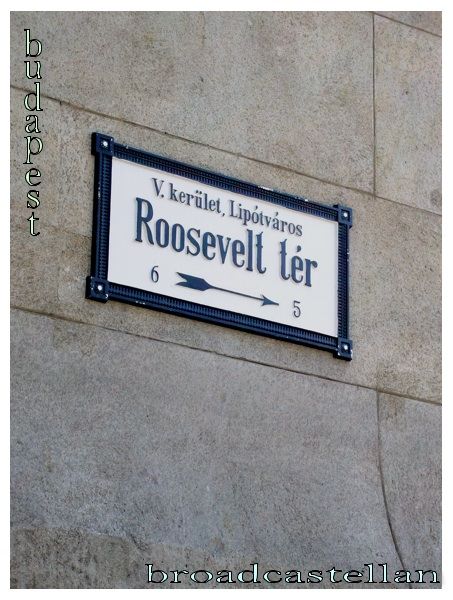
At one point it was prosaically called Uploading Square. Roosevelt tér in Budapest, that is. I decided to start our visit to the Hungarian capital by walking across the old Chain Bridge to pay my respects to the thirty-second US President who died in office on this day, 12 April, in 1945. As previously mentioned here, FDR owed much to the radio; his voice and views were known to millions of Americans who tuned in to hear his Fireside Chats. Three days after his death, his life was recalled by two special and very different broadcast, one headed by Ronald Colman and featuring an uncommonly yet appropriately somber Fibber McGee and Molly, the other featuring Canada Lee, reciting FDR’s D-Day prayer.

Roosevelt did not get a square deal, I thought, as I approached the spot named after him in 1947. These days, it is little more than a roundabout, a traffic island with a few statues in the middle—and none of them of FDR. Seen from the top of the hill in Buda, however, its prominence in the cityscape becomes apparent. Besides, as Fibber expressed it: “You know, a man is entitled to a lot of credit when people can say his family, and his community, and his country are better off for his having lived; but when a man dies and the whole world was a better place for his living, well, nobody needs much more of a monument than that.”

Meanwhile, the statues of Soviet heroes and leaders from whose rule Hungary struggled to free itself (after having lost the war siding with Nazi Germany) have been relegated to a park of their own . . .

A Bell for . . . Talafar?

It is the fuel that keeps the search engines humming. It is fodder for loudmouthed if often unintelligible webjournalists thriving on the divisive. It is the foundation of many a rashly erected platform by means of which the invisible make a display of themselves. The so-called war on terror, I mean, and the time, the shape, and the lives it is taking in Iraq. My position becomes sufficiently clear in those words, as tenuous as it sometimes seems to myself. Experiencing the uncertainty, the turmoil and sorrow that was New York City during the days following the destruction of the World Trade Center, I was anxious to see prevented what then felt like an out and out war against the democratic West; but as a descendant of Nazi sympathizers who is convinced that putting an end to thralldom is a noble cause and conflicted about the use of military force to achieve this end, I could only work myself up to a restrained fervor, which soon gave way to bewilderment, anger, and frustration.

Presented as a success story of the US led invasion of Iraq, the town of Talafar is once again in the news this week, shown in the unfavorable light of exploding bombs and insurgent violence. It has (or ought to have) become obvious that the US and its allies (reluctant or otherwise) are failing in their professed mission against terror and tyranny not because they lack military expertise or international support but because they engaged in this operation with an insufficient awareness and understanding of the different and differing cultures in a region they presumed, hoped, or misrepresented to be a unified (or at any rate unifiable) nation.

I was reminded of all this, if any reminders were required, while watching the wartime parable-turned-Hollywood romance A Bell for Adano (1945), a movie depicting the occupation of an Italian village by American forces toward the close of the Second World War. I generally dislike and avoid war pictures; at least those that reduce history to well-staged action sequences interspersed with scenes of map-pointing generals exchanging remarks about strategies and objectives as if contemplating a game of checkers. A Bell is not that kind of movie.

Based on a 1944 Pulitzer Prize winning bestseller by John Hersey (a Time correspondent and former secretary to Sinclair Lewis), it tells of the struggle for peace, order and community in a battle-scarred town whose lack of pride, hope, and unity is symbolized by the missing bell in the town square, weaponized by Italian’s fascist regime. Realizing the significance of this communal centerpiece, a New York Italian major disregards military orders to find and install an adequate replacement.

On this day, 28 March, in 1944—well over a year before the movie version premiered in US cinemas—NBC radio, in cooperation with the Council on Books in Wartime, presented an adaptation of Hersey’s novel as part of a series titled Words at War. Henry King’s film would attempt to shape parts of Hersey’s narrative into the romance of a lost “Belle” from Adano by casting Gene Tierney as John Hodiak’s Italian love interest, considerably downplaying the ugly Americans his character is up against.

The radio dramatization dispenses with such heartstringings-along to concentrate on the heart of the story: the failings of military strategy and the imperative of cultural sensitivity in the treatment of liberated civilians as exemplified by the response of one Italian-American to the challenges of ideological reorientation, his efforts to understand and assist his ancestral people after the removal of the enemy force that possessed, intimidated and estranged them.

On the radio, A Bell for Adano was announced as a story about “thoughtful Americans, and Americans not so thoughtful.” The very suggestion of America’s humanitarian blunders in an essentially propagandist series like Words at War renders this broadcast “Bell” altogether more compelling than those backlot scenes in which all-American he-fighters show the Axis what what is. The “what” here is “What to do with occupied territory?” once it appears to be under the control of the ostensible victor.

The war in Iraq has yet to deliver a bell ringing loudly enough to convince the world (or me, at any rate) that the freedom, stability, and opportunity it meant to bring about were worth all those local blasts and their global repercussions. Romancing a cracked one just won’t do.

“. . . only a crude little glass baby”: The “Father of Radio” Remembers

Well, I am off this instant on a short and none-too-well planned trip to the south of England, to which quick exit you owe the uncommon brevity and, what is more irregular still, the antemeridian dispatch of this entry in the broadcastellan journal. However inconvenient this last-minute post might be for my traveling companions, I simply could not wait another year to share this anniversary. True, I excite easily when it comes to the old wireless; but in this case the enthusiasm is not altogether unwarranted.

On this day, 23 March, in 1941, Dr. Lee de Forest was called upon to address the American public through a means and medium for the creation of which he was largely responsible.

“Most people believe Guglielmo Marconi invented the radio,” Tom Lewis states in the Prologue of his study Empire of the Air (1991, immediately to make the necessary correction: “he did not.” Among those who did was said Dr. de Forest, once acknowledged to be the “Father of Radio,” due in part to his tireless self-promotion.

To mark the 34th anniversary of the invention of the wireless telephone in 1907 (it is thus the 100 anniversary this year), CBS radio caught up with this daddy of the dial for another edition of Behind the Mike, a CBS program billed as “radio’s own show.”

Based on accounts furnished by his assistant, Frank Butler (present in the broadcasting studio), Behind the Story dramatization of de Forest’s story, his initial struggle, his failure to interest the navy in his invention, the destruction of his New York laboratory by fire, and his indictment for fraud.

After this fictionalized sketch, a cheerful de Forest, by then “almost the sole living survivor of the old guard,” spoke from Los Angeles to his former assistant, to the audience gathered in an East Coast studio, and to the listening public tuning in across the United States:

In 1907, no one could possibly have foreseen what is occurring right now between Los Angeles and New York because then the amplifier, which has since made possible the transcontinental telephone, was only a crude little glass baby lying in swaddling cotton in that little old shoebox in our laboratory.  How well I remember those first audion tubes [. . .].  How difficult they were to construct.  How great our chagrin when one of them burned out.  And what headaches we suffered to keep those first radio telephone transmitters on the air.  Bittersweet are those old memories.

More bitter than sweet, as it turns out. In the 1941 broadcast, de Forest expressed the wish to “live until the 21st century, just to observe the state of radio and television then.” He died in 1961; but not long after he made that unfulfilled wish, so well suited to a radio broadcast designed to celebrate the medium, he all but disowned his invention. In an open letter to the National Association of Broadcasters that appeared in the Chicago Tribune on 28 October 1946 and was reprinted in de Forests 1950 autobiography, Father of Radio, he exclaimed, after years of expressing similar misgivings:

What have you […] done with my child? He was conceived as a potent instrumentality for culture, fine music, the uplifting of America’s mass intelligence.  You have debased this child [to] collect money from all and sundry [..].  You have made of him a laughing stock to the intelligence, surely a stench in the nostrils of the gods of the ionosphere […].

While lamenting the “bedtime stories” that “ruled the waves” and “rendered children psychopathic,” he nonetheless remained “proud” of his “child,” as “[h]ere and there from every station come each day some brief flashes worth the hearing, some symphony, some intelligent debate, some playlet worth the wattage.”

Not one to throw out the baby with the airwaves, I shall return anon to discuss some “playlet,” to debate whether such “brief flashes” were “worth the wattage” or just curious enough to catch my attention.

Who Knows What Heart Lurks in the Evil of Men?

Driving Miss Daisy it ain’t.  The Last King of Scotland, I mean, with which I finally caught up last night at the local movie house. Like Downfall before it, this portrait of a dictator breaks with the conventions of Hollywood melodrama by challenging us to discard with the convenient absolutes of good and evil, the very binaries that clarify much but explain so little. Director Kevin Macdonald—whose next project, a documentary promisingly titled My Enemy’s Enemy, will deal with Nazi Germany and feature archival footage of Adolf Hitler—does not presume to judge his subject, Idi Amin, but to show or suggest the workings of his mind, his joys, sorrows, and fears.

In traditional Western storytelling, be it for stage or radio, for big screen or small, sketches of a certain enemy “other” are often crudely drawn for the sake of ready identification; the resulting picture is not that of an ostensibly evil person, but of evil personified. It is the very stuff of satire and sensational melodrama in which the alleged shortcomings of a dangerous individual may be exposed or playfully defused for the purpose of stirring an apathetic populace or boosting the morale of those stifled by terror. Historical portraits or caricatures of villainy rarely dare to encourage empathy and thus avoid to render their subjects human; they shun any approach suggestive of naturalism—the attempt at a serious and sincere depiction of what is.

Then again, what is? No matter how convinced I was by Forest Whitaker’s deservedly Oscar-nominated performance, I did not once think of The Last King as anything other than a work of fiction, a response largely owing to a lack of knowledge about the historical figure depicted, the culture represented, and the events on which it is based—the kind of ignorance I might pass off as skepticism if I were not hoping to achieve some semblance of naturalism in these soundings of my mind. Years of schooling and pop cultural exposure seem to have made it difficult for me to think of history as anything I sense to be reality. By virtue of seeming real, Whitaker’s Amin became a fiction to me.

My own reservations and prejudices aside, Macdonald’s film raises questions about what, beyond verifiable data, the records that have not been lost or suppressed, should make it into our histories, those stories we (or those acting on our or someone else’s behalf) construct out of scraps of documented facts upon which historians impose the comforting logic of causality. Like All the King’s Men, The Last King documents the corruption of power; yet it is also a corruption of documents. The figure of the young Scottish doctor, through the interaction with whom Amin’s personality is being revealed (for the cinema has to tell by showing), does much to render suspect the historicity of the drama, suspicions that even the facts and figures appended to the film after the conclusion of its narrative cannot lay to rest.

After all, how are we to know what heart lurks in the evil of men? What does it mean to accept that historical figures like Hitler or Idi Amin were thinking, feeling men rather than destructive forces? Perhaps we dread real people in our histories because they make us aware that, given human nature, no tools of social science can prevent us from repeating the horrors of the past.

Beyond the Walk of Fame: A Monument for Madeleine Carroll

I don’t quite understand the concept; nor do I approve of such an abuse of the medium. The radio alarm clock, I mean. It accosts me with tunes and blather when I am least able or inclined to listen appreciatively. I much prefer being turned on by the radio rather than being roused by it to the point of turning it off or wishing it dead and getting on with the conscious side of life. This morning, however, BBC Radio 2—our daybreaker of choice—managed both to surprise and delight me with the following less-than-timely newsitem. Twenty years after her death, British-born Hollywood actress Madeleine Carroll (whose life and career are documented in this website maintained by her cousin) returns to the place of her birth as the English town of West Bromwich unveils a monument erected in her honor.

Film stars are perhaps least deserving of monuments—not merely because their off-screen antics rarely warrant praise, but because the celluloid on which their contributions to humanity are preserved are fitting enough testimonies to their achievements. Unless, that is, the achievements lie beyond those captured on film. In Carroll’s case, this translates into a return to Britain to serve as a Red Cross nurse during the Second World War.

The star of Alfred Hitchcock’s The Thirty-Nine Steps and Secret Agent put her film career on hold following the death of her sister during the London blitz in October 1940. Just days prior to this personal loss she had already signalled her intentions by contributing to a Canadian Red Cross Emergency Appeal, which aired on 29 September.

Subsequent parts in American radio dramas echoed her new career. In the late 1930s, Carroll had starred in frothy comedies and sensational melodramas produced by the Campbell Playhouse and the Lux Radio Theater; during the war, by comparison, she was most often heard in propaganda plays written for and produced by the aforementioned Cavalcade of America. On 5 October 1942, for instance, she played an army nurse in “I Was Married on Bataan,” scripted by reluctant radio playwright Arthur Miller. Two weeks later, on 19 October, she portrayed a pioneering female doctor in “That They Might Live”; and on 30 November 1942, she played the title character in “Sister Kenny.”

Unlike so many of her glamorous colleagues, Carroll truly inhabited these roles. It is her humanitarian work that is being remembered today.

The Big Brother Incident

Well, I did not tune in for it; but you would have to be dwelling under a boulder without broadband not to have become aware of the diplomatic incident and international protests caused by the treatment of Bollywood star Shilpa Shetty on the Channel 4’s Celebrity Big Brother program here in the UK. I generally shut off and down at the mere mention of the word “celebrity,” which to me signals the exhibition of some latter-day Zsa Zsa Gaborisms—the state of being prominently stupid for the sake of being stupendously prominent—that I can well do without.

Where is the humility that convinced notoriously competitive Rose Nylund (portrayed by birthday Girl Betty White, born on this day in 1922) to turn down the St. Olaf Woman of the Year award after discovering that the judges had been swayed by a spurious account of her achievements?

That said, confronting undereducated, overexposed, and self-absorbed have-beens or wannabes with someone who is someone somewhere else strikes me as an inspired premise for a potentially edifying spectacle. It might offer a cultural corrective to the culturing of fame, forcing those who fancy themselves somebodies—along with those who buy into or by way of mockery perpetuate the process of celebrification (the fabrication of celebrity)—to reevaluate the limits and merits of popularity. At any rate, it lends a culture clash edge to a program that is otherwise nothing but trash edging itself in on culture.

Now, Celebrity Big Brother has received some twenty-thousand viewer complaints citing the abuse of Ms. Shetty by other housemates, deploring the ethnic slurs and biasides (you know, those tossed in remarks revealing a speaker’s prejudices) that have translated into a ratings bonanza for the program. In a development worthy of satirist Johnathan Swift, these televised housecoolings have led to protests in India and protestations by the British Prime Minister (who, like the folks in the East, has never seen the show).

The public shaming of this guilty pleasure is a remarkable development indeed, considering that much of British entertainment is based on the principle of offending. Apparently, it is acceptable to caricature and be-Little Britain, but not to portray as reality the actual small-mindedness of some of its people who have been elevated to the status of representatives by virtue of their omnipresence.

It’s been good for business, this brouhaha; but might a muzzle put an end to the foul-mouthing? Could Big Brother live up to its Orwellian name by resulting in overzealous watchdoggedness, by causing a backlash more profound than the aftermath of Janet Jackson’s wardrobe malfunction, by pushing any kind of social controversy off the screen and by keeping prejudice private so that it may flourish, undetected and unchecked. Perhaps it is better to permit those in need of publicity to make fools of themselves (and each other) than to fool ourselves into believing such ignorance extinct.

The ongoing debate whether to aspire to cultural universals or favor the ethnically distinct predates the social climate change brought on by political correctness. Jewish writer-actress Gertrude Berg (previously mentioned here), whose sitcom The Goldbergs had its television premiere on this day in 1949, once remarked about the success of her series in the age of anti-Semitic Gentleman’s Agreements that “we all respond to human situations and human emotions—and that dividing people into rigid racial, economic, social, or religious groups is a lot of nonsense.” Worse than nonsense would be to deny that those divisions exist and that an assumed, unquestioned sameness is a healthy substitute for hard-fought equality.

Langston Hughes, Destination Freedom, and the "Funny Things" White Folks Do

A lot was left out of the picture, no matter how vividly it was being painted by the brush of sound on the canvas of the mind. Radio. No other mass medium could create pictures at once so generic and genuine, as invested as they were with the desires and experiences of those tuning in. And yet, in its soundscapes of the nation, in its portraits of the multitude, US broadcasters too often brushed aside or airbrushed what they dared not echo or evoke; too often they resorted to caricature and counterfeit, unless they altogether erased the experiences and memory of millions of citizens on whom broadcasters turned a deaf ear. 

The Southernaires

In the 1930s and ‘40s, when Amos ‘n’ Andy was America’s most popular work of comic serial fiction, commercial radio rarely permitted the minority population mimicked and minstrelized by the program the privilege of a voice, unless to sing gospel music (as delivered by the Southernaires, pictured here) and the hep tunes to which white folks would try to dance. Two notable exceptions to this misrepresentation of, adopting the parlance of the day, the ‘Negro’ experience on American radio were New World A-Coming and Destination Freedom.

On this day, 15 January, in 1950—when Martin Luther King, Jr. celebrated his twenty-first birthday—Destination Freedom presented “Birth of a League,” a dramatization of the exodus of some two million African-Americans from the South to the urban centers of the North—the “greatest internal migration in American history”—as it accelerated in the years just prior to the first World War. As “The Birth of a League” recounts, this led to the formation of the “Urban League” movement. You might say it was the real story behind Amos ‘n’ Andy, the white fiction of two black boys from Georgia who made their way up to Chicago in the late-1920s.

Appended to Richard Durham’s episodic and chronologically somewhat muddled play was an interview with Sidney Williams, the executive secretary of the League’s Chicago branch, with whose co-operation Destination Freedom was presented by station WMAQ, Chicago—the same station that had introduced America to Amos ‘n’ Andy back in 1928.

Williams deplored that “what other Americans expect and get as a matter of right, we Negro workers have to beg and fight for.” The fight, however, was not to be construed as a violent one. The League’s motto—”Not arms, but opportunity”—and the involvement of white businessmen “of good will” in its foundation made this depiction of the segregated South and the struggle for integration in the North more acceptable both to broadcasters and to a larger audience.

The challenge of such broadcasts was to inform and appeal, to protest yet placate. Despite the hope expressed in its title, taken from the book by Roi Ottley), New World A-Coming was at times cynical in its exposure of the injustices suffered by the Negro population. On 16 April 1944, for instance, the series promised the “Story of Negro Humor” as seen through the eyes of Langston Hughes. While it was filled with laughter, the program offered little amusement. Instead, it recalled Hughes’s own experience of Southern inhospitality, which Hughes had previously shared in his article “White Folks Do Some Funny Things.”

Hughes, who at one time was considered for a radio serial project of his own, found little amusement in the treatment the Negro—as character and creator of characters alike—received on American radio (as previously discussed here). In “The Story of Negro Humor,” and its somewhat toned-down reworking a year later (on 8 April 1945) under the article’s original title, Hughes was portrayed by Canada Lee, who acted out various scenes of humiliation personally witnessed or suffered by the American poet and novelist.

The program presented the prejudice and hatred toward black Americans as an American problem, rather than one faced by the minority population alone. Commenting on those who “practice Jim Crow at home and preach democracy abroad,” Hughes expressed himself puzzled at their “lack of humor concerning their own absurdities.” Having “read that Hitler has no sense of humor either,” he concluded that “the greatest killers cannot afford to laugh” and that those “most determined to Jim Crow” were “grimly killing democracy in America.”

Both New World A-Coming and Destination Freedom are rarities in so-called old-time radio. They are programs seldom discussed or traded by those who twist the dial by proxy and distort its history to meet their needs for light or wholesome entertainment. These two programs should not be dug up in defense of the ignorant or indifferent; they should not be aired for the chief purpose of clearing American radio of charges of misrepresentation. Yet, however marginal their role, it would be equally wrong to neglect or dismiss them, and the talent involved in their production, thereby to propagate the image of American radio drama as historically irrelevant and relegate it to the neither-here-nor-there that is nostalgia.