Lillian Gish Does Not Recall My Name

Mine is not an illustrious one. There are a few others who fared well enough with it; but none among them are my relations. It is uncommon enough to catch my eye or ear whenever it is mentioned, even though my own is frequently misspelled or mispronounced. My surname, I mean. As I shared a while ago in this journal, names hold a special fascination for me. Imagine my surprise when, in search of a broadcast event worth recalling today, I came across the modest proper noun attached to my existence while listening to a recording of an American radio program that aired on this day, 4 July, in 1939.

The program in question is Information, Please!, a quiz show that, as discussed here, invited radio listeners to send in brain teasers and memory testers to “stump” a panel of so-called experts and notable personalities. The guest guesser featured on this day in 1939 was silent screen actress Lillian Gish.

He “wouldn’t be surprised,” host Clifton Fadiman remarked, if Ms. Gish could not answer the first question of the evening, a comment suggesting that the venerable actress was too far removed from the everyday to tune in like regular folk (despite the fact that she had been a panelist on previous occasions).

Whether unable to supply the expected response or unwilling to utter it, Ms. Gish had the smartest reply anyone thus confronted could have given. In keeping with her glorious past and altogether more dignified than the prompted line, her response was silence. You see, the panel was called upon to “give the exact wording” used by announcer Milton Cross in the opening of the program, which, at that time, was sponsored by the makers of Canada Dry. To provide the correct piece of trivia would have meant to parrot a commercial message.

It was a clever game of naming nonetheless. The ostensible poser of said puzzler was awarded a small prize, and the solution, revealed by Fadiman, was rendered even more prominent as a result of it having supposedly managed to elude the experts, much to the amusement of the crowd in the studio.

This introductory bit of product placement was followed by another nominal challenge. The panelists were asked to “name four literary works whose titles consist entirely of initials.” Columnist Franklin P. Adams came up with R.U.R. (short for “Rossum’s Universal Robots”), the science fiction drama by Karel Capek to which we owe the word “robot.” Ms. Gish advanced R.F.D. (for “Rural Free Delivery”), a now obscure volume on farm living in 1930s Ohio by one Charles Allen Smart.

Getting into the spirit of things, Gish then allowed herself to suggest “The Life of the Bee.” She didn’t get away with the pun, but garnered some chuckles, following it up with “Abie’s Irish Rose.” Prepared for such levity with a pun of his own, Fadiman suggested X.L.C.R. as the title of a poem by Longfellow. Controlling herself—and asked not to make another joke—Gish think of R.V.R., a book on Rembrandt by Hendrik Willem van Loon, an essayist whose work (compiled as Air-storming) was regularly heard on US radio back then.

Now, I had to look most of these names up—and quite forgot my own in the process. That name, however, was brought up shortly thereafter on the broadcast, Ms. Gish having been given an opportunity to be anecdotal about silent movies by claiming that she had to smooch a bedpost in Birth of a Nation since no actress was “allowed to kiss the men” in front of camera in those days. The question that followed transported listeners back into the reality of the present day; it concerned names of people in the news. Apparently, one of those names was A. Heuser—H E U S E R.

So, who was this A. Heuser? Ms. Gish left it to fellow panelist John Kiernan, the noted sports columnist who would later host the television version of Information, Please, to answer that question. Turns out, said Herr Heuser was a German prizefighter. Also known as the “Bulldog,” Heuser had been soundly defeated by Max Schmeling two days prior to the broadcast. His first name may have made that defeat sound particularly pleasing to those among the American listeners who kept a watchful eye on Nazi Germany: the initial A. stands for Adolf. That, at least, is an ignominy I do not have to live down.

Amelia Earhart Is Late

I could tell things wouldn’t go my way today. The evidence was right there on the carpet, and next to it, with a wet cloth, was I, trying to ameliorate the situation. Jack Russell terrier Montague, who has been our companion for a week now, has finally made his mark. I guess I should be thankful that it was only exhibit number one, not number two. Then was the computer giving me grief by making it impossible for me to access my own homepage. Now, I am no fastidious Phileas Fogg; but such vagaries are the antithesis of an orderly, well-structured existence.

In old-time radio, there was little tolerance for anything amounting to chaos, be it disorder or nothingness. The broadcast schedule was tight, and any deviance from it meant to alienate both the listening public and the corporate sponsors who footed the bills. On this day, 28 June, in 1937, millions of Americans expected to meet on the air the leading lady in it. The famed aviatrix (pictured above, right, next to screen stars Ruth Chatterton and Kay Francis) was scheduled to appear on the Lux Radio Theatre; not as an actress in a play, but as an added attraction, a latter-day Phileas Fogg whose life in flight was the very stuff of melodrama.

Announcer Melville Ruick was forced to offer tuners-in the following apology: “We had hoped at this time to bring you Ms. Amelia Earhart. However, she has not yet completed her sensational around-the-world flight; so, will be heard instead next Monday evening from the Lux Radio Theatre, will she have arrived by that time.”

Ms. Earhart, who was on her way to New Guinea, would not appear in the following broadcast. In fact, a few days after her delay was announced, she would disappear altogether when her plane was lost somewhere in the Pacific Ocean, more than 6000 miles from her destination. During the subsequent Lux broadcast, the last of the season, host Cecil B. DeMille read the following statement:

Somewhere in a distant corner of the South Pacific is Ms. Amelia Earhart, who had planned at this moment to be on the stage of the Lux Radio Theatre. I know everyone hearing me now joins in our hope that the rescuers of Ms. Earhart and her navigator, Fred Noonan, will reach them swiftly and find them safe. I’ve just spoken with George Palmer Putnam, husband of Ms. Earhart at Oakland. Considerably more encouraged than he was yesterday, Mr. Putnam says that after a careful check of all reports, he believes the fliers are on land believes. He adds that they have adequate supplies, which will last Ms. Earhart and Captain Noonan until the arrival of rescue ships or planes.

You might say that Ms. Earhart was done in by radio; radio navigation, that is, which let her down in the clouds. To find her turned out to be the most costly mission yet undertaken by the US government. It was an effort to no avail. Her body vanished into the thin air that had failed to carry her, the air that did not transport her into millions of homes as publicized. The rest, speculation about her reappearance or her being killed by the Japanese, is legend. Within days after her final scheduled appearance on the radio, such speculations would be all over the front pages of the world’s newspapers.

The Front Page—that was the name of the play heard on the Lux Radio Theatre on the night she was originally slated to speak. At hand to lend realism to the role of unscrupulous newshound Hildy Johnson was one of America’s most celebrated and controversial news columnists, Walter Winchell. He was meant to have met his match not only in Hildy but in the living news story invited to relate her own tale. While he performed admirably in the Hecht/MacArthur comedy-drama staple (previously discussed here), the real scoop was beyond his reach.

On This Day in 1949: At Quip’s End, Wireless Wit Calls It Quits

Well, I’ll probably laugh about it—eventually. Not a day in my life passes without mishaps, some major, some trivial, all vexing. Sure, I could blame it now on Montague, our new canine companion. After all, dogs are expected to be inept, to be indifferent to our technological comforts and headaches; but a few remaining bristles on that scouring brush called conscience go against the grain of my indolence and continue to tickle until I make a clean breast of it. The “it,” this time around, is a cordless phone plunged into the watery grave of a bathtub. The rest, as they say (in Hamlet) is silence.

I won’t be silent about the quietus of one of the great American radio comedians whose program left the air on this day, 26 June, in 1949. The comedian in question is Fred Allen, a mediocre juggler who discovered that playing with words attracted a larger audience. That is, until the quiz and giveaway craze of the late 1940s revealed the greed and idiocy of a public that was eager to leave radio behind for the promises of a few bucks, some gifts, and a little flickering picture in a box of tubes and wires.

Fred Allen was a satirist. Whereas Jack Benny relied on situational humor, Allen relished in timely wit. Benny got people to laugh by making a fool of himself on our behalf. His age, his musical shortcomings, his vanity and tightfistedness—they were as hilarious as they were endearing. Rival Allen, on the other hand, made fun of all and sundry. He was the court jester in the living room, sending up what got listeners down: New Deal bureaucracy, wartime rationing, postwar housing shortage—anything fit for banter in Allen’s Alley.

That Alley was Allen’s finest piece of airwaves architecture. It was just the airway to vent anger and open up debate. How unfortunate that, in his final months on the air, Allen stooped to driving around that lane—a broader and less angular Alley called Main Street—in a Ford vehicle, in keeping with the demands of his new sponsor and the greed rampant after years of sacrifice. It wasn’t television that ended Allen’s career, even though, as critics insisted, he had no face for it. That he had no voice for radio did not prevent him from excelling in that medium. It was commerce, plain and simple.

The sponsors kept giving him a tough time, demanding cuts or cutting him off. The giveaway programs cut him to the quick; he was smarting from the audience’s lack of loyalty. It was just a phase; but Allen, plagued by poor health, did not wait for it to end. On the final program, Portland Hoffa started things off “with a laugh” by telling a few intentionally corny jokes and supplying the laughter herself. “If I can keep up this pace, I’ll end up with my own program,” Hoffa declared. “The way radio is going, that is quite possible,” her husband retorted. It was Allen having the last laugh at the age of canned cheer. It was the gallows humor of a man at wit’s end.

There were jokes, too, about Milton Berle, the epitome of television humor, comedy that translated sharp lines into slips and gaffes, allusions into grimaces, and travesty into cross dressing. True, television could deliver verbal jokes—but it had to justify the image, however grainy or ghostly at first. An old vaudevillian who learned to tell jokes when his juggling hands failed to do the trick, Allen was not a lad of Berlesque. He made some attempts, as Alan Havig noted, but none succeeded, just as his film career had flopped while Benny and Hope stayed afloat.

On his last program, Allen confronted wit and humor by pairing fellow satirist Henry Morgan with humor triumphant—none other than Benny, the fall guy who would be back in the fall. Having overspent by buying into the installment plan scheme, Morgan, “flatter than something that has been stepped on,” is forced to go to a pawnshop. There, he is greeted by Benny, the broker, proudly showing off his cool, green vault and counting whatever money was coming his way. As it turns out, Benny was also the shyster whose loan got Morgan still deeper into his financial fix.

It paid to adjust, this final sketch suggested; and pinning your hopes on a medium that was being abandoned, as Allen put it in Treadmill to Oblivion, like the “bones at a barbecue” was no picnic. It’s no good to be good at something if it’s something the many no longer cares about. It’s the death sentence under the law of supply and demand. I know. I’ve been staring at that noose for years.

The Immaculate Misconception of George W. Bush, Ex-President

Well, this is a day to remember the fallen. Perhaps that includes those fallen from grace; and according to M*A*S*H creator Larry Gelbart, the fallen one to be recalled this Memorial Day is none other than George W. Bush, Ex-President. I am referring to Gelbart’s radio play Abrogate, which aired on BBC Radio 4 on Friday, 26 May. Memorial Day roughly coincides with Ascension, which the British insist on celebrating as “Spring Bank Holiday.” I rather resent this government-imposed erasure of traditions, as if the “holi” of this “holiday” were the culture of saving and spending, and the miracle to behold and recall were the power of Mammon.

The holiday-by-any-other-name broadcast of Gelbart’s play is well-timed, considering that the futuristic satire Abrogate not only serves as a memorial to the Bush and Cheney years—which it imagines to have given way to a Hillary Clinton administration—but also serves up a miracle, revealing, in an act of levi(tationali)ty, that Baby W. was the product of Barbara Bush’s immaculate conception, his rise to office being decreed from above. Ascension meets condescension in what is itself a high-spirited, irreverent, but less than immaculate confection.

Abrogate is conceived as a broadcast by the fictional AGN (the All Gates Network), “devoted to the endless scandals and excesses which White House after White House also seem so endlessly devoted to.” Carrying on the tradition of truth-finding lowered to the level of scandalmongering, AGN presents

highlights of the recent hearings held by the Special Senate Committee that was charged by the present administration with the investigation of the extent to which the former administration was engaged in a campaign of secrecy and deception, as well as a thorough disdain for the law, the result of which was tantamount to a virtual second American Revolution that threatened to undo the first, a nullification no less of over two hundred years of this nation’s civil and social progress, as well as the alarming arbitrary banishment of recognizable order or, as it has come to be known throughout and within the media, Abrogate.

Or, as the Committee Chair puts it “at the onslaught” of the hearing, to answer the “sixty- four trillion dollar question”: “Did the powers that then were, the previous Bush administration, pursue with both malice and perhaps some aforethought certain actions which served to violate the letters and spirit of the laws of this land in a way never here before thought possible? And do the sum of these reactionary actions equal a total that smacks of a conspiracy [. . .]?” In other words, “What did the President know, aside from what the Vice President told him he already did?”

From Senator Fulsome (played by Vincent Spano), for instance, you will learn about the Secretive Service, the Center for Shame and Public Apology, and Bush’s POOP (Photo-op Operations Program). “[I]t has become more and less common knowledge that anyone who was everyone was a spy in those days,” Fulsome declares, excusing the administration’s errors in judgment by arguing that “Terrible times create terrible thinking.” Among those called to the microphone during the hearing are Condoleezza Rice (played by Theresa Randle), Lynn Cheney (Joanne Baron), and Barbara Bush (Pat Carroll), whose motherly defense of her heavenly-fathered child provides the outrageous climax of Abrogate.

It all may have sounded rather more radiogenic as it turned out: a series of voices denouncing and defending the present-turned-former president and his actions, criminal or otherwise. As a radio production, Abrogate does not quite come off, however. It is too verbose, for one, squandering many of its inspired oneliners (while drowning out some less than subtle puns). My prose, for instance, barely suited to a blog, would have no chance on the air. On the air, lines need to be snappy, delivered slowly and forcefully enough in well-timed intervals to be absorbed in a single sitting.

Nor does Abrogate succeed in sounding verisimilitudinous, in coming across like a real newscast, an actual Senate committee hearing, which is the setting of this satire. What exactly is being sent up here, other than the heavens-bound Ms. Bush? Is Abrogate deriding the former President, his family and staff; the subsequent (and presumably Democrat White House) that indulges in this fault-finding mission; or the media, for leaping at every opportunity to undermine the authority of a much-maligned administration? And while it is true that the speakers implicated themselves in their ineptitude, the dizzy spin of Gelbart’s fictive broadcast seems to be taking too many turns, ridiculing the medium of which it avails itself and thereby negating the valid (op)positions to which it gives voice.

Such shortcomings notwithstanding, Abrogate is worth a listen, especially since attempts at contemporary radio drama, let alone timely politically relevant plays, are so rare these days. For inconsequential folly, you can always tune in to my podcast, a new feature of broadcastellan about which I will have more to say in the near future.

On This Day in 1944: A Travelogue Introduces Americans to Tel Aviv

Well, it seems that the power lines are beginning to rot. The electric lights went out just after the sun had set, a sun, mind you, that had been hidden for days behind a wind-blown, tattered curtain of clouds. I was rather relieved to find my none-too-successful experimentations in podcasting cut short by this momentary outage, lit a large candle, and began to read a few pages of Mervyn Peake’s epic Gormenghast. In doing so, I was readying myself for a dramatization of this dreadful story—a study in dread—that I am going to attend tomorrow evening.

My reading aloud soon sent my audience (of one) to sleep, just as I have often dozed off listening to recordings of old-time radio programs—a sonically induced somnolence largely responsible for the delay in the completion of my doctoral study. In the image empire of the west, closing one’s eyes is generally associated with rest, rather than heightened attention.

Most of us are too visually trained, weaned on and preoccupied by the ocular, to become fully audile—that is, capable of learning through hearing. It was a challenge that radio producers had to meet when education—or indoctrination—by radio became an essential aspect of mobilizing the masses during the Second World War.

There are a number of radiodramatic techniques that assist listeners in taking in whatever needs to be conveyed; but rather than sharing information—factual specifics or intricate data—radio drama was most successful at creating impressions, stirring sensations, and instilling beliefs. One such belief, slow to take root, was that Americans were not fighting by themselves or for themselves alone, that it was not simply a war against an identifiable enemy, but a struggle for democratic ideals and their realization elsewhere.

In 1943, journalist, poet, and radio dramatist Norman Corwin was asked to create a series that would tell Americans at the home front something about their nation’s gobal allies. Passport for Adams was a sonic travelogue relating the impressions of a small-town newspaper editor assigned to report on the impact of the war on the world’s civilian population; weekly broadcasts transported listeners to Moscow and Marrakesh, to Monrovia and Belem.

As Corwin explains it in his notes on the play “Tel Aviv”—a second production of which was soundstaged by Columbia Presents Corwin on this day, 23 May, in 1944—the “idea was to pull for unity and victory.” The “omission of ugly details was quite beside the point. To have dwelt upon them would have been to play exactly the same tune as Goebbels, who was constantly reminding the world that the British, in their time, were dreadful imperialists.”

To counter the ignorance of his fellow citizens, Corwin created a comic sidekick more naïve than they—a culturally insensitive if good-natured news photographer who greets with wisecracks his colleague’s advice that he prepare for his assignment by “striking up an acquaintance” with Hebrew: “I know plennya Hebrew: aleph, baze, vaze, gimbel, dullard, kibitz, schlemiel, guniff, kosher, gefilte fish, Yehudi Menuhin. . . .”

Poet-journalist Corwin, who, pressed for time, gleaned most of his facts about life in Tel Aviv from a single interview with a former correspondent in Palestine—approached his subject linguistically by making a foreign tongue sound friendly and familiar—a language expressing the ideals known to and embraced by all who fought fascism.

During their tour of the city, Adams and his colleague gather information like pieces of vocabulary, from the shouts of a newsboy (“Davar Iton Erev”) to street signs such as “Rechow Umot Hameuchadot” (Street of the United Nations). Along the way, the ignorant photographer—a man dealing in images rather than words—is set right about the Hora, which he thought of as some “kind of a Jewish jitterbug dance,” while Adams talks to the people of Tel Aviv, among them a construction worker who, once a lawyer in Germany, is proud of having helped laying the bricks of the “Bet-Haam” (House of the People).

The broadcast ends with the word “shalom,” which Adams hopes will gain in a “future not too distant” a “new meaning and a more lasting one than we have ever known.” While “shalom”—or “peace”—is a dream that has yet to be translated into a global reality, radio, as a disseminator of sentiments, kept alive an ideal that kept home front Americans from abandoning the war as a means of achieving it.

On This Day in 1938: Americans Are Invited to "Stump the Experts"

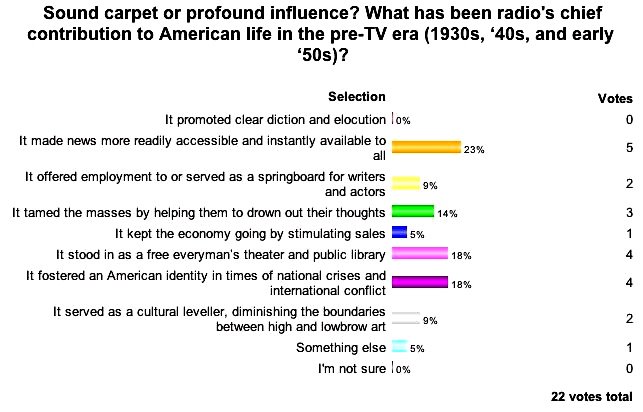
Well, it was time to close the sixth broadcastellan poll, if only to devise another in which you are herewith invited to participate. So, what, in my view, has been radio’s chief contribution to American life in the pre-TV era? There is some validity to all of the proposed replies (which I would not have bothered to list otherwise); and even though the statement that the medium “promoted clear diction and elocution” was endorsed by none, it was not meant to be facetious. Depending so much on the spoken word, radio producers certainly had more respect for it than today’s entertainers, artists whose mumblings are the Brad Pitt-falls of visual storytelling. And “Something else”? It might very well be broadcasting’s influence on the nation’s musical tastes, radio having served not only as an “everyman’s theater and public library,” but as a virtual concert hall.

Polls are nearly as fascinating to me as they are frustrating. I, for one, prefer not to give straight answers; I much rather respond or challenge, preferably after some reflection. The kind of question that can be answered decisively—the kind that requires one particular, supposedly right reply—is either unnecessary or suspect.

Nor can I rely upon my memory as a fail-safe system for the ready retrieval of data, pieces of trivia with which I’d rather not clutter up my mind. So, it is with some trepidation that I note a significant anniversary in American broadcasting: the quiz program Information, Please!, which had its radio premiere on this day, 17 May, in 1938 (and not, as the History Channel website will have you know, back in 1930).

Information, Please! was billed as a celebrity quiz program on which everyday citizens asked the questions that experts from the fields of literature, science, motion pictures or politics were called upon to answer. Noted guest panelists to appear on the show during its first two seasons (along with regulars like the aforementioned Oscar Levant) include movie director Alfred Hitchcock, playwright Moss Hart, as well as authors Ben Hecht, Rex Stout, Louis Bromfield, and Christopher Morley.

Here are some of the questions raised during the first program:

“Correct the following line and name its author. And the line is: ‘In the spring a young man’s fancy always turns to thoughts of love.'”

“In what well-known symphony did the composer include a chord in order to awaken a sleeping audience?”

“How is immigration to the United States from the following nations restricted: England, Brazil, China?”

“Kyosti Kallio is a Greek Island, a dictator of Peru, President of Finland, or the name of a Japanese political party?”

Unlike the quiz and giveaway programs of late 1940s—which had an even more devastating effect on the production of dramatic entertainment than the reality show format has on today’s television storytelling—Information, Please did not depend for its success on shrewdly engendered greed and promises of instant gratification, whether experienced by the participant or felt by the listener. This does not mean, however, that the instincts worked upon by the comparatively sophisticated Information, Please were any less basic.

“Now, folks,” moderator Clifton Fadiman greeted the audience, “any education that you and I may pick up for the next half hour or so is all to the good; but beyond that we’re out simply to play this as a game and have some fun at it.” And the “fun” of Information, Please! was not so much the thrill of getting it right, but of witnessing others of supposedly “towering intellect” (as Fadiman put it, mockingly) struggle and fail to meet the public’s challenge. To “stump the expert” was the objective, which was nothing less than an exercise in ridiculing the artist and the intellectual in a joyous vindication of mediocrity.

On This Day in 1951: A Radio Sitcom Is Cited by the Chamber of Commerce

Well, I can’t say that I have been, lately. Well, I mean. My digestive system is on the fritz, and my mood is verging on the dyspeptic. So, if I am to begin this entry in the broadcastellan journal with “Well”—as I have so often done these past six or seven months—it must be a brusque and slightly contentious one, for once. My jovial, welcoming “Well,” by the way, was inspired by Paul Rhymer’s Vic and Sade, a long-running radio series whose listeners were greeted by an announcer who, as if opening the door to the imaginary home of the Gook family, ushered in each of Rhymer’s dialogues with expositions like this one:

Well, sir, it’s a few minutes or so past eleven o’clock in the morning as our scene opens now, and here in the kitchen of the small house half-way up in the next block we discover Mrs. Victor Gook industriously bending over her ironing-board. Tuesday is the time usually given over to this task, but the holidays have more or less thrown Sade off schedule. And so she irons. But there’s a newcomer approaching apparently . . . because the back door is opening. Listen.

Writing my introductions, I chose to omit the gendered address; but I hope to have retained the friendly, casual tone of the interjection.

Now, Vic and Sade was one of those shows that did not successfully transition to the radio format that became such a staple of television entertainment: the situation comedy or sitcom. Rhymer was a raconteur, not a dramatist; he allowed his characters to reveal something about themselves through their words, rather than their actions. If you, like me, enjoy the Golden Girls, imagine Rose, Blanche, Dorothy and Sophia sitting around the kitchen table, telling stories about St. Olaf, the old South, Brooklyn and Sicily—without the dramatized flashbacks. The situation comedy became popular in the mid-1940s; and it did away with the old vaudeville routines, the minstrel shows, and the quietly funny Americana in which Rhymer excelled.

On this day, 2 May, in 1951, one of the finest American radio sitcoms was being honored in Washington, where the cast performed before members of the Chamber of Commerce. The program, which had just received the prestigious Peabody Award, was the aforementioned Halls of Ivy, and the cast was led by Ronald Colman (as William Todhunter Hall, the president of an imaginary American college) and his wife, Benita Hume (as the academic’s refreshingly non-academic spouse, a former stage actress). What made The Halls of Ivy worthy of such accolades was writer-creator Don Quinn’s ability—and the sponsor’s willingness—to tackle a number of social problems, whether topical or universal.

In the spring of 1951, that problem was the Korean War and the resentment with which the draft was greeted by college students who believed to have had their future mapped out for them and now found their careers derailed, their very lives in danger. On Halls of Ivy, the resulting campus unrests were dealt with in a rather tentative and sentimental manner; but Quinn’s sophisticated prose—peppered with smart puns, metaphors, and literary allusions no other radio or television sitcom can hope to rival—make this a worthwhile entry in the annals of Ivy.

Asked to speak before the members of the Chamber of Commerce, Colman had this to say about his radio role (which he later performed on television):

I want to thank you for being such an appreciative audience and for accepting me as a college professor. Come to think of it, I can’t be too bad at that because, I believe, I am probably the only college professor in the country that can take a difficult problem and solve it in exactly half an hour. More that this, I can do it every week.

Highlighting the strength of the program, Colman was also pointing out its weakness. Today, in the post-Seinfeldian era of social irresponsibility in entertainment, the problem sitcom strikes many as simplistic and hypocritical. Of course, most of us fail to express our cynicism and anti-social rants nearly as eloquently as any of the makeshift wisdom shared by The Halls of Ivy.

Realism may lie well beyond the scope of witticisms and sentiments—but the monosyllabic insult and the actions-speak-louder-than-words approach to problem solving contribute even less in the shaping of a better reality for us all.

How About a Cup of Freshly Mined Uranium?

Well, we’ve all pulled stunts the memories of which are best pushed back into the farthest recesses of our cranial database—unless, of course, such anecdotal evidence of our dimwittedness might serve some educational purpose or is just too temptingly absurd not to be passed on for a few laughs at our expense. Ever tried walking on water? I sure did—and very nearly drowned in the realization that slipping your feet into a pair of water wings won’t do the trick.

Some folks, myself included, never entirely grow out of this awkward—and at times perilous—stage of rationed rationality, a protracted dizzy spell during which life unfolds as a series of trials by misfire. How comforting it is then to find one’s preposterous self in fictional characters—and to find oneself outdone by them in folly and futility.

At a period in not-too-distant American history—the Great Depression of the 1930s—when formerly secure or relatively well-to-do folks were suddenly forced to live by their wits and found them wanting, radio was a reliable purveyor of reassuring fall-guy tales, stories of crazy schemers like Lum and Abner, proprietors of the Jot-Em-Down Store in the imaginary backwoods community of Pine Ridge, Arkansas.

Never quite satisfied to run their unassuming store, Lum and Abner were always in search of a sure-fire get-rich-quick venture, whether it meant digging for oil or running a matrimonial bureau. Their common sense did not match their ambitions, creating plenty of opportunities for quacks and swindlers.

On this day, 27 April, in 1942, for instance, they were dreaming of real estate, a mighty complex of “Wonderful World Apartments,” for the erection of which they were promised, free of charge, a contractor who, they had not reason enough to doubt, had been responsible for the construction of the Empire State Building.

During the lean years of the depression and the time of personal sacrifices that was World War II, Lum and Abner’s antics were occasionally rendered relevant by drawing attention to a particular need or service, be it the demand for scrap metal or the benefits of local bookmobiles.

Shortly after the end of the war, however, such built-in public service announcements and dramatized propaganda seemed out of touch with listeners who had been told to do without (or do with less) for too long. Freed from the constraint imposed upon them during the war, the creators of radio entertainment could once again be unabashedly escapist and thoroughly commercial.

The dropping of the atomic bomb—a drastic act of getting it done and moving on at last—was greeted as the dawn of a new era: a peaceful one, it was hoped; but certainly one of renewed and indeed unprecedented consumerism, of wish-fulfilment and instant gratification. Rather than being rendered dreadful and threatening, radioactivity was sold to the public as a boon, the very fount of ready-made enrichment.

Barely a month after V-J Day (14 August 1945), Lum and Abner believed themselves to be in possession of this new and most magical source of energy—uranium. If only their neighbor, Cedric Weehunt, had not attempted to boost his own strength by having a sip from the cup supposedly containing “that uranium stuff.” In one of the serial’s ostensibly comic cliffhangers, Lum and Abner assume their friend to have been transformed into a dog as a result of imbibing the substance.

Such clowning around, such Enola Gayety, was a heavy-handed attempt at making light of an incredible burden. Even if the long-lasting effects of radiation were not fully grasped for some time—a horrifying discovery exploited in the sci-fi thrillers of the 1950s—the trivializing of uranium so shortly after the bombings of Hiroshima and Nagasaki now comes across as a distasteful act of raising a cup to nuclear fallout, of toasting the loss of thousands of civilians.

On This Day in 1943: Arthur Miller Asks Americans to "Listen for the Sound of Wings"

As I sat at my desk on this cool, gray April afternoon, looking out onto the Welsh hills, I found myself transported back to—or at least forcefully reminded of—my childhood in Germany. It wasn’t the view of my present surroundings that brought on these not altogether pleasant recollections. It was a recording of Arthur Miller’s “Listen for the Sound of Wings,” a radio play first broadcast on this day, 19 April, in 1943. While not a great dramatic achievement, it serves as a reminder to me just why I have not set foot on German soil in nearly sixteen years.

It is not any single event that made me vow never to return in anything other than a wooden box. It is the sense of being tainted, of being part of a violent and terrifying past which isn’t past at all but still very much present in the minds and attitudes of the German people. That one side of my family was somehow connected with one of the characters in the play—Joachim von Ribbentrop, for whose family my grandmother worked as a seamstress—only makes such reflections about my native country more dreadful to me.

Miller’s play dramatizes the life of Martin Niemöller, a German pastor who dared to speak up against the Nazi regime, and act of treason for which he was imprisoned and for which he nearly lost his life. Miller’s portrayal and the performance of the avuncular, gentle-voiced Paul Lukas, make Niemöller sound like a naïve believer who, concerned about the decline of faith in Germany, agrees to side with the emerging Nazi party when promised that, once in power, the fascists would assist in restoring the erstwhile prominent role of the church.

Eventually, the pastor realizes his grave mistake—an error in judgment that not only endangered his own life but led to the persecution and slaughter of millions. Resisting attempts at cajoling or coercing him into cooperation, he yet remains hopeful as, from his prison cell, he looks westward to “Listen for the Sound of Wings”—the wings of allied planes that to him are angelic messengers who signal that the “word is born again.”

Niemöller’s past, his initial acceptance—and indeed support—of anti-Semitism is being glossed over in this propaganda play to emphasize the message that one of the great American freedoms—the freedom of religion—was under attack elsewhere and that it was a mission of the US military to protect such rights at home and restore or establish them wherever threatened. What Miller’s play does not represent is captured in Niemöller’s own words, uttered some thirty years after the end of World War II. Here is one version of the original (which was initially spoken and not written down), followed by my own translation:

Als die Nazis die Kommunisten holten, habe ich geschwiegen, ich war ja kein Kommunist.

Als sie die Sozialdemokraten einsperrten, habe ich geschwiegen, ich war ja kein Sozialdemokrat.

Als sie die Gewerkschafter holten, habe ich geschwiegen, ich war ja kein Gewerkschafter.

Als sie die Juden holten, habe ich geschwiegen, ich war ja kein Jude.
Als sie mich holten, gab es keinen mehr, der protestieren konnte.

When the Nazis came for the Communists, I kept quiet.  After all, I was not a Communist.

When they locked up the Social Democrats, I kept quiet.  After all, I was not a Social Democrat.

When they came for the Labor Unionists, I kept quiet.  After all, I was not a Labor Unionist.

When they came for the Jews, I kept quiet.  After all, I was not a Jew.
When they came for me, there was no one left to protest.

The Germans were fortunate in having had a rescuer in the United States; but enough remains of the spirit of fascism and of professed realizations or belated admissions of its dangers, as exemplified by Niemöller’s story, to make me uneasy about the Teutonic nature. And then there was the time, decades after the end of the Third Reich, when I, too, was introduced to the von Ribbentrop family, my grandmother having remained loyal to them long after Nuremberg. Perhaps that is why, when I am looking eastward, I still listen for the sound of the right wing.

On This Day in 1939: Pearl S. Buck Gets Into the “Patriot” Act

I had intended to spend much of today al fresco, our long-neglected garden being in serious need of attention. Dragging the old lawnmower out of hibernal retirement a while ago, I had managed to knock over a can of paint and, the spilled contents being blue, very nearly ended up looking like a Smurf in the process. No sooner had we unleashed the noisy monstrosity, engulfed in a cloud of smoke, than one of its wheels broke off, which immediately put a stop to my horticultural endeavors. It is to the latter mishap on this Not-So-Good Friday and the fact that I am all thumbs (none of which green) that you owe the questionable pleasure of this entry in the broadcastellan journal.

An afternoon’s dilly-dallying among the daffodils may be just as escapist an act as tuning in an old radio program. In either case, however, it is difficult to get very far away from the news of the day, headlines so maddening and haunting that there is little relief even in irreverence, in mocking those among our political leaders who turn a blind eye to the signs of the times or who succeed in nothing more than in making enemies and alienating their allies.

Are we to believe, are we to accept that a nuclear attack from Iran is to be expected and that a pre-emptive raid is therefore necessary? Is it impossible to win a war—on terror, no less—without waging one? Is it possible to win (in) any violent conflict? On this day, 14 April, in 1939, Nobel Prize winning author Pearl S. Buck (pictured above) appeared on the Campbell Playhouse to address this very question.

Orson Welles, the official producer of this weekly radio series featuring adaptations of stories, plays, and motion pictures, had chosen Buck’s latest novel, The Patriot, as the “best new book for April” and presented a dramatization of the narrative starring Anna May Wong. Shaking hands with Welles and Wong during the curtain call, Buck was invited to comment on the “situation in the east,” the Chinese-American war that may have seemed even more remote, incomprehensible, or irrelevant to Americans than the crises in Europe. Welles inquired whether it was possible to sympathize with China and Japan alike in this conflict. To this, Buck responded:

When one has had experience of many wars, one comes to see that the pattern is always the same. No matter who is the aggressor and who is attacked, both are victim and both lose in the end.

To be sure, such a remark would not have been welcomed some two and a half years later, when the US felt compelled to enter the Second World War after the bombing of Pearl Harbor. Yet patriotism might find expression other than jingoist speech and the complexities of war called for responses other than simple slogans. Realizing the significance of radio as a means of connecting (with) the world and addressing far-reaching political and humanitarian crises, Buck decided to become a radio dramatist herself.

As Erik Barnouw relates in his Media Marathon, Buck enrolled incognito in his class (Radio Writing U2) at Columbia University to prepare for a proposed series of plays titled America Speaks to China. During the Second World War, she went on to write a number of propaganda plays about Asian-Americans and the relationship between East and West.

Today, perhaps, more people are beginning to discern the pattern Buck pointed out. And, once again, the definition, the concept of the patriot is changing: the action hero, the go-getter of few words now seems infinitely less desirable and rare than the thinker who not only knows how to use each word effectively but can be trusted to keep it.