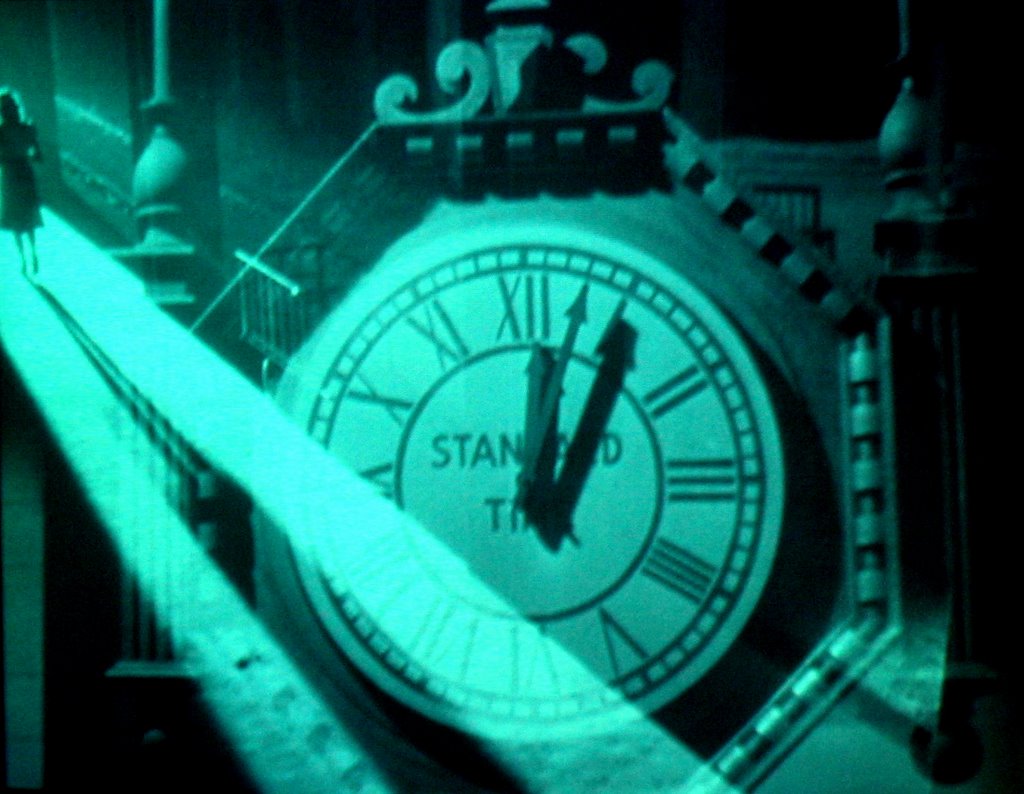
On This Day in 1930: Murder Trial Broadcast Summons Millions to Court

Well, it is Black Friday here in New York—the stores are opening at preposterously early hours and shoppers are lured away from their leftover turkey with promises of early bird specials and nest egg busting savings. Too lazy after a sumptuous Thanksgiving meal, I am not partaking of any 5 AM bargain debasements. Instead, I am going to celebrate yet another milestone in radio drama history—The Trial of Vivienne Ware, which opened on this day, 25 November, in 1930 and ushered in a new age of cross-promotional multimediacy.

“There’s murder in the air,” the New York Times had announced in its Sunday radio section, predicting that The Trial of Vivienne Ware would “occupy the attention of listeners over WJZ’s network for six consecutive nights beginning Tuesday.” Considerably more enthusiastic was the New York American, which declared the six-part serial to be “one of the most stirring mystery radiodramas ever presented,” quoting NBC president M. H. Aylesworth as saying that its script “established a new standard in the creation of radio plays. The simplicity and fidelity of the theme, together with the colorful word and character pictures, stand out in this new field of adaptive writing.”

The New York American—the Hearst “paper for people who think”—had good reason to eulogize the as yet unaired serial as “one of the best radio dramas ever written,” given that the program had been conceived by one of its own feature writers.

Every effort was made to prevent the program from appearing like a cheap marketing ploy and to convince WJZ, New York—the flagship station of NBC’s Blue network—to produce the series in its glass-curtained Times Square studio atop the New Amsterdam Theatre and to broadcast the event locally instead of making the required six half-hour spots available to national advertisers.

Certain to impress NBC executives was the fact that—along with Ferdinand Pecora, Assistant District Attorney of New York, and prominent New York attorney George Gordon Battle—none other than US Senator and Supreme Court Justice Robert F. Wagner had agreed to participate in the mock trial by assuming the role of the presiding judge. The titular heroine was played by Rosamund Pinchot, a stage actress who had appeared in Max Reinhardt’s celebrated staging of The Miracle, and the entire spectacular was supervised by well-known Broadway producer John Golden.

“Ladies and Gentlemen of the Radio Jury,” Wagner addressed the audience during the inaugural broadcast:

You have been called to one of the most trying tasks which befalls the lot of a citizen. You are to try a fellow being on a charge of first degree murder.  It is the more difficult for you in that this defendant has everything which would make life for any young woman most desirable.  Yet it may become your solemn duty to deprive her of her enjoyment of that life.

Standing to gain cash prizes for the most convincing verdict, readers of the New York American were advised to prepare themselves by taking in the published “information” daily, since they might miss “important loop-holes” if they did not “carefully follow the testimony and the evidence” as presented on the radio. “By reading the New York American every morning” throughout the trial and by “tuning in on WJZ each night at the specified time,” readers should be able to form their verdict as to Miss Ware’s guilt or innocence—“just like any other juror.”

According to Radio Digest, verdicts, letters of congratulations, and demands for a sequel were received from places as remote as Canada and Virginia, as well as from ships at sea; an estimated 14,000 listeners eventually acquitted the fictional heroine on trial, with about 2000 arguing the “society girl” to be guilty. More significant for the publisher was that the serial had increased the circulation of the New York American “far in excess of expectations,” as a result of which Hearst papers in San Francisco, Chicago, Los Angeles, Washington, and Omaha sponsored the trial with different casts of local luminaries.

A follow-up trial involving the murder victim’s less privileged “friend,” nightclub singer Dolores Divine, was staged a few weeks after the acquittal of the first defendant. A generic version of the radio scripts for both serials, prefaced by excepts from the printed reports and concluding with the audience verdict, was subsequently published by Grosset and Dunlap, which marketed Kenneth M. Ellis’s The Trial of Vivienne Ware as the “first radio novel, an innovation in both the radio and publishing worlds.”

Unfortunately, no recordings of this interactive multi-media event seem to have survived. I sure would have enjoyed tuning in . . .

Avian Flu Threats and “The Birds” on the Wireless

“What’s on the wireless?” he said. “About the birds,” she said. “It’s not only here, it’s everywhere. In London, all over the country. Something has happened to the birds.”—Daphne du Maurier, “The Birds” (1952).

Lately I have been eyeing our bird feeder with considerable apprehension. Not because I am anticipating some sort of Tippi Hedren incident while taking care of my feathered charge, but because of the recent news about the deadly avian flu that has been spreading in the east. Some time ago, a UN health official warned that a pandemic “could happen at any time” and might “kill between 5 and 150 million people.” Today, the EU decided to “ban all Turkish live bird and feather imports,” after as many as sixty people had succumbed to the disease in Turkey and Romania. Should I banish the feeder from its prominent spot to some remote corner of the garden? Should I stop treating the local tits and finches to their daily allowance of choice peanuts? Back when Daphne du Maurier conjured up ornithological horrors with her short story “The Birds,” at least, the threat was posed by bills and beaks instead of bacteria.

Long before Alfred Hitchcock trained them for his big-screen spectacular, “The Birds” came to US radio in two noteworthy productions by the Lux Radio Theater (20 July 1953) and Escape (10 July 1954). Unlike Hitchcock’s thriller, both radio versions were remarkably faithful to du Maurier’s simple tale of (wo)man versus nature. The 1953 production, starring Herbert Marshall, was probably one of the most imaginatively soundstaged melodramas ever to be presented on the Lux program. The terror generated by an imaginary army of shrieking birds was a veritable tour de fowl in sound effects engineering. Even Marshall had to admit that he was “scarcely the star of the piece when you consider the gulls and the gannets. Villains that they were, they ran the whole show.”

The story of a family under attack in an avian air raid on a remote farmhouse was rendered more intense by the fact that the terrorized characters, like the listener at home, had only the radio to keep them updated to the minute about the world around them. In du Maurier’s “Birds,” tuning in became disquieting, the wireless a source of anxiety to a public dependent on and attuned to the comforting predictability of the precisely timed broadcast schedule:

. . . they’d been giving directions on the wireless.  People would be told what to do.  And now, in the midst of many problems, he realized that it was dance music only coming over the air.  Not Children’s Hour, as it should have been.  He glanced at the dial. Yes, they were on the Home Service all right.  Dance records.  He switched to the Light programme.  He knew the reason.  The usual programmes had been abandoned.  This only happened at exceptional times.  Elections, and such. . . .

At six o’clock the records ceased.  The time signal was given. . . .  Then the announcer spoke.  His voice was solemn, grave. . . .

“This is London,” he said, “A national Emergency was proclaimed at four o’clock this afternoon.  Measures are being taken to safeguard the lives and property of the population, but it must be understood that these are not easy to effect immediately, owing to the unforeseen and unparalleled nature of the present crisis. . . .  The population is asked to remain calm, and not to panic.  Owing to the exceptional nature of the emergency, there will be no further transmission from any broadcasting station until seven a.m. tomorrow.” 

They played the National Anthem.  Nothing more happened. . . .

Here, as in “The War of the Worlds” (the fictional account of a war won by airborne bacteria, no less), the silencing of the relied-upon media is even more alarming than the tumult and the shouting it carries into our homes. . . .

On This Day in 1950: Our Miss Brooks Tackles Climate Change, Global Media, and Communism

Well, I know, today marks the anniversary of Ozzie and Harriet, whose on-the-air adventures were first heard on this day in 1944. Since a transcription of that broadcast is not known to be extant—and since I am not particularly partial to the exploits of the Nelson clan—I paid a visit to Walter and Harriet instead. High school sweethearts Walter Denton and Harriet Conklin, that is, and their peerless teacher, Our Miss Brooks. On this day, 8 October 1950, Miss Brooks got into quite a “tizzy”—”And I don’t tizz easily,” she assures us.

Being temporarily left in charge of Madison High School after its principal, the irascible Mr. Conklin, is delayed at home awaiting a furniture delivery, Miss Brooks finds herself dealing with a potentially serious crisis: a hurricane with winds up to 150 MPH is fast approaching. At least, that is the news according to the weather bulletin she has picked up with the radio receiver Walter built for his Electrical Shop class.

The bad weather has been on everyone’s mind that morning. “Our climatic conditions are undergoing a slow but steady change,” heartthrob biology teacher Mr. Boynton informed her earlier. “It’s something of a meteorological phenomenon, but do you realize that at this very moment the equatorial belt is slipping slowly southward?” “Well, I’ll turn my back. You tighten it up,” she permitted herself to quip. “It’s entirely possible that in the future our area may be engulfed in icy arctic weather,” Mr. Boynton continued his lecture. Of course, that would take about 10,000 years. “Good, I should be finished knitting my mittens by then,” Miss Brooks sighed in relief.

And now the weather report! “Mr. Boynton said our climate was changing, but this is ridiculous.” Or is it? As acting principal, Miss Brooks decides to follow the advisory and closes the school. Together with Walter, Harriet, and Mr. Boynton, she rushes to the principal’s home to make her report. In the fever of excitement, it escaped all who listened that the bulletin came from “downtown Bombay, India.”

A no-nonsense academic, Mr. Conklin is none too pleased about Miss Brooks’s rash actions, dismissing the reports about the advancing storm as “unmitigated jabberwocky.” After all, he reasons, “How could a hurricane possibly get this far into the United States?” “Smugglers?” Miss Brooks dares to suggest. Yet when Walter turns on the receiver he has brought along, the advisory hits home. Listeners are being told to “board up all windows,” preferably by “using bamboo shoots.”

Convinced by the urgency of the newsflash, Mr. Conklin agrees to take the precautions deemed necessary and the storm watchers are heard cheerfully and noisily chopping up his brand-new garden furniture.

It is only after the damage has been done that the advisories are beginning to sound rather peculiar: “lash down your ox carts,” the radio voice cautions. “Disperse all natives to the hills” and “Be sure to tether your elephants carefully.” The mistake becomes painfully obvious to all. Now it is no longer the hurricane that poses a threat to Our Miss Brooks. It is the frightful wrath of Osgood Conklin. She’d better watch after her priceless porcelain (pictured above)!

I doubt whether such a light-hearted approach to deadly weather phenomena would go over well these days. Now, as I confessed previously, I had a similar experience misreading a radio report about a natural disaster when I came across a fake bulletin on the Jeremy Vine Show. And, as is often the case, the prospect of such horrors heading one’s own way was taken in differently than reports about far-off disasters.

Miss Brooks expressed no concern either for the “natives” in India who hovered in their wind-whipped huts. The weather was really not perceived as that much of a national or global threat back then. In 1950, that threat, Westerners were made to believe, was communism.

Now, Miss Brooks had something to say about communism, or about the dangers faced by those who interpreted their granted freedoms too freely. When subjected to a particularly dull meteorological observation by Mr. Boynton, the hunk oblivious to her charms, she sneers: “You’ll never be investigated for that remark.”

In this one innocuous line, Our Miss Brooks writer Al Lewis communicates the fears of radio artists who found themselves subject to persecution by the House Un-American Activities Committee. Yet as soon as she had hung up her schoolteacher costume, actress Eve Arden was asked to step before the microphone once more to address all those “concerned about the threat of communism.”

As if in fear of being “investigated for that [aforementioned] remark,” she urged listeners to join the “crusade for freedom” headed by General Lucius Clay and to support . . . Radio Free Europe.

What if Walter Denton had picked up Radio Free Europe on his receiver that rainy October morning? What if Mr. Conklin had dared to make his president responsibility for hurricane emergency mismanagement? What if . . . Well, no such controversy on Our Miss Brooks—but don’t call those dated radio sitcoms apolitical. Tune in some time, won’t you, for some unexpected lessons in American history.

On This Day in 1941: Carl Sandburg Talks (to) the People

Well, the castellan is back in his element, which is air, preferably arid. Surely it is not water. I am still drying out—coughing, sneezing, and slowly recovering—from the why-not folly of riding a rollercoaster on a rain-soaked night in Blackpool, England. Listening to the soundwaves of old broadcasts seems a comparatively safer contact with the air—and a more edifying one at that—than having one’s aged bones twirled and one’s addled brains twisted in a series of gravity-defying thrill rides.

Yet while there might have been little instruction in this bathetic experience of fairground gothics, there still was a thought to be distilled thereafter from the confines of my soused cranium. It was the thought of one who stood by in spirit that night, one taking notes while passing through a sea of everyday people; it was a passing thought of one once known as the people’s poet, America’s Carl Sandburg.

A while ago, I asked what a soundscape of Britain might turn out to be, if ever there were such an exhibition devoted to regional noise. The voicescape of the United Kingdom has been quite thoroughly mapped since then, with the BBC’s voices project capturing the diverse accents of the British Isles in hundreds of recordings now online, including a group of Blackpool Romany.

For anyone moving here with memories of Dick Van Dyke Cockney, finding everyday British voices charted like this is a revelation (even though I doubt whether my own German high school English gone Nu Yawk and Wales is represented in this mix). Carl Sandburg, who set out to render and represent the thought and speech of the American every(wo)man in the 1920s and ‘30s, might have embraced such a charting of diction—even though a map like this still calls for the voice of a poet to make it sing and signify. Sandburg attempted just that.

On this day in 1941, when the United States anxiously eyed a United Kingdom at war, Sandburg addressed American radio listeners on the long-running Cavalcade of America program in an effort to celebrate a unified diversity. The play, “Native Land,” opened with words read by actor Burgess Meredith, who reminded all tuning in of the timeliness of the lines to follow:

Monday, September 22, 1941. A number on a calendar, arrived at after a million years of watching the stars, of telling the time of harvest by a shadow foreshortening, and the time of planting by the sun in the equinox. September 22, 1941. We will start at the beginning; for the beginning was the land and the stars moving overhead. And that is today, this week, the land America—a beginning. And the land is what people have made of it, what people are making of it in this fourth week of September. . . .

The ensuing broadcast, which interwove excerpts of Sandburg’s verse with its author’s autobiography, expounded on the thought that a “poet must do a lot of listening before he begins to talk.”

“Where do we get these languages?” Sandburg wondered, as actor’s voiced snippets from everyday speech picked up on the streets of the poet’s home turf, Chicago. Now that the “people in cities had forgotten the old sayings,” they “talked a new lingo,” a vocal vibrancy to which the program was meant to be an anything-but-mute testimonial. The voices of the people were worth preserving, the broadcast suggested. Yet, with war in the offing, a task larger than one to be undertaken by a librarian and curator of sounds was at hand—the preservation of the people itself.

In keeping with the at times sanctimonious patriotics of the DuPont-sponsored Cavalcade program, the broadcast concluded with Sandburg’s appropriation of words from Abraham Lincoln’s Second Annual Message to Congress (1 December 1862); they were, Sandburg remarked, “Lincoln words for now, for this hour”:

The dogmas of the quiet past are inadequate to the stormy present. The occasion is piled high with difficulty, and we must rise with the occasion. As our case is new, so we must think anew, and act anew. We must disenthrall ourselves, and then we shall save our country.

In his own words compiled and adapted from his 1936 voice-collage The People, Yes, Sandburg insisted in cautious optimism that the “learning and blundering people will live on”:

This old anvil,
the people, yes,
This old anvil laughs at many broken hammers. . . .

Today, in our own “stormy present,” the internet has become the new smithy of thought. It is the workshop in which the “old anvil” is sounded anew, where people may “think anew” and speak anew, not only to suit new cases, but to revisit old. Now, I wonder whether my own language is suited to the task to revisit and reacquaint, whether I should not spent more time listening before speaking.

It sure felt comforting to hop on the rollercoaster in Blackpool, just to scream and laugh for a change. Queer and quaint, my verbiage seems ill-chosen at times to communicate my thoughts, to argue my cases old and new. . . . Still, it is my tongue, and I must have it out.

On This Day in 1942: Tyrone Power Slips Out to War on a Bar of Soap

In the days before television and video, Americans who felt like taking home a movie tuned in Monday nights to CBS radio and took in the Lux Radio Theatre, a lavishly produced and highly popular dramatic program on which Hollywood stars performed in audio versions of motion pictures old and new. The Lux listeners did not expect political drama or social commentary, but an hour of romance, gossip, and soap commercials. On 14 September 1942, however, as the Lux Radio Theatre returned from its customary summer hiatus to raise the curtain on its eighth season, the audience was greeted by host Cecil B. DeMille (pictured here with Loretta Young and Fred MacMurray) with the following announcement:

“Once more it is opening night in the Lux Radio Theatre; but a new kind of opening night. Without benefit of searchlights or brightly lit marquees. Like Broadway’s White Way, Hollywood Boulevard’s Neon Lane is dimmed out for the duration.”

There was a war on—and the producers of radio entertainment were learning how to carve a handgun out of soap and to turn bubbles into ammunition. Not to offend the war-weary, the famed producer-director quickly added: “But there’s no dim-out on glamour and adventure inside the Lux Radio Theatre tonight.”

The play presented live that evening was “This Above All,” a wartime melodrama based on the 1941 movie and novel of the same title. The “first great love story to come out of this war,” DeMille declared, it’s “what the critics call an important drama and what the public calls great entertainment.” Sure, it was “the story of two people. A man and a woman from different worlds. One reared in poverty in the slums of London [dashing Tyrone Power, mind you], the other a child of England’s aristocracy [Barbara Stanwyck, miscast in the Joan Fontaine part].” But it was “also a story of England today, an England in which social barriers are forgotten in the united effort of all her people to fight this war.” Above all, it was the story of radio propaganda itself.

“This Above All” begins with war news, brought, via radio, into the home of the class-conscious Cathaways. “Well there’s one good thing about the wireless,” remarks the haughty aunt of heroine Prudence Cathaway. “You can always turn it off.” Prudence is tired of such talk and ashamed of her family’s high-toned isolationism: “When you talk I seem to hear words oozing through the holes of a moth-eaten sofa,” she tells her shocked elders. “I’m in 1940 and you’re in 1880. Your kind of thinking is more dangerous to us than Hitler is.”

Having joined the Women’s Auxiliary Air Force, Prudence meets and falls in love with a private who, confused about the aims of the war, decides to desert. She gives a passionate speech about why England is worth fighting for, but is unable to sway her war-torn lover. On the run from the military police, the deserter is exposed to several speeches about duty and faith, but is ultimately converted by the experience of rescuing some of his fellow citizens during an air raid. He realizes what he could not quite see when told of it by the aristocratic Prudence, his superiors, and a priest: he is one of millions drawn together in the common cause that make commoners out of all.

The Lux broadcast underscores this message by reminding listeners that Rosalind Russell was going to entertain the troops and that she, having just filmed a romance about a “girl flyer in the pre-war Pacific,” might “even tour the Pacific in reality.” That stars were real folks—and that radio brought all folks together was further driven home in DeMille’s curtain call:

“And now ladies and gentlemen, I must to tell you that this is the last time we’ll be able to have Tyrone Power in the Lux Radio Theatre for months or perhaps years to come. He’s made a contract with Uncle Sam; and within the few two weeks, he’ll report to the United States Marine Corps as Private Tyrone Power.” Thundering applause from the studio audience follows.

The conflicting or, at least, competing aims of selling soap, promoting Hollywood, and delivering propaganda may have resulted in a confusion of disingenuousness at odds with the Shakespearean motto referenced in the title of that night’s story and read by Prudence to her lover:

This above all: to thine own self be true,
And it must follow, as the night the day,
Thou canst not then be false to any man.

Somehow, though, the long-running Lux program escaped a wartime identity crisis and, on that night, managed to tell a compelling story justifying its own existence.

Flinging the Book: Archibald MacLeish, the Airwaves, and the Anniversary of Atahuallpa’s Death

Archibald MacLeish (right) with (from left to right) Orson Welles, Betty Garde, and Ray Collins in rehearsal for Air Raid (1938)

Well, I thought I’d better carry on with my Spanish lessons, having discovered, upon leafing through the travel guides, that I am not merely linguistically challenged but culturally ignorant as well.

 According to one guidebook (admittedly, a someone dated volume), the citizens of Madrid—the madrileños—have a “lingering suspicion of foreigners” and are reluctant to speak English. Granted, it’s been a while since conquistadors rather than tourists filled Spain’s coffers, but the Spaniards have been known to be somewhat insensitive when it comes to other cultures. There sure is dirt under the old welcome mat.

On this day in 1533, for instance, Francisco Pizarro put an end to the Incan empire by doing away with emperor Atahuallpa. The Incas were not a chirographic people and did not appreciate having the book flung at them—especially not the good book. Intrigued by the thought that the demise of the Inca meant not only the loss of their aureate treasures but of their aural tradition, I flung my travel guides aside and tuned in again to one of the more ambitious if lesser known American radio series of the 1940s, Archibald MacLeish’s American Story.

A Pulitzer Prize winner for his poem Conquistador (1933), MacLeish (above, right, in a photograph reproduced in Irving Settel’s Pictorial History of Radio), was one of the first American writers to take radio seriously and to encourage others to emerge from their ivory towers by broadcasting their choice words to the masses. After all, he remarked in the foreword to The Fall of the City, his first and most significant contribution to the aural arts, “what poet ever lived who was really satisfied with writing the thin little books to lie on the front parlor tables?”

As a Librarian of Congress, MacLeish enjoyed ready access to many an obscure document—and radio offered an opportunity of sharing this wealth of unheard words. Rather than dramatizing scenes from history books, MacLeish wanted to let ancient texts speak for themselves:

To place historical personages in historical situations and then imagine the words they must have spoken to each other is to imitate the historical dramas of the stage at the expense of radio’s unique function and unique opportunity.  Because radio is limited mechanically to sound, and particularly to the sound of speech, radio is capable of a concentration upon the speech itself, the text itself, which can give words a life and a significance they rarely achieve outside the printed page—and which they achieve there only for the most gifted and fortunate readers.

In “The Many Dead,” one of the scripts for the American Story series, MacLeish drew on the writings of Pizarro’s secretary Francisco de Xeres to recount the death of emperor Atahuallpa. In order to convey this sobering story without turning it into sensational melodrama, the poet-historian chose to deliver the “pertinent excerpts” of Xeres’s official account in the somber and matter-of-fact voice of a clerk, a newscaster of his time:

The Governor [Pizarro] asked the Father Friar Vicente if he wished to go and speak to Atahuallpa with an interpreter. He replied that he did wish it, and he advanced with a cross in one hand and the Bible in the other [. . .] and [. . .] thus addressed him: “I am a Priest of God, and I teach Christians the things of God, and in like matter I come to teach you. What I teach is that which God says to us in this Book [. . .].”

Atahuallpa asked for the book that he might look at it, and the priest gave it to him closed. Atahuallpa did not know how to open it, and the Priest was extending his arm to do so, when Atahuallpa, in great anger, gave him a blow on the arm, not wishing that it should be opened [. . .].  Then he opened it himself, and, without any astonishment at the letters and paper, as had been shown by other Indians, he threw it away form him five or six paces . . . .

Then the Governor put on a jacket of cotton, took his sword and dagger, and, with the Spaniards who were with him, entered amongst the Indians most valiantly.
 Then the Governor put on a jacket of cotton, took his sword and dagger, and, with the Spaniards who were with him, entered amongst the Indians most valiantly.

According to Xeres’s account, Pizarro and his men “fearlessly seized” Atahuallpa and the infantry of the Spaniards “made so good an assault” on the fleeing natives that “in a short time most of them were put to the sword.”  Pizarro was said to have protected the emperor from the Spaniards—to give him the benefit of a proper execution—and was slightly wounded as a result.  “It was a very wonderful thing,” the clerk concludes, “to see so great a lord taken prisoner in so short a time [. . .].”

The men with the books have generally proved victorious over the vocal but readily muted thinkers who spread their words without the benefit of the printing press. Atahuallpa, bereft of his voice after rejecting the book, chose death by strangulation. Even MacLeish, as Librarian of Congress, largely failed in his attempt to return written records to the air and revive the breath that gave them life. Who, after all, still listens to his American Story today?

Now, I hear that the madrileños are a noisy, boisterous people; perhaps the powerful, silencing, and not-so-good book instilled them with confidence. . . .

Case Closed? The Piano Man, Olga Chekhova, and the Pleasures of Uncertainty

Well, the case of the “Piano Man” has been solved, it appears—and another mystery disappears. The denouement could hardly have been more disappointingly prosaic. It tends to be so with mysteries: unraveling them means to explain them away. “Mystery,” as I discovered when I looked up the word in my etymological dictionary, has its roots in muein, “to close the eyes,” as well as mu, a “slight sound with closed lips; of imitative origin.” Mystery is a condition, a state in which the people and things we perceive remain unclear; it is the temptation to discover and the pleasure of delaying the solution.

To “love a mystery,” as I put it in Etherized Victorians, suggests a delight in suspension rather than solution—a reveling in the act of unravelling in which what matters is a good yarn, not the clew one walks away with when it’s all done, or undone. It is a precarious and wondrous state of twilight and hushed voices, of bewilderment and speculation. That the biographical impulse to shed light on and make sense of things are at odds with the mysterious was conclusively demonstrated by a documentary I caught on BBC2 last night.

It was Antony Beevor’s account of his endeavor to tackle The Mystery of Olga Chekhova, a book I picked up a few months ago after having attended a screening of the silent movie Moulin Rouge, starring the alluring Ms. Chekhova. Niece of the playwright Anton Chekhov, major film star in Nazi Germany, and a spy for Russian intelligence, Chekhova sure is an intriguing personality; but little of that came across in the matter-of-fact sleuthing to which Beevor subjected her story.

In the documentary, we see him peeping through windows and rummaging through files in hopes of finding compelling evidence of her espionage activities; we hear him in conference with his translator, piecing together fragmentary data to forge causal relationships and force romance into patterns of logic. It was a dull display of diligence, only occasionally brightened by glimpses of his enigmatic subject.

The book itself, to be fair, is rather superior to the documentary, even though it nearly drowns the subject in heaps of historical detail surrounding her existence. As David Edgar remarked in his review, “somehow [Chekhova] seems smaller than her story, and it’s tempting to wonder what she would look like in the hands of a writer who could indulge in more speculation and extrapolation than the historian can allow.”

In search of truth, Beevor dismisses Chekhova’s brazen autobiographies as spurious. Factual lies, such embellished memoirs may tell so much more of the writer’s desire to be the author of her own life, to obfuscate and overwrite, to put pen to paper and eraser to past.

Over the years, “[r]umours about her mysterious life continued to grow,” Beevor writes in the concluding paragraph of his book. To me, the chief merit of his investigation is that it might give rise to further wonderings, that the rumors have not been quelled but quickened as a result. Grateful to the historian for having given me hooks on which to fasten my imaginings, I continue to dwell between the lines, where mystery lingers.

Right now, I am picturing Chekhova as a chameleonic adventuress, someone like the heroine of Top Secret, a radio series of spy thrillers starring “gorgeous Ilona Massey” (as she was tantalizingly announced). Here, as in Beevor’s documentary, mystery lies beyond tired phrases and contrived storylines; here, it is the allure of Ms. Massey’s voice that draws me in, just as Chekhova’s image captured my imagination when I saw her in the silent Moulin Rouge. Perhaps mystery is the willingness to take leave of at least one of your senses. Ahh, to be closing my eyes again . . .

The (T)error of Their Ways: Conrad, Hitchcock, and the Aftermath of the London Bombings

He had no future. He disdained it. He was a force. His thoughts caressed the image of ruin and destruction. He walked frail, insignificant, shabby, miserable—and terrible in the simplicity of his idea calling madness and despair to the regeneration of the world. Nobody looked at him. He passed on unsuspected and deadly, like a pest in the street full of men.

Thus ends Joseph Conrad’s long-in-the-works novel The Secret Agent. First published in 1920, the story had been conceived decades earlier, inspired by the terrorist bombings that took place in London during the 1880s and 1890s. In particular, it was the infamous 1894 attempt to blow up the Greenwich Observatory that served as a plot for Conrad’s narrative.

While based on events that occurred well over a century ago, the above passage could describe any suicide bomber today. Of this—Conrad’s The Secret Agent and its obvious connections to the recent acts of terror in London—I was forcefully reminded when I screened Alfred Hitchcock’s 1936 thriller Sabotage last night. I had not seen this film in years and, being unprepared, was startled by its up-to-dateness.

Even though Hitchcock was not particularly pleased with it, Sabotage is one of his most mature earlier thrillers. It has none of the adventure or intrigue of his better known pre-Hollywood films, such as the seminal but perhaps overrated caper The Thirty-Nine Steps; nor does it have the romance and humor of his lesser efforts, such as Rich and Strange or Young and Innocent. Instead, it offers a portrait of a terrorist so stark, so dark, so nearly naturalistic that it remains startling today.

Hitchcock claims to have regretted the scene in which the innocent young boy, Stevie, the brother of the terrorist’s young wife, is blown up while unknowingly delivering a bomb as instructed by his stepfather. Compared to the inane Hollywood endings we are still expected to endure—such as the infuriatingly contrived reunion of Tom Cruise’s character with his teenage son in The War of the Worlds—Hitchcock’s Sabotage comes across as relentlessly true-to-life. According to the conventions of Hollywood storytelling, characters with whom we identify are not generally blown to bits—especially not children.

The reality of our everyday, however, does not heed such conventions. The innocent are victimized without remorse, either by indiscriminate terrorists or their persecutors, as the story of Jean Charles de Menezes, wrongfully shot as a terrorist suspect, forcefully drove home in recent weeks; his story continues to unfold as the probing into his death lays bare some of the criminal errors of anti-terrorist actions.

Hitchcock always enjoyed telling the story of The Wrong Man—innocent people unjustly pursued by the authorities the director had dreaded since childhood. During the chase that is essentially the Hitchcock experience, our sympathies are more often directed toward the hunted than the hunter, encouraging us to reexamine established roles of criminal and persecutor, to question our definition of justice.

Sabotage tells the story of flawed and guilty people—the saboteur, who risks a boy’s life to carry out his mission of destruction, and his young wife, sister of the victim, who ends up stabbing her husband in revenge, despair, or sheer confusion (this is being left ambiguous). Even the boy—whom we catch early breaking a plate and filching a bit of food—is not altogether innocent; his tardiness and negligence contribute to his death.

Killer, victims, and hapless messenger alike are sentenced to death brought on by ruthlessness and ignorance. Only a combination of knowledge and ethics, of smarts and decency, can save those caught in the web of terror that is our everyday.

“God and Uranium”: Corwin, VJ Day, and the Disorientation of American Culture

Today, August 14, marks the 60th anniversary of VJ Day—the supposedly glorious day ending the second World War, a day of triumph in the wake of terror and devastation in Hiroshima and Nagasaki. On US radio, poet-journalist Norman Corwin commemorated the event with this hastily composed script:

Congratulations for being alive and listening. 

Millions didn’t make it. They died before their time, and they are gone and gone, for the Fascists got them. . . .  

Fire a cannon to their memory!

[Cannon.] 

God and uranium were on our side.

And the wrath of the atom fell like a commandment, 

And the very planet quivered with implications. 

Tokyo Rose was hung over from the news next day 

And the Emperor, he of the august stupid face, prayed to himself for succor. 

Sound the gun for Achilles the Atom and the war workers: Newton and Galileo, Curie and Einstein, the Archangel Gabriel, and the community of Oak Ridge, Tennessee.

Jubilantly joining the concept of God and the reality of uranium as if blessing the killing of thousands of civilians by the US and their allies, the celebratory broadcast titled “14 August”—expanded and rebroadcast five days later as “God and Uranium”—is one of Corwin’s few artistic misfires; insensitive, smug, and crudely patriotic in its derision of the “stupid”-looking emperor and his nuked subjects.

Did Americans really need to commemorate the dead by “[s]ound[ing] the gun,” by firing yet another cannon? After all, it was US weaponry, not “the Fascist,” that “got them” over in Japan. Unlike the subdued “On a Note of Triumph,” “God and Uranium” is an unquestioning sanction of total warfare, of nuclear means justifying the end—the end of a culture: “The Jap who never lost a war has lost a world: learning, / This too is worth a cheer.”

The “very planet quivered with implications,” all right, but the broadcast does not acknowledge the potentially terrible consequences of nuclear armament. These days, the implications continue to make themselves felt as more and more nations join the “community of Oak Ridge, Tennessee” and aspire to becoming atomic superpowers.

Instead, rather too sure about a peaceful future, Corwin’s salute to the victors asserts that the “peoples have come a long way since the time of Cain.” He claims that, “[e]ffective 15 August, peace, its care and handling, becomes our ward.” It appears that the US still fancies itself to be such a “ward,” imposing its views onto the world, jeopardizing the lives of thousands of civilians in a quest for a Western-centric conception of peace.

“14 August” was “written overnight, alas,” Corwin remarked somewhat apologetically shortly after the war; it was a project he did not want to accept at the time. A mere two and a half months later, on October 29, 1945, he offered far more sobering reflections of atomic power with “Set Your Clock at U235,” a broadcast that contributed to the appearance of his name in Red Channels:

Now we are in it together:

The rich with their automatic comforts, and the family bunkering seven in a room. 

The highly trained, who understand the poems and the engines; and those whose culture measures five hundred words 

across the middle: Old people tired of wars and winters, and children who do not yet know they are made of matter: 

The famous face in four colors, nationalized on the cover of the magazine; and the crowd face, the background face, gray, nameless, out of focus: 

Now we are in it, in it together.

The secrets of the earth have been peeled, one by one, until the core is bare:

The latest recipe is private, in a guarded book, but the stink of death is public on the wind from Nagasaki: 

The nations have heard of the fission of the atom and have seen the photographs: skies aboil with interlocking fury, mushrooms of uranium smoke ascending to where angels patrol uneasily.

As if coming to his senses after having toasted victory rather too shrilly, Corwin encouraged listeners to “reset the clock.” No longer was 15 August proposed as a ringing in of peace, but as the beginning of a new age of terror. As such it now behooves us to consider the legacy of VJ Day—the ticking of the atomic clock, the spiral of retaliatory actions, and the fallacy that a war well waged could end all wars. 

After all, we are still “in it together. . . .”

Anodyne Thrills, Abject Thraldom: Broadcasting “fear itself”

“The only thing we have to fear is fear itself,” US president Franklin Delano Roosevelt insisted in his 1933 inaugural speech. These days, as bombs are going off again in London (and, for that matter, in many other places east and west) and as people are being victimized both by terrorism and the measures taken to control it, this famous aphorism seems particularly poignant. What is to be feared, certainly, is the abject thraldom of fear, the suspicion it breeds, and the potential it has to quell the spirit of humanity, to diminish our ability to act within reason and with understanding. As is the case with all epigrams, however, FDR’s becomes shorter on wisdom the longer it is pondered.

What might this be, “fear itself”? Is fear not always a reaction, whether reasonable or not? As a response to stimuli or surroundings, it is neither to be feared in “itself” nor as part of our being. The avoidance of conditions potentially harmful to us is an instinct it would hardly behoove us to conquer in our efforts to become more civilized, less primal. I lived in New York City when the World Trade Center towers crumbled in a cloud of asbestos-filled dust. What impressed me most during the immediate aftermath was that those living in fear and trembling were reminded of their mortality, encouraged to examine their everyday lives in order to find ways of making themselves useful to others. Even heroes were publicly shedding tears.

While often admired, warriors who prefer fight over flight are often less civilized than the worriers who respond to threats by trying to avoid them or void them with circumspection. In any case, fear is hardly the “only thing” to be dreaded, no matter how dire the situation. Recklessness and heedless indifference of dangerous consequences beget more horrors than caution, awe, or diffidence. What is to be feared most, perhaps, is fearmongering—the deliberate provocation of fear, the manufacturing of fear for profit or political gain. The media are open, the masses vulnerable to such designs. Yet when the fears are real and not sensed keenly enough, imagined terror may assist in making true horrors apparent.

The 7 December 1941 broadcast of Inner Sanctum Mysteries‘s “Island of Death” suggests just slow the radio industry was to react to the terror that had finally hit home. The show, however inappropriate, had to go on, for the sake of the sponsors. The titular island is not, of course, Hawaii; but it is doubtful that either this “strange and terrible tale” of black magic or the sponsor’s product, “Carter’s Little Liver Pills” (the “best friend to your sunny disposition”) could do much to get people’s minds off the topic of the day or alleviate the anxieties the news—or lack thereof—must have produced.

The government could not afford radio drama to remain escapist. Within a few weeks after the attack on Pearl Harbor, fear became a weapon aimed at mobilizing the homefront. In Arch Oboler’s “Chicago, Germany,” for instance, listeners were confronted with the dystopia of an America annexed and governed by the Nazis. With nightmarish fantasies like these, the Treasury hoped to raise millions for defense.

It is too simplistic to argue that audiences then were more gullible or less sophisticated than today’s consumers of popular culture. Certainly, the 1940s, when millions of civilians perished or faced irreparable losses as the result of global warfare, were not “innocent” times, as those pining for nostalgia might opine. They were times of uncertainty like any “now” any time, times of suffering, hardship, and frustration—times during which those tired of threats or numbed by pain needed to be reminded that a present free from fear might bring about a future without freedom, that to stop fearing might well mean to stop living.

The weekly blood-and-thunder anthologies were deemed particularly suitable to the awakening of real terror through imaginary thrills. Underlying the tension of such melodramas, wrapped up neatly within less than 30 minutes, were the anxieties of war, which were often driven home with a final curtain call appeal. Even shortly before the end of the war in Europe, when those listening to the tales of The Mysterious Traveler were invited to rejoice as ”Death Comes for Adolf Hitler” (24 March 1945), a mere month prematurely, they were cautioned that the dangers of Nazism were still very much alive. So, rather than being purely escapist, the terror of the airwaves provided anodyne thrills to impede abject thraldom.

Today, the uses of fear are well understood by the terrorists, that new breed of indiscriminals holding the world hostage; but the weapon that once was the thriller is too rarely being honed to prepare us for them.