Scoop up a tidbit, seemingly at random, however half-baked or nutritiously dubious. Ask what made you stick your fork—or spork or chopstick—in it. Reflect on why that morsel suits your palate, if indeed it does, at that particular moment in time. Present your thoughts on a platter meant for sharing. Hope for company, but don’t count on it. That, in a coconut shell has been my approach to writing for the web since I commenced this journal back in the blogging heyday of 2005. Eight hundred and forty-seven entries on, I am still at it, even though my diet, constitution and taste for potluck have changed considerably.
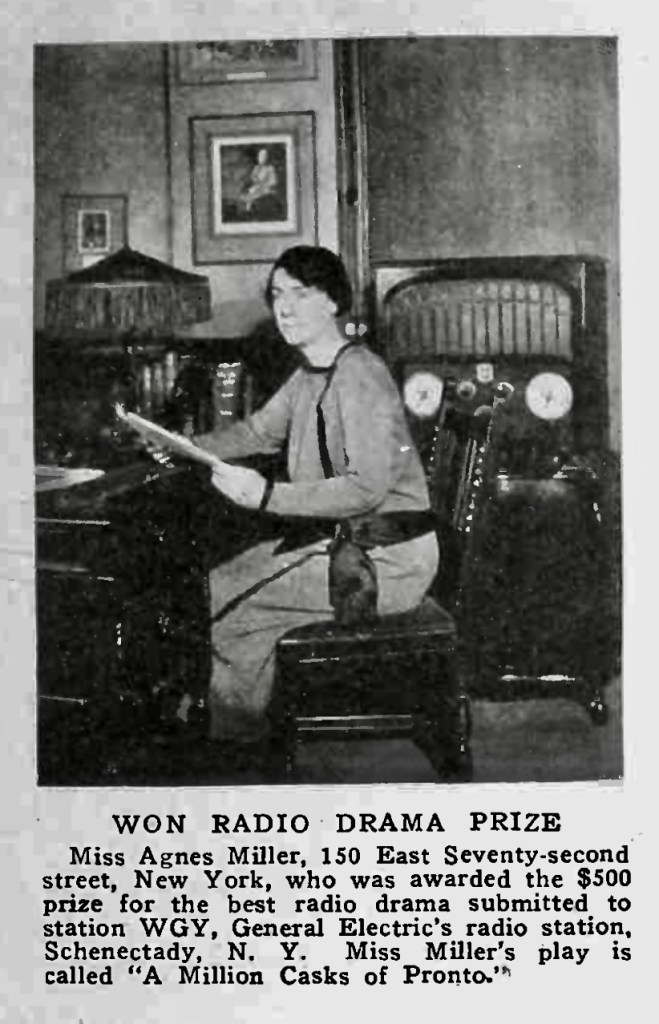
Not that I know exactly what those “Million Casks of Pronto” alluded to in the title of this blog entry contain; but more about that in as “pronto” as I can manage, especially since, as Wordsworth might have put it, these are lines composed a few minutes from Bronglais Hospital, where I went—and went under—for an endoscopy today. Gallstones be damned, I am in a reflective mood, and those “Casks,” which were tossed onto the airwaves back in 1924, have been on my mind for quite some time now.
Cover of the theater program for the Theatre Royal Haymarket production of Farm Hall (2024)
No horses—wild, domesticated or strictly metaphorical—would have dragged this fool (meaning, yours truly) to see Only Fools and Horses, a musical adaptation of a 1980s Britcom that made hay of nostalgia at the Theatre Royal Haymarket, where it enjoyed a record run before the stable doors closed, at last, in April 2023. How relieved was I then, returning to London after an eighteen-month-long hiatus, to find that what I assumed to be legitimate drama or, at any rate, a show beyond the dog-and-pony variety had returned to a venerable venue where, over the years, I had taken in plays as varied as William Wycherley’s The Country Wife (1675), Edward Albee’s The Goat, or Who Is Sylvia? (2000), and James Goldman’s The Lion in Winter (1966).
Granted, none of those theatrical evenings—certainly not the heavy-handed 2015 revival of the delightfully immaterial Harvey—were more memorably dramatic than The Rivals, during the 23 December 2010 performance of which I witnessed a member of the cast gallantly jumping off the stage to assist a fellow theatregoer suffering a stroke.
Nothing approaching such drama, scripted or otherwise, materializes in the course of the ninety minutes or so that historian Katherine Moar sets aside for the development of her episodic “snapshot,” as she calls it, of Farm Hall, the titular setting of a play about what happened in the summer of 1945 when a group of German nuclear scientists—members of the Uranium Club—were being kept under surveillance at a house in Cambridgeshire, only to learn, listening to news broadcast by BBC radio, that the United States had dropped the atomic bomb on Hiroshima.
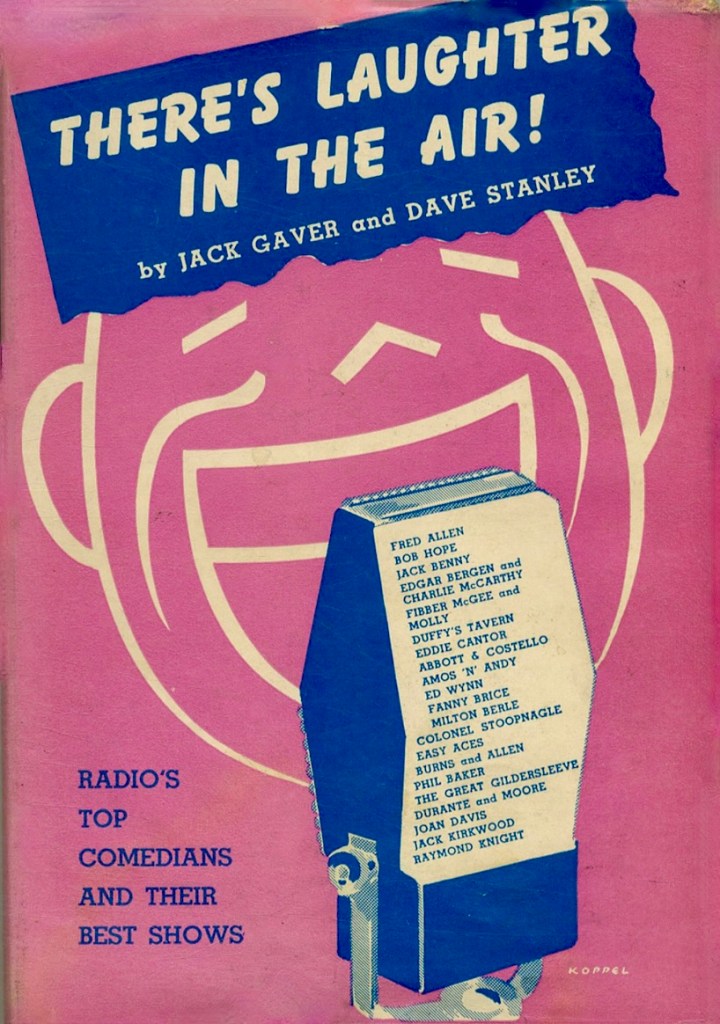
Granted, this 1945 book has little to do with the current debate about statespersonship and laughter
You might say that laughter has gotten us into this mess. Well, I am saying it, and I, though hypergelastically inclined (meaning laughter-prone) in my youth, am not laughing much at and about this present moment in time. By “mess”—an understatement, surely—I mean the state of global politics, and the state of our political discourse in particular.
Could laughter—supposedly the best medicine—also get us out of this mess? Might it be a symptom of our ailment as well as its cure? Not, I venture, if we carry on trying to laugh it all off. In the act of trivializing matters in hopes of dematerializing danger by declaring it risible, we run the risk of nixing democracy—a system predicated on the willingness to listen—altogether, throwing it away with a hearty tossing back of our heads in a communal display of hilarity. A ditch, after all, is not called a ha-ha for nothing.
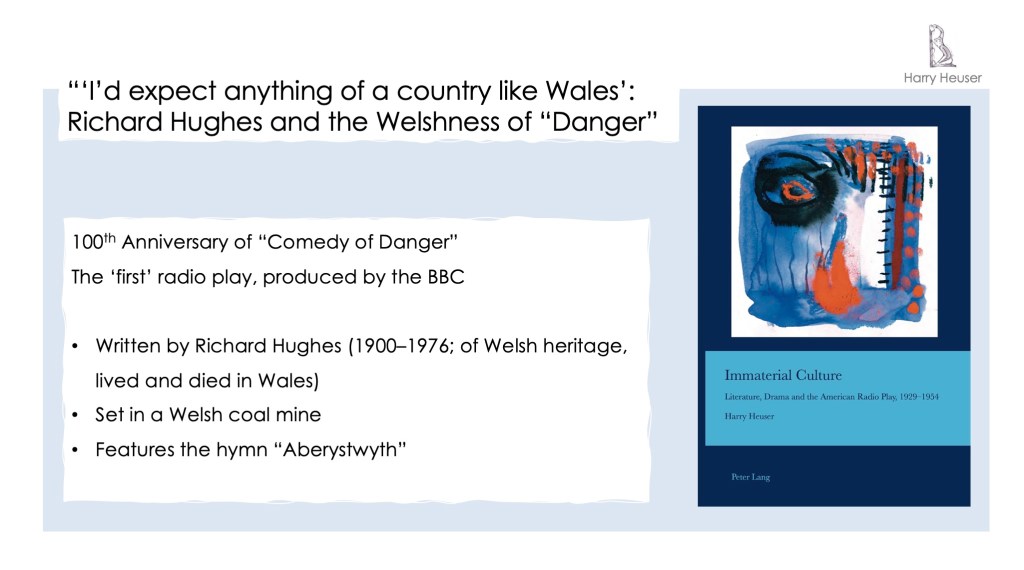
Taking the radio play to the library has long been an ambition of mine, given that dramatic and literary works written for the medium of sound broadcasting occupy comparatively little space on the bookshelves. Taking the first of its kind to a national library—the National Library of Wales, no less—is a chance of a lifetime amounting to poetic justice. Allow me to shed a modicum of light on that, and on my benightedness besides.
So that meaningful conclusions may be drawn from my peculiar challenge of commemorating one hundred years of radio dramatics in just a few minutes, it strikes me as essential that the centenary first be quartered, a fate I hope to escape on 22 February 2024, the date set for the event.
To say that I had misgivings about visiting the Heidi Horten Collection during a recent stay in Vienna is an understatement, especially in light of the scandal surrounding the scrapped auction of Horten’s jewelry, misappropriated as it was from Jewish families from whose disenfranchisement Horten and her husband demonstrably profited.
The Heidi Horten Collection. All photographs: Harry Heuser
“Christie’s Cancels Sale of Jewelry Connected to Nazi-Era Fortune,” a 31 August 2023 headline in the New York Times read. According to the article, the “decision follow[ed] a backlash from Jewish organizations after the auction house generated $202 million” in an earlier sale of Horten’s hoarded treasures.
My views on the Heidi Horten Collection—just like my viewing of the temporary exhibition “Rendez-Vous: Picasso, Chagall, Klein and Their Times” then on show there—were no doubt skewed. And yet, I am certain that I would have felt just as disturbed and affronted had I been unaware of the controversy.
Well, it ain’t over ‘til the proverbial — and stereotypically plus-sized — diva, binary or otherwise, puts down her lozenges to launch a final attack on the lorgnette-clutching, socially-distanced crowds. In as plain a variety of English as I can bring myself to adopt: we haven’t heard the last of COVID-19. Done as we might think we are with the pandemic the US President declared over, the virus continues to catch us unawares and mess with our lives.
It sure is messing with mine right now, in a number of ways. Almost immediately on arrival in New York City two weeks ago, I caught some resilient variant of the bug I had managed to steer clear of for so long. And it caught up with me despite all vaccinations and boosters, having taken advantage of the first opportunity to have my last antiviral top-up just two days before my departure.
Imperative mood
This is my first return visit to my old Manhattan neighborhood in three years … but clearly things did not go as planned or hoped for. What makes matters worse is that I had intended to be of some use to an old friend and former domestic partner, who, just days prior to my arrival, suffered a massive heart attack and has been in intensive care ever since. Here I am, stuck in his apartment, just a 20-minute walk away from the hospital that is now off limits. No doubt, millions of New Yorkers felt like that during lockdown — when everything and everyone close by was suddenly out of reach.
“A thing can sometimes be too extraordinary to be remembered.” With that intriguing overthrow of conventional wisdom opens “The Fad of the Fisherman,” a short story by G. K. Chesterton, first published in 1921. “If it is clean out of the course of things,” Chesterton expounds, “and has apparently no causes and no consequences, subsequent events do not recall it; and it remains only a subconscious thing, to be stirred by some accident long after. It drifts apart like a forgotten dream….”
A contemporary illustration for Chesterton’s story by William Hatherell, showing the “extraordinary” incident.
In light of the extraordinary and memorable events unfolding over the last few days like a crumpled serviette disclosing the spat-out remains of a prolonged Partygate feast – the rules-breaking incident that contributed to the eventual if only reluctantly heeded call for the resignation of Prime Minister Boris Johnson – the notion that something might be “too extraordinary to be remembered” does not quite ring true. So much in politics these days is head-scratchingly, gut-churningly out of the ordinary, the Trump Presidency and its aftermath being a prime example. And yet, the violation of established codes of conduct have become so flagrant and frequent that we, or some – or, I suspect, many – of us no longer recognize them to be unprecedented, unethical or unconstitutional.
It now takes greater effort to remember, if ever we knew, what once were assumed to be formal matters of procedure and protocol. And we struggle as well to connect the tell-tale dots that, if they were examined closely – like some seemingly random Rorschach blots – and in relation to each other, might enable us not only to arrive at the “causes” – the egoistic and downright egomaniacal roots – of socio-political developments but also to realize the “consequences” of our inattention to pattern-forming details whose neglect profoundly compromises our ability to draw meaningful inferences from the reality of facts and fictions with which we are confronted: the erosion of trust in political figures who, instead of serving their country, help themselves and cling to power as if they were absolute monarchs. How reassuring, then, are the ratiocinations that bring many a murder mystery to its logical if not always satisfactory conclusion.
It is the conclusion rather than the opening lines of Chesterton’s story – a story involving the unlawful actions of a Prime Minister – that brought to mind the astonishment with which I first reached it – a solution that I, appropriating shelved products of popular culture rather than reviewing them, am under no compulsion to withhold. The by me highly anticipated conclusion to Mr. Johnson’s sorry and increasingly sordid Downing Street saga, meanwhile, remains unknown while I am writing this, the 822nd entry in my journal. I might as well say it flat out: the Prime Minister in Chesterton’s story is a murderer who gets away with his crime.
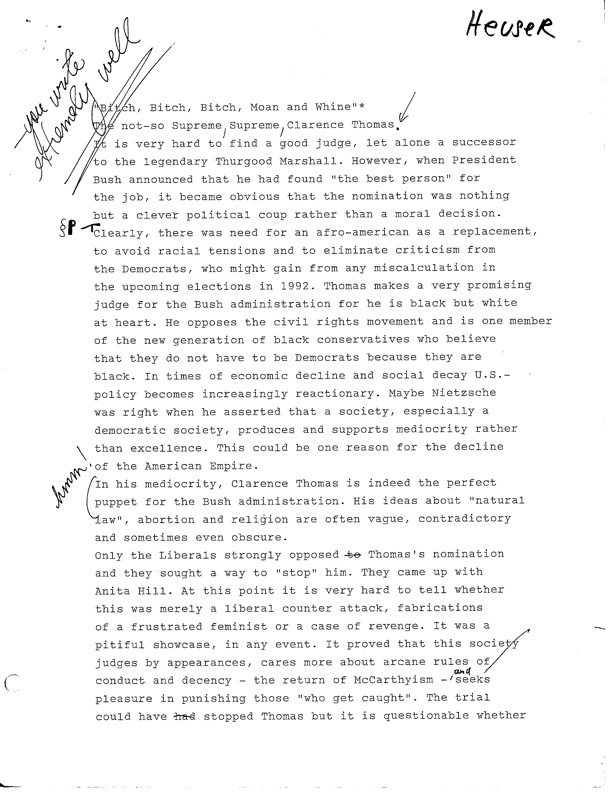
First page of a college essay, dated 17 October 1991
Bitch. Moan. Whine. I certainly do a lot of that. Always have. The complaining probably started around the time my mother first pulled away her nipple. These days, though, there just seems to be more to “bitch, moan and whine” about; from the cumulative fallout of the unending pandemic, the new normal of war in Europe and the aftermath of Brexit and the Trump presidency to the burnout and sense of deflation I experience in my line of work as a newly promoted ‘Senior Lecturer’ whose recent and long-fought-for £8 a week pay increase feels more like a slap in the face than a patronising pat on the back for services rendered, albeit not without bitching.
Quit whining about that last one, you might well say; indeed, I try to remind myself that it is nothing compared to what others are suffering, possibly of necessity in the silence that does not necessarily translate into acquiescence.
Seeing things in proportion – which is proper, according to some – or putting them into the perspective that, by definition, depends on your angle, tends to be more difficult when you feel ever more keenly that everything is related rather than being relative by default. When you are living in that fragile ecosystem of despair that some might deride as egocentricity, anything is apt to become everything, and it can weigh you down something awful.
“Bitch, bitch, bitch, moan and whine.” That is hardly a comprehensive, let alone compassionate, assessment of the voicing of dissatisfaction by your contemporaries, however motivated. It is a derision and dismissal of criticism as selfish, pointless and downright destructive. As the quotation marks indicate, that does not reflect my general views on disaffection.
In fact, those words – “Bitch, bitch, bitch, moan and whine” – were uttered in the 1980s by Clarence Thomas, now a US Supreme Court Justice. And they were voiced not in response to finicky folks rolling their eyes at just about anything – the kind of ‘why me’ injustices of our everyday – but to civil rights leaders who, in their rejection of the status quo, aim to address actual, momentous and seemingly insoluble inequalities.
Page from the published script of Archibald MacLeish’s “The Fall of the City” (1937)
As the world awaits news from Ukraine and its people awake daily to the sounds of shelling, many of us, having survived the pandemic that at once isolated and united us, become alive anew to our connectedness to world events and to the urgency, the necessity, of connecting dots in plain sight, and of listening out for tell-tale signs, be it the rumble of tanks or the roar of tyrants. We should have seen this one coming, we might suspect; but such hindsight provides no relief in the face of local destruction and global upheaval.
I am reminded of the events that came to be known as 9/11 – an attack that did not, as some claimed and many felt, hit us ‘out of the blue’ on that bright September morning – and of feeling both helpless and useless in the wake of the terror that would shape history. I was teaching writing in the Bronx, and I was researching radio drama of the 1930s. None of that seemed to matter at a moment when digging in and digging up – literally and figuratively – was felt to be needed to uncover lives lost and recover the history that had gotten us to that point. I kept on teaching writing, and I kept on researching radio – and I strove to find the usefulness and relevance of both. That is, I did not carry on “regardless.”
Instead of retreating into the past of broadcasts decades old, I tried to retrieve messages pertinent to the present. And while we might think that messages are merely repeated rather than being heeded, we may also find that we did receive them and that we are capable of learning from history even as a world leader insists on repeating it.
Take, for instance, Archibald MacLeish’s “The Fall of the City.” First produced and broadcast in the US on 11 April 1937 – with a cast including Orson Welles and Burgess Meredith, and a score by Bernard Herrmann – it was a response to the rise of a dictator who, unchecked and unresisted, conquers a city despite warning voices from the past – the ancient and the dead. In MacLeish’s allegory, the ‘conquerer’ is not a person: it is fear. It is fatalism. It is the surrender of freedom to fascism.
In “The Fall of the City,” a radio announcer (played by Welles in the 1937 production) serves as our eyes, an observer by proxy reporting from the scene of an unnamed city. MacLeish’s plays – from “Air Raid” to “The Trojan Horse” – are never simply plays for the medium of radio but also plays about that medium – about tuning in from a distance, about mediation and reception, and about misinformation and deception. The listeners are implicated, their role in the event of listening reflected upon in the shared act of telling stories and hearing histories in the making.
“The sun is yellow with smoke,” the announcer informs the audience, “the town’s burning…. The war’s at the broken bridge.” It is impossible to listen to those lines now without seeing the cities under siege in Ukraine; and yet, “The Fall of the City” – which was broadcast just two weeks prior to the arial bombing of Guernica in April 1937 but written some months earlier, in 1936 – not about the reality of any particular invasion but about the real threat posed by evasiveness. It caution against giving in to ideas and being enslaved by ideologies, for which it was criticised during the Second World War: “In these last years,” Randall Jarrell, himself a poet, wrote in 1943:
many millions of these people, over the entire world, have died fighting their oppressors. Say to them that they invented their oppressors, wished to believe in them, wished to be free of their freedom; that they lie there.
Jarrell wrote this in the aftermath of air raids, and the war of ideas were not uppermost on his mind.
I do not know whether I am writing at a moment that future records might document to be days or weeks before the start of a Third World War. I know I am writing it in wartime. Unlike in the scenario envisioned by MacLeish, the world is not only watching the atrocities perpetrated by Russians in the towns and cities of Ukraine; it is responding, both to aid Ukrainian civilians (my sister in Germany has welcomed Ukrainian refugees into her home) and to avoid an escalation of military conflict. Unlike the abstract “citizens” of MacLeish’s play, men and women are resisting. Cities do not fall. They are attacked. They are defended. They are fought over. And it is citizens – civilians – that are doing the fighting.
How different this fight is from the defeat as MacLeish conceived it. “The city is doomed,” the Voices of Citizens in his play declare,
The age is his! It’s his century!
Our institutions are obsolete.
He marches a mile while we sit in a meeting.
Opinions and talk!
Deliberative walks beneath the ivy and the creepers!
His doubt comes after the deed or never.
He knows what he wants for his want’s what he he knows.
He’s gone before they say he’s going.
He’s come before you’ve barred your house.
He’s one man: we are but thousands!
Who can defend us from one man?
Bury your arms! Break your standards!
Give him the town while the town stands!
We know the price of such surrender. Putin might have believed that his invasion would meet with little or no resistance, and that the global community, understood as a community, is powerless in the face of his aggression. Putin’s methods date from the past; his mind, however made up it may be, was made up last century. It is no match for what humanity can achieve if we – and that includes the people of Russia – put our minds and methods to it. Right now, his thinking and his tanks, his misfiring strategies and his unwillingness to listen, are being answered by the rallying cries of the present that will help us secure a future.
Nothing is innately trifling. As I put it once, when I had the nerve to make a public display – in a museum gallery, no less – of the mass-produced ephemera I collect, ‘Trivia is knowledge we refuse the potential to matter.’ Now, some products of culture are more resistant than others to our realization of them as worth more than a fleeting glance, if that. Exerting the effort to make them matter may feel downright perverse when there are claimed to be so many more deserving candidates for appreciation around.
When looking out for something to look into, I invariably draw on my own sense of otherness, of queerness. It is not altogether by choice that I am drawn to the presumed irrelevant. My perceived marginality is both the effect and the cause of my attraction to the margins. What matters – and according to whom – is always worth questioning. That is why I created Gothic Imagination, an alternative art history course I teach at Aberystwyth University.
To augment the weekly lectures and seminars, I created a series of film screenings for my students further to explore the territories of the visual ‘gothic’ beyond literary genre Gothic and the Gothic as an architectural style. The second film in the chronologically arranged series, The Cat and the Canary (1927), is, for all its technical and cinematographic achievements, a rather undemanding old chestnut. In part, such a view of it is owing to our belatedness of catching up with it, now that much of it strikes us as a grab bag of narrative clichés.
Well, those clichés were up for grabs even back in 1927, as the film draws on its audience’s familiarity with murder mysteries and stage melodramas. Like Seven Keys to Baldpate before it, The Cat and the Canary is parodic and self-reflexive. It play with conventions and our awareness, even our weariness, of them. The Cat got our tongue firmly in cheek; and as much as we may feel sticking it out at the derivative claptrap to which we are subjected, we are encouraged to appreciate that the film anticipates our response, that it is one step ahead, dangling our tongue cheekily in front of us like a carrot intended to keep us playing along.
Is it only a single step ahead? Ahead of what? Is it ahead, retro or perhaps even reactionary? The Cat and the Canary is postmodern before there was a word for it. Like any adaptation of a text I have not caught up with, it also makes me wonder just how what we get to see has evolved and how the film, in addition to interpreting its source material cinematically, questions, edits and revises that material as well.
One revision draws attention to itself in the credits – and it made me aware of the consequences the seemingly inconsequential can have. I am referring to the character Mammy Pleasant, a housekeeper played in the film by the scene-stealing Martha Mattox. Given that The Cat and the Canary was released in the same year that The Jazz Singer stridently hammered a sonic nail in the coffin of silent film – at times simply by dragging said nail screechingly across the surface of an eloquent body of work shaped over a quarter of a century – the reference to the ‘Mammy’ legend stood out like a discordant note.
A slide from my introduction to the screening
What is ‘Mammy’ about Mammy Pleasant, particularly when the role is performed by a white female actor? The 1922 stage melodrama by John Willard, who also acted in the play on which the film is based, describes the character as an ‘old negress.’ Not that Blanche Friderici, who originated the part on the stage, was black. She performed it in blackface.
As The Jazz Singer and other early sound films such as the ‘Amos ‘n’ Andy’ vehicle Check and Double Check (1930), blackface and minstrel shows were very much part of Western popular culture at the time, and they were not effectively challenged – that is, were not permitted effectively to challenge – until decades later.
And yet, the film does not partake of that tradition, retaining the character’s name only. In the play, Mammy Pleasant is a servant who has gained enough independence to choose whether or not to serve the future heir to the fortune of her deceased employer, as is clear from this exchange with the family lawyer, Roger Crosby, prior to the reading of the will:
Crosby. Six! All the surviving relatives. By the way—Mammy—your job as guardian of this house is up to-night. What are you going to do?
Mammy. It all depends. If I like the new heirs—I stay here. If I don’t—I goes back to the West Indies.
There is no such exchange in the film, and the ethnicity of Mammy Pleasant is not made central to the characterisation, which in the play is rooted in stereotypes surrounding superstitions to be rooted out in the act of ratiocination. The Cat and the Canary is, after all, not a Gothic romance but a whodunit in which weird goings-on are shown to have a logical, albeit preposterous, explanation.
The name Mammy Pleasant, in Willard’s play at least, carries with it a reference to an actual person – the businesswoman and abolitionist Mary Ellen Pleasant, who, by passing as white, managed to become the first African American millionaire.
In the stage play, produced nearly two decades after Pleasant’s death in 1904, the reference is facetious and derogatory. Mary Ellen Pleasant, who lost the fortune she had made and shared as an activist, and whose character was destroyed when her passing as a white cook and landlady was exposed, is misremembered in the film as a not altogether trustworthy and slightly threatening outsider operating on the inside of a dead white millionaire’s mansion.
Why did the reference remain? How many viewers back in 1927 would have recognised it as a reference to Mary Ellen Pleasant? And how many would have found comic relief in what might have been some sort of white revenge fantasy that renders Pleasant odious while keeping her in her supposed place?
It is a gothic reading, as opposed to a reading of the gothic, that refuses to privilege the center and, imagining alternatives, lets the canary chase the cat for a change. An unlikely scenario, to be sure; but to expose what is cultural it is useful to conjure what is unnatural.