“There [still] ain’t no sense to nothin’”: A Wayward Text Comes Home

“Home at last,” I could almost hear myself sigh as, out of the narrow slit in our front door, I yanked the packet arriving today.  Bearing my name, as few pieces of mail of any consequence or sustenance do nowadays, it contained the volume Audionarratology: Lessons from Radio Drama, to which I had been invited a few years ago to contribute a chapter.  The book was published in July 2021 by Ohio State University, a press renowned for its contribution to the evolving discourse on narratology.  
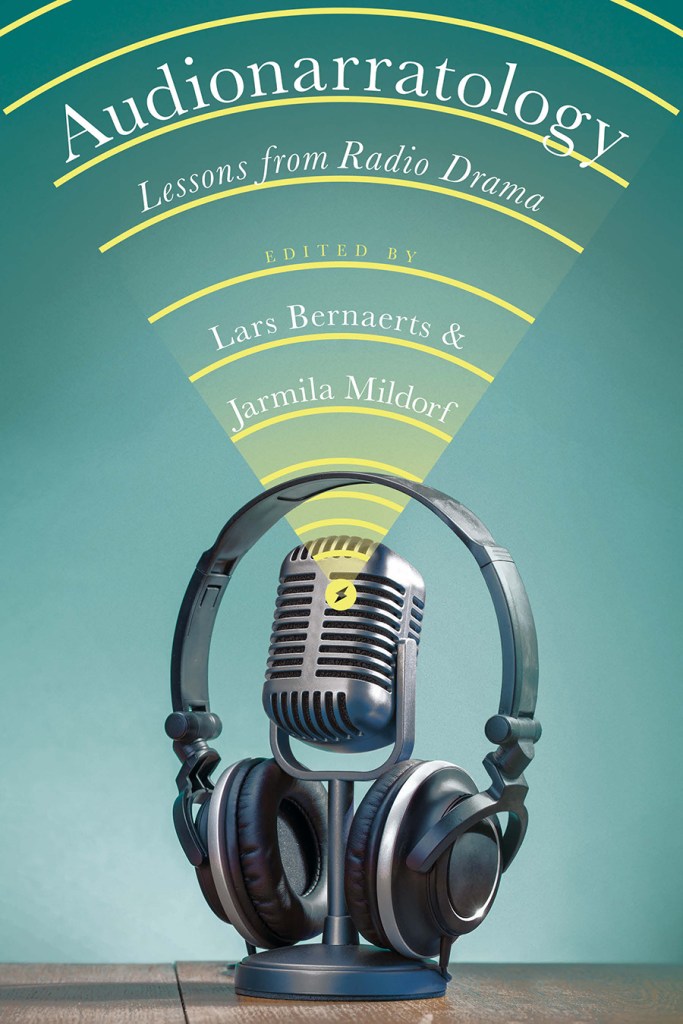
The titular neologism suggests that an engagement with aural storytelling is proposed as one way of broadening a field that has enriched the interpretation not only of literature but also of visual culture.  Whether such aural storytelling should be subsumed under the rubric ‘radio drama’ is something I debated in my study Immaterial Culture, for which I settled on the term ‘radio play,’ as, I argued, the fictions written for radio production and transmission are hybrids whose potentialities remained underexplored and whose contribution to the arts underappreciated in part due to the alignment of such plays with works for stage and screen.  Nor am I sure that, by adding the prefix, “audionarratology” will be regarded as a subgroup of narratology – which would defeat the purpose of broadening said field.

To the question what “Lessons” may be learned from plays for radio, or from our playing with them, the quotation that serves as title of my essay provides a serviceable response: “There ain’t no sense to nothin.”  The line is uttered by one of the characters in I Love a Mystery, the thriller serial I discuss – and it is expressive of the bewilderment I felt when first I entered the world created in the 1930s and 1940s by the US American playwright-producer Carlton E. Morse.  My cumbersome subtitle is meant to suggest how I responded to the task of making sense not only of the play but also of the field in which I was asked to position it: “Serial Storytelling, Radio-Consciousness and the Gothic of Audition.”

By labelling ‘gothic’ not simply the play but my experience of it, I aim to bring to academic discourse my feeling of unease, a sense of misgivings about explaining away what drew me in to begin with, the lack of vocabulary with which adequately to describe my experience of listening, the anxiety of having to theorise within the uncertain boundaries of a discourse that I sought to broaden instead of delimiting.

Throughout my experience with radio plays of the so-called golden age, I felt that, playing recording or streaming play, I had to audition belatedly for a position of listener but that I could never hear the plays as they were intended to be taken in – serially, via radio – during those days before the supremacy of television, the medium that shaped my childhood.

In the essay, I try to communicate what it feels like not knowing – not knowing the solution to a mystery, not quite knowing my place vis-à-vis the culture in which the play was produced or the research culture in which thriller programs such as I Love a Mystery are subjected to some theory and much neglect.  Instead of analysing a play, I ended up examining myself as a queer, English-as-second-language listener estranged from radio and alien to the everyday of my grandparent’s generation – never mind that my German grandfather fought on the Axis side while the US home front stayed tuned to news from the frontlines as much as it tuned in to thrillers and comedies that were hardly considered worthy of being paraded as the so-called forefront of modernism.  So, a measure of guilt enters into the mix of emotions with which I struggle to approach or sell such cultural products academically.

The resulting chapter is proposed as a muddle, not as a model – although its self-consciousness may be an encouragement to some who are struggling to straddle the line between their searching, uncertain selves and the construct of a scholarly identity.  Its failings and idiosyncrasies are no strategic efforts to fit in by playing the misfit or refitting the scene – they are proposed as candid reflection of my mystification.  

They also bespeak the fact that the essay, unfinished or not fully realised though it may seem, was a quarter century in the making.  It started out by twisting the dial of my stereo receiver and happening on Max Schmid’s ear-opening program The Golden Age of Radio on WBAI, New York, agonising whether to turn my newly discovered hobby into the subject of academic study, enrolling in David H. Richter’s course “The Rise of the Gothic” at CUNY, and by responding to the essay brief by exploring gothic radio plays and radio adaptations of Gothic literature.

Once I had decided to abandon my Victorian studies in favor of old-time radio, the essay was revised to become a chapter of my PhD study Etherized Victorians.  It was revisited but removed from Immaterial Culture as an outlier – the only longer reading of a play not based on a published script – during the process of negotiating the space allotted by the publisher.  It had a lingering if non-too-visible presence on my online journal broadcastellan as an experiment in interactive blogging, and it now appears in a volume devoted to a subject of which I had no concept when I started out all those years ago.

The draft, too, has gone through a long process of negotiation — of editing, cutting and rewriting – at some point of which the frankness of declaring myself to be among the “outsiders” of the discourse did not make the editors’ cut.

So, home the essay has come; but the home has changed, as has its dweller, a student of literature who transmogrified into an art historian with a sideline of aurality, and who now has to contend with tinnitus and hearing loss when listening out for clues to non-visual mysteries and, ever self-conscious, waits for his cue to account for the latest of his botches, or, worse still, to be met with silence.  Estrangement, uncertainty, and the misery of having to account for the state of being mesmerised by mysteries unsolved – such is the gothic of audition.

Gotham/Gothic; or, A Tale of Two Strawberries

Visiting Strawberry Hill

Much of what I know about English literature I learned in the Bronx.  The peculiar indirection of my path—a German approaching British culture by taking the Lexington Avenue Express—did not escape me then; and even though I had no doubt as to the qualifications of those who taught me, I decided, upon finishing my Master’s thesis on the Scottish essayist-translator Thomas Carlyle, to go after something that, geographically speaking, lay closer to my temporary home.  

Never one for obvious choices, I wrote my doctoral study on US radio drama, a subject that, however arcane, struck me as being rather more compatible with life in a Mecca for the enthusiasts of American popular culture among which I numbered.  It also made it possible for me to take advantage of some of the resources particular to Manhattan, the isle of Radio City.

Not that I considered studying British culture so far removed from the Globe Theatre, the Scottish Borders, or the wilds of Yorkshire to be much of a disadvantage, being that I had adopted a subjective mode of reading that favors response over intention, that explores the reception of a written work rather than tracing is origins.  Call it rationalizing, call it kidding yourself—I thought that I should make a virtue of vicariousness. 

Living in Britain now, I am rediscovering its literature through the landscape rather than by way of the library; and I am finding my way back to those old books by stepping into even older buildings.  One such book and one such building is Horace Walpole’s Castle of Otranto (1764), otherwise known as Strawberry Hill.

A most un-Gothic—but glorious—day at Strawberry Hill

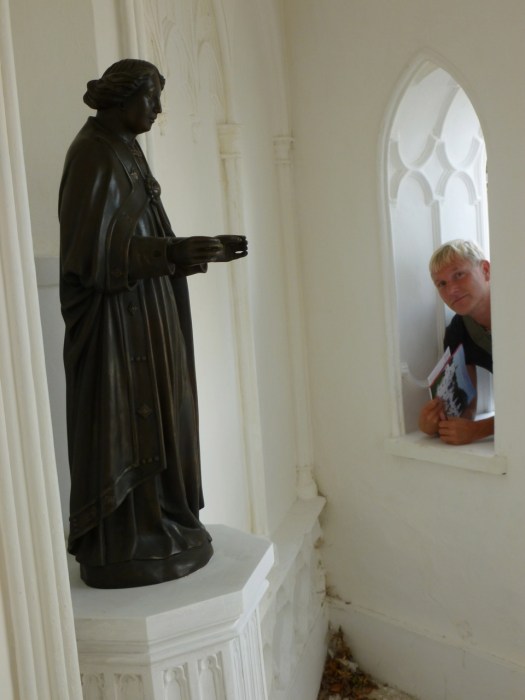
Originally a small cottage in rural Twickenham, Strawberry Hill was transformed by Walpole into a gothic castellino; it also housed the author’s own printing press, although Otranto was published in nearby London.  The crenelated battlements were made of wood and needed to be replaced more than once in Walpole’s lifetime.  “My buildings are paper, like my writings,” Walpole famously declared, “and both will blown away in ten years after I am dead.” This could well have happened; but, despite the relative weakness of his materials—a spurious medieval romance and the less than solid additions to Chopp’d Straw Cottage—both survive today as a testimony to Walpole’s enduring influence on popular tastes in architecture and literature.

And yet, however exciting the experience, walking around Strawberry Hill after all those years of living and studying so close to Strawberry Fields, Central Park, brought home nothing more forcibly than that getting to the heart of the matter that is art is not a matter of inspection but of introspection. Stripped of most of its furnishings, Strawberry Hill is a tease. Beyond the stained glass windows and the restored façade, there is little left of Walpole’s story or his antiquarian spirit.  To be sure, even if Walpole’s library had not been emptied of the contents that makes and defines it, it would remain inaccessible to those looking around now without being permitted to touch and turn the pages.

Visitors to historic houses, like readers of fictions, must always be prepared to supply the fittings, to construct in their mind’s eye what the supposedly first-hand experience of seeing for ourselves can never make concrete and, therefore, never quite smash or supplant.  Where, if not in our reading, dreaming, thinking selves does the spirit of literature reside?

The audio guide at Strawberry Hill is a self-conscious acknowledgment of this sightseeing conundrum; it plays like a radio drama—my studies of which have not gone to waste altogether—that teases us with the voices of the dead and the echoes of their footsteps. Our own footfall, meanwhile, is muffled by the protective plastic coverings provided for our shoes at the entrance to the site.

Walpole’s paper house has been given a permanence in the midst of which I am reminded of the paper-thinness of my own existence.  What lingers is the anxiety of leaving here—or anywhere—without having left a trace at all.

"This . . . is London": Fuseli’s Nightmare Revisited

Sometimes it takes questionable taste in art to make us realize how unpalatable or insipid our ready-meal answers to life’s challenges can be. In the bourgeois mediocrity of German suburbia, where I was obliged to wade through the quagmire of adolescence, an installation by performance artist Santiago Sierra is currently creating no inconsiderable controversy by daring to turn a synagogue into a gas chamber.

Media Nightmare

I suspect that quite a few of Sierra’s detractors who think such confrontations of violent history with artistic violence reprehensible will be less disturbed to learn that, some forty years after the end of World War II, the building had been a symbol of Germany’s inability to deal with its horrible past: obscured from public view and unknown to schoolboys like myself, who passed it daily, it had been permitted to deteriorate to such a state of dereliction that it was only deemed fit to serve as a barn or pigsty.

Fuseli’s Nightmare

Iconoclasm, barbarism, and unreason—these were also pre- occupations of 18th-century Gothic art, samples of which are now on display at the Tate Britain. Unfortunately, Gothic Nightmares: Fuseli, Blake and the Romantic Imagination suggests nothing more forcefully than that visual representations of horror are often less than horrifying; less horrifying, that is, than the terrors of which a fertile imagination can conceive and a methodic mind rent from humanity can implement without scruple. Instead, the shock-and-schlock artistry of Fuseli and his followers comes across as juvenile rather than rejuvenating, as cheap rather than free-spirited, as exhausted rather than inspired.

Gothic images are often too crude and obvious to stir the emotions, not unlike the gag-reflex testing effects achieved by today’s horror movies. Aiming at our throats, these lesser Romantics often extract mere giggles and at times guffaws.

Another version of Fuseli’s Nightmare

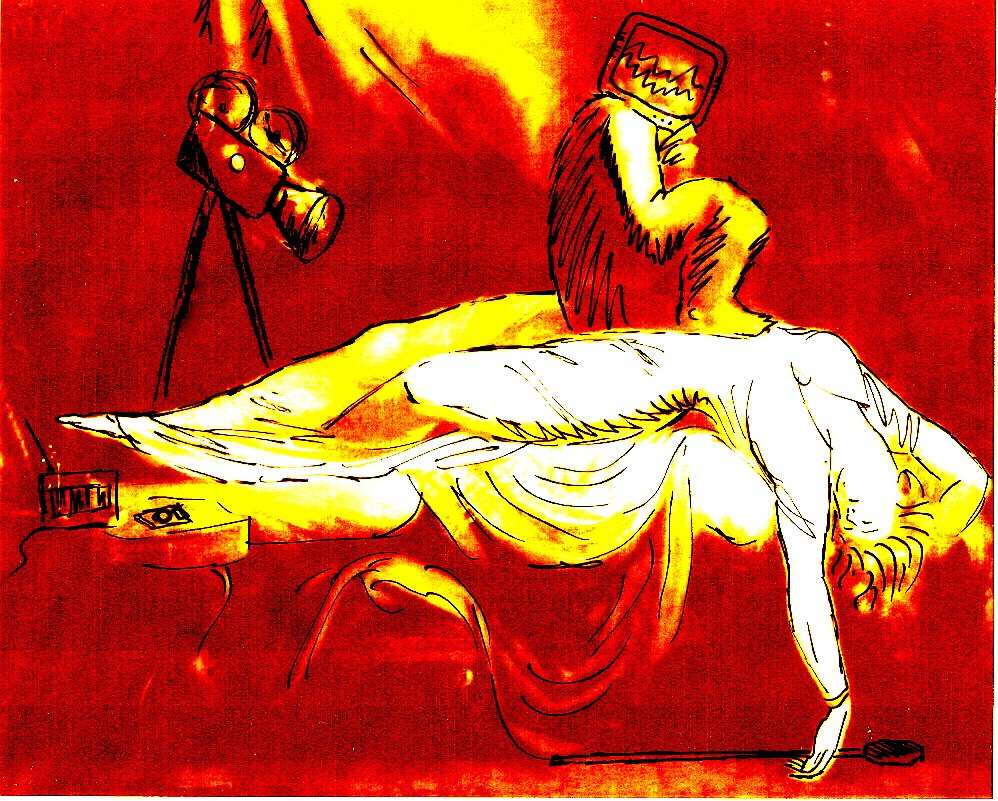
Not surprisingly, Fuseli’s (in)famous Nightmare painting was frequently mocked, especially in its day, when it served as a template for political caricatures such as the one attempted by me here, one in which liberty is being haunted by images of the Middle East (the camel in our bedrooms) and the ineptitude or rampant ambitions of a certain world leader.

How infinitely more stimulating, I thought, while wandering through the exhibition—which does some violence of its own by pairing sublime Blake with silly Fuseli, or by confronting the pre-cinematic Phantasmagoria with French-revolutionary Romanticism—is the suggestive terror of the airwaves, compared to the horror of the image, whether still or moving.

Of course, I am resorting to another caricature of my own to support—and thus undermine—my point: that the imagination, stifled or silenced by clamorous images, suffered its greatest defeat with the deposition of short-reigning radio by the matter-over-mind medium of television.