Thneaking Up on "Thubway Tham"

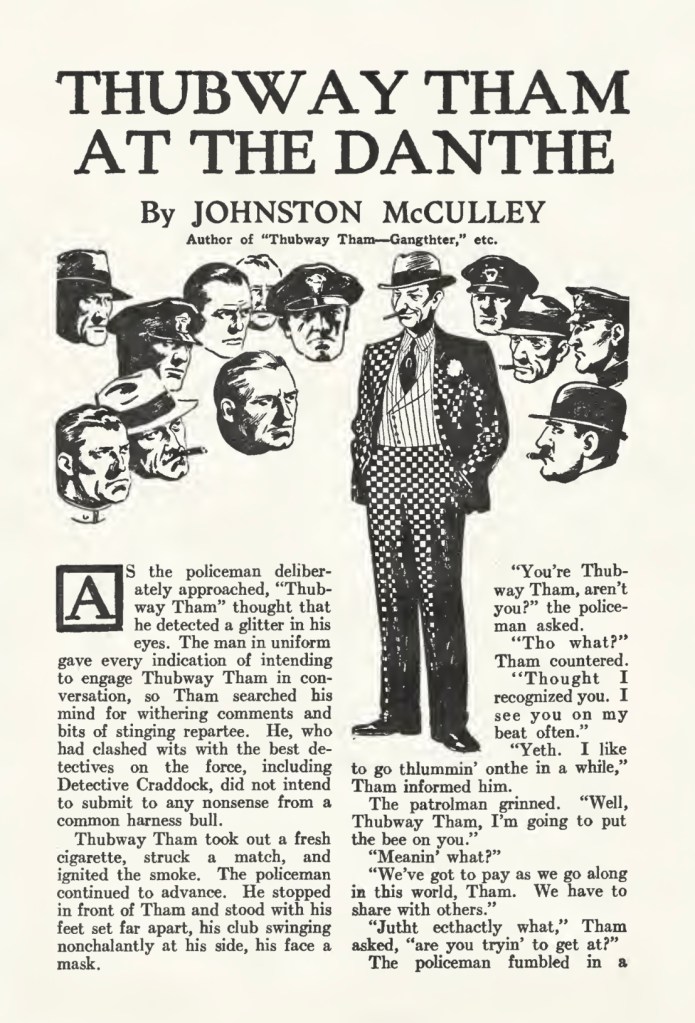
Thubway Tham, as he appeared in Detective Story magazine, 25 Jan. 1934

The other day I called detective Ellery Queen to the rescue when I found myself in need of some pop-cultural assistance while dealing with a certain case of bigotry in the blogosphere. Searching for a visual aid to prop up my improbable prose, I dug up my copy of Ellery Queen’s Rogues’ Gallery, a 1945 anthology of crime fiction containing radio scripts by Dannay/Lee and John Dickson Carr.

It occurred to me that, aside from those two scripts, I hadn’t read any of the other pieces in said volume. So, leafing through, I happened upon a story about a small-time crook with a big-time speech impediment, a lisp so thick that it earned him the nickname “Thubway Tham.”

Now, Tham never hit it big in radio or the talkies (with that voice, he had about as much of a chance to make it there as silent-screen siren Dolores Costello). That said, he was a rather popular pulp hero in his day, which is reason enough for me to make his acquaintance.

Thubway Tham was the brainchild of Johnston McCulley, creator of the recently if not altogether successfully resuscitated Zorro. According to McCulley (as retold by Mssrs. Ellery Queen), Tham first sprang into action during his author’s visit to New York City in 1919. Observing the crowds being “spewed out of the subway,” McCulley realized that those Big Apple commuters were a veritable herd of cash cows for a clever pickpocket.

In need of a saleable story, McCulley came up with “Subway Sam”; but, somewhat intoxicated at the time, the writer found that his mouth would not cooperate in pronouncing the name and settled for “Thubway Tham” instead.

An artful little dodger who forever thumbed his nose at the luckless Detective Craddock, his arch-enemy, Tham kept appearing and disappearing in story after story (some 182 by 1945, according to his prolific father); yet the times were changing, and what might have been amusing in the prosperous 1920s or reassuring in the lean 1930s was no longer appropriate during the war years, when paper was too precious for the spreading of questionable romances of self-serving criminals and the glorification of devious individualism.

Even less-than upright characters, such as the Saint, were being recruited for the war effort. And unless Tham was satisfied to go underground for the duration, disappearing from public view along with other misfits like honorable, but propagandistically irredeemable Mr. Moto, he was expected to take his hand out of other people’s pockets long enough to lend it to Uncle Sam.

Here is how McCulley’s aging lawbreaker, anno 1944, saw his dilemma:

Thubway Tham found his favorite bench unoccupied, and sat upon it.  He was thinking of the war.  Many of his younger friends had enlisted or been drafted.  Familiar faces were missing.  Even certain of the gentry habitually under the eyes of the police had accepted honest toil in shipyards and factories turning out munitions and war supplies.

Tham was sad.  A few days before he had tried to enlist and get into a uniform.  But there were several things wrong with him physically, the army surgeons found.  Tham had started the physical examination feeling rather fit, but by the time they got through with him he was wondering which hospital l would be the best when he unexpectedly collapsed on the street.

He was contemplating now seeking work in some defense plant.  But, frankly, that did not appeal to him.  Tham was a creature of habit, and a part of that habit was to ignore manual labor.  Moreover, work in a war plant would keep him away from his beloved subway.

So, McCulley confronted poor Tham with “the lowest of the low,” with con artists whose prey were “hicks from the sticks,” the “real men” about to fight for their country. Tham could continue stealing, but, punishing those more selfish than he and redistributing his loot, morphed into some simulated Saint, a decidedly less daring and debonair Robin Hood of Modern Crimes.

However valuable such sentimental propaganda might have been, the wartime heroics of turnabout Tham, as recorded in “Thubway Tham, Thivilian,” made for a rather dull and disingenuous Oliver! twist.

What might Thubway Tham be doing these days? Is he still trying his shaky hand at subway robbery? Or has he turned to that superhighway in the sky, where latter-day tricksters, unhampered by physical defects, find ample opportunity to keep their fingers busy and their pockets full?

Don’t let me catch you again, Tham.  Disguised as a conscientious “thivilian,” you pretty much wore out your welcome.

Up to My Eyes in Dog-eared Books

This is one of those rare, lugubrious days of landscape-swallowing fogginess on which you might as well retreat, brandy in hand, into the confines of your small but reassuringly familiar study. My thought being as opaque as the wintry sky, my mind as obnubilated as the mist-shrouded hills, I have put aside all semi-intellectual or quasi-artistic endeavors for the moment. Instead, I busy myself cataloguing the books in my radio drama library, another four dusty volumes of forgotten plays having arrived by mail yesterday. During my years of researching so-called old-time radio in New York City, I had access to several excellent public and academic libraries, however deficient my own.

While a vast number of recordings have been preserved, there are some plays you can only find on paper, among them rare pieces by noted American authors like Sherwood Anderson, who died on this day, 8 March, in 1941. Writing my dissertation, I was determined not to discuss at length any play I had never set my ears upon. The page seemed to be a poor substitute for a performance. Who, I ask you, would claim to know a movie having only read the screenplay? I thought. And yet, once your eye is becoming accustomed to the language of radio, you can almost hear the plays as they might have been produced.

Distrustful of my less than reliable memory, I used to photocopy much of what I read and carefully filed away each text for ready reference. After I had earned my doctorate and decided, propelled by romance, to move to the United Kingdom, I took those thousands of sheets out of their assigned ring binders, boxed them up, and posted them, along with most of my belongings, to be shipped overseas.

Upon my arrival in Blighty, I was not only confronted with stacks of paper (relieved to find them there), but with the problem of making a new and orderly home for them. Little did I know when I decided to be economic by dumping the old binders that the paper sizes in the UK differ from those in the US, that British sheet protectors are too narrow for American paper, and that such incompatibilities would spell many a tedious hour punching holes or cropping paper. Eventually, I resigned in frustration from such labors and resolved to ditch some of the copies in exchange for the originals, however obscure.

Tossing another photocopied script into the bin this morning, I noticed that the play thus preserved was broadcast on the first anniversary of Anderson’s death on this day in 1941. The piece in question is “The Test” by radio dramatist Joseph Ruscoll, and I have not yet come across a recording of it.

Produced by the Columbia Workshop, it concerns adolescent lovers Janet and Joseph who, thirty years after parting, are nothing but joyful memories and pangs of regret to one another. They separated as the result of a dare—the eponymous “test”—that was to prove Joseph’s love for Janet: would he give up his harmonica for their harmonious union? No, he would not stoop to accepting the challenge—and the two were twained no more. Through the miracle of the pre-cellular phone wireless, a radio commentator interviewing both brings about a reunion of sorts. After all, radio was, as Gerald Nachman put it, “yesterday’s internet”:

Narrator: And you never spoke to him again, Janet?

Janet.  Never.  (Sorrowfully)

Narrator: Or you to her, Mr. Pike? 

Joseph: I had my pride.  (Lowly)

Narrator (sighs): And that was thirty years ago?

Janet (flaring up): Pride! If he had really loved me, he wouldn’t have had any pride!

Joseph (flaring up in turn): And if she really loved me, she—what about her foolish pride?

Janet (indignantly): Foolish?

Joseph (crying out): Foolish! Foolish!

Janet: What do you think, Mr. Narrator?

Narrator (sadly): I think you were both very, very foolish.

Perhaps, we’d better put our keyboard to some special use tonight by searching for old friends or else put it aside altogether, seeking instead the company of neglected loved ones rather than dwelling in the sheltering obscurity of our inconsequentiality or sweltering in the ersatz heat of emboldening internet anonymity. I write for myself and strangers—but I live for a hug and a smile.

On This Day in 1948: James M. Cain Authenticates a “Lovely Counterfeit”

Well, I’ve done my darndest here to spread the word about old-time radio. Before it became “old-time,” radio did this rather more effectively, of course; spreading the word, about itself that is. It had professional announcers who could make you buy, or at least desire, most anything, from a can of soup to a slice of soap opera. Sure, not everyone fell for the hyperboles of the air, especially when they fell on the deaf ears of journalists who made a living trashing the American pastime of listening to romantic serials, aural funnies, and gory thrillers; if they did not ignore radio drama altogether, as they do nowadays, the peddlers of the printed word tended to denounce and deride as gleefully and excessively as radio announced and applauded itself.

Unlike the feud between radio comedians Fred Allen and Jack Benny, this was an all too real confrontation. If listening to the radio continued to be a pleasure, it was increasingly thought of as a guilty one, much to the displeasure of the sponsors.

One way of countering the attacks of the press, of assuring listeners that radio drama was perfectly respectable, middle-class fare, was to drag noted authors before the microphone, especially when their works were being adapted for the broadcast medium. When Howard Koch’s dramatization of Rebecca opened the Campbell Playhouse on 9 December 1938—thus predating the premiere of Hitchcock’s film adaptation by well over a year—the legitimacy of the production was underscored by producer-host Orson Welles’s transatlantic telephone conversation with Daphne du Maurier.

Five months later (5 May 1939), when the Campbell Playhouse presented Wickford Point, author J. P. Marquand was also on hand to add prestige to the production. And when Edna Ferber was heard in the 31 March 1939 broadcast of Show Boat, she not only appeared for a curtain call, but joined the stock company of the Campbell Playhouse to play the role of Parthy in a non-musical adaptation of her 1926 bestseller.

Of course, such cross-promotions, which were likely to benefit authors and publishers even more than broadcasters, were no guarantors of excellence or authenticity. Agatha Christie’s previously discussed sanctioning of The Adventures of Hercule Poirot (22 February 1945) could hardly have deceived anyone about the spurious parentage of this anonymously penned and not surprisingly short-lived series. Christie spoke with dignity and authority, but could lend none to the production.

Quite the reverse can be said about the Suspense production of Love’s Lovely Counterfeit and its endorsement by author James M. Cain, heard over the US network CBS on this day, 17 January, in 1948. The play, headed by James Cagney and introduced by Robert Montgomery (who also read an excerpt from the novel, was the real thing: not mere dramatic snipped, but an hourlong presentation that could do justice to Cain’s short novel.

Its author, however, was little of help when asked to address the public: “briefly, I thought it was excellent.” In a rather unusual move, bespeaking the prestige of the Suspense program, Cain also congratulated the two men responsible for the adaptation. Missing his cue twice during his short scripted small talk with Cagney and Montgomery, he rendered his authentication disingenuous in the process.

Perhaps, a bit of fakery, such as Cagney’s enthusiasm about the “particular element that makes Cain the most powerful writer of true suspense fiction in America”—the “inevitable climax, an explosion of the energy” generated by “two people in love”—might have been more convincing. Most listeners would not have noticed if their favorite author had been impersonated by a professional actor, reading lines prepared for the occasion by the author; but so eager were producers to demonstrate that radio was no cheap substitute, that they felt compelled to sell the authentic at the cost of sounding phony.

Having a "Million Pound Day"; or, the Case of the Breathless Blogger

Well, I was just trying to get into Hollywood Horror House (also known as Savage Intruder), an obscure, late 1960s Hagsploitation movie starring Miriam Hopkins, a video tape of which was sent to me (and is being reviewed here) by a connoisseur of camp, when I was seized by a violent coughing fit. Judging from the opening slasher scene, the film itself seems quite capable of irritating the throat muscles; but this was the oft-mentioned, nagging cold I have not been able to get off my chest ever since I caught it one rainy November night in New York City.
Being even more stubborn than the cough, I decided to tough it out once again—until I was entirely out of breath by about 2 AM. So, after a trip to the emergency room, I am loaded with steroids, sucking on my inhaler, and ready for another dose of murder and transmogrification.

As I remarked in the previous post, I have been following the adventures of the Saint in a series of RKO thrillers that aired on BBC 2 in early January (after having missed the movies when they were shown elsewhere a few months ago). The first film adaptation of a Saint story was the 1938 thriller The Saint in New York. Except for a bit of cross-dressing, it is very much a gangster movie fit for a Robin Hood of modern crime rather than one of those cosmopolished capers in which a smartly-suited man about town amuses himself, like a Nick without his Nora, by solving the odd case of murder between Martinis.

The Saint Strikes Back [my thanks to Saint expert Burl Barer, for editing here], the second Simon Templar story to be adapted for the screen, is somewhat closer to the Nick-and-Nora formula, with Simon being paired with a lovely—if preposterously coiffed—sidekick who actually kicks instead of just standing aside. Author Leslie Charteris disliked the film intensely—or at least its star, George Sanders.

As Barer shares in his book on the multimediated Saint (The Saint: A Complete History in Print, Radio, Film and Television), Charteris would have preferred a Cary Grant; but the studio was not in need of, nor willing to pay for, such star power to churn out a potentially long-lasting, low-budget franchise.

Shortly after striking back in San Francisco, Sander returned as The Saint in London, based on Charteris’s 1931 story “Black Face.” Retitled “The Million Pound Day,” it appeared in the first Saint omnibus, the 1951 paperback edition of which (pictured above) I found some years back at the Black Orchid, a mystery bookstore in Manhattan. So, I released my copy of Arrest the Saint from its wrapper at last, started to read and, inevitably, compare.

My intention was not to go in search of the real Simon Templar, but to find out what had been done to it, for better or worse. Most of the Saint adventure starring Vincent Price, one of the Templars of the airwaves, were written especially for the medium in which they played out. To my surprise, “The Million Pound Day” has all the makings of a terrific radio play.

Indeed, Charteris, (who, as I mentioned earlier, did write for radio), clearly acknowledges his interest in audio thrills: “Simon heard the juicy whuck! of his shoe making contact. . . . The wheezy phe-e-ew of electrically emptied lungs merged into the synchronised sound effects, and ended in in a little grunting cough.” The story, unlike the film, opens in “impenetrable” darkness. The first sound we hear (or are told about) is that most impressive of sirens—the scream of a human being in peril. Footsteps are approaching—a “wild tattoo” of running feet that spelled “stomach-sinking dread” and “stark terror.”

Rather than being pointed to a crook whose capture requires the Saint’s reckless, beyond-the-law approach to matters of turpitude, Simon finds himself in a dangerous situation of uncertain moral boundaries. Whereas the film shows a duel between two men, with the police more than halfway on the Saint’s side, the short story offers a free-for-all by twilight. “But the Queensberry Rules were strictly observed. There was no hitting below belts, which were worn loosely around the ankles,” Templar remarks nonchalantly after his first encounter with the criminal and his prey.

Whether the endangered one is a rogue, a gentleman, or both, matters little. Simon rescues the hunted, knocks out the “gorilla” in pursuit, and rushes the victim to a hotel near his own apartments in London. As a result of his selfless efforts to save the life of a stranger, the Saint is being suspected by the police of having committed the crime himself.

Hollywood movies tend to draw far clearer lines; and Charteris’s intriguing ambiguities were lost in the process.

Original? Sin!: Romancing the Reproducers (Part Two)

Well, I did say “romancing,” didn’t I? It may have sounded more like “pooping on” in the entry I balderdashed off yesterday. The accompanying image, by the way, referred to the new television series Balderdash and Piffle (on BBC2 in the UK), which invites the public to challenge, edit and amend the Oxford English Dictionary. More about that in a few days, perhaps. So, why “romancing”?

For one thing, I am very much attracted to and fascinated by remakes and adaptations. I am not one of those clamoring for so-called original material in favor of a smart revision or charming homage. Let’s face it: “originality” is a downright prelapsarian concept. There are only so many juicy stories to tell. We should not expect to be handed another forbidden fruit from the tree of knowledge; which does not mean that we should settle for any old lemon.

Reworking a so-called classic can be a questioning of its definitiveness, its very status. It can also mean a translation of a great idea or worthwhile thought into a context and language more accessible to present-day audiences, thus a way of keeping the original alive in spirit, rather than slaughtering it.

As diverting as both King Kong and The Producers might have been, I feel they have failed on both accounts. Yet even though I am not infrequently disappointed with remakes and sequels (which are often remakes in disguise), I seek them out again and again, embracing them—in concept, at least—as an alternative form of criticism.

Last night, for instance, I watched The Saint in London (1939), which aired during the first week of January 2006 on BBC 2 in a series of four Saint adventures. The movie is a reworking of Leslie Charteris’s mystery “The Million Pound Day.” So, I could not refrain from digging up that story from my library and will probably report my comparison in the near future, drawing on the 1940s Saint radio series as well.

I felt compelled to do the same after watching King Kong, of which I found an undated radio adaptation, with Captain Englehorn as narrator. And I might take the same multimedia approach to the Charlie Chan mystery, The Black Camel, having recently come across a first edition of the 1933 omnibus The Celebrated Cases of Charlie Chan at a local second-hand bookstore.

Tracing an adaptation to its source—not necessarily an original itself—often enhances my appreciation or understanding of a work and its workings. It does not follow that the older version is superior by virtue of its antecedents, even though our fondness for it may make us sceptical of any attempts at revision.

While in London, I saw two 1930s plays. One was the Kaufman and Hart comedy Once in a Lifetime, the other And Then There Were None. The latter is based on the 1939 Agatha Christie novel in which ten strangers find themselves on a remote island, murdered, one by one, by an unknown adversary among them. Rene Clair’s 1945 film adaptation is a marvel of both atmosphere and fidelity—right until the very end. One reviewer having his say on the internet movie database (IMDb) remarks that the novel’s ending “would never *ever* work in a dramatized setting, film or stage”—but Kevin Elyot’s new stage adaptation proved him wrong. I couldn’t wait for the play to be over. Not because it was so awful, not because I wanted to know the identity of the murderer (familiar to me from book and film)—but because I needed to see what was being done to the ending. A very satisfying counting down of corpses it turned out to be.

Once in a Lifetime—staged by the National Theatre, no less—was dead on arrival. Even the spirit of nostalgia, if I were possessed by it, could not assist in animating this propped up carcass. Period costumes, smart sets, and fidelity to the script—itself much in need of tightening and deserving of fresher jokes—are no substitute for a director’s knowing and assured handling of material that was still relevant and topical in 1930 (the advent of cinema’s sound era), but that now comes across as a quaint and pointless revisitation of Singin’ in the Rain—without the Singin’. A soggy muddle indeed.

The program for the show supplied a “Once in a Lifetime Glossary” to an audience confronted with a slew of 75-year-old in-jokes. What’s left is a dim farce of decidedly low wattage. Very few directors can work up and sustain the energy to prevent the potentially zany from being plain dull.

In short, rummaging through remakes and revivals can be a disenchanting exercise; but there are rewards in romancing the reproducers, especially if they take you to the occasional gem you might have otherwise overlooked.

On This Day in 1945: Katharine Hepburn Acts Like It Is Nineteen Thirty-Three

Well, the past three weeks or so have been rather trying. My New York City souvenir proves to be one of the most adhesive colds I’ve ever had the misfortune to catch. I’ve slipped up on several occasions composing my blog entries—and am indebted to those who pointed it out to me. For weeks now I have not been able to enjoy my daily dose of classic Hollywood. You know there’s something amiss when you, an ardent movie buff, find yourself dozing off while watching some of the finest motion pictures of Hollywood’s golden age. Over the past few weeks I’ve been falling asleep during or failing to follow film classics including (in order of their disappearance before my eyes) the exotic Greta Garbo vehicle Mata Hari; Jacques Tourneur’s Cat People; Garson Kanin’s Bachelor Mother; the Rogers and Hammerstein musical Carousel; and The Milky Way starring my favorite comedian, Harold Lloyd. What will this cold deprive me of next!

Now, tonight I was determined to take in another holiday themed radio play—and, having selected an hourlong recording, I was anxious to put my attention to the test. Instead of nodding off, I found myself laughing and shedding tears as I listened to Erik Barnouw’s adaptation of Little Women, first heard on this day, 23 December, in 1945 on the Theatre Guild program.

Barnouw, who later became one of the first historians of American broadcasting (and who recalled one of his experiences adapting plays for the Theatre Guild program in Media Marathon, pictured above), chopped up Louisa May Alcott’s beloved story so expertly that it comes across as whole and rich and unhurried. The success of this production is in large part due to the passionate performance of Katharine Hepburn as Jo, a role she first took on back in 1933, when she appeared in George Cukor’s cinematic rendering of the 1868 original.

Now, Ms. Hepburn’s voice aged rather more rapidly than her exterior; or at least it proved more difficult to cover up the brittleness of her vocal chords than it is to apply fresh paint to pallid or freckled cheeks. Generally, radio served aging actors quite well; but Ms. Hepburn, then merely 38 years old, sounded considerably older, especially when heard among the youthful voices of the three women who played her sisters. Since she also told the story in retrospect, however, this did not create much of a problem; besides, Hepburn’s enthusiasm and vigor readily assist the listener in imagining her as the quick-tempered and sharp-tongued Jo March, whose “ambition was to do something very splendid.”

Hepburn did something splendid that night, as did Oskar Homolka in the role of the Professor who wins Jo’s heart. The wounds of war were still fresh that Christmas—so Professor Bhaer was turned into an Austrian, instead of being Alcott’s idea of a “regular German—rather stout, with brown hair tumbled all over his head, a bushy beard, good nose, the kindest eyes [Jo] ever saw, and a splendid big voice that does one’s ears good, after our sharp or slipshod American gabble.” With the exception of a line from Goethe, this adaptation cuts most references to and expressions in German, which feature so prominently in Alcott’s novel.

Still, after those two previously discussed holiday plays on Suspense—the second of which I apparently forgot as soon as I had heard it—this intelligible and charming aural production of Little Women was a joy not behold. “‘I wish it was Christmas or New Year’s all the time. Wouldn’t it be fun?’ answered Jo, yawning dismally.” I am yawning, too, now; but I am glad to have stayed awake long enough to see Jo and the Professor happily united.

Now it is time to pack my suitcase once again. I’m off to the south of Wales and to London thereafter. So (as not to be forced into perpetuating the unfortunate “Happy Holidays”/”Merry Christmas” debate), I’ll say in my native German, “Frohe Weihnachten,” one and all!

‘Tis the Season to Reappraise

Well, you know ‘tis the season when you are pleased to find the cardboard likeness of Ms. Claudette Colbert dangling from the branches of a chopped down evergreen. After all, ‘tis the season to revisit old favorites, living, dead, or imagined—the season when the prefix “re-“ becomes the hook on which to fasten our sentiments as we remember old tunes, reflect upon past times, and return unwanted presents. To be sure, it takes a bit of effort (and a want of respect for etymology) to respond to each wintry gale with the determination to regale; but as I am eager to rejoice even while battling a relentless cold with ever-diminishing resilience, I am applying any remedy I can get my hands, eyes, or ears on.

So, once I had finished decking the halls with belles of Hollywood, I caught up with the week’s worth of serialized Dickens I had recorded while still in London. I am referring to Mike Walker’s twenty-part radio adaptation of David Copperfield. Having given up on the BBC’s thrilling television series of Bleak House after missing a few installments, I was anxious to get my Victorian fix for the holidays.

The first five chapters of Walker’s serial faithfully dramatize David’s birth and childhood, bringing before us the acquaintances of his youth—shapeless Peggotty, little Em’ly, hopeful Micawber, and the ever-willing Barkis were all there. Only David was missing, or his point of view, at least. Instead of retaining the first-person narration, Walker decided to install Dickens as the teller of this tale, rather than David, whom the author appointed partly as a stand-in for himself.

The charming, well-remembered opening was chopped in favor of some well-nigh inarticulate blather: “When you care greatly about something or someone . . . well, this is a story about a lot of things and a lot of people. It is a story, . . . but is it my story?” A rather bumbling, awkward start, isn’t it, especially considering that the narrator was not only a first-rate storyteller, but a celebrated orator and performer of his own material.

This is how the real Mr. Dickens, who still wrote in complete, structurally sound sentences, had David introduce himself: “Whether I shall turn out to be the hero of my own life, or whether that station will be held by anybody else, these pages must show. To begin my life with the beginning of my life, I record that I was born (as I have been informed and believe) on a Friday, at twelve o’clock at night. It was remarked that the clock began to strike, and I began to cry, simultaneously.” And these are pretty much the lines Richard Burton utters at the opening of the US Theatre Guild’s radio adaptation of the novel back on 24 December 1950. The BBC may be a refuge for radio drama—but it frequently blunders where US commercial broadcasting used to succeed.

Is anyone else tuning in? The last broadcastellan poll suggested that radio drama is not quite as doornail-dead as I may have made it out to be. I guess I ought not to infer from the silence of cyber-space that no one is familiar with the culture I chose to recover here. And yet, while researching for my dissertation, I realized just how many plays by noted American novelists, playwrights, and poets have been kept out of earshot by those who have us believe that radio drama is neither remarkable nor marketable. It is the act of refusal that turns art into refuse, and it takes some digging to resist it.

My latest poll is meant to draw further attention to this neglect. Few of these plays are still are heard on radio today, and fewer still are in print. Are these works really any worse than the television offerings that spawn glossy companions and trivia books?

But I am being prickly, aren’t I? And ‘tis the season to be otherwise . . .

Loving Mysteries: Between the Martin Mansion and Bleak House

Well, I am still hoping other internet tourists will join me in rediscovering I Love a Mystery beginning this Halloween (see previous post for details). I know, it might seem sacrilegious to ignore the anniversary of that most famous of all Halloween pranks, “The War of the Worlds,” in favor of Carlton E. Morse’s serial thriller. Actually, “The War” was waged on the night before Halloween (30 October 1938), which means that I can listen forward without remorse to reviewing the first installment of “The Thing That Cries in the Night,” a neo-gothic mystery starring Mercedes McCambridge (as the tortured Charity Martin) and Tony Randall (as Reggie Yorke, one of the three intrepid investigators, pictured above, who are called upon to examine the Martin’s rotten family tree). So, consider tuning in and coming along for the ride.

In the meantime, I am also looking forward to the new adaptation of Bleak House starring Charles Dance (as Mr. Tulkinghorn) and Gillian Anderson (as Lady Dedlock). It has been nearly ten years since last I read the novel, my favorite among Dickens’s works; so perhaps I won’t notice the liberties taken with the original. Beginning this Thursday on BBC One, the complex melodrama will be played out in fifteen parts, just like Morse’s “Thing.”

Not that the comparisons end there. There are deadly secrets, the proverbial skeletons in the closet, and a curse on both of those decidedly bleak houses, the Martin mansion and Dickens’s eponymous edifice. The overused label “soap opera” has been attached to the BBC production, along with other disclaimers, such as the introduction of new characters; whatever the terminology, serialization and bowdlerization are quite in keeping with Victorian practices.

I might put aside my copy of Don Quixote for the duration and reread Bleak House, now that the days are getting shorter and the winds are a-wuthering, if only to re-encounter the carefree Harold Skimpole and the careworn Richard Carstone, two characters of whom I once fancied myself some kind of composite.

Perhaps I’m someone else among the dramatis personae now; that’s one of the pleasures of rereading. As long as I won’t turn into Mr. Turveydrop. . . . Say, what kind of Dickensian character are you?

On This Day in 1930: Old Sleuth Re-emerges in New Medium

Well, before taking a moment to give my page a bit of a makeover and getting all gimmicky by setting up a poll to encourage reader participation (despite my own difficulties with such surveys), I tuned in again to BBC 4 last night and watched another fine British thriller: Edward Dmytryk’s Obsession (1949). Sufficiently motivated by the experience, I promptly cast my vote at IMDb, which is something I am just getting into the habit of doing.

Obsession is told mainly from the perspective of the criminal, a jealous husband determined to do away with his wife’s lover; eventually, Scotland Yard is on his case, and the storytelling loses some of its focus as the inspector keeps calling and occasionally takes the camera along with him. Still, with its emphasis on the execution and prevention rather than the detection of a crime, Obsession is a psychological thriller as opposed to a whodunit, the genre revolutionized in the 1880s by Conan Doyle and his famed Sherlock Holmes stories.

I have always enjoyed a solid whodunit, even though I prefer them in print instead of visualized on the screen or dramatized for radio, as I explained previously. I nonetheless put aside my copy of Agatha Christie’s Poirot puzzler The Clocks to commemorate a milestone in radio mystery drama. It was on this day, 20 October, in 1930, that master detective Holmes and his sidekick-chronicler, the logic-deficient Dr. Watson solved their first mystery on the air.

The mystery, “The Speckled Band,” was a familiar one, to be sure, as was the actor who assumed the role of the brilliant if conceited armchair detective. The performer before the microphone that night was none other than William Gillette, who had not only played Holmes more than a thousand times before but had rewritten some of his adventures to create a stage melodrama that was to serve as his star vehicle for over three decades.

As a Theatre Magazine critic pointed out, Gillette “himself cut the radio score, arranged by Edith Meiser [. . .], directed his cast, and spoke into the microphone from the special glass-curtained stage of the National Broadcasting Company’s Times Square studio” atop the theater that had been “the scene of Gillette’s farewell return to the footlights” earlier that year.

Gillette was already in his late 70s and did not return to the microphone for subsequent episodes; but, being described by a New York Times reviewer as standing “erect and unbending” and as having a “clear, precise, vibrant” voice, the aged thespian was lured out of retirement now and again to play the part for several years longer, returning to the airwaves once more for the 18 November 1935 Lux Radio Theatre production of his stage success.

Holmes survived Gillette’s death in 1937 and continued for another decade to solve mysteries on US radio, even though he had to face plenty of competition on the blood-speckled bandwidths. Like the motion picture series starring Basil Rathbone and Nigel Bruce, the Holmes adventures on the air also played an important role in home front motivation, endearing Americans to their at times veddy peculiar and snobby sounding allies in Britain. After the war, the British reclaimed Holmes and continued to dramatize his adventures on BBC radio.

Although I was not immediately taken by such pastiche, the American dramatizations eventually won me over with their charm. Retaining Watson as the narrator added much to the cozy atmosphere of these miniature mysteries; the banter between Holmes and his friend supplied the wit; and the thrills were not wanting either, as aforementioned writer-adaptor Meiser managed to keep the guessing game going despite the challenge of making the short plays intelligible by reducing the number of suspects and dropping fairly conspicuous hints.

So, as the sun is setting earlier or refuses to appear altogether on these gray autumn days, I will sit back more often to join Dr. Watson at his fireside, listening attentively to his tales of intrigue and murder. Just don’t call it an obsession . . .

On This Day in 1948: Boris Karloff Gets Himself In and Out of a “Beastly Silly Wheeze of a hole!”

“Hole!” said Mr. Polly, and then for a change, and with greatly increased emphasis: “‘Ole!” He paused, and then broke out with one of his private and peculiar idioms: “Oh! Beastly Silly Wheeze of a hole!” —H. G. Wells, The History of Mr. Polly (1909)

Well, we’ve all been there, I guess; call it a rut, a depression, or down in the dumps. A hole by any other name is just as deep. To look on while someone you love is stuck in one can make you as miserable as dwelling there yourself; it seems difficult to find a way out either way. One could throw a book, I suppose, in lieu of a rope. Light enough to be hit by without sustaining injury, but profound enough to make what you might call an impact, The History of Mr. Polly is just the right volume to toss. While not exactly a guide to better living without chemistry, it sure is comforting—a friendly reminder to anyone who is deeply dissatisfied with the “hole” of life that it is possible to get out or on with it somehow.

In Mr. Polly’s case, getting out involves a botched suicide attempt, arson and insurance fraud, an unreliable pistol, a pair of stolen trousers, and the fortuitous departure of an abject scoundrel. I didn’t suggest there’s an easy way out, and neither does the author, H. G. Wells.

Middle-aged, mismatched, and miserable, Mr. Polly has very nearly gone crackers; but he learns, at last, that a change of luck or pace is not beyond his own powers. On this day, 17 October, in 1948, Boris Karloff assumed the role of the man in the proverbial ditch, seizing the rare opportunity to step onto the stage for a noteworthy stab at reinvention.

Karloff could probably identify with Wells’s antihero, considering that the actor had been in the beastly hole of typecasting for far too long and was, after a string of horror movies, in danger of becoming a mere caricature. The Grinch of box office calculations had absconded with his thespian options.

The NBC University Theater, a radio program that featured adaptations of literary works of fiction and provided brief lectures between the acts, gave the soft-spoken Londoner an opportunity to take off the Halloween costume he’d been dealt by Hollywood’s costume department and put on the mask of comedy instead.

Some three years later, when Anthony Pelissier’s motion picture adaptation of the novel opened in New York City, the audience was faced with a Mr. Polly who had the features and figure of John Mills; but on radio, it was Karloff who inhabited the role in a moving study of malady conquered and hope restored.

Let’s assume life is a broadcast studio. Consider the possibilities. Grab that microphone, my friend. I’ll be listening.