Flesh/Fur: “Significant Othering” in Island of Lost Souls (1932)

The index for volume 94 of Essays, Poems and Reviews, collected by George E. J. Powell. Aberystwyth University

Some years ago, researching the life of the Anglo-Welsh dilettante and collector George Powell of Nanteos (1842-1882), I set out to piece together whatever archival material I could get my hands on to gain access to the heart and mind of an eminently queer Victorian, a man who is now mainly known, if at all, as a friend of—and bad influence on—the poet Algernon Swinburne.

Powell bequeathed “all [he] possess[ed] of bigotry and virtue” to Aberystwyth University, where I teach art history and where, as part of my “Gothic Imagination” module, I screen films in the gothic mode on Wednesday afternoons.  For the third entry in “Significant Othering,” the current series, I chose Island of Lost Souls (1932), a pre-code Hollywood creature feature loosely based on The Island of Doctor Moreau (1896) by H. G. Wells.

Continue reading “Flesh/Fur: “Significant Othering” in Island of Lost Souls (1932)”

Mirror/Lamp: “Significant Othering” in The Old Dark House (1932)

The last time I approached that Old Dark House – the titular edifice of a 1932 Hollywood thriller directed by the queer English filmmaker James Whale and founded on a novel by the English social critic J. B. Priestley—my eyes were not focussed on any particular visual detail.  I was remarking generally on the house as a concretization of Priestley’s views on the condition of Britain after the so-called Great War, as the film and its source, Priestley’s Benighted (1927), are often understood: Interwar Britain as an empire haunted by its past and a kingdom lacking a vision as unifying as the largely unchallenged rule of its alleged heyday.

Never mind the map. Now entering gothic territory

Not that British moviegoers, let alone US American audiences, would have considered this perspective, partially obscured by the retitling of the property, as being essential to the experience of the fun house-ghost train atmosphere the film conjures.  Sure, the house, with its shadowy corridors, massive oaken doors and branching staircases, is as ill-lit as any old Gothic-fictional castle; but the unenlightened ones at the heart of this picture are its denizens, the backward, dim-witted and intractable Femms in whose midst we, along with a small group of unfortunate travelers, find ourselves.

Continue reading “Mirror/Lamp: “Significant Othering” in The Old Dark House (1932)”

Gaslight Express: Ethel Lina White’s The Wheel Spins, the Vanishing Spinster, and the Freewheeling Single Englishwoman

Winifred Froy spelling her name for Iris Carr in the Alfred Hitchcock directed adaptation of Ethel Lina White’s novel The Wheel Spins (1936)

I was determined to read at least a few chapters of The Wheel Spins (1936) in transit.  The novel is, after all, set aboard a train, hundreds of miles from what the main character, Iris Carr, regards—and at times calls into question—as home.  Written by a female novelist born in Wales, it is a story concerned with Englishness, with patriotism, prejudices and pretenses, and with feeling foreign in strange, peculiarly European, company.

So, after booking a last-minute vacation in the Europe that is now foreign territory to the British—living though they may be alongside European expatriates like myself—I made sure to slip the 2023 British Library paperback edition of White’s mystery into my hand luggage before departure for Vienna.  Habitually slow to turn the pages, I was certain there would be more left in store for me than the dénouement on the short onward rail trip a few days later to the capital of Slovakia, just as it was turning on besieged Ukraine in the matter of grain exports.

Continue reading “Gaslight Express: Ethel Lina White’s The Wheel Spins, the Vanishing Spinster, and the Freewheeling Single Englishwoman”

“A Radio Tragedy”; or, Making a Song and Dance about Past Novel Experiences

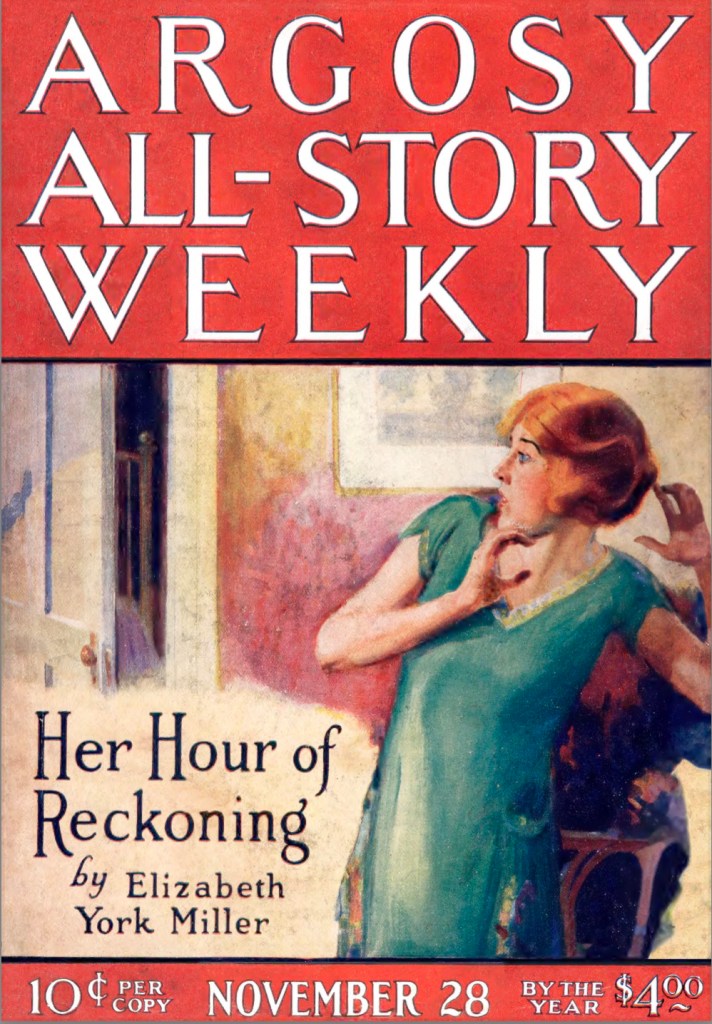
The issue of Argosy in which “A Radio Tragedy” appeared.

Flicking at random, as is my wont when unwinding, through digital copies of decades-old magazines, I came across a poem so trifling as to catch my attention.  To be sure, the lightweight verse in question is titled “A Radio Tragedy,” which makes it stand out for a reader who is also a writer on the subject.

Penned by one John McColl, an occasional contributor of lines, rhyming or otherwise, to 1920s magazines such as The Saturday Evening Post, “A Radio Tragedy” appeared in the 28 November 1925 issue of Argosy All-Story Weekly, a US American periodical then in its fifth decade.  

Unlike print publishing, broadcasting was still a new phenomenon at the time.  As I put it in Immaterial Culture, radio in those pre-network days was yet transitioning from “a ham-and-DXer playground to the bread and butter of virtual bill- boarders, from the site of an amateur cult to a scene of consumer culture involving, by 1930, over six hundred stations and sixty million listeners.”

Continue reading ““A Radio Tragedy”; or, Making a Song and Dance about Past Novel Experiences”

Egg ‘n’ I Column: “Your Problems Answered by Claudette Colbert”

Who was it that said “I shall do my very best to be of aid to anyone who has a problem, large or small”? If the title of this, the 824th entry into the broadcastellan journal did not give away the answer, it might have been anyone’s guess.  And perhaps it still is, the black-and-white of legacy media notwithstanding.  According to Photoplay – a publication leaving more room for doubt than any self-respecting sceptic would require – that Nightingalean sentiment emanated from the pen of none other than Claudette Colbert, a leading lady most widely known for her Academy Award-winning performance in It Happened One Night – a lady, no less, who gave anyone involved in making movies no end of problems by not letting a Hollywood studio lamp shine on the right side of her face, a cheek that came to be dubbed the dark side of the moon.  

“And what might you want?” Colbert seems to be asking in this original publicity photograph from my collection.

Dear me, I thought, when, quite by accident, I discovered that I my favorite film star lent her name to a “Dear Abby” column over a decade before the pseudonymous Abby started answering letters from all and sundry.  Having written two letters to Ms. Colbert myself – albeit not until 1991, mind – I was anxious to find out just what advice was given in her name to alleged Photoplay readers whose last names were, as is both customary and convenient, reduced to initials.

Continue reading “Egg ‘n’ I Column: “Your Problems Answered by Claudette Colbert””

“You beat time on my head”: Thoughts on Being Older Than My Father

My father, Gerhard Heuser, before I was born.

“As all the pleasures of intellect arise from the association of ideas,” Richard Payne Knight reasoned in An Analytical Inquiry into the Principles of Taste (1805), “the more the materials of association are multiplied, the more will the sphere of these pleasures be enlarged.”  He argued that, to a

mind richly stored, almost every object of nature or art, that presents itself to the sense either excites fresh trains and combinations of ideas, or vivifies and strengthens those which existed before: so that recollection enhances enjoyment, and enjoyment brightens recollection.

While I am not convinced that the “association of ideas” always brings “pleasures” or ‘brightens recollection” – experiences that are not strictly a matter of “intellect” to begin with – I am so prone to raids on the store of memories, in varying states of neglect and disrepair, that any and all matter may turn up and, often unexpectedly, turn into reassembled “materials of association.”

Tracing the proverbial dots that speckle – or perhaps constitute – my mindscape, I invariably connect the tell-tale marks that, like splotches of blood, lead right to the heart of what is the matter with me, and, without any recourse to science, make themselves felt to match my DNA.  I am dotty that way.

Call it egocentrism, call it empathy, such provoked but uncalled-for recall can lead to discoveries decidedly beyond “enjoyment.”  The compulsion to relate – to find associations relevant and revelatory rather than beside whatever the point of anything may be, according to some – keeps driving home that the past, however processed or pasteurized, like spilled milk made longer-lasting to be cried over anew – keeps repeating on us.  Hold our tongue as we may, we can still taste it.  I am tasting it now.

Continue reading ““You beat time on my head”: Thoughts on Being Older Than My Father”

“Does a big fish ever break the line and get away?”:  Boris Johnson, G. K. Chesterton, and the Case of the Deadly Prime Minister

“A thing can sometimes be too extraordinary to be remembered.”  With that intriguing overthrow of conventional wisdom opens “The Fad of the Fisherman,” a short story by G. K. Chesterton, first published in 1921.  “If it is clean out of the course of things,” Chesterton expounds, “and has apparently no causes and no consequences, subsequent events do not recall it; and it remains only a subconscious thing, to be stirred by some accident long after.  It drifts apart like a forgotten dream….”

A contemporary illustration for Chesterton’s story by William Hatherell, showing the “extraordinary” incident.

In light of the extraordinary and memorable events unfolding over the last few days like a crumpled serviette disclosing the spat-out remains of a prolonged Partygate feast – the rules-breaking incident that contributed to the eventual if only reluctantly heeded call for the resignation of Prime Minister Boris Johnson – the notion that something might be “too extraordinary to be remembered” does not quite ring true.  So much in politics these days is head-scratchingly, gut-churningly out of the ordinary, the Trump Presidency and its aftermath being a prime example.  And yet, the violation of established codes of conduct have become so flagrant and frequent that we, or some – or, I suspect, many – of us no longer recognize them to be unprecedented, unethical or unconstitutional.

It now takes greater effort to remember, if ever we knew, what once were assumed to be formal matters of procedure and protocol.  And we struggle as well to connect the tell-tale dots that, if they were examined closely – like some seemingly random Rorschach blots – and in relation to each other, might enable us not only to arrive at the “causes” – the egoistic and downright egomaniacal roots – of socio-political developments but also to realize the “consequences” of our inattention to pattern-forming details whose neglect profoundly compromises our ability to draw meaningful inferences from the reality of facts and fictions with which we are confronted: the erosion of trust in political figures who, instead of serving their country, help themselves and cling to power as if they were absolute monarchs.  How reassuring, then, are the ratiocinations that bring many a murder mystery to its logical if not always satisfactory conclusion.

It is the conclusion rather than the opening lines of Chesterton’s story – a story involving the unlawful actions of a Prime Minister – that brought to mind the astonishment with which I first reached it – a solution that I, appropriating shelved products of popular culture rather than reviewing them, am under no compulsion to withhold.  The by me highly anticipated conclusion to Mr. Johnson’s sorry and increasingly sordid Downing Street saga, meanwhile, remains unknown while I am writing this, the 822nd entry in my journal.  I might as well say it flat out: the Prime Minister in Chesterton’s story is a murderer who gets away with his crime.

Continue reading ““Does a big fish ever break the line and get away?”:  Boris Johnson, G. K. Chesterton, and the Case of the Deadly Prime Minister”

Penwomanship and Poison: The Chianti Flask by Marie Belloc Lowndes as an Antidote to Toxic Masculinity

The original dust jacket makes no mention of The Lodger; instead, it reminds readers of a more recent crime novel by Lowndes, which was adapted for the movies in 1932: Letty Lynton.

There is a lot of talk these days about ‘toxic masculinity.’  Making a strong case for the correlation of venom and virility, war criminal Vladimir Putin recently mocked the physique of world leaders who, by rolling their eyes at his shirtless posing, permitted themselves a moment of levity at his expense amid a crisis talk on Ukraine.  Meanwhile, COVID-19-rules violating British Prime Minister Boris Johnson, himself a noxious cocktail of mendacity and indiscretion, opined that, had Putin been born female, the invasion of Ukraine would not have happened.  Seriously, would the US Supreme court have decided differently on undoing environmental protection if more earth mothers were among the judges?

I thought the claim that toxicity is masculine had been conclusively laid to rest by Lucretia Borgia – or by Margaret Thatcher, at the very latest.  That the flip side of our fancies is still deemed to be “another man’s poison” makes me long for gender fluidity, itself a noisome notion to some.  Apart from lamenting the bane of binaries, I have nothing further to say here about exposed torsos or the merits of any remarks made by a disreputable Prime Minister.  And yet, there is no escaping the everyday – not even in the attempt to retreat into the presumably out-of-date, of pop past its sell-by date, for the sampling of which this journal was conceived.

Continue reading “Penwomanship and Poison: The Chianti Flask by Marie Belloc Lowndes as an Antidote to Toxic Masculinity”

“See what the boys in the [dark]room will have”: No Highway, Angus McBean, and Dietrich’s Face

Marlene Dietrich (1951) by Angus McBean, SoAM&G, Aberystwyth University
Purchase: Adrian Woodhouse (2016)
Funding support: ACE/V&A Purchase Grant Fund and The Art Fund

Of all the pictures currently on display in Make/Believe, the latest in a series of annual exhibition projects I create for staging by students of my curating class at Aberystwyth University, Angus McBean’s 1951 photograph of Marlene Dietrich is my favorite. 

What draws me in is the blankness of Dietrich’s face, her eyes looking not at us but beyond us, at nothing in particular, with a lack of any definable expression, emotion or urgency. The vacant gaze, bespeaking an unavailability and a refusal to engage, suggests the subject’s control over an image that is all surface: like theatrical curtains, the lids may come down on those eyes any moment now, shutting us out entirely.

It is a blankness that is not nothingness, invested as it becomes with the spectacle it makes of our longing.  It is a blankness that is not openness; it gives nothing away while it commands our attention and inspires our awe at its sublime perfection – a perfection that belies the sprezzatura, the rehearsed effortlessness and nonchalance of the performance.

Nothing here encourages us to imagine what those eyes are looking at; nothing that invites us to see anything through those eyes.  Those eyes are the event in a face – a site – that is all look.  I am glamor, this face says, and what else, what more could you – or anyone – possibly be looking for!

The photograph holds me because the look withholds so much. What we are not getting is a portrait of the sitter, then in her fiftieth year.  This photograph, clearly, is not of Dietrich, the person.  It is the image of a mask that is already a persona.  In this masquerade, as intriguing as anything conceived by Cindy Sherman in her film stills, the image is a simulacrum – the fiction of a fiction of a fiction.

Continue reading ““See what the boys in the [dark]room will have”: No Highway, Angus McBean, and Dietrich’s Face”

“Uneasy Threshold”: The Snake Pit (1948), Shock Treatment and a Straitjacket for Female Aspiration

I had misgivings about screening The Snake Pit (1948) as part of a festival of gothic films that included chestnuts such as The Cat and the Canary and The Old Dark House, many of which, for all their darkness, make light of mental health.  Aside from the plot to deprive Annabelle West of her millions by robbing her of her senses (The Cat and the Canary) and the miasmic madness of the Femms (The Old Dark House), there is cuckoo Miss Bird, in The Uninvited, collecting pebbles like eggs in a basket.  There are the convalescent servicemen in Sherlock Holmes Faces Death, whose nervous breakdowns are trivialised as ticks and foibles.  And there is psychoanalysis surrealised in the romance of Secret beyond the Door.  

By comparison, The Snake Pit, which is set in a mental institution, aims to deal seriously with mental disorder and health practitioners’ at times disorderly approaches to it.  To call such a film “gothic” – or to place it in the context of the modally gothic – may seem insensitive and insulting.  After all, ever since Vasari called medieval architecture “gothic,” the term has generally been used pejoratively, denoting products of culture that are beyond, and thus beneath, the grand narrative of the Enlightenment – beyond truth, beauty, and “all ye need to know.”

And yet, by choosing The Snake Pit as the concluding entry in my festival Uneasy Threshold – which explored non-genre gothic films that prominently feature houses as contested territories – I aimed to explore just how far that term may be stretched until it loses whatever elastic usefulness it might have when defining and describing certain or uncertain aspects of narrative film (such as imagery, cinematography or costume design) and film narrative.

Different treatment, same old story

Academics engaging with the gothic tend to draw attention to the challenges and perils of such an engagement, in part to cast themselves in the role of intrepid explorer by insisting on the treacherousness of the path they do not fear to tread.  It is a postmodern move as well to create a scholarly persona only to tear it off and examine it as if it were some uncanny other.  

Ushering us into her study Gothic Contemporaries (2012), for example, Joanne Watkiss performs the part of an educator who is taught by a student asking her “is there such a thing as the contemporary Gothic?” to question her subject:

I hesitated before I answered, because I realized this was an impossible question to answer.  For starters, there is no such thing, entity or body of work, delineated as the contemporary Gothic.  So his question raised all kinds of other interesting questions: was there such a thing as the Gothic in the first place? If so, where and when was the Gothic? Has it been and gone? Can it be located within a specific time frame? Impossible.  How can limits be place upon concepts that frustrate those very limits?

Her “convoluted answer” to the student’s question was “that the Gothic has never been a genre to define,” and that that is “certainly the current critical consensus – a move, as outlined by Catherine Spooner, ‘towards understanding Gothic as a set of discourses rather than simply as a genre.’”

As Watkiss acknowledges, that conclusion, such as it is, has already been reached, which raises the question: why claim having been challenged or perplexed when the answer is argued to be so obvious? Besides, the student’s question has not been answered, as the question was not whether the gothic is a genre but whether it is “a thing” – meaning, I presume, a subject, something to go on about.

My response to the student, fictive or otherwise, would have been: what is your understanding of “gothic”? And would you prefer I use lower case for that word, being that it is not a genre? Undeterred by the copyeditors of a book chapter on the “Gothic of Audition” who insisted I use upper case consistently, I am making a case for the modality of gothic by using lower case.

The gothic mode is a questioning of the conventionalising of purported wisdom, of classifications, of the tyranny of systems, and of the false sense of clarity achieved by staying clear of – disregarding, discarding, or else deforming and reforming – whatever does not fit the picture as framed.  In The Snake Pit, the pendulum swings from realism to romance, from therapy to terror, from civilisation to barbarism; but, to those receptive to its weight, its trajectory is the equilibrium-defying gothic.

The snake pit metaphor in Ward’s novel and the screen adaptation by Frank Partos

As Lindsay Hallam observes in her notes on the film, The Snake Pit shows the “grim reality” of therapy by “employing techniques more commonly associated with Gothic horror.” For instance, in the scene in which Virginia Cunningham, played by Olivia de Havilland, receives her

first electro-shock treatment the hospital becomes akin to a torture chamber or a Gothic pile, full of evil villains and threatening devices.  This is further emphasised through the prevalence of high-angle shots looking down on Virginia and the other patients, accentuating their powerlessness and vulnerability and making the medical staff and the hospital itself into menacing figures.

Aside from the visualisation of the titular Pit, a teeming abyss in which women are locked up, as Virginia remarks, like “animals” in a “zoo,” and in which authority figures such as a jealous, vindictive nurse and a repugnant doctor, stand in for the monks and sisters encountered in the fictions of Ann Radcliffe and Matthew Lewis, what makes Anatole Litvak’s film a candidate for the gothic – as experienced by me – is its insistence on its own allegedly good intentions: it is gothic in spite of itself.

Virginia Cunningham, a writer who suffered a nervous breakdown, endures shock treatment and straitjacket so that, upon release, she may once again function as wife to a husband she has quite forgotten.  “I have no husband,” she insists, remembering only the name she had before marriage, and the system is devoted to disabusing her of that notion.  “Let me go. Don’t touch me,” Virginia screams when her husband, visiting her in the Pit, tries to take hold of her.  “No, you can’t make me love you! You can’t make me belong to you! You can’t!”

Women can be doctors in 1940s Hollywood movies: provided they cure the emasculated male

The Snake Pit, like so many Hollywood films, aims to convince us that he not only can but must, for her own good.  Post-Second World War Hollywood, with its codes and prejudices, its blacklist and censorship, its narrative straitjackets and Christian cover stories is as gothic a structure as any house capable of haunting us with our pasts.