"Samson, made captive, blind": Milton on the Wireless

BBC Radio 3 is in the middle of a Milton season, designed to commemorate the 400th anniversary of the poet’s birth. This week, John Milton’s works are the subject of The Essay; his views, their significance and influence, are discussed on this week’s Sunday Feature, while excerpts from his poetry are recited on Words and Music. On 14 December, a new production of Milton’s Samson Agonistes will be presented by Drama on 3.

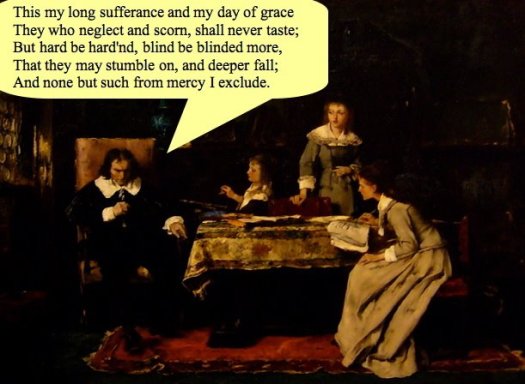
The wireless gave birth to the career of many a Milton, from announcers Milton Cross and John Milton Kennedy to comic Milton Berle. Among its writers numbers Milton Geiger, a playwright whom Best Broadcasts anthologist Max Wylie singled out for his ability to bring “reality and movement to a property that is in every sense an allegory.” More than any of those Miltons on the air, John, the poet and essayist, is truly in his element in the so-called blind medium of radio. His struggle to combat metaphorical blindness while being afflicted with physical sightlessness—a challenge that became the subject of a radio play (previously discussed here) was frequently the theme of his poetry, from “To Mr. Cyriack Skinner Upon His Blindness” to Paradise Lost and, finally, Samson Agonistes:

“O loss of sight, of thee I most complain!” the captured Samson, blinded and bereft of his powers, laments:

Blind among enemies! O worse than chains,
Dungeon, or beggary, or decrepit age!
Light, the prime work of God, to me is extinct,
And all her various objects of delight
Annulled, which might in part my grief have eased.
Inferior to the vilest now become
Of man or worm, the vilest here excel me:
They creep, yet see; I, dark in light, exposed
To daily fraud, contempt, abuse and wrong,
Within doors, or without, still as a fool,
In power of others, never in my own—
Scarce half I seem to live, dead more than half.

As a political writer eager to get his word out, Milton might have embraced the swift spreading of ideas that wireless technology makes possible. He would have seen in broadcasting the dissemination of so much good mingled “almost inseparably” with so much evil, from which the good is “hardly to be discerned.” To him, though, discernment was not the result of a shutting out of anything potentially harmful or ostensibly bad, but of a taking in of it all and an informed judging of its qualities. He would have welcomed the chance to have his words reach the ears of the multitude in a single broadcast, and of hearing the voices of others in an open forum.

Yet was there ever such a forum on the air? As he did in his Areopagitica, Milton would have objected to the licensing and censorship that threaten and curtail the freedom of speech. Commercial broadcasting, he might have argued, is not unlike Samson, betrayed, imprisoned and abused: “in power of others, never in [its] own,” a “moving grave” awaiting death by television. Even when it was still capable of bringing down the house, radio, like Samson, went down in the process before ever entirely convincing anyone of the power and virtue of sightless vision.

So, if Samson is Radio, who is his Delilah? Would it be television, the sponsors, radio executives, or, perhaps, the Philistine public at large?

"Everybody talks too much": Dylan Thomas and the Long-Lost "Art of Conversation"

“To begin at the beginning.” Thus opens what is undoubtedly the most famous of all plays written for radio: Under Milk Wood, by Welsh poet Dylan Thomas. BBC radio first produced the play in January 1954, with fellow Welshman Richard Burton in the role of the narrator. It had been previously performed in New York, shortly before Thomas’s death in November 1953 (which is the subject of a new book, Fatal Neglect by David N. Thomas, whose previous biography was the source for the motion picture The Edge of Love. Thomas’s poetry is still widely read today; but little is known generally about his other works for the wireless, about which there is generally little talk these days.

Thomas’s most popular story, “A Child’s Christmas in Wales” (published posthumously in 1955) was originally written for radio, as may be deduced from the attention Thomas’s pays to descriptions of sounds and voices, from the “most unducklike sound, a mewing moo that an ambitious cat might make who wished to be a cow” to that “small, dry voice, like the voice of someone who has not spoken for a long time,” a “small, dry, eggshell voice from the other side of the door: a small dry voice through the keyhole.”

Indeed, as I learned from Douglas Cleverdon’s introduction to the Folio edition of Under Milk Wood, Thomas had been on the air, whether as poet, critic, or actor, since 1939. Among his broadcast features is “Return Journey” (1947), a precursor to “Mad Town” (as Under Milk Wood was initially titled); it has been published in the anthology Wales on the Wireless (1988). Earlier this year, another play for voices by Dylan Thomas has been discovered and is now being given its first production on the air. Titled “The Art of Conversation,” it is available online until 9 December.

The title is somewhat misleading, since the play is really about shutting up. It is a Second World War propaganda piece, commissioned as part of a “Loose Lips Sink Ships” campaign, the sort of cautionary talk on the virtue of silence exemplified in the US by mystery writer Mignon Eberhart’s “The Enemy Is Listening” (Cavalcade of America, 7 June 1943). In it, a sinister voice (Everett Sloane’s) replies to remark that no “real American intends to give information to the enemy,” that

sometimes, sometimes someone forgets.  A word overheard and repeated. A small fact passed on to someone else may mean little to you.  It may mean nothing to the person to whom you repeat it.  But the third or the fourth person or the tenth or the twentieth may be your enemy. Your enemy.

Thomas’s “The Art of Conversation” is a rather more subtle performance. It permits us to indulge in the excesses of talk by Britain’s most celebrated conversationalists, only to remind us that there are times when—and subjects about which—the word should be “mum.” “I don’t think you’ll find Mr. Hitler with a little notebook under our table, do you?” one careless talker quips; but, just to be on the safe side, the idle talk that ensures is being censored.

Like Eberhart, Thomas weaves a web of compromising voices; yet he dispenses with melodrama and, indeed, as is typical of his compositions, with plot altogether. Instead, he opts for an informal lecture (replete with audience) punctuated by “the lantern slides of sound”: a multitude of voices, some distinct, others choric. All are preliminaries and subject to shushing:

Hundreds of odds and ends of hundreds of hearsays and rumours may, and can, be brought together into such a pattern that a whole Allied enterprise is thwarted or destroyed. A wagging tongue may sink a ship; a stray word over a mild-and-bitter may help to murder children.

However chatty and playful, “The Art of Conversation” eventually gets down to business and brings its message across; at least, it might have done, had it not disappeared for decades—apparently before it was ever broadcast. According to the current issue of the Radio Times, there is no evidence that the play was intended for radio; but you need only to listen to know that it could have hardly been written with any other medium in mind.

Alison Hindell’s belated production slightly condenses the original script (available here in its entirety), but otherwise takes few liberties with Thomas’s prose and directions; a 1920s “nigger” is turned into “negro,” a concession to our politically corrected sensibilities. Few US radio dramatists were treated with such respect.

The single exception is the rather pointless addition of an opening line that is not part of Thomas’s “Art,” but the famous introduction to Under Milk Wood, quoted above. No doubt, the presenters intended to draw the famous poet into his forgotten “Conversation,” so as to validate this lesser performance; but, instead of indulging in such self-conscious reverberations, they should have left themselves out of it, especially since there is enough of Thomas in it to make the lecture worth our while.

If only a discovery like this could get us talking again about radio . . .

Even Reindeer Get the Flu

Four weeks and a day! As the exclamation mark suggests, being that I use it so sparingly, I am not counting down the days to New Year’s Eve here or marvel at the seemingly accelerated passing of time. It is the time my cold has been taking thus far to run its collision course and me crazy into the not so welcome bargain. It could be, though, that today’s headache has been exacerbated by Mickey Rooney.

My attempt to book tickets to his latest show, that is. I tried to get in touch with a sales representative to make sure that the tickets I ordered online won’t be sent to our home, as requested, given that, as it dawned on me only after I had finalized the booking, we are elsewhere during the latter part of December.

The apparently unstoppable octogenarian, Judy Garland’s co-star in a series of musical-comedies, is going to be in one of those pantomimes so popular in Britain during the holiday season; this time, some eighty-two years after his acting debut in motion pictures, he appears at the Hippodrome in Bristol, England, where we had planned to spend the final forty-eight hours of 2008.

The busy Mr. Rooney, slated to appear in four films in the upcoming months, stars opposite British stage and television actress Michelle Collins, whom last we saw backstage at the Shaftesbury Theatre in London (and whose autograph I displayed here). Anyway, I eventually sorted out the mailing situation and can only hope that the constitution of the man formerly known as Andy Hardy will prove sturdier than mine.

I am in the mood for a seasonal tale, tall or otherwise, but would much rather close my eyes than read Christmas Stories with its selection of fiction by Conan Doyle, Damon Runyon, Evelyn Waugh, and, a personal favorite, Anthony Trollope. So, once again, I rely on the radio, or recordings of plays once produced for the medium. On this day, 2 December, in 1945, The Philco Radio Hall of Fame presented a new story, which it predicted to “become a Christmas classic.”

Never mind that this prediction did not quite come true. After all, the woman who made it was not chiefly known as a clairvoyant, even though she had a voice that could induce millions to spend millions on war bonds and forge stars in the smithy of her own radio shows. Announcer Glenn Riggs somewhat needlessly reminded the public that, “as commentator, singer, forceful personality and discoverer of stars,” she had “no equal on the air.” Yes, it was Kate Smith who ventured that guess, no doubt boosting the sales of the volume. When Smith sings, you can count on sales as well as volume.

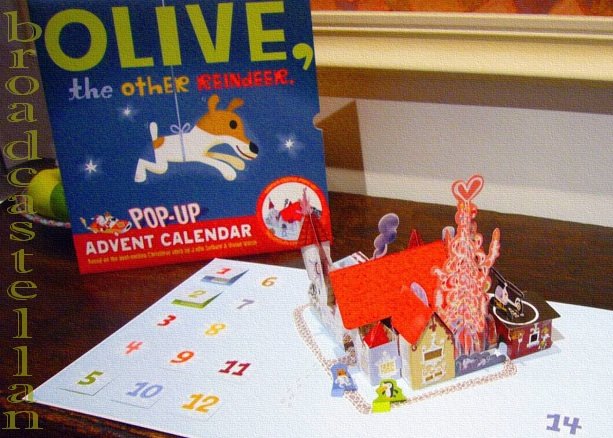
On the Hall of Fame, Smith not only belts out a number of tunes, including “If I Loved You” from the latest Rodgers and Hammerstein musical Carousel and her celebrated rendition of “God Bless America”; as story lady, Smith narrates a dramatized version of Roger Duvoisin’s “The Christmas Whale,” a whimsical paean to ingenuity involving the breakout of a flu epidemic at Santa’s toyshop and the reindeer that flew not because they all came down with it. Perhaps, such susceptibility explains why this year’s advent calendar featuring Olive, the Other Reindeer, arrived a day late in the mail.

The title of Duvoisin’s story leaves no doubt as to the creature lending a helping fin. Perhaps, the sudden substitution was a metaphor for the death of FDR just at the time when things were beginning to look up and the theaters of war were closing, not merely for the duration of the holidays. There is no mention of Harry Truman; but, when asked what Christmas gift she would make General Eisenhower, Smith remarks: “Well, I’d give him a future as great as his past.” Perhaps, she was prophetic after all . . .

Mark Twain, Six Feet Under

“I have been trying all I could to get down to the sentimental part of it,” Mark Twain remarked on the “subject of graveyards.” Yet, he concluded, there was “no genuinely sentimental part” to the spectacle we make of the act of decomposing. “It is all grotesque, ghastly, horrible.”

Perhaps it takes a higher degree of sentimentality to find the romance in the morbid; but I am capable of just that. Whenever I travel, I enjoy visiting places of interment, particularly those large necropolises with their temples and statues erected in memory of mortals who, while above ground, played a vital role in the workings of our large metropolises.

Bankers and bigwigs seem to insist on occupying the largest dwellings in the cities of the dead. There must be some consolation in knowing that, even when six feet below, one can still get folks to look up in admiration. Writers, by comparison, often have modest graves. They, after all, leave their impressions by filling volumes that, however small by comparison to a mausoleum, are apt and ample monuments to their craft. Tombs are largely reserved for those who managed no tomes.

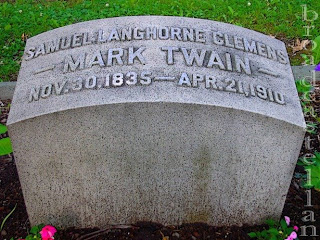
Mark Twain’s own grave is an encasement in point. Last summer, returning to New York City from a trip to Niagara Falls, we had a stopover in the town of Elmira. Since I was in charge of both the map and the guide book, I made sure it was on our way. After all, the humorist from Missouri is buried there. The first thing we did, after securing a room for the night, was to go in search of his final resting place, which we found, eventually, along with that of filmmaker Hal Roach (shown here). However impaired our sense of dimensions after beholding the Falls, the stone (pictured) is less than majestic.

Close to it, though, is a larger monument, about twice as high as the number of feet I presume him to be under, which is precisely the length denoted by the cry of “mark twain” from which Samuel Clemens took his name. The cleverness of the tribute notwithstanding, I wonder whether the writer so honored would have welcomed such a column. Resting assured that monuments are being perpetually erected in the minds of those who read, relish, and recite his words, Mark Twain may well have been better pleased with a more modest disposal, given his attitude toward burials as expressed in Life on the Mississippi:

Graveyards may have been justifiable in the bygone ages, when nobody knew that for every dead body put into the ground, to glut the earth and the plant-roots, and the air with disease-germs, five or fifty, or maybe a hundred persons must die before their proper time; but they are hardly justifiable now, when even the children know that a dead saint enters upon a century-long career of assassination the moment the earth closes over his corpse.  It is a grim sort of a thought.  The relics of St. Anne, up in Canada, have now, after nineteen hundred years, gone to curing the sick by the dozen.  But it is merest matter-of-course that these same relics, within a generation after St. Anne’s death and burial, made several thousand people sick.  Therefore these miracle-performances are simply compensation, nothing more.

Besides, he pointed out (quoting a member of Chicago Medical Society, who was an advocate of cremation), “[f]unerals cost annually more money than the value of the combined gold and silver yield of the United States in the year 1880! These figures do not include the sums invested in burial-grounds and expended in tombs and monuments, nor the loss from depreciation of property in the vicinity of cemeteries.”

Mark Twain was born on this day, 30 November, in 1835; he died nearly a century ago and, whatever his views on the matter of tombstones, has well earned his keep at Woodlawn. Here he immaterializes for us in “The Adventures of Mark Twain” (Cavalcade of America, 1 May 1944), the voice being that of Fredric March. In light of Mark Twain’s remarks, I believe he would have approved of the memorial services a cost-effective medium like radio can provide. Radio gets rid of the body but keeps the spirit alive.

Hattie Tatty Coram Girl: A Casting Note on the BBC’s Little Dorrit

They are still after him, those producers of television drama. And they know that many of us are eager to follow. In a way, we cannot help being After Dickens, to borrow the title of a study on “Reading, Adaptation and Performance” by John Glavin. It is a sly title, that. After all, we are belated in our pursuit; we do more than simply try to catch up. We are bringing something to the game that is the act of reading. We are making sense, and we remake it, too.

Andrew Davies, the writer responsible for the award-winning dramatization of Bleak House, subsequently tackled Little Dorrit (1855-57), one of the lesser-known works in the Dickens canon. Having greatly enjoyed Bleak House when it first aired back in 2005, I was again drawn away from the wireless, to which most of the posts in this blog are dedicated, to go after what is being shared out—in installments, not unlike in Dickens’ day—by radio’s distant and rich relation.

Now, it has been some time since I read Little Dorrit. During my graduate studies, the novel tantalized me with its perplexing nomenclature, an uncrackable code of names and monikers that inspired me to dabble in the dark art of onomastic speculation. The result of my academic labors, “Nominal Control: Dickens’s Little Dorrit and the Challenges of Onomancy,” is available online.

While many of the names heard in the adaptation of Little Dorrit still ring the proverbial bell for me, some of the faces, as made up for us by the adaptor, seem less familiar. Never mind Arthur Clennam, who is rather younger than the middle-aged man Dickens was so bold to place at the center of his novelistic commentary on the manners, mores, and money matters of Victorian Britain. The character of Tattycoram is the one to watch out for and puzzle over: a foundling turned changeling.

In the original story, Tattycoram (alias Harriet Beadle, alias Hattey—the act of naming is that complicated in Little Dorrit) is introduced as a “handsome girl with lustrous dark hair and eyes, and very neatly dressed.” As portrayed by Freema Agyeman, the televisualized Tatty certainly fits the bill: a young woman with dark hair and eyes, and, my metaphorical hat off to the costume department, handsomely outfitted.

Hang on, though. The color of her skin, to which no reference is made in the novel, appears to have been adjusted; and, in a crowd of pale faces, it is a change that really makes a difference. Has Tattycoram just “growed” that way?

It surely is not simply a case of equal opportunity for television actors like Agyeman, if such cases are ever simple. A black Tattycoram transforms the very fabric of Little Dorrit. It imposes an historical subtext on our reading of the story and the young woman’s part in it.

Adaptors, like translators, frequently engage in such updates, if that is the word for what can amount not only to anachronisms but to presentism, the latter being the imposition of a viewpoint contemporary with the audience of the new version. I was not bothered by the lesbian characters the BBC insisted on sneaking into the staid and psychologically none too complex mysteries of Agatha Christie, even though such reorientations seem gratuitous. The determination adaptors made regarding Tattycoram’s ethnicity is altogether more problematic.

While slavery was abolished in Britain prior to its publication, Little Dorrit is set some thirty years in the past, the possible implications of which present-day television audiences are not given sufficient context to ponder and may not even notice. I had certainly forgotten about the dating of the action prior to the coronation of Queen Victoria. Little Dorrit, unlike Dickens’ A Tale of Two Cities and Barnaby Rudge, is not an historical novel, however; nor is it a commentary on the slave trade.

Concerned with prison reform, and the injustices of the debtor’s prison in particular, the novel refers to slavery only metaphorically to signify systems of oppression and forms of thraldom, perceived or actual. At one point, the orphan Harriet is taken in as a companion by the fiercely independent Miss Wade who, in readings of the novel, has been outed as a lesbian. In a first-person narrative, Miss Wade reflects on her earlier experience as a governess: “I was not bought, body and soul. She [Miss Wade’s employer] seemed to think that her distinguished nephew had gone into a slave-market and purchased a wife.” Clearly, in this questionable equation of servitude and slavery, no comment on the reality of the slave trade was intended by Dickens in this expression of a character’s anger regarding her station and the transgression of which she believes herself to have been accused.

In the Victorian novel, the black or “mulatto” figure remained largely invisible, or else was the brunt of derision. One such laughing-stock character is Thackeray’s Miss Swartz, the “rich woolly-haired mulatto from St. Kitt’s” who parades through Vanity Fair being “about as elegantly decorated as a she chimney-sweep on May-day.” In Dickens’ Bleak House, concerns about black lives in the colonies are dismissed as the folly of “educating the natives of Borrioboola-Gha, on the left bank of the Niger.”

Of the nearly one hundred, mostly flat characters that flit in and out of Little Dorrit—which, according to the Radio Times, were reduced to around seventy-five in the process of compression—it is Tattycoram, an orphan named after the notorious Coram hospital in London, who now stands out as an individual struggling to emerge from a socially imposed conspicuous invisibility that, the adaptation insists, is owing to her ethnicity. Thus, a marginal character takes center stage by an imposed discourse on the nature of her marginalization. In other words, the attention paid to her, belatedly, is justified mainly by the postcolonial narrative grafted on the novel in which the Harriet in question is treated as if she were the brainchild of Beecher Stowe.

Showing a little skin, and revealing it to be black, Davies’ retailoring may strike some audiences who are acquainted with the genuine article as a bold new cut. And yet, in the process of giving the old Empire new clothes, the Dickensian fabric is suggested to be more than a little Tatty. Perhaps, instead of such alterations, the assumption that, with strategic trimming, Dickens can still meet our aspirations needs adjusting.

They are still after Dickens, all right. The question is: are they even trying to get him or, riding on his coat-tails, are they out get at something he just hasn’t got?

Holocaust Ending: The Boy in the Striped Pyjamas

“Enjoy the movie.” That is the response we get when we tell friends and acquaintances that we are on our way to the cinema. And while it is true that we generally seek enjoyment, whether by looking at separated lovers or severed heads, movie-going can be a disconcerting, unsettling event well beyond the shocks and jolts provided by horror and romance. The Boy with the Striped Pyjamas (a British film in its British spelling), is likely to be such an experience to anyone with a pulse and a sense of humanity ready for the tapping. To me, it was nothing short of devastating. I am not resorting to hyperbole when I say that I was rendered speechless; those accompanying me can attest to my disquietude. It has been a decade since last I watched a film (Saving Private Ryan) that has stirred and traumatized me to such a degree that, coming out of the theater, I felt sick to my stomach. No wonder. I had just been coerced into walking straight into the gas chamber of a concentration camp.
Whimsical and naïve, The Boy with the Striped Pyjamas is a suitably misleading title for a story that is out to challenge and deceive you. It is not your traditional Hollywood response to the horrors of the Third Reich, which is why I refer to the film’s conclusion as a Holocaust ending. Hitchcock might have voiced his objections, as he did in the case of his own Sabotage (previously discussed here); but the dark twist in Mark Herman’s melodrama is no cheap device to rattle your nerves: it is both heart wrenching and thought provoking, as the emotions it elicits will be mixed, depending on whose life, whose position you examine: those engaged in the horror or those consumed by it.

The Boy with the Striped Pyjamas is largely told from the perspective of a child, which is to say that it casts a familiar and much examined world into a twilight of the uncanny—the known revisited as the hazily uncharted in the act of exploration. The Boy is about as un-Hollywood in its exploration of childhood and fascism as Pan’s Labyrinth—and similarly gruesome. In its final scenes, in which terrified parents run through the woods in search of their son, it resembles the horror of a Grimm’s tale before Disney got his fingers on it.

The Boy is uncompromisingly bleak. The title character, as you might have guessed, is a Jewish child in a Nazi concentration camp. As I was reminded on a recent visit to Riga, Latvia, the camp uniform does indeed resemble old-fashioned sleep ware, a comparison all the more poignant if we consider that the camps were the final resting place for most of its inmates.

The central character, though, is the son of a Nazi officer. Eight years old, he is unaware of what is going on beyond the walls of his austere new home, the one to which his family moved from Berlin after his father was assigned with the supervision of the nearby concentration camp. To the boy in his cheerless isolation, the camp is farm, a lively community where he might make new friends. Day after day, he ventures through the woods to the electric fence behind which he descries a boy is own age, a fellow whose life seems mysterious and exciting to him. Why should he accept that his new playmate is separated from him? Why not ignore or overcome this barrier? Why not wear “striped pyjamas” to be just like his new friend?

We have the answers to those questions; history provided them, and everyday life often confirms them. We know what happened. We might even know what is going on right now. Some of us know and are ready to confess to the limits of our humanity, the margins beyond which fall those whom we consider in the abstract of numerals rather than as individuals. The Boy is too intimate a story to be called metaphorical. We are being sentenced to death, and the film’s ending is our own. Facing it, we realize that beyond knowing lies the challenge of understanding.

Cruikshank Running Away With Dickens: Oliver Twist (1909)

The Oxford English Dictionary devotes an astonishing number of pages to the definition and history of the word “old.” Thus far, I have not been entered as an example. To be sure, whether or not something or someone is “old” depends largely on the age and attitude of the beholder; but it also depends on the history and evolution of what is being beheld and judged. Based on the history of film alone, one can safely describe Vitagraph’s “Oliver Twist” as “old” without incurring many objections as to the subjectiveness of the chosen adjective. After all, “Oliver Twist” was released back in 1909. At the time, some of the first readers of Dickens’s serial novel still numbered among the living. They might have looked upon those images in motion as a novel approach to an old favorite, while we, who have come to realize that technology dates faster than art, look at it as a creaky and inadequate translation.

The thought of film as a bridge between us and the early Victorian age is awe-inspiring; not that extant constructions rising above that gap are particularly trustworthy, considering the cardboard sets and threadbare production values of films like “Oliver Twist.” Directed by Englishman J. Stuart Blackton, it is all but nine minutes long; and as such, it is more or less a synopsis of the novel.

Indeed, it is rather less. Here we have the richly descriptive words of Dickens, a master of penning indelible if none-too-intricately sketched word-portraits, translated into the moving images that are, to this date, the competitors of moving English. Intertitles are sparse, an economy of words that turns the spectacle into a set of tableaux in the service of a moral whose statement even a sentimentalist like Dickens might well reject as rather too obvious and prosaic.

Owing to the film industry’s raiding of the Dickens canon, the author’s original illustrator, Cruikshank, appears to have run away with the show. In film, now and then, the word is largely an adjunct to the image, reversing the precedent set by the illustrated novel, itself the product of modern printing technology. Without any close-ups and a style of emoting that makes Lana Turner’s acting look like the epitome of realism, “Oliver Twist,” unlike Dickens’s Oliver Twist, can no longer engross us as anything but a curio to be marveled at and studied. Unless, of course, one thinks of those sitting in the auditorium back then, finding their books to be projected onto a screen in the most peculiar form of translation, with authors and actors alike removed from the scene.

What a comfort it might have been to pick up the novel anew and give it life in one’s own breath, to learn that Oliver’s story was the story of modern, industrial society in which even the living things of our imaginings are reduced to commodities. Nancy is literature, I kept thinking, and the thieving Bill Sikes is film. It will require a screening of Frank Lloyd’s 1922 version, starring Lon Chaney and Jackie Coogan, to adjust this image; I am very much looking forward to the latter, being that our friend, the aforementioned silent film composer and (radio) dramatist Neil Brand, showed me his studio as he was in the process of scoring the film. 

Both versions, along with a lantern show of “Gabriel Grub” (from an episode in Pickwick Papers), are included in the collection Dickens Before Sound, compiled and preserved by the British Film Institute. At the sight of this feast in small doses, nutritiously dubious as some may be, I can hardly refrain from echoing Oliver’s familiar plea for “more.”

The Lilt of the Lilliputian

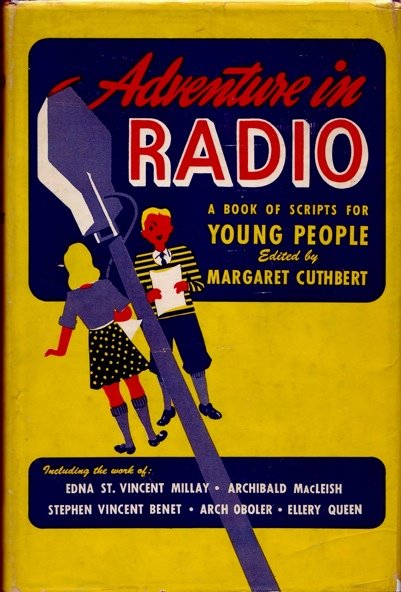
The cover of Adventure in Radio, from my collection

A few years ago, walking home from graduate school one afternoon, I stopped by at a second-hand bookstore in my old neighborhood of Yorkville, Manhattan. Judging from the window display, the shop seemed to specialize in children’s books and memorabilia. While this did not deter me, I hardly expected to make any significant acquisition of a volume on the subject to which this journal is chiefly devoted. I mean, I was not looking for a decoder ring or some such souvenir from the bygone age of radio dramatics. I was, after all, researching my dissertation. There was on the shelves a beautiful copy of Adventure in Radio (1945). Subtitled “A Book of Scripts for Young People,” it may be expected to include juvenile playlets written for the medium, although not necessarily produced on network radio. On such compilations, of which there are many, I was not inclined to waste money or time.

Spiting my assumptions, Adventure in Radio not only contains a number of broadcast scripts from programs like Jack Armstrong and Let’s Pretend but also propaganda plays and wartime commentaries geared toward an adult audience. In addition, it offers insights on the production of radio plays, on sound effects, announcing, and “radio language.” It took a little salestalk from the owner of the by now long closed store, but I was soon convinced. Where (I did not know much about eBay back then) would I ever find such a book again? And how could I claim to be serious about old-time radio if I did not snatch up this copy? So, I handed over my $40 (it was the price tag that made me hesitate) and walked off, eager to continue my studies . . . and determined to find the recordings to match the published scripts now at my fingertips.

That often proved quite difficult; but I had made up my mind that I was not going to write about words divorced from performance. I wanted to hear what was being done with those scripts, how they were edited and interpreted. Take the NBC University Theater’s production of “Gulliver’s Travels,” for instance. It was broadcast on this day, 24 September, in 1948. My appreciation of the challenges of soundstaging the play grew after reading the comments with which Frank Papp, a director of radio drama for NBC, prefaces the script, originally written for the series World’s Great Novels. Papp points out the “unusual problems” Frank Wells’s adaptation posed in production:

In the matter of casting, the Lilliputian was the most difficult.  Here was needed a voice which gave the illusion of a tiny man.  A trick voice in itself would be only a caricature.  What was required was a voice that created a picture of a real human being of Lilliputian size.  After extensive auditioning, an actor was found whose talent and vocal capabilities fulfilled these requirements.

The actor portraying Gulliver was placed in an isolation booth, Papp explains, “so that the Lilliputian’s voice would not spill over into his microphone” and the two voices could be miked separately, with a volume reflecting the size of each character. The voice of the King of Brobdingnag, meanwhile, was “fed” both through an electronic filter to amplify its base quality and through NBC’s largest echo chamber to create the illusion of a giant.

The 24 September 1948 presentation of “Gulliver’s Travels,” starring Henry Hull in the title role, does not quite live up to the expectations raised by Papp’s introduction. Under the direction of Max Hutto, child actor (Anthony Boris) is cast in the role of the Lilliputian, a choice that infantilizes the character and renders pointless the effects achieved by the sound engineer.

While Wells’s script downsizes Swift’s story and diminishes its bitterness and bite, it is the production that contributes to a sense that Gulliver’s Travels is, at heart, a juvenile fantasy, despite its airing on the ambitious if misguided NBC University Theater, a program that linked listening to such bowdlerizations with courses in distant learning. I may have been able to match the script with a production, but it was not the one described in Adventure in Radio.

Squeezed as I am into the isolation booth of my preoccupations, it is my mind’s voice that supplies the lilt of the Lilliputian . . .

“ . . . only a generation older than radio”; or, Thinking Comfort

Comfort, Aldous Huxley once remarked, “is a thing of recent growth, younger than steam, a child when telegraphy was born, [and] only a generation older than radio.” With a few million listeners guaranteed to sit down for it, the aforementioned Columbia Workshop embroidered on that reference and, on this day, 4 August, in 1946, presented radio critic and historian Robert J. Landry’s digest of Huxley’s essay in a broadcast proposing “Happy Thoughts for a Hot Afternoon” (the second being given to “Laughter”).

“Exactly. Comfort is new,” the narrator concurs with Huxley; and while not an “American invention,” it was an “American enthusiasm.” That much is irrefutable; but is “comfort” truly an invention peculiar—and in its origins traceable—to any particular age? After all, was it not a state responsible for the fall of the Roman Empire? Perhaps, it is merely a new term for an age-old desire the fulfilment of which came within the no-need-for-stretching-much reach of a New World catering to it, for a price?

Surely, the Neanderthal knew better than to rest his aching head on a pillow of granite; but he might not have had the nerve or need to sell the idea to anyone inclined to recline and ready to cave in upon being hit over the noggin with the padded yet relentless hammer of persuasion so adroitly wielded in consumer cultures.

Apparently, “comfort” is not even a new term, considering that “kunfort” (from the Latin “confortare”) has been part of the English language for centuries preceding the ostensibly New World, even though it might have been applied only to those rare, restful moments in the lives of the few who could make the Old World believe they had a divine right to experiencing it.

In the Middle Ages, Huxley suggests, comfort was a neglected ideal; and it was not until the dawn of the 20th century that the “padded chair, the well-sprung bed, the sofa, central heating, and the regular hot bath—these and a host of other comforts enter into the daily lives of even the most moderately prosperous of the Anglo-Saxon bourgeoisie.”

Lolling about on a none too hot afternoon, more comfortable than a 1940s audience deficient in conditioned air, I tuned in belatedly and ever so lazily to hear what the Workshop made of Huxley’s “Comfort” and how, a decade before handing the microphone to its author, CBS went about comforting its listeners with what it insisted on turning into “Happy Thoughts.”

Landry, it appears, was sold on the idea that “comfort” is modern, at least in the technological sense:

Announcer. Now, sir, without straining a muscle, I think you can reach one of those mother-of-pearl buttons.

[Biz: Switch.]

Fine. That’s remote control for the twelve-tubed radio receiver hidden in the mirrored refreshment bar across the room. Now we should get some soft music.
[Soft Music.]

Dependable, easy, effortless bedside radio music. Lullabies for grown-ups.

Listener (drowsily). Does the . . . radio shut off automatically if you fall asleep?

What the narrator-announcer promised is just what broadcasters were often accused of proffering: inoffensive and largely forgettable fare. Outspoken in his critic of radio elsewhere, Landry is rather coy here, suggesting only that programmers would do well to keep their audience by keeping it awake. Giving listeners what they want might well translate into a general want of listeners.

“Happy Thoughts” dwells on “comfort” as a feature and enabler of democracy, a political system that begot radio as the voice of—or at least for—the common folk. It refers to fascist Germany as a dictatorship that had no use for—and reason to be wary of—comfort, just as the rulers of the past depended on a populace that was never quite at ease. That the medium may have more detrimental effects than being soporific, that the Third Reich made great use of it in herding the masses, are thoughts too uncomfortable for Landry to ponder on this “Happy” occasion.

“Yes,” the audio essay concludes, “I guess we’ve got a lot of comforts to be grateful for nowadays. Happy thought, comfort!” In its gentle mockery of our insistence on contentment, the Workshop lecture makes a shortcut straight to the easy chair. Whereas Huxley held comfort to be a worthy “means to an end” in that it “facilitates mental life”—just as “[d]iscomfort handicaps thought” when a “cold and aching” body inhibits the use of the mind—he went on to caution that the “modern world seems to regard it as an end in itself, an absolute good. One day, perhaps, the earth will have been turned into one vast feather-bed, with man’s body dozing on top of it and his mind underneath, like Desdemona, smothered.”

Now, I am not sure whether Desdemona would have been better off being stoned to death by a solid idea than being choked by a foolish notion; but I wonder whether I should not opt for a boulder in lieu of a comforter sometime. May not a restless night produce thoughts capable of pushing us forward instead of returning us to the site of comfort for more of the same? Should we continue to pad our cells so as not to crack our brains on disquieting thoughts brought on by deprivation?

It might be a thought that strikes many of us as barbaric as the prehistoric, but, as those spineless and far from fortified creatures aboard that Brave New World of a space cruiser in WALL-E reminded me recently, “comfort” has the discomfiting side-effect of effecting nothing . . .

As Jane Airs; or, Going KUKU

My copy of Jane Woodfin’s novel Of Mikes and Men

“Jane Woodfin has worked for a West Coast radio station, in practically every known capacity, for more than twenty years—a period which almost spans the life of modern radio.” That is pretty much all I know about the wit that penned Of Mikes and Men, a narrative promising the “humorous inside story of early radio, when announcers doubled as soundmen and microphones went dead once a program.” I should not be quite so petty or perplexed—but the broadcast historian in me still doesn’t know quite what he’s reading.

At least, “humorous” is an entirely appropriate tag for Woodfin’s tale, that, tall or not, was published in 1951, when radio was still the source of mystery, romance, and adventure, but only in a programming sense. Otherwise, it was a big business, a well-oiled if somewhat past its prime machinery that bore little resemblance to the “anything goes”—or “nothing quite works”—broadcasting of the 1920s recalled by Woodfin.

Of Mikes and Men, which I picked up at a bookstore in Dryden, New York (aforementioned), opens like a prequel to Remember WENN. You know, the nostalgic sitcom set in a broadcasting studio, which aired on AMC during the mid-to late 1990s. Woodfin’s narrator, presumably the author, relates how she, penniless and none too skilled, got a job at a radio station in Portland, Oregon just after Wall Street laid that infamous “Egg.” Perusing the want ads, the young woman applied for the only position offered to female job searchers—that of “continuity writer” at station KUKU.

Not that she had any idea what a “continuity writer” was. She beat out a number of applicants and, being paid partly in cash, partly in the goods the station’s sponsors tried to peddle, was expected to deliver not only advertising copy and chatter (the so-called “continuity”) but also her own cooking program. That Jane, as her friend and neighbor points out, would be lost without a can opener, was something she kept to herself, until the audience, trying to follow her recipes, found out as much while gazing at the indigestible mess sticking to their pots and pans.

This is all rather jolly and preferable to leafing through I Hid It under the Sheets, the at times exasperatingly ungrammatical and disorganized reminiscences of journalist, sports writer, and radio listener Gerald Eskanezi, which I mentioned previously. At least, Woodfin knew how to turn a phrase and tell a story. So, why am I not just sitting back and enjoying that story?

For one, I am wondering just whose story it is. I mean, is it based on actual experiences? Is there anything between the covers that might tell me something factual about what it was like working in broadcasting before radio reached what is generally referred to as its “golden age”? Or is it a calculated, well timed antidote to the run-of-the-mill radio of the post-war years with whose Hucksterism Americans became so thoroughly disenchanted?

Playing it sly, Woodfin dedicates her book to those who presumable worked with her by stating:

To my dear friends and co-workers in early radio who will attempt in vain to find themselves in the pages of this book.  You aren’t here. I couldn’t put you in because you are normal.  But you may recognize some of the screwballs we both knew.

Station KUKU? I assumed Woodfin’s book to be an account of an early radio comedy of the same name. It was created by Raymond Knight, one of whose later Cuckoo programs you may find in the Internet Archive. According to the aforementioned Messrs. Gaver and Stanley, Knight began broadcasting on 1 January 1930 and distinguished himself by being one of the first radio satirists to poke fun at the medium. Groucho Marx reputedly thought him to be “the best comedian on the air.”

Turns out, Of Mikes and Men does not concern Mr. Knight, who broadcast from the East Coast. Nor have I come across any names that I recognize as referring to an actual radio pioneer. Still, leafing through Woodfin’s book, wondering whether Jane ever aired, I feel not unlike the earliest reader’s of Jane Eyre, who assumed the novel to be a biographical account of a governess in love with her master.

That Woodfin loved the radio, and knew it well, I do not doubt. I was just hoping for a bit of dirt I could trace to some of the real men and women behind those carbon mikes; but then I remembered my Aunt Ilse, the baby crier, bit my captious tongue, and let Woodfin keep hers firmly lodged in her unblushing cheek. Besides, those distinctions between fact and fiction, well nigh incomprehensible to today’s reality-TV audiences, went out of fashion in the days of the Spanish-American War . . .