Beyond Trickery: Houdini at Niagara Falls

While in New York City, I took in a few films I would have otherwise missed (the intoxicating My Winnipeg, featuring 1940s B-movie actress Ann Savage) or given a miss (the eerie Happening, which went nowhere, but worked well as a prolonged exercise in foreshadowing). Of these offerings, The Incredible Hulk was certainly the least, despite the compelling opening sequences shot on location in Brazil. Thereafter, Fantastic Four and X-Men: The Last Stand screenwriter’s Zack Penn’s adaptation of the Marvel strip exhausted itself, like so many of today’s nominal blockbusters, in CGI trickery that, after all these years, still fails to convince me.

Lou Ferrigno’s cameo sure made me long for the days in which monsters were made of materials that a more or less effectively resembled flesh and bone and stuntmen were at hand to bruise and break theirs for our amusement—the kind of hands-on work recalled for us in the unlikely medium of radio as a series of dramatic reenactments titled Daredevils of Hollywood.

I appreciate a solid stunt or expertly executed legerdemain, which is why I admire the work of the digits-deficient Harold Lloyd and the spectacles of the silent era in general.

During a visit to Niagara Falls, I wondered whether Harry Houdini, who also starred in a series of silent films, had ever gone over them in a barrel. He did not; but that is just the kind of stunt his public would have expected of the great escape artist, whose specter looms large in Michael Chabon’s The Amazing Adventures of Kavalier & Clay, which I had devoured not long before my trip to Niagara.

Rich in pop cultural references to comic books and superheroes, the novel makes mention of Houdini, a “hero to little men, city boys, and Jews,” in the opening paragraph:

In later years, holding forth to an interviewer or to an audience of aging fans at a comic book convention, Sam Clay liked to declare, apropos of his and Joe Kavalier’s greatest creation, that back when he was a boy, sealed and hog-tied inside the airtight vessel known as Brooklyn, New York, he had been haunted by dreams of Harry Houdini. “To me, Clark Kent in a phone booth and Houdini in a packing crate, they were one and the same thing,” he would learnedly expound at WonderCon or Angoulême or to the editor of The Comics Journal.  “You weren’t the same person when you came out as when you went in.  Houdini’s first magic act, you know, back when he was just getting started.  It was called ‘Metamorphosis.’ It was never just a question of escape. It was also a question of transformation.” The truth was that, as a kid, Sammy had only a casual interest, at best, in Harry Houdini and his legendary feats; his great heroes were Nikola Tesla, Louis Pasteur, and Jack London.  Yet his account of his role—of the role of his own imagination—in the Escapist’s birth, like all of his best fabulations, rang true.  His dreams had always been Houdiniesque: they were the dreams of a pupa struggling in its blind cocoon, mad for a taste of light and air.

There was no escaping the illusionist and stunt performer. So, while browsing at one of New York City’s few remaining video stores, I was not surprised to come across Harry Houdini box set, which I promptly snatched up.

Earlier this week, I screened The Man from Beyond (1922). A convoluted and somewhat ramshackle thriller involving cryonics, the supernatural, and plenty of melodramatic villainy, Beyond features a Niagara Falls-set climax not unlike the one in Henry Hathaway’s previously mentioned technicolor spectacle Niagara (1953). The only trickery is achieved through editing, which, to be sure, makes film a dubious vehicle for the display of an illusionist’s real-time feats. That aside, however, and despite all its cardboard hooey, Beyond achieves a physicality—a corpo-reality—missing from today’s CGIdeated action-adventures. When it comes to movie magic, I take bodies over pixels any day.

On the Effects of Beholding the Kaaterskill Falls

“Whoever has made a voyage up the Hudson must remember the Catskill Mountains. They are a dismembered branch of the great Appalachian family, and are seen away to the west of the river, swelling up to a noble height, and lording it over the surrounding country. Every change of season, every change of weather, indeed, every hour of the day, produces some change in the magical hues and shapes of these mountains, and they are regarded by all the good wives, far and near, as perfect barometers. When the weather is fair and settled, they are clothed in blue and purple, and print their bold outlines on the clear evening sky; but sometimes, when the rest of the landscape is cloudless, they will gather a hood of gray vapors about their summits, which, in the last rays of the setting sun, will glow and light up like a crown of glory.”

Thus opens a most curious tale related by the late Diedrich Knickerbocker, a New York historian whose papers have been passed on to us by one Washington Irving. As Mr. Irving comments in his preface to “Rip Van Winkle,” the story in question, the Knickerbocker records of Catskills lore have long since been “admitted into all historical collections as a book of unquestionable authority.”

The astonishing incident in the life of Rip Van Winkle need hardly be recounted here, famous as it has remained to this day. Besides, it has already been retold and dramatized on numerous occasions (such as this 30 November 1949 broadcast of the Family Theater), albeit not always with the respect and fidelity due to a chronicle of such historical significance. The producers of the 26 December 1948 presentation of “Rip Van Winkle,” starring an uncommonly tired Fred Allen, had the decency, at least, to prefix their bowdlerization with the disclaimer that “Any similarity to Washington Irving’s original is purely accidental.”

They ought to have called it Knickerbocker’s original, of course—but we should not expect such scholarly attention to detail from the purveyors of popular entertainments, especially when their tongues are so firmly lodged in their cheeks as to render them barely intelligible. Arch Oboler even went so far as to appropriate the legend for one of his propaganda performances, none too subtly titled “Rip Von Dinkel of Nuremberg.”

Earlier this week, while travelling through the ancient Catskill Mountains—which, truth be told, are not nearly as shadowy and mysterious as the Welsh countryside—we happened upon the Kaaterskill Falls, the very sight of the extraordinary episode in the life of the legendary idler. We retraced his steps, stumbling over the rocks and trees that nature has so liberally and carelessly strewn upon this secluded spot. The hike was tiring enough; but that could hardly account for the fatigue I have been experiencing ever since our return to Wales. A long forgotten lecture by a venerable physician appears to provide the answer.

One of Knickerbocker’s contemporaries, the now entirely forgotten Augustus Ohrenauf, had much to say about the effects of the Kaaterskill waters in a lecture entitled “Ansichten über das Betrachten von Wasserfällen,” which, soon after its publication in 1817, was haphazardly translated into English as “Falls Deductions.” Having perused the original treatise, I am now convinced that my fatigue, commonly known as “jet lag,” is due to that jet of water emanating from the Kaaterskill Falls.

According to Dr. Ohrenauf, it was the fall (and not the flagon of gin from a party of ghosts) that brought on Van Winkle’s decades-spanning slumber and all that befell him thereafter. Without any concern for etymological niceties, the good doctor insists that metaphorical expressions like “to fall asleep” (or the German “Augen fallen zu”) are directly related to the sensation of beholding cataracts and cascades. He argues further that the German expression of “einen Kater haben” (literally, having a tomcat, but meaning, “having a hangover”) is derived from that more than catnap-inducing Catskills ravine.

Entering the trail to the falls, we were instructed to sign a register (shown above), a precautionary measure, no doubt, to prevent visitors from getting lost in the woods due to the somnolent effects of the natural water feature they have set eyes on they are not likely to keep open for long. Dr. Ohrenauf thus advises sightseers to keep their ears peeled for the sounds of falling waters, lest they are prepared for a hazardous exposure to Lethean influences.

Meanwhile, I hope to stay awake for my subsequent entries in the broadcastellan journal, in which I shall continue to expound on the matter.

Travels with My Antenna

If I did not already have a past, the seaside resort of Brighton might be just the place to get one. Last night, I got back from a jaunt to the ever popular London by the Sea, and what now follows is the kind of literary travelogue with the keeping of which I amuse myself in these hours of homebound retrospection. This time around, I need not dip into the reflecting pool of personal reminiscences, considering that the former fishing village of Brighthelmstone is brimming with the wickedness of others. The local museum introduces visitors to many a story about the less than pious townspeople, vengeful dames like the Chocolate Cream Poisoner, and various murderous goings-on (such as the Brighton Trunk Murders) that give you a pretty good idea why the place lent its name to thrillers like The Brighton Strangler (adapted here for Suspense) and Graham Greene’s Brighton Rock, which famously opens with the line: “Hale knew, before he had been in Brighton three hours, that they meant to murder him.”

Brighton sure is a hotbed of passion. After all, it was put on the map by Prince Regent George IV, who converted an old farmhouse here to erect his pleasure dome (pictured above on a bright Sunday morning) so that he might escape the strictures of the court and be with his unlawfully wedded wife, Maria Fitzherbert (“unlawful,” since soon-to-be-declared mad King George III did not give his approval).

“I’d like to be at the centre of all the devilry,” said the eccentric old woman with whom Henry Pulling got a “bizarre foretaste” of what it was like to Travel with [his] Aunt. Returning to the crime scene of Brighton Rock, Greene had his unlikely pair of travellers check into the Royal Albion. “Apparently,” Henry remarks, Aunt Augusta “had come first to Brighton when she was quite a young woman, full of expectations which [he was] afraid were partly fulfilled.” No doubt, Augusta had come to town for the same delights that attracted Jane Austen’s Lydia (in Pride and Prejudice, heard here in a Studio One production), namely to be at a “gay bathing place covered with officers.”

Like Greene’s free-spirited septuagenarian, we wanted to “be near the Palace Pier and the Old Steine.” So, we booked our room in the hotel next to the Albion, the stylish Royal York. According to last weekend’s edition of the Argus, Brighton’s local newspaper, the Royal York had just reopened after some eighty years, during which time it had housed government offices. Now, travellers can once again occupy rooms once slept in by Dickens, Disraeli, and Thackeray, who (in Vanity Fair) remarked that Brighton “always looks brisk, gay, and gaudy, like a harlequin’s jacket.”

In American radio drama, designed to supply a skeletal plot of classics like Vanity Fair (a thick volume condensed here for Favorite Story to play out in just under twenty minutes), such brightly hued capes are rarely captured in sound. Listeners were not so much transported to colorful locales as left to their own brushes. Without a map or an encyclopaedia at hand, it is difficult for anyone tuning in to picture a scene. Instead, listeners either pencilled in the missing detail or liberally applied the eraser of ignorance.

Sometimes, you just have to switch the old wireless off and spread your antennae to get a feel for what is wanting on the air . . .

Once Over “Lightly”?

My blood is running cold tonight; and the chiller responsible for it is no mere work of fiction. Our house has all the comforts of a mausoleum. The faucets are spouting glacial water; and “daylight savings,” which went into effect last night, meant no appreciable gain in solar heat. We ran out of oil, and, except for the benefit of a fire blazing in the living room, are feeling the want keenly, as hail the size of chickpeas pelted our conservatory roof this afternoon. So, reaching for a certain volume in my library with hands in gloves, like a thief anxious not to leave incriminating fingerprints, was quite beyond playacting. Never mind the melodramatic embellishment. Warmth was the effect I was after.

There is something comforting (and very British besides) about sitting by the fire while contemplating cold-blooded crimes as perpetrated by the villains of a cozy whodunit. The aforementioned John Dickson Carr is the man of this frigid hour. His “Dead Sleep Lightly” was first broadcast on this day, 30 March, in 1943, with noted theater actor Walter Hampden, screen star Susan Hayward, and Lee Bowman (who would play opposite Hayward in Smash-Up) in the leads.

As I picked up the script (published in an anthology of the same title), I wondered how its production would measure up to the words on the page. As it turns out, the published script differs significantly from the play as broadcast in the United States. Revising it for a British audience, the author did not simply go once over “Lightly.”

To begin with, as Carr biographer Douglas Greene points out in his foreword, the BBC script (produced on 28 August 1943 as part of the series Appointment with Fear) is considerably longer (about thirty percent). Carr struggled with twenty-odd minute frame allotted for his puzzlers when they aired on Suspense, a brevity that forced him to be simplistic or otherwise render his plots overly complicated. Like most Carr thrillers, “The Dead” invites listeners to figure out not only whodunit, but how it was done. On the air, the mysteries could not be quite as confounding yet fair as they appear on the page, where, undisturbed by the ticking of the studio clock, readers may gather clues and ponder them at leisure.

That said, the lengthened script is not any more intricate in its construction than the shorter dramatization. Removed from the romantic mist of atmospheric sound effects, its clues are strewn in plain sight. Nor does the provision a guide (Gideon Fell, Carr’s serial killer-catcher) enhance the thrill of the hunt. The US version does without such a voice of authority, a detective who examines the facts for us and solves the mystery in due course; instead, those tuning in find themselves in the company of the parties most immediately affected.

“Ashes to ashes, dust to dust.” With these apposite words the Suspense drama gets underway. We are at a funeral on a rainy spring morning; but the buried body is not the one referred to in the title. We are being misled or meant to stumble upon something along the way, just like crotchety Mr. Templeton (or Pemberton, as Carr renamed the character in his revised script). The man has just been confronted with his none too comforting past, a moral blot that the British version darkens to the point at which American broadcasters generally draw the line, in fear of offending the puritanically overzealous among the public they were meant to serve. The victim, you see, is no honorable fellow and might well deserve persecution. In the more sentimental original, he may just have the ghost of a chance at redemption.

Fair play or foul, “The Dead” is made for airplay. There is a disembodied voice at the cold heart of it all. What I appreciate most about listening and not having to turn the pages on a day like this is that, while taking it all in, I can keep these icy digits up my sleeves . . .

The Everlasting “Huh?”: Thoughts on Being a Member of Estate 4.0

Herewith, my five-hundredth entry in the broadcastellan journal. Without making a big to-do about it, I shall mark this occasion by summoning the irascible, inimitable Thomas Carlyle (1795-1881), whose carte de visite (pictured) lies among the books and papers in my attic room, the “Sage of Chelsea” whose house in 24 Cheyne Row I can be seen inspecting below. Featured here as a character in a radio play about Margaret Fuller, America’s first female foreign correspondent (“The Heart and the Fountain” [28 April 1941], Carlyle had much to say about the press, to which he referred as the “fourth estate.” Perhaps, that makes us web journalists the estate 4.0. What is our role, our place, our worth? Whether derided, courted or ignored, we carry on surveying and opining, spreading and reprocessing what goes for news these days. In my case, chiefly old news.

According to Carlyle, “fourth estate” is no mere “figure of speech, or a witty saying,” but “a literal fact,” and a “very momentous” one at that. Publishing one’s thoughts, the Scottish philosopher-historian remarked, “is equivalent to Democracy: invent Writing, Democracy is inevitable.” What might he have said about the phenomenon of web journalism? I shall put a few words in his mouth, a cheekiness duly signalled by brackets, and update his thoughts as expressed in Heroes and Hero-Worship (1840):

Writing brings [publishing]; brings universal everyday extempore [publishing] as we see at present. Whoever can speak, speaking now to the whole nation, becomes a power, a branch of government, with inalienable weight in law-making, in all acts of authority. It matters not what rank he has, what revenues or garnitures. The requisite thing is, that he have a tongue which others will listen to; this and nothing more is requisite. The nation is governed by all that has tongue in the nation: Democracy is virtually there [. . . ]!

On all sides, are we not driven to the conclusion that, of the things which man can do or make here below, by far the most momentous, wonderful and worthy are the things we call [Blogs]! Those poor [digital bits and bites, . . . ] what have they not done, what are they not doing!—For indeed, whatever be the outward form of the thing [. . . ],

is it not verily, at bottom, the highest act of man’s faculty that produces a [Blog]]? It is the Thought of man; the true thaumaturgic virtue; by which man works all things whatsoever. All that he does, and brings to pass, is the vesture of a Thought. This [modern world], with all its houses, palaces, steam-engines, cathedrals, and huge immeasurable traffic and tumult, what is it but a Thought, but millions of Thoughts made into One—a huge immeasurable Spirit of a Thought, embodied in brick, in iron, smoke, dust, Palaces, Parliaments, [cars, highways], and the rest of it! Not a brick was made but some man had to think of the making of that brick.—The thing we called [digital bits and bites] is the purest embodiment a Thought of man can have. No wonder it is, in all ways, the activest and noblest.

All this, of the importance and supreme importance of [bloggers] in modern Society, and how [web journalism] is to such a degree superseding the Pulpit, the Senate, the academia and much else, has been admitted for a good while; and recognized often enough, in late times, with a sort of sentimental triumph and wonderment. It seems to me, the Sentimental by and by will have to give place to the Practical. If [bloggers] are so incalculably influential, actually performing such work for us [. . .] from day to day, then I think we may conclude that [web journalists] will not always wander like unrecognized unregulated Ishmaelites among us! Whatsoever thing, as I said above, has virtual unnoticed power will cast off its wrappages, bandages, and step forth one day with palpably articulated, universally visible power.

Perhaps, I am squandering this magical potential, the thaumaturgy of casting myself broadly, by writing obscurely on the obscure, all the while revelling in my own obscurity. And yet, without romancing the scale, the struggle and the thrill of writing seem to outweigh any desire I might have to be read, let alone understood . . .

Angels Over Broadcasts? Ben Hecht on the Air

I’m not sure whether I like the idea. Of me being psychic, I mean. So, I generally come up with some feeble explanation for occurrences not quite so readily explained away. I don’t like the idea of explaining things away either. What’s left to be debated or wondered about once you have gotten to the bottom of the unfathomable? If indeed you truly have. There is room for doubt; and as uncomfortable as I am in that dimly lit chamber, I keep its door unlocked—just in case something peculiar escapes that, without any such doubt, would indubitable have escaped me. This evening, for instance, I answered the question “What’s the movie tonight?”—a question generally posed to me at dinner time—by suggesting Twentieth Century (1934), said to have been George Bernard Shaw’s favorite film. The DVD has been in our library for a while and I have been waiting for just the moment to watch this screwball classic.

It was only a little later that I discovered that the screening would be a timely one, given that today, 28 February, is the birthday of Ben Hecht, who co-wrote the screenplay with Charles MacArthur. To be precise, the screenplay is based on Hecht and MacArthur’s stage comedy of that title, itself based on Napoleon of Broadway by one Charles Bruce Millholland. Anyway. My ostensible choice having having an air of the ethereal, I felt compelled to commune with the spirits by going in search of Hecht’s voice on the ether.

The writer-producer-director of Angels Over Broadway wasn’t hard to find, either. In their introduction to a reprint of Hecht’s sentimental medical mystery “The Fifteen Murderers” (first published in Collier’s Magazine in January 1943), Messrs. Ellery Queen describe its author thus:

Ben Hecht—child-prodigy[,] violinist, circus acrobat, theater owner, reporter, novelist (remember Eric Dorn?), foreign correspondent, columnist, newspaper publisher, playwright (remember The Front Page?—with co-dramatist Charles MacArthur), scenarist, and motion-picture producer, to mention in rough chronological order some of his vocations and avocations [. . .]

Regretting that Hecht “invaded the Coast of Criminalia only on rare occasions,” the editors drew the reader’s attention to the story “Actor’s Blood,” which they recommended as “sheer melodramatic fireworks.” Before the story was reworked as Actors and Sin (1952), with Hecht providing the voice-over narration, the author had narrated his own radio dramatization of it for a Suspense production starring Fredric March (24 August 1944). For Inner Sanctum Mysteries, Hecht acted as the narrator of his short story “The Specter of the Rose,” dramatized on 19 August 1946, just days prior to the premiere of the motion picture adaptation.

Hecht’s stories, stage and screenplays were often reworked for radio, and perhaps none more often than aforementioned The Front Page and its screwball remake His Girl Friday (in a 30 September 1940 Lux Radio Theater broadcast starring Claudette Colbert). As for the swift and shimmering Twentieth Century. it took off again with Elissa Landi (in a Campbell Playhouse production from 24 March 1939); even Gloria Swanson got on board, performing a scene from the play on the Big Show (31 December 1950), whose hostess, Tallulah Bankhead, had read Hecht and MacArthur’s “What Is America?” on the 29 March 1942 broadcast of Command Performance.

In 1935, Hecht and MacArthur’s musical extravaganza Jumbo, starring Jimmy Durante and featuring songs by Rogers and Hart, was lavishly staged at New York City’s giant Hippodrome, from which venue it was broadcast live in weekly instalments. As biographer William MacAdams points out, Hecht washed his hands of this production after many of his lines were cut as being not easily intelligible in such a large auditorium. He did not, however, turn a deaf ear to the medium. A few years later, he was a panellist on the quiz program Information, Please on 19 July 1938 and 30 August 1938. In the 1950s, he was interviewed for the documentary series Biography in Sound, recalling the lives of Carl Sandburg and Alexander Woollcott.

Considering his resume, it is difficult to not to be exposed to the works of Ben Hecht. That may well be an answer to my psychic experience; but, without question, I appreciate any helping hands and hints from the hereafter, especially if I am being led to a vehicle as bright as Twentieth Century. And now you’ll have to excuse me. I’ve got a reserved seat . . .

"A two-headed Zulu could do it": Irwin Shaw and the Radio

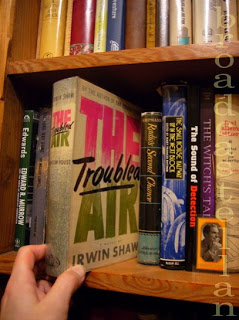
This being the birthday of novelist Irwin Shaw (1913-1984), I dusted off my copy of The Troubled Air (1951) to pay tribute to a radio writer who successfully channelled his anger and frustration by feeding it to the press, a rival medium that was only too pleased to get the dirt on broadcasting. Like his previously mentioned short story “Main Currents of American Thought,” published in 1939, The Troubled Air is a blistering commentary on the business to which Shaw was introduced by radio writer-producer Himan Brown, for whom he penned the aural comic strip The Gumps. For details on the novelist’s experience in radio, I refer you to Michael Shnayerson’s insightful 1989 biography; here, I am drawing on a few passages of The Troubled Air to document a hack-turned-published author’s urge to let off steam at a time (the McCarthy era) when the old radio mill seemed on the verge of blowing up.

Clement Archer, a former history teacher with hopes of becoming a playwright, enters radio after being persuaded by one of his students that a “ two-headed Zulu could do it. As long as you can type fast enough, you have nothing to worry about.” Archer has his doubts:

“My natural prose style,” he [tells his student], “is something of a cross between Macaulay and the editorial page of the New York Times, and my idea of how people should behave in fiction comes mostly from James Joyce and Proust. And I never had Bright’s disease and I never tried to seduce a twenty-year-old immigrant, and I actually believe that the innocent always suffer and the evil always prosper in real life. So I can’t say I feel boyishly confident about my equipment on a Monday morning when I sit down and know I have to write five fifteen-minute heart-breaking episodes before Friday. I have a lovely idea for next week. Little Catherine (the name of the program was Young Catherine Jorgenson, Visitor from Abroad) is going to California and she’s going to get caught in an earthquake and be arrested for looting when she goes into a burning building to rescue an old miser in a wheelchair. Ought to be good for ten programs, what with the arrest, the examination by the police, the meeting with the cynical newspaper reporter who is reformed by her, and the trial.

In fact, life in radio’s fiction factory turns out to be “murderously hard work.” After years of it, Archer gets a break at last when he becomes the producer-director of University Town, a series of anthology drama under the sponsorship of a drug company. When his actors and musicians are accused of Communist affiliations by Blueprint, a “belligerent” and “mysteriously” financed magazine “dedicated to exposing radical activities in the radio and movie industries,” the advertising agency in charge of the program gives Archer two weeks to find out from the five people involved—a Jewish immigrant composer, an aging actress, a gorgeous ingénue, a black comedian, as well as Archer’s best friend and former student—whether the accusations are false.

When asked by Archer why drastic measures such as the firing of his composer were deemed necessary, the agency representatives responds by arguing that radio

is not at the moment in a strong position. In fact, it is not putting it too vigorously to say that the medium is fighting for its life. A new form of entertainment, television, is gaining enormous momentum, capturing our clients and our audience; the economic situation of the country is uncertain and advertisers are retrenching everywhere—the old days when we could do anything and get away with every—are gone, perhaps forever.

Being supportive of his creative team, Archer is denounced as a Red sympathizer, even though the communists denounce him equally. His phone is tapped, his career is finished, his marriage in turmoil and a friendship exposed as a fraud.

Shaw was hardly alone in denouncing the industry in which he had worked; but, unlike former gag writer Herman Wouk (from whose satire Aurora Dawn I quoted here), he could not bring himself to make light of the experience.

Based on Untrue Stories; or, When Jolson Sings Again

”Hooray for Hollywood!” The big-screenings over at our house have finally resumed. As shared here, the projector gave up the ghost last fall, during the climactic scene of I Want to Live!, when the bulb imploded with a bang. I inaugurated the arrival of its replacement with a screening of The Jolson Story (1946) and Jolson Sings Again (1949), two hugely popular Columbia Pictures that reportedly raked in a combined $15 million—a lot of dough in those days. Now, I’ve never much cared whether or not a movie is “based on a true story”; to me, such a claim is certainly not an endorsement. It reeks of Lifetime entertainment, or some such exercises in exploitation. That is probably why I wasn’t half as irritated as I might otherwise have been watching the suspect Jolson Story, which, dramatically speaking, is really not much of a story at all.

The Jolson Story is so bland and uneventful, it makes Till the Clouds Roll By look like an exposé. For anything compelling, one would have to turn to the real-life stories of Jolson’s stand-ins, Larry Parks and Scott Beckett, whose careers were subsequently nixed by dirty politics and personal turmoil. One of the few “true” incidents in the Jolson Story, allegedly the one that sold the project to Columbia president Harry Cohn, was the has-been treatment Jolson received from the Hillcrest Country Club in Beverly Hills, for whose benefit he was signed on as a closing act, scheduled at an hour so advanced that few members of the audience could have been expected to remain in their seats. It sort of makes for a made for Hollywood comeback story; but it is hardly given the Star Is Born treatment.

Never mind. At least you get to hear the real Jolson (whose image I previously appropriated for a picture of my own) sing much of his best-known material, for the delivery which he used to disguise his face anyway. What really puzzled me was the sequel. I am not sure just how to read it. Not that I mind reading it in several ways at once, which—its foreshadowing of Jolson’s death in 1950 aside—is the reason the sequel intrigues me more than the pale “original,” or however you want to call the 1946 version of a faked and faded copy of Jolson’s life story.

A biopic self-conscious about its dubiety, Jolson Sings Again is coy about its artifice. “Let’s agree on one thing at the start, boys,” the film’s Jolson character tells the Hollywood producers interested in turning his life into a movie.

I don’t think anybody cares about the facts of my life, about dates and places. I’ll give you a mess of ‘em, you juggle them any way you like. What matters is the singing a man did and the difference that made.

Now, is this inspired bit of reflexivity an apology or a proudly displayed poetic licence? How brazen of the sequelmakers to quell our disbelief by making up for the make-believe of the first film with a faked endorsement from a false Jolson. But then, the true Jolson—who starred in the Lux Radio Theater versions of Story (16 February 1948) and Sings Again (22 May 1950)—had agreed to the project and made a tidy $5 million profit. It seemed to me as if I had followed up the “true story” death row drama of I Want to Live! with Jolson’s last cry of “I want to live on like this.”

The Slaughter of Beowulf; or, Grendel’s Momma Still Kills Them in Hollywood

Well, I have not quite recovered from the horror that is Robert Zemeckis’s Beowulf, whose feats and defeat I witnessed at the local movie house yesterday evening. When I say “horror,” I do not refer to the digital violence that turns the screen’s silver to red; I mean the harm done to poetry. The manuscript of the old-English poem was very nearly destroyed in a fire back in 1731; but it was not spared the fate of being torn to shreds by corporate Hollywood. Visualizing a poem is worse than giving an a cappella number the orchestral treatment. It renders the magic of the spoken word powerless, especially if the poet’s tongue is being digitally removed and substituted by the kind of mouthings you expect to hear in a direct-to-video action flick, circa 1984.

Now, I did not see the 3D version; but this would hardly add dimension to the characters, who, in this kind of digital motion capture animation, remain as expressionless as the Botoxed cast of Desperate Housewives. What is the point of hiring potentially great actors only to replace their bodies with lifeless, charmless animation? Robin Wright Penn’s Queen Wealtheow is a taxidermist’s vision of Bo Derek, while Anthony Hopkins’s King Hrothgar is imbued with the emotive powers of a garden gnome. Apparently, even a man’s age spots are beyond the skills of current CGI designers.  Then again, nobody remembers age spots in Hollywood.

Not that the voice talents could improve matters; at least not in the case of John Malkovich, who proved conclusively that he is unfit for such disembodiment.  You could almost hear the script in the hands you never got to see.  And while an attempt was made to recreate Old English in the laments of Grendel, the spoken word was not given a fighting chance to create an image in the mind’s eye.

The world of Beowulf has to be adapted to remain intelligible; but you are better off with Seamus Heaney as a guide:

In off the moors, down through the mist-bands
God-cursed Grendel came greedily loping.
The bane of the race of men roamed forth,
hunting for a prey in the high hall.
Under the cloud-murk he moved toward it
until it shone above him, a sheer keep
of fortified gold.

The new and improved Beowulf is about as poetic as a Mr. Clean commercial reconceived as a slasher movie (the Grim Sweeper?).  It is both vulgar and prim, showing you severed limbs but stopping short of giving you a glimpse of a man’s part, in a striptease that was tongue-in-cheekier in the coy cover-ups of Austin Powers and the Simpsons Movie.

Beowulf is truly a sorry spectacle, an ersatz best sat out.  Whatever the reasons for the no-shows, it is gratifying that this would-be behemoth has proven so toothless at the box office.  Watching it, I felt as if I had entered a computer game whose object it was to do in rather than do literature and to shout down the curse that, to the perpetrators of such high-infidelities, is the imagination of a reader lost in a line of poetry.

Graphic

Well, what do we mean when we say that a story (a book or movie or play) is “graphic”? Do we refer to the mode of depiction or to the matter depicted? Does it describe a work of art that is especially vivid or particularly morbid? These days, the term is both a warning label and a genre marker. It is designed to signify horror, which, distinct from terror, details rather than insinuates violence. When applied to print media, it signals a superior kind of picture story, something set apart from the comic by virtue of its mature themes or adult language (regardless of how immature “adult” language may often be).

The first picture book I came across that warrants the label “graphic” in both respects is Art Spiegelman’s Maus. It is a biographical account of Jewish life in fascist Germany, the horrors of the concentration camps, and a storyteller’s struggle to grapple with such memories as recalled by a close relative.

To depict the Holocaust in drawings of half-human animal figures is a daring project to begin with. It takes on the tradition of the fable and renders concrete what constitutes the dehumanization suffered under totalitarianism. On the one hand, Maus de-Disneyfies the fable, which, for centuries, had served as a coded moral tale not restricted to children or petty lessons in table manners. On the other, more bloody hand, it takes the figures of the fable out of their abstract realm and places them into concrete historical settings.

I was reminded of Spiegelman’s Maus last night when I went to see Die Fälscher (2007), a German film set in a concentration camp. Die Fälscher (translated as The Counterfeiters, tells the story of Jews forced by the Nazis to forge foreign currencies in an attempt to ruin the enemy’s economy and finance the ruinous Wirtschaft at home. For the conscripted Jews, foremost among them a highly talented criminal, it means survival and relative safety as well as an act aiding the system that has isolated, degraded and singled them out for extinction . . .

Like Maus, Die Fälscher deals with the guilt of those who forge a future for themselves in a world that insists on their pastness; it is a graphic story of craftsmanship drawn upon for the art of survival. The pen is mightier then the sword, Bulwer-Lytton famously remarked; its true test, however, lies in countering an army of erasers . . .