
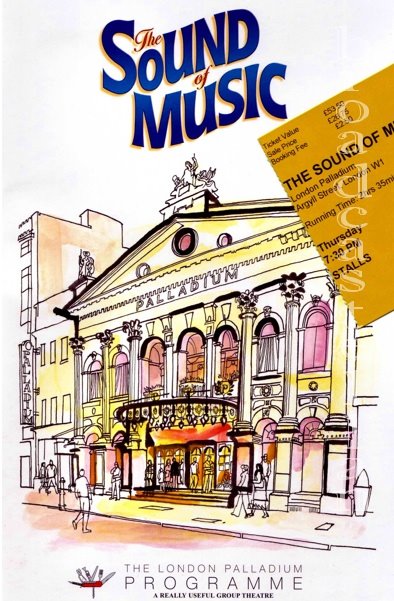
That’s a Sound All Right, but It Ain’t Music

As much as I enjoy Hollywood musicals, I’ve never sat through The Sound of Music. In fact, before I moved to the US, I had never even heard of the film, let alone anything of the true story behind it. Being born and raised in Germany does have its advantages, you might say; but I am not inclined to be flippant about censorship. Fact is, depictions of Nazism in popular culture were carefully filtered in (West) Germany, even decades after the end of the Third Reich. The reminders of past atrocities and the shared culpability for them were apparently deemed too humiliating or distressing to audiences out to enjoy a bit of cinematic escapism. Perhaps, the decision not to exhibit certain films or to edit and dub them so as to render them inoffensive was based on the notion that the horrors hinted at or exploited for their melodramatic value were too severe to serve as mere diversions. In any case, I was not exposed to the Von Trapps. And when I had my first glimpse of them, I did not feel particularly sorry to have missed out on the acquaintance.

I was as much turned off by the 1960s look of what was meant to have been the late 1930s as I was by those cloying sounds and images. This picture needed to be altogether darker, the music more haunting, more angry and sorrowful than “My Favorite Things.” For years, I avoided what to many remains a sing-a-long occasion. A few weeks ago, the stubborn Teuton in me surrendered at last and got a discount ticket to Andrew Lloyd Webber’s production of the Rodgers and Hammerstein classic at the London Palladium, a production launched and shrewdly promoted back in 2006 by an American Idol-style singing contest in which the British public, along with Sir Andrew, went in search of the perfect Maria.

I can’t say that the West End changed my mind about The Sound of Music. Sure, there are bright and eminently hummable numbers in it, but what is left of the story has less weight than the average supermodel. What is at stake for Maria is not life or liberty, but a chance to trill a few more tunes. No moral dilemma, no sense of danger, no signs of turmoil as Maria grapples with the difficulties of choosing between the convent and the conventional. I don’t expect a treatise on the relationship between fascism and the church; but I sure am tired of those insipid scenes of Sister Activity to which nuns are reduced in popular culture.

In the production’s single instance of dramatically effective set design, the auditorium is transformed into a fascist venue, as brown shirted guards appear in the isles and swastika banners are imposed onto the walls of the Palladium; but the machinery, the show tune factory that is The Sound of Music, does not permit any forebodings to build, any doubt or dread to work on the spectator’s mind. The pageant must go on, dispassionate and smooth as clockwork.

Not everything was quite so well oiled that evening. I knew that what had been mounted here would not amount to anything resembling absorbing melodrama the moment I saw Maria atop a circular platform that was slowly and laboriously tilted in an obvious but feeble imitation of Ted McCord’s Oscar-nominated cinematography. The hills were alive all right; you could hear them aching so loudly that Maria—not the one chosen on the reality program but a paler substitute (the chirpily unengaging Summer Strallen)—couldn’t climb any high note piercing enough to deaden them, spread out as she was on that giant pizza like a slice of parma ham, extra lean.
Less dulcet than the tones produced by those tectonic shifts was whatever emanated from the gaping jaws of the Captain, impersonated that night by Simon MacCorkindale, whose credentials as an actor include, need I say more, featured roles in Falcon Crest and Jaws III. “If you know the notes to sing,” Maria instructs the children in “Do-Re-Mi.” Well, you still can’t “sing most anything” if restricted by the vocal chords of a MacCorkindale, whose rendition of “Edelweiss” should have resulted in his immediate seizure by Nazi officials. The Sound of Music was the croaking Mac’s first—and, let the nuns of the world pray, his last—venture into musical theater.

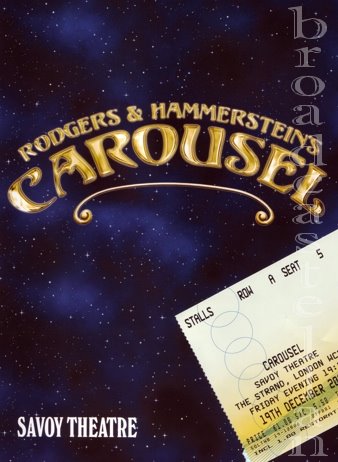
Decidedly more rewarding both tunefully and dramatically is the current West End production of Carousel at the Savoy, which I saw the following day. Starring Jeremiah James as the troubled Billy Bigelow and an earthy, buxom Lesley Garrett as Nettie, it proved a nutritious alternative to pizza with the Von Trapps.
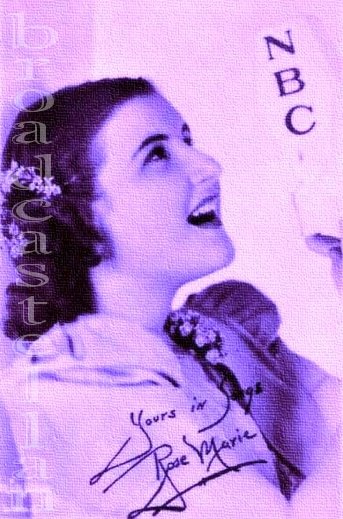
“How’dja Like to Love Me?”: Baby Rose Marie Turns . . . She Is . . . Well, Here She Is!

I couldn’t believe my eyes. I couldn’t believe my ears, either. That is how I felt when I first watched International House (1933) and saw the sensational Baby Rose Marie belting out “My Bluebird Is Singing the Blues.” Watch out, Shirley Temple, I thought, this kid has got a little more octane; she’s more Maker’s Mark than Little Miss Marker, more moonshine than Sunnybrook. Today, that kid is celebrating her ( )th birthday. Her shoes may be on display at the Smithsonian in a few weeks; but, later this year, she is also going to be back on the screen—in a movie adaptation of the musical revue Forever Plaid. To find out more about the wunderkind from her own lips, I am tuning in to the first installment of a five-part interview with Rose Marie, recorded in 1999.

The interviewer, one Karen Herman, is about as dense as a pea souper, only far less absorbing; but the quondam phenom doesn’t seem to be phased by it, brushing aside or simply ignoring what she does not care to hear or answer: “Age is only good with wine and cheese,” she responds when Herman quizzes her on her date of birth, something “Baby” had to deal with right from the start of her career.

She also had to deal with doubters like me who, listening to her, imagined a rather more mature performer. “I never sounded like a child. I never had a Shirley Temple voice. Always had a Sophie Tucker type of voice,” Rose Marie commented. Now, that is a problem for a performer who is not seen. Sure enough, the singer-actress recalls, “people started writing in letters saying ‘that’s not a child, that’s a thirty-year-old midget.'” So, the alleged midget was sent on tour around the country.

Very little of Rose Marie’s many years on NBC radio is extant or readily available today. A clip from the 14 March 1938 broadcast of the Baby Rose Marie Show may be found here. Among the number is the catchy “How’dja Like to Love Me?” from College Swing (1938). Nearly a decade later, in 1947, “the little tyke who used to be in movies and on the air” was featured on Command Performance, hosted by a cheerfully daft Ken Niles, who was looking forward to holding her in his lap once again. Ginger Rogers set him right by describing Rose Marie to listeners as a “grown-up, luscious, attractive blonde.” “Well . . . ?” Niles replies rather salaciously and invites the guest to come up to his apartment to look at his rattles.

Mercifully cutting short the patter, Rose Marie sings “My Mama Says No, No” and, later in the program, goes back to the year 1926 BS (“before Sinatra) and does a swell Jimmy Durante impression (also heard on Durante’s own show).

This anniversary strikes me as just the occasion to reopen my Gallery of Radio Stars . . .

"By [David], she’s got it"; or, To Be Fair About the Lady

Having spent a week traveling through Wales and the north of England—up a castle, down a gold mine, and over to Port Sunlight, where Lux has its origins—I finally got to sit down again to take in an old-fashioned show. That show was My Fair Lady, a production of which opened last night at the Aberystwyth Arts Centre, where each summer a musical is put on for the amusement of the locals and the visitors to the seaside town a few miles east of which I now reside. These productions, the aforementioned Oliver!, Fiddler on the Roof, and West Side Story among them, tend to be quite ambitious in their choice of Broadway and West End fare, titles likely to raise expectations higher than any theatrical curtain falling on them, whether to the relief or regret of the assembled crowds. The present Lady is no exception.

According to lore shared by Michael Kantor and Laurence Maslon in Broadway: The American Musical, even Oscar Hammerstein gave up on the idea of showtuning Shaw’s Pygmalion, advising fellow songwriter and radio alumnus Alan Jay Lerner against it. “Just You Wait,” the librettist thought and, to the delight of millions, he and his partner, Frederick Loewe, got on with the show that not only opened on Broadway in 1956 but refused to close for several seasons, proving an enduring popular and critical success.

Now, I did not expect a performer equal to Julie Andrews or Audrey Hepburn when I took my seat and glanced at the program. Indeed, I was never fond of the former or of the film version starring the latter. I had read in the local paper that two leading ladies were taking turns during the month-long run and that the show’s director, Michael Bogdanov, was yet to determine which one of them would perform on opening night. The Lady in question was Elin Llwyd, a graduate of the Royal Welsh College of Music and Drama. Sure, a Welsh lead for a part requiring a Cockney accent transformed into an English that would both please and fool high society as being the genuine article. I’m a far more “Ordinary Man” than Professor Higgins professes to be; but, having lived among the Welsh for some time now, I can tell a Cymru tongue from an English one when it is stuck out at me from a reverberating stage.

“The English have no respect for their language,” the Irish playwright (heard here introducing himself) deplored in his Preface to Pygmalion. Neither have theatrical directors, it seems; or, rather, they do not appear to have much respect for the ear by which they mean to drag audiences into the realm of make-believe. Mind you, the production is being coy about the filiations of Eliza, casting fellow Welshman Ieuan Rhys as her father and throwing in a few self-conscious references about the culture and language. Still, no matter how ably supported and otherwise capable, the slate-hewn Galatea taking center stage faces the well-nigh impossible task of faking not one accent, but two; and, as her acting became more energetic and engaging during the second act, Welsh got the better of the flower girl from the slums of Lisson Grove, London, whom a conceited gentleman scholar wagers to unveil as one of his kind by chiseling at her accent. “By George, she’s got it”? By David, she couldn’t get rid of it!

“Ah-ah-ah-ow-ow-ow-oo!” A few years ago, I was incapable of discerning what now spoke so clearly against the effort to suspend my disbelief. I have spent most of my adult life being cast as a foreigner based on the sound of my utterings. Often, I was made to feel like an imposter, earmarked as one supposedly pretending to be American or English while invariably exposed by a slip of my wayward Teutonic tongue. Given my accentual trials, I am drawn to stories like Eliza Doolittle’s . . . or Elin Llwyd’s.

Patois may be less restricting and defining these days; but, for a play like Pygmalion or its tuneful remake to ring true, phonetic distinctions should not be leveled along with the social discriminations they beget. In this case, equal opportunity spells a missed one. Besides, it just ain’t fair to the memory of the vernacularly challenged ladies and lads whose speech was not equal to their ear.

The "universal language of mankind"; or, Do You Verstehen Surtitles?

According to Henry Wadsworth Longfellow, our “universal language” is music. This might account for the international crowd at Budapest’s splendid opera and operetta houses; or perhaps it is ticket prices, which the locals are less likely to tolerate than the visitors in town for a good time. It is like that the world over, I suspect. New Yorkers are hardly the main audience for Broadway shows. What is on offer in any cultural center is largely owing to centrifugal forces. Is it the music that is universally understood? Or is it just that money talks without an accent?

Longfellow—who made above remark while on the subject of “Ancient Spanish Ballads”—is often quoted out of context. The “universal” is not meant to imply the absence or insignificance of regional or national idioms. We might all share a love of song without necessarily trilling the same tune:

The muleteer of Spain carols with the early lark, amid the stormy mountains of his native land. The vintager of Sicily has his evening hymn; the fisherman of Naples his boat-song; the gondolier of Venice his midnight serenade. The goatherd of Switzerland and they Tyrol, the Carpathian boor, the Scotch Highlander, the English ploughboy, singing as he drives his team afield—peasant, serf, slave, all, all have their ballads and traditional songs.

It is not local color you are likely to discover when stepping inside the larger venues, painted as they are in the color of money. What, I asked myself as I walked past a Finn in the foyer, is the intended audience for productions mounted by the National Hungarian Opera, where last year we took in the bewildering spectacle of Gone With the Wind, staged as a ballet to the music of Czech composer Dvořák, a pop-cultural miscalculation meant to foster good relations between Hungary and the United States. On offer this time around was Leoš Janáček’s Jenůfa, in Czech, with Magyar surtitles. Is it any wonder I am getting Prague and Pest confused as I try to recall our adventures in theatregoing?

In such moments of cultural confusion the Pontevedrian embassy can generally be relied upon as a refuge for the historically challenged. Yes, the Pontevedrian embassy is always open for business. Said Graustarkian edifice was set up for our convenience at the Budapesti Operettszínház, where the ever popular Lustige Witwe (heard here in a 23 January 1950 broadcast of Railroad Hour starring Gordon MacRae) once more saved her make-believe nation (or was it Montenegro?) from bankruptcy and waltzed off with the less-than-patriotic Danilo (portrayed with brio by Dániel Gábor) into the bargain—all in Hungarian with German supertitles, which, much to my irritation, I caught myself editing.

Finally, we went to the ballet, where “universal” meant lissome girl dancing with scrawny boy . . . to canned music. “Can real friendship exist between a man and a woman, and if so, why not? Happiness and pain follows each other again and again until death comes,” choreographer Antal Fodor comments in his note on “A nö hétszer” (“Women Times Seven”). Sometimes, you just have to provide your own translation . . .

“Ich weiss . . .”: The Certainties of Zarah Leander

“Es ist unmöglich, von Edgar Wallace nicht gefesselt zu sein,” the German translation of a famous publisher’s slogan goes. Never mind the author, whose name, to me, is synonymous with a long series of neogothic film shockers produced in Germany from the late 1950s to the early ‘70s, starring, the enigmatic Klaus Kinski aside, the by then soured crème de la crème of German cinema. It is not the author or the actors but the catchphrase that came to mind today. The original—the assertion that it is “impossible not to be thrilled” by said writer—is decidedly less expressive.

But then, English so often is, compared to the directness of the emotionally charged German language, whose dictionary, largely free from sterilizing Latin, lays meaning bare like a wound bleeding with the memory of deeply felt sensations. “Sehnsucht,” “Weltschmerz,” “Leidenschaft”—I know of no equivalent vehicle in the English lexicon with which to convey quite so forcibly the shattered frame of an agitated mind! The exclamation point, an expedient in punctuation to which I rarely permit myself the resorting, is meant here to imply at once the passion evoked by the German and the frustration of approximating it as my mother tongue sticks itself out at me.

Let us not get tongue-tied. “Gefesselt” loosely translates into “captivated” or, so as not to be loose about what is tight and binding, “tied up” and “enthralled.” What could be more enthralling than the timbre of Zarah Leander? Who could capture longing better than she? Enthralling, yes; but listening to Leander, I can feel rope burn—the sensation of struggling to loosen a restraint. A desire to put a name and voice to my feelings (described in the previous post) compelled me to go in search of her online, the internet being a lifeline for those who, like me, have struggled and failed to sever their ties from the culture into which they were born.

Leander, of course, was a leading lady in Third Reich cinema. As such, her voice and image are both riveting and repulsive to me. Like my present wavering and uncertainty, the figure of Zarah Leander, spellbinding as it may be, spells ambiguity and contradiction. To begin with, Leander was not German; she had Jewish ancestry; a homosexual friend wrote some of her best-known songs. And yet, she was in the service of fascism, implicated in song, as the jolly crowd of Nazis listening and swaying to one of her signature tunes, “Davon geht die Welt nicht unter” in this clip from Die Grosse Liebe (1942) drive home.

Knowing this, I still feel like the blond boy sitting by her side as she teases him that he could not possibly know the most basic sensations—the smell of hazelnuts or an icy wind against one’s cheeks (a song performed, no less, in in a film by the man who would be Douglas Sirk). Wrapped up in her presence, “Schatten der Vergangenheit” (shadows of the past) are crowding in on me.

Zarah Leander is telling me more about myself than I have had the guts to digest at times. By the 1970s, she had become a queer icon, appropriated by the crowd that the regime she tacitly endorsed used to send off to the camps. “Kann denn Liebe Sünde sein?” (Yet can love be sin?) she famously sang, which became—or indeed was conceived as—a song of gay longing. I did not want to be reminded of that liberation, either. In the confusion of a childhood spent in the awareness that I would be unlike the men who desire women sexually, there was no assurance in the taking possession of her in the name of the love then thought of as having to remain unnamed.

Tonight, Leander’s performances are strangely reaffirming. There is “something understood” in her voice, in the lyrics and their delivery. She knows, her character claims in this song, of a future miracle (“Ich weiss, es wird einmal ein Wunder geschehn”), in her voice a conviction her tears seem to belie. I have no need of miracles. Instead, I glory in the wonder of feeling intensely, of being alive to my conflicting emotions, my fears and longings. Recognizing those feelings, I suddenly know myself again . . .

Going His Way: The Bing Crosby Trail

Well, I’m on his way. Instead of Going Hollywood, where the WGA strike is beginning to make itself felt, I am listening all this week to the BBC, taking in drama, music, and talk. Late to catch up, I started on The Bing Crosby Trail, a six week tour whose first installment took me on a road to California, New York City, and Spokane, where listeners get to meet the daughter, the widow, and many of the contemporaries of the man known as Bing.

With The Bing Crosby Trail, producer and host Michael Freedland, a prolific biographer (whose audio portrait “Danny Kaye: UNICEF’s Jester” is available online until 12 November), attempts a departure from the traditional approach to telling a life story: “This is not just another biographical series,” Freedland insists in his introduction. “You could say it is more in the way of geography than history.” He also issues a “warning” to those about to follow him: “No obvious star names on the roster here. No sycophantic interviews with actors or other singers who, in Bing’s lifetime, called him great to his face and whispered other things behind his back.”

Instead, Freedland has been traveling around the US, “talking to people whose life Bing touched.” Not that those he interviews are nobodies: Buddy Bregman (“Bing Sings Whilst Bregman Swings”), veteran Paramount producer A.C. Lyles, and historian Ken Barnes (who produced the CD box set “Swingin’ With Bing”) have all gone on Freedland’s record.

“My life is like an open book,” Bing is heard singing (lines from his “That’s What Life Is All About”); and the man with the microphone who is out to capture that life is taking Bing by his word. Not content to “glance back through the pages” of printed volumes, he tries to pick up bits and pieces that perhaps never made it into any biography. Sounds good to me.

And yet, the cross-country Crosby Trail gets lost on a Road to Utopia, an ambition that must remain a dream. Freedland has gone out of his way to come away with comparatively little. The tour is not off to a promising start. We are take on a “winding mountain road above Malibu” to hear Mary Crosby sharing the insight that her father enjoyed playing golf and liked to whistle a lot. Does one really have to travel way out west for such a soundbite?

A subsequent inspection of Bing’s statue at Gonzaga University in Spokane and a tour of the Student Center housing the Crosby Museum are altogether misguided in their visual-mindedness. I’d rather be listening to Bing whistle than being given this runaround, blindfolded. At times so glossy as to make me cross, the Crosby Trail is a gross betrayal of the medium.

“. . . till the fat lady sings”

It seems that the proverbial one who’s got more curves than the skeletons on the catwalks has not warbled her last.  No, it ain’t over yet.  According to my students, at least, whose rallying cries generated enough interest to keep my rather esoterically titled course “Writing for the Ear” alive, death warrants and prematurely issued certificates notwithstanding. The “fat lady,” of course, is the diva who gets to have the last word in opera. I don’t know where the expression originates; but it seems to be true for much of the operatic canon.  Tonight, I am going to see Mimi expire in a production of La Bohème, performed by the Mid-Wales Opera Company.

Now, I have been going to the opera since I was a teenager, even though prohibitively high prices made for long gaps in my exposure to this kind of melo-drama.  And even though a tenor numbered among my close friends in New York, Opera-going still mostly meant finding an empty space to spread my blanket on the Great Lawn whenever the New York Opera toured the parks, taking the sandwiches out of the basket, and hoping that no cellular device would go off to mar the performance as I lost myself in the night skies in search of that rare star darting its long-delayed light through the smog and light pollution of Gotham.

My tenor friend tried to convince me that opera is the highest form of dramatic storytelling; but, for the most part, I struggled to follow the plot and keep straight just who is who and doing it with whom. Last night, watching the pre-code melodrama Secrets of a Secretary, starring Claudette Colbert and Herbert Marshall, I thought what a great plot for an opera it might have made.  A woman repentant of her follies, a sinister husband, a pining lover (a nobleman, no less), and bloodstained dress.  Perhaps, I’d rather lose track of the plot than the ability to lose myself in the drama of a moment; but I still find it strange to be confronted with a narrative only to ignore it, along with the translations flashing above the stage.

There are few plays I have seen as often as La Bohème, sat through the gloom of Rent and the glamour of Baz Luhrman; but, the music aside, I still recall little else beyond an extinguished candle and a distinct cough.  Not that I believe comedian Ed Wynn to be a reliable translator in matters operatic. Wynn, whom I previously consulted on Carmen, once tried to tell the story of La Boheme (or “La Bum,” as he called it) to tenor James Melton (pictured above), on whose radio program he was featured in the mid-1940s.

It was on the 10 March 1946 broadcast of The James Melton Show that Wynn introduced listeners to Mimi, who, preparing for a ball, had just put on her bustle and was “rearing to go.” In Wynn’s version, Mimi had been named “Miss Soft Drink of the Year” because she was “interested in any guy from seven up.” He had nothing to say about flirtatious Musetta, who had such terrible puns coming.

Now, Mimi lives in the same boarding house as Rodolfo, you see.  One day, she hears the pot, the poet [. . .] reciting.  He says: “There is an old lady who lives in a shoe.”  And Mimi says, “Well, she’s pretty lucky, the way that the room situation is.”

Not Rent-controlled, apparently. Such references to the housing crisis of the mid-1940s pop up frequently in radio entertainment, from Fred Allen to Hercule Poirot (who, as I discussed here, inexplicably relocated to the US and found himself without a flat).

The synopsis is mercifully interrupted by a few notes from the opera, sung by Annamary Dickey.  It is the kind of highhatting of the uplift that was so common an approach to the so-called high arts in the middlebrow medium of 1930s and 1940s radio. It is the working-class re-vision and consequent rejection of culture as imposition, of art as irrelevance, a way of looking without seeing to which I was conditioned as I grew up, my father being hostile toward anything that smacked of the “high classical,” a self-imposed exclusion from the beautiful, transporting and inspiring that expressed itself in crude mockery.

Fortunately, I don’t need to draw on the jovial if misfiring old Fire Chief to enlighten me. The Mid-Wales Opera’s La Bohème is “cenir mewn Saesneg,” which is to say, sung in English. For once I can just face the music, rather than being confronted with my own ignorance . . .

It Might As Well Be Maytime

Well, I neither know nor care whether it is still considered a gaffe in some circles, but this was the kind of post-Labor Day that makes me want to wear white, or less. Mind you, I was just lounging in our garden, a rare enough treat this year. I am not among those who look toward fall as a fresh and colorful season, marked and marred by decay as it is. In New York City, my former home, September and October come as a relief from the stifling heat, a cooling down for which there is generally no need here in temperate and meteorologically temperamental Wales. Pop culturally speaking, to be sure, autumn is a time of renewal. In the US, at least, there is the fall lineup to look forward to as the end of an arid stretch in which fillers and (starting in the late 1940s) repeats convinced folks of the pleasures to be had outdoors.
No doubt, the producers of the Peabody Award-winning Lux Radio Theater were trying to stress this sense of a vernal rebirth when it opened its tenth season on this day, 4 September, back in 1944. Here is how host Cecil B. DeMille welcomed back the audience to what then was, statistically speaking, the greatest dramatic show on radio:

Greetings from Hollywood, ladies and gentlemen. At every opening night in the theater, for a thousand years, there’s been a breathless feeling of expectancy, a sense of new adventure. And tonight, as the light to on again in our Lux Radio Theater, there’s the added thrill of knowing that the lights are going on all over the world. With the liberation of France, the torch of Freedom burns again in Europe, and tonight we have a play that expresses something of the bond between song-loving America and music-loving Paris. Metro-Goldwyn-Mayer’s screen hit Maytime, with Sigmund Romberg’s unforgettable music, and for our stars, those all-American favorites, Jeanette MacDonald and Nelson Eddy.

Leave it to the spokesperson of Lever Brothers (last spotted here with the Lord of toilet soaps) and the continuity writers in their employ, to link historical events of such magnitude as D-Day, the establishment of a French provisional government and its relocation from Algiers to Paris a few days prior to the broadcast with an escapist trifle like Maytime (1937), which, as Connie Billips and Arthur Pierce pointed out in Lux Presents Hollywood, bears little musical resemblance to Romberg’s original operetta, begot in the dark days of the Europe of 1917, before the US entered the first World War.

Commercial interests were anxious to reclaim the airwaves, after a period of restraint that we living in the 21st century have not witnessed since the attack on the World Trade Center back in September 2001. During his curtain call with co-star MacDonald (whose 1930 effort The Lottery Bride was released on DVD today), the aforementioned Mr. Eddy was further making “light” of the situation in the European war theater by plugging his new radio program. By expressing that “the lights were going on again all over the world,” Nelson remarked as he dutifully read from his script, DeMille had put him “on the spot.” After all, his sponsors were “160 leading electric light and power companies.” Houselights, please!

Twenty Men Singing—But Why?

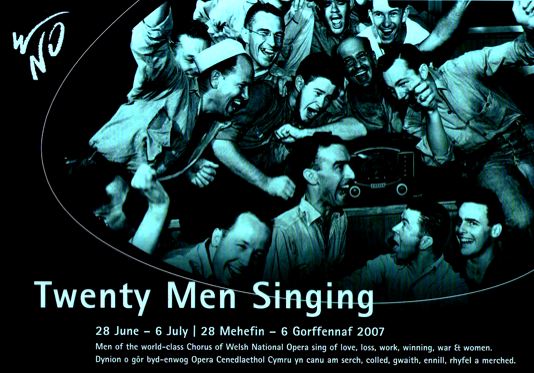
There they stood last night, singing a cappella, performing songs from Schubert to South Pacific, from the 13th-century Middle-English “Sumer Is Icumen In” to Alfred Schnittke’s “Adam Sat Weeping at the Gates of Paradise,” which premiered in 1988. Twenty they were; men of the Welsh National Opera, touring Wales with their aptly titled program Twenty Men Singing. Some of their sonic offerings were tonic, many (and for my taste rather too many) of them somber, reverent, and brooding.

Why were they singing? To amuse themselves, to entertain others, to earn a few quid or to enjoy the applause of an appreciative crowd? Why sing in unison when what you want is to stand out? If, indeed, that is what you want.

According to the program notes, those Twenty Men Singing explore just that: why men raise their voice together in song, whether to celebrate life, to protest or lament. In song, a hoped for unity is being realised in sonic unison. A chorus of disapproval is formed in resistance to voices and actions that may threaten community. Leoš Janáček’s “Sedmdesát tisíc” (1909), for instance (as translated by John Binias), many-voices the pressures inflicted on the national identity of a Czech bordertown by neighboring but less than neighborly Germans and Poles:

70,000 graves they dig for us
Outside Tesin
Beg for help from heaven
Herded like cattle
Like cattle we gaze about
Our own slaughter [ . . .]. 

Let our voices thunder out: [. . .].
Before we are finished [. . .].

This Saturday, performers around the world are singing to bring awareness to what may well be the greatest threat to humanity, regardless how much religion and nationalism, how much faith and terror (and the terror of faith) are being exploited by those who make a fortune keeping us at war with one another.

On this day of Live Earth, festivities that coincide with the anniversary of the London suicide bombings of 2005, we are asked to consider the terra we share, not the terror that divides us, to let “our voices thunder out” before we are “finished.” I cannot think of a better reason for joining a chorus.

Thanks for the Autograph. Now, Who the Hell Are You?

Don’t tell me. You’ve had a great time at the beach, enjoyed a picnic with friends and family, followed by a splendid fireworks display on a balmy evening. I mean it, don’t tell me! It’s been raining here for, let’s see, about three weeks, ever since my return from New York City; and today I read a forecast telling me that, after the “wettest June since records began,” July here in Britain is going to be a washout and that August and September “will not be worth waiting for.” Is it any wonder I am becoming more cantankerous by the minute?

To keep it gay, I dug up (and Ted Turnerized) this autograph a friend of mine from the indubitably sunnier and less lugubrious San Francisco sent me a few years ago. His mother was an avid radio listener and autograph hunter back in the pre-Television age I set out to recall in this journal. Previously, I’ve raided her collection for images of Baby Rose Marie, Rudy Vallee, and the Merry Macs.

So, who is this Del Casino? I reckon he is the same chap the Internet Movie Database insists on calling “Del Cansino,” a once popular singer whose star is rather a dark one by now. Perhaps that is not such an apt metaphor, considering that dark stars are at least detectable by their radio emissions, of which, in the case of Mr. Casino, there appear to be none.

Here he is, in an early 1940s “soundie,” crooning the pretty if none too memorable ”One Look at You.” You’d be able to tell a lot from one look at me just now; but you probably wouldn’t end up writing love songs about it. I’ll try to snap out of this mood and vow to return in good cheer anon.