
Spike Jones: The Man Who Found His Hit in Hitler

Well, this is a tough time for heroes. There might still be a need for them, but we stop short of worship. The nominal badge of honor has been applied too freely and deviously to inspire awe, let alone lasting respect. Even Superman is not looking quite so super these days, his box-office appeal being middling at best. And as much as I loathe the cheap brand of sarcasm that passes for wit these days, I am among those who are more likely to raise an eyebrow than an arm in salute.

Compared to the hero, the villain has proven a more durable figure. After all, it takes considerably more effort to forgive than to forget. Besides, we appreciate the convenience of a scapegoat, of a stand-in for our collective guilt; one hideous visage to represent what we dare not find within ourselves.

In government propaganda, the villain serves to remind us against (and, by indirection, for) what we are supposed to fight—a single face to signal what we must face lest we are prepared to face doomsday.

So, who is the next big thing in villainy—fading pop icons excluded? Is there any such person alive today who is as reviled or dreaded as the man who paved the career of one of the most successful US musicians of the 1940s? Adolf Hitler, I mean. That’s the villain. The musician, of course, was bandleader Spike Jones.

A California native born in 1911, Jones had his breakout hit in the early 1940s with the song “The Führer’s Face,” a merry war mobilizer of a tune that went something like this:

When Der Führer says, “We ist der master race”
We Heil! Heil! Right in Der Führer’s face,
Not to love Der Führer is a great disgrace,
So we Heil! Heil! Right in Der Führer’s face. 

When Herr Goebbels says, “We own der world und space.”
We Heil! Heil! Right in Herr Göring’s face.
When Herr Göring says they’ll never bomb this place,
We Heil! Heil! Right in Herr Göring’s face. 

Are we not the supermen?
Aryan pure supermen?
Ja we ist der supermen,
Super-duper supermen. 

Ist this Nutzi land not good?
Would you leave it if you could?
Ja this Nutzi land is good!
Vee would leave it if we could. 

We bring the world to order.
Heil Hitler’s world New Order.
Everyone of foreign race will love Der Führer’s face
When we bring to der world disorder. 

When Der Führer says, “We ist der master race”
We Heil! Heil! Right in Der Führer’s face,
When Der Führer says, “We ist der master race”
We Heil! Heil! Right in Der Führer’s face.

Are we still singing chart-topping songs like this about any one of our present-day (mis)leader? Should we? Is to laugh at them enough? Might the laughter perhaps be cheap and the joke on us? I don’t presume to have any answers. Listen to Spike Jones and his famous song on BBC Radio 4 this week, a song initially banned by the BBC. Don’t starting hitting your grandma with a shovel, even if yours, as mine, was working for one of Germany’s biggest names in fascism.

Manhattan Transcript: Why The Drowsy Chaperone Might Have Done Well on the Air

Well, there I was this afternoon, walking Montague, our terrier, and picking sloes along the lane near our house halfway up in the Welsh hills. I was walking him in order to get to the sloes, truth be told. Unlike Montague, though, the sloes won’t be seen again until Christmas, as I learned, much to my dismay, after having spent half an hour pricking them. I had heard of a Sloe Gin some time ago; but I always assumed it to be spelled “slow” and work as fast as the regular kind. Now I know that my ear hadn’t led me altogether astray, considering that it will take so long to appreciate this potent concoction. At any rate, a predilection for booze is something I share with that celebrated Broadway dame known as The Drowsy Chaperone, who may currently be seen failing her charge in the Tony Award-winning “Musical Within a Comedy” of the same name, a show that reminded me of my love not only for stiff drinks but old-fashioned radio drama.

I might not have learned about The Drowsy Chaperone had it not been for some of my New York City pals, some of whom work in the theater. Now, Broadway isn’t exactly “My Beat.” As much as I enjoy “How Do You Solve a Problem Like Maria?” (a West End Sound of Music audition-turned-TV reality show starring Andrew Lloyd Webber presently unfolding on BBC television), I am rather selective in my choice of musical treats. I would not be caught dead watching Cats, to be sure, and have refused to attend a performance of Phantom even when a close friend of mine was one of its featured actors on Broadway.

A few years ago, I enjoyed Drowsy Chaperone‘s leading lady Sutton Foster in a revival of Thoroughly Modern Millie, and her presence, as long as it does not remind me of Leslie Caron (as indeed it sometimes does), suffices to make me shell out some $75, the highest price I have yet paid for a TKTS ticket, to see a show that is an amusing trifle rather than a certified classic.

Now, on that particular night (the date of which you may glean from the ticket displayed above), Ms. Foster was rather subdued and lackluster. Too bad, considering that her “Show Off” routine is the smartest number in the whole production, which opens with Mary Tyler Moore alumna Gloria Engel going on about her “Fancy Dress,” a tune that is insipid rather than comically inspired. Worse still, the eponymous character (the Drowsy one) was played by an understudy, as that dreaded white slip in my Playbill informed me. Understudy, in this case, meant second best. Luckily, the same was not true for the whole production.

There is a self-reflexivity about The Drowsy Chaperone that is so subtle and commercially slick as to render this musical comedy charming rather than clever. In fact, the play struck me as decidedly dumb—in a manner that ingratiates instead of irritates. The smartest thing about it all is the opening of the play and its concept. After all, The Drowsy Chaperone begins in utter darkness, with the voice of a middle-aged Broadway aficionado (who, traditionally, does not speak in a booming baritone) telling you about the costly experience of going to the theater these days before sharing a record (vinyl, no less) from his collection of show tunes.

One of those forgotten gems is The Drowsy Chaperone, the forgotten (and entirely fictional) 1929 musical our host (the “Man in a Chair”) has never seen but imagined often enough sitting in front of his outmoded home entertainment system and listening to an old and not altogether groove-proof record in his rundown New York City apartment. As he tells the audience about the show, the impressions made by the recording come to life and The Drowsy Chaperone materializes before us as it presumably might come alive in our MC’s mind. Of course, for seventy-five bucks or more, we demand to see our theater. Most of us go to a Broadway show for sheer dazzle, not dialectics. We rely on Off-off Broadway for the subversive and provocative—and the clear demarcation makes it easy for most to avoid such intellectual challenges.

And yet, nothing I saw onstage quite matched the excitement or warranted the enthusiasm of that middle-aged man (wonderfully portrayed by Bob Martin), an unassuming cardigan-clad homebody whose visions, no doubt, were more potent than anything devised by the set designers of this show. I wonder how theatregoers might have reacted had the scene been cast in darkness for the entire eighty-odd minutes (a short enough time for a Broadway play). They might have concurred with the guy.

Aside from “Show Off,” “Accident Waiting to Happen” and the surprising “Message from a Nightingale,” The Drowsy Chaperone wasn’t all that much to look at. Then again, who would pay this much for a single radio play? The eyes had it, as usual—but they did not quite have their fill . . .

Fiddle/Sticks; or, When Broadway Comes to Town

Well, there’s milk in the old cow yet. The cash cow that is Fiddler on the Roof, I mean, which started giving in 1964 and ran for a record-breaking 3,242 performances. Forced to abandon the town of Anatevka, Tevye and his neighbors have travelled the world to inhabit the small but rich territory that is the theatrical stage. One of those theaters giving a temporary home to the Fiddler is the Arts Center in Aberystwyth, Wales, where the plight of the Russian Jews and their threatened “Tradition” are now being re-enacted by a mostly Welsh cast, headed by Welsh-born Peter Karrie in the role of Tevye.
Karrie (“The World’s Most Popular Phantom”) performed in the same venue last summer, when he impressed me with his sensitive portrayal of Fagin in Lionel Bart’s Oliver! (as discussed here). This time around, the show truly revolves around him, which is somewhat of a problem for his fellow actors, who can’t hold a candlestick to him. Karrie is a musical actor; he does not merely saunter or dance across the stage to belt out tunes like the familiar “If I Were a Rich Man.” Even with a microphone coming unglued and protruding from his cheek like a handle on a paper bag, he is thoroughly convincing and engrossing.

Holding up well enough opposite him as his wife is Andrea Miller, who takes on Golde with a long-faced, comical severity that reminds me of Edna May Oliver. Her sentimental duet with Tevye, “Do You Love Me?” is one of the highlights of a show whose greatest shortcoming is that it is rather devoid of darkness. After all, the pogroms, the razing of entire villages and the exodus of the Jews from their Russian homes, are not to be treated like an occasion for so many routinely staged showstoppers. This Fiddler came across like a Jewish version of Pride and Prejudice, with hard-up Golde, like Jane Austen’s Mrs. Bennett, trying to get her five daughters married to well-to-do suitors while her permissive husband caves in to the youngsters’ concept of matrimony as a union of loving partners.

Central to this plot is the matchmaker Yente, a role originated by Golden Girl Bea Arthur (whom I last spotted autographing DVDs at a Manhattan bookstore). In this production, a shtick-figure of a Yente slips in and out of her Yiddish accent. Less fitting still were most of the wigs and beards, rendering the Rabbi, as performed by a juvenile, so laughable as to compromise the sincerity of the entire production. Now, Aberystwyth is a summer resort for Hassidic Jews, who take over one of its beaches during the month of August. Should any of them venture out to see this production, as directed by BAFTA-award winning Michael Bogdanov, they might very well hiss this unfortunate miscast off the stage.

Studying the playbill, I came across one intriguing radio dramatic connection–a wireless connection I invariably seek and find without fail. Apart from Andrea Martin, who is an award-winning writer of radio plays, the playbill names Arnold Perl as the man by whose “special permission” the Tevye stories of Sholem Aleichem were adapted for Fiddler.

I am not sure how Perl got to acquire the rights to these late 19th/eary 20th-century tales; but, as a writer whose old-time radio play “The Empty Noose” commented on the inconclusiveness of the Nuremberg Trials (as mentioned here), he was undoubtedly drawn to them due to their special cultural and political significance, a heritage of horrors now playing itself out in the uneasy compromise that is Israel, a heritage that Bogdanov, himself a descendant of Ukranian Jews, merely fiddles with his amiable roof hoofers for the sticks.

Somebody, Please, Stop the Music!; or, There’s a Fly in My Diegesis

Well, I am feeling rather languid. I rarely take naps in the afternoon—but today I’m as supine as Montague, our terrier, who arose this morning with a pronounced limp. A limp, that is, pronouncing his exhaustion. Sunday’s outing on Cardigan Bay has taken its belated toll. Monty has been with us for less than a week now and I am not sure just how much exercise he can handle (or would that be pawdle?). Apparently, rock climbing and sea diving are new disciplines for the less than limber chap. Perhaps, I should not grumble at his temporary torpor. It has been a while since last I worked on my little play. My play for radio, I mean.

Watching the video clips of Montague frolicking on those rocks (clips I am editing for a potential webjournal of Missives from Montague) made me ask a question I had not considered before: the question of music. Pardon my synesthesia, but some of those images sounded as if they had been scored by Bernard Herrmann, the radio composer who went on to make it big in pictures. There was an abandon in the seascape, a pathos in the scene of small dog staring into the foamy waters from the doubtful perch of a slippery rock as a decidedly more daring dog plunged into the surf to leap for a small rubber ball as if his life depended upon it. From Montague’s point of view (or from my perspective imposed upon his), it was exhilaration tempered with anguish, a longing and lingering in a tempest of impulses.

No doubt, I will hear these pictures differently if I look at them again; perhaps they will be altogether soundless. Right now, this muteness would spell indifference. If I don’t hear anything while looking at them I fear that I might have lost the sense of replaying a personal memory, however excessive my indulging in sentiment may seem at presence. Is music theatrical—or, as the name implies, melo-dramatic—while natural sound and stillness are matter of fact? Are silent images any more objective than musically underscored ones? Am I not being manipulated by the picture, an image that seems to supply its own score?

I have been wondering about the soundscape of my play. Supposedly, there is something called extradiegetic sound. That is, music superimposed on a diegesis, the story as experienced by its characters. Now, if my play included a scene in which the old lady (one of the two main characters) played a musical instrument, that strain would be considered diegetic. Everything else—music not heard by the characters, but by the audience only—is understood to be beyond their senses. Sounds clear. But might not the distinction be rather too neat and exclusive?

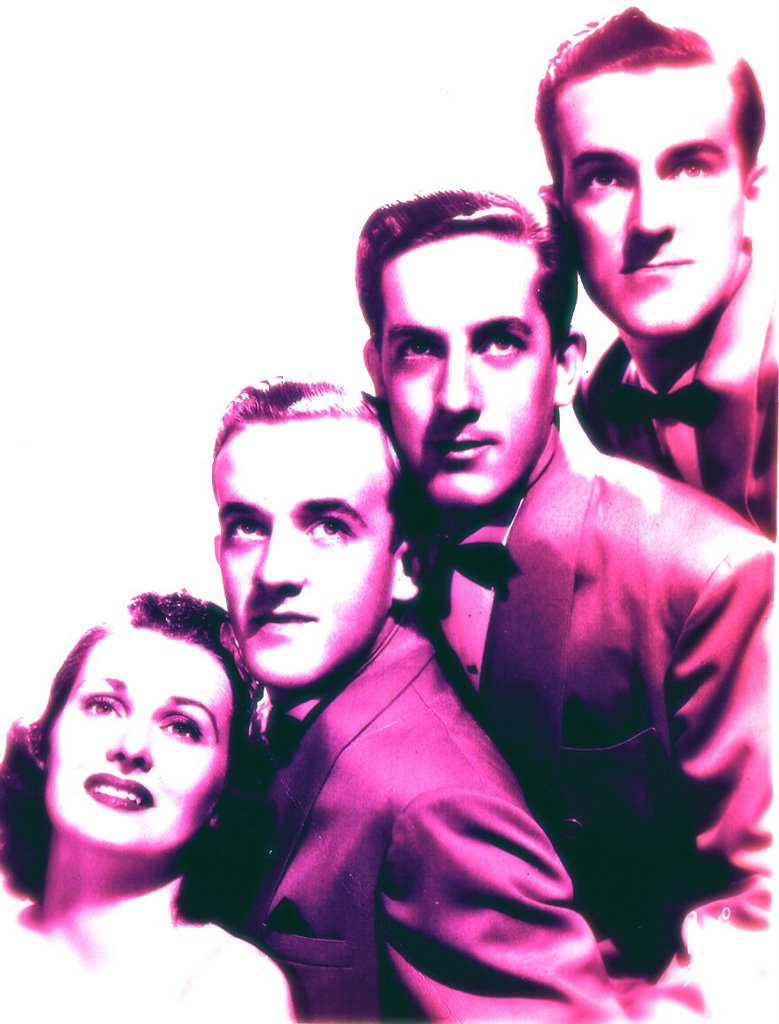
Now, the old lady won’t be playing any instrument; she might know how to play the organ—and she would most certainly enjoy the harp. Old enough, she might even remember the Merry Macs (pictured above), tune trillers featured on Fred Allen’s radio program. Right now—that is, for the duration of the play as soundstaged—she is too busy playing with that young man, the stranger she has lured into her dark house or, rather, the darkness of her mind. How about the music playing in that mind, unsound but not necessarily unsounded? Might she be scoring the melodrama in which she has cast that strange man? Might the young man, gradually turning suspicious, begin to hear John Carpenter’s theme from Halloween (or some such Psycho score with which he is familiar), just as I mentally soundtracked my pictures of Montague?

Should I play around with such potentialities? Or should I tell myself to stop the music, despite the fact that its effective use has enriched scores of radiogenic performances, including the “glitter” of harps and strings heard on Norman Corwin’s “Odyssey of Runyon Jones”—a fantasy in which a harp, playing a harpy, “holds a conversation” with a boy in search of his late dog?

“Stop the Music”? That, of course, was the name of a popular quiz program often being blamed, and not unjustly, for the slow but certain death of radio playfulness. “Radio is the Marshall Plan with music,” quipped the aforementioned Allen, who, on this day, 27 June, in 1948, tried to stand up against the giveaway shows that prompted millions of his listeners to twist the dial in hopes of getting rewarded for waiting by the telephone: “The slogan of the quiz program is, ‘If you can’t entertain people, give them something.'”

To Allen, and anyone with a keen, uncommon sense for the aural medium, this was a dead giveaway that radio artistry was being slaughtered for commerce, that those in charge of broadcasting were ready to renounce the sounds of the imagination for the common sense of the “ka-ching.”

Considering today’s economy of radio dramatics, which advises against what is conveniently dismissed as old-fashioned or corny in storytelling, I will rely on the music playing in the mind’s ear of the audience. Perhaps, characters and setting will succeed in suggesting the soundtrack I had in mind—theirs and mine.

Old-time Radio Primer: C Stands for Crooner

Well, I am mad about music this weekend, or something remotely resembling it. After fifteen years of going without while living in the Eurotrash-resisting US, I finally got another hit of it last spring. The Eurovision Song Contest, I mean, the spectacle (or cultural war) in whose battles have fought the likes of Celine Dion, Olivia Newton-John, Abba, Lulu, Cliff Richards, Katrina and the Waves, and whoever it was first to belt out “Volare.” Thursday night’s semi-finals in Athens were predictably vulgar—short on fabric and long on fanfare, feuds and fanaticism.

Gone are the days in which a song could be sold without a dance, in which lyrics could catch the ear while the eye got a rest, on in which a chart-topper could have legs without the exposure of gams (assets that rarely hurt but failed Kate Ryan in her attempt to step up for Belgium).

So, my Norman Corwin-inspired Old-time Radio Primer, a lexical expedition of yesterday’s airwaves that got underway with definitions of “audience” and broadcastellan will pay tribute today to a craze that is as closely associated with radio as the set itself; to the vocal chords that, if Marion Davies’s experience in Going Hollywood is to be believed, ensnared a generation, made youngsters rebel and schoolmarm’s swoon; in short, the crooners and their tunes.

The crooners seized the advantage of the sonic close-up, the proximity to the microphone that can lend force to a whisper, a subtlety and intimacy hard to achieve in a crowded auditorium. They performed for an unprecedented multitude, but, coming home into parlor or boudoir, could always create the illusion of reaching everyone separately, singly, and, if imagined so by the listener, secretly as well.

Having no voice to match the tones of Rudy Vallée or Bing Crosby—whose “Temptation” still sends me—I will salute the much-mocked crooner with some slight but only slightly irreverent verse I penned for the occasion:

Well-oiled enough to wrestle
And steady enough to grind
It finds a niche to nestle
In the ever so obstinate mind.

Well-groomed enough for cocktails
And flashy enough to blind
It sticks when other crock fails
In the ever so obstinate mind. 

Well-heeled enough to dally
Obliging enough to bind:
The crooner and his sally
On the ever so obstinate mind. 

The crooner and his bally-
hoo,
of the
ever so obstinate
no-chance-you-will-forget
cure’s-not-discovered-yet
match-that-your-mind-has met
(more? how about a bet?) kind.

With the notable exception of Mr. Vallée, crooners quickly came to resent the term, insisting, like Crosby, to be billed or labeled otherwise (a simple “baritone” would do). After all, as much as they were adored by the radio listeners of the 1930s, who fantasized about American idols like Vallée, their “Vagabond Lover,” the crooners were widely dismissed or ridiculed by the press, whose writers might have felt threatened by these newly emerging voices, vocal Valentinos whose low, lavender tones seemed to have so much more erotic sway than can be generated by the most aggressive and boisterous Winchellean journalese.

To the chauvinists of the tabloids, radio had opened a Pandora’s voice box, and what poured out into the air to impregnate the imagination of millions was a provokingly and intimidatingly potent seed, strongly suggesting that such sounds could be mightier than the pen.

What Those Who Remembered Forgot: Cy Feuer (1911-2006) on the Air

Well, the marquee lights of New York City’s playhouses will be dimmed tonight at 8 PM (EST) in commemoration of Tony Award-winning theatrical producer and composer Cy Feuer, who passed away this week at the age of 95. Active for well over half a century on Broadway and in Hollywood, Feuer produced shows like Guys and Dolls and How to Succeed in Business Without Really Trying, wrote original scores for a great number of popular movies (including the much loved Adventures of Captain Marvel [1941], and served as musical director for numerous other motion picture projects.

I first heard the name Cy Feuer, who published his memoir in 2003, while listening to recordings of a late-1940s series of radio thrillers titled Escape. So, as I have done before in tributes to Shelley Winters and Don Knotts, I will provide a footnote to the obituaries you might find elsewhere.

Escape presented adaptations of adventure yarns, fantastic tales, and horror stories by noted authors like Joseph Conrad, H. G. Wells, and Robert Louis Stevenson. Among the stories rendered more exciting or eerie to the ear by Feuer, who composed the music as well as conducted the orchestra, were Edgar Allan Poe’s “The Fall of the House of Usher,” John Collier’s “Evening Primrose,” and—the stand-out of the series—Carl Stephenson’s “Leiningen Versus the Ants.”

The musical accompaniment for such high melodrama was generally less noticeable or noteworthy than the sound effects, and more often incidental rather than integral; unlike the terrifying animal sounds conceived and created by the Escape sound artists, music was employed mainly to set scenes or enhance atmosphere. It is only when you pay attention to those bridges and screens of sound that you appreciate them as being of some consequence.

Feuer—whose work was also featured on the Ford Theater program, the episodic thriller Case, Crime Photographer, and the short-lived adventure serial Shorty Bell, starring Mickey Rooney—was not given much of a chance to turn musical sounds into characters; like fellow Escape alumni Ivan Ditmars, Leith Stevens, and Wilbur Hatch, he had largely to content himself with producing the odd note to prop up or propel the plot, however odd or ordinary.

In order to fulfill their weekly assignments, radio composers commonly recycled stock music (like the musical crutches handed to The Lone Ranger when he came to television, for the supply of which Feuer is now being credited). Perhaps this is what compelled former radio composer Bernard Herrmann to emerge from the airwaves by making his music speak for and draw attention to itself, refusing to let film scores—such as the intense ones he created for Vertigo and Obsession—go under by pounding them into the viewer’s consciousness so as to let them take center stage in their minds.

On at least one occasion, however, Feuer was involved in something a trifle more ambitious, when, on 25 August 1946, he was called upon to conduct the orchestra assembled for the Columbia Workshop. Billed as “radio’s foremost laboratory of writing and production techniques,” the Workshop produced the experimental play “The Path and the Door” by newcomer Les Crutchfield (previously mentioned here), which boasted a score by modernist composer George Antheil, who had never before worked in or for broadcasting.

To intrigue audiences, radio producers were more likely to invite artists new or altogether alien to the medium, rather than permitting the reliable Girls and Guys Friday of the business to make a name for themselves. Making his escape from the radio (and B-movie thriller) mill, Cy Feuer eventually earned such distinction on the Great White Way, which will appear somewhat less dazzling during tonight’s 60-second salute to a man who managed to “Succeed in Business” these past six decades.

"This . . . is London": Florence Foster Jenkins, Again

Well, it doesn’t always take “practice, practice, practice” to get to Carnegie Hall. Sometimes, delusions of grandeur—and a few thousand gawkers in search of the proverbial train wreck—will do. If you are among those who still marvel at the American public’s decision to include Kevin Covais among this year’s American Idol finalists, consider the career of a tone-deaf diva who brought the William Hung-factor to classical music: Florence Foster Jenkins, a coloratura-blind soprano so astonishingly awful that audiences are still pricking up their ears in disbelief some sixty years after her silencing. Call it “Schadenfreude schöner Götterfunken.”

When last I was in New York City, I went to see Souvenir, a “fantasia on the life of Florence Foster Jenkins” starring Judy Kaye (and reviewed it here). A few weeks later, I was surprised to discover that another not-so-musical portrait of the miss-most-notes notable was on display in London, where it can be taken in at the Duchess Theatre until the end of April. Of course, I had to see and hear for myself how La-la-la Jenkins was being treated overseas, so far from the famed hall she brought down in the fall of 1944, within weeks of her exit at age 76.

As conceived by Peter Quilter, patched-together from what little he could find about the performer in print, Glorious is the sort of guilty theatrical pleasure few people permit themselves these days, given the exorbitant ticket prices that make the legitimate stage a recycle bin for acknowledged classics and crowd-pleasing musicals. Glorious doesn’t quite live up to its title. It is unambitious, trivial, and decidedly silly. Maureen Lipman, whom I had previously seen opposite Sir Ian McKellen in a rather chintzy reproduction of the pantomime Aladdin, delivers the broad jokes and broader slapstick with pitch-perfection. Only too rarely, when addressing us as Jenkins’s audience, does she become as captivating or “glorious” as the original herself must have been to 1940s concert-goers.

Unlike Souvenir‘s Judy Kaye, Lipman does not go far beyond shtick, not being required or encouraged to do so by Quilter’s cartoonish script, which at times seems little more than an assortment of rather ho-hum puns, few of which you would get away with even in intoxicated company.

Unlike Ms. Kaye—who was just and judiciously supported by a pianist-narrator based on Jenkins’s own accompanist, Cosme McMoon—Lipman is being surrounded by a host of sitcom characters: an irascible Hispanic maid, a womanising admirer, a ditzy confidante, and a society lady appalled at her caterwauling. The situations derived from these fictional foes and associates are far less inspired than the close-up of Jenkins at her self-delusional best.

And, unlike Ms. Kaye, Lipman is unable to end on the moving high note both Quilter and Stephen Temperley (the writer of Souvenir) chose for their flourish. Both playwrights attempt to bring home Ms. Jenkins’s blissful ignorance of her tone-deafness by letting us hear the dulcet tones the performers assumes to be producing. Musical star Judy Kaye gets an opportunity to sing “Ave Maria,” while Lipman merely lip-synchs to a recording. The audiences of Souvenir are offered a glimpse, at least, of the diva’s doubts and fears, while those seeing Glorious will encounter a consummate mis-performer sheltered by a stupefying lack of self-awareness.

“[I]t was certainly rather wonderful living in the head of this unique woman,” Quilter remarks in his notes on the play. Unfortunately, we get to enter neither his mind nor hers. Instead, we are being treated to two hours of Will and Disgrace.

A New York Souvenir Is Glorious! in London

Well, I am on my way to London in a few hours, even though I have barely recovered from my trip to New York City, a souvenir of which is a lingering cold. Still, I am looking forward to a weekend in the metropolis, where I’ll be reunited with my best pal to celebrate his birthday and the twentieth anniversary of our friendship. We used to have our annual get-togethers in the Big Apple, but the Big Smoke will do.

While there, I would love for us to take in a few shows, impervious as he is to the wonders of the “wooden O.” I, for one, have had some terrific theatrical experiences lately, including a rare staging of the outrageously bloody Revenger’s Tragedy at New York City’s Red Bull Theater, an all-male production of The Winter’s Tale by the touring Propeller company, and an out-of-tuneful Broadway evening with Judy Kaye in Souvenir.

True, the 9 December issue of Entertainment Weekly did not exactly endorse Souvenir, reviewer Thom Geier calling Stephen Temperley’s play “too broad, too shallow, and far too long for [its] modest pleasures.” Still, Kaye is marvellous in the role of Florence Foster Jenkins, the tone-deaf soprano and unlikely recording artist who managed to fill seats and thrill audiences in NYC’s Carnegie Hall, unaware that many came to gawk and deride, not to admire her.

I have seen musical-comedienne Kaye several times onstage and even had an after-theater drink with her, back in November 1992, when she played Sweeney Todd‘s Mrs. Lovett at the Paper Mill Playhouse in New Jersey. Her portrayal of the real-life phenomenon that was Florence Foster Jenkins managed at once to amuse and touch me, even though Souvenir, as written by Temperley, is slight, repetitive, and less than incisive.

You’ll have to get up close and zoom in on Kaye’s features—the snare and shelter of Jenkins’s oblivion expressing itself in innocent smiles and youthful exuberance, the firm belief in her musical disabilities as she refuses to heed the at fist cautioning then caustic words from her hapless accompanist, and the terror of recognition when at last she discerns the cruel laughter of the crowd—to wrest any oomphs from Temperley’s pleasant and chuckles-filled survey of the dubious diva’s odd career. Fortunately, I sat in the third row. Anyone back on the balcony is unlikely to get half as much out of this play, which is suited to a smaller venue than Broadway’s grand Lyceum.

Upon returning to the UK, I learned that another dramatization of Jenkins’s life, conceived by another playwright (Peter Quilter), is currently playing in London. Called Glorious, this version stars Maureen Lipman, whom I have last seen opposite Ian McKellen in the pantomime Aladdin at the Old Vic. Ms. Lipman hasn’t got Kaye’s pipes, but her acting garnered some favorable notices. I am sufficiently intrigued by Jenkins’s antics to judge her performance myself later this year.

How come there are two plays running simultaneously about a 1930s New York City curiosity, a novelty act who, like those making a spectacle of themselves during last year’s American Idol auditions, has become an old joke few can recall? It is encouraging, somehow. Ready to rediscover most anything, the public might yet turn a favourable ear to the golden age of radio. I sure wouldn’t mind having someone to talk to . . .

Back in the X Factory; or, the Legacy of Major Bowes

Today marked the beginning of the second season of The X Factor on ITV1. It had pathos, it had romance, and it had its fair share of wackiness—just like Major Bowes’s Original Amateur Hour. The Major, pictured left in his lavish New Jersey home, was the first talent scout to enter broadcasting, to captivate and to make millions. According to radio historian John Dunning, the “rise of Major Edward Bowes in the summer and fall of 1934 led to a national rage of frantic and sometimes tragic proportions.” It offered hope to many a poor laborer and fueled the delusions of many a talentless wretch.

Major Bowes in a contemporary publicity photo

To get on Bowes’s programs, contestants were known to have sold their homes and hitchhiked to the studios of the Columbia Broadcasting System in New York City. Back in 1935, Bowes’s program attracted up to 10,000 amateurs a month, of which about 25% could audition each week.   Of these 500 to 700 hopefuls, twenty were chosen to perform on the Major’s weekly broadcasts, a ratio of rejection that, during the Great Depression, caused hundreds of homeless rejects to apply for shelter in the Big Apple.

The X Factor does not come close to such real life drama, of course—drama, that, back then, was not part of the program, but the harsh reality behind the scenes.  Still there were poignant moments of blind ambition on tonight’s X Factor premiere, snapshots that told of shattered dreams, thwarted ambitions, and years of therapy.  How dairy farmer Justin, who returned as drag queen Justine to win over the flabbergasted judges, got through the audition process must be attributed to the producers’ desire to stir up controversy and keep reality-show fatigued audiences watching and voting.

Simon Cowell may have claimed to be in search of someone “normal” this time around, but the producers certainly seem to be after amateurs with the F factor—freaks to be gawked at, fools to be ridiculed, and frumps to be pitied.  The Major, who cut off performers with his gong, was accused of setting up contestants for ridicule as well, even though he denied such charges.  Then as now, the audience went for the joy ride and flocked to the public beheading of swellheaded nobodies and self-awareness lacking airheads.

The major auditioned all sorts of wannabes, such as jugglers, tap dancers, and mimes—which, to be sure, did not make for the best in aural entertainment. On The X Factor, the moves, the make-up, and the general stage presence is all part of the act, to be appreciated or, if wanting in quality, deplored by those tuning in.  As in the case of 16-year-old Trevor, appearances and voice might be at odds, leaving viewers to decide whether vocal cords really matter more than personas in today’s celebrity business. 

Once the audition clip shows are over, contestants will be given a chance to call in their votes.  The Amateur Hour was interactive as well. Each week the program aired, an American town was chosen as a so-called “honor city,” which made its citizens eligible to cast their votes along with the NYC audience. Votes were phoned in or submitted in writing.

As is the case for programs like American Idol today, talent was later sent on tour across the country.   Yet whereas today’s instant celebrities are given the opportunity to make a fortune, the Amateur Hour, which made Major Bowes a millionaire, at best secured found talent a salary of $100 per week.

Today, even the William Hongs among the contestants get lavished with record contracts. Don’t remember William Hong? Well, I guess his 15 minutes of infamy were up last fall.  The main question for me as I tune in to The X Factor is whether there will be another Rowetta.  Don’t remember her either? Major Bowes’s gong sure is beaten faster these days.