“Ministry of All Fools”: Carol Carnac’s Murder as a Fine Art (1953), “Cozy” Crime, and the Crisis of the “Contemporary”

Digging into my collection of British Library Crime Classics

You do not need to be a card-carrying member of the Thursday Murder Club to have spotted the signs, superabundant as they are.  Like red herrings surreptitiously slipped into a vegan barbeque, the pattern of mischief and deceit is too conspicuous to go unnoticed: murder mysteries, whether freshly prepared, reheated or rehashed à la mode, are back with the vengeance particular to them.

Fictional murders are just what we assume the doctor would order if reliable medical advice, especially in this age of unfounded attacks on science—were within easy reach of our purse.  I won’t go so far as to call mysteries the patent medicine of our day; but I am convinced they are taken freely and frequently as a temporary remedy for the widespread malady of which they are symptomatic.

Not to generalize from the small sample of my experience, but only yesterday—and “yesterday” only because I can never get my act together so as to leave “today” unedited—I walked home after paying an overdue visit to the Gayberystwyth Books, that indispensable local dispensary of diversity-affirming queerness, with a copy of Jaime West’s Death on the Pier (2022), a murder mystery set in 1933 Brighton.  All the while, I am screaming bloody murder at the sight of division sowers like Trump and Farage who are determined to push the democracies they blight ever closer toward Berlin 1933.

Meanwhile, so-called “cozy crime” is back on the pop-cultural menu.  Mysteries have become part of a regular diet, healthy or otherwise, followed, like a regimen of killer recipes from a keto cookbook, by millions of contemporary fiction bingers, be they bookworms or streaming service subscribers.  Defying the warning label, I am currently ingesting Not to Be Taken (1937-38), a serialized whodunit by Anthony Berkeley published in the US under the title “A Puzzle in Poison.”

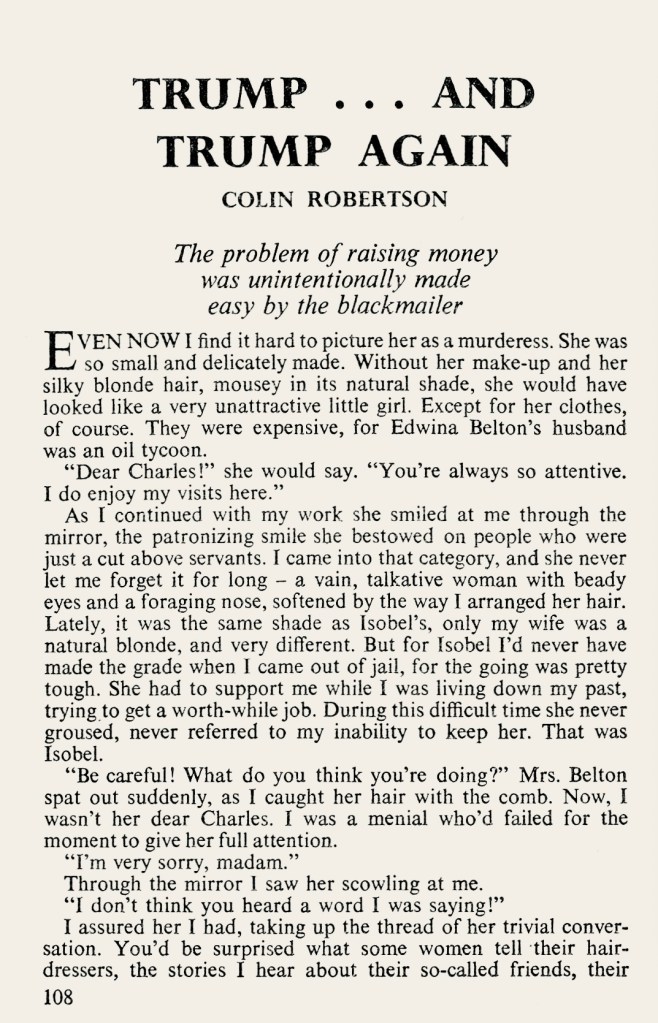
“One Man’s Poison” might be a suitable alternative title for Murder as a Fine Art (1953), my previous dose of the genre, even though the weapon employed by “another man”—whose identity I shall refrain from divulging here—is, despite its material refinement, rather less sophisticated once applied: a pompous government employee at the fictional Ministry of Art is brought down—splatter of brains and all—by a giant Canova bust, for which the victim had long expressed a violent dislike.

The crime novelist determining upon that choice weapon was Edith Caroline Rivett (1894-1958), writing as Carol Carnac.  Some five years before assuming this guise, Rivett had started her career as a mystery writer under the decidedly more ambiguous name of E. C. R. Lorac.

Continue reading ““Ministry of All Fools”: Carol Carnac’s Murder as a Fine Art (1953), “Cozy” Crime, and the Crisis of the “Contemporary””

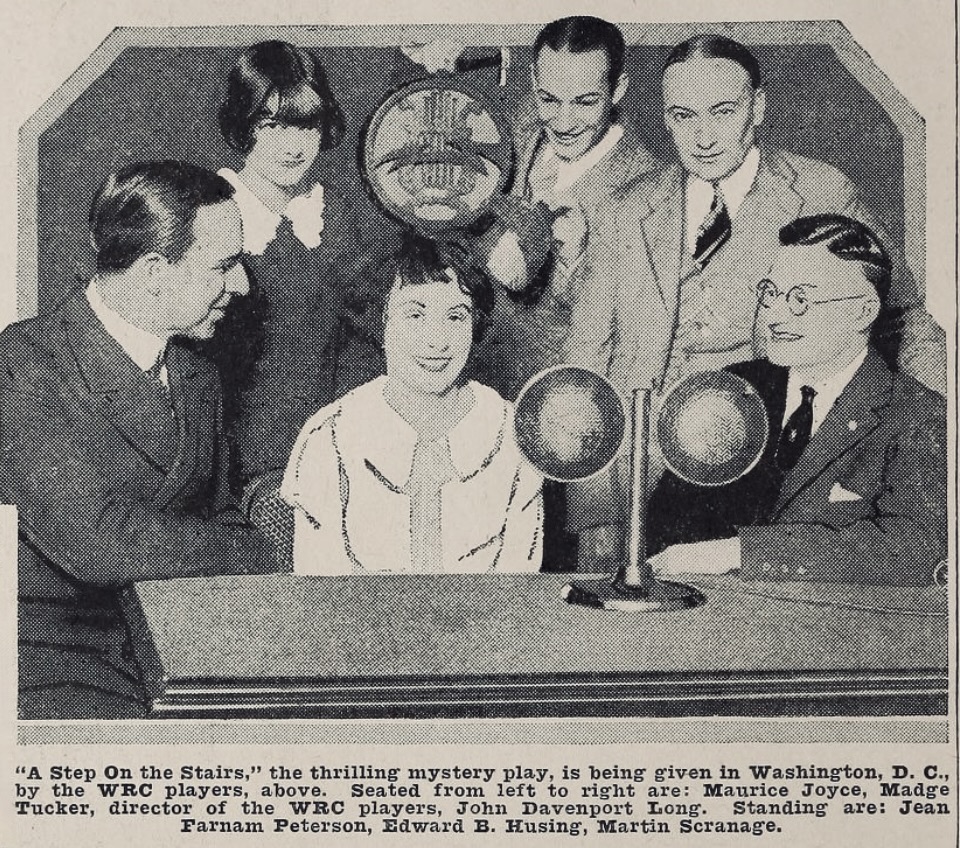
Static and Spirits: Anarchic Airwaves, Prohibition, and the Return of Philo Gubb, Correspondence School “Deteckative”

Illustration for “The McNoodle Brothers’ Radio Mystery” in Radio News, Sept. 1923

Philo … Gubb? Never heard of him.  Nor, in all my years—make that decades—as a reader of detective fiction, had I come across, or become aware of, Ellis Parker Butler (1869–1937), the writer who brought Philo Gubb—“a tall, thin man, with the face and gait of a flamingo,” a paperhanger with a hankering for “deteckative” work—into a flurry of being.  Not until recently, that is.

Generally, I do not mind stumbling onto what might have been got at with greater ease and efficiency through methodical research.  I am aware that any perceived surprise on my part—that “Eureka!”-inducing moment of discovery—may be owing to an absence of assiduity.  That said, some of the most memorable encounters are made by chance, along circuitous routes.

In the case of Ellis Parker Butler and his brainchild Philo Gubb, though, I regret not having made the acquaintance of either of them sooner, given that this particular route led me back, unexpectedly, to the early days of broadcasting, about which Butler had much to say that might have been of interest and use to me in Immaterial Culture, my study of so-called old-time radio.

Now, Immaterial Culture does not pick up on the story of broadcasting until the network days of the late 1920s.  To gain an understanding how radio evolved, a look at prehistoric transmissions, albeit largely in the absence of sound recordings, is nonetheless instructive.  You cannot expect to “get” the cream of old-time broadcasting if you neglect an inspection of the cat’s whiskers for traces of same.

“… I prefer to explain all differently”: A Specious Rationalization of the Criminal Impulse to Possess Forbidden Fruit in Eden Phillpotts’ “The Iron Pineapple”

The Bookshop by the Sea, where I purchased A Century of Detective Stories

The Welsh seaside town of Aberystwyth, where I live, has no shortage of bookstores, first-hand and otherwise.  At one of them—The Bookshop by the Sea, which sells both old and new volumes—I purchased, some time ago, A Century of Detective Stories.  Published in 1935, it is an anthology of crime and mystery tales introduced by G. K. Chesterton, whose outrageous “Fad of the Fisherman” I found occasion to discuss here previously.

Ystwyth Books, where I purchased Death by Marriage by E. G. Cousins on the day I posted this blog entry.

Trying to live up to its title, A Century of Detective Stories is a brick of pulp, and it is not easy to handle when you are reclining in a lounge chair hoping to catch those rare vernal rays that are the oft unfulfilled promise of summer on the typically temperamental and frequently bleak west coast of Britain.  

Oxfam Bookshop, Aberystwyth, where someone beat me to a large selection of Three Investigators books on the day of writing this entry.

Aberystwyth and its environs have, in part for that reason, been the setting of murder mysteries, among them the noirish detective series Hinterland and the quirky retro-noir novels of Malcolm Pryce.  And, as I am writing this, the place is a veritable crime scene, with local booksellers displaying mystery novels and hosting literary events dedicated to the art of murder.  It is all part of Gwyl Crime Cymru, billed as “Wales’ first international crime fiction festival.”

Waterstones, Aberystwyth, where I tend to purchase copies of British Library Crime Classics.

Meanwhile, I am still catching up with A Century of Detective Stories.  Selections include narratives by Edgar Allan Poe, Wilkie Collins and Marie Belloc Lowndes, as well as works by some of the biggest names in crime fiction written between the two World Wars: Agatha Christie, H. C. Bailey, Dorothy L. Sayers, and Edgar Wallace, to drop just a few.  The diversity of this collection is part of its strength and appeal.  Its title is nonetheless misleading.

Continue reading ““… I prefer to explain all differently”: A Specious Rationalization of the Criminal Impulse to Possess Forbidden Fruit in Eden Phillpotts’ “The Iron Pineapple””

The Medium Is the Murder: Technology, Human Nature, and “The Voice That Killed” (1923)

Illustration for “The Voice That Killed” (1923) by Leo Bates (1890-1957)

“There is a modern touch about this story that stamps it with the brand of originality.” That is how the editors of Detective Magazine introduced “The Voice That Killed,” a short work of fiction that first—and, as far as I can tell, last—appeared in print on 28 September 1923.  The man responsible for this slight but nonetheless noteworthy “touch” of the “modern” was Gwyn Evans (1898-1938), a writer best known for his fanciful contributions to the sprawling Sexton Blake Library.

While I am not prepared to pursue Evans’ trail into the far recesses of that vault of once popular culture, I have read enough of his stories to get the impression that “The Voice That Killed” is representative of Evans’ none-too original fascination with—or, perhaps, his adroit cashing in on the widespread ambiguity of his readers toward—modernity and the rapidity with which, in the years between the two World Wars, technology was transforming every aspect of human life, consuming some lives in the process.

Continue reading “The Medium Is the Murder: Technology, Human Nature, and “The Voice That Killed” (1923)”

Lying Down/Sitting Up: “Significant Othering” in Cat People (1942)

Never equals: Irena at Oliver’s feet

Cat People (1942) is a legendary and much-loved B-movie […] that, as Geoffrey O’Brien has argued in “Darkness Betrayed,” his notes on the Blu-ray release of Jacques Tourneur’s fantasy film, “manages, over multiple viewings, to break free from its own legend.”  Despite the fact that viewers—professional critics, academics and horror film enthusiasts alike—“have sifted every shot and every situation of this seventy-three-minute feature,” O’Brien adds, a “fundamental mysteriousness remains, a slippery unwillingness to submit to final explanation.”

There is no danger of that slippage into certainty happening here.  My mind, too, has a “slippery” nature.  It is resistant to, and indeed incapable of, any thought amounting to an “explanation” that could possibly be taken for a “final” solution—a terminal reasoning that, bearing my Germany ancestry in mind, has demonstrably shown to bring about and justify no end of horrors.  

A lack of understanding: Irena and Oliver

Cat People was produced at a particular time of uncertainty—and of particular uncertainties—about democratically enshrined equalities, about the limits of reason and the extent to which the stirring of irrational fear could be instrumental in the unfolding of millionfold death.  It is fantasy that, rather than being escapist, gets us to the core of uncertainties about the state of humanity, the doubtful definition and futurity of which, a year after the raid on Pearl Harbor and the end of US isolationism, many a cat got many a tongue.

Cat People is “fantastic” in the way the term was proposed by Tzvetan Todorov.  In his seminal study The Fantastic(1973), Todorov argues that the phrase “I nearly reached the point of believing” constitutes the “formula” that “sums up the spirit” he calls “fantastic.”  Perhaps, that thought, being proposed so declaratively and summarily, itself sounds rather too conclusive.  Subverting such reasoning, the “fantastic” exists only because it resists any summing up.  To grasp it in this way is to deny it.  Its existence is predicated on its elusiveness, on its perceived indeterminacy.

Continue reading “Lying Down/Sitting Up: “Significant Othering” in Cat People (1942)”

Mirror/Lamp: “Significant Othering” in The Old Dark House (1932)

The last time I approached that Old Dark House – the titular edifice of a 1932 Hollywood thriller directed by the queer English filmmaker James Whale and founded on a novel by the English social critic J. B. Priestley—my eyes were not focussed on any particular visual detail.  I was remarking generally on the house as a concretization of Priestley’s views on the condition of Britain after the so-called Great War, as the film and its source, Priestley’s Benighted (1927), are often understood: Interwar Britain as an empire haunted by its past and a kingdom lacking a vision as unifying as the largely unchallenged rule of its alleged heyday.

Never mind the map. Now entering gothic territory

Not that British moviegoers, let alone US American audiences, would have considered this perspective, partially obscured by the retitling of the property, as being essential to the experience of the fun house-ghost train atmosphere the film conjures.  Sure, the house, with its shadowy corridors, massive oaken doors and branching staircases, is as ill-lit as any old Gothic-fictional castle; but the unenlightened ones at the heart of this picture are its denizens, the backward, dim-witted and intractable Femms in whose midst we, along with a small group of unfortunate travelers, find ourselves.

Continue reading “Mirror/Lamp: “Significant Othering” in The Old Dark House (1932)”

Apart/in Parts: “Significant Othering” in The Lodger (1927)

In conjunction with “Gothic Imagination,” a visual culture module I teach at the School of Art, Aberystwyth University, I host an extracurricular festival of films by way of which to skirt the boundaries of the gothic beyond the landmarks and hallmarks of the Gothic as genre.

The Alfred Hitchcock-helmed silent romance thriller The Lodger (1927), a loose adaptation of a short story (1911) and novel (1913) by the suffragette Marie Belloc Lowndes, has featured in each of these series of film screenings—“Treacherous Territories” (2019), “Uneasy Threshold” (2021) and “Significant Othering” (2023). Approaching The Lodger anew, “Significant Othering” concentrates on the gothic or gothicized bodies that—in whole or in parts—figure in the sprawling landscape of movies in the gothic mode.

None of the prime embodiments of the literary Gothic materialize in the films screened.  The modally gothic does not depend on the presence of Frankenstein’s creature, Jekyll and Hyde, or Dracula; the multiplicity and hybridity that characterize those familiarly strange bodies are alive—make that “undead”—in the mutations of the gothic mode beyond the permutations of the genre.

As The Lodger drives home, what makes bodies what we might call gothic—although others may argue otherwise—is their otherness or, more precisely, the othering of them.

Continue reading “Apart/in Parts: “Significant Othering” in The Lodger (1927)”

Gaslight Express: Ethel Lina White’s The Wheel Spins, the Vanishing Spinster, and the Freewheeling Single Englishwoman

Winifred Froy spelling her name for Iris Carr in the Alfred Hitchcock directed adaptation of Ethel Lina White’s novel The Wheel Spins (1936)

I was determined to read at least a few chapters of The Wheel Spins (1936) in transit.  The novel is, after all, set aboard a train, hundreds of miles from what the main character, Iris Carr, regards—and at times calls into question—as home.  Written by a female novelist born in Wales, it is a story concerned with Englishness, with patriotism, prejudices and pretenses, and with feeling foreign in strange, peculiarly European, company.

So, after booking a last-minute vacation in the Europe that is now foreign territory to the British—living though they may be alongside European expatriates like myself—I made sure to slip the 2023 British Library paperback edition of White’s mystery into my hand luggage before departure for Vienna.  Habitually slow to turn the pages, I was certain there would be more left in store for me than the dénouement on the short onward rail trip a few days later to the capital of Slovakia, just as it was turning on besieged Ukraine in the matter of grain exports.

Continue reading “Gaslight Express: Ethel Lina White’s The Wheel Spins, the Vanishing Spinster, and the Freewheeling Single Englishwoman”

“Does a big fish ever break the line and get away?”:  Boris Johnson, G. K. Chesterton, and the Case of the Deadly Prime Minister

“A thing can sometimes be too extraordinary to be remembered.”  With that intriguing overthrow of conventional wisdom opens “The Fad of the Fisherman,” a short story by G. K. Chesterton, first published in 1921.  “If it is clean out of the course of things,” Chesterton expounds, “and has apparently no causes and no consequences, subsequent events do not recall it; and it remains only a subconscious thing, to be stirred by some accident long after.  It drifts apart like a forgotten dream….”

A contemporary illustration for Chesterton’s story by William Hatherell, showing the “extraordinary” incident.

In light of the extraordinary and memorable events unfolding over the last few days like a crumpled serviette disclosing the spat-out remains of a prolonged Partygate feast – the rules-breaking incident that contributed to the eventual if only reluctantly heeded call for the resignation of Prime Minister Boris Johnson – the notion that something might be “too extraordinary to be remembered” does not quite ring true.  So much in politics these days is head-scratchingly, gut-churningly out of the ordinary, the Trump Presidency and its aftermath being a prime example.  And yet, the violation of established codes of conduct have become so flagrant and frequent that we, or some – or, I suspect, many – of us no longer recognize them to be unprecedented, unethical or unconstitutional.

It now takes greater effort to remember, if ever we knew, what once were assumed to be formal matters of procedure and protocol.  And we struggle as well to connect the tell-tale dots that, if they were examined closely – like some seemingly random Rorschach blots – and in relation to each other, might enable us not only to arrive at the “causes” – the egoistic and downright egomaniacal roots – of socio-political developments but also to realize the “consequences” of our inattention to pattern-forming details whose neglect profoundly compromises our ability to draw meaningful inferences from the reality of facts and fictions with which we are confronted: the erosion of trust in political figures who, instead of serving their country, help themselves and cling to power as if they were absolute monarchs.  How reassuring, then, are the ratiocinations that bring many a murder mystery to its logical if not always satisfactory conclusion.

It is the conclusion rather than the opening lines of Chesterton’s story – a story involving the unlawful actions of a Prime Minister – that brought to mind the astonishment with which I first reached it – a solution that I, appropriating shelved products of popular culture rather than reviewing them, am under no compulsion to withhold.  The by me highly anticipated conclusion to Mr. Johnson’s sorry and increasingly sordid Downing Street saga, meanwhile, remains unknown while I am writing this, the 822nd entry in my journal.  I might as well say it flat out: the Prime Minister in Chesterton’s story is a murderer who gets away with his crime.

Continue reading ““Does a big fish ever break the line and get away?”:  Boris Johnson, G. K. Chesterton, and the Case of the Deadly Prime Minister”

Penwomanship and Poison: The Chianti Flask by Marie Belloc Lowndes as an Antidote to Toxic Masculinity

The original dust jacket makes no mention of The Lodger; instead, it reminds readers of a more recent crime novel by Lowndes, which was adapted for the movies in 1932: Letty Lynton.

There is a lot of talk these days about ‘toxic masculinity.’  Making a strong case for the correlation of venom and virility, war criminal Vladimir Putin recently mocked the physique of world leaders who, by rolling their eyes at his shirtless posing, permitted themselves a moment of levity at his expense amid a crisis talk on Ukraine.  Meanwhile, COVID-19-rules violating British Prime Minister Boris Johnson, himself a noxious cocktail of mendacity and indiscretion, opined that, had Putin been born female, the invasion of Ukraine would not have happened.  Seriously, would the US Supreme court have decided differently on undoing environmental protection if more earth mothers were among the judges?

I thought the claim that toxicity is masculine had been conclusively laid to rest by Lucretia Borgia – or by Margaret Thatcher, at the very latest.  That the flip side of our fancies is still deemed to be “another man’s poison” makes me long for gender fluidity, itself a noisome notion to some.  Apart from lamenting the bane of binaries, I have nothing further to say here about exposed torsos or the merits of any remarks made by a disreputable Prime Minister.  And yet, there is no escaping the everyday – not even in the attempt to retreat into the presumably out-of-date, of pop past its sell-by date, for the sampling of which this journal was conceived.

Continue reading “Penwomanship and Poison: The Chianti Flask by Marie Belloc Lowndes as an Antidote to Toxic Masculinity”