They Also Sell Books: W-WOW! at Partners & Crime

Legend has it that, when asked what Cecil B. DeMille was doing for a living, his five-year-old grand-daughter replied: “He sells soap.” Back then, in 1944, the famous Hollywood director-producer was known to million of Americans as host and nominal producer of the Lux Radio Theater, from the squeaky clean boards of which venue he was heard slipping (or forcefully squeezing) many a none-too-subtle reference to the sponsor’s products into the behind-the-scenes addresses and rehearsed chats with Tinseltown’s luminaries, lines scripted for him by unsung writers selling out in the business of making radio sell.

No doubt, the program generated sizeable business for Lever Brothers; otherwise, the theatrical spin cycle conceived to bang the drum for those Lads of the Lather would not have stayed afloat for two decades, much to the delight of the great (and only proverbially) unwashed. For all its entertainment value, commercial radio was designed to hawk, peddle and tout; and although the spiel heard between the acts of wireless theatricals like Lux has long been superseded by the show and sell of television and the Internet, old radio programs still pay off, no matter how freely they are now shared on the web. In a manner of speaking, they still sell, albeit on a far smaller and downright intimate scale.

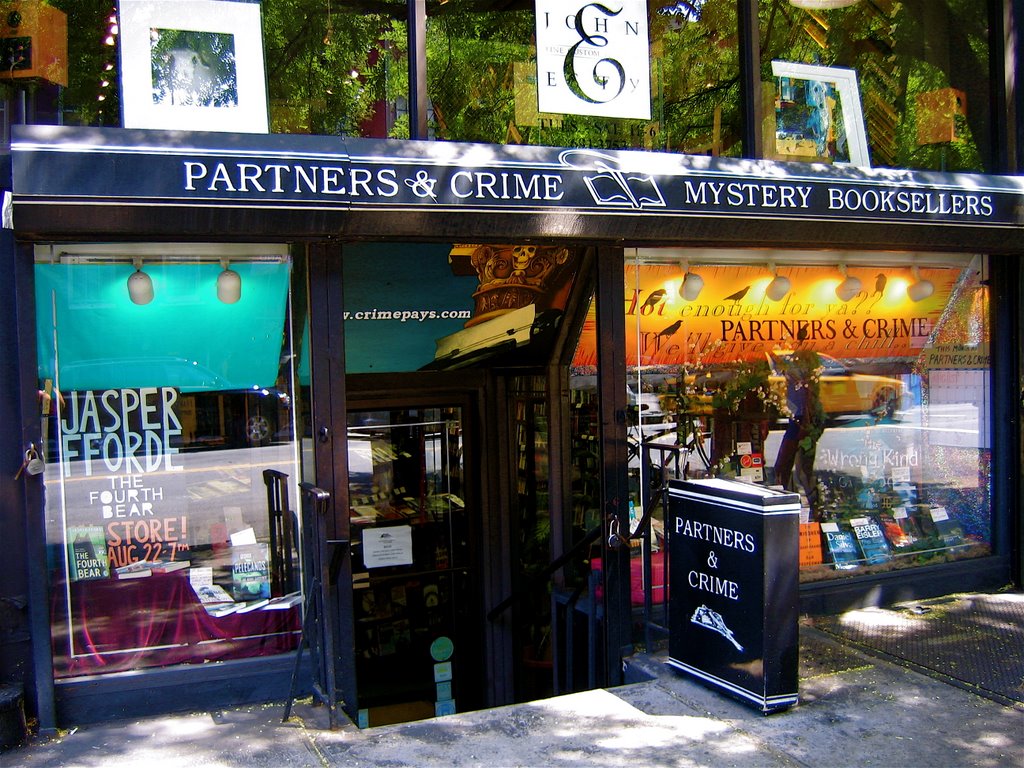
Take W-WOW! Radio. Now in its fourteenth season, the opening of which I attended last month, the W-WOW! Mystery Hour can be spent—heard and seen—on the first Saturday of every month (July and August excepting) from a glorified store room at the back of one of the few remaining independent and specialty booksellers in Manhattan: Partners & Crime down on Greenwich Avenue in the West Village. The commercials recited by the cast are by now the stuff of nostalgia, hilarity, and contention (“In a coast-to-coast test of hundreds of people who smoked only Camels for thirty days, noted throat specialists noted not one single case of throat irritation due to smoking Camels“); but the readings continue to draw prospective customers like myself.

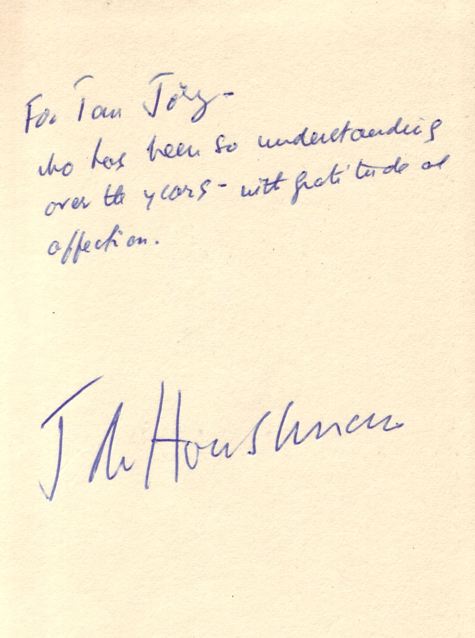
Whenever I am in town, I make a point of making a tour of those stores, even though said tour is getting shorter and more sentimental every year. There are rewards, nonetheless. Two of my latest acquisitions, Susan Ware’s 2005 “radio biography” of the shrewdly if winningly commercial Mary Margaret McBride and John Houseman’s 1972 autobiography Run-through (signed by the author, no less) were sitting on the shelves of Mercer Street Books (pictured) and brought home for about $8 apiece. The latter volume is likely to be of interest to anyone attending the W-WOW! production scheduled for this Saturday, 3 October, when the W-WOW! players are presenting the Mercury Theatre on the Air version of Dracula as adapted by none other than John Houseman.

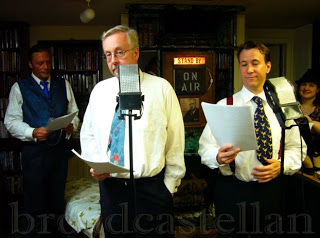
As Houseman puts it, the Mercury’s “Dracula”—the series’s inaugural broadcast—is “not the corrupt movie version but the original Bram Stoker novel in its full Gothic horror.” Indeed, Houseman’s outstanding adaptation is a challenge worthy of W-WOW!’s voice talent and just the kind of material special effects artist DeLisa White (pictured above, on the right and to the back of those she so ably backs) will sink her teeth into, or whatever sharp and blunt instruments she has at her disposal to make your hair stand on end.

Rather more run-of-the-mill were the scripts chosen for W-WOW!’s September production, which, regrettably, was devoid of vamps. You know, those double-crossing, tough-talking dames that enliven tongue-in-cheek thrillers like The Saint (“Ladies Never Lie . . . Much” or “The Alive Dead Husband,” 7 January 1951) and Richard Diamond (“The Butcher Shop Case,” 7 March 1951 and 9 March 1952), a story penned by Blake “Pink Panther” Edwards and involving a protection racket. The former opened encouragingly, with a wife pretending to have killed a husband who turned out to be yet living, if not for long; but, as it turned out, the dame had less lines than any of the ladies currently in prime time, or any other time for that matter. Sure, crime paid on the air; but sex, or any vague promise of same, sells even better.

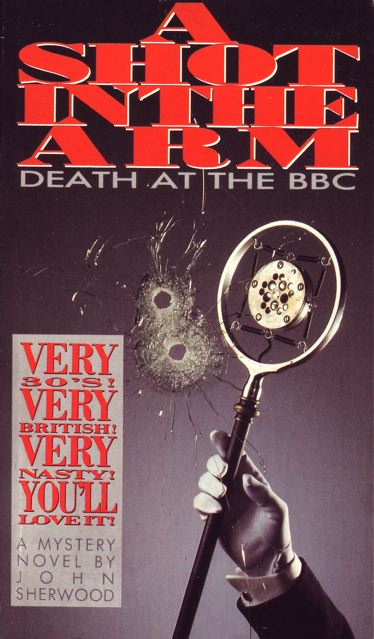
That said, I still walked out of Partners & Crime with a book in my hand. As I passed through the store on my way out, an out-of-print copy of A Shot in the Arm caught my eye and refused to let go. Subtitled “Death at the BBC,” John Sherwood’s 1982 mystery novel, set in Broadcasting House anno 1937 and featuring Lord Reith, the dictatorial Baron who ran the place, is just the kind of stuff I am so readily sold on, as I am on browsing in whatever bookstores are still standing offline—if only to give those who are still in the business of vending rare volumes a much-deserved shot in the open and outstretched arm.

Related recordings
“Ladies Never Lie . . . Much,” The Saint (7 January 1951)
“The Butcher Case,” Richard Diamond (7 January 1950)
“The Butcher Case,” Richard Diamond (9 March 1951)

So to Speke

When not at work on our new old house—where the floorboards are up in anticipation of central heating—we are on the road and down narrow country lanes to get our calloused hands on the pieces of antique furniture that we acquired, in 21st-century style, by way of online auction. In order to create the illusion that we are getting out of the house, rather than just something into it, and to put our own restoration project into a perspective from which it looks more dollhouse than madhouse, we make stopovers at nearby National Trust properties like Chirk Castle or Speke Hall.

The latter (pictured here) is a Tudor mansion that, like some superannuated craft, sits sidelined along Liverpool’s John Lennon Airport, formerly known as RAF Speke. The architecture of the Hall, from the openings under the eaves that allowed those within to spy on the potentially hostile droppers-in without to the hole into which a Catholic priest could be lowered to escape Protestant persecution, bespeaks a history of keeping mum.

Situated though it is far from Speke, and being fictional besides, what came to mind was Audley Court, a mystery house with a Tudor past and Victorian interior that served as the setting of Mary Elizabeth Braddon’s sensational crime novel Lady Audley’s Secret. The hugely popular thriller was first serialized beginning in 1861 and subsequently adapted for the stage. Resuscitated for a ten-part serial currently aired on BBC Radio 4, the eponymous “lady”—a gold digger, bigamist, and arsonist whose ambitions are famously diagnosed as the mark of “latent insanity”—can now be eavesdropped on as she, sounding rather more demure than she appeared to my mind’s ear when reading the novel, attempts to keep up appearances, even if it means having to make her first husband, a gold digger in his own right, disappear down a well.

As if the house, Audley Court, did not have a checkered past of its own—

a house in which you incontinently lost yourself if ever you were so rash as to attempt to penetrate its mysteries alone; a house in which no one room had any sympathy with another, every chamber running off at a tangent into an inner chamber, and through that down some narrow staircase leading to a door which, in its turn, led back into that very part of the house from which you thought yourself the furthest; a house that could never have been planned by any mortal architect, but must have been the handiwork of that good old builder, Time, who, adding a room one year, and knocking down a room another year, [ … ] had contrived, in some eleven centuries, to run up such a mansion as was not elsewhere to be met with throughout the county […].

“Of course,” the narrator insists,

in such a house there were secret chambers; the little daughter of the present owner, Sir Michael Audley, had fallen by accident upon the discovery of one.  A board had rattled under her feet in the great nursery where she played, and on attention being drawn to it, it was found to be loose, and so removed, revealed a ladder, leading to a hiding-place between the floor of the nursery and the ceiling of the room below—a hiding-place so small that he who had hid there must have crouched on his hands and knees or lain at full length, and yet large enough to contain a quaint old carved oak chest, half filled with priests’ vestments, which had been hidden away, no doubt, in those cruel days when the life of a man was in danger if he was discovered to have harbored a Roman Catholic priest, or to have mass said in his house.

Loose floorboards we’ve got plenty in our own domicile, and room enough for a holy manhole below. It being a late-Victorian townhouse, though, the hidden story we laid bare is that of the upstairs-downstairs variety. At the back, in the part of the house where the servants labored and lived, there once was a separate staircase, long since dismantled. It was by way of those steep steps that the maid, having performed her chores out of the family’s sight and earshot, withdrew, latently insane or otherwise, into the modest quarters allotted to her.

I wonder whether she read Lady Audley’s Secret, if indeed she found time to read at all, and whether she read it as a cautionary tale or an inspirational one—as the story of a woman who dared to rewrite her own destiny:

No more dependency, no more drudgery, no more humiliations,” Lucy exclaimed secretly, “every trace of the old life melted away—every clue to identity buried and forgotten—except […]

… that wedding ring, wrapped in paper.  It’s enough to make a priest turn in his hole.

Do Bother to Knock: Richard Widmark (1914-2008) in the Broadcast Studio

“I can’t figure you out. You’re silk on one side and sandpaper on the other,” a puzzled Jed Towers tells the deranged young woman who caught his eye. The film, Don’t Bother to Knock (1952); the stars, Richard Widmark and Marilyn Monroe. Widmark, who died today at the age of 93, might have been describing his screen persona: abrasive and easily frayed if you rubbed him the wrong way. There is another side, as well, to Widmark’s career as an actor. He started out being all voice, invisible to his audience. He was an established radio actor who hit the big time in pictures with his breakout performance in 1947 with Kiss of Death (revived on the air in this Lux Radio Theatre production from 12 January 1948).

Widmark (shown here during a Theatre Guild broadcast, an image freely adapted from David R. Mackey’s Drama on the Air [1951]) entered broadcasting in the late 1930s. By the early 1940s, he had made a name for himself in daytime serials (Front Page Farrell, Joyce Jordan, MD) and proven his versatility in a number of plays produced by the prestigious Columbia Workshop. On Words at War, he was the narrator of “Gunners Get Glory” (9 May 1944), a dramatized account of a merchant ship torpedoed by a Nazi submarine. He was frequently featured on Cavalcade of America (here, for instance, in “The Man with the Cargo of Water” [12 September 1950]), Inner Sanctum Mysteries (in thrillers like “Make Ready My Grave” [23 April 1946]), and Suspense, where he was cast as “Mate Bram” (14 April 1952) in a chilling true-crime story of an amnesiac serial killer on the high seas who contemplates the horrors of the deed he cannot recall committing:

They put me in irons, locked in my own quarters. And here I’ll stay. There’ve been no more murders in the three days past, which does not stand in favor of another killer being aboard, and my being innocent. What I’ve written, my good friend, is the whole truth [. . .]. In my own mind, I am not convinced that I am guilty. For one reason, that however violent I’ve been, I have never killed before . . . before! Never . . . killed . . . before!

A few months later, after his performance in ”How Long Is the Night” (13 October 1952) Widmark was presented with the first annual “Golden Mike” award, being named “best actor” of 1951 by his peers, the regular radio performers who supported the guest stars on Suspense.

Like most film stars of the 1950s, Widmark continued to make occasional return trips to the broadcasting studio in adaptations of Hollywood movies (such as this Hollywood Soundstage production of “The Postman Always Rings Twice” [24 January 1952]); but aside from such standard fare, he was also heard in prominent parts of literary distinction, including the roles of anti-hero Winston Smith in an adaptation of George Orwell’s Nineteen Eighty-Four on the Theatre Guild program (26 April 1953) and Iago in a two-part adaptation of Shakespeare’s Othello that aired on Suspense (4 May and 11 May 1953).

In 1979, long after radio drama had become pretty much a thing of the past, or at any rate a marginal and neglected field of the performing arts in American culture, Widmark once more returned to the medium in which his acting career originated, performing in a number of plays soundstaged by the Sears Radio Theatre. Listening to his voice—”silk on one side and sandpaper on the other”—you can easily figure out why he was truly at home behind the microphone . . .

Anxious for Her Next Close-up, Gloria Swanson Murders "By the Book"

She might have been auditioning for Sunset Blvd. or hoping for some such comeback; then again, she sounded as if acting lay in a distant, silent past. Screen legend Gloria Swanson, I mean, who, on this day, 10 July, in 1947, stepped behind the microphone to make her only appearance on CBS radio’s Suspense series in a thriller titled ”Murder by the Book (a clip of which I appropriated for one of my old-time radio podcasts).

Swanson (pictured above in a scene from Music in the Air [1934]) plays a mystery writer suffering from dizzy spells, memory loss, and nervous tension, ever since her husband’s death by drowning. She’d been seeing a doctor about it; but he died as well. “You see, he has been murdered,” she declares, narrating her story. Still, she is determined to continue her latest book, a thriller “about a woman who kills her husband”; but, she admits, she’s been having “all kinds of trouble with the end. Everything was all right up until the explanation.”

For the sake of publicity, and to get her mind off her troubled new volume, she agrees to her publisher’s suggestion to turn reporter and cover her doctor’s murder, much to the distress of her stepdaughter. “She’d always been a little strange,” Swanson’s character remarks. Then again, she’s the one with the dizzy spells.

Swanson, you will agree, was not very assured in her reading of her lines, and at times scans the script downright carelessly. Then again, her best years had been silent ones. Nevertheless, she succeeds in turning the character of Emily into one cooky dame. Since we sense from the start that she cannot be trusted, the pleasure of listening to Robert L. Richard’s “Murder by the Book” lies in hearing her fall apart. It’s a fine premise for the kind of movie thriller many an aging Hollywood diva would take on in the 1950. Ready or not, Swanson had one glorious last close-up in her future . . .

Laddie of Burlesque: David Hyde Pierce Steps Through Curtains

This one seemed strangely familiar. It felt as if I had seen and heard it all before—which is not to say that the déjà vu was an unpleasant sensation. I am referring to Curtains, the final Kander and Ebb collaboration now playing at the Al Hirschfeld Theatre (pictured). Time Out New York called it ”your grandmother’s musical,” which bit of sexist ageism suggests dentures rather than bite. It so happens, I’m with grandma when it comes to a grand night out. At the theatre, that is. I take in musicals to be charmed rather than provoked, to be tickled or wowed rather than indoctrinated. Give me showtunes I can recall and perhaps even attempt to hum (at Marie’s Crisis, say, the Village piano bar where we spent a few hours of merry sing-along on Tony’s night). Besides, I’ve got a mirror for warts ‘n all.

So, Curtains is really my kind of show, if only it weren’t so obviously and deliberately steeped in Broadway musical history as to evoke other and unquestionably superior ones. A backstage murder mystery, Curtains is set in the late 1950s, which is a fine excuse for pastiche, as is its show within a show construction.

Most of its songs are echoes of the period (“Show People” is something you’d expect to be belted out by Ethel Merman), even though the show being rehearsed seems to date back to the 1930s and the sentimental “I Miss the Music” recalls the to me well-nigh intolerable Andrew Lloyd Webber, especially in the earnest interpretation by the to my ears miscast-for-comedy Jason Danieley. That the show is being tinkered with as its cast is being knocked off seems an excuse for the repetition of an inferior number like “In the Same Boat.”

Curtains, of course, offers its own response to captious reviewers “What Kind of Man?”:

What kind of putz
Would squeeze your nuts like that?

Musicals aside, what the show brought to my mind was The Lady of Burlesque (1943) starring Barbara Stanwyck, which I saw earlier this year (for an itemized list of my movie diet, turn right). In that comedy-thriller, a show must go on while a killer is on the loose and an investigation underway. In the case of Curtains, though, it is not the leading lady but the detective who takes center stage and—despite the obvious handicaps of lacking a leading man’s looks or voice, not to mention a convincing Boston accent—takes it in strides at that.

I happen to have been at the Hirschfeld on the day that the show’s male lead, Tony-winning David Hyde Pierce, lifted the curtain on his private life and came out of the closet at last; on stage, he was busy turning a double life into a single one (negotiating his love for musicals with the business of solving crime), and being single into a happy double (by teaming up romantically with one of the suspects). It might be “your grandmother’s musical”; but its leading man is finally breaking with conventions that seemed out-of-date two decades ago.

Shutting Private Eyes; or, the Day Spade Kicked the Bucket

When is it ever the right time, the moment to call it a day after all those years and retire that greasy old trenchcoat—or whatever fashion-defying trademark you might have worn out long before your welcome? Who’s to say, or decide? Peter Falk, apparently, is having a tough time convincing executives that he’s still kicking anything but the bucket. He simply can’t get them to greenlight another Columbo mystery, not even one that closes the book on the four-decades old franchise. I was reminded of the booted gumshoe when, walking around Pest (as in Budapest), we came across that dive in the doctored snapshot.

Columbo is a legend, all right; but to those with an eye for fresh blood, that’s just a fancy way of saying “past it.” Those bags under your eyes sure can get you sacked. These days, wrinkles don’t give a guy character; they take it away from him. And unless you can pass yourself off as Miss Marple, your days in the business are numbered if you can still manage facial expressions.

It wasn’t a matter of putting a stud out to pasture, though, when Sam Spade was kicked out of the radio branch of his office on this day, 27 April, in 1951, after solving what those who got paid to put words into his mouth called, “for obvious reasons,” the “Hail and Farewell Caper.”

Spade wasn’t too old, see. Just ask his secretary, Effie, who would have loved to straighten more than his tie. Besides, on radio you’re as old as your voice can make others imagine you are; and tough-talking Spade was a good enough egg to make you think hardboiled rather than rotten. It was his father who got him axed. Dashiell Hammett, I mean, who got blacklisted for being so un-American as to exercise his right to a political position. After Washington started to dig and got red dirt on Hammett, no broadcaster dared to touch his Spade. That’s when they got out the axe.

There was some retooling, initially. But dropping Hammett’s name just wasn’t enough to appease the network, just as giving Spade a new voice (Stephen Dunne taking over for Howard Duff) did little to please prospective sponsors, the old one (Wildroot Cream Oil) having defected. What was left of Spade after the blunt instruments in the business of commercial broadcasting had operated on his larynx just wasn’t enough to convince listeners, who had fought to get their favorite detective back on the air and lift Spade’s two-month suspension in the fall of 1950.

Radio was a queer racket in those days. You could be a a Communist for the FBI, but not a pink private eye. As I said, a new agenda called for a new kind of scouring agent. It mattered little that Hammett had nothing to do with the writing of the show (he just collected the royalties, which is pretty good business sense for a Commie), or that the Spade on the air was about as red as the greenbacks he was after but always short of.

At the close of the “Hail and Farewell Caper,” Spade makes a final sales pitch, a word to prospective advertisers; but, being that it wasn’t yet time for the obligatory summer hiatus, during which executives decided the fate of radio heroes, the plea sounds out of place. If you ask me, it was a ruse intended to quiet listener protest by leaving some hope for a commercially sponsored resurrection, a denial of the politics behind the show’s death warrant. It was the spirit of the age that dug Spade‘s grave.

Earwitness for the Prosecution

Being that this is the anniversary of the birth of Guglielmo Marconi, a scientist widely, however mistakenly, regarded as the inventor of the wireless, I am once again lending an ear to the medium with whose plays and personalities this journal was meant to be chiefly concerned. Not that I ever abandoned the subject of audio drama or so-called old-time radio; but efforts to reflect more closely my life and experiences at home or abroad have induced me of late to turn a prominent role into what amounts at times to little more than mere cameos. Besides, “Writing for the Ear” is a course I am offering this fall at the local university; so I had better prick ’em up (my auditory organs, I mean) and come at last to that certain one of my senses.
The English lexicon amply documents the western bias against listening, generally “seen” as being secondary to sight. Compared to the commonly used “eyewitness,” for instance, the expression “earwitness” sounds rather unusual. What’s more, it is rejected by my electronic dictionary and, when typed in defiance, promptly marked as a spelling error. That is perhaps the victorious eye thumping its nose at the once superior ear, which, prior to the invention of the printing press, played a greater or at any rate more respected role in the sharing and absorption of information than it does in this our age of gossip and hearsay. If the always favored ocular proof cannot be discovered, it is the eyewitness report that carries more weight than the overheard.

I am going to refrain from channeling McLuhan, however, and concentrate instead on a notable fictional witness whose testimony was brought before an audience in the strictest sense of the word. I am referring to Agatha Christie’s Witness for the Prosecution, a courtroom melodrama initially conceived as a short story and subsequently adapted, albeit not by Dame Agatha herself, for US radio, whose early experiments in courtroom dramatics have been previously discussed here.

According to the Wikipedia, the “very first performance of Witness for the Prosecution was in the form of a live telecast which aired on CBS’s Lux Video Theatre on 17 September 1953. Now, this is accurate only if Witness is meant to denote Christie’s stage play, rather than her story. The latter had already been dramatized nearly four and a half years earlier. Produced by NBC’s Radio City Playhouse, it was broadcast on this day, 25 April, in 1949.

Such a hold has visual storytelling on our imagination today that it is difficult to approach this audio performance of Witness without seeing before one’s mind’s eyes the features and the legs of the legendary Marlene Dietrich (of whom I have seen quite a bit this year [see my movie lineup on the right] and to whose voice I intend to devote my next podcast). Then there is that prominent scar in the face of the titular character, more prominent still than Ms. Dietrich’s invaluable German accent. Can a sound-only adaptation without access to Dietrich’s features or voice succeed in rendering Christie’s cheeky deception?

Unlike the character of Leonard Vole, the accused, whose innocence is laid on rather too thickly by David Gothard in the Radio City Playhouse production to escape the listener’s suspicion, the mysterious woman who comes to his aid (ably portrayed by theater actress Lotte Stavisky) might just manage to pull the wool over your ears. The radio dramatization handles the challenges of duping the audience, both the listeners at home and in the fictional courtroom, remarkably well, the scar being made audible in the gasp of its beholder. Like the members of a jury, when called upon to examine accusations and protestations of innocence, the listener deals with interpretations of reality, on someone’s word taken for an otherwise unknowable “it.”

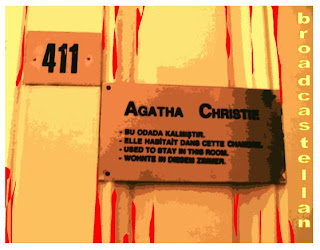
I confess, though, that, as much as I value my hearing, I frequently feel compelled to see for myself; which is why, on the anniversary of Dame Agatha’s birthday, I went up to her room at the Pera Palas Hotel in Istanbul last fall and had a look. There wasn’t much to see, really; not so much as an air of her presence. And, after paying the concierge who escorted us up to room 411, which the enterprising management has shrouded in a mystery of its own, I felt as if I were getting a box on the ear for not having had more sense.

Many Happy Reruns: John Dickson Carr

Well, it has long been an ambition of mine to write a whodunit. Red herrings, fishy alibis, a murky pool of slippery suspects, and a case so deep it would have kept even the likes of Sherlock Holmes, Charlie Chan, and Hercule Poirot angling for clues, chapter after chapter, much to the delight of an equally confounded readership. Take my word for it, I have tried. Otherwise, I submit to you this piece of evidence, which I dug up from where it rightly belongs and promptly edited for the occasion:

“I am going to kill somebody, tonight,” was written on the invitations. Glossy, who had sent them, was dressed for the part, greeting the crowd that had come for the killing. She looked marvelous, her dress and body the result of careful design, a shrewd calculation in fabric and flesh [. . .]. 

It was my sister Veronica who had arranged the party. I had stayed out of it. After all, I am merely a party chronicler. Or so I thought.

“Why, it’s simply deranged,” I heard Glossy squealing, surrounded by a throng of professed admirers; it was a favored expression of hers, which she employed almost universally, except to describe her own behavior. She was sober enough to observe the crowd of friends and colleagues she had drawn toward her in an effort to gain control in a moment of crisis. Tonight, she wanted to be seen in order to see for herself. To see them all, at once. She scrutinized the scene as carefully as her condition allowed. I, for one, knew that her noisy enthusiasm was nothing but an act. Glossy had confessed as much to my sister: she feared that the days of her reign as the queen of daytime drama were numbered and suspected that someone had already planned a ruthless regicide. So, being the center of attention was not just vital for her ego, but for her alter ego as well. Glossy was on the lookout for the conspirators, and I guess the fact that she knew most of the guests provided hardly any comfort at all. . . .”

Perhaps you should have taken my word for it. It’s best to leave such murderous plots to the masters and mistresses of the craft. Experts like John Dickson Carr, for instance, who was born on this day, 30 November, in 1906. Throughout the 1940s, his plays were often heard on American and British radio, on series like Suspense, Cabin B-13 and Appointment with Fear, all of which were designed to showcase his writing. He also served as host and narrator of the mystery anthology Murder by Experts, for which services his latest novels were being duly promoted.

“Mr. Carr brings to his radio work the same superlative craftsmanship and high integrity that distinguish all his novels and short stories,” Messrs. Ellery Queen contended in their anthology Rogues’ Gallery (pictured above), prefacing Carr’s play “Mr. Markham, Antique Dealer,” which was produced by Suspense and broadcast on 11 May 1943.

Having discussed Carr’s work at length in my dissertation and on several occasions in this journal, I have come to the conclusion that the whodunit, especially when combined with the “how’sitdone”—the locked room puzzle in which Carr specialized—was best suited to the printed page, where it can unfold gradually and be appreciated at a pace determined by the reader, rather than the merciless clock of the broadcast studio.

Now, clocks feature prominently in “Mr. Markham.” One of these old-fashioned chronometers is set up to hold a clue, but their ticking is more effective in setting the scene, creating the atmosphere of the antique dealer’s establishment, and reminding the listener that time might be running out for at least one of the characters. In the one-dimensional, that is time-only medium of aural storytelling, suspense is far more effective than surprise. While not devoid of suspense, Carr’s plays attempt—and often fail to—startle the audience with a final twist that, rather than being dramatized, is tagged on in a cumbersome and less than thrilling epilogue.

Is Carr’s brand of whodunit a radiogenic genre? You may judge for yourself by listening to the British as well as the American version of “Mr. Markham.” It is hardly fitting to celebrate someone’s birthday by opening fire. Then again, there’s Glossy, lying in a pool of blood.

Where Silent Partners Join for Noisy Crime

White trousers may be out of fashion; but there are still a lot of ways to tell that summer is officially over. And I am not even talking about the mist rolling in from the Irish Sea this afternoon. After all, I am reporting from New York City, even though my reports are filed a few weeks late and some three thousand three hundred miles away.

In the United States, the summer season traditionally ends on the first weekend in September, a time when millions of college students abandon beaches for bookstores and a certain band of players reclaims its space behind the shelves. Unlike those students I used to teach during my ten years of adjunct lecturing in the metropolis, the W-WOW! troupe only frequents one exclusive—if academically less than sound—venue: the Partners & Crime bookstore in the West Village.

Ever since the mid-1990s, when the city that presumably never sleeps still bore a slight resemblance to the bawdy and raucous town it had been before naps (and a lot else) became mandatory or derigueur, the W-WOW! players have been gathering on the first Saturday of each month (summer excepting) to re-enact the cases of Sherlock Holmes, Harry Lime, Philip Marlowe, and The Shadow as they were heard on US radio during the 1940s and early 1950s. You know, those days when the city had so much character to spare that a shadier one of it could be knocked off and tossed into the East River without causing more than a RIP-ple. Those days when the city was divided into distinct and clashing neighborhoods rather than being homogenized for the purpose of corporate milking. Those pre-television days during which keeping ones eyes shut to the world to share an imagined one was a national pastime rather than a geo-political hazard.

Anyway. Partners & Crime is a terrific store, one of the few sites that somehow managed to withstand the pressures imposed by chains like Borders or Barnes and Noble. One day, when the millennium was still very young and terrorism something that, from an American perspective, happened mainly to people in Europe and the distant Middle East, I discovered that Partners & Crime had become somewhat of an old-time radio institution—without ever going on the air. In short, it was an intriguing anachronism in a town about to trade in its past for clean facades and the promise of crime-free streets. I’d rather look at the scar above my left eye, dating back to a nightly stroll anno 1989, than walk what now goes for 42nd Street. But, back to fictitious felonies . . .

I was probably browsing for an old copy of Seven Keys to Baldpate or some such chestnut brought to light in my dissertation, when, much to my astonishment and joy, I spotted a microphone at the back of the store. As it turned out, there was an entire studio in the tiny, windowless backroom, a space modelled after station WXYZ in Detroit, as the playbill informed me.

I don’t suppose the goings-on behind the shelves do much for the sales at Partners & Crime. I, for one, immediately forgot all about the volumes around me and inquired about the microphone and its purpose. I was thrilled to learn that it was not set up for a reading of a contemporary crime novel, but for some old-fashioned radio mystery, to be performed for the benefit of a small group of theater-of-the-mind goers who eagerly squeezed into this nook beyond the books. I joined them, of course.

The W-WOW! players recreate old-time radio thrillers—commercials ‘n all—by placing their audience inside the make-believe Studio B of the equally imaginary W-WOW Broadcast Building. It may not further or elevate the art of radio drama and be done largely for camp (a way of misreading I can do without); but watching the performers as audiences once watched live broadcasts over at Radio City is nonetheless an enjoyable experience, particularly if you happen to eye the sound effects artist eager to elicit a few laughs while playing to the onlookers.

It is unfortunate that the W-WOW! troupe, unlike the Gotham Radio Players, do not go on the air to put their skills to the ultimate test of prominent invisibility. Theatrical training insures that some of the voices are fit for radio; and the actors are passionate even when the scripts are ho-hum. One among them, a certain Darin Dunston, not only appeared in a production of Under Milk Wood, but was the lead in Radioman, an award-winning student film about drama.

For a mere five bucks (less than one tenth of the cost of a half-price theater ticket), you may still take in a double feature of thrillers, transcribed from original recordings. Never mind that most of those in attendance at Partners & Crime seem more interested in the corny sales talk than in the plot of the mysteries or in the history of radio dramatics. I, for one, often listen to audio plays to get lost in sound instead of bothering to find much sense in them; and the noise made in the back of that West Village bookstore is quite in keeping with the shots, thuds, and wisecracks heard on US radio during the 1940s.

Maureen O’Hara Sounds Matter-of-fact about Murder

I can’t seem to get through this romance. It is tempestuous, steeped in mystery, and features a fierce heroine who bears a vague resemblance to Jane Eyre. Daphne du Maurier’s Jamaica Inn, I mean, one of the novels I picked up to set the mood for my trip to Cornwall. That was in April—and I am still not done with Mary’s adventure among the smugglers. I do like Mary, though. She is not the fainting kind, despite the danger she’s in:

A girl of three-and-twenty, in a petticoat and a shawl, with no weapons but her own brain to oppose a fellow twice her age and eight times her strength, who, if he realised she had watched the scene tonight from her window, would encircle her neck with his a hand, and, pressing lightly with finger and thumb, put an end to her questioning.

Now, the woman who portrayed her Hitchcock’s film version of Jamaica Inn, Maureen O’Hara (pictured above, during the production of the 1938 film), was a few weeks from turning twenty-three when she played another character of that mettle. On this day, 6 July, in 1943, she was heard on the US radio series Suspense in a thriller titled “The White Rose Murders.” An adaptation of a story by Cornell Woolrich, it is the sort of yarn Suspense came to be famous for.

“You’ve been reading too many of those romantic stories,” Virginia tells her fiancé, a police officer with so little self-esteem that he thinks he needs a promotion to deserve a well-to-do debutante like the young woman who’s so devoted to him, she sets out to get what he thinks is in the way of their connubial bliss. This woman is serious about marriage. You might say that she’s dying to get hitched. To achieve just that, she sets out to catch the White Rose murderer, a serial killer who strangles young women, apparently incited or inspired by the “Beer Barrel Polka” (also known as “Rosamunde”). As a token of his perverse affection, he leaves behind the bud of a white rose, the symbol, Virginia explains, of “purity, loyality, devotion.”

Virginia carefully dresses to resemble the victims and “tours the low dives,” searching in each “dingy bar” where “Rosamunde” plays, hoping to attract the man the police has been looking for in vain. As it turns out, the tune is practically everyone’s favorite, just as roses prove popular with the men she encounters. She has to smell a lot of red herrings before she meets the one who is eager to offer her that certain rose. It’s the one she least expected, of course, who is out to do her in.

Despite the names attached to this project—O’Hara, Woolrich, and composer Bernard Herrmann—”The White Rose Murders” is less lurid than it is ludicrous. The situation is suitably creepy—the kind of tale of entrapment and prolonged peril fully deserving of the label Suspense. Even the cheerful “Rosamunde” begins to sound ominous as, in the mind of the listener, it becomes associated with impending horror. Yet instead of relying on a suspenseful mood, the producers of the series insisted on adding an element of surprise—a last minute twist meant to startle the audience. It is a surprise, all right, but one that is psychologically so unconvincing as to reduce the play to mere melodramatic claptrap.

Nor does O’Hara fit her voice to the performance. Perfunctory in her reading of the script, she sounds very much like a sophisticated businesswoman out to get a job done. Perhaps, Virginia’s only adventure was to put an end to all thrills by going through the mill of matrimony. Perhaps, O’Hara had “been reading too many of those romantic stories” not to know which ones were played strictly for the money.